 Meaning/definitions
 Nature of PA
 Scope of PA
 Public and Private Administration
 Approaches to the study of PA
 Significance of PA
 Evolution of PA
 Public administration to New PA( New public
administration
PA stands for two implications-
 Activity administering the affairs of
government like enforcement of law and
order.
 Field of study like Sociology, Economics, Law
etc
Activity administering the affairs of government like
enforcement of law and order.
 PA is a combination of two words-
public + administration
Public- people, government
Administration- two Latin words ad and ministrare
meaning to serve or to manage.
Literally administration- management of affairs –
public or private.
Field of study or an academic discipline that
studies this implementation of government
policies and prepares civil servants for
working in the public service.
As a field of systematic study PA is only about
hundred years old.
 L.D. White
“Public administration consists of all those operations having
for their purpose the fulfilment or enforcement of public
policy”.
 Percy Mc Queen
Public administration is related to the operations of
government whether local or central.
 Luther Gulick
Public administration is that part of the science of
administration, which has to do with the government; it
concerns itself primarily with the executive branch where the
work of the government is done; though there are obviously
problems also in connection with the legislative and judicial
branches.
 J.M Pfiffner
“Administration consists of getting the work of government
done by coordinating the efforts of people so that they can
work together to accomplish their set tasks”.
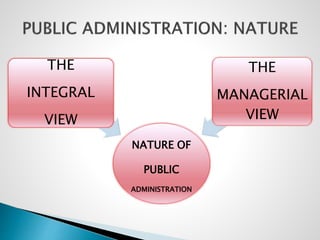
NATURE OF
PUBLIC
ADMINISTRATION
THE
INTEGRAL
VIEW
THE
MANAGERIAL
VIEW
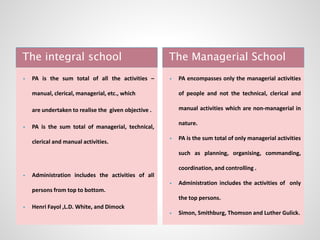
The integral school The Managerial School
 PA is the sum total of all the activities –
manual, clerical, managerial, etc., which
are undertaken to realise the given objective .
 PA is the sum total of managerial, technical,
clerical and manual activities.
 Administration includes the activities of all
persons from top to bottom.
 Henri Fayol ,L.D. White, and Dimock
 PA encompasses only the managerial activities
of people and not the technical, clerical and
manual activities which are non-managerial in
nature.
 PA is the sum total of only managerial activities
such as planning, organising, commanding,
coordination, and controlling .
 Administration includes the activities of only
the top persons.
 Simon, Smithburg, Thomson and Luther Gulick.
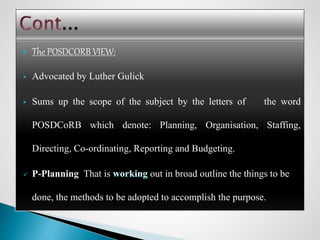
 The POSDCORB VIEW:
 Advocated by Luther Gulick
 Sums up the scope of the subject by the letters of the word
POSDCoRB which denote: Planning, Organisation, Staffing,
Directing, Co-ordinating, Reporting and Budgeting.
 P-Planning That is out in broad outline the things to be
done, the methods to be adopted to accomplish the purpose.
 The POSDCORB VIEW:
 O-Organisation That is the establishment of the formal structure of
authority through which the work is sub-divided, arranged, defined and
coordinated.
 S-Staffing That is the recruitment and training of the personnel and their
conditions of work.
 D-Directing That is the continuous making decisions and issuing orders
and instructions.
 The POSDCORB VIEW:
C-Coordinating That is inter-relating the work of various divisions, sections
and other parts of the organisation.
R-Reporting That is informing the superiors within the agency to whom the
executive is responsible about what is going on.
B-Budgeting That is fiscal planning, control and accounting.
 According to Gullick the POSDCoRB activities are common to all
organisations. They are the common problems of management which are
found in different agencies regardless of the nature of the work they do.
 The Subject Matter View
 public administration deals not only with the processes but also with the substantive matters of
administration, such as Defence, Law and Order, Education, Public Healthetc.
 These services require not only POSDCoRB techniques but also have important specialised
techniques of their own which are not covered by POSDCoRB techniques.
 For example, if you take Police Administration it has its own techniques in crime detection,
maintenance of Law and Order, etc., which are much and more vital to
 efficient police work, than the formal principles of organisation, personnel management,
coordination or finance and it is the same with other services too.
 Therefore, the study of public administration should deal with both the processes (that is
POSDCoRB techniques and the substantive concerns).
 Political Direction: Public administration is political, while private administration
is non-political.
 Absence of profit motive The primary purpose of governmental organisation is to
provide services to the people and promote social good and not the profit
maximisation which is the sole objective of the private organisations.
 Prestige: Public administrators who serve in the Government enjoy high status and
prestige in comparison to their counterparts in private enterprises especially
developing countries
 Prestige: Public administrators who serve in the Government enjoy high status and
prestige in comparison to their counterparts in private enterprises especially
developing counties.
 Public Gaze: All the actions of public administration are exposed to wide public
gaze because the public closely watches it. This does not happen in private
administration.
 Service and Cost: Most governments spend more money than their income or
revenues. That is the reason for finding generally a deficit budget that is,
expenditure exceeding income. Conversely, private administration income often
exceeds expenditure without which they cannot survive.
 Legal framework: Public administration operates within a legal framework. It is
rule oriented. The responsibilities of public administrators are fixed by a set of
constitutional practices, laws and powers and not outside the law.
 Consistency of treatment: A government official is required by law to maintain a
high degree of consistency in his dealings with the public. He has to observe the
principle of equality of treatment in serving the people. It is a legal obligation to
not to discriminate against any person.
 Public accountability: Public accountability is the hallmark of Public administration
in a democracy. Public administration is responsible to the public, though not
directly but indirectly through political executive, legislature, judiciary, etc.
 Large-scale administration: Public administration is large-scale administration. It is
by all means larger than any big private concern in terms of size., complexity and
diversity of activities.
 Officials remain Anonymous: In public administration, even the most senior
officials remain anonymous and their identity is not disclosed. This is so because
whatever they do, they do in the name of the government and not in their own
name.
 Financial meticulousness: Public administration has to be very careful in financial
matters because it is working as custodian of people’s money.
 According to Sir Josiah Stamp, the four principles, which differentiate
public from private administration, are:
 Principle of Uniformity: Common and uniform laws and regulations
mostly regulate public Administration.
 Principle of External Financial Control: the representatives of the people
through a legislative body control the Government revenues and heads of
expenditure.
 Principle of Ministerial Responsibility: Public administration is accountable
to its political masters and through them to the people.
 Principle of marginal Return: The main objective of a business venture is
profit, however small it may be.
 Both public and business administration rely on common skills, techniques and
procedures.
 In modern times the principle of profit motive is not peculiar to private
administration, because it is now accepted as a laudable objective for public
sector enterprises also.
 The private concerns are also subjected to many legal constraints. Government
is exercising much control over business firms through regulatory legislation
such as taxation, monetary and licensing policies, etc.
 There is a similar type of hierarchy and management systems, both in
public and private sectors. Both have same kind of organisation structure,
superior – subordinate relationships, etc.
 Both Pubic and private administration carries on continuous efforts to
improve their internal working and also for efficient delivery of services to
people or customers.
 Public Administration has become the essential segment of modern society
which has witnessed the emergence of what is called by administrative
thinkers as ‘Administrative State’.
 This means that the every activity of individuals from ‘womb to tomb’ is
regulated and controlled by the state agencies, that is administrative
agencies.
The role of public administration in various facets is noted below:
 Basis of the Government: A Government can exist without a legislature or
an independent judiciary. But no Government can exist without
administration.
 An instrument for providing services: Public administration is mainly
concerned with providing various services to the public which are
sanctioned by the government in the public interest”.
An instrument for implementing policies: PA is the instrument of executing
laws, policies and Programmes formulated by the state.
A stabilising force in society: PA acts as an stabilising force in the society
as it provides continuity when the government changes either due to
revolution, election or Coups.
Instrument of national integration: PA acts as an instrument of national
integration particularly in the developing countries which are facing the
challenges of sub-nationalism, class wars etc.
 Instrument of Social change: PA is an instrument of social and economic
development especially in the Third World which are engaged in the
process of social-welding and nation-building
 According Gerald Caiden public administration has assumed the
following crucial roles in contemporary modern society:
 Preservation of polity;
 Maintenance of stability and order;
 Institutionalisation of Socio-Economic changes;
 Management of large scale commercial services;
 Ensuring growth and economic development;
 Protection of the weaker sections of society;
 Formation of public opinion; and
 Influencing Public policies.
 Emergence of Welfare and Democratic state
Emergence of welfare and democratic state has led to an increase in the
activities of public administration compared to that of the laissez-faire
state. The state has to now serve all sections of people in the society. This
amount to enhanced responsibilities of public administration. Public
administration is also to regulate and control private economic enterprises
to meet the objectives of the state.
 Industrial Revolution
The industrial revolution gave rise to socio-economic problems making the
government to assume new roles and responsibilities such as protection and
promotion of the rights of workers in industrial establishments, etc.
Consequently, the state has enacted a number of Industrial and Labour
laws and it is imperative for public administration to implement such laws
in order to meet the requirements of labour welfare.
 Scientific and Technological Development
• Scientific and technological developments have brought about welcome
additions in infrastructure such as power, transport and communication
system.
• The invention of telephone, telegraph and other mechanical devices such as
typewriter, tele-printer, and calculators, photocopying machines,
computers, fax and the electronic mail has brought revolutionary changes
in office administration.
• All these have made possible ‘big government’ and ‘large scale
administration’.
 Economic Planning
Centralised economic planning has been pursued in many developing
countries as a method for socio-economic development.
It requires a large number of experts and elaborate administrative
machinery for plan formulation, implementation, monitoring, and
evaluation.
 Apart from the reasons cited the rapid growth of population, modern
warfare, increase in natural and manmade disasters, decline in social
harmony, increase in violence due to conflicts, communal riots, ethnic
wars, terrorism, etc. have increased the importance of public
administration.
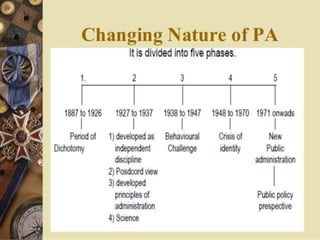
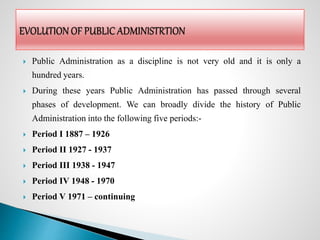
 Public Administration as a discipline is not very old and it is only a
hundred years.
 During these years Public Administration has passed through several
phases of development. We can broadly divide the history of Public
Administration into the following five periods:-
 Period I 1887 – 1926
 Period II 1927 - 1937
 Period III 1938 - 1947
 Period IV 1948 - 1970
 Period V 1971 – continuing
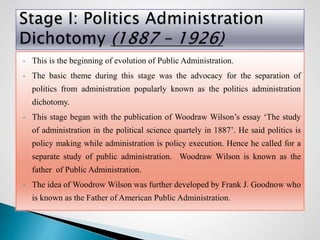
• This is the beginning of evolution of Public Administration.
• The basic theme during this stage was the advocacy for the separation of
politics from administration popularly known as the politics administration
dichotomy.
• This stage began with the publication of Woodraw Wilson’s essay ‘The study
of administration in the political science quartely in 1887’. He said politics is
policy making while administration is policy execution. Hence he called for a
separate study of public administration. Woodraw Wilson is known as the
father of Public Administration.
• The idea of Woodrow Wilson was further developed by Frank J. Goodnow who
is known as the Father of American Public Administration.
 Certain principles could be discovered that increased the efficiency,
economy of public administration.
 This was also a period when Public Administration commanded a high
degree or respectability and its product were in great demand both in
government and business.
 The main theme during this period was the advocacy of ‘Human
Relationship Behavioral Approach’ to the study of Public Administration.
 The idea of administrative dichotomy was rejected. It was argued that
Administration cannot be separated from politics because its political
nature and role, Administration is not only concern with policy decision but
it deals with the policy formulation.
 Similarly, the principle of Administration was challenge and criticised on
the ground of lack of scientific validity and universal relevancy. Hence
they were dubbed as ‘proverbs’ and ‘naturalistic fallacies’.
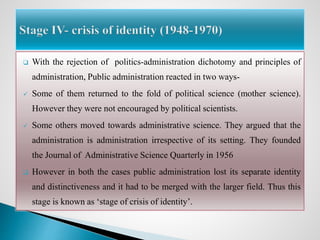
 With the rejection of politics-administration dichotomy and principles of
administration, Public administration reacted in two ways-
 Some of them returned to the fold of political science (mother science).
However they were not encouraged by political scientists.
 Some others moved towards administrative science. They argued that the
administration is administration irrespective of its setting. They founded
the Journal of Administrative Science Quarterly in 1956
 However in both the cases public administration lost its separate identity
and distinctiveness and it had to be merged with the larger field. Thus this
stage is known as ‘stage of crisis of identity’.
 The main theme is the concern for public policy analysis.
 Public administration are showing much interest in the related fields of
policy-science, political economy, policy making, policy analysis and so
on.
 With the adoption of public policy approach, public administration has
become inter-disciplinary and gained in social relevance and expanded its
scope.
 In 1930s, Luknow University became the first one in India to have included a full
compulsory paper on administration in the M.A Political Science syllabus.
 In 1937, Madras University started a diploma course in public administration.
 In 1949-1950, Nagpur University established a separate full-fledged department of
public administration . With this PA was invested in India, for the first time, with the full
academic legitimacy.
 In 1954, the Indian Institute of Public Administration was established in New Delhi
 1987, PA was introduced as a full-fledged subject in the Civil Service examination
conducted by UPSC.
 Today, nearly 50 Universities, hundreds of colleges and number of training institutes
have come up.
The Minnowbrook Conference held under the patronage of Dwight Waldo
gave rise to ‘New Public Administration’ in 1960s.
THE FIRST MINNOWBROOK CONFERENCE 1968
The First Minnowbrook Conference was an offshoot of two factors-
 The 1960s in the USA was a time of turbulence due to war in Vietnam,
black American movements, urban riots, campus unrest, political violence
and so on.
 In 1960s, PA came under the influence of younger generation, which was
feeling restless due to the prevailing sorry status of the discipline. In short
PA was facing some sort of generation gap.
THE FIRST MINNOWBROOK CONFERENCE 1968
 In September 1968, thirty three young scholars and practioners of Public
Administration gathered at the Minnowbrook Conference centre under the
inspired leadership of Dwight Waldo and challenged the traditional PA.
 It was this youth conference which gave rise to New Public Administration
Goals or themes of New Public Administration-
Frank Marini summarises the themes of NPA under five heads-
• Relevance
The NPA points out that PA has traditionally been interested in efficiency
and economy. It stresses that the discipline had little to say about
contemporary problems and issues and was therefore becoming irrelevant.
It demands meaningful studies in the realities of social life.
• Values
The NPA rejects the value-neutral stand taken by the management –
oriented PA. It advocates openness about the values being served through
administrative actions.
Goals or themes of New Public Administration-
• Social Equity
According to NPA the realization of social equity must be the objective of
PA. Social equity means PA should become the champion of the under-
privileged sections of the society.
• Change
Public officials should become active agents of social change and
nonbeliever in status-quo. It does not allow enslavement to permanent
institution which become self-perpetuating power centres dominant class.
Goals or themes of New Public Administration-
• Client-focus
• The NPA advocates client focus approach.
• Besides providing goods and services to the clients , they should be given a
voice in deciding how, when and what is to be provided.
• It requires positive, proactive and responsive administration rather than
authoritarian and ivory-tower bureaucrats.
Other goals of NPA
 Representative bureaucracy
 Peoples participation in administration
 More ready to influence policies that can improve quality of working life
as well as more competent to implement those policies.
 Debureaucratisation
 Democratic decision making
 Decentralization of administrative process in the interest of more effective
and human delivery of public services.
 Pushed the discipline towards greater relevance.
 Brought the academic field and the profession of PA closer
 Strengthened client- orientation in administration
 Produced greater awareness of internal democracy through genuine
participation in public systems
 Intensified the PA community’s self awareness, ecological orientation
INTRODUCTION
 NPM is the latest paradigm in the evolution of PA
 Came into existence in the 1990s
 The book entitled Reinventing Government by David Osborne and Ted
Gaebler published in 1992 heralded the birth of the NPA
 The NPM represents the secon reinvention in PA, the first being the NPA of
the late 1960s.
 The term NPA was coined by Christopher Hood.
 The NPA represents a synthesis of the public and private administration. It
takes ‘What’ and ‘Why’ from public administration.
 It aims at 3Es- economy, efficiency and effectiveness
Economy- eradication of waste
Efficiency- the streamlining of services
Effectivness- the specification of objectives to ensure that the resources are
targeted on problem
 The emphasis of NPM is on-
 Performance-appraisal
 Managerial autonomy
 Cost-cutting
 Quality improvement
 Financial incentives
 Accountability
 Market Orientation
 Contracting out
 Flexibility
 Information technology
 Competition
 Decentralization
 Choice

AN INTRODUCTION TO PUBLIC ADMINISTRATION.pptx

  • 2.
     Meaning/definitions  Natureof PA  Scope of PA  Public and Private Administration  Approaches to the study of PA  Significance of PA  Evolution of PA  Public administration to New PA( New public administration
  • 3.
    PA stands fortwo implications-  Activity administering the affairs of government like enforcement of law and order.  Field of study like Sociology, Economics, Law etc
  • 4.
    Activity administering theaffairs of government like enforcement of law and order.  PA is a combination of two words- public + administration Public- people, government Administration- two Latin words ad and ministrare meaning to serve or to manage. Literally administration- management of affairs – public or private.
  • 5.
    Field of studyor an academic discipline that studies this implementation of government policies and prepares civil servants for working in the public service. As a field of systematic study PA is only about hundred years old.
  • 6.
     L.D. White “Publicadministration consists of all those operations having for their purpose the fulfilment or enforcement of public policy”.  Percy Mc Queen Public administration is related to the operations of government whether local or central.
  • 7.
     Luther Gulick Publicadministration is that part of the science of administration, which has to do with the government; it concerns itself primarily with the executive branch where the work of the government is done; though there are obviously problems also in connection with the legislative and judicial branches.  J.M Pfiffner “Administration consists of getting the work of government done by coordinating the efforts of people so that they can work together to accomplish their set tasks”.
  • 8.
  • 9.
    The integral schoolThe Managerial School  PA is the sum total of all the activities – manual, clerical, managerial, etc., which are undertaken to realise the given objective .  PA is the sum total of managerial, technical, clerical and manual activities.  Administration includes the activities of all persons from top to bottom.  Henri Fayol ,L.D. White, and Dimock  PA encompasses only the managerial activities of people and not the technical, clerical and manual activities which are non-managerial in nature.  PA is the sum total of only managerial activities such as planning, organising, commanding, coordination, and controlling .  Administration includes the activities of only the top persons.  Simon, Smithburg, Thomson and Luther Gulick.
  • 11.
     The POSDCORBVIEW:  Advocated by Luther Gulick  Sums up the scope of the subject by the letters of the word POSDCoRB which denote: Planning, Organisation, Staffing, Directing, Co-ordinating, Reporting and Budgeting.  P-Planning That is out in broad outline the things to be done, the methods to be adopted to accomplish the purpose.
  • 12.
     The POSDCORBVIEW:  O-Organisation That is the establishment of the formal structure of authority through which the work is sub-divided, arranged, defined and coordinated.  S-Staffing That is the recruitment and training of the personnel and their conditions of work.  D-Directing That is the continuous making decisions and issuing orders and instructions.
  • 13.
     The POSDCORBVIEW: C-Coordinating That is inter-relating the work of various divisions, sections and other parts of the organisation. R-Reporting That is informing the superiors within the agency to whom the executive is responsible about what is going on. B-Budgeting That is fiscal planning, control and accounting.  According to Gullick the POSDCoRB activities are common to all organisations. They are the common problems of management which are found in different agencies regardless of the nature of the work they do.
  • 14.
     The SubjectMatter View  public administration deals not only with the processes but also with the substantive matters of administration, such as Defence, Law and Order, Education, Public Healthetc.  These services require not only POSDCoRB techniques but also have important specialised techniques of their own which are not covered by POSDCoRB techniques.  For example, if you take Police Administration it has its own techniques in crime detection, maintenance of Law and Order, etc., which are much and more vital to  efficient police work, than the formal principles of organisation, personnel management, coordination or finance and it is the same with other services too.  Therefore, the study of public administration should deal with both the processes (that is POSDCoRB techniques and the substantive concerns).
  • 15.
     Political Direction:Public administration is political, while private administration is non-political.  Absence of profit motive The primary purpose of governmental organisation is to provide services to the people and promote social good and not the profit maximisation which is the sole objective of the private organisations.  Prestige: Public administrators who serve in the Government enjoy high status and prestige in comparison to their counterparts in private enterprises especially developing countries
  • 16.
     Prestige: Publicadministrators who serve in the Government enjoy high status and prestige in comparison to their counterparts in private enterprises especially developing counties.  Public Gaze: All the actions of public administration are exposed to wide public gaze because the public closely watches it. This does not happen in private administration.  Service and Cost: Most governments spend more money than their income or revenues. That is the reason for finding generally a deficit budget that is, expenditure exceeding income. Conversely, private administration income often exceeds expenditure without which they cannot survive.
  • 17.
     Legal framework:Public administration operates within a legal framework. It is rule oriented. The responsibilities of public administrators are fixed by a set of constitutional practices, laws and powers and not outside the law.  Consistency of treatment: A government official is required by law to maintain a high degree of consistency in his dealings with the public. He has to observe the principle of equality of treatment in serving the people. It is a legal obligation to not to discriminate against any person.  Public accountability: Public accountability is the hallmark of Public administration in a democracy. Public administration is responsible to the public, though not directly but indirectly through political executive, legislature, judiciary, etc.
  • 18.
     Large-scale administration:Public administration is large-scale administration. It is by all means larger than any big private concern in terms of size., complexity and diversity of activities.  Officials remain Anonymous: In public administration, even the most senior officials remain anonymous and their identity is not disclosed. This is so because whatever they do, they do in the name of the government and not in their own name.  Financial meticulousness: Public administration has to be very careful in financial matters because it is working as custodian of people’s money.
  • 19.
     According toSir Josiah Stamp, the four principles, which differentiate public from private administration, are:  Principle of Uniformity: Common and uniform laws and regulations mostly regulate public Administration.  Principle of External Financial Control: the representatives of the people through a legislative body control the Government revenues and heads of expenditure.
  • 20.
     Principle ofMinisterial Responsibility: Public administration is accountable to its political masters and through them to the people.  Principle of marginal Return: The main objective of a business venture is profit, however small it may be.
  • 21.
     Both publicand business administration rely on common skills, techniques and procedures.  In modern times the principle of profit motive is not peculiar to private administration, because it is now accepted as a laudable objective for public sector enterprises also.  The private concerns are also subjected to many legal constraints. Government is exercising much control over business firms through regulatory legislation such as taxation, monetary and licensing policies, etc.
  • 22.
     There isa similar type of hierarchy and management systems, both in public and private sectors. Both have same kind of organisation structure, superior – subordinate relationships, etc.  Both Pubic and private administration carries on continuous efforts to improve their internal working and also for efficient delivery of services to people or customers.
  • 23.
     Public Administrationhas become the essential segment of modern society which has witnessed the emergence of what is called by administrative thinkers as ‘Administrative State’.  This means that the every activity of individuals from ‘womb to tomb’ is regulated and controlled by the state agencies, that is administrative agencies.
  • 24.
    The role ofpublic administration in various facets is noted below:  Basis of the Government: A Government can exist without a legislature or an independent judiciary. But no Government can exist without administration.  An instrument for providing services: Public administration is mainly concerned with providing various services to the public which are sanctioned by the government in the public interest”.
  • 25.
    An instrument forimplementing policies: PA is the instrument of executing laws, policies and Programmes formulated by the state. A stabilising force in society: PA acts as an stabilising force in the society as it provides continuity when the government changes either due to revolution, election or Coups. Instrument of national integration: PA acts as an instrument of national integration particularly in the developing countries which are facing the challenges of sub-nationalism, class wars etc.
  • 26.
     Instrument ofSocial change: PA is an instrument of social and economic development especially in the Third World which are engaged in the process of social-welding and nation-building
  • 27.
     According GeraldCaiden public administration has assumed the following crucial roles in contemporary modern society:  Preservation of polity;  Maintenance of stability and order;  Institutionalisation of Socio-Economic changes;  Management of large scale commercial services;  Ensuring growth and economic development;  Protection of the weaker sections of society;  Formation of public opinion; and  Influencing Public policies.
  • 28.
     Emergence ofWelfare and Democratic state Emergence of welfare and democratic state has led to an increase in the activities of public administration compared to that of the laissez-faire state. The state has to now serve all sections of people in the society. This amount to enhanced responsibilities of public administration. Public administration is also to regulate and control private economic enterprises to meet the objectives of the state.
  • 29.
     Industrial Revolution Theindustrial revolution gave rise to socio-economic problems making the government to assume new roles and responsibilities such as protection and promotion of the rights of workers in industrial establishments, etc. Consequently, the state has enacted a number of Industrial and Labour laws and it is imperative for public administration to implement such laws in order to meet the requirements of labour welfare.
  • 30.
     Scientific andTechnological Development • Scientific and technological developments have brought about welcome additions in infrastructure such as power, transport and communication system. • The invention of telephone, telegraph and other mechanical devices such as typewriter, tele-printer, and calculators, photocopying machines, computers, fax and the electronic mail has brought revolutionary changes in office administration. • All these have made possible ‘big government’ and ‘large scale administration’.
  • 31.
     Economic Planning Centralisedeconomic planning has been pursued in many developing countries as a method for socio-economic development. It requires a large number of experts and elaborate administrative machinery for plan formulation, implementation, monitoring, and evaluation.
  • 32.
     Apart fromthe reasons cited the rapid growth of population, modern warfare, increase in natural and manmade disasters, decline in social harmony, increase in violence due to conflicts, communal riots, ethnic wars, terrorism, etc. have increased the importance of public administration.
  • 33.
     Public Administrationas a discipline is not very old and it is only a hundred years.  During these years Public Administration has passed through several phases of development. We can broadly divide the history of Public Administration into the following five periods:-  Period I 1887 – 1926  Period II 1927 - 1937  Period III 1938 - 1947  Period IV 1948 - 1970  Period V 1971 – continuing
  • 35.
    • This isthe beginning of evolution of Public Administration. • The basic theme during this stage was the advocacy for the separation of politics from administration popularly known as the politics administration dichotomy. • This stage began with the publication of Woodraw Wilson’s essay ‘The study of administration in the political science quartely in 1887’. He said politics is policy making while administration is policy execution. Hence he called for a separate study of public administration. Woodraw Wilson is known as the father of Public Administration. • The idea of Woodrow Wilson was further developed by Frank J. Goodnow who is known as the Father of American Public Administration.
  • 36.
     Certain principlescould be discovered that increased the efficiency, economy of public administration.  This was also a period when Public Administration commanded a high degree or respectability and its product were in great demand both in government and business.
  • 37.
     The maintheme during this period was the advocacy of ‘Human Relationship Behavioral Approach’ to the study of Public Administration.  The idea of administrative dichotomy was rejected. It was argued that Administration cannot be separated from politics because its political nature and role, Administration is not only concern with policy decision but it deals with the policy formulation.  Similarly, the principle of Administration was challenge and criticised on the ground of lack of scientific validity and universal relevancy. Hence they were dubbed as ‘proverbs’ and ‘naturalistic fallacies’.
  • 38.
     With therejection of politics-administration dichotomy and principles of administration, Public administration reacted in two ways-  Some of them returned to the fold of political science (mother science). However they were not encouraged by political scientists.  Some others moved towards administrative science. They argued that the administration is administration irrespective of its setting. They founded the Journal of Administrative Science Quarterly in 1956  However in both the cases public administration lost its separate identity and distinctiveness and it had to be merged with the larger field. Thus this stage is known as ‘stage of crisis of identity’.
  • 39.
     The maintheme is the concern for public policy analysis.  Public administration are showing much interest in the related fields of policy-science, political economy, policy making, policy analysis and so on.  With the adoption of public policy approach, public administration has become inter-disciplinary and gained in social relevance and expanded its scope.
  • 40.
     In 1930s,Luknow University became the first one in India to have included a full compulsory paper on administration in the M.A Political Science syllabus.  In 1937, Madras University started a diploma course in public administration.  In 1949-1950, Nagpur University established a separate full-fledged department of public administration . With this PA was invested in India, for the first time, with the full academic legitimacy.  In 1954, the Indian Institute of Public Administration was established in New Delhi  1987, PA was introduced as a full-fledged subject in the Civil Service examination conducted by UPSC.  Today, nearly 50 Universities, hundreds of colleges and number of training institutes have come up.
  • 41.
    The Minnowbrook Conferenceheld under the patronage of Dwight Waldo gave rise to ‘New Public Administration’ in 1960s. THE FIRST MINNOWBROOK CONFERENCE 1968 The First Minnowbrook Conference was an offshoot of two factors-  The 1960s in the USA was a time of turbulence due to war in Vietnam, black American movements, urban riots, campus unrest, political violence and so on.  In 1960s, PA came under the influence of younger generation, which was feeling restless due to the prevailing sorry status of the discipline. In short PA was facing some sort of generation gap.
  • 42.
    THE FIRST MINNOWBROOKCONFERENCE 1968  In September 1968, thirty three young scholars and practioners of Public Administration gathered at the Minnowbrook Conference centre under the inspired leadership of Dwight Waldo and challenged the traditional PA.  It was this youth conference which gave rise to New Public Administration
  • 43.
    Goals or themesof New Public Administration- Frank Marini summarises the themes of NPA under five heads- • Relevance The NPA points out that PA has traditionally been interested in efficiency and economy. It stresses that the discipline had little to say about contemporary problems and issues and was therefore becoming irrelevant. It demands meaningful studies in the realities of social life. • Values The NPA rejects the value-neutral stand taken by the management – oriented PA. It advocates openness about the values being served through administrative actions.
  • 44.
    Goals or themesof New Public Administration- • Social Equity According to NPA the realization of social equity must be the objective of PA. Social equity means PA should become the champion of the under- privileged sections of the society. • Change Public officials should become active agents of social change and nonbeliever in status-quo. It does not allow enslavement to permanent institution which become self-perpetuating power centres dominant class.
  • 45.
    Goals or themesof New Public Administration- • Client-focus • The NPA advocates client focus approach. • Besides providing goods and services to the clients , they should be given a voice in deciding how, when and what is to be provided. • It requires positive, proactive and responsive administration rather than authoritarian and ivory-tower bureaucrats.
  • 46.
    Other goals ofNPA  Representative bureaucracy  Peoples participation in administration  More ready to influence policies that can improve quality of working life as well as more competent to implement those policies.  Debureaucratisation  Democratic decision making  Decentralization of administrative process in the interest of more effective and human delivery of public services.
  • 47.
     Pushed thediscipline towards greater relevance.  Brought the academic field and the profession of PA closer  Strengthened client- orientation in administration  Produced greater awareness of internal democracy through genuine participation in public systems  Intensified the PA community’s self awareness, ecological orientation
  • 48.
    INTRODUCTION  NPM isthe latest paradigm in the evolution of PA  Came into existence in the 1990s  The book entitled Reinventing Government by David Osborne and Ted Gaebler published in 1992 heralded the birth of the NPA  The NPM represents the secon reinvention in PA, the first being the NPA of the late 1960s.  The term NPA was coined by Christopher Hood.
  • 49.
     The NPArepresents a synthesis of the public and private administration. It takes ‘What’ and ‘Why’ from public administration.  It aims at 3Es- economy, efficiency and effectiveness Economy- eradication of waste Efficiency- the streamlining of services Effectivness- the specification of objectives to ensure that the resources are targeted on problem
  • 50.
     The emphasisof NPM is on-  Performance-appraisal  Managerial autonomy  Cost-cutting  Quality improvement  Financial incentives  Accountability  Market Orientation  Contracting out  Flexibility  Information technology  Competition  Decentralization  Choice