Introduction to Public Administration
Define Public Administration
Explain What is Public Administration
Differentiate between Public and Private Administration
Describe the Nature of Public Administration
Explain Gulick’s Principles of Organizational Structure Design
Describe the Various Approaches to Public Administration
Explain Gulick’s POSDCORB
Describe the Types of Budgets in Public Administration
Explain the New Public Management Model 2 (NPM Model 2)
Explain the New Public Management Model
Course Objectives
Introduction
• You must know that in the
olden days, there were
various kingdoms which
were ruled by monarchs.
• So, how do you think the
kingdom was run?
• Do you think it was the
king who directly
managed the
administration of the
kingdom?
Introduction
• No, of course not! In the
olden days, the
administrative functions were
managed by a chosen few
people who were responsible
for general administration
functions such as maintaining
law and order and collecting
revenues with little or no
welfare activities.
• These administrators were
selected by the monarchs and
were no better than their
personal servants.
Introduction
• However, as monarchy was
replaced by a democratic,
socialist or a capitalist state
and with the advent of
industrial revolution; the
Government forayed into
trade and commerce.
• Next, the industrial
revolution gave way to
Imperialism, Nationalism and
Internationalism which added
on to the widening avenues
of Government duties and
responsibilities.
Introduction
• As times changed, the
objective of public
administration also
underwent a change and by
the nineteenth century; an
organized approach to public
servants and public
administration was adopted.
• This approach was based on
an exhaustive legal
framework replacing the
patriarchal and hereditary
function with bureaucracy.
Introduction
• Hence, public administration
today has become an integral
part of the Government, the
State, the People and the way
they function with each other
because all aspects of
citizen’s life are influenced
and decided by the
government.
• Public Administration is
especially crucial because it is
not enough to make policies
and laws on paper.
Introduction
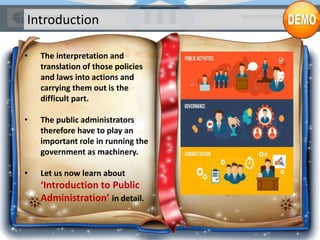
• The interpretation and
translation of those policies
and laws into actions and
carrying them out is the
difficult part.
• The public administrators
therefore have to play an
important role in running the
government as machinery.
• Let us now learn about
‘Introduction to Public
Administration’ in detail.
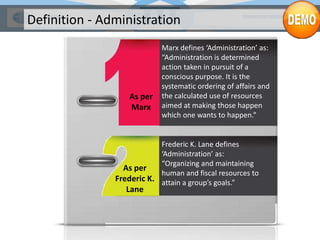
Definition - Administration
Marx defines ‘Administration’ as:
“Administration is determined
action taken in pursuit of a
conscious purpose. It is the
systematic ordering of affairs and
the calculated use of resources
aimed at making those happen
which one wants to happen.”
As per
Marx
As per
Frederic K.
Lane
Frederic K. Lane defines
‘Administration’ as:
“Organizing and maintaining
human and fiscal resources to
attain a group’s goals.”
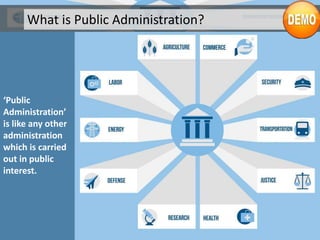
‘Public
Administration’
is like any other
administration
which is carried
out in public
interest.
What is Public Administration?
Differences between Public & Private Administration
• In order to function
efficiently, the public sector
organizations are borrowing
heavily from the business
knowledge, administration
and process orientation of the
private organizations.
• However, there still remains a
considerable difference
between these two
administrative practices.
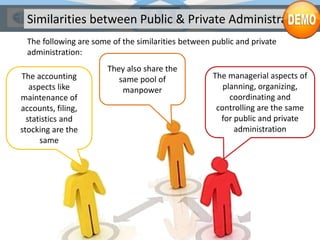
Similarities between Public & Private Administration
The following are some of the similarities between public and private
administration:
The accounting
aspects like
maintenance of
accounts, filing,
statistics and
stocking are the
same
They also share the
same pool of
manpower
The managerial aspects of
planning, organizing,
coordinating and
controlling are the same
for public and private
administration
Integral View
Managerial View
Integral View
Integral View Integral View:
• The ‘Integral View’ is all encompassing
and consists of sum total of all
managerial, clerical, technical and
manual activities and employees from all
levels.
• This view was endorsed by L. D. White
and Dimock.
• It may differ from one agency to another
depending on their sphere of work.
Historical and Legal Approach
• Historical and Legal Approach:
o The ‘Historical and Legal Approach’ to the study of Public
Administration focuses on the administrative systems, process
and policies practiced in the past and then try to interpret
them relevantly in the context of present times.
o Some scholars feel that this approach provides rich details
regarding what did and did not work in the past.
2
Tip
• The ‘Principle of Unity of Command’
implies one subordinate-one
superior relationship.
• Every subordinate is answerable and
accountable to one boss at one time.
• This helps in avoiding
communication gaps and feedback
and response is prompt.
• ‘Unity of Command’ also helps in
effective combination of resources,
that is, physical, financial resources
which helps in easy co- ordination
and, therefore, effective
organization.
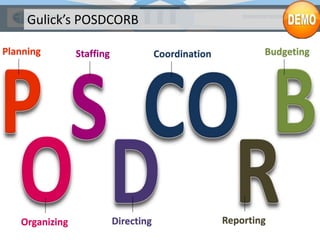
Gulick’s POSDCORB
Planning
Organizing
Staffing
Directing
Coordination
Reporting
Budgeting
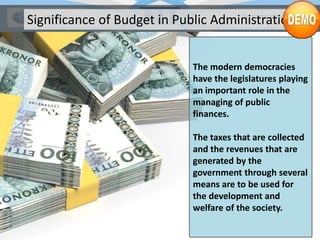
Significance of Budget in Public Administration
The modern democracies
have the legislatures playing
an important role in the
managing of public
finances.
The taxes that are collected
and the revenues that are
generated by the
government through several
means are to be used for
the development and
welfare of the society.
New Public Management Model
The term ‘New Public Management’
was coined by scholars from UK and
Australia (Hood 1991 and Hood and
Jackson 1991), to propose a new
point of view towards the
organizational design in the public
sector.
‘New Public Management’ means the
introduction of new institutional
economics to public management
and pattern changes in policy making.
Core Themes of the New Public Management
The core themes of the ‘New Public Management’ were:
• A strong focus on financial control, value for money and
increasing efficiency
• A command and control mode of functioning, identifying and
setting targets and continuance monitoring of performance,
handing over the power to the senior management
• Introducing audits at both financial and professional levels,
using transparent means to review performances, setting
benchmarks, using protocols to improve professional behavior
• Greater customer orientation and responsiveness and
increasing the scope of roles played by non public sector
providers
This is a DEMO Course On – Public
Administration.
The Complete PPT consists of 157
Slides.
Become a Member and Get Access to
Complete Powerpoint Presentations
for more than 150 Subjects.
What You Get:
1. View All Courses Online.
2. Download Powerpoint
Presentation for Each Course.
ManagementStudyGuide.com

Introduction to Administration - PPT.pptx

  • 1.
    Introduction to PublicAdministration
  • 2.
    Define Public Administration ExplainWhat is Public Administration Differentiate between Public and Private Administration Describe the Nature of Public Administration Explain Gulick’s Principles of Organizational Structure Design Describe the Various Approaches to Public Administration Explain Gulick’s POSDCORB Describe the Types of Budgets in Public Administration Explain the New Public Management Model 2 (NPM Model 2) Explain the New Public Management Model Course Objectives
  • 3.
    Introduction • You mustknow that in the olden days, there were various kingdoms which were ruled by monarchs. • So, how do you think the kingdom was run? • Do you think it was the king who directly managed the administration of the kingdom?
  • 4.
    Introduction • No, ofcourse not! In the olden days, the administrative functions were managed by a chosen few people who were responsible for general administration functions such as maintaining law and order and collecting revenues with little or no welfare activities. • These administrators were selected by the monarchs and were no better than their personal servants.
  • 5.
    Introduction • However, asmonarchy was replaced by a democratic, socialist or a capitalist state and with the advent of industrial revolution; the Government forayed into trade and commerce. • Next, the industrial revolution gave way to Imperialism, Nationalism and Internationalism which added on to the widening avenues of Government duties and responsibilities.
  • 6.
    Introduction • As timeschanged, the objective of public administration also underwent a change and by the nineteenth century; an organized approach to public servants and public administration was adopted. • This approach was based on an exhaustive legal framework replacing the patriarchal and hereditary function with bureaucracy.
  • 7.
    Introduction • Hence, publicadministration today has become an integral part of the Government, the State, the People and the way they function with each other because all aspects of citizen’s life are influenced and decided by the government. • Public Administration is especially crucial because it is not enough to make policies and laws on paper.
  • 8.
    Introduction • The interpretationand translation of those policies and laws into actions and carrying them out is the difficult part. • The public administrators therefore have to play an important role in running the government as machinery. • Let us now learn about ‘Introduction to Public Administration’ in detail.
  • 9.
    Definition - Administration Marxdefines ‘Administration’ as: “Administration is determined action taken in pursuit of a conscious purpose. It is the systematic ordering of affairs and the calculated use of resources aimed at making those happen which one wants to happen.” As per Marx As per Frederic K. Lane Frederic K. Lane defines ‘Administration’ as: “Organizing and maintaining human and fiscal resources to attain a group’s goals.”
  • 10.
    ‘Public Administration’ is like anyother administration which is carried out in public interest. What is Public Administration?
  • 11.
    Differences between Public& Private Administration • In order to function efficiently, the public sector organizations are borrowing heavily from the business knowledge, administration and process orientation of the private organizations. • However, there still remains a considerable difference between these two administrative practices.
  • 12.
    Similarities between Public& Private Administration The following are some of the similarities between public and private administration: The accounting aspects like maintenance of accounts, filing, statistics and stocking are the same They also share the same pool of manpower The managerial aspects of planning, organizing, coordinating and controlling are the same for public and private administration
  • 13.
    Integral View Managerial View IntegralView Integral View Integral View: • The ‘Integral View’ is all encompassing and consists of sum total of all managerial, clerical, technical and manual activities and employees from all levels. • This view was endorsed by L. D. White and Dimock. • It may differ from one agency to another depending on their sphere of work.
  • 14.
    Historical and LegalApproach • Historical and Legal Approach: o The ‘Historical and Legal Approach’ to the study of Public Administration focuses on the administrative systems, process and policies practiced in the past and then try to interpret them relevantly in the context of present times. o Some scholars feel that this approach provides rich details regarding what did and did not work in the past. 2
  • 15.
    Tip • The ‘Principleof Unity of Command’ implies one subordinate-one superior relationship. • Every subordinate is answerable and accountable to one boss at one time. • This helps in avoiding communication gaps and feedback and response is prompt. • ‘Unity of Command’ also helps in effective combination of resources, that is, physical, financial resources which helps in easy co- ordination and, therefore, effective organization.
  • 16.
  • 17.
    Significance of Budgetin Public Administration The modern democracies have the legislatures playing an important role in the managing of public finances. The taxes that are collected and the revenues that are generated by the government through several means are to be used for the development and welfare of the society.
  • 18.
    New Public ManagementModel The term ‘New Public Management’ was coined by scholars from UK and Australia (Hood 1991 and Hood and Jackson 1991), to propose a new point of view towards the organizational design in the public sector. ‘New Public Management’ means the introduction of new institutional economics to public management and pattern changes in policy making.
  • 19.
    Core Themes ofthe New Public Management The core themes of the ‘New Public Management’ were: • A strong focus on financial control, value for money and increasing efficiency • A command and control mode of functioning, identifying and setting targets and continuance monitoring of performance, handing over the power to the senior management • Introducing audits at both financial and professional levels, using transparent means to review performances, setting benchmarks, using protocols to improve professional behavior • Greater customer orientation and responsiveness and increasing the scope of roles played by non public sector providers
  • 20.
    This is aDEMO Course On – Public Administration. The Complete PPT consists of 157 Slides. Become a Member and Get Access to Complete Powerpoint Presentations for more than 150 Subjects. What You Get: 1. View All Courses Online. 2. Download Powerpoint Presentation for Each Course. ManagementStudyGuide.com