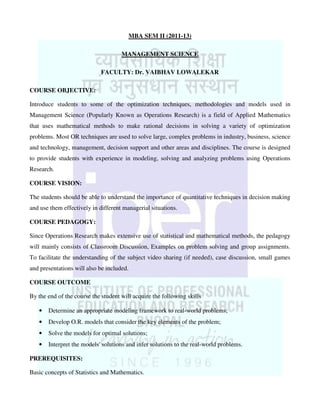
MBA SEM II (2011-13)

                                     MANAGEMENT SCIENCE

                             FACULTY: Dr. VAIBHAV LOWALEKAR

COURSE OBJECTIVE:

Introduce students to some of the optimization techniques, methodologies and models used in
Management Science (Popularly Known as Operations Research) is a field of Applied Mathematics
that uses mathematical methods to make rational decisions in solving a variety of optimization
problems. Most OR techniques are used to solve large, complex problems in industry, business, science
and technology, management, decision support and other areas and disciplines. The course is designed
to provide students with experience in modeling, solving and analyzing problems using Operations
Research.

COURSE VISION:

The students should be able to understand the importance of quantitative techniques in decision making
and use them effectively in different managerial situations.

COURSE PEDAGOGY:

Since Operations Research makes extensive use of statistical and mathematical methods, the pedagogy
will mainly consists of Classroom Discussion, Examples on problem solving and group assignments.
To facilitate the understanding of the subject video sharing (if needed), case discussion, small games
and presentations will also be included.

COURSE OUTCOME

By the end of the course the student will acquire the following skills

   •   Determine an appropriate modeling framework to real-world problems;
   •   Develop O.R. models that consider the key elements of the problem;
   •   Solve the models for optimal solutions;
   •   Interpret the models' solutions and infer solutions to the real-world problems.

PREREQUISITES:

Basic concepts of Statistics and Mathematics.
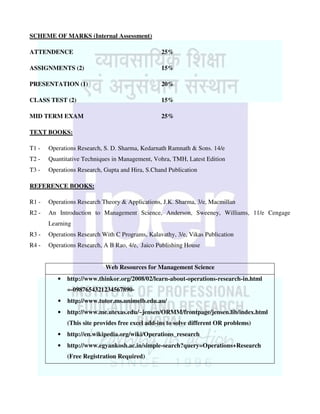
SCHEME OF MARKS (Internal Assessment)

ATTENDENCE                                       25%

ASSIGNMENTS (2)                                  15%

PRESENTATION (1)                                 20%

CLASS TEST (2)                                   15%

MID TERM EXAM                                    25%

TEXT BOOKS:

T1 -   Operations Research, S. D. Sharma, Kedarnath Ramnath & Sons. 14/e
T2 -   Quantitative Techniques in Management, Vohra, TMH, Latest Edition
T3 -   Operations Research, Gupta and Hira, S.Chand Publication

REFERENCE BOOKS:

R1 -   Operations Research Theory & Applications, J.K. Sharma, 3/e, Macmillan
R2 -   An Introduction to Management Science, Anderson, Sweeney, Williams, 11/e Cengage
       Learning
R3 -   Operations Research With C Programs, Kalavathy, 3/e, Vikas Publication
R4 -   Operations Research, A B Rao, 4/e, Jaico Publishing House


                            Web Resources for Management Science
          •   http://www.thinkor.org/2008/02/learn-about-operations-research-in.html
              =-0987654321234567890-
          •   http://www.tutor.ms.unimelb.edu.au/
          •   http://www.me.utexas.edu/~jensen/ORMM/frontpage/jensen.lib/index.html
              (This site provides free excel add-ins to solve different OR problems)
          •   http://en.wikipedia.org/wiki/Operations_research
          •   http://www.egyankosh.ac.in/simple-search?query=Operations+Research
              (Free Registration Required)
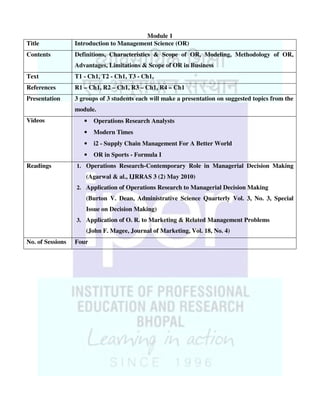
Module 1
Title             Introduction to Management Science (OR)
Contents          Definitions, Characteristics & Scope of OR, Modeling, Methodology of OR,
                  Advantages, Limitations & Scope of OR in Business
Text              T1 - Ch1, T2 - Ch1, T3 - Ch1,
References        R1 – Ch1, R2 – Ch1, R3 – Ch1, R4 – Ch1
Presentation      3 groups of 3 students each will make a presentation on suggested topics from the
                  module.
Videos               •   Operations Research Analysts
                     •   Modern Times
                     •   i2 - Supply Chain Management For A Better World
                     •   OR in Sports - Formula I
Readings          1. Operations Research-Contemporary Role in Managerial Decision Making
                      (Agarwal & al., IJRRAS 3 (2) May 2010)
                  2. Application of Operations Research to Managerial Decision Making
                      (Burton V. Dean, Administrative Science Quarterly Vol. 3, No. 3, Special
                      Issue on Decision Making)
                  3. Application of O. R. to Marketing & Related Management Problems
                      (John F. Magee, Journal of Marketing, Vol. 18, No. 4)
No. of Sessions   Four
Module II

Title             Project Management through CPM / PERT
Contents          Defining a Project and the basic objectives of a project. Network Analysis in
                  Project – Critical Path Method (CPM) and Project Evaluation Review
                  Technique (PERT).

Text              T1 – Ch25, T2 – Ch12, T3 – Ch14
References        R1 – Ch13, R2 – Ch10, R3 – Ch15, R4 – Ch8
Videos            Planning Christmas Party Using PERT/CPM
Assignment        Group of 3 students will submit an assignment based on their Summer Internship
                  Programme.
Readings          1.   PERT/CPM: A Tool for Project Management
                       (Wolf and Hauck, Industrial management, Vol. 27, No. 1, IIE, 1985)
                  2.   Critical Path Analysis for new Product Planning
                       (Yung Wong, Journal of Marketing, Vol. 28, No. 4)
                  3.   Case    Study    :   Using    CPM     or    PERT      in   time      planning
                       (http://hafeezrm.hubpages.com/hub/Case-Study-Using-CPM-or-PERT-in-
                       time-planning--control)
                  4.   Program Evaluation and Review Technique (PERT) and Critical Path
                       Method (CPM) Applications (faculty.uml.edu/adoerr/92.321/pdf/week14.pdf)
Presentation      3 groups of 3 students each will make a presentation on suggested topics from the
                  module.
No. of Sessions   Eight
Module III

Title             Decision Theory & Game Theory
Contents          Decision making under uncertainty and risk. Game theory, two persons zero
                  sum games; saddle Point, Dominance Rule, and Mixed Strategy Games.
                  Graphical Solution. Using Decision Trees to make decisions.

Text              T1 – Ch18, Ch19, T2 – Ch13, Ch15, T3 – Ch9
References        R1 – Ch11, Ch12; R2 – Ch14, R3 – Ch21, R4 – Ch10
Videos               •    Game Theory on a British Game Show!
                     •    How to Buy a Car, Using Game Theory
Test              A test based on Module I, II and III will be held at the end of module III
Readings          1. Use of Decision Theory in Regional Planning
                     (http://www.ncbi.nlm.nih.gov/pmc/articles/PMC1071782/)
                  2. The Prisoner's Dilemma
                     (businessmanagementcourses.org/Lesson29ThePrisonersDilemma.pdf)
Presentation      3 Groups of 3 Students each will make a presentation on topics provided by the
                  instructor.
No. of Sessions   Eight
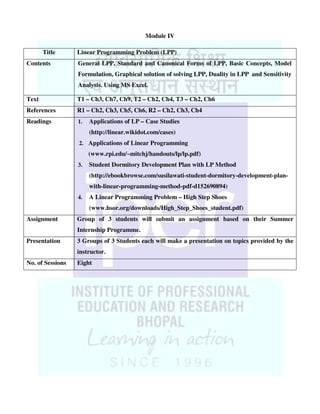
Module IV

       Title      Linear Programming Problem (LPP)
Contents          General LPP, Standard and Canonical Forms of LPP, Basic Concepts, Model
                  Formulation, Graphical solution of solving LPP, Duality in LPP and Sensitivity
                  Analysis. Using MS Excel.

Text              T1 – Ch3, Ch7, Ch9, T2 – Ch2, Ch4, T3 – Ch2, Ch6
References        R1 – Ch2, Ch3, Ch5, Ch6, R2 – Ch2, Ch3, Ch4
Readings          1.   Applications of LP – Case Studies
                       (http://linear.wikidot.com/cases)
                  2. Applications of Linear Programming
                       (www.rpi.edu/~mitchj/handouts/lp/lp.pdf)
                  3.   Student Dormitory Development Plan with LP Method
                       (http://ebookbrowse.com/susilawati-student-dormitory-development-plan-
                       with-linear-programming-method-pdf-d152690894)
                  4.   A Linear Programming Problem – High Step Shoes
                       (www.hsor.org/downloads/High_Step_Shoes_student.pdf)
Assignment        Group of 3 students will submit an assignment based on their Summer
                  Internship Programme.
Presentation      3 Groups of 3 Students each will make a presentation on topics provided by the
                  instructor.
No. of Sessions   Eight
Module V

Title              Transportation Problem
Contents           Basic concept, North – West corner method, Row minima method, Column
                   minima method, Least cost method, Voggel’s Approximation method. MODI
                   method and Special Cases. Using MS Excel to solve the TP.

Text               T1 – Ch12, T2 – Ch5, T3 – Ch3
References         R1 – Ch9, R2 – Ch7, Ch9, R3- Ch8, Ch9, R4 – Ch3
Readings           1. Transportation Problem: A Special Case for Linear Programming Problems
                      ((Reeb and Leavengood, June 2002, Oregon State University)
                   2. Experimental Analysis of some variants of VAM (Asia Pacific Journal of
                      Operational Research Vol. 21, No. 4 (2004) 447-462)
Presentation       3 Groups of 3 Students each will make a presentation on topics provided by the
                   instructor.
No. of Sessions    Six


                                            Module VI

Title             Assignment and Sequencing Problem
Contents          Assignment Problem – Basic concepts, Hungarian method of solving assignment
                  problem, LP Formulation. Using MS Excel to solve the Assignment Problem.

                  Sequencing Problem, Processing n Jobs through k machine(s). Johnson’s
                  Algorithm.

Text              T1 - Ch12, Ch24, T2 - Ch5, Ch8, T3 – Ch4, Ch5
References        R1 - Ch10, Ch22, R2 – Ch7, R3 – Ch9, Ch14, R4 – Ch4
Videos            • Operations Management
                  • Visa Power
Readings          1. Scheduling    Programming       Activities   and       Johnson's   Algorithm
                     (www.nesug.org/Proceedings/nesug10/ma/ma07.pdf)
Test              A Test based on Modules IV, V and VI will be held at the end of Module VI.
No. of Sessions   Eight

Management science

  • 1.
    MBA SEM II(2011-13) MANAGEMENT SCIENCE FACULTY: Dr. VAIBHAV LOWALEKAR COURSE OBJECTIVE: Introduce students to some of the optimization techniques, methodologies and models used in Management Science (Popularly Known as Operations Research) is a field of Applied Mathematics that uses mathematical methods to make rational decisions in solving a variety of optimization problems. Most OR techniques are used to solve large, complex problems in industry, business, science and technology, management, decision support and other areas and disciplines. The course is designed to provide students with experience in modeling, solving and analyzing problems using Operations Research. COURSE VISION: The students should be able to understand the importance of quantitative techniques in decision making and use them effectively in different managerial situations. COURSE PEDAGOGY: Since Operations Research makes extensive use of statistical and mathematical methods, the pedagogy will mainly consists of Classroom Discussion, Examples on problem solving and group assignments. To facilitate the understanding of the subject video sharing (if needed), case discussion, small games and presentations will also be included. COURSE OUTCOME By the end of the course the student will acquire the following skills • Determine an appropriate modeling framework to real-world problems; • Develop O.R. models that consider the key elements of the problem; • Solve the models for optimal solutions; • Interpret the models' solutions and infer solutions to the real-world problems. PREREQUISITES: Basic concepts of Statistics and Mathematics.
  • 2.
    SCHEME OF MARKS(Internal Assessment) ATTENDENCE 25% ASSIGNMENTS (2) 15% PRESENTATION (1) 20% CLASS TEST (2) 15% MID TERM EXAM 25% TEXT BOOKS: T1 - Operations Research, S. D. Sharma, Kedarnath Ramnath & Sons. 14/e T2 - Quantitative Techniques in Management, Vohra, TMH, Latest Edition T3 - Operations Research, Gupta and Hira, S.Chand Publication REFERENCE BOOKS: R1 - Operations Research Theory & Applications, J.K. Sharma, 3/e, Macmillan R2 - An Introduction to Management Science, Anderson, Sweeney, Williams, 11/e Cengage Learning R3 - Operations Research With C Programs, Kalavathy, 3/e, Vikas Publication R4 - Operations Research, A B Rao, 4/e, Jaico Publishing House Web Resources for Management Science • http://www.thinkor.org/2008/02/learn-about-operations-research-in.html =-0987654321234567890- • http://www.tutor.ms.unimelb.edu.au/ • http://www.me.utexas.edu/~jensen/ORMM/frontpage/jensen.lib/index.html (This site provides free excel add-ins to solve different OR problems) • http://en.wikipedia.org/wiki/Operations_research • http://www.egyankosh.ac.in/simple-search?query=Operations+Research (Free Registration Required)
  • 3.
    Module 1 Title Introduction to Management Science (OR) Contents Definitions, Characteristics & Scope of OR, Modeling, Methodology of OR, Advantages, Limitations & Scope of OR in Business Text T1 - Ch1, T2 - Ch1, T3 - Ch1, References R1 – Ch1, R2 – Ch1, R3 – Ch1, R4 – Ch1 Presentation 3 groups of 3 students each will make a presentation on suggested topics from the module. Videos • Operations Research Analysts • Modern Times • i2 - Supply Chain Management For A Better World • OR in Sports - Formula I Readings 1. Operations Research-Contemporary Role in Managerial Decision Making (Agarwal & al., IJRRAS 3 (2) May 2010) 2. Application of Operations Research to Managerial Decision Making (Burton V. Dean, Administrative Science Quarterly Vol. 3, No. 3, Special Issue on Decision Making) 3. Application of O. R. to Marketing & Related Management Problems (John F. Magee, Journal of Marketing, Vol. 18, No. 4) No. of Sessions Four
  • 4.
    Module II Title Project Management through CPM / PERT Contents Defining a Project and the basic objectives of a project. Network Analysis in Project – Critical Path Method (CPM) and Project Evaluation Review Technique (PERT). Text T1 – Ch25, T2 – Ch12, T3 – Ch14 References R1 – Ch13, R2 – Ch10, R3 – Ch15, R4 – Ch8 Videos Planning Christmas Party Using PERT/CPM Assignment Group of 3 students will submit an assignment based on their Summer Internship Programme. Readings 1. PERT/CPM: A Tool for Project Management (Wolf and Hauck, Industrial management, Vol. 27, No. 1, IIE, 1985) 2. Critical Path Analysis for new Product Planning (Yung Wong, Journal of Marketing, Vol. 28, No. 4) 3. Case Study : Using CPM or PERT in time planning (http://hafeezrm.hubpages.com/hub/Case-Study-Using-CPM-or-PERT-in- time-planning--control) 4. Program Evaluation and Review Technique (PERT) and Critical Path Method (CPM) Applications (faculty.uml.edu/adoerr/92.321/pdf/week14.pdf) Presentation 3 groups of 3 students each will make a presentation on suggested topics from the module. No. of Sessions Eight
  • 5.
    Module III Title Decision Theory & Game Theory Contents Decision making under uncertainty and risk. Game theory, two persons zero sum games; saddle Point, Dominance Rule, and Mixed Strategy Games. Graphical Solution. Using Decision Trees to make decisions. Text T1 – Ch18, Ch19, T2 – Ch13, Ch15, T3 – Ch9 References R1 – Ch11, Ch12; R2 – Ch14, R3 – Ch21, R4 – Ch10 Videos • Game Theory on a British Game Show! • How to Buy a Car, Using Game Theory Test A test based on Module I, II and III will be held at the end of module III Readings 1. Use of Decision Theory in Regional Planning (http://www.ncbi.nlm.nih.gov/pmc/articles/PMC1071782/) 2. The Prisoner's Dilemma (businessmanagementcourses.org/Lesson29ThePrisonersDilemma.pdf) Presentation 3 Groups of 3 Students each will make a presentation on topics provided by the instructor. No. of Sessions Eight
  • 6.
    Module IV Title Linear Programming Problem (LPP) Contents General LPP, Standard and Canonical Forms of LPP, Basic Concepts, Model Formulation, Graphical solution of solving LPP, Duality in LPP and Sensitivity Analysis. Using MS Excel. Text T1 – Ch3, Ch7, Ch9, T2 – Ch2, Ch4, T3 – Ch2, Ch6 References R1 – Ch2, Ch3, Ch5, Ch6, R2 – Ch2, Ch3, Ch4 Readings 1. Applications of LP – Case Studies (http://linear.wikidot.com/cases) 2. Applications of Linear Programming (www.rpi.edu/~mitchj/handouts/lp/lp.pdf) 3. Student Dormitory Development Plan with LP Method (http://ebookbrowse.com/susilawati-student-dormitory-development-plan- with-linear-programming-method-pdf-d152690894) 4. A Linear Programming Problem – High Step Shoes (www.hsor.org/downloads/High_Step_Shoes_student.pdf) Assignment Group of 3 students will submit an assignment based on their Summer Internship Programme. Presentation 3 Groups of 3 Students each will make a presentation on topics provided by the instructor. No. of Sessions Eight
  • 7.
    Module V Title Transportation Problem Contents Basic concept, North – West corner method, Row minima method, Column minima method, Least cost method, Voggel’s Approximation method. MODI method and Special Cases. Using MS Excel to solve the TP. Text T1 – Ch12, T2 – Ch5, T3 – Ch3 References R1 – Ch9, R2 – Ch7, Ch9, R3- Ch8, Ch9, R4 – Ch3 Readings 1. Transportation Problem: A Special Case for Linear Programming Problems ((Reeb and Leavengood, June 2002, Oregon State University) 2. Experimental Analysis of some variants of VAM (Asia Pacific Journal of Operational Research Vol. 21, No. 4 (2004) 447-462) Presentation 3 Groups of 3 Students each will make a presentation on topics provided by the instructor. No. of Sessions Six Module VI Title Assignment and Sequencing Problem Contents Assignment Problem – Basic concepts, Hungarian method of solving assignment problem, LP Formulation. Using MS Excel to solve the Assignment Problem. Sequencing Problem, Processing n Jobs through k machine(s). Johnson’s Algorithm. Text T1 - Ch12, Ch24, T2 - Ch5, Ch8, T3 – Ch4, Ch5 References R1 - Ch10, Ch22, R2 – Ch7, R3 – Ch9, Ch14, R4 – Ch4 Videos • Operations Management • Visa Power Readings 1. Scheduling Programming Activities and Johnson's Algorithm (www.nesug.org/Proceedings/nesug10/ma/ma07.pdf) Test A Test based on Modules IV, V and VI will be held at the end of Module VI. No. of Sessions Eight