Operations Research


J. M. Rivera
Jmrnovo@yahoo.com
Operation Research
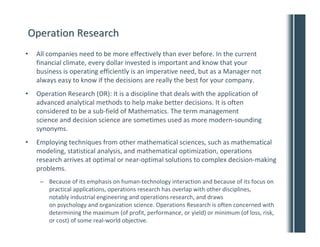
•   All companies need to be more effectively than ever before. In the current
    financial climate, every dollar invested is important and know that your
    business is operating efficiently is an imperative need, but as a Manager not
    always easy to know if the decisions are really the best for your company.
•   Operation Research (OR): It is a discipline that deals with the application of
    advanced analytical methods to help make better decisions. It is often
    considered to be a sub-field of Mathematics. The term management
    science and decision science are sometimes used as more modern-sounding
    synonyms.
•   Employing techniques from other mathematical sciences, such as mathematical
    modeling, statistical analysis, and mathematical optimization, operations
    research arrives at optimal or near-optimal solutions to complex decision-making
    problems.
     – Because of its emphasis on human-technology interaction and because of its focus on
       practical applications, operations research has overlap with other disciplines,
       notably industrial engineering and operations research, and draws
       on psychology and organization science. Operations Research is often concerned with
       determining the maximum (of profit, performance, or yield) or minimum (of loss, risk,
       or cost) of some real-world objective.
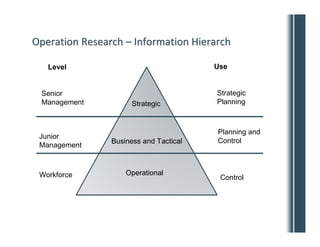
Operation Research – Information Hierarch

   Level                                Use


 Senior                                 Strategic
 Management           Strategic         Planning


                                        Planning and
 Junior
                Business and Tactical   Control
 Management


 Workforce          Operational
                                         Control
Philosophies and Methodology
Continuous Improvement
• Operation Research share values with continuous
  improvement philosophies and methodology like it;
  – Total Quality Management
     • Focusing on Deming’s 14 rules
  – Kaizen
     • Plan, Do, Check, and Act
  – Six Sigma
     • DMAIC, DMADV and DPSS
  – Lean Thinking
     • Identify Value and Stream, Flow, Pull and Perfection
  – Theory of Constraints
     • Identify Constraint, Exploit Constraints, Subordinate processes
       and Repeat cycle.
Data Analysis
                                             EDW= Enterprise Data Warehouse
•    Data analytics (DA) is the science of
     examining raw data with the
     purpose of drawing conclusions
     about that information. Data
     analytics are used in many industries
     to allow companies and organization
     to make better business decisions
     and in the sciences to verify or
     disprove existing models or theories.
     Data analytics are distinguished
     from data mining by the scope,
     purpose and focus of the analysis.
     Data miners sort through huge data
     sets using sophisticated software to
     identify undiscovered patterns and
     establish hidden relationships. Data
     analytics focuses on inference, the
     process of deriving a conclusion
     based solely on what is already
     known by the researcher.
Operation Research
Operation Research
Operation Research Logic Structure

                                                  High Level
 Channel                                         Design Aspect


  VOC
  Input                   Workforce
                                                                 Performance
                         Management
                                                                 Management
                          Activities


                                                                  Measures,
           Forecasting     Staffing               Scheduling     Analysis and
                                                                 Optimization


                                       Model Approach and
                                         Developmental


                                          Conclusions and
                                         Recommendation


                                        Implementation
Operations Research
• Some areas where Operation Research can help;
   –   Increases competitive advantage
   –   Reduction cost of operation
   –   Increase customer (I/E) satisfaction and loyalty
   –   Optimization of call center operation
        •   Identify areas for improvement – gaps processes
        •   Visualize where the problems are and provide a root cause analysis
        •   Optimize service level
        •   Simplified processes
        •   Identify pattern and trend
        •   Manage and reduce risk
        •   Improve forecast (e.g. staffing and scheduling & queue wait time)
   – Sales - Stimulate the customer to buy more
   – Provide management a powerful tool - Dashboard
Operation Research- How to start…

 Create a presentation to the high level of management


  Presents proposal to
 create the new division
                                                 Set up the guideline for
  with cost and benefit
                            Presents to IT and   the new division and
analysis, and operational
                            EDW the Operation    start recruiting:
    saving projection.                                                      Start operation
                             Research scope      Performance Analyst
     Get the approval


       Step 1                    Step 2                Step 3               Step 4
Operation Research Analyst – Job Description
•   Performance analysts provide subject matter expertise on organizational performance and
    statistical functions. In this role, analysts support systems applications, initiatives, and projects.
    Performance analysts' roles are typically self-directed. The position could be performed in a
    supervisory or non-supervisory capacity.
•   GENERAL DUTIES
     –   Analysts monitor organizational performance and perform quality control evaluations. They are involved
         in departmental projects and corporate initiatives. Performance analysts will review processes,
         recommend improvements, increase customer service levels, and reduce operational risks. Analysts build
         strong relationships between internal and external customers. They also contribute subject expertise to
         team and organizational efforts
•   JOB DESCRIPTION
     –   Possesses great analytical skills and is able to interpret data sets.
     –   Analyzes current processes and procedures in order to make recommendations to promote effective
         operations within and between departments.
     –   Manages the completion of difficult projects that are broad in nature by following general guidelines and
         using creativity and resourcefulness to meet established goals.
     –   Generates summaries of the analysis and include specific details, trends, agents' behavior, etc.…
     –   Performs ad hoc analysis of Center Performance as requested by the Center and organizational leaders.
     –   Expert level in MS-Office applications, and Excel Ability to compile data and present to large groups.
     –   Evaluates performance against established metrics to determine acceptable levels of quality or efficiency
         for various business functions and units.
     –   Be able to provide independent recommendations for process improvements based on the analysis
         performed.
Operation Research Analyst – Job Description
     –     Independently works to identify opportunities for improvement in department performance and
           results.
     –     Maintains and applies expert knowledge of practices and procedures in areas of expertise and
           maintains a broad knowledge of practices and procedures of other departments.

•EDUCATION & EXPERIENCE
     –     Bachelor's degree or MBA in mathematics, statistics, operation research, programming or
           engineering.
     –     Plus certification in Six Sigma, Kaizen or PMP.
     –     Minimum three years of experience in OR.

• SKILLS
     –     Ability to read, analyze and interpret business information and data. Ability to create
           reports/correspondence/presentations, and present information and respond to questions from
           upper management. Proficient use of Excel, Access, PowerPoint, Visio, and Project, SQL, Minitab,
           SAS, and SPSS. Ability to apply statistical concepts. Ability to define problems, collect data,
           establish facts, and draw valid conclusions. Ability to interpret an extensive variety of technical
           instructions in mathematical or diagram form and deal with several abstract and concrete
           variables.

Operations research

  • 1.
    Operations Research J. M.Rivera Jmrnovo@yahoo.com
  • 2.
    Operation Research • All companies need to be more effectively than ever before. In the current financial climate, every dollar invested is important and know that your business is operating efficiently is an imperative need, but as a Manager not always easy to know if the decisions are really the best for your company. • Operation Research (OR): It is a discipline that deals with the application of advanced analytical methods to help make better decisions. It is often considered to be a sub-field of Mathematics. The term management science and decision science are sometimes used as more modern-sounding synonyms. • Employing techniques from other mathematical sciences, such as mathematical modeling, statistical analysis, and mathematical optimization, operations research arrives at optimal or near-optimal solutions to complex decision-making problems. – Because of its emphasis on human-technology interaction and because of its focus on practical applications, operations research has overlap with other disciplines, notably industrial engineering and operations research, and draws on psychology and organization science. Operations Research is often concerned with determining the maximum (of profit, performance, or yield) or minimum (of loss, risk, or cost) of some real-world objective.
  • 3.
    Operation Research –Information Hierarch Level Use Senior Strategic Management Strategic Planning Planning and Junior Business and Tactical Control Management Workforce Operational Control
  • 4.
    Philosophies and Methodology ContinuousImprovement • Operation Research share values with continuous improvement philosophies and methodology like it; – Total Quality Management • Focusing on Deming’s 14 rules – Kaizen • Plan, Do, Check, and Act – Six Sigma • DMAIC, DMADV and DPSS – Lean Thinking • Identify Value and Stream, Flow, Pull and Perfection – Theory of Constraints • Identify Constraint, Exploit Constraints, Subordinate processes and Repeat cycle.
  • 5.
    Data Analysis EDW= Enterprise Data Warehouse • Data analytics (DA) is the science of examining raw data with the purpose of drawing conclusions about that information. Data analytics are used in many industries to allow companies and organization to make better business decisions and in the sciences to verify or disprove existing models or theories. Data analytics are distinguished from data mining by the scope, purpose and focus of the analysis. Data miners sort through huge data sets using sophisticated software to identify undiscovered patterns and establish hidden relationships. Data analytics focuses on inference, the process of deriving a conclusion based solely on what is already known by the researcher.
  • 6.
  • 7.
  • 8.
    Operation Research LogicStructure High Level Channel Design Aspect VOC Input Workforce Performance Management Management Activities Measures, Forecasting Staffing Scheduling Analysis and Optimization Model Approach and Developmental Conclusions and Recommendation Implementation
  • 9.
    Operations Research • Someareas where Operation Research can help; – Increases competitive advantage – Reduction cost of operation – Increase customer (I/E) satisfaction and loyalty – Optimization of call center operation • Identify areas for improvement – gaps processes • Visualize where the problems are and provide a root cause analysis • Optimize service level • Simplified processes • Identify pattern and trend • Manage and reduce risk • Improve forecast (e.g. staffing and scheduling & queue wait time) – Sales - Stimulate the customer to buy more – Provide management a powerful tool - Dashboard
  • 10.
    Operation Research- Howto start… Create a presentation to the high level of management Presents proposal to create the new division Set up the guideline for with cost and benefit Presents to IT and the new division and analysis, and operational EDW the Operation start recruiting: saving projection. Start operation Research scope Performance Analyst Get the approval Step 1 Step 2 Step 3 Step 4
  • 11.
    Operation Research Analyst– Job Description • Performance analysts provide subject matter expertise on organizational performance and statistical functions. In this role, analysts support systems applications, initiatives, and projects. Performance analysts' roles are typically self-directed. The position could be performed in a supervisory or non-supervisory capacity. • GENERAL DUTIES – Analysts monitor organizational performance and perform quality control evaluations. They are involved in departmental projects and corporate initiatives. Performance analysts will review processes, recommend improvements, increase customer service levels, and reduce operational risks. Analysts build strong relationships between internal and external customers. They also contribute subject expertise to team and organizational efforts • JOB DESCRIPTION – Possesses great analytical skills and is able to interpret data sets. – Analyzes current processes and procedures in order to make recommendations to promote effective operations within and between departments. – Manages the completion of difficult projects that are broad in nature by following general guidelines and using creativity and resourcefulness to meet established goals. – Generates summaries of the analysis and include specific details, trends, agents' behavior, etc.… – Performs ad hoc analysis of Center Performance as requested by the Center and organizational leaders. – Expert level in MS-Office applications, and Excel Ability to compile data and present to large groups. – Evaluates performance against established metrics to determine acceptable levels of quality or efficiency for various business functions and units. – Be able to provide independent recommendations for process improvements based on the analysis performed.
  • 12.
    Operation Research Analyst– Job Description – Independently works to identify opportunities for improvement in department performance and results. – Maintains and applies expert knowledge of practices and procedures in areas of expertise and maintains a broad knowledge of practices and procedures of other departments. •EDUCATION & EXPERIENCE – Bachelor's degree or MBA in mathematics, statistics, operation research, programming or engineering. – Plus certification in Six Sigma, Kaizen or PMP. – Minimum three years of experience in OR. • SKILLS – Ability to read, analyze and interpret business information and data. Ability to create reports/correspondence/presentations, and present information and respond to questions from upper management. Proficient use of Excel, Access, PowerPoint, Visio, and Project, SQL, Minitab, SAS, and SPSS. Ability to apply statistical concepts. Ability to define problems, collect data, establish facts, and draw valid conclusions. Ability to interpret an extensive variety of technical instructions in mathematical or diagram form and deal with several abstract and concrete variables.