PUNJAB COLLEGE OF TECHNICAL EDUCATION,
            LUDHIANA


                        COURSE MODULE
                    OPERATIONS RESEARCH
                          [ BC- 504(N2) ]


Max. Marks 100                                      Internal
Assessment - 40
                                              External Assessment -
60


Instruction for paper setter

      The question paper will consist of two sections A and B.

      Sections B will have Six questions and will carry 10 marks
       each. Section A will have 10 short answer type questions,
       which will cover the entire syllabus uniformly and will carry
       20 marks in all.


Instructions for Candidates

      Candidates are required to attempt four questions from
       section B and the entire section A.

      Use of non-programmable scientific calculator is allowed.
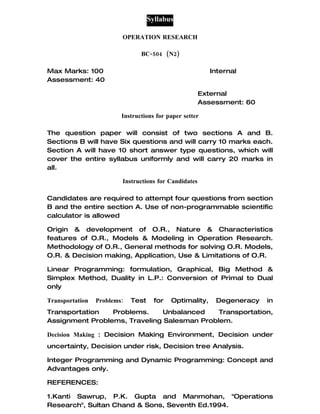
Syllabus

                         OPERATION RESEARCH

                                BC-504 (N2)

Max Marks: 100                                            Internal
Assessment: 40

                                                       External
                                                       Assessment: 60

                         Instructions for paper setter

The question paper will consist of two sections A and B.
Sections B will have Six questions and will carry 10 marks each.
Section A will have 10 short answer type questions, which will
cover the entire syllabus uniformly and will carry 20 marks in
all.

                         Instructions for Candidates

Candidates are required to attempt four questions from section
B and the entire section A. Use of non-programmable scientific
calculator is allowed

Origin & development of O.R., Nature & Characteristics
features of O.R., Models & Modeling in Operation Research.
Methodology of O.R., General methods for solving O.R. Models,
O.R. & Decision making, Application, Use & Limitations of O.R.

Linear Programming: formulation, Graphical, Big Method &
Simplex Method, Duality in L.P.: Conversion of Primal to Dual
only

Transportation   Problems:   Test     for   Optimality,    Degeneracy   in
Transportation   Problems.    Unbalanced     Transportation,
Assignment Problems, Traveling Salesman Problem.

Decision Making : Decision Making Environment, Decision under
uncertainty, Decision under risk, Decision tree Analysis.

Integer Programming and Dynamic Programming: Concept and
Advantages only.

REFERENCES:

1.Kanti Sawrup, P.K. Gupta and Manmohan, "Operations
Research", Sultan Chand & Sons, Seventh Ed.1994.
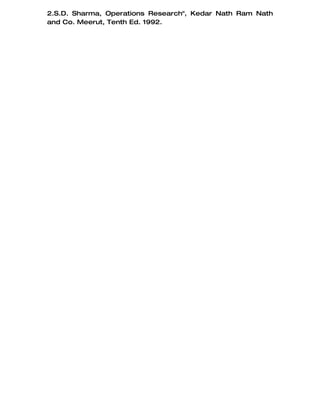
2.S.D. Sharma, Operations Research", Kedar Nath Ram Nath
and Co. Meerut, Tenth Ed. 1992.
Important Guidelines


   1. ATTENDANCE CRITERIA – 75% (NO COMPROMISES!!)
   2. YOU ARE EXPECTED TO BE IN CLASS ON/BEFORE SCHEDULED
      TIME. AFTER THAT YOU CAN ATTEND THE CLASS BUT WOULD
      NOT BE AWARDED ATTENDANCE. NO EXCUSES FOR BEING LATE
      WILL BE ENTERTAINED.
   3. MAKE SURE YOU ARE NOT ABSENT ON PRESENTATION DAY OR
      ACTIVITY DAY OR TESTS. ZERO MARKS WOULD BE AWARDED TO
      ABSENTEES. YOU’LL BE INFORMED WELL IN ADVANCE ABOUT
      THE IMPORTANT DEADLINES.
   4. DO NOT COPY ASSIGNMENTS. ALL THE COPIED ASSIGNMENTS
      AND       MASTER    ASSIGNMENT      WOULD      BE   STRAIGHT      AWAY
      CANCELLED & AWARDED ZERO MARKS.


Following are the parameters along with weight-age for the final calculation of
Internal.

                         Internal Evaluation Breakup


         Marks                                 Parameters

            15                 MID SEMESTER EXAMINATION [MSE]

            5                               PRESENTATION

            10                   TESTS [First Hourly, Second Hourly]

            10                               ASSIGNMENTS
Course Breakup
Class: BCA-III-D                                                 Lectures: 47

Subject: Operations Research                                     No. of Tests: 3

Code: BC- 504(N2)                                                Assignments: 3

Teacher: Kapil Prashar [KP]


Lecture     Date    Contents of Lecture
                                                                         Tests     Assignment
No.
      1.            Introduction to Operation Research:

                    Origin & Development of O. R.

                    Meaning & Definitions of O.R.

                    Nature and Characteristics of O. R.

      2.            Introduction to O.R.

                    Various Models of O. R.
                    Methodology of O.R.
      3.            Introduction to Operation Research:

                     O. R. And Decision making
                     Applications of O. R.
                     Uses and Limitations of O.R.
      4.            Assignment Problems

                        ♦     Meaning of Assignment Problems
                        ♦     Formulation of Assignment Matrix
                        •     Hungarian Method
      5.                •     Application of Hungarian Method.                     ASSG 1


      6.                •     Maximization and Unbalanced case in
                              Assignment Problems
      7.                •     Air crew Assignment Problems

      8.            Assignment Problem

                        •     Travelling Salesman Problem
      9.                •     Tutorial/ Problems

      10.           Introduction to Transportation Model

                        •     Feasible solution
                        •     Basic feasible solution
                        •     Optimal solution
                        •     Balanced & Unbalanced Transportation
                              Model
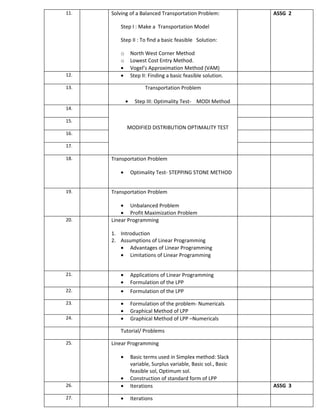
11.   Solving of a Balanced Transportation Problem:              ASSG 2

         Step I : Make a Transportation Model

         Step II : To find a basic feasible Solution:

         o       North West Corner Method
         o       Lowest Cost Entry Method.
         •       Vogel’s Approximation Method (VAM)
12.      •       Step II: Finding a basic feasible solution.

13.                    Transportation Problem

             •     Step III: Optimality Test- MODI Method
14.

15.
             MODIFIED DISTRIBUTION OPTIMALITY TEST
16.

17.

18.   Transportation Problem

         •       Optimality Test- STEPPING STONE METHOD


19.   Transportation Problem

          • Unbalanced Problem
          • Profit Maximization Problem
20.   Linear Programming

      1. Introduction
      2. Assumptions of Linear Programming
         • Advantages of Linear Programming
         • Limitations of Linear Programming


21.      •       Applications of Linear Programming
         •       Formulation of the LPP
22.      •       Formulation of the LPP

23.      •       Formulation of the problem- Numericals
         •       Graphical Method of LPP
24.      •       Graphical Method of LPP –Numericals

         Tutorial/ Problems

25.   Linear Programming

         •       Basic terms used in Simplex method: Slack
                 variable, Surplus variable, Basic sol., Basic
                 feasible sol, Optimum sol.
         •       Construction of standard form of LPP
26.      •       Iterations                                      ASSG 3

27.      •       Iterations
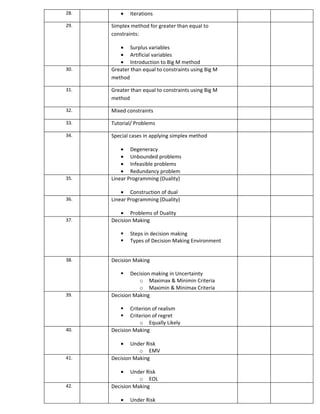
28.      •   Iterations

29.   Simplex method for greater than equal to
      constraints:

         • Surplus variables
         • Artificial variables
         • Introduction to Big M method
30.   Greater than equal to constraints using Big M
      method

31.   Greater than equal to constraints using Big M
      method

32.   Mixed constraints

33.   Tutorial/ Problems

34.   Special cases in applying simplex method

          • Degeneracy
          • Unbounded problems
          • Infeasible problems
          • Redundancy problem
35.   Linear Programming (Duality)

          • Construction of dual
36.   Linear Programming (Duality)

         • Problems of Duality
37.   Decision Making

            Steps in decision making
            Types of Decision Making Environment


38.   Decision Making

             Decision making in Uncertainty
                 o Maximax & Minimin Criteria
                 o Maximin & Minimax Criteria
39.   Decision Making

             Criterion of realism
             Criterion of regret
                  o Equally Likely
40.   Decision Making

         •    Under Risk
                 o EMV
41.   Decision Making

         •    Under Risk
                 o EOL
42.   Decision Making

         •   Under Risk
o EVPI
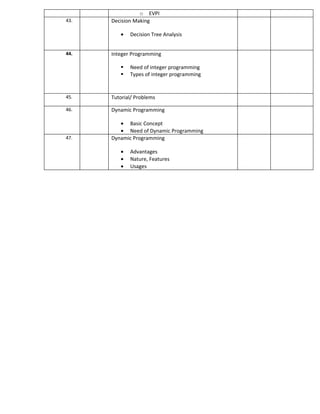
43.   Decision Making

         •   Decision Tree Analysis


44.   Integer Programming

            Need of integer programming
            Types of integer programming


45.   Tutorial/ Problems

46.   Dynamic Programming

         • Basic Concept
         • Need of Dynamic Programming
47.   Dynamic Programming

         •   Advantages
         •   Nature, Features
         •   Usages

BC 504-Operation Research

  • 1.
    PUNJAB COLLEGE OFTECHNICAL EDUCATION, LUDHIANA COURSE MODULE OPERATIONS RESEARCH [ BC- 504(N2) ] Max. Marks 100 Internal Assessment - 40 External Assessment - 60 Instruction for paper setter  The question paper will consist of two sections A and B.  Sections B will have Six questions and will carry 10 marks each. Section A will have 10 short answer type questions, which will cover the entire syllabus uniformly and will carry 20 marks in all. Instructions for Candidates  Candidates are required to attempt four questions from section B and the entire section A.  Use of non-programmable scientific calculator is allowed.
  • 2.
    Syllabus OPERATION RESEARCH BC-504 (N2) Max Marks: 100 Internal Assessment: 40 External Assessment: 60 Instructions for paper setter The question paper will consist of two sections A and B. Sections B will have Six questions and will carry 10 marks each. Section A will have 10 short answer type questions, which will cover the entire syllabus uniformly and will carry 20 marks in all. Instructions for Candidates Candidates are required to attempt four questions from section B and the entire section A. Use of non-programmable scientific calculator is allowed Origin & development of O.R., Nature & Characteristics features of O.R., Models & Modeling in Operation Research. Methodology of O.R., General methods for solving O.R. Models, O.R. & Decision making, Application, Use & Limitations of O.R. Linear Programming: formulation, Graphical, Big Method & Simplex Method, Duality in L.P.: Conversion of Primal to Dual only Transportation Problems: Test for Optimality, Degeneracy in Transportation Problems. Unbalanced Transportation, Assignment Problems, Traveling Salesman Problem. Decision Making : Decision Making Environment, Decision under uncertainty, Decision under risk, Decision tree Analysis. Integer Programming and Dynamic Programming: Concept and Advantages only. REFERENCES: 1.Kanti Sawrup, P.K. Gupta and Manmohan, "Operations Research", Sultan Chand & Sons, Seventh Ed.1994.
  • 3.
    2.S.D. Sharma, OperationsResearch", Kedar Nath Ram Nath and Co. Meerut, Tenth Ed. 1992.
  • 4.
    Important Guidelines 1. ATTENDANCE CRITERIA – 75% (NO COMPROMISES!!) 2. YOU ARE EXPECTED TO BE IN CLASS ON/BEFORE SCHEDULED TIME. AFTER THAT YOU CAN ATTEND THE CLASS BUT WOULD NOT BE AWARDED ATTENDANCE. NO EXCUSES FOR BEING LATE WILL BE ENTERTAINED. 3. MAKE SURE YOU ARE NOT ABSENT ON PRESENTATION DAY OR ACTIVITY DAY OR TESTS. ZERO MARKS WOULD BE AWARDED TO ABSENTEES. YOU’LL BE INFORMED WELL IN ADVANCE ABOUT THE IMPORTANT DEADLINES. 4. DO NOT COPY ASSIGNMENTS. ALL THE COPIED ASSIGNMENTS AND MASTER ASSIGNMENT WOULD BE STRAIGHT AWAY CANCELLED & AWARDED ZERO MARKS. Following are the parameters along with weight-age for the final calculation of Internal. Internal Evaluation Breakup Marks Parameters 15 MID SEMESTER EXAMINATION [MSE] 5 PRESENTATION 10 TESTS [First Hourly, Second Hourly] 10 ASSIGNMENTS
  • 5.
    Course Breakup Class: BCA-III-D Lectures: 47 Subject: Operations Research No. of Tests: 3 Code: BC- 504(N2) Assignments: 3 Teacher: Kapil Prashar [KP] Lecture Date Contents of Lecture Tests Assignment No. 1. Introduction to Operation Research: Origin & Development of O. R. Meaning & Definitions of O.R. Nature and Characteristics of O. R. 2. Introduction to O.R. Various Models of O. R. Methodology of O.R. 3. Introduction to Operation Research:  O. R. And Decision making  Applications of O. R.  Uses and Limitations of O.R. 4. Assignment Problems ♦ Meaning of Assignment Problems ♦ Formulation of Assignment Matrix • Hungarian Method 5. • Application of Hungarian Method. ASSG 1 6. • Maximization and Unbalanced case in Assignment Problems 7. • Air crew Assignment Problems 8. Assignment Problem • Travelling Salesman Problem 9. • Tutorial/ Problems 10. Introduction to Transportation Model • Feasible solution • Basic feasible solution • Optimal solution • Balanced & Unbalanced Transportation Model
  • 6.
    11. Solving of a Balanced Transportation Problem: ASSG 2 Step I : Make a Transportation Model Step II : To find a basic feasible Solution: o North West Corner Method o Lowest Cost Entry Method. • Vogel’s Approximation Method (VAM) 12. • Step II: Finding a basic feasible solution. 13. Transportation Problem • Step III: Optimality Test- MODI Method 14. 15. MODIFIED DISTRIBUTION OPTIMALITY TEST 16. 17. 18. Transportation Problem • Optimality Test- STEPPING STONE METHOD 19. Transportation Problem • Unbalanced Problem • Profit Maximization Problem 20. Linear Programming 1. Introduction 2. Assumptions of Linear Programming • Advantages of Linear Programming • Limitations of Linear Programming 21. • Applications of Linear Programming • Formulation of the LPP 22. • Formulation of the LPP 23. • Formulation of the problem- Numericals • Graphical Method of LPP 24. • Graphical Method of LPP –Numericals Tutorial/ Problems 25. Linear Programming • Basic terms used in Simplex method: Slack variable, Surplus variable, Basic sol., Basic feasible sol, Optimum sol. • Construction of standard form of LPP 26. • Iterations ASSG 3 27. • Iterations
  • 7.
    28. • Iterations 29. Simplex method for greater than equal to constraints: • Surplus variables • Artificial variables • Introduction to Big M method 30. Greater than equal to constraints using Big M method 31. Greater than equal to constraints using Big M method 32. Mixed constraints 33. Tutorial/ Problems 34. Special cases in applying simplex method • Degeneracy • Unbounded problems • Infeasible problems • Redundancy problem 35. Linear Programming (Duality) • Construction of dual 36. Linear Programming (Duality) • Problems of Duality 37. Decision Making  Steps in decision making  Types of Decision Making Environment 38. Decision Making  Decision making in Uncertainty o Maximax & Minimin Criteria o Maximin & Minimax Criteria 39. Decision Making  Criterion of realism  Criterion of regret o Equally Likely 40. Decision Making • Under Risk o EMV 41. Decision Making • Under Risk o EOL 42. Decision Making • Under Risk
  • 8.
    o EVPI 43. Decision Making • Decision Tree Analysis 44. Integer Programming  Need of integer programming  Types of integer programming 45. Tutorial/ Problems 46. Dynamic Programming • Basic Concept • Need of Dynamic Programming 47. Dynamic Programming • Advantages • Nature, Features • Usages