OPERATIONS
RESEARCH
By Group 7
OPERATIONS RESEARCH
is a subfield of applied mathematics that uses advanced
mathematical principles or analytical methods to solve
the problems that business leaders and managers often
experience. It encourages businesspeople to use
advanced analytical tools to make more informed and
effective decisions for organizations.
This type of research has a variety of modern uses in
business, and it uses data mining, statistical analysis and
mathematical modeling to formulate solutions to a wide
variety of problems.
ESSENTIALS CHARACTERISTICS OF
OPERATION RESEARCH
Three essential characteristics of operations research are a
systems orientation, the use of interdisciplinary teams, and
the application of scientific method to the conditions under
which the research is conducted.
• Systems Orientation
The systems approach to problems recognizes that the behaviour of
any part of a system has some effect on the behaviour of the system
as a whole. Even if the individual components are performing well,
however, the system as a whole is not necessarily performing equally
well.
• The interdisciplinary team
Scientific and technological disciplines have proliferated
rapidly in the last 100 years. The proliferation, resulting from
the enormous increase in scientific knowledge, has provided
science with a filing system that permits a systematic
classification of knowledge.
• Methodology
Until the 20th century, laboratory experiments were the
principal and almost the only method of conducting scientific
research. But large systems such as are studied in operations
research cannot be brought into laboratories.
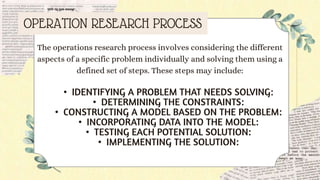
The operations research process involves considering the different
aspects of a specific problem individually and solving them using a
defined set of steps. These steps may include:
OPERATION RESEARCH PROCESS
• IDENTIFYING A PROBLEM THAT NEEDS SOLVING:
• DETERMINING THE CONSTRAINTS:
• CONSTRUCTING A MODEL BASED ON THE PROBLEM:
• INCORPORATING DATA INTO THE MODEL:
• TESTING EACH POTENTIAL SOLUTION:
• IMPLEMENTING THE SOLUTION:
PHASES OF OPERATIONS RESEARCH
• Problem formulation
To formulate an operations research problem, a suitable
measure of performance must be devised, various possible
courses of action defined (that is, controlled variables and
the constraints upon them), and relevant uncontrolled
variables identified. To devise a measure of performance,
objectives are identified and defined, and then quantified. If
objectives cannot be quantified or expressed in rigorous
(usually mathematical) terms, most operations research
techniques cannot be applied.
PHASES OF OPERATIONS RESEARCH
• Model construction
A model is a simplified representation of the real world
and, as such, includes only those variables relevant to
the problem at hand. A model of freely falling bodies,
for example, does not refer to the colour, texture, or
shape of the body involved. Furthermore, a model may
not include all relevant variables because a small
percentage of these may account for most of the
phenomenon to be explained.
PHASES OF OPERATIONS RESEARCH
• Deriving solutions from models
Procedures for deriving solutions from models are
either deductive or inductive. With deduction one
moves directly from the model to a solution in either
symbolic or numerical form. Such procedures are
supplied by mathematics; for example, the calculus.
An explicit analytical procedure for finding the
solution is called an algorithm.
PHASES OF OPERATIONS RESEARCH
• Testing the model and the solution
A model may be deficient because it includes irrelevant
variables, excludes relevant variables, contains
inaccurately evaluated variables, is incorrectly structured,
or contains incorrectly formulated constraints. Tests for
deficiencies of a model are statistical in nature; their use
requires knowledge of sampling and estimation theory,
experimental designs, and the theory of hypothesis
testing (see also statistics).
PHASES OF OPERATIONS RESEARCH
• Implementing and controlling the solution
The acceptance of a recommended solution by the responsible
manager depends on the extent to which he believes the
solution to be superior to alternatives. This in turn depends on
his faith in the researchers involved and their methods. Hence,
participation by managers in the research process is essential for
success.
Operations researchers are normally expected to oversee
implementation of an accepted solution. This provides them with
an ultimate test of their work and an opportunity to make
adjustments if any deficiencies should appear in application.
EXAMPLES OF OPERATIONS RESEARCH
MODELS AND APPLICATIONS
Resource allocation
Allocation problems involve the distribution of resources
among competing alternatives in order to minimize total
costs or maximize total return. Such problems have the
following components: a set of resources available in given
amounts; a set of jobs to be done, each consuming a
specified amount of resources; and a set of costs or returns
for each job and resource. The problem is to determine how
much of each resource to allocate to each job.
EXAMPLES OF OPERATIONS RESEARCH
MODELS AND APPLICATIONS
Linear programming
Linear programming (LP) refers to a family of mathematical
optimization techniques that have proved effective in
solving resource allocation problems, particularly those
found in industrial production systems. Linear programming
methods are algebraic techniques based on a series of
equations or inequalities that limit a problem and are used
to optimize a mathematical expression called an objective
function.
EXAMPLES OF OPERATIONS RESEARCH
MODELS AND APPLICATIONS
Inventory control
Inventories include raw materials, component parts, work in process,
finished goods, packing and packaging materials, and general supplies.
The control of inventories, vital to the financial strength of a firm, in
general involves deciding at what points in the production system stocks
shall be held and what their form and size are to be. As some unit costs
increase with inventory size—including storage, obsolescence,
deterioration, insurance, investment—and other unit costs decrease with
inventory size—including setup or preparation costs, delays because of
shortages, and so forth—a good part of inventory management consists
of determining optimal purchase or production lot sizes and base stock
levels that will balance the opposing cost influences.
EXAMPLES OF OPERATIONS RESEARCH
MODELS AND APPLICATIONS
Japanese approaches
In the 1970s several Japanese firms, led by the Toyota Motor
Corporation, developed radically different approaches to the
management of inventories. Coined the “just-in-time” approach, the
basic element of the new systems was the dramatic reduction of
inventories throughout the total production system. By relying on
careful scheduling and the coordination of supplies, the Japanese
ensured that parts and supplies were available in the right quantity,
with proper quality, at the exact time they were needed in the
manufacturing or assembly process.
EXAMPLES OF OPERATIONS RESEARCH
MODELS AND APPLICATIONS
Replacement and maintenance
Replacement problems involve items that degenerate with use or with the
passage of time and those that fail after a certain amount of use or time. Items
that deteriorate are likely to be large and costly (e.g., machine tools, trucks,
ships, and home appliances). Nondeteriorating items tend to be small and
relatively inexpensive (e.g., light bulbs, vacuum tubes, ink cartridges). The
longer a deteriorating item is operated the more maintenance it requires to
maintain efficiency. Furthermore, the longer such an item is kept the less is its
resale value and the more likely it is to be made obsolete by new equipment. If
the item is replaced frequently, however, investment costs increase. Thus the
problem is to determine when to replace such items and how much
maintenance (particularly preventive) to perform so that the sum of the
operating, maintenance, and investment costs is minimized.
EXAMPLES OF OPERATIONS RESEARCH
MODELS AND APPLICATIONS
Queuing
A queue is a waiting line, and queuing involves dealing with items or
people in sequence. Thus, a queuing problem consists either of
determining what facilities to provide or scheduling the use of them.
The cost of providing service and the waiting time of users are
minimized. Examples of such problems include determining the
number of checkout counters to provide at a supermarket, runways at
an airport, parking spaces at a shopping centre, or tellers in a bank.
Many maintenance problems can be treated as queuing problems;
items requiring repair are like users of a service. Some inventory
problems may also be formulated as queuing problems in which
orders are like users and stocks are like service facilities.
EXAMPLES OF OPERATIONS RESEARCH
MODELS AND APPLICATIONS
Job shop sequencing
In queuing problems, the order in which users waiting for
service are served is always specified. Selection of that
order so as to minimize some function of the time to
perform all the tasks is a sequencing problem. The
performance measure may account for total elapsed time,
total tardiness in meeting deadlines or due dates, and the
cost of in-process inventories.
EXAMPLES OF OPERATIONS RESEARCH
MODELS AND APPLICATIONS
Manufacturing progress function
Because of the enormous complexity of a typical mass
production line and the almost infinite number of changes
that can be made and alternatives that can be pursued, a
body of quantitative theory of mass production
manufacturing systems has not yet been developed. The
volume of available observational data is, however, growing,
and qualitative facts are emerging that may eventually serve
as a basis for quantitative theory. An example is the
“manufacturing progress function.” This was first recognized
in the airframe industry.
EXAMPLES OF OPERATIONS RESEARCH
MODELS AND APPLICATIONS
Network routing
A network may be defined by a set of points, or “nodes,” that
are connected by lines, or “links.” A way of going from one
node (the “origin”) to another (the “destination”) is called a
“route” or “path.” Links, which may be one-way or two-way,
are usually characterized by the time, cost, or distance
required to traverse them. The time or cost of traveling in
different directions on the same link may differ.
EXAMPLES OF OPERATIONS RESEARCH
MODELS AND APPLICATIONS
Search problems
Search problems involve finding the best way to obtain information needed
for a decision. Though every problem contains a search problem in one
sense, situations exist in which search itself is the essential process; for
example, in auditing accounts, inspection and quality control procedures, in
exploration for minerals, in the design of information systems, and in
military problems involving the location of such threats as enemy ships,
aircraft, mines, and missiles.
Two kinds of error are involved in search: those of observation and those of
sampling. Observational errors, in turn, are of two general types:
commission, seeing something that is not there; and omission, not seeing
something that is there. In general, as the chance of making one of these
errors is decreased, the chance of making the other is increased.
THANK YOU !

Operations-research in quantitative math

  • 1.
  • 2.
    OPERATIONS RESEARCH is asubfield of applied mathematics that uses advanced mathematical principles or analytical methods to solve the problems that business leaders and managers often experience. It encourages businesspeople to use advanced analytical tools to make more informed and effective decisions for organizations. This type of research has a variety of modern uses in business, and it uses data mining, statistical analysis and mathematical modeling to formulate solutions to a wide variety of problems.
  • 3.
    ESSENTIALS CHARACTERISTICS OF OPERATIONRESEARCH Three essential characteristics of operations research are a systems orientation, the use of interdisciplinary teams, and the application of scientific method to the conditions under which the research is conducted. • Systems Orientation The systems approach to problems recognizes that the behaviour of any part of a system has some effect on the behaviour of the system as a whole. Even if the individual components are performing well, however, the system as a whole is not necessarily performing equally well.
  • 4.
    • The interdisciplinaryteam Scientific and technological disciplines have proliferated rapidly in the last 100 years. The proliferation, resulting from the enormous increase in scientific knowledge, has provided science with a filing system that permits a systematic classification of knowledge. • Methodology Until the 20th century, laboratory experiments were the principal and almost the only method of conducting scientific research. But large systems such as are studied in operations research cannot be brought into laboratories.
  • 5.
    The operations researchprocess involves considering the different aspects of a specific problem individually and solving them using a defined set of steps. These steps may include: OPERATION RESEARCH PROCESS • IDENTIFYING A PROBLEM THAT NEEDS SOLVING: • DETERMINING THE CONSTRAINTS: • CONSTRUCTING A MODEL BASED ON THE PROBLEM: • INCORPORATING DATA INTO THE MODEL: • TESTING EACH POTENTIAL SOLUTION: • IMPLEMENTING THE SOLUTION:
  • 6.
    PHASES OF OPERATIONSRESEARCH • Problem formulation To formulate an operations research problem, a suitable measure of performance must be devised, various possible courses of action defined (that is, controlled variables and the constraints upon them), and relevant uncontrolled variables identified. To devise a measure of performance, objectives are identified and defined, and then quantified. If objectives cannot be quantified or expressed in rigorous (usually mathematical) terms, most operations research techniques cannot be applied.
  • 7.
    PHASES OF OPERATIONSRESEARCH • Model construction A model is a simplified representation of the real world and, as such, includes only those variables relevant to the problem at hand. A model of freely falling bodies, for example, does not refer to the colour, texture, or shape of the body involved. Furthermore, a model may not include all relevant variables because a small percentage of these may account for most of the phenomenon to be explained.
  • 8.
    PHASES OF OPERATIONSRESEARCH • Deriving solutions from models Procedures for deriving solutions from models are either deductive or inductive. With deduction one moves directly from the model to a solution in either symbolic or numerical form. Such procedures are supplied by mathematics; for example, the calculus. An explicit analytical procedure for finding the solution is called an algorithm.
  • 9.
    PHASES OF OPERATIONSRESEARCH • Testing the model and the solution A model may be deficient because it includes irrelevant variables, excludes relevant variables, contains inaccurately evaluated variables, is incorrectly structured, or contains incorrectly formulated constraints. Tests for deficiencies of a model are statistical in nature; their use requires knowledge of sampling and estimation theory, experimental designs, and the theory of hypothesis testing (see also statistics).
  • 10.
    PHASES OF OPERATIONSRESEARCH • Implementing and controlling the solution The acceptance of a recommended solution by the responsible manager depends on the extent to which he believes the solution to be superior to alternatives. This in turn depends on his faith in the researchers involved and their methods. Hence, participation by managers in the research process is essential for success. Operations researchers are normally expected to oversee implementation of an accepted solution. This provides them with an ultimate test of their work and an opportunity to make adjustments if any deficiencies should appear in application.
  • 11.
    EXAMPLES OF OPERATIONSRESEARCH MODELS AND APPLICATIONS Resource allocation Allocation problems involve the distribution of resources among competing alternatives in order to minimize total costs or maximize total return. Such problems have the following components: a set of resources available in given amounts; a set of jobs to be done, each consuming a specified amount of resources; and a set of costs or returns for each job and resource. The problem is to determine how much of each resource to allocate to each job.
  • 12.
    EXAMPLES OF OPERATIONSRESEARCH MODELS AND APPLICATIONS Linear programming Linear programming (LP) refers to a family of mathematical optimization techniques that have proved effective in solving resource allocation problems, particularly those found in industrial production systems. Linear programming methods are algebraic techniques based on a series of equations or inequalities that limit a problem and are used to optimize a mathematical expression called an objective function.
  • 13.
    EXAMPLES OF OPERATIONSRESEARCH MODELS AND APPLICATIONS Inventory control Inventories include raw materials, component parts, work in process, finished goods, packing and packaging materials, and general supplies. The control of inventories, vital to the financial strength of a firm, in general involves deciding at what points in the production system stocks shall be held and what their form and size are to be. As some unit costs increase with inventory size—including storage, obsolescence, deterioration, insurance, investment—and other unit costs decrease with inventory size—including setup or preparation costs, delays because of shortages, and so forth—a good part of inventory management consists of determining optimal purchase or production lot sizes and base stock levels that will balance the opposing cost influences.
  • 14.
    EXAMPLES OF OPERATIONSRESEARCH MODELS AND APPLICATIONS Japanese approaches In the 1970s several Japanese firms, led by the Toyota Motor Corporation, developed radically different approaches to the management of inventories. Coined the “just-in-time” approach, the basic element of the new systems was the dramatic reduction of inventories throughout the total production system. By relying on careful scheduling and the coordination of supplies, the Japanese ensured that parts and supplies were available in the right quantity, with proper quality, at the exact time they were needed in the manufacturing or assembly process.
  • 15.
    EXAMPLES OF OPERATIONSRESEARCH MODELS AND APPLICATIONS Replacement and maintenance Replacement problems involve items that degenerate with use or with the passage of time and those that fail after a certain amount of use or time. Items that deteriorate are likely to be large and costly (e.g., machine tools, trucks, ships, and home appliances). Nondeteriorating items tend to be small and relatively inexpensive (e.g., light bulbs, vacuum tubes, ink cartridges). The longer a deteriorating item is operated the more maintenance it requires to maintain efficiency. Furthermore, the longer such an item is kept the less is its resale value and the more likely it is to be made obsolete by new equipment. If the item is replaced frequently, however, investment costs increase. Thus the problem is to determine when to replace such items and how much maintenance (particularly preventive) to perform so that the sum of the operating, maintenance, and investment costs is minimized.
  • 16.
    EXAMPLES OF OPERATIONSRESEARCH MODELS AND APPLICATIONS Queuing A queue is a waiting line, and queuing involves dealing with items or people in sequence. Thus, a queuing problem consists either of determining what facilities to provide or scheduling the use of them. The cost of providing service and the waiting time of users are minimized. Examples of such problems include determining the number of checkout counters to provide at a supermarket, runways at an airport, parking spaces at a shopping centre, or tellers in a bank. Many maintenance problems can be treated as queuing problems; items requiring repair are like users of a service. Some inventory problems may also be formulated as queuing problems in which orders are like users and stocks are like service facilities.
  • 17.
    EXAMPLES OF OPERATIONSRESEARCH MODELS AND APPLICATIONS Job shop sequencing In queuing problems, the order in which users waiting for service are served is always specified. Selection of that order so as to minimize some function of the time to perform all the tasks is a sequencing problem. The performance measure may account for total elapsed time, total tardiness in meeting deadlines or due dates, and the cost of in-process inventories.
  • 18.
    EXAMPLES OF OPERATIONSRESEARCH MODELS AND APPLICATIONS Manufacturing progress function Because of the enormous complexity of a typical mass production line and the almost infinite number of changes that can be made and alternatives that can be pursued, a body of quantitative theory of mass production manufacturing systems has not yet been developed. The volume of available observational data is, however, growing, and qualitative facts are emerging that may eventually serve as a basis for quantitative theory. An example is the “manufacturing progress function.” This was first recognized in the airframe industry.
  • 19.
    EXAMPLES OF OPERATIONSRESEARCH MODELS AND APPLICATIONS Network routing A network may be defined by a set of points, or “nodes,” that are connected by lines, or “links.” A way of going from one node (the “origin”) to another (the “destination”) is called a “route” or “path.” Links, which may be one-way or two-way, are usually characterized by the time, cost, or distance required to traverse them. The time or cost of traveling in different directions on the same link may differ.
  • 20.
    EXAMPLES OF OPERATIONSRESEARCH MODELS AND APPLICATIONS Search problems Search problems involve finding the best way to obtain information needed for a decision. Though every problem contains a search problem in one sense, situations exist in which search itself is the essential process; for example, in auditing accounts, inspection and quality control procedures, in exploration for minerals, in the design of information systems, and in military problems involving the location of such threats as enemy ships, aircraft, mines, and missiles. Two kinds of error are involved in search: those of observation and those of sampling. Observational errors, in turn, are of two general types: commission, seeing something that is not there; and omission, not seeing something that is there. In general, as the chance of making one of these errors is decreased, the chance of making the other is increased.
  • 21.