Dilip Ketiwalla
M.Tech HSE (III)
SAP id- 500021447
R080212017

 Introduction
 What is Human-Machine Interface (HMI)?
 HMI as an „Emerging Risk‟
 Controls
 Importance of HMI in relation to OSH
 Conclusion
Roadmap

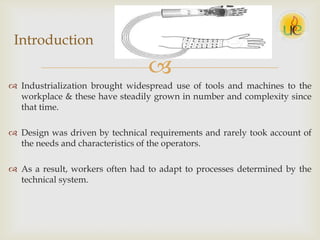
 Industrialization brought widespread use of tools and machines to the
workplace & these have steadily grown in number and complexity since
that time.
 Design was driven by technical requirements and rarely took account of
the needs and characteristics of the operators.
 As a result, workers often had to adapt to processes determined by the
technical system.
Introduction
 „Machinery‟ : ”An apparatus using or applying mechanical power,
having several parts each with a definite function and together
performing certain kinds of work.”
 „Human Factors‟ : “The relationships and interactions between a system
and its human elements and between the human elements themselves in
a system or its adjacent organization.
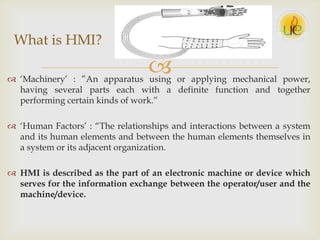
 HMI is described as the part of an electronic machine or device which
serves for the information exchange between the operator/user and the
machine/device.
What is HMI?

 „Machinery‟ : ”An apparatus using or applying mechanical power,
having several parts each with a definite function and together
performing certain kinds of work.”
 „Human Factors‟ : “The relationships and interactions between a system
and its human elements and between the human elements themselves in
a system or its adjacent organization.
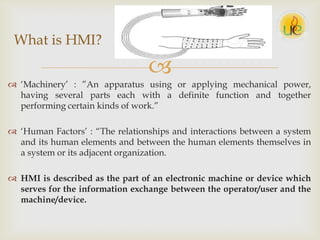
 HMI is described as the part of an electronic machine or device which
serves for the information exchange between the operator/user and the
machine/device.
What is HMI?

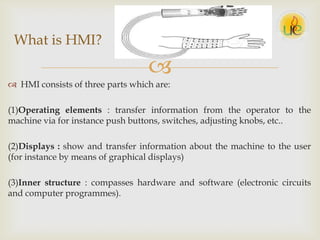
 HMI consists of three parts which are:
(1)Operating elements : transfer information from the operator to the
machine via for instance push buttons, switches, adjusting knobs, etc..
(2)Displays : show and transfer information about the machine to the user
(for instance by means of graphical displays)
(3)Inner structure : compasses hardware and software (electronic circuits
and computer programmes).
What is HMI?

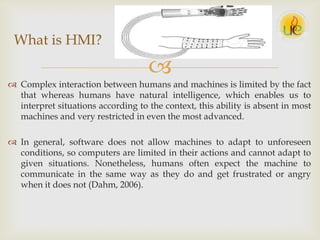
 Complex interaction between humans and machines is limited by the fact
that whereas humans have natural intelligence, which enables us to
interpret situations according to the context, this ability is absent in most
machines and very restricted in even the most advanced.
 In general, software does not allow machines to adapt to unforeseen
conditions, so computers are limited in their actions and cannot adapt to
given situations. Nonetheless, humans often expect the machine to
communicate in the same way as they do and get frustrated or angry
when it does not (Dahm, 2006).
What is HMI?

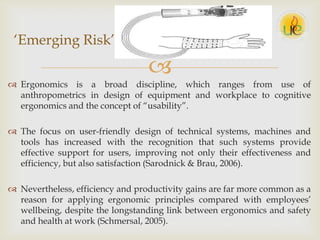
 Ergonomics is a broad discipline, which ranges from use of
anthropometrics in design of equipment and workplace to cognitive
ergonomics and the concept of “usability”.
 The focus on user-friendly design of technical systems, machines and
tools has increased with the recognition that such systems provide
effective support for users, improving not only their effectiveness and
efficiency, but also satisfaction (Sarodnick & Brau, 2006).
 Nevertheless, efficiency and productivity gains are far more common as a
reason for applying ergonomic principles compared with employees‟
wellbeing, despite the longstanding link between ergonomics and safety
and health at work (Schmersal, 2005).
„Emerging Risk‟

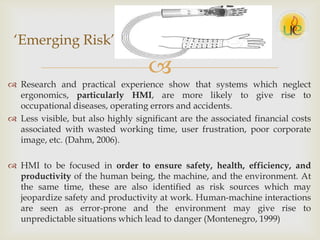
 Research and practical experience show that systems which neglect
ergonomics, particularly HMI, are more likely to give rise to
occupational diseases, operating errors and accidents.
 Less visible, but also highly significant are the associated financial costs
associated with wasted working time, user frustration, poor corporate
image, etc. (Dahm, 2006).
 HMI to be focused in order to ensure safety, health, efficiency, and
productivity of the human being, the machine, and the environment. At
the same time, these are also identified as risk sources which may
jeopardize safety and productivity at work. Human-machine interactions
are seen as error-prone and the environment may give rise to
unpredictable situations which lead to danger (Montenegro, 1999)
„Emerging Risk‟

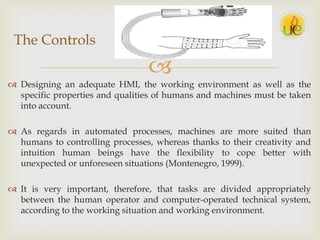
 Designing an adequate HMI, the working environment as well as the
specific properties and qualities of humans and machines must be taken
into account.
 As regards in automated processes, machines are more suited than
humans to controlling processes, whereas thanks to their creativity and
intuition human beings have the flexibility to cope better with
unexpected or unforeseen situations (Montenegro, 1999).
 It is very important, therefore, that tasks are divided appropriately
between the human operator and computer-operated technical system,
according to the working situation and working environment.
The Controls

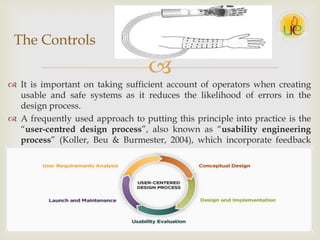
 It is important on taking sufficient account of operators when creating
usable and safe systems as it reduces the likelihood of errors in the
design process.
 A frequently used approach to putting this principle into practice is the
“user-centred design process”, also known as “usability engineering
process” (Koller, Beu & Burmester, 2004), which incorporate feedback
loops and evaluation in the HMI design process.
The Controls

 New HMI challenges will arise as humans work evermore closely with
increasingly complex machines and new control interfaces are designed.
 Operational or system safety, or reliability engineering, considers how
accidents can result from the interaction of different parts of a system
with each other and with their environment.
 But HMI rather than looking at occupational accidents, it is concerned
principally with the avoidance of major accidents that can affect large
numbers of people, both workers and public.
The Controls

 The part played by human operators in systems – especially those related
to major hazards, such as chemical plants, nuclear facilities, airliners, etc.
– is affected to a great extent by the HMI. Research fields such as human
error and human reliability analysis consider HMI.
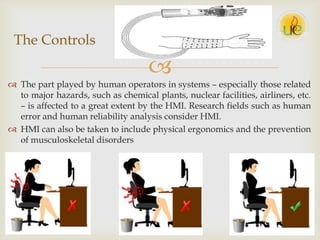
 HMI can also be taken to include physical ergonomics and the prevention
of musculoskeletal disorders
The Controls

 “Usability” is defined in the norm ISO 9241-115 as the “extent to which a
product can be used by specified users to achieve specified goals with
effectiveness, efficiency and satisfaction in a specified context of use".
Thus, usability is an essential part of (cognitive) ergonomics, which
permits humans to use machines and tools efficiently, effectively and in a
way that is satisfying (Sarodnick & Brau, 2006).
„Usability‟

 Greater automation can have the following consequences for workers‟
health and safety:
Psychosocial and musculoskeletal problems caused by reduced physical
activity, more static postures and higher mental work load (e.g. when
monitoring and controlling); less privacy at work (as technology allows
closer and more intrusive supervision); and more decision-making
problems.
Increased risk of accidents resulting from human errors; usually affecting
the user, but – especially in the case of high-risk industries - having the
potential for serious consequences beyond the operator to include fellow
workers, the wider community and environment.
Importance of HMI in relation to OSH

 Increased levels of mental strain and stress: Automation should result in
better working conditions, but, sometimes it can result in control systems
that are more complicated to operate and it can change working methods
so that demands increase with regard to stamina, time pressure and the
pace of work.
 As automation reduces the number of operators, those remaining are
increasingly isolated and have to act and communicate with the help of
the new technology.
 Poor design of HMI can lead to bad temper and even to negative health
effects. For instance, Sarodnick and Brau (2006) report that frustration
caused by the computer can lead to depression.
Importance of HMI in relation to OSH

 The workload may increase and the impact of errors is likely to be
greater. The changes in how work is organized means that teamwork
loses importance and operators increasingly have to be experts in many
different fields and bear more responsibility; this may increase task
variety, but can also increase mental work load.
 The neglect of human factor design principles in interface design,
particularly where it results in system failure, is a major cause of
increased mental strain, which can result in stress (Nachreiner et al.,
2006)
Importance of HMI in relation to OSH

 Deficiencies in the HMI significantly increase the likelihood of human
error, but can easily result in occupational accidents. Much less likely to
occur, but with far graver consequences, human error can also result in
major accidents or even disasters.
 Human errors can be analyzed using taxonomies, which demand
different criteria:
Identification of the underlying causes of incidents
Consideration of human error mechanisms
Identification of deviation from existing rules / manipulation
Understanding safety relevant consequences
Understanding technical consequences in production processes
Consideration of the frequency of the incidents
Identification of the relevant actions to resolve a dysfunction
Human Error

 “inadequate ergonomic design of the interaction interface
increases control difficulty… or impedes successful control,
which is associated with increased mental work load for
the operator and increased strain, thus leading to less
effective and less efficient process control.”
Conclusion

Any Questions?
Thank You

Man machine interface & it’s controls

  • 1.
    Dilip Ketiwalla M.Tech HSE(III) SAP id- 500021447 R080212017
  • 2.
      Introduction  Whatis Human-Machine Interface (HMI)?  HMI as an „Emerging Risk‟  Controls  Importance of HMI in relation to OSH  Conclusion Roadmap
  • 3.
      Industrialization broughtwidespread use of tools and machines to the workplace & these have steadily grown in number and complexity since that time.  Design was driven by technical requirements and rarely took account of the needs and characteristics of the operators.  As a result, workers often had to adapt to processes determined by the technical system. Introduction
  • 4.
     „Machinery‟ :”An apparatus using or applying mechanical power, having several parts each with a definite function and together performing certain kinds of work.”  „Human Factors‟ : “The relationships and interactions between a system and its human elements and between the human elements themselves in a system or its adjacent organization.  HMI is described as the part of an electronic machine or device which serves for the information exchange between the operator/user and the machine/device. What is HMI?
  • 5.
      „Machinery‟ :”An apparatus using or applying mechanical power, having several parts each with a definite function and together performing certain kinds of work.”  „Human Factors‟ : “The relationships and interactions between a system and its human elements and between the human elements themselves in a system or its adjacent organization.  HMI is described as the part of an electronic machine or device which serves for the information exchange between the operator/user and the machine/device. What is HMI?
  • 6.
      HMI consistsof three parts which are: (1)Operating elements : transfer information from the operator to the machine via for instance push buttons, switches, adjusting knobs, etc.. (2)Displays : show and transfer information about the machine to the user (for instance by means of graphical displays) (3)Inner structure : compasses hardware and software (electronic circuits and computer programmes). What is HMI?
  • 7.
      Complex interactionbetween humans and machines is limited by the fact that whereas humans have natural intelligence, which enables us to interpret situations according to the context, this ability is absent in most machines and very restricted in even the most advanced.  In general, software does not allow machines to adapt to unforeseen conditions, so computers are limited in their actions and cannot adapt to given situations. Nonetheless, humans often expect the machine to communicate in the same way as they do and get frustrated or angry when it does not (Dahm, 2006). What is HMI?
  • 8.
      Ergonomics isa broad discipline, which ranges from use of anthropometrics in design of equipment and workplace to cognitive ergonomics and the concept of “usability”.  The focus on user-friendly design of technical systems, machines and tools has increased with the recognition that such systems provide effective support for users, improving not only their effectiveness and efficiency, but also satisfaction (Sarodnick & Brau, 2006).  Nevertheless, efficiency and productivity gains are far more common as a reason for applying ergonomic principles compared with employees‟ wellbeing, despite the longstanding link between ergonomics and safety and health at work (Schmersal, 2005). „Emerging Risk‟
  • 9.
      Research andpractical experience show that systems which neglect ergonomics, particularly HMI, are more likely to give rise to occupational diseases, operating errors and accidents.  Less visible, but also highly significant are the associated financial costs associated with wasted working time, user frustration, poor corporate image, etc. (Dahm, 2006).  HMI to be focused in order to ensure safety, health, efficiency, and productivity of the human being, the machine, and the environment. At the same time, these are also identified as risk sources which may jeopardize safety and productivity at work. Human-machine interactions are seen as error-prone and the environment may give rise to unpredictable situations which lead to danger (Montenegro, 1999) „Emerging Risk‟
  • 10.
      Designing anadequate HMI, the working environment as well as the specific properties and qualities of humans and machines must be taken into account.  As regards in automated processes, machines are more suited than humans to controlling processes, whereas thanks to their creativity and intuition human beings have the flexibility to cope better with unexpected or unforeseen situations (Montenegro, 1999).  It is very important, therefore, that tasks are divided appropriately between the human operator and computer-operated technical system, according to the working situation and working environment. The Controls
  • 11.
      It isimportant on taking sufficient account of operators when creating usable and safe systems as it reduces the likelihood of errors in the design process.  A frequently used approach to putting this principle into practice is the “user-centred design process”, also known as “usability engineering process” (Koller, Beu & Burmester, 2004), which incorporate feedback loops and evaluation in the HMI design process. The Controls
  • 12.
      New HMIchallenges will arise as humans work evermore closely with increasingly complex machines and new control interfaces are designed.  Operational or system safety, or reliability engineering, considers how accidents can result from the interaction of different parts of a system with each other and with their environment.  But HMI rather than looking at occupational accidents, it is concerned principally with the avoidance of major accidents that can affect large numbers of people, both workers and public. The Controls
  • 13.
      The partplayed by human operators in systems – especially those related to major hazards, such as chemical plants, nuclear facilities, airliners, etc. – is affected to a great extent by the HMI. Research fields such as human error and human reliability analysis consider HMI.  HMI can also be taken to include physical ergonomics and the prevention of musculoskeletal disorders The Controls
  • 14.
      “Usability” isdefined in the norm ISO 9241-115 as the “extent to which a product can be used by specified users to achieve specified goals with effectiveness, efficiency and satisfaction in a specified context of use". Thus, usability is an essential part of (cognitive) ergonomics, which permits humans to use machines and tools efficiently, effectively and in a way that is satisfying (Sarodnick & Brau, 2006). „Usability‟
  • 15.
      Greater automationcan have the following consequences for workers‟ health and safety: Psychosocial and musculoskeletal problems caused by reduced physical activity, more static postures and higher mental work load (e.g. when monitoring and controlling); less privacy at work (as technology allows closer and more intrusive supervision); and more decision-making problems. Increased risk of accidents resulting from human errors; usually affecting the user, but – especially in the case of high-risk industries - having the potential for serious consequences beyond the operator to include fellow workers, the wider community and environment. Importance of HMI in relation to OSH
  • 16.
      Increased levelsof mental strain and stress: Automation should result in better working conditions, but, sometimes it can result in control systems that are more complicated to operate and it can change working methods so that demands increase with regard to stamina, time pressure and the pace of work.  As automation reduces the number of operators, those remaining are increasingly isolated and have to act and communicate with the help of the new technology.  Poor design of HMI can lead to bad temper and even to negative health effects. For instance, Sarodnick and Brau (2006) report that frustration caused by the computer can lead to depression. Importance of HMI in relation to OSH
  • 17.
      The workloadmay increase and the impact of errors is likely to be greater. The changes in how work is organized means that teamwork loses importance and operators increasingly have to be experts in many different fields and bear more responsibility; this may increase task variety, but can also increase mental work load.  The neglect of human factor design principles in interface design, particularly where it results in system failure, is a major cause of increased mental strain, which can result in stress (Nachreiner et al., 2006) Importance of HMI in relation to OSH
  • 18.
      Deficiencies inthe HMI significantly increase the likelihood of human error, but can easily result in occupational accidents. Much less likely to occur, but with far graver consequences, human error can also result in major accidents or even disasters.  Human errors can be analyzed using taxonomies, which demand different criteria: Identification of the underlying causes of incidents Consideration of human error mechanisms Identification of deviation from existing rules / manipulation Understanding safety relevant consequences Understanding technical consequences in production processes Consideration of the frequency of the incidents Identification of the relevant actions to resolve a dysfunction Human Error
  • 19.
      “inadequate ergonomicdesign of the interaction interface increases control difficulty… or impedes successful control, which is associated with increased mental work load for the operator and increased strain, thus leading to less effective and less efficient process control.” Conclusion
  • 20.