MAN-MACHINE
COMUNICATION:
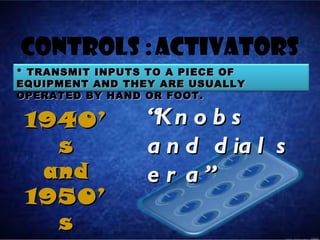
CONTROLS : activators
* TRANSMIT INPUTS TO A PIECE OF
EQUIPMENT AND THEY ARE USUALLY
OPERATED BY HAND OR FOOT.

 1940’           “K n o b s
   s             a n d d ia l s
  and            er a”
 1950’
   s
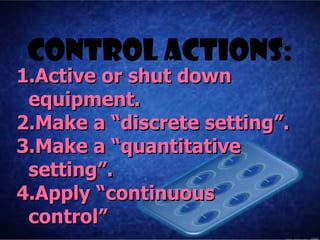
Control actions:
1.Active or shut down
 equipment.
2.Make a “discrete setting”.
3.Make a “quantitative
 setting”.
4.Apply “continuous
 control”
Types of
  control
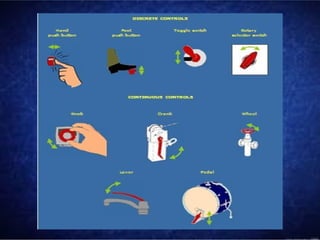
● DISCRETE
● CONTINUOUS
DISCRETE
1 .Activation
2. Data Entry
3. Setting
CONTINUOUS
3.Quantitative
setting
4.Continuous
control
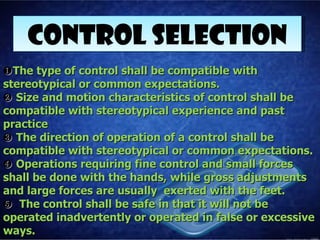
CONTROL SELECTION
❶ The type of control shall be compatible with
stereotypical or common expectations.
❷ Size and motion characteristics of control shall be
compatible with stereotypical experience and past
practice
❸ The direction of operation of a control shall be
compatible with stereotypical or common expectations.
❹ Operations requiring fine control and small forces
shall be done with the hands, while gross adjustments
and large forces are usually exerted with the feet.
❺ The control shall be safe in that it will not be
operated inadvertently or operated in false or excessive
ways.
Compatibili
   ty of
 control-
  machine
 movement
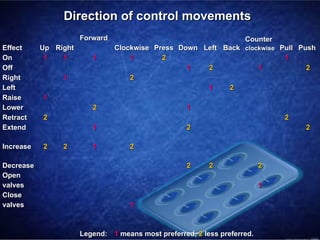
Direction of control movements
                      Forward                                       Counter
Effect     Up Right             Clockwise Press Down Left Back clockwise Pull Push
On          1   1        1          1       2                             1
Off                                               1   2            1            2
Right           1                   2
Left                                                  1    2
Raise      1
Lower                    2                          1
Retract    2                                                                  2
Extend                   1                          2                             2

Increase   2    2        1          2

Decrease                                            2     2               2
Open
valves                                                                    1
Close
valves                              1


                      Legend: 1 means most preferred, 2 less preferred.
Control
actuation
 force or
  torque
1 O n e d im e n s io n a l
s t e e r in g
2 T w o d im e n s io n a l
s t e e r in g
3 P r im a r y v e h ic le
b r a k in g
4 P r im a r y v e h ic le
a c c e le r a t io n
5 S e le c t io n o f a
t r a n s m is s io n g e a r
Arrangement &
grouping of controls
  LOCATE FOR EASE OF OPERATION
     PRIMARY CONTROLS FIRST
GROUP RELATED CONTROLS TOGETHER
ARRANGE FOR SEQUENTIAL OPERATION
          BE CONSISTENT
        DEAD-MAN CONTROL
    GUARD AGAINST ACCIDENTAL
           ACTIVATION
 PACK TIGHTLY, BUT DO NOT CROWD
FACTORS
IMPORTANT
IN CONTROL
   DESIGN
FEEDBACK
 CONTROL
RESISTANT
   SIZE
 WEIGHT
 TEXTURE
FEEDBACK
CONTROL
RESISTANCE
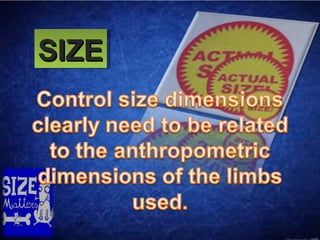
SIZE
WEIGHT
TEXTURE
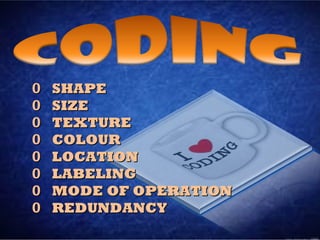
0   SHAPE
0   SIZE
0   TEXTURE
0   COLOUR
0   LOCATION
0   LABELING
0   MODE OF OPERATION
0   REDUNDANCY
man-machine communication:controls

man-machine communication:controls

  • 1.
  • 2.
    CONTROLS : activators *TRANSMIT INPUTS TO A PIECE OF EQUIPMENT AND THEY ARE USUALLY OPERATED BY HAND OR FOOT. 1940’ “K n o b s s a n d d ia l s and er a” 1950’ s
  • 3.
    Control actions: 1.Active orshut down equipment. 2.Make a “discrete setting”. 3.Make a “quantitative setting”. 4.Apply “continuous control”
  • 4.
    Types of control ● DISCRETE ● CONTINUOUS
  • 5.
  • 6.
  • 8.
    CONTROL SELECTION ❶ Thetype of control shall be compatible with stereotypical or common expectations. ❷ Size and motion characteristics of control shall be compatible with stereotypical experience and past practice ❸ The direction of operation of a control shall be compatible with stereotypical or common expectations. ❹ Operations requiring fine control and small forces shall be done with the hands, while gross adjustments and large forces are usually exerted with the feet. ❺ The control shall be safe in that it will not be operated inadvertently or operated in false or excessive ways.
  • 9.
    Compatibili ty of control- machine movement
  • 10.
    Direction of controlmovements Forward Counter Effect Up Right Clockwise Press Down Left Back clockwise Pull Push On 1 1 1 1 2 1 Off 1 2 1 2 Right 1 2 Left 1 2 Raise 1 Lower 2 1 Retract 2 2 Extend 1 2 2 Increase 2 2 1 2 Decrease 2 2 2 Open valves 1 Close valves 1 Legend: 1 means most preferred, 2 less preferred.
  • 11.
  • 16.
    1 O ne d im e n s io n a l s t e e r in g 2 T w o d im e n s io n a l s t e e r in g 3 P r im a r y v e h ic le b r a k in g 4 P r im a r y v e h ic le a c c e le r a t io n 5 S e le c t io n o f a t r a n s m is s io n g e a r
  • 17.
    Arrangement & grouping ofcontrols LOCATE FOR EASE OF OPERATION PRIMARY CONTROLS FIRST GROUP RELATED CONTROLS TOGETHER ARRANGE FOR SEQUENTIAL OPERATION BE CONSISTENT DEAD-MAN CONTROL GUARD AGAINST ACCIDENTAL ACTIVATION PACK TIGHTLY, BUT DO NOT CROWD
  • 18.
  • 19.
    FEEDBACK CONTROL RESISTANT SIZE WEIGHT TEXTURE
  • 20.
  • 21.
  • 22.
  • 23.
  • 24.
  • 25.
    0 SHAPE 0 SIZE 0 TEXTURE 0 COLOUR 0 LOCATION 0 LABELING 0 MODE OF OPERATION 0 REDUNDANCY