Click to edit Master subtitle style


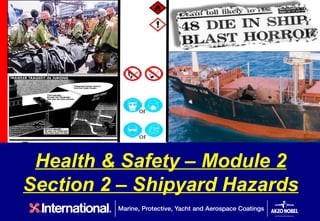
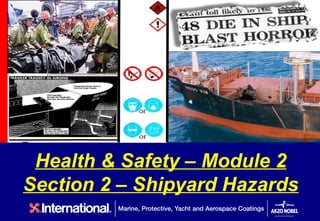
 Health & Safety – Module 2
Section 2 – Shipyard Hazards
Disclaimer
We have taken reasonable care in preparing this training material (“the Material”) and in
collecting and preparing material for inclusion in it but do not represent or warrant that it is free
from error or that the information content is complete or accurate. The information is advisory
only and the use of the Material is solely at your own risk.

In the event that the Material contains print-outs of presentations, please note that the Material
does not necessarily stand on its own and is not intended to be relied upon in specific
circumstances.
It is your responsibility to be aware of relevant current national, state and international laws and
regulations that affect or may affect your activities or operations. The Material is not intended to
provide comprehensive coverage of such laws and regulations.
To the extent permitted by law, we do not accept any liability to any person for any loss or
damage (direct or indirect) that may arise from any use of or reliance on any of the methods or
information contained in the Material for any purpose.

If you wish, you may take copies of the Material for your own use but all copies must carry this
important notice.

© Akzo Nobel, 2009. All rights reserved
TS Training - Module 2 Health & Safety
--- Introduction

1) Clothing & Personal Protective Equipment

•   Shipyard Hazards

•   Safe Working at Heights

•   Inspection of Ships in Service

•   Product Hazards

•   Tank Coating Hazards
Section 2 – Shipyard Hazards
Aim is to be able to identify hazards associated with:-

•   Shipyard Traffic
•   Electrical & Mechanical Equipment
•   High Pressure washing & Hydroblasting
•   Surface Preparation (Manual Mechanical, Blasting)
•   Paint Application
•   Ionising radiation in shipyards
•   Asbestos

…….and be able to carry out risk assessments on these.
Section 2 – Shipyard Hazards
Shipyards are dangerous places and accidents are common.

The general lack of a 'safety culture' in many shipyards means
that serious hazards are always present, and that procedures
for dealing with them are either lax or non-existent.

In these circumstances it is only a matter of time before
accidents and injuries occur.
Section 2 – Shipyard Hazards


Simple awareness of the hazards will not keep you safe – and
over-familiarisation may itself lead to a lack of caution.

We must think in terms of “Risk Assessment”.
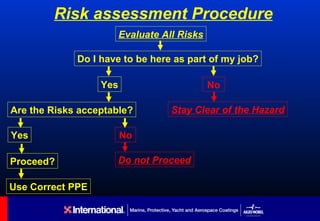
Risk assessment Procedure
                        Evaluate All Risks

             Do I have to be here as part of my job?

                  Yes                        No

Are the Risks acceptable?          Stay Clear of the Hazard

Yes                     No

Proceed?             Do not Proceed

Use Correct PPE
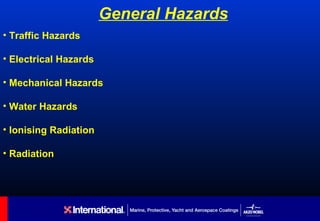
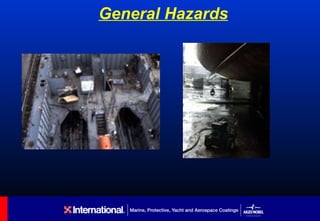
General Hazards
• Traffic Hazards

• Electrical Hazards

• Mechanical Hazards

• Water Hazards

• Ionising Radiation

• Radiation
General Hazards
Traffic Hazards
• Shipyards are busy with lots of traffic moving about.

• Access for vehicles is often narrow & restricted.

• Vehicles and pedestrians must use the same space.

• Fluorescent vests/strips increase visibility to drivers, but must
still be both cautious and observant to avoid traffic hazards.

• When accidents do happen they often cause serious injury.

• Trucks / Fork Lift Trucks / Low Loaders / Mobile Cranes
Trucks
Risks
• Use of non-segregated ground for traffic and pedestrians.
• Reversing trucks.

Avoidance
• Be cautious.
• Stay clear of reversing vehicles.

PPE
• Fluorescent Vest. Not mandatory, but advisable.
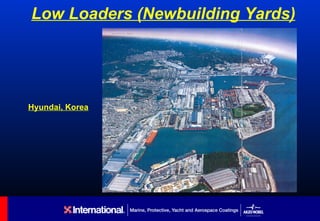
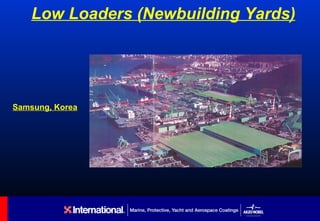
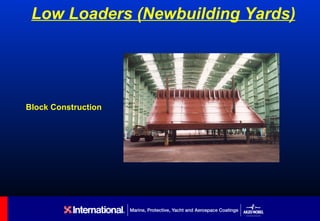
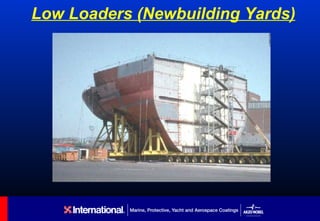
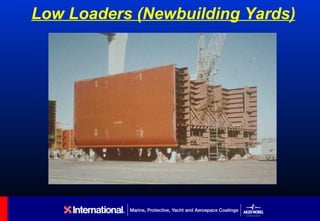
Low Loaders (Newbuilding Yards)
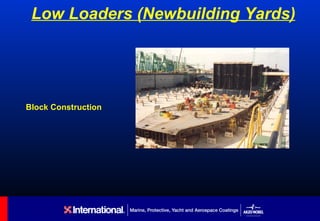
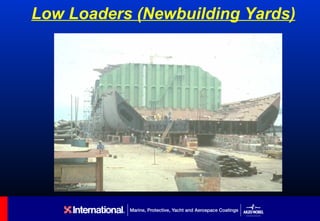
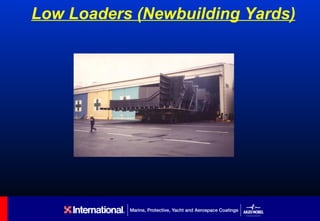
Risks
• Wide Loads.
• Off-loading by cranes & FLTs.

Avoidance
• Be cautious.
• Stay clear when off-loading.

PPE
• Fluorescent Vest.
Low Loaders (Newbuilding Yards)


Hyundai, Korea
Low Loaders (Newbuilding Yards)


Samsung, Korea
Low Loaders (Newbuilding Yards)


Block Construction
Low Loaders (Newbuilding Yards)


Block Construction
Low Loaders (Newbuilding Yards)
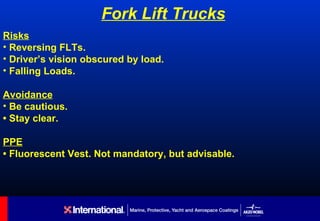
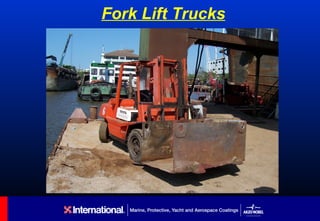
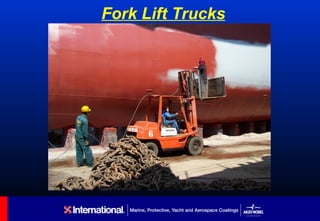
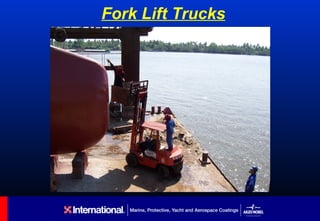
Fork Lift Trucks
Risks
• Reversing FLTs.
• Driver’s vision obscured by load.
• Falling Loads.

Avoidance
• Be cautious.
• Stay clear.

PPE
• Fluorescent Vest. Not mandatory, but advisable.
Fork Lift Trucks
Fork Lift Trucks
Fork Lift Trucks
Mobile Cranes
Risks
• Driver’s vision obscured.
• Stationary cranes moving without seeing you.
• Being trapped between a mobile crane & an obstacle.

Avoidance
• Listen for Warning Sirens & Bells.
• Stay clear of stationary cranes which are moving loads.
• Stay clear of moving cranes.
Electrical Hazards
• All shipyards use electrical equipment of many sorts.

    Generators
       110V Single-Phase to 440V Three-Phase

    Welding Sets
       40V

• Equipment is portable so yard criss-crossed with cables – so
these are often damaged – AVOID TOUCHING ALL CABLES.

• Shocks & burns are obvious dangers, but they can also cause
fire & catastrophic explosions.
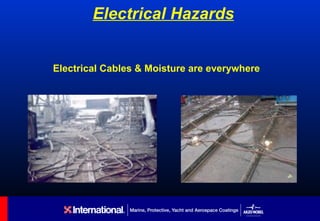
Electrical Hazards


Electrical Cables & Moisture are everywhere
Shocks & Burns
Risks
• Live Cables are present everywhere in shipyards.
• Damaged cable insulation is common
• Contact with a live conductor
• Wet conditions.

Avoidance
• Do not touch or step on cables.
• Wear insulating footwear.
• Take care especially in damp conditions

PPE
• Insulating footwear.
Fires & Explosions
• Faulty electrical equipment can short circuit or overload and
ignite combustible material.

• Unfortunately, fires are almost an everyday occurrence in yards
or on board ships under construction and repair.

• Many fires are started by welding/burning sparks igniting waste
materials such as cleaning rags – often due to poor housekeeping.

• Fires, whatever their cause, may be minor, or they may gut large
sections of the ship and cause considerable damage.

• In the event of a fire, you must follow the yard evacuation
procedures.
Fires & Explosions
• Always be alert to potential fire hazards, particularly in enclosed
spaces (eg engine rooms), where fires are more likely to occur.

• NEVER enter tanks etc alone. You may quickly be overcome by
toxic smoke and be unable to escape.

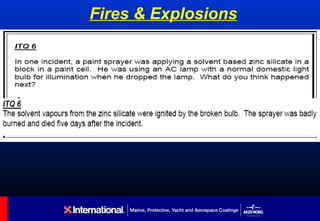
• Explosions can occur when solvent vapours are ignited, and the
ignition source may be faulty or damaged electrical equipment).

• In solvent saturated areas only intrinsically safe electrical
equipment can be used.

• There are MANY cases of paint sprayers being killed or badly
burned in such cases.
Fires & Explosions
Fires & Explosions
• You should not be asked to work in areas with high solvent
concentration but vapours can exist in pockets where ventilation
is poor.

• Be aware of all electrical sources of ignition in such atmospheres
and refuse to work unless equipment is intrinsically safe.

• Many shipowners now insist that all equipment used in such
areas is intrinsically safe, and they will prohibit the use of unsafe
equipment (eg mobile phones, lamps, cameras, dft gauges).

• If you are carrying out inspections on this type of ship in service,
you must comply with these requirements.
Fires & Explosions
• Mobile phones etc should not be used, left switched on or left on
stand-by near open paint containers, paint mixing or spraying.

• In open air they should be >2m from any open container and >4m
from the edge of a spray fan.

• In enclosed spaces, they must not be used (etc) in any
circumstances when paint is being mixed or sprayed.

• When a confined space/tank has been tested and certified as gas-
free by the ship/shipyard site such equipment may be used.

• In recently painted (<48H) confined spaces, should only be used
if gas test shows levels below 25% of LEL at lowest point of space.
Fires & Explosions
Risks
• Sparks igniting waste material.
• Being alone when overcome by smoke.
• High Solvent Vapour concentrations.
• Ignition sources in solvent atmosperes.

Avoidance
• Removal of ignition sources.
• Use of intrinsically safe electrical equipment.
• Do not work alone n confined spaces.
• Good ventilation of solvent atmospheres.
Fires & Explosions
Mechanical Hazards
• Open Machinery

• Falling Objects
Open Machinery
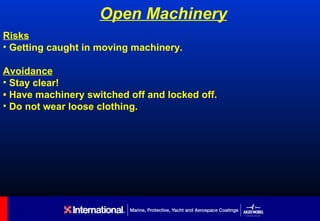
Risks
• Getting caught in moving machinery.

Avoidance
• Stay clear!
• Have machinery switched off and locked off.
• Do not wear loose clothing.
Falling Objects
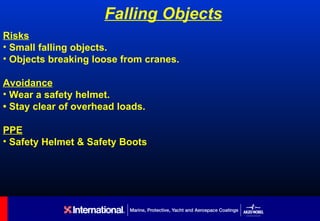
Risks
• Small falling objects.
• Objects breaking loose from cranes.

Avoidance
• Wear a safety helmet.
• Stay clear of overhead loads.

PPE
• Safety Helmet & Safety Boots
Water Hazards
• Close proximity to unguarded water presents a hazard –
especially in shipyards:-

   - housekeeping standards are often poor

   - if you fall into water, it is likely that you will be injured
   (meaning that you can not swim)

   - you will be wearing boots, overalls etc
Ionising Radiation
• Alpha, Beta, Gamma and X-rays all have the ability to ionise
matter and cause damage to cells in the body.

• Gamma and X-rays are used for radiographic non-destructive
testing of welds using radioactive isotopes or x-ray equipment.

• The use of such equipment is subject to strict controls, usually
governed by national legislation.

• All yards should have procedures to prevent accidental
exposure of personnel (ie “permit to work” systems and zoning).

• Zoned areas should be clearly indicated by the use of barriers
and warning signs.
Asbestos
• >3,500 people die per year, in the UK alone, from mesothelioma
and asbestos related lung cancer due to past exposure.

• This figure will continue to rise as illnesses can take up to 60
years to develop.

• Chrysotile (white asbestos) was used from the 1800’s right up to
the mid 1980’s.

• Many deaths and illnesses today are due to heavy exposure to
asbestos in the shipbuilding industry, despite the end of its use.
Asbestos
• Asbestos was widely used because of it’s excellent insulation,
fireproofing and sound absorption properties and, on ships, was
commonly used in engine rooms on boilers, steam and hot water
pipes.

• Control measures should be in place in most shipyards when
work involves exposing or removing asbestos.

• This is a legal requirement in many countries, but we must take
care when working on older ships.
Specific Hazards
• High Pressure Washing

• Hydroblasting

• Manual Surface Preparation

• Mechanical Surface Preparation

• Dry Abrasive Blasting

• Airless Spraying
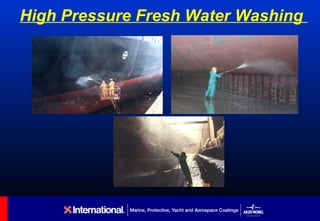
High Pressure Fresh Water Washing
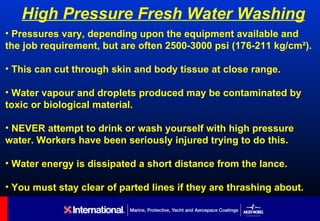
• Pressures vary, depending upon the equipment available and
the job requirement, but are often 2500-3000 psi (176-211 kg/cm²).

• This can cut through skin and body tissue at close range.

• Water vapour and droplets produced may be contaminated by
toxic or biological material.

• NEVER attempt to drink or wash yourself with high pressure
water. Workers have been seriously injured trying to do this.

• Water energy is dissipated a short distance from the lance.

• You must stay clear of parted lines if they are thrashing about.
High Pressure Fresh Water Washing
Risks
• Contact with high pressure water will cut through skin and
tissue.
• Inhalation of waterborne contaminants.

Avoidance
• Stay clear!
• Do not drink or wash from a high pressure water source.

PPE
• Face Mask
Hydroblasting
• Similar to HPFWW but higher pressures so more dangerous.

• Hydroblasting is used to remove rust, scale and paint from
steel and other substrates, with water exiting at up to 700ms-1.

• This can cut through concrete or wood – and flesh and bone.

• Operators must be fully trained, and the equipment must have
all safety features fitted.

• Best fluid lines are steel reinforced and can take 90,000 psi but
if bursts do occur, they can be very dangerous.
Hydroblasting
• Water energy is dissipated within a short distance from the
lance and is no longer dangerous.

• You must wear safety glasses/goggles near hydroblasting, as
solid particles removed by blasting will have considerable
energy, and could cause eye injury.

• You are also advised to wear a face mask to avoid inhalation of
contaminated water vapour and droplets.
Hydroblasting
Risks
• Contact with ultra high pressure water can be lethal.
• Line bursts can be very dangerous.
• Eye injury can be very dangerous.
• Inhalation of waterborne contaminants.

Avoidance
• Do not operate hydroblasting equipment.
• Stay clear of both water jets and fluid lines.

PPE
• Face Mask
• Safety glasses or goggles.
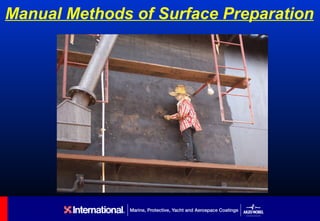
Manual Methods of Surface Preparation
• Wire brushing, scraping and chipping, are tedious, but not
particularly hazardous to the operator.

• Adequate safety clothing will protect him and others nearby from
harm.

• There is, however, a real danger of fire or explosion if this type of
preparation is carried out in a solvent laden atmosphere.

• All manual and mechanical methods of surface preparation will
produce sparks by the action of the tools against steel, and they
should not be carried out where there is a risk of explosion.
Manual Methods of Surface Preparation
Risks
• Sparks may cause fire or explosions.

Avoidance
• Do not carry out this work in solvent atmospheres.

PPE
• Face Mask
• Safety glasses or goggles.
Mechanical Methods of Surface Prep’n
• This includes needle guns, angle grinders, in-line rotary
grinders, power sanders and rotary impact tools.

• They may be powered by either electricity or compressed air.

• There are obviously mechanical and electrical hazards for the
operators using this equipment.

• Main problems for people working nearby are noise, dust and
debris, produced by all of these – and the sparks produced by
angle grinders.

• You are advised to wear a face mask, ear protectors, and safety
glasses or goggles.
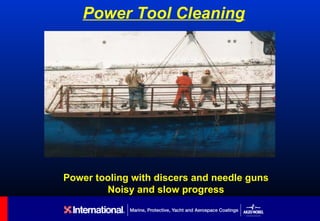
Power Tool Cleaning


Power tooling with discers and needle guns
        Noisy and slow progress
Mechanical Methods of Surface Prep’n
Risks
• Sparks may cause fire or explosions.
• Mechanical & Electrical Hazards of the tools themselves.
• Noise levels.
• Inhalation of dust & debris.
• Eye injury from sparks and flying debris.

Avoidance
• Do not operate the equipment yourself.
• Stay clear of electric cables & compressed air lines.
• Stay clear of the work vicinity.

PPE
• Face Mask / Safety glasses or goggles / Ear Protectors.
Dry Abrasive Blasting
• Compressed Air

• Over Pressurisation of Pots

• Abrasive Velocity

• Dust

• Noise

• Sparks & Electrostatic Discharge
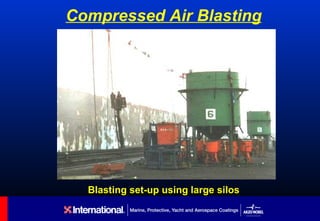
Compressed Air Blasting


  Blasting set-up using large silos
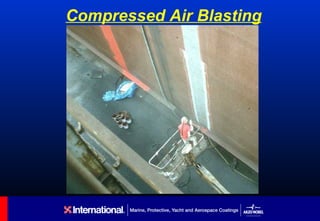
Compressed Air Blasting
Dry Abrasive Blasting
                       Compressed Air

Risks
• Compressed air penetrating the body can be LETHAL.

Avoidance
• DO NOT PLAY WITH COMPRESSED AIR.
• DO NOT USE IT TO CLEAN OFF OVERALLS!
Dry Abrasive Blasting
                       Over-Pressurisation

Risks
• Damaged or over-pressurised pots can rupture.

Avoidance
• Stay clear and inform the blasting supervisor.
Dry Abrasive Blasting
                          Abrasive Velocity

Velocity is normally 180ms-1 (450mph) – so eye injuries @ 20-30m.

Risks
• Direct hits with abrasive streams can be lethal.
• Rebounded particles can cause eye injury.
• Blasting recommencing when you are doing an inspection.

Avoidance
• Stay clear.
• Do not inspect until the blasting hood is off.

PPE
• Safety glasses or goggles.
Dry Abrasive Blasting
                                Dust

Risks
• Inhalation of dust containing toxic or harmful particles.

Avoidance
• Stay clear.
• Wear a face mask.

PPE
• Face Mask.
• Safety glasses or goggles.
Dry Abrasive Blasting
                             Noise

Risk
• Loud noise can damage your hearing.

Avoidance
• Stay clear.
• Wear ear protectors.

PPE
• Ear Protectors.
Dry Abrasive Blasting
                 Spark & Electrostatic Discharge

Risks
• Electrostatic discharges through badly earthed equipment.

Avoidance
• Ensure earthing.
Airless Spraying
• Compressed Air

• Over Pressurisation of Airless Spray Pumps

• High Pressure Paint Jets

• Electrostatic Discharge
Airless Spraying
                       Compressed Air

Risks
• Compressed air penetrating the body can be LETHAL.

Avoidance
• DO NOT PLAY WITH COMPRESSED AIR.
• DO NOT USE IT TO CLEAN OFF OVERALLS!
Airless Spraying
           Over-Pressurisation of Airless Spray Pumps

• Pumps used for marine coatings generally have air to hydraulic
ratios ranging from 20:1 to 63:1.
• A pump with a 20:1 ratio will require 100 psi air input pressure to
operate at a normal 2000 psi fluid output pressure, but a 60:1
pump could operate at a massive 6000 psi fluid output pressure
with an unregulated 100 psi air input pressure.

• Such high fluid output pressures can rupture pumps or cause
leaks and bursts to fluid lines and couplings carrying the
pressurised paint.

• These are very dangerous but occur quite frequently.
Airless Spraying
           Over-Pressurisation of Airless Spray Pumps

• Problems usually occur with old and badly maintained
equipment, and untrained operators.

• It is quite 'normal' for all the pressure gauges on a pump to be
broken, and for the operator not to know the pump ratio.

• In such cases the operator will adjust the input pressure either
up or down until the sprayer tells him to stop because he has a
good spray fan – and so operate at an 'unknown' pressure.

• When lines or couplings burst, they whip around and spray paint
everywhere.
Airless Spraying
            Over-Pressurisation of Airless Spray Pumps

Risks
• Over-pressurised pumps can rupture.
• Fluid lines and couplings can burst.

Avoidance
• Stay clear.
Airless Spraying
                     High Pressure Paint Jets

• Atomised paint leaves an airless spray gun tip at very high
pressures, usually 2000-3000 psi (141-211 kg/cm²).

• Paint at these pressures can easily penetrate the skin and enter
the blood stream. If this occurs, an immediate surgical operation is
required to clean out the wound and prevent gangrene.

• The affected finger or hand may have to be amputated.

• Paint sprayers are the people at risk. They should take proper
safety precautions when operating the gun, cleaning it, or
reversing the tip to free blockages.
Airless Spraying
                    High Pressure Paint Jets

• Accidents do occur, even to experienced people.

• There are many sprayers in the shipyards who have missing
fingers.

• Untrained people should never operate spray guns. If you have
never operated a spray gun, or been trained in its use, do not
assume you can pick it up and operate it in a safe manner
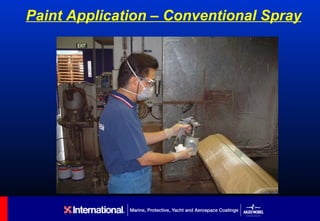
Paint Application – Conventional Spray
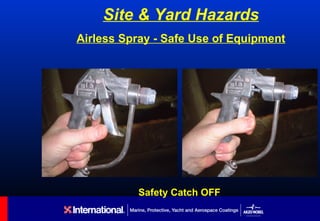
Site & Yard Hazards
Airless Spray - Safe Use of Equipment


          Safety Catch OFF
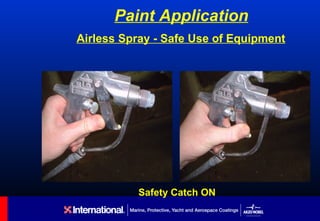
Paint Application
Airless Spray - Safe Use of Equipment


          Safety Catch ON
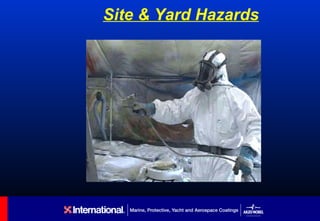
Site & Yard Hazards
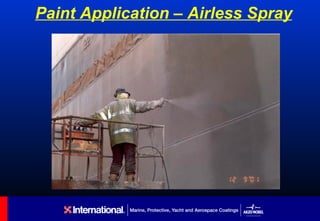
Paint Application – Airless Spray
Airless Spraying
                     High Pressure Paint Jets

Risks
• Paint jets can enter the skin.
• Affected fingers and hands may have to be amputated.

Avoidance
• Do not operate spray guns unless you are trained to do so.
Airless Spraying
                       Electrostatic Discharge

• Paint flow through fluid lines, and the atomisation process can
build up an electrostatic charge which is dangerous if discharged.

• It can give paint sprayers an electric shock, but it can also ignite
solvent vapours in the atmosphere around the spray gun.

• This is potentially catastrophic in enclosed places like tanks.

• All airless spray guns should be earthed through the conductive
braiding of the fluid lines, back to the spray pump, which itself
should be properly earthed.
Airless Spraying
                      Electrostatic Discharge

Risks
• Electrostatic discharges through badly earthed equipment.
• Ignition of Solvent Vapours.

Avoidance
• Ensure equipment is properly earthed (contractor responsibility).
Click to edit Master subtitle style


 Health & Safety – Module 2
Section 2 – Shipyard Hazards

shipyard hazards rev 01 2009 01

  • 1.
    Click to editMaster subtitle style Health & Safety – Module 2 Section 2 – Shipyard Hazards
  • 2.
    Disclaimer We have takenreasonable care in preparing this training material (“the Material”) and in collecting and preparing material for inclusion in it but do not represent or warrant that it is free from error or that the information content is complete or accurate. The information is advisory only and the use of the Material is solely at your own risk. In the event that the Material contains print-outs of presentations, please note that the Material does not necessarily stand on its own and is not intended to be relied upon in specific circumstances. It is your responsibility to be aware of relevant current national, state and international laws and regulations that affect or may affect your activities or operations. The Material is not intended to provide comprehensive coverage of such laws and regulations. To the extent permitted by law, we do not accept any liability to any person for any loss or damage (direct or indirect) that may arise from any use of or reliance on any of the methods or information contained in the Material for any purpose. If you wish, you may take copies of the Material for your own use but all copies must carry this important notice. © Akzo Nobel, 2009. All rights reserved
  • 3.
    TS Training -Module 2 Health & Safety --- Introduction 1) Clothing & Personal Protective Equipment • Shipyard Hazards • Safe Working at Heights • Inspection of Ships in Service • Product Hazards • Tank Coating Hazards
  • 4.
    Section 2 –Shipyard Hazards Aim is to be able to identify hazards associated with:- • Shipyard Traffic • Electrical & Mechanical Equipment • High Pressure washing & Hydroblasting • Surface Preparation (Manual Mechanical, Blasting) • Paint Application • Ionising radiation in shipyards • Asbestos …….and be able to carry out risk assessments on these.
  • 5.
    Section 2 –Shipyard Hazards Shipyards are dangerous places and accidents are common. The general lack of a 'safety culture' in many shipyards means that serious hazards are always present, and that procedures for dealing with them are either lax or non-existent. In these circumstances it is only a matter of time before accidents and injuries occur.
  • 6.
    Section 2 –Shipyard Hazards Simple awareness of the hazards will not keep you safe – and over-familiarisation may itself lead to a lack of caution. We must think in terms of “Risk Assessment”.
  • 7.
    Risk assessment Procedure Evaluate All Risks Do I have to be here as part of my job? Yes No Are the Risks acceptable? Stay Clear of the Hazard Yes No Proceed? Do not Proceed Use Correct PPE
  • 8.
    General Hazards • TrafficHazards • Electrical Hazards • Mechanical Hazards • Water Hazards • Ionising Radiation • Radiation
  • 9.
  • 10.
    Traffic Hazards • Shipyardsare busy with lots of traffic moving about. • Access for vehicles is often narrow & restricted. • Vehicles and pedestrians must use the same space. • Fluorescent vests/strips increase visibility to drivers, but must still be both cautious and observant to avoid traffic hazards. • When accidents do happen they often cause serious injury. • Trucks / Fork Lift Trucks / Low Loaders / Mobile Cranes
  • 11.
    Trucks Risks • Use ofnon-segregated ground for traffic and pedestrians. • Reversing trucks. Avoidance • Be cautious. • Stay clear of reversing vehicles. PPE • Fluorescent Vest. Not mandatory, but advisable.
  • 12.
    Low Loaders (NewbuildingYards) Risks • Wide Loads. • Off-loading by cranes & FLTs. Avoidance • Be cautious. • Stay clear when off-loading. PPE • Fluorescent Vest.
  • 13.
    Low Loaders (NewbuildingYards) Hyundai, Korea
  • 14.
    Low Loaders (NewbuildingYards) Samsung, Korea
  • 15.
    Low Loaders (NewbuildingYards) Block Construction
  • 16.
  • 17.
  • 18.
    Low Loaders (NewbuildingYards) Block Construction
  • 19.
  • 20.
  • 21.
    Fork Lift Trucks Risks •Reversing FLTs. • Driver’s vision obscured by load. • Falling Loads. Avoidance • Be cautious. • Stay clear. PPE • Fluorescent Vest. Not mandatory, but advisable.
  • 22.
  • 23.
  • 24.
  • 25.
    Mobile Cranes Risks • Driver’svision obscured. • Stationary cranes moving without seeing you. • Being trapped between a mobile crane & an obstacle. Avoidance • Listen for Warning Sirens & Bells. • Stay clear of stationary cranes which are moving loads. • Stay clear of moving cranes.
  • 26.
    Electrical Hazards • Allshipyards use electrical equipment of many sorts.  Generators  110V Single-Phase to 440V Three-Phase  Welding Sets  40V • Equipment is portable so yard criss-crossed with cables – so these are often damaged – AVOID TOUCHING ALL CABLES. • Shocks & burns are obvious dangers, but they can also cause fire & catastrophic explosions.
  • 27.
    Electrical Hazards Electrical Cables& Moisture are everywhere
  • 28.
    Shocks & Burns Risks •Live Cables are present everywhere in shipyards. • Damaged cable insulation is common • Contact with a live conductor • Wet conditions. Avoidance • Do not touch or step on cables. • Wear insulating footwear. • Take care especially in damp conditions PPE • Insulating footwear.
  • 29.
    Fires & Explosions •Faulty electrical equipment can short circuit or overload and ignite combustible material. • Unfortunately, fires are almost an everyday occurrence in yards or on board ships under construction and repair. • Many fires are started by welding/burning sparks igniting waste materials such as cleaning rags – often due to poor housekeeping. • Fires, whatever their cause, may be minor, or they may gut large sections of the ship and cause considerable damage. • In the event of a fire, you must follow the yard evacuation procedures.
  • 30.
    Fires & Explosions •Always be alert to potential fire hazards, particularly in enclosed spaces (eg engine rooms), where fires are more likely to occur. • NEVER enter tanks etc alone. You may quickly be overcome by toxic smoke and be unable to escape. • Explosions can occur when solvent vapours are ignited, and the ignition source may be faulty or damaged electrical equipment). • In solvent saturated areas only intrinsically safe electrical equipment can be used. • There are MANY cases of paint sprayers being killed or badly burned in such cases.
  • 31.
  • 32.
    Fires & Explosions •You should not be asked to work in areas with high solvent concentration but vapours can exist in pockets where ventilation is poor. • Be aware of all electrical sources of ignition in such atmospheres and refuse to work unless equipment is intrinsically safe. • Many shipowners now insist that all equipment used in such areas is intrinsically safe, and they will prohibit the use of unsafe equipment (eg mobile phones, lamps, cameras, dft gauges). • If you are carrying out inspections on this type of ship in service, you must comply with these requirements.
  • 33.
    Fires & Explosions •Mobile phones etc should not be used, left switched on or left on stand-by near open paint containers, paint mixing or spraying. • In open air they should be >2m from any open container and >4m from the edge of a spray fan. • In enclosed spaces, they must not be used (etc) in any circumstances when paint is being mixed or sprayed. • When a confined space/tank has been tested and certified as gas- free by the ship/shipyard site such equipment may be used. • In recently painted (<48H) confined spaces, should only be used if gas test shows levels below 25% of LEL at lowest point of space.
  • 34.
    Fires & Explosions Risks •Sparks igniting waste material. • Being alone when overcome by smoke. • High Solvent Vapour concentrations. • Ignition sources in solvent atmosperes. Avoidance • Removal of ignition sources. • Use of intrinsically safe electrical equipment. • Do not work alone n confined spaces. • Good ventilation of solvent atmospheres.
  • 35.
  • 36.
    Mechanical Hazards • OpenMachinery • Falling Objects
  • 37.
    Open Machinery Risks • Gettingcaught in moving machinery. Avoidance • Stay clear! • Have machinery switched off and locked off. • Do not wear loose clothing.
  • 38.
    Falling Objects Risks • Smallfalling objects. • Objects breaking loose from cranes. Avoidance • Wear a safety helmet. • Stay clear of overhead loads. PPE • Safety Helmet & Safety Boots
  • 39.
    Water Hazards • Closeproximity to unguarded water presents a hazard – especially in shipyards:- - housekeeping standards are often poor - if you fall into water, it is likely that you will be injured (meaning that you can not swim) - you will be wearing boots, overalls etc
  • 40.
    Ionising Radiation • Alpha,Beta, Gamma and X-rays all have the ability to ionise matter and cause damage to cells in the body. • Gamma and X-rays are used for radiographic non-destructive testing of welds using radioactive isotopes or x-ray equipment. • The use of such equipment is subject to strict controls, usually governed by national legislation. • All yards should have procedures to prevent accidental exposure of personnel (ie “permit to work” systems and zoning). • Zoned areas should be clearly indicated by the use of barriers and warning signs.
  • 41.
    Asbestos • >3,500 peopledie per year, in the UK alone, from mesothelioma and asbestos related lung cancer due to past exposure. • This figure will continue to rise as illnesses can take up to 60 years to develop. • Chrysotile (white asbestos) was used from the 1800’s right up to the mid 1980’s. • Many deaths and illnesses today are due to heavy exposure to asbestos in the shipbuilding industry, despite the end of its use.
  • 42.
    Asbestos • Asbestos waswidely used because of it’s excellent insulation, fireproofing and sound absorption properties and, on ships, was commonly used in engine rooms on boilers, steam and hot water pipes. • Control measures should be in place in most shipyards when work involves exposing or removing asbestos. • This is a legal requirement in many countries, but we must take care when working on older ships.
  • 43.
    Specific Hazards • HighPressure Washing • Hydroblasting • Manual Surface Preparation • Mechanical Surface Preparation • Dry Abrasive Blasting • Airless Spraying
  • 44.
    High Pressure FreshWater Washing • Pressures vary, depending upon the equipment available and the job requirement, but are often 2500-3000 psi (176-211 kg/cm²). • This can cut through skin and body tissue at close range. • Water vapour and droplets produced may be contaminated by toxic or biological material. • NEVER attempt to drink or wash yourself with high pressure water. Workers have been seriously injured trying to do this. • Water energy is dissipated a short distance from the lance. • You must stay clear of parted lines if they are thrashing about.
  • 45.
    High Pressure FreshWater Washing
  • 46.
    High Pressure FreshWater Washing Risks • Contact with high pressure water will cut through skin and tissue. • Inhalation of waterborne contaminants. Avoidance • Stay clear! • Do not drink or wash from a high pressure water source. PPE • Face Mask
  • 47.
    Hydroblasting • Similar toHPFWW but higher pressures so more dangerous. • Hydroblasting is used to remove rust, scale and paint from steel and other substrates, with water exiting at up to 700ms-1. • This can cut through concrete or wood – and flesh and bone. • Operators must be fully trained, and the equipment must have all safety features fitted. • Best fluid lines are steel reinforced and can take 90,000 psi but if bursts do occur, they can be very dangerous.
  • 48.
    Hydroblasting • Water energyis dissipated within a short distance from the lance and is no longer dangerous. • You must wear safety glasses/goggles near hydroblasting, as solid particles removed by blasting will have considerable energy, and could cause eye injury. • You are also advised to wear a face mask to avoid inhalation of contaminated water vapour and droplets.
  • 49.
    Hydroblasting Risks • Contact withultra high pressure water can be lethal. • Line bursts can be very dangerous. • Eye injury can be very dangerous. • Inhalation of waterborne contaminants. Avoidance • Do not operate hydroblasting equipment. • Stay clear of both water jets and fluid lines. PPE • Face Mask • Safety glasses or goggles.
  • 50.
    Manual Methods ofSurface Preparation • Wire brushing, scraping and chipping, are tedious, but not particularly hazardous to the operator. • Adequate safety clothing will protect him and others nearby from harm. • There is, however, a real danger of fire or explosion if this type of preparation is carried out in a solvent laden atmosphere. • All manual and mechanical methods of surface preparation will produce sparks by the action of the tools against steel, and they should not be carried out where there is a risk of explosion.
  • 51.
    Manual Methods ofSurface Preparation
  • 52.
    Manual Methods ofSurface Preparation Risks • Sparks may cause fire or explosions. Avoidance • Do not carry out this work in solvent atmospheres. PPE • Face Mask • Safety glasses or goggles.
  • 53.
    Mechanical Methods ofSurface Prep’n • This includes needle guns, angle grinders, in-line rotary grinders, power sanders and rotary impact tools. • They may be powered by either electricity or compressed air. • There are obviously mechanical and electrical hazards for the operators using this equipment. • Main problems for people working nearby are noise, dust and debris, produced by all of these – and the sparks produced by angle grinders. • You are advised to wear a face mask, ear protectors, and safety glasses or goggles.
  • 54.
    Power Tool Cleaning Powertooling with discers and needle guns Noisy and slow progress
  • 55.
    Mechanical Methods ofSurface Prep’n Risks • Sparks may cause fire or explosions. • Mechanical & Electrical Hazards of the tools themselves. • Noise levels. • Inhalation of dust & debris. • Eye injury from sparks and flying debris. Avoidance • Do not operate the equipment yourself. • Stay clear of electric cables & compressed air lines. • Stay clear of the work vicinity. PPE • Face Mask / Safety glasses or goggles / Ear Protectors.
  • 56.
    Dry Abrasive Blasting •Compressed Air • Over Pressurisation of Pots • Abrasive Velocity • Dust • Noise • Sparks & Electrostatic Discharge
  • 57.
    Compressed Air Blasting Blasting set-up using large silos
  • 58.
  • 59.
    Dry Abrasive Blasting Compressed Air Risks • Compressed air penetrating the body can be LETHAL. Avoidance • DO NOT PLAY WITH COMPRESSED AIR. • DO NOT USE IT TO CLEAN OFF OVERALLS!
  • 60.
    Dry Abrasive Blasting Over-Pressurisation Risks • Damaged or over-pressurised pots can rupture. Avoidance • Stay clear and inform the blasting supervisor.
  • 61.
    Dry Abrasive Blasting Abrasive Velocity Velocity is normally 180ms-1 (450mph) – so eye injuries @ 20-30m. Risks • Direct hits with abrasive streams can be lethal. • Rebounded particles can cause eye injury. • Blasting recommencing when you are doing an inspection. Avoidance • Stay clear. • Do not inspect until the blasting hood is off. PPE • Safety glasses or goggles.
  • 62.
    Dry Abrasive Blasting Dust Risks • Inhalation of dust containing toxic or harmful particles. Avoidance • Stay clear. • Wear a face mask. PPE • Face Mask. • Safety glasses or goggles.
  • 63.
    Dry Abrasive Blasting Noise Risk • Loud noise can damage your hearing. Avoidance • Stay clear. • Wear ear protectors. PPE • Ear Protectors.
  • 64.
    Dry Abrasive Blasting Spark & Electrostatic Discharge Risks • Electrostatic discharges through badly earthed equipment. Avoidance • Ensure earthing.
  • 65.
    Airless Spraying • CompressedAir • Over Pressurisation of Airless Spray Pumps • High Pressure Paint Jets • Electrostatic Discharge
  • 66.
    Airless Spraying Compressed Air Risks • Compressed air penetrating the body can be LETHAL. Avoidance • DO NOT PLAY WITH COMPRESSED AIR. • DO NOT USE IT TO CLEAN OFF OVERALLS!
  • 67.
    Airless Spraying Over-Pressurisation of Airless Spray Pumps • Pumps used for marine coatings generally have air to hydraulic ratios ranging from 20:1 to 63:1. • A pump with a 20:1 ratio will require 100 psi air input pressure to operate at a normal 2000 psi fluid output pressure, but a 60:1 pump could operate at a massive 6000 psi fluid output pressure with an unregulated 100 psi air input pressure. • Such high fluid output pressures can rupture pumps or cause leaks and bursts to fluid lines and couplings carrying the pressurised paint. • These are very dangerous but occur quite frequently.
  • 68.
    Airless Spraying Over-Pressurisation of Airless Spray Pumps • Problems usually occur with old and badly maintained equipment, and untrained operators. • It is quite 'normal' for all the pressure gauges on a pump to be broken, and for the operator not to know the pump ratio. • In such cases the operator will adjust the input pressure either up or down until the sprayer tells him to stop because he has a good spray fan – and so operate at an 'unknown' pressure. • When lines or couplings burst, they whip around and spray paint everywhere.
  • 69.
    Airless Spraying Over-Pressurisation of Airless Spray Pumps Risks • Over-pressurised pumps can rupture. • Fluid lines and couplings can burst. Avoidance • Stay clear.
  • 70.
    Airless Spraying High Pressure Paint Jets • Atomised paint leaves an airless spray gun tip at very high pressures, usually 2000-3000 psi (141-211 kg/cm²). • Paint at these pressures can easily penetrate the skin and enter the blood stream. If this occurs, an immediate surgical operation is required to clean out the wound and prevent gangrene. • The affected finger or hand may have to be amputated. • Paint sprayers are the people at risk. They should take proper safety precautions when operating the gun, cleaning it, or reversing the tip to free blockages.
  • 71.
    Airless Spraying High Pressure Paint Jets • Accidents do occur, even to experienced people. • There are many sprayers in the shipyards who have missing fingers. • Untrained people should never operate spray guns. If you have never operated a spray gun, or been trained in its use, do not assume you can pick it up and operate it in a safe manner
  • 72.
    Paint Application –Conventional Spray
  • 73.
    Site & YardHazards Airless Spray - Safe Use of Equipment Safety Catch OFF
  • 74.
    Paint Application Airless Spray- Safe Use of Equipment Safety Catch ON
  • 75.
    Site & YardHazards
  • 76.
    Paint Application –Airless Spray
  • 77.
    Airless Spraying High Pressure Paint Jets Risks • Paint jets can enter the skin. • Affected fingers and hands may have to be amputated. Avoidance • Do not operate spray guns unless you are trained to do so.
  • 78.
    Airless Spraying Electrostatic Discharge • Paint flow through fluid lines, and the atomisation process can build up an electrostatic charge which is dangerous if discharged. • It can give paint sprayers an electric shock, but it can also ignite solvent vapours in the atmosphere around the spray gun. • This is potentially catastrophic in enclosed places like tanks. • All airless spray guns should be earthed through the conductive braiding of the fluid lines, back to the spray pump, which itself should be properly earthed.
  • 79.
    Airless Spraying Electrostatic Discharge Risks • Electrostatic discharges through badly earthed equipment. • Ignition of Solvent Vapours. Avoidance • Ensure equipment is properly earthed (contractor responsibility).
  • 80.
    Click to editMaster subtitle style Health & Safety – Module 2 Section 2 – Shipyard Hazards