Workplace Safety
Guidelines
Why Work Safely?
 Work safely for the
most important people
in your life, your family.
 Work related injuries
cause not only time
away form production
activities at work but
also time away from
activities with your
family.
What is working safely?
 Wearing required PPE
 Completing every task the correct way, not
taking hazardous shortcuts
 Paying attention to the task at hand
 Asking for instruction when completing
unfamiliar tasks.
Emergency Evacuation
 Evacuation of the building may be required if
an emergency situation threatens the life or
safety of employees.
 Situations that may require evacuation: fire or
smoke; chemical spill – (five (5) gallons or
more); bomb threat; violence; power failure;
terrorist attacks.
Emergency Evacuation
If there is an emergency:
 Proceed to the nearest EXIT. Do not stop to
pick up personal property.
 After exiting building, proceed to the
assigned outside Evacuation Area.
 The Emergency Coordinator will verify all
employees are accounted for.
 The Emergency Coordinator will notify the
Manager on the status of employees.
Fork Lifts & Manlifts
 Only licensed and certified operators are
authorized to operate forklifts & manlifts.
 Do not operate mobile equipment until you
pass the required training and are
certified.
 Never stand on raised forks or on a pallet
on the fork lift.
 Never place any body part under raised
forks, pallet or other load.
Fork Lifts & Manlifts
 Always keep a buffer distance of at least 6
feet from all directions of possible travel.
 Always insure the lift operator knows you will
walk in front of or behind the lift.
 Never stand in an area where a load could
fall off forks and strike you.
 Never ride on a fork lift as a passenger.
Death Zones
 These areas are called death zones
because if the load fell or shifted and you
were in a death zone you would be killed.
 Examples of Death Zones are as follows:
 Positioning yourself between a raised load and
a fixed object.
 In an area where the load would strike you if it
fell.
Personal Protective Equipment
 Safety Glasses/Face Shields
 Hearing protection
 Gloves
 Hard Hats
 Steel Toe Boots
 Respirators/Dust Masks
THESE ARE THE PIECES OF YOUR UNIFORM
Care of PPE
 Inspect all PPE prior to using each time.
 If any part of your PPE is damaged, seek
repair or replacement
 Store all PPE in a clean, dry and secure
place.
Limitations of PPE
 Hardhats will protect you from falling bolts
from cranes but not heavy falling objects.
 Dust, airborne dirt, and sparks can travel
underneath and around the lens of safety
glasses.
 Leather gloves can be be cut through.
Eye Safety
 Never rub your face or
eyes with dirty hands or
while wearing a glove.
 If you get something in
your eye never rub it
with your finger, this will
only make it worse.
 If something is in your
eye blink it several
times then use an eye
wash.
Hearing Conservation
 Always wear hearing protection in required
areas.
 Prolonged exposure to noise without
protection will cause permanent hearing loss.
 To insert earplugs pull up on top of ear and
insert.
 Earmuffs should cover the entire outer ear
and be snug.
Electrical Safety
 Only trained maintenance employees are
authorized to conduct trouble shooting or
electrical repairs.
 Do not attempt any maintenance
activities you are not trained or
authorized to conduct.
 Never use a damaged extension cord or
any other piece of damaged equipment.
 Never used electrical equipment in damp
or wet areas.
Lock Out/Tag Out
 Lockout/Tagout refers to specific practices and
procedures which safeguard employees from the
unexpected energization or startup of machinery.
 If you ever see a red lock, yellow lock or a danger tag
on a machine it is locked out for repairs.
 Never try to start a locked out machine.
 Never remove locks or tags.
 Only trained and authorized
maintenance employees can
lock a machine out.
Lifting and Moving Material
 Always check the weight of an object prior to
lifting it.
 If it seems heavy get help from another
person, use a fork lift or a crane.
 Stretch and plan the path of travel before the
lift.
 Always lift with your legs keeping your back
straight.
 Never twist while carrying a load.
Hazard Communication
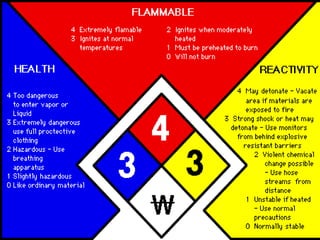
 All chemicals must be labeled with the name
of the chemical & manufacturer
 Bulk chemicals and chemicals with a hazard
must be labeled with the Hazard
Management Information System Label
shown on the next page.
 The higher the number rating the more
hazardous the chemical.
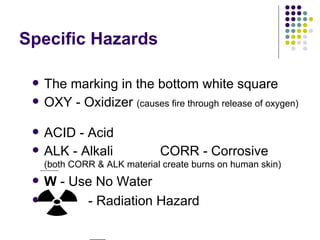
Specific Hazards
 The marking in the bottom white square
 OXY - Oxidizer (causes fire through release of oxygen)
 ACID - Acid
 ALK - Alkali CORR - Corrosive
(both CORR & ALK material create burns on human skin)
 W - Use No Water
 - Radiation Hazard
MSDS
 MSDS = Material Safety Data Sheets
 In-depth information on health hazards,
reactivity, flammability chemical properties,
guidelines on usage and storage.
 MSDS for all products used at facility are in
binders onsite.
 See supervisor/manager for MSDS binder
location.
Confined Spaces
 Never enter an area labeled
as a Confined Space
 Confined Spaces need to be
locked out and checked to
insure the atmospheric
conditions are safe before an
entry is made.
 Only trained and authorized
employees may enter a
confined space.
House Keeping
 It is important to maintain a high level of
housekeeping throughout the facility.
 Trip hazards
 Water/Spills cause slip hazards
 Clean up or immediately notify your
supervisor of these conditions.
Working from Heights
 Never enter an area
with a fall hazard of 4
feet or greater without
appropriate PPE.
 Training is required for
all employees prior to
using fall protection.
 Fall protection is also
required to be worn at
all times in manlifts.
Heat Stress – Stay Cool
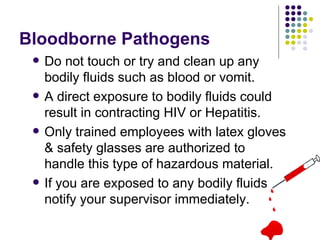
Bloodborne Pathogens
 Do not touch or try and clean up any
bodily fluids such as blood or vomit.
 A direct exposure to bodily fluids could
result in contracting HIV or Hepatitis.
 Only trained employees with latex gloves
& safety glasses are authorized to
handle this type of hazardous material.
 If you are exposed to any bodily fluids
notify your supervisor immediately.
Medical Emergencies
 If someone needs Emergency medical
care follow the guidelines below:
 Summon a first responder to the injured
person and call 911 if necessary.
 Insure an employee stands at the entrance to
direct the EMS crew to the injured employee.
 Inform your supervisor of the situation
Fire Procedures
 If you find a fire smaller then a
small trash can you can try and
put it out.
 Anything larger sound the
alarm, notify your manager and
evacuate the building.
 Assemble in your designated
area outside
 Report any missing coworkers
to manager
Fire Extinguishers
 Fire extinguishers only have a minute of
retardant in each extinguisher.
 So you will only be able to put out fires the
size of a small trash can.
 To use a fire extinguisher Remember
PASS
 Pull the pin
 Aim at the base of the fire
 Squeeze the handle
 Sweep the base of the fire
Injuries & Accidents
 All injuries and accidents must be reported to
your manager immediately.
 This includes first aid injuries and close calls.
 Accidents and injuries resulting in medical
treatment must be documented on a accident
investigation form (OSHA 300 log).
Disciplinary Action
 Disregarding safety rules or established
safety practices can result in immediate
dismissal or other action receiving a
formal, written notice.
 Examples of violations:
 Not wearing required PPE
 Not immediately reporting an injury or damage
 Committing an unsafe act such Standing in a
Death Zone or removing a guard
 Operating a piece of equipment you are not
authorized to operate such as a crane or fork
lift
Questions?

Safety.pdf

  • 1.
  • 2.
    Why Work Safely? Work safely for the most important people in your life, your family.  Work related injuries cause not only time away form production activities at work but also time away from activities with your family.
  • 3.
    What is workingsafely?  Wearing required PPE  Completing every task the correct way, not taking hazardous shortcuts  Paying attention to the task at hand  Asking for instruction when completing unfamiliar tasks.
  • 4.
    Emergency Evacuation  Evacuationof the building may be required if an emergency situation threatens the life or safety of employees.  Situations that may require evacuation: fire or smoke; chemical spill – (five (5) gallons or more); bomb threat; violence; power failure; terrorist attacks.
  • 5.
    Emergency Evacuation If thereis an emergency:  Proceed to the nearest EXIT. Do not stop to pick up personal property.  After exiting building, proceed to the assigned outside Evacuation Area.  The Emergency Coordinator will verify all employees are accounted for.  The Emergency Coordinator will notify the Manager on the status of employees.
  • 6.
    Fork Lifts &Manlifts  Only licensed and certified operators are authorized to operate forklifts & manlifts.  Do not operate mobile equipment until you pass the required training and are certified.  Never stand on raised forks or on a pallet on the fork lift.  Never place any body part under raised forks, pallet or other load.
  • 7.
    Fork Lifts &Manlifts  Always keep a buffer distance of at least 6 feet from all directions of possible travel.  Always insure the lift operator knows you will walk in front of or behind the lift.  Never stand in an area where a load could fall off forks and strike you.  Never ride on a fork lift as a passenger.
  • 8.
    Death Zones  Theseareas are called death zones because if the load fell or shifted and you were in a death zone you would be killed.  Examples of Death Zones are as follows:  Positioning yourself between a raised load and a fixed object.  In an area where the load would strike you if it fell.
  • 9.
    Personal Protective Equipment Safety Glasses/Face Shields  Hearing protection  Gloves  Hard Hats  Steel Toe Boots  Respirators/Dust Masks THESE ARE THE PIECES OF YOUR UNIFORM
  • 10.
    Care of PPE Inspect all PPE prior to using each time.  If any part of your PPE is damaged, seek repair or replacement  Store all PPE in a clean, dry and secure place.
  • 11.
    Limitations of PPE Hardhats will protect you from falling bolts from cranes but not heavy falling objects.  Dust, airborne dirt, and sparks can travel underneath and around the lens of safety glasses.  Leather gloves can be be cut through.
  • 12.
    Eye Safety  Neverrub your face or eyes with dirty hands or while wearing a glove.  If you get something in your eye never rub it with your finger, this will only make it worse.  If something is in your eye blink it several times then use an eye wash.
  • 13.
    Hearing Conservation  Alwayswear hearing protection in required areas.  Prolonged exposure to noise without protection will cause permanent hearing loss.  To insert earplugs pull up on top of ear and insert.  Earmuffs should cover the entire outer ear and be snug.
  • 14.
    Electrical Safety  Onlytrained maintenance employees are authorized to conduct trouble shooting or electrical repairs.  Do not attempt any maintenance activities you are not trained or authorized to conduct.  Never use a damaged extension cord or any other piece of damaged equipment.  Never used electrical equipment in damp or wet areas.
  • 15.
    Lock Out/Tag Out Lockout/Tagout refers to specific practices and procedures which safeguard employees from the unexpected energization or startup of machinery.  If you ever see a red lock, yellow lock or a danger tag on a machine it is locked out for repairs.  Never try to start a locked out machine.  Never remove locks or tags.  Only trained and authorized maintenance employees can lock a machine out.
  • 16.
    Lifting and MovingMaterial  Always check the weight of an object prior to lifting it.  If it seems heavy get help from another person, use a fork lift or a crane.  Stretch and plan the path of travel before the lift.  Always lift with your legs keeping your back straight.  Never twist while carrying a load.
  • 17.
    Hazard Communication  Allchemicals must be labeled with the name of the chemical & manufacturer  Bulk chemicals and chemicals with a hazard must be labeled with the Hazard Management Information System Label shown on the next page.  The higher the number rating the more hazardous the chemical.
  • 19.
    Specific Hazards  Themarking in the bottom white square  OXY - Oxidizer (causes fire through release of oxygen)  ACID - Acid  ALK - Alkali CORR - Corrosive (both CORR & ALK material create burns on human skin)  W - Use No Water  - Radiation Hazard
  • 20.
    MSDS  MSDS =Material Safety Data Sheets  In-depth information on health hazards, reactivity, flammability chemical properties, guidelines on usage and storage.  MSDS for all products used at facility are in binders onsite.  See supervisor/manager for MSDS binder location.
  • 21.
    Confined Spaces  Neverenter an area labeled as a Confined Space  Confined Spaces need to be locked out and checked to insure the atmospheric conditions are safe before an entry is made.  Only trained and authorized employees may enter a confined space.
  • 22.
    House Keeping  Itis important to maintain a high level of housekeeping throughout the facility.  Trip hazards  Water/Spills cause slip hazards  Clean up or immediately notify your supervisor of these conditions.
  • 23.
    Working from Heights Never enter an area with a fall hazard of 4 feet or greater without appropriate PPE.  Training is required for all employees prior to using fall protection.  Fall protection is also required to be worn at all times in manlifts.
  • 24.
    Heat Stress –Stay Cool
  • 25.
    Bloodborne Pathogens  Donot touch or try and clean up any bodily fluids such as blood or vomit.  A direct exposure to bodily fluids could result in contracting HIV or Hepatitis.  Only trained employees with latex gloves & safety glasses are authorized to handle this type of hazardous material.  If you are exposed to any bodily fluids notify your supervisor immediately.
  • 26.
    Medical Emergencies  Ifsomeone needs Emergency medical care follow the guidelines below:  Summon a first responder to the injured person and call 911 if necessary.  Insure an employee stands at the entrance to direct the EMS crew to the injured employee.  Inform your supervisor of the situation
  • 27.
    Fire Procedures  Ifyou find a fire smaller then a small trash can you can try and put it out.  Anything larger sound the alarm, notify your manager and evacuate the building.  Assemble in your designated area outside  Report any missing coworkers to manager
  • 28.
    Fire Extinguishers  Fireextinguishers only have a minute of retardant in each extinguisher.  So you will only be able to put out fires the size of a small trash can.  To use a fire extinguisher Remember PASS  Pull the pin  Aim at the base of the fire  Squeeze the handle  Sweep the base of the fire
  • 29.
    Injuries & Accidents All injuries and accidents must be reported to your manager immediately.  This includes first aid injuries and close calls.  Accidents and injuries resulting in medical treatment must be documented on a accident investigation form (OSHA 300 log).
  • 30.
    Disciplinary Action  Disregardingsafety rules or established safety practices can result in immediate dismissal or other action receiving a formal, written notice.  Examples of violations:  Not wearing required PPE  Not immediately reporting an injury or damage  Committing an unsafe act such Standing in a Death Zone or removing a guard  Operating a piece of equipment you are not authorized to operate such as a crane or fork lift
  • 31.