Anne Saputra
by. Guidelines Urological Trauma EAU 2015
UROGENITAL TRAUMA
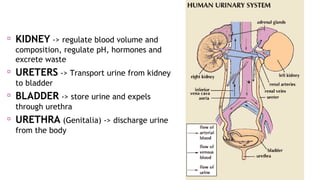
⦿ KIDNEY -> regulate blood volume and
composition, regulate pH, hormones and
excrete waste
⦿ URETERS -> Transport urine from kidney
to bladder
⦿ BLADDER -> store urine and expels
through urethra
⦿ URETHRA (Genitalia) -> discharge urine
from the body
EPIDEMIOLOGY
•Male > Female
•Most common injured: KIDNEY (seatbelt or steering wheel side impact
crashes)
•Rare : URETERAL (due to iatrogenic / penetrating gunshot)
•CLASSIFICATION: Blunt and Penetrating
•BLUNT :
1.Mostly BLADDER and posterior urethra (associated pelvic fracture)
2.Anterior urethra (fall-astride trauma)
Summerton et al, 2015 Guidelines on Urological Trauma EAU
INITIAL EVALUATION
•A-B-C-D-E
•Blunt : Bruise / hematome flank-urogenital area
•Penetrating : weapon in stabbing
•HEMATURIA (minor/gross)
RENAL
Jacobs, L.M., Luk, S.S., 2010. Advanced Trauma Operative
Management. 2nd ed. CineMed. Canada.
Summerton et al, 2015 Guidelines on Urological Trauma
EAU
Summerton et al, 2015 Guidelines on Urological Trauma
EAU
DIAGNOSTIC
1. Physical examination
2. Laboratory -> CBC, UL, RFT
3. Imaging -> Ultrasound, IVP, One-shot intraoperative, CT, MRI
`
Mc.Aninch JW; Surgery for Renal Trauma. in Novick AC. Stewart’s Operative Urology.
Baltimore. Williams&Wilkins Urology. 1989:234-9
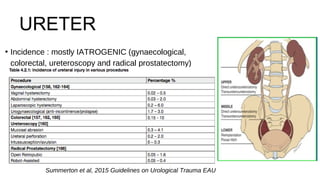
URETER
• Incidence : mostly IATROGENIC (gynaecological,
colorectal, ureteroscopy and radical prostatectomy)
Summerton et al, 2015 Guidelines on Urological Trauma EAU
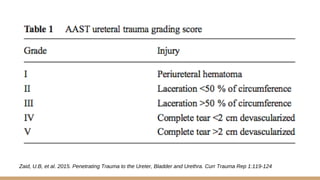
Zaid, U.B, et al. 2015. Penetrating Trauma to the Ureter, Bladder and Urethra. Curr Trauma Rep 1:119-124
Jacobs, L.M., Luk, S.S., 2010. Advanced Trauma Operative Management. 2nd ed. CineMed. Canada.
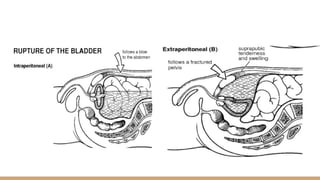
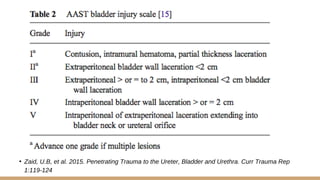
BLADDER
Classified :
1. Contusion
2. Rupture : Intraperitoneal (20%) and
Extraperitoneal (80%)
Mostly -> BLUNT trauma (85% occur pelvic
fractures)
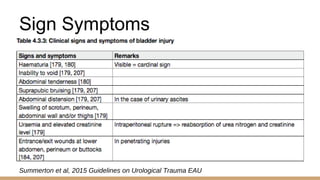
Sign Symptoms
Summerton et al, 2015 Guidelines on Urological Trauma EAU
• Zaid, U.B, et al. 2015. Penetrating Trauma to the Ureter, Bladder and Urethra. Curr Trauma Rep
1:119-124
Diagnostic : CYSTOGRAPHY
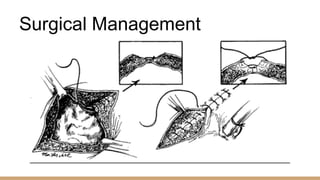
Surgical Management
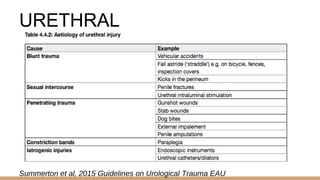
URETHRAL
Summerton et al, 2015 Guidelines on Urological Trauma EAU
• Zaid, U.B, et al. 2015. Penetrating Trauma to the Ureter, Bladder and Urethra. Curr Trauma Rep
1:119-124
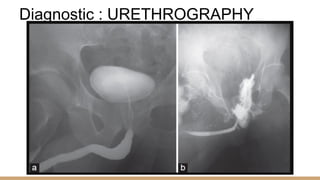
Diagnostic : URETHROGRAPHY
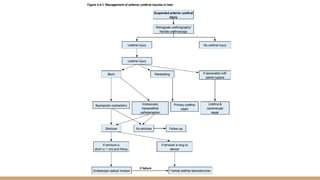
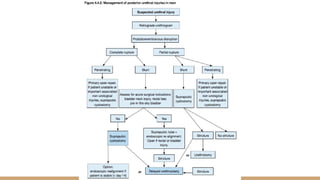
Management
1. PARTIAL TEAR -> careful passage of 12-14Fr. foley, if any
resistance : UROLOGY
2. COMPLETE TEAR : UROLOGY + Suprapubic cath
3. If Foley already there and suspect tear : LEAVE Foley in a
place
*Initial urethral repair is not recommended, because of risk hemorrhage,
impotence and risk of pelvic infection hematoma
REFFERENCE
• Jacobs, L.M., Luk, S.S., 2010. Advanced Trauma Operative Management. 2nd ed. CineMed. Canada.
• Mattox, et al. 2013. Trauma. 7th ed. Mc Graw Hill. New York.
• Mc.Aninch JW; Surgery for Renal Trauma. in Novick, A.C., Streem, S.B., Pontes, J.E.. Stewart’s Operative
Urology. Baltimore. Williams & Wilkins Urology. 1989:234-9
• Metro J.M., Mc Aninch, J.W., 2003. Surgical Exploration of the injured kidney: Current Indications and
Techniques. Int bras urol. vol.29 no.2 Rio de Janiero.
• Skandalakis L.J., 2014. Surgical Anatomy and Technique. 4th ed. Springer. New York
• Summerton et al, 2015 Guidelines on Urological Trauma EAU
• Williams, N.S., Bulstrode, C.J., 2008. Bailey & Love’s Short Practice of Surgery. 25th ed. Hodder Arnold.
Great Britain
• Zaid, U.B, et al. 2015. Penetrating Trauma to the Ureter, Bladder and Urethra. Curr Trauma Rep 1:119-124
• Zollinger, R.M., Ellison, E.C., 2011. Atlas of Surgical Operations. 9th ed. Mc Graw Hill. New York.
THANK YOU

Urogenital Trauma

  • 1.
    Anne Saputra by. GuidelinesUrological Trauma EAU 2015 UROGENITAL TRAUMA
  • 2.
    ⦿ KIDNEY ->regulate blood volume and composition, regulate pH, hormones and excrete waste ⦿ URETERS -> Transport urine from kidney to bladder ⦿ BLADDER -> store urine and expels through urethra ⦿ URETHRA (Genitalia) -> discharge urine from the body
  • 3.
    EPIDEMIOLOGY •Male > Female •Mostcommon injured: KIDNEY (seatbelt or steering wheel side impact crashes) •Rare : URETERAL (due to iatrogenic / penetrating gunshot) •CLASSIFICATION: Blunt and Penetrating •BLUNT : 1.Mostly BLADDER and posterior urethra (associated pelvic fracture) 2.Anterior urethra (fall-astride trauma) Summerton et al, 2015 Guidelines on Urological Trauma EAU
  • 4.
    INITIAL EVALUATION •A-B-C-D-E •Blunt :Bruise / hematome flank-urogenital area •Penetrating : weapon in stabbing •HEMATURIA (minor/gross)
  • 5.
    RENAL Jacobs, L.M., Luk,S.S., 2010. Advanced Trauma Operative Management. 2nd ed. CineMed. Canada.
  • 6.
    Summerton et al,2015 Guidelines on Urological Trauma EAU
  • 7.
    Summerton et al,2015 Guidelines on Urological Trauma EAU
  • 8.
    DIAGNOSTIC 1. Physical examination 2.Laboratory -> CBC, UL, RFT 3. Imaging -> Ultrasound, IVP, One-shot intraoperative, CT, MRI
  • 10.
    ` Mc.Aninch JW; Surgeryfor Renal Trauma. in Novick AC. Stewart’s Operative Urology. Baltimore. Williams&Wilkins Urology. 1989:234-9
  • 11.
    URETER • Incidence :mostly IATROGENIC (gynaecological, colorectal, ureteroscopy and radical prostatectomy) Summerton et al, 2015 Guidelines on Urological Trauma EAU
  • 14.
    Zaid, U.B, etal. 2015. Penetrating Trauma to the Ureter, Bladder and Urethra. Curr Trauma Rep 1:119-124
  • 15.
    Jacobs, L.M., Luk,S.S., 2010. Advanced Trauma Operative Management. 2nd ed. CineMed. Canada.
  • 16.
    BLADDER Classified : 1. Contusion 2.Rupture : Intraperitoneal (20%) and Extraperitoneal (80%) Mostly -> BLUNT trauma (85% occur pelvic fractures)
  • 18.
    Sign Symptoms Summerton etal, 2015 Guidelines on Urological Trauma EAU
  • 19.
    • Zaid, U.B,et al. 2015. Penetrating Trauma to the Ureter, Bladder and Urethra. Curr Trauma Rep 1:119-124
  • 20.
  • 21.
  • 22.
    URETHRAL Summerton et al,2015 Guidelines on Urological Trauma EAU
  • 24.
    • Zaid, U.B,et al. 2015. Penetrating Trauma to the Ureter, Bladder and Urethra. Curr Trauma Rep 1:119-124
  • 25.
  • 28.
    Management 1. PARTIAL TEAR-> careful passage of 12-14Fr. foley, if any resistance : UROLOGY 2. COMPLETE TEAR : UROLOGY + Suprapubic cath 3. If Foley already there and suspect tear : LEAVE Foley in a place *Initial urethral repair is not recommended, because of risk hemorrhage, impotence and risk of pelvic infection hematoma
  • 30.
    REFFERENCE • Jacobs, L.M.,Luk, S.S., 2010. Advanced Trauma Operative Management. 2nd ed. CineMed. Canada. • Mattox, et al. 2013. Trauma. 7th ed. Mc Graw Hill. New York. • Mc.Aninch JW; Surgery for Renal Trauma. in Novick, A.C., Streem, S.B., Pontes, J.E.. Stewart’s Operative Urology. Baltimore. Williams & Wilkins Urology. 1989:234-9 • Metro J.M., Mc Aninch, J.W., 2003. Surgical Exploration of the injured kidney: Current Indications and Techniques. Int bras urol. vol.29 no.2 Rio de Janiero. • Skandalakis L.J., 2014. Surgical Anatomy and Technique. 4th ed. Springer. New York • Summerton et al, 2015 Guidelines on Urological Trauma EAU • Williams, N.S., Bulstrode, C.J., 2008. Bailey & Love’s Short Practice of Surgery. 25th ed. Hodder Arnold. Great Britain • Zaid, U.B, et al. 2015. Penetrating Trauma to the Ureter, Bladder and Urethra. Curr Trauma Rep 1:119-124 • Zollinger, R.M., Ellison, E.C., 2011. Atlas of Surgical Operations. 9th ed. Mc Graw Hill. New York.
  • 31.

Editor's Notes

  • #4 From epidemiology, genitourinary trauma is significant source of death and morbidity which the ratio male > female Most common injured organ: Kidney and ureteral are less common injured From the classification, there is blunt and penetrating trauma. which penetrating trauma, typically need surgical explorations.
  • #6 Renal injury grading based on AAST 2010, there is 5 grade from mild to severe grading Contussion, non expanding sub capsular hematome Cortical laceration less 1cm deep Cortical laceration more 1cm, WITHOUT urine extravacasion Laseration on corticomedular Shatered kidney (pedicle avulsion)
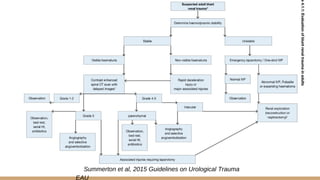
  • #7 This is flowchart of blunt renal trauma from EAU Guidelines 2015
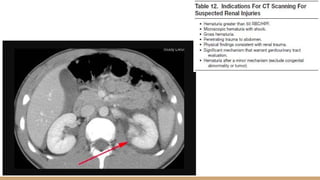
  • #10 This is CT Scan Abdominal, the red arrow showed pedicle shattered of the left renal
  • #11 Surgical management: Rhenorrhapy, to closure of pelvic vein ligation
  • #12 Anatomical Ureter divided by: Upper (Proximal): At Lumbosacral border Middle : parallel to the Sacral bone Lower (Distal): High psoas muscle
  • #21 Intraperitoneal: Contrast enters the intraperitoneal cavity and outlines loops of bowel Extrapritoneal: Contrast extravasates from the bladder into the premedical space