MALDI-TOF
JAYA PRAKASH. S
INTRODUCTION
 Matrix-assisted laser desorption/ionization
(MALDI) is a soft ionization technique used in
mass spectroscopy, allowing the analysis of
biomolecules (such as DNA, Proteins, peptide and
sugars) and organic molecules (such as polymers,
dendrimers and other macromolecules).
 Method where a laser is used to generate ions of
samples, such as proteins and polymers.
PARTS OF MALDI TOF
1. Sample plate
2. Matrix
3. Laser
4. Variable voltage grid
5. Vacuum system
6. Flight tube
7. Time mass detectors
MATRIX
• The analyte incorporated into
a suitable matrix is the first step of the
MALDI process, and is an important
feature of the MALDI method.
• A typical sample preparation
involves using 10-6 M solution of the
analyte mixed with 0.1 M
solution of the matrix
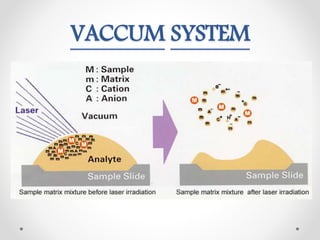
• The solvents are then evaporated
in a vacuum of the MS,
and the matrix crystallizes
with the analyte incorporated
LASER
• Most MALDI devices use a pulsed UV laser at 337
nm.
• Neodymium-yttrium aluminum garnet
(Nd:YAG) Emits at 355 nm.
• IR lasers are also used. The most common IR laser is
the erbium doped-yttrium aluminum garnet
(Er:YAG).
Emits at 2.94 micrometer. It is “softer” than the
UV, which is useful for certain biomolecules.
VACCUM SYSTEM
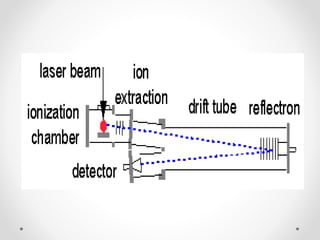
TIME MASS DETECTOR
The typical detector used with MALDI is the time of
flight mass detector.
• TOF is a method where the ions are accelerated by an
electric field, resulting in ions of the same strength to
have the same kinetic energy.
• The time it takes for each ion to traverse the flight
tube and arrive at the detector is based on its mass-to-
charge ratio; therefore the heavier ions have shorter
arrival times compared to lighter ions.
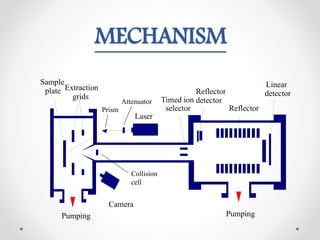
Camera
Laser
Sample
plate
Pumping Pumping
Timed ion
selector Reflector
Linear
detector
Extraction
grids
Reflector
detectorAttenuator
Prism
Collision
cell
MECHANISM
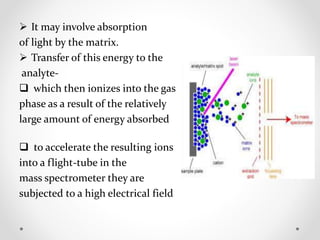
 It may involve absorption
of light by the matrix.
 Transfer of this energy to the
analyte-
 which then ionizes into the gas
phase as a result of the relatively
large amount of energy absorbed
 to accelerate the resulting ions
into a flight-tube in the
mass spectrometer they are
subjected to a high electrical field
APPLICATIONS
 Soft ionization - analyze intact biomolecules and
synthetic polymers
 Broad mass range - analyze a wide variety of
biomolecules
 Relatively tolerant of buffers and salts
 Fast data acquisition
 Easy to use and maintain, no water or gas hook
ups required
 High sensitivity, superior mass resolution and
accuracy
Maldi tof

Maldi tof

  • 1.
  • 2.
    INTRODUCTION  Matrix-assisted laserdesorption/ionization (MALDI) is a soft ionization technique used in mass spectroscopy, allowing the analysis of biomolecules (such as DNA, Proteins, peptide and sugars) and organic molecules (such as polymers, dendrimers and other macromolecules).  Method where a laser is used to generate ions of samples, such as proteins and polymers.
  • 3.
    PARTS OF MALDITOF 1. Sample plate 2. Matrix 3. Laser 4. Variable voltage grid 5. Vacuum system 6. Flight tube 7. Time mass detectors
  • 4.
    MATRIX • The analyteincorporated into a suitable matrix is the first step of the MALDI process, and is an important feature of the MALDI method. • A typical sample preparation involves using 10-6 M solution of the analyte mixed with 0.1 M solution of the matrix • The solvents are then evaporated in a vacuum of the MS, and the matrix crystallizes with the analyte incorporated
  • 5.
    LASER • Most MALDIdevices use a pulsed UV laser at 337 nm. • Neodymium-yttrium aluminum garnet (Nd:YAG) Emits at 355 nm. • IR lasers are also used. The most common IR laser is the erbium doped-yttrium aluminum garnet (Er:YAG). Emits at 2.94 micrometer. It is “softer” than the UV, which is useful for certain biomolecules.
  • 6.
  • 7.
    TIME MASS DETECTOR Thetypical detector used with MALDI is the time of flight mass detector. • TOF is a method where the ions are accelerated by an electric field, resulting in ions of the same strength to have the same kinetic energy. • The time it takes for each ion to traverse the flight tube and arrive at the detector is based on its mass-to- charge ratio; therefore the heavier ions have shorter arrival times compared to lighter ions.
  • 9.
    Camera Laser Sample plate Pumping Pumping Timed ion selectorReflector Linear detector Extraction grids Reflector detectorAttenuator Prism Collision cell MECHANISM
  • 10.
     It mayinvolve absorption of light by the matrix.  Transfer of this energy to the analyte-  which then ionizes into the gas phase as a result of the relatively large amount of energy absorbed  to accelerate the resulting ions into a flight-tube in the mass spectrometer they are subjected to a high electrical field
  • 11.
    APPLICATIONS  Soft ionization- analyze intact biomolecules and synthetic polymers  Broad mass range - analyze a wide variety of biomolecules  Relatively tolerant of buffers and salts  Fast data acquisition  Easy to use and maintain, no water or gas hook ups required  High sensitivity, superior mass resolution and accuracy