CARBOHYDRATES 
HIMA HARIDASAN
INTRODUCTION 
 Most abundant biomolecule on earth 
 Def : polyhydroxy aldehydes or ketones 
 G.F. : (CH2O) n 
Composition : C: H :O – 1:2:1
FUNCTIONS 
 Organic matter 
 Energy stores, fuels, & metabolic intermediates 
 Ribose & deoxyribose 
 Structural components 
 Glycolipids &glycoproteins 
 Industries 
 Excess Fat 
 Can’t be further hydrolysed
CLASSIFICATION 
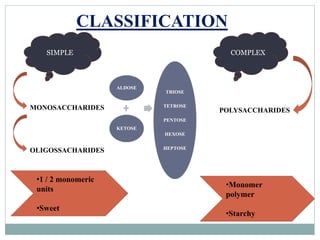
SIMPLE COMPLEX 
MONOSACCHARIDES 
OLIGOSSACHARIDES 
POLYSACCHARIDES 
ALDOSE 
KETOSE 
TRIOSE 
TETROSE 
PENTOSE 
HEXOSE 
HEPTOSE 
•1 / 2 monomeric 
units 
•Sweet 
•Monomer 
polymer 
•Starchy
MONOSACCHARIDES 
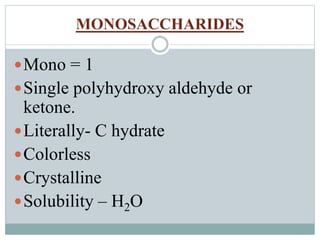
Mono = 1 
Single polyhydroxy aldehyde or 
ketone. 
Literally- C hydrate 
Colorless 
Crystalline 
Solubility – H2O
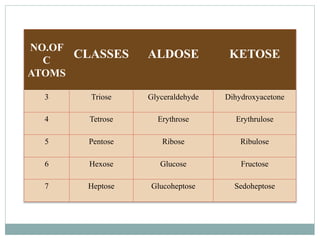
NO.OF 
C 
ATOMS 
CLASSES ALDOSE KETOSE 
3 Triose Glyceraldehyde Dihydroxyacetone 
4 Tetrose Erythrose Erythrulose 
5 Pentose Ribose Ribulose 
6 Hexose Glucose Fructose 
7 Heptose Glucoheptose Sedoheptose
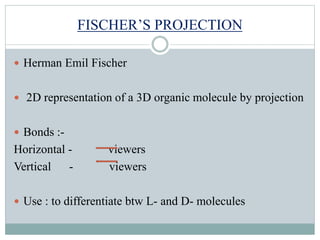
FISCHER’S PROJECTION 
 Herman Emil Fischer 
 2D representation of a 3D organic molecule by projection 
 Bonds :- 
Horizontal - viewers 
Vertical - viewers 
 Use : to differentiate btw L- and D- molecules
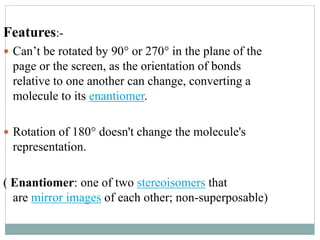
Features:- 
 Can’t be rotated by 90° or 270° in the plane of the 
page or the screen, as the orientation of bonds 
relative to one another can change, converting a 
molecule to its enantiomer. 
 Rotation of 180° doesn't change the molecule's 
representation. 
( Enantiomer: one of two stereoisomers that 
are mirror images of each other; non-superposable)
HAWORTH PROJECTION 
 Syn: Norman projection; pyranose projection 
 Sir Norman Haworth 
 In aqs soln. 
 Cyclic/ring structure of monosaccharide 
 3D
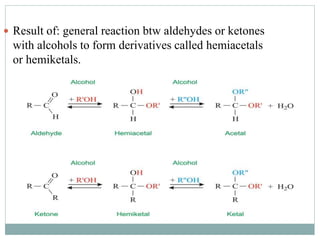
 Result of: general reaction btw aldehydes or ketones 
with alcohols to form derivatives called hemiacetals 
or hemiketals.
Characteristics:_ 
 C - implicit type; C1- anomeric carbon. 
 H - implicit 
 Thicker/Thinner line indicates atoms that are closer/far 
to the observer. 
 The groups below the plane of the ring in Haworth 
projections = groups on the right-hand side of a Fischer 
projection.
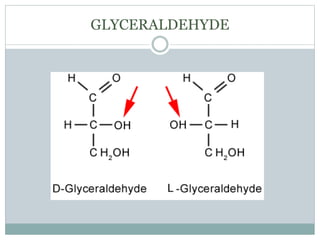
GLYCERALDEHYDE
FISCHER’S 
PROJECTION 
HAWORTH 
PROJECTION 
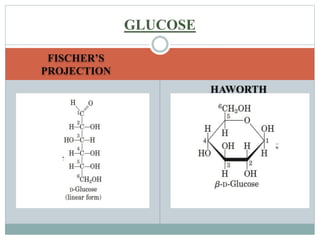
GLUCOSE
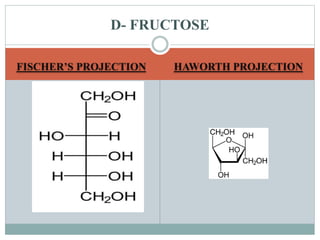
D- FRUCTOSE 
FISCHER’S PROJECTION HAWORTH PROJECTION
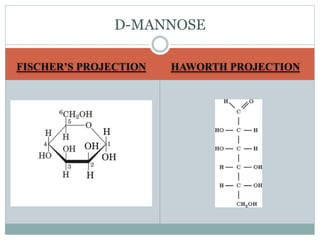
D-MANNOSE 
FISCHER’S PROJECTION HAWORTH PROJECTION
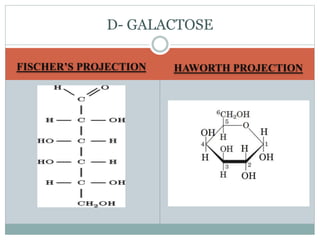
D- GALACTOSE 
FISCHER’S PROJECTION HAWORTH PROJECTION
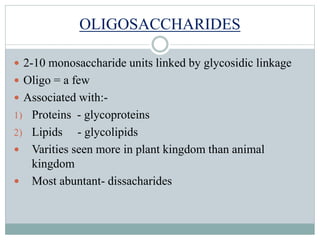
OLIGOSACCHARIDES 
 2-10 monosaccharide units linked by glycosidic linkage 
 Oligo = a few 
 Associated with:- 
1) Proteins - glycoproteins 
2) Lipids - glycolipids 
 Varities seen more in plant kingdom than animal 
kingdom 
 Most abuntant- dissacharides
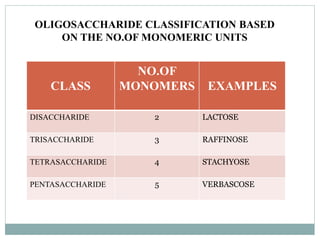
OLIGOSACCHARIDE CLASSIFICATION BASED 
ON THE NO.OF MONOMERIC UNITS 
CLASS 
NO.OF 
MONOMERS EXAMPLES 
DISACCHARIDE 2 LACTOSE 
TRISACCHARIDE 3 RAFFINOSE 
TETRASACCHARIDE 4 STACHYOSE 
PENTASACCHARIDE 5 VERBASCOSE
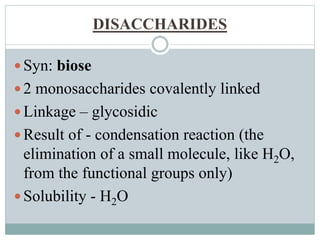
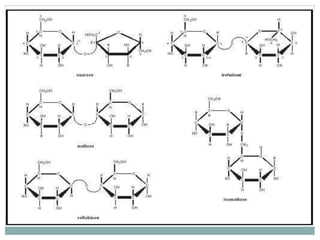
DISACCHARIDES 
Syn: biose 
 2 monosaccharides covalently linked 
 Linkage – glycosidic 
 Result of - condensation reaction (the 
elimination of a small molecule, like H2O, 
from the functional groups only) 
 Solubility - H2O
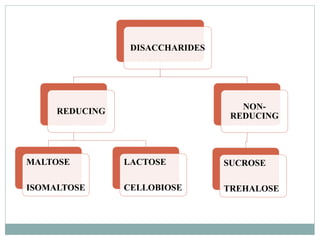
DISACCHARIDES 
REDUCING 
MALTOSE 
ISOMALTOSE 
LACTOSE 
CELLOBIOSE 
NON-REDUCING 
SUCROSE 
TREHALOSE
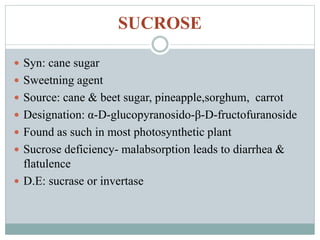
SUCROSE 
 Syn: cane sugar 
 Sweetning agent 
 Source: cane & beet sugar, pineapple,sorghum, carrot 
 Designation: α-D-glucopyranosido-β-D-fructofuranoside 
 Found as such in most photosynthetic plant 
 Sucrose deficiency- malabsorption leads to diarrhea & 
flatulence 
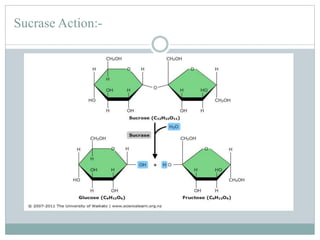
 D.E: sucrase or invertase
Sucrase Action:-
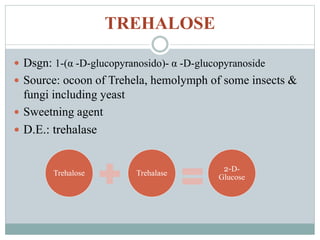
TREHALOSE 
 Dsgn: 1-(α -D-glucopyranosido)- α -D-glucopyranoside 
 Source: ocoon of Trehela, hemolymph of some insects & 
fungi including yeast 
 Sweetning agent 
 D.E.: trehalase 
Trehalose Trehalase 
2-D-Glucose
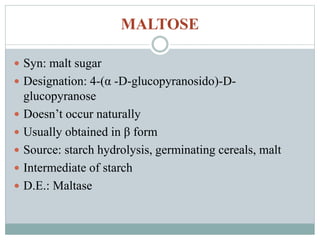
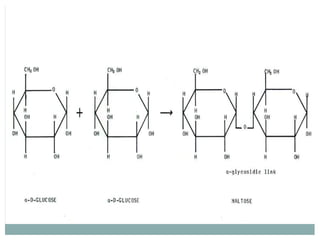
MALTOSE 
 Syn: malt sugar 
 Designation: 4-(α -D-glucopyranosido)-D-glucopyranose 
 Doesn’t occur naturally 
 Usually obtained in β form 
 Source: starch hydrolysis, germinating cereals, malt 
 Intermediate of starch 
 D.E.: Maltase
LACTOSE 
Syn: milk sugar 
 Reducing 
 Designation: 4-(β -D-galactopyranosido)- 
D-glucopyranose 
Usually obtained in β form 
 Constitute 5% in milk 
 Exclusive cbh source for breast fed infants
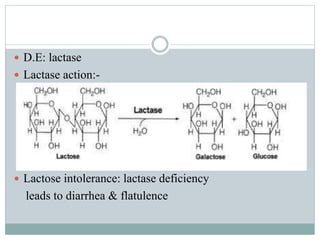
 D.E: lactase 
 Lactase action:- 
 Lactose intolerance: lactase deficiency 
leads to diarrhea & flatulence
CELLOBIOSE 
 Formed on cellulose degradation 
 On hydrolysis gives β -D-glucose 
 Dsgn: 4-(β -D-glucopyranosido)-D-glucopyranose 
 Source: enzymatic or acidic hydrolysis of cellulose and 
cellulose rich materials such as cotton, jute, or paper. 
ISOMALTOSE 
 Dsgn: 6-(α -D-glucopyranosido)-D-glucopyranose 
 Produced when high maltose syrup is treated with the 
enzyme transglucosidase
POLYSACCHARIDE 
 Poly = many 
 >10 monosaccharide units 
 Syn: glycans 
 Classification – different ways on the basis of:- 
1. Structure : linear & branched 
2. Homogenity btw monomers: homo & hetero 
3. Function: muco, storage & structural 
 Linear polysaccharides: line/ chain. Eg- cellulose. 
 Branched polysaccharides: linear chains with units arising 
from different C atoms, branched. Eg- starch, glycogen.
 Storage polysaccharides:- 
1. acts as reserve food 
2. Hydrolysed to sugars required for respiration & 
biosynthesis 
3. Eg- starch, glycogen, inulin. 
4. Syn: nutrient polysaccharides 
 Structural polysaccharides:- 
1. Fibrous 
2. Cell walls of plants, fungi, & exoskeleton of arthropods
Mucopolysaccharides 
1. Syn: GAG 
2. Heteroglycans 
3. Slime & mucilage producing. 
4. Composition- repeating units of sugar derivatives 
namely, amino sugars & uronic acids. 
5. General groups present- acetylated amino groups, 
sulphate & carbonyl groups 
6. Acid mucopolysaccharides - Sulphate & carbonyl 
groups contributes to acidity 
7. Eg- heparin, hyalouronic acid
 Homopolysaccharide 
1. Homoglycans 
2. Eg- Starch, glycogen,cellulose,chitin,xylan 
 Heteropolysaccharide 
1. Heteroglycans 
2. Monomers- non-identical 
3. Complex 
4. Eg: hyaluronic acids, heparin, agar, chondroitin 
sulphate, keratan sulphate, dermatan sulphate, gum 
arabic, pectin & so more.
STARCH 
 Syn: amylum 
 Widely distributed in plant kingdom 
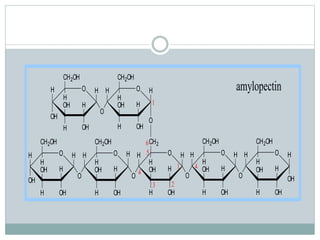
 Components- amylose & amylopectin 
 D.E.:- 
1. Amylase - maltose, glucose; Site of action- α(1 4) glycosidic bonds 
2. Sucrase – G & F; α(1 4) glycosidic bonds 
3. Α-glucosidase- removes 1 unit at a time from oligosaccharide 
4. Α-dextrinase – debranching enzyme; α (1 4) & α(1 6) .
FEATURE AMYLOSE AMYLOPECTIN 
Content in starch 15% - 20% 80% - 85% 
Branching Absent Present [α(1,6) g.l. at brancing 
points] 
Linkage α-1,4 α-1,4 ; α-1,6 
No.of G units 200-1000 20-30 
Water solubility Present Absent 
Color reaction with 
iodine gives 
Blue Reddish-violet
CH2OH 
CH2OH 
H 
OH 
H O 
OH 
H 
H 
OH 
H OH 
CH2 
CH2OH 
H 
OH 
H H O H 
H O 
H 
CH2OH 
H 
OH 
H OH 
O 
O 
H 
H 
OH 
H OH 
CH2OH 
CH2OH 
H H O 
H O H 
H 
H 
OH 
H OH 
OH 
O 
H 
H 
OH 
H OH 
O 
H 
O 
1 4 
6 
H O 
H 
H OH 
H H O 
H 
H OH 
H 
O 
1 
OH 
3 
4 
5 
2 
amylopectin
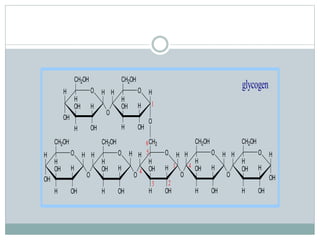
GLYCOGEN 
 Animal starch 
 Stored in liver & muscles 
 Source- plants that lack chlorophyll, yeast, fungi, etc. 
 D.E. : glycogen phosphorylaseand amylase 
 Monomers- α & β G units; (1,4)g.l. 
 Glycogenolysis 
 With I2 – red 
 Branching occurs after 12 G units
CH2OH 
CH2OH 
H 
OH 
H O 
OH 
H 
H 
OH 
H OH 
CH2 
CH2OH 
H 
OH 
H H O H 
H O 
H 
CH2OH 
H 
OH 
H OH 
O 
O 
H 
H 
OH 
H OH 
CH2OH 
CH2OH 
H O H 
H H O 
H 
H 
OH 
H OH 
OH 
O 
H 
H 
OH 
H OH 
O 
H 
O 
1 4 
6 
H O 
H 
H OH 
H H O 
H 
H OH 
H 
O 
1 
OH 
3 
4 
5 
2 
glycogen
Carbohydrates

Carbohydrates

  • 1.
  • 2.
    INTRODUCTION  Mostabundant biomolecule on earth  Def : polyhydroxy aldehydes or ketones  G.F. : (CH2O) n Composition : C: H :O – 1:2:1
  • 3.
    FUNCTIONS  Organicmatter  Energy stores, fuels, & metabolic intermediates  Ribose & deoxyribose  Structural components  Glycolipids &glycoproteins  Industries  Excess Fat  Can’t be further hydrolysed
  • 4.
    CLASSIFICATION SIMPLE COMPLEX MONOSACCHARIDES OLIGOSSACHARIDES POLYSACCHARIDES ALDOSE KETOSE TRIOSE TETROSE PENTOSE HEXOSE HEPTOSE •1 / 2 monomeric units •Sweet •Monomer polymer •Starchy
  • 5.
    MONOSACCHARIDES Mono =1 Single polyhydroxy aldehyde or ketone. Literally- C hydrate Colorless Crystalline Solubility – H2O
  • 6.
    NO.OF C ATOMS CLASSES ALDOSE KETOSE 3 Triose Glyceraldehyde Dihydroxyacetone 4 Tetrose Erythrose Erythrulose 5 Pentose Ribose Ribulose 6 Hexose Glucose Fructose 7 Heptose Glucoheptose Sedoheptose
  • 7.
    FISCHER’S PROJECTION Herman Emil Fischer  2D representation of a 3D organic molecule by projection  Bonds :- Horizontal - viewers Vertical - viewers  Use : to differentiate btw L- and D- molecules
  • 8.
    Features:-  Can’tbe rotated by 90° or 270° in the plane of the page or the screen, as the orientation of bonds relative to one another can change, converting a molecule to its enantiomer.  Rotation of 180° doesn't change the molecule's representation. ( Enantiomer: one of two stereoisomers that are mirror images of each other; non-superposable)
  • 9.
    HAWORTH PROJECTION Syn: Norman projection; pyranose projection  Sir Norman Haworth  In aqs soln.  Cyclic/ring structure of monosaccharide  3D
  • 10.
     Result of:general reaction btw aldehydes or ketones with alcohols to form derivatives called hemiacetals or hemiketals.
  • 11.
    Characteristics:_  C- implicit type; C1- anomeric carbon.  H - implicit  Thicker/Thinner line indicates atoms that are closer/far to the observer.  The groups below the plane of the ring in Haworth projections = groups on the right-hand side of a Fischer projection.
  • 12.
  • 13.
    FISCHER’S PROJECTION HAWORTH PROJECTION GLUCOSE
  • 14.
    D- FRUCTOSE FISCHER’SPROJECTION HAWORTH PROJECTION
  • 15.
  • 16.
    D- GALACTOSE FISCHER’SPROJECTION HAWORTH PROJECTION
  • 17.
    OLIGOSACCHARIDES  2-10monosaccharide units linked by glycosidic linkage  Oligo = a few  Associated with:- 1) Proteins - glycoproteins 2) Lipids - glycolipids  Varities seen more in plant kingdom than animal kingdom  Most abuntant- dissacharides
  • 18.
    OLIGOSACCHARIDE CLASSIFICATION BASED ON THE NO.OF MONOMERIC UNITS CLASS NO.OF MONOMERS EXAMPLES DISACCHARIDE 2 LACTOSE TRISACCHARIDE 3 RAFFINOSE TETRASACCHARIDE 4 STACHYOSE PENTASACCHARIDE 5 VERBASCOSE
  • 19.
    DISACCHARIDES Syn: biose  2 monosaccharides covalently linked  Linkage – glycosidic  Result of - condensation reaction (the elimination of a small molecule, like H2O, from the functional groups only)  Solubility - H2O
  • 20.
    DISACCHARIDES REDUCING MALTOSE ISOMALTOSE LACTOSE CELLOBIOSE NON-REDUCING SUCROSE TREHALOSE
  • 21.
    SUCROSE  Syn:cane sugar  Sweetning agent  Source: cane & beet sugar, pineapple,sorghum, carrot  Designation: α-D-glucopyranosido-β-D-fructofuranoside  Found as such in most photosynthetic plant  Sucrose deficiency- malabsorption leads to diarrhea & flatulence  D.E: sucrase or invertase
  • 22.
  • 23.
    TREHALOSE  Dsgn:1-(α -D-glucopyranosido)- α -D-glucopyranoside  Source: ocoon of Trehela, hemolymph of some insects & fungi including yeast  Sweetning agent  D.E.: trehalase Trehalose Trehalase 2-D-Glucose
  • 24.
    MALTOSE  Syn:malt sugar  Designation: 4-(α -D-glucopyranosido)-D-glucopyranose  Doesn’t occur naturally  Usually obtained in β form  Source: starch hydrolysis, germinating cereals, malt  Intermediate of starch  D.E.: Maltase
  • 26.
    LACTOSE Syn: milksugar  Reducing  Designation: 4-(β -D-galactopyranosido)- D-glucopyranose Usually obtained in β form  Constitute 5% in milk  Exclusive cbh source for breast fed infants
  • 27.
     D.E: lactase  Lactase action:-  Lactose intolerance: lactase deficiency leads to diarrhea & flatulence
  • 28.
    CELLOBIOSE  Formedon cellulose degradation  On hydrolysis gives β -D-glucose  Dsgn: 4-(β -D-glucopyranosido)-D-glucopyranose  Source: enzymatic or acidic hydrolysis of cellulose and cellulose rich materials such as cotton, jute, or paper. ISOMALTOSE  Dsgn: 6-(α -D-glucopyranosido)-D-glucopyranose  Produced when high maltose syrup is treated with the enzyme transglucosidase
  • 30.
    POLYSACCHARIDE  Poly= many  >10 monosaccharide units  Syn: glycans  Classification – different ways on the basis of:- 1. Structure : linear & branched 2. Homogenity btw monomers: homo & hetero 3. Function: muco, storage & structural  Linear polysaccharides: line/ chain. Eg- cellulose.  Branched polysaccharides: linear chains with units arising from different C atoms, branched. Eg- starch, glycogen.
  • 31.
     Storage polysaccharides:- 1. acts as reserve food 2. Hydrolysed to sugars required for respiration & biosynthesis 3. Eg- starch, glycogen, inulin. 4. Syn: nutrient polysaccharides  Structural polysaccharides:- 1. Fibrous 2. Cell walls of plants, fungi, & exoskeleton of arthropods
  • 32.
    Mucopolysaccharides 1. Syn:GAG 2. Heteroglycans 3. Slime & mucilage producing. 4. Composition- repeating units of sugar derivatives namely, amino sugars & uronic acids. 5. General groups present- acetylated amino groups, sulphate & carbonyl groups 6. Acid mucopolysaccharides - Sulphate & carbonyl groups contributes to acidity 7. Eg- heparin, hyalouronic acid
  • 33.
     Homopolysaccharide 1.Homoglycans 2. Eg- Starch, glycogen,cellulose,chitin,xylan  Heteropolysaccharide 1. Heteroglycans 2. Monomers- non-identical 3. Complex 4. Eg: hyaluronic acids, heparin, agar, chondroitin sulphate, keratan sulphate, dermatan sulphate, gum arabic, pectin & so more.
  • 34.
    STARCH  Syn:amylum  Widely distributed in plant kingdom  Components- amylose & amylopectin  D.E.:- 1. Amylase - maltose, glucose; Site of action- α(1 4) glycosidic bonds 2. Sucrase – G & F; α(1 4) glycosidic bonds 3. Α-glucosidase- removes 1 unit at a time from oligosaccharide 4. Α-dextrinase – debranching enzyme; α (1 4) & α(1 6) .
  • 35.
    FEATURE AMYLOSE AMYLOPECTIN Content in starch 15% - 20% 80% - 85% Branching Absent Present [α(1,6) g.l. at brancing points] Linkage α-1,4 α-1,4 ; α-1,6 No.of G units 200-1000 20-30 Water solubility Present Absent Color reaction with iodine gives Blue Reddish-violet
  • 36.
    CH2OH CH2OH H OH H O OH H H OH H OH CH2 CH2OH H OH H H O H H O H CH2OH H OH H OH O O H H OH H OH CH2OH CH2OH H H O H O H H H OH H OH OH O H H OH H OH O H O 1 4 6 H O H H OH H H O H H OH H O 1 OH 3 4 5 2 amylopectin
  • 37.
    GLYCOGEN  Animalstarch  Stored in liver & muscles  Source- plants that lack chlorophyll, yeast, fungi, etc.  D.E. : glycogen phosphorylaseand amylase  Monomers- α & β G units; (1,4)g.l.  Glycogenolysis  With I2 – red  Branching occurs after 12 G units
  • 38.
    CH2OH CH2OH H OH H O OH H H OH H OH CH2 CH2OH H OH H H O H H O H CH2OH H OH H OH O O H H OH H OH CH2OH CH2OH H O H H H O H H OH H OH OH O H H OH H OH O H O 1 4 6 H O H H OH H H O H H OH H O 1 OH 3 4 5 2 glycogen