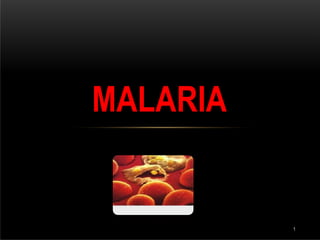
MALARIA
1
HISTORY AND FUTURE RESEARCH
DR.T.V.RAO MD 2
• One of the oldest known diseases.
• King Tut died of malaria.
• Malaria has been infecting humans for over 50,000 years.
• References to malaria have been recorded for nearly 6000 years, starting
in China.
• Used to be common in Europe and North America.
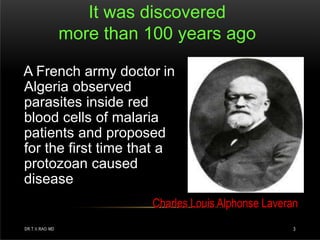
• First advances in malaria were made in 1880 by a French army doctor
named Charles Laveran.
• He looked into infected red blood cells and discovered the parasite was a
protist. This was the first time a protist was discovered to cause a disease.
• Carlos Finlay discovered that mosquitoes transmitted
diseases.
It was discovered
more than 100 years ago
A French army doctor in
Algeria observed
parasites inside red
blood cells of malaria
patients and proposed
for the first time that a
protozoan caused
disease
Charles Louis Alphonse Laveran
DR.T.V.RAO MD 3
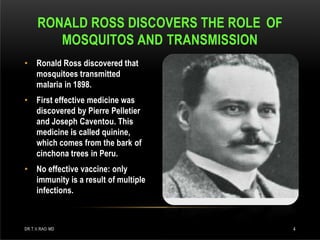
• Ronald Ross discovered that
mosquitoes transmitted
malaria in 1898.
• First effective medicine was
discovered by Pierre Pelletier
and Joseph Caventou. This
medicine is called quinine,
which comes from the bark of
cinchona trees in Peru.
• No effective vaccine: only
immunity is a result of multiple
infections.
RONALD ROSS DISCOVERS THE ROLE OF
MOSQUITOS AND TRANSMISSION
DR.T.V.RAO MD 4
MALARIA
DR.T.V.RAO MD 5
• 40% of the world’s population lives in
endemic areas (present in a community t
all time but in relatively low frequency.)
• 1-2million deaths (90%Africa)
• increasing problem (re-emerging disease)
• drug resistance ( mortality)
• causative agent =
Plasmodium species
• protozoan parasite
• member of Apicomplexa
• 4 species infecting humans
• transmitted by anopholine mosquitoes
•P. falciparum
•P. vivax
•P. malariae
•P. ovale
WHAT IS MALARIA?
DR.T.V.RAO MD 7
• Malaria is a parasite that enters the blood.
• This parasite is a protozoan called plasmodium.
• 3 to 700 million people get malaria each year,
but only kills 1 to 2 million
• 40% of the worlds population lives in malaria
zones
• Malaria zones are: Africa, India, Middle East,
Southeast Asia, Central and South America,
Eastern Europe, and the South Pacific
WHAT DETERMINES THE SPREAD OF
MALARIA?
?
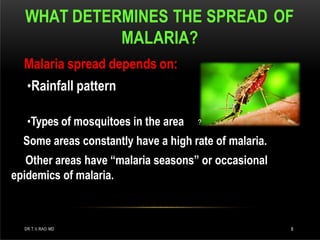
Malaria spread depends on:
•Rainfall pattern
•Types of mosquitoes in the area
Some areas constantly have a high rate of malaria.
Other areas have “malaria seasons” or occasional
epidemics of malaria.
DR.T.V.RAO MD 8
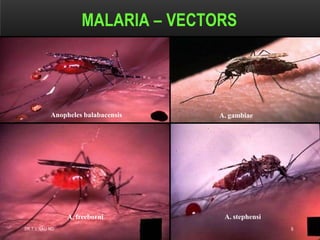
MALARIA – VECTORS
Anopheles balabacensis
DR.T.V.RAO MD 9
A. freeborni
A. gambiae
A. stephensi
CHARACTERISTIC OF LIFE CYCLE
DR.T.V.RAO MD 10
• Intermediate host : human
• Final host : mosquito
• Infective stage : sporozoite
• Infective way : mosquito bite skin of human
• Parasitic position : liver and red blood cells
• Transmitted stage : gametocytes
• Schizogonic cycle in red cells : 48 hrs/P.v
• Sporozoite : tachysporozite and bradysporozite
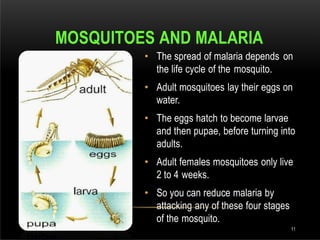
MOSQUITOES AND MALARIA
• The spread of malaria depends on
the life cycle of the mosquito.
• Adult mosquitoes lay their eggs on
water.
• The eggs hatch to become larvae
and then pupae, before turning into
adults.
• Adult females mosquitoes only live
2 to 4 weeks.
• So you can reduce malaria by
attacking any of these four stages
of the mosquito.
DR.T.V.RAO MD 11
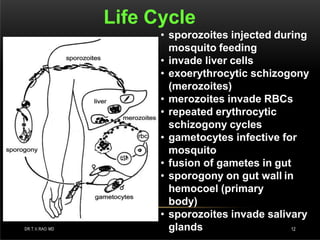
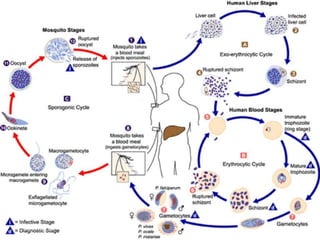
Life Cycle
• sporozoites injected during
mosquito feeding
• invade liver cells
• exoerythrocytic schizogony
(merozoites)
• merozoites invade RBCs
• repeated erythrocytic
schizogony cycles
• gametocytes infective for
mosquito
• fusion of gametes in gut
• sporogony on gut wall in
hemocoel (primary
body)
• sporozoites invade salivary
glands
DR.T.V.RAO MD 12
DR.T.V.RAO MD 13
INCUBATION PERIOD
DR.T.V.RAO MD 14
Following the infective bite by the Anopheles
mosquito a period of time (the "incubation
period") goes by before the first symptoms
appear.
The incubation period in most cases varies
from 7 to 30 days.
The shorter periods are observed most
frequently
with P.falciparum and the longer ones with P.
malariae.
Clinical Features
DR.T.V.RAO MD 15
• characterized by acute febrile attacks (malaria
paroxysms)
• periodic episodes of fever alternating with symptom-free
periods
• manifestations and severity depend on species and host
status
• immunity, general health, nutritional state, genetics
• recrudescences and relapses can occur over months or
years
• can develop severe complications (especially P.
falciparum)
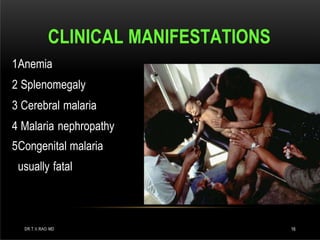
CLINICAL MANIFESTATIONS
1Anemia
2 Splenomegaly
3 Cerebral malaria
4 Malaria nephropathy
5Congenital malaria
usually fatal
DR.T.V.RAO MD 16
WHAT ARE THE SIGNS AND SYMPTOMS OF MALARIA?
DR.T.V.RAO MD 17
Symptoms of malaria include fever and flu-like
illness, including shaking chills, headache,
muscle aches, and tiredness. Nausea, vomiting,
and diarrhea may also occur. Malaria may
cause anemia and jaundice (yellow coloring of
the skin and eyes) because of the loss of red
blood cells.
Infection with one type of malaria,
Plasmodium falciparum, if not promptly
treated, may cause kidney failure, seizures,
mental confusion, coma, and death.
UNCOMPLICATED MALARIA
DR.T.V.RAO MD 18
The classical (but rarely observed) malaria
attack lasts 6-10 hours.
It consists of a cold stage (sensation of cold,
shivering) ; a hot stage (fever, headaches,
vomiting; seizures in young children) and
finally a sweating stage (sweats, return to
normal temperature, tiredness)
IS IT FALCIPARUM?
DR.T.V.RAO MD 19
• WHAT DOES THE SMEAR SHOW?
• >3% PARASITEMIA
• MONOTONOUS SMALL RINGS
• NO TROPHOZOITES OR SCHIZONTS
• BANANA SHAPED GAMETOCYTES
• MULTIPLY INFECTED CELLS
• CELLS OF ALL SIZES INFECTED
•MALIGNANT MALARIA
Malaria caused by P.falciparum. is more severe than
that caused by other plasmodia.
----The serious complication of P.falciparum. involves
cerebral malaria (involving the brain); massive
haemoglobinuria (blackwater fever) in which the urine
becomes dark in color, because of acute hemolysis of
RBC; acute respiratory distress syndrome; severe
gastrointestinal symptoms; shock and renal failure
which may cause death.
DR.T.V.RAO MD 20
LABORATORY DIAGNOSIS
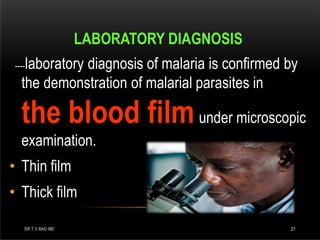
----laboratory diagnosis of malaria is confirmed by
the demonstration of malarial parasites in
the blood filmunder microscopic
examination.
• Thin film
• Thick film
DR.T.V.RAO MD 21
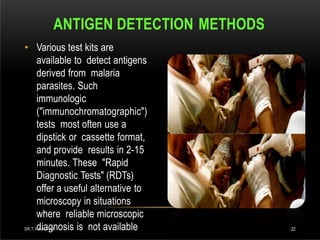
• Various test kits are
available to detect antigens
derived from malaria
parasites. Such
immunologic
("immunochromatographic")
tests most often use a
dipstick or cassette format,
and provide results in 2-15
minutes. These "Rapid
Diagnostic Tests" (RDTs)
offer a useful alternative to
microscopy in situations
where reliable microscopic
diagnosis is not available
ANTIGEN DETECTION METHODS
DR.T.V.RAO MD 22
• Serology detects antibodies
against malaria parasites,
using either indirect
immunofluorescence (IFA)
or enzyme-linked
immunosorbent assay
(ELISA). Serology does not
detect current infection but
rather measures past
exposure.
SEROLOGY IN MALARIA
DR.T.V.RAO MD 23
• Parasite nucleic acids are
detected using polymerase
chain reaction (PCR).
Although this technique
may be slightly more
sensitive than smear
microscopy, it is of limited
utility for the diagnosis of
acutely ill patients in the
standard healthcare setting.
PCR results are often not
available quickly enough to
be of value in establishing
the diagnosis of malaria
infection.
MOLECULAR DIAGNOSIS OF MALARIA
DR.T.V.RAO MD 24
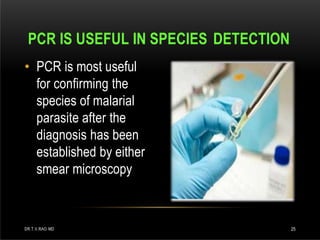
• PCR is most useful
for confirming the
species of malarial
parasite after the
diagnosis has been
established by either
smear microscopy
PCR IS USEFUL IN SPECIES DETECTION
DR.T.V.RAO MD 25
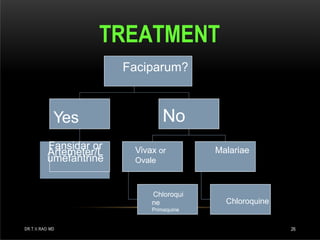
TREATMENT
Faciparum?
Yes
Fansidar or
Artemeter/L
umefantrine
No
Vivax or
Ovale
Chloroqui
ne
Primaquine
Malariae
Chloroquine
DR.T.V.RAO MD 26
TREATMENT
DR.T.V.RAO MD 27
• HALOFANTRINE
• MALARONE
• ATOVAQUONE / PROGUANIL
• TAFENOQUINE
• QUININE based regimens
• CHLOROQUINE / PROGUANIL IS AN
INFERIOR REGIMEN AND SHOULD NOT BE
USED
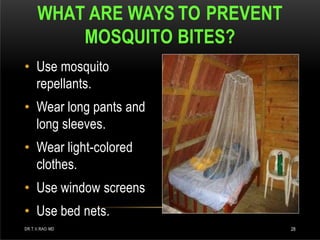
• Use mosquito
repellants.
• Wear long pants and
long sleeves.
• Wear light-colored
clothes.
• Use window screens
• Use bed nets.
WHAT ARE WAYS TO PREVENT
MOSQUITO BITES?
DR.T.V.RAO MD 28
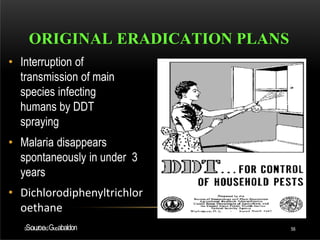
ORIGINAL ERADICATION PLANS
• Interruption of
transmission of main
species infecting
humans by DDT
spraying
• Malaria disappears
spontaneously in under 3
years
• Dichlorodiphenyltrichlor
oethane
D
SR
o.
T
u.
V
r.
cR
eA
O
:GMDabaldon 56
OTHER WAYS TO PREVENT MALARIA
DR.T.V.RAO MD 30
Who is at the highest risk of malaria?
• Travelers to an area high in malaria
• Travelers often take prophylactic (preventive)
medicines to prevent malaria.
• Pregnant women (especially those with HIV)
• Pregnant women are given intermittent preventive
treatment. They are given at least 2 doses of a
malaria drug during their pregnancy.
• Young children
• How can you protect young children?
MALARIA VACCINE
DR.T.V.RAO MD 31
• Scientists are working on a new malaria
vaccine.
• The vaccine would help protect children from
deadly malaria.
• The vaccine boosts the immune response
against malaria.
• However, the vaccine is still being tested.
THANK YOU

2. malaria.pptx for bsc nursing student.

  • 1.
  • 2.
    HISTORY AND FUTURERESEARCH DR.T.V.RAO MD 2 • One of the oldest known diseases. • King Tut died of malaria. • Malaria has been infecting humans for over 50,000 years. • References to malaria have been recorded for nearly 6000 years, starting in China. • Used to be common in Europe and North America. • First advances in malaria were made in 1880 by a French army doctor named Charles Laveran. • He looked into infected red blood cells and discovered the parasite was a protist. This was the first time a protist was discovered to cause a disease. • Carlos Finlay discovered that mosquitoes transmitted diseases.
  • 3.
    It was discovered morethan 100 years ago A French army doctor in Algeria observed parasites inside red blood cells of malaria patients and proposed for the first time that a protozoan caused disease Charles Louis Alphonse Laveran DR.T.V.RAO MD 3
  • 4.
    • Ronald Rossdiscovered that mosquitoes transmitted malaria in 1898. • First effective medicine was discovered by Pierre Pelletier and Joseph Caventou. This medicine is called quinine, which comes from the bark of cinchona trees in Peru. • No effective vaccine: only immunity is a result of multiple infections. RONALD ROSS DISCOVERS THE ROLE OF MOSQUITOS AND TRANSMISSION DR.T.V.RAO MD 4
  • 5.
    MALARIA DR.T.V.RAO MD 5 •40% of the world’s population lives in endemic areas (present in a community t all time but in relatively low frequency.) • 1-2million deaths (90%Africa) • increasing problem (re-emerging disease) • drug resistance ( mortality)
  • 6.
    • causative agent= Plasmodium species • protozoan parasite • member of Apicomplexa • 4 species infecting humans • transmitted by anopholine mosquitoes •P. falciparum •P. vivax •P. malariae •P. ovale
  • 7.
    WHAT IS MALARIA? DR.T.V.RAOMD 7 • Malaria is a parasite that enters the blood. • This parasite is a protozoan called plasmodium. • 3 to 700 million people get malaria each year, but only kills 1 to 2 million • 40% of the worlds population lives in malaria zones • Malaria zones are: Africa, India, Middle East, Southeast Asia, Central and South America, Eastern Europe, and the South Pacific
  • 8.
    WHAT DETERMINES THESPREAD OF MALARIA? ? Malaria spread depends on: •Rainfall pattern •Types of mosquitoes in the area Some areas constantly have a high rate of malaria. Other areas have “malaria seasons” or occasional epidemics of malaria. DR.T.V.RAO MD 8
  • 9.
    MALARIA – VECTORS Anophelesbalabacensis DR.T.V.RAO MD 9 A. freeborni A. gambiae A. stephensi
  • 10.
    CHARACTERISTIC OF LIFECYCLE DR.T.V.RAO MD 10 • Intermediate host : human • Final host : mosquito • Infective stage : sporozoite • Infective way : mosquito bite skin of human • Parasitic position : liver and red blood cells • Transmitted stage : gametocytes • Schizogonic cycle in red cells : 48 hrs/P.v • Sporozoite : tachysporozite and bradysporozite
  • 11.
    MOSQUITOES AND MALARIA •The spread of malaria depends on the life cycle of the mosquito. • Adult mosquitoes lay their eggs on water. • The eggs hatch to become larvae and then pupae, before turning into adults. • Adult females mosquitoes only live 2 to 4 weeks. • So you can reduce malaria by attacking any of these four stages of the mosquito. DR.T.V.RAO MD 11
  • 12.
    Life Cycle • sporozoitesinjected during mosquito feeding • invade liver cells • exoerythrocytic schizogony (merozoites) • merozoites invade RBCs • repeated erythrocytic schizogony cycles • gametocytes infective for mosquito • fusion of gametes in gut • sporogony on gut wall in hemocoel (primary body) • sporozoites invade salivary glands DR.T.V.RAO MD 12
  • 13.
  • 14.
    INCUBATION PERIOD DR.T.V.RAO MD14 Following the infective bite by the Anopheles mosquito a period of time (the "incubation period") goes by before the first symptoms appear. The incubation period in most cases varies from 7 to 30 days. The shorter periods are observed most frequently with P.falciparum and the longer ones with P. malariae.
  • 15.
    Clinical Features DR.T.V.RAO MD15 • characterized by acute febrile attacks (malaria paroxysms) • periodic episodes of fever alternating with symptom-free periods • manifestations and severity depend on species and host status • immunity, general health, nutritional state, genetics • recrudescences and relapses can occur over months or years • can develop severe complications (especially P. falciparum)
  • 16.
    CLINICAL MANIFESTATIONS 1Anemia 2 Splenomegaly 3Cerebral malaria 4 Malaria nephropathy 5Congenital malaria usually fatal DR.T.V.RAO MD 16
  • 17.
    WHAT ARE THESIGNS AND SYMPTOMS OF MALARIA? DR.T.V.RAO MD 17 Symptoms of malaria include fever and flu-like illness, including shaking chills, headache, muscle aches, and tiredness. Nausea, vomiting, and diarrhea may also occur. Malaria may cause anemia and jaundice (yellow coloring of the skin and eyes) because of the loss of red blood cells. Infection with one type of malaria, Plasmodium falciparum, if not promptly treated, may cause kidney failure, seizures, mental confusion, coma, and death.
  • 18.
    UNCOMPLICATED MALARIA DR.T.V.RAO MD18 The classical (but rarely observed) malaria attack lasts 6-10 hours. It consists of a cold stage (sensation of cold, shivering) ; a hot stage (fever, headaches, vomiting; seizures in young children) and finally a sweating stage (sweats, return to normal temperature, tiredness)
  • 19.
    IS IT FALCIPARUM? DR.T.V.RAOMD 19 • WHAT DOES THE SMEAR SHOW? • >3% PARASITEMIA • MONOTONOUS SMALL RINGS • NO TROPHOZOITES OR SCHIZONTS • BANANA SHAPED GAMETOCYTES • MULTIPLY INFECTED CELLS • CELLS OF ALL SIZES INFECTED
  • 20.
    •MALIGNANT MALARIA Malaria causedby P.falciparum. is more severe than that caused by other plasmodia. ----The serious complication of P.falciparum. involves cerebral malaria (involving the brain); massive haemoglobinuria (blackwater fever) in which the urine becomes dark in color, because of acute hemolysis of RBC; acute respiratory distress syndrome; severe gastrointestinal symptoms; shock and renal failure which may cause death. DR.T.V.RAO MD 20
  • 21.
    LABORATORY DIAGNOSIS ----laboratory diagnosisof malaria is confirmed by the demonstration of malarial parasites in the blood filmunder microscopic examination. • Thin film • Thick film DR.T.V.RAO MD 21
  • 22.
    • Various testkits are available to detect antigens derived from malaria parasites. Such immunologic ("immunochromatographic") tests most often use a dipstick or cassette format, and provide results in 2-15 minutes. These "Rapid Diagnostic Tests" (RDTs) offer a useful alternative to microscopy in situations where reliable microscopic diagnosis is not available ANTIGEN DETECTION METHODS DR.T.V.RAO MD 22
  • 23.
    • Serology detectsantibodies against malaria parasites, using either indirect immunofluorescence (IFA) or enzyme-linked immunosorbent assay (ELISA). Serology does not detect current infection but rather measures past exposure. SEROLOGY IN MALARIA DR.T.V.RAO MD 23
  • 24.
    • Parasite nucleicacids are detected using polymerase chain reaction (PCR). Although this technique may be slightly more sensitive than smear microscopy, it is of limited utility for the diagnosis of acutely ill patients in the standard healthcare setting. PCR results are often not available quickly enough to be of value in establishing the diagnosis of malaria infection. MOLECULAR DIAGNOSIS OF MALARIA DR.T.V.RAO MD 24
  • 25.
    • PCR ismost useful for confirming the species of malarial parasite after the diagnosis has been established by either smear microscopy PCR IS USEFUL IN SPECIES DETECTION DR.T.V.RAO MD 25
  • 26.
  • 27.
    TREATMENT DR.T.V.RAO MD 27 •HALOFANTRINE • MALARONE • ATOVAQUONE / PROGUANIL • TAFENOQUINE • QUININE based regimens • CHLOROQUINE / PROGUANIL IS AN INFERIOR REGIMEN AND SHOULD NOT BE USED
  • 28.
    • Use mosquito repellants. •Wear long pants and long sleeves. • Wear light-colored clothes. • Use window screens • Use bed nets. WHAT ARE WAYS TO PREVENT MOSQUITO BITES? DR.T.V.RAO MD 28
  • 29.
    ORIGINAL ERADICATION PLANS •Interruption of transmission of main species infecting humans by DDT spraying • Malaria disappears spontaneously in under 3 years • Dichlorodiphenyltrichlor oethane D SR o. T u. V r. cR eA O :GMDabaldon 56
  • 30.
    OTHER WAYS TOPREVENT MALARIA DR.T.V.RAO MD 30 Who is at the highest risk of malaria? • Travelers to an area high in malaria • Travelers often take prophylactic (preventive) medicines to prevent malaria. • Pregnant women (especially those with HIV) • Pregnant women are given intermittent preventive treatment. They are given at least 2 doses of a malaria drug during their pregnancy. • Young children • How can you protect young children?
  • 31.
    MALARIA VACCINE DR.T.V.RAO MD31 • Scientists are working on a new malaria vaccine. • The vaccine would help protect children from deadly malaria. • The vaccine boosts the immune response against malaria. • However, the vaccine is still being tested.
  • 32.