Curriculum
Essentials
Ivy Rose B. Recierdo
BSED I – A
Curriculum in
Schools
Lesson 1
Saber-Tooth Curriculum
OHarold Benjamin (1939)
OCurriculum then, was seen as a
tradition of organized taught in
schools of the 19th century.
ONo formal, non-formal or
informal education exists
without a curriculum.
Educational Levels
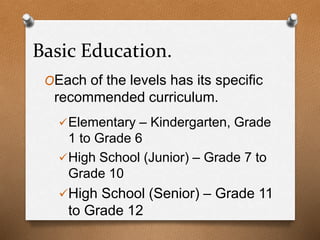
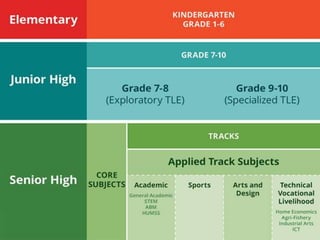
Basic Education.
OEach of the levels has its specific
recommended curriculum.
Elementary – Kindergarten, Grade
1 to Grade 6
High School (Junior) – Grade 7 to
Grade 10
High School (Senior) – Grade 11
to Grade 12
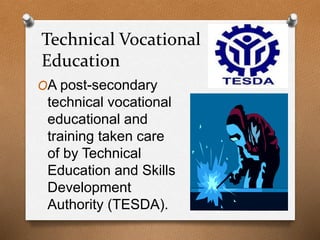
Technical Vocational
Education
OA post-secondary
technical vocational
educational and
training taken care
of by Technical
Education and Skills
Development
Authority (TESDA).
Higher Education.
OIncludes the Bachelor Degrees
and the Graduate Degrees
(Master’s and Doctorate) which
are under the regulation of the
Commission on Higher Education
(CHED).
Types of Curricula in
Schools
Recommended Curriculum
OAlmost all curricula found in our
schools are recommended.
OThe recommendations come in
the form of memoranda or
policies, standards and
guidelines.
Written Curriculum
OThis includes documents based
on the recommended
curriculum.
OThey come in the form of
course of study, syllabi,
modules, books or instructional
guides among others.
Taught Curriculum
OFrom what has been written or
planned, the curriculum has to
be implemented or taught.
OThe taught curriculum will
depend largely on the teaching
style of the teacher and the
learning style of the learners.
Supported Curriculum
OThis is described as support
materials that the teacher
needs to make learning and
teaching meaningful.
OSupported curriculum also
includes facilities where
learning occurs outside or
inside the four-walled building.
Assessed Curriculum
OTaught and supported curricula
have to be evaluated to find out
if the teacher has succeeded or
not in facilitating learning.
OIn the process of teaching and
at the end of every lesson or
teaching episode, an
assessment is made.
Learned
Curriculum.
OIn this curriculum,
learning is measured by
tools in assessment,
which can indicate the
cognitive, affective and
psychomotor outcomes.
OLearned curriculum will also
demonstrate higher order and
critical thinking and lifelong skills.
Hidden/Implicit Curriculum
OThis curriculum is not deliberately
planned, but has a great impact on
the behavior of the learner.
OTeachers must have good
foresight to include these in the
written curriculum, in order to bring
to the surface what are hidden.
The Teacher As
A Curricularist
Lesson 2
Who is a
Curricularist?
In the past, referred only to those
who developed curriculum
theories.
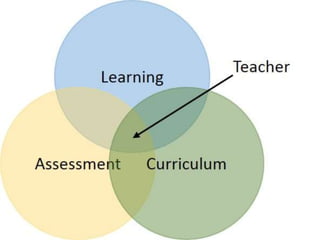
The teacher as a Curricularist…
K
N
O
W
E
R
OKnows the Curriculum.
OThe teacher as a
learner starts with
knowing about the
curriculum, the subject
matter or the content.
WRITER
OThe teacher writes books,
modules, laboratory manuals,
instructional materials,
instructional guides, and
reference materials in paper
or electronic media as a
curriculum writer or reviewer.
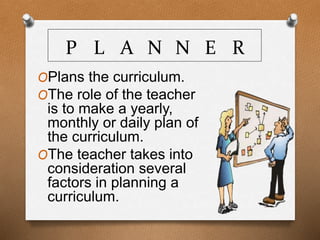
P L A N N E R
OPlans the curriculum.
OThe role of the teacher
is to make a yearly,
monthly or daily plan of
the curriculum.
OThe teacher takes into
consideration several
factors in planning a
curriculum.
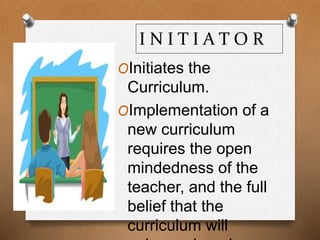
I N I T I A T O R
OInitiates the
Curriculum.
OImplementation of a
new curriculum
requires the open
mindedness of the
teacher, and the full
belief that the
curriculum will
I N N O V A T O R
OInnovates the Curriculum.
OA curriculum is always dynamic,
hence it keeps on changing. A
good teacher, therefore,
innovates the curriculum and
thus becomes a curriculum
innovator.
I M P L E M E N T O R
OImplements the Curriculum.
OIt is the role of the teacher to
become the curriculum
implementor.
OAn implementor gives life to the
curriculum plan.
OThe success of a recommended,
well written and planned
curriculum depends on the
E V A L U A T O R
OEvaluates the Curriculum.
OTeacher ask questions that will
determine the achievement of
the desired learning outcomes.
“A teacher affects
eternity; he can never tell
where his influence stop.”
- Henry Brooks Adams

Curriculum Essentials

  • 1.
    Curriculum Essentials Ivy Rose B.Recierdo BSED I – A
  • 2.
  • 3.
    Saber-Tooth Curriculum OHarold Benjamin(1939) OCurriculum then, was seen as a tradition of organized taught in schools of the 19th century. ONo formal, non-formal or informal education exists without a curriculum.
  • 6.
  • 7.
    Basic Education. OEach ofthe levels has its specific recommended curriculum. Elementary – Kindergarten, Grade 1 to Grade 6 High School (Junior) – Grade 7 to Grade 10 High School (Senior) – Grade 11 to Grade 12
  • 11.
    Technical Vocational Education OA post-secondary technicalvocational educational and training taken care of by Technical Education and Skills Development Authority (TESDA).
  • 12.
    Higher Education. OIncludes theBachelor Degrees and the Graduate Degrees (Master’s and Doctorate) which are under the regulation of the Commission on Higher Education (CHED).
  • 13.
  • 14.
    Recommended Curriculum OAlmost allcurricula found in our schools are recommended. OThe recommendations come in the form of memoranda or policies, standards and guidelines.
  • 15.
    Written Curriculum OThis includesdocuments based on the recommended curriculum. OThey come in the form of course of study, syllabi, modules, books or instructional guides among others.
  • 16.
    Taught Curriculum OFrom whathas been written or planned, the curriculum has to be implemented or taught. OThe taught curriculum will depend largely on the teaching style of the teacher and the learning style of the learners.
  • 17.
    Supported Curriculum OThis isdescribed as support materials that the teacher needs to make learning and teaching meaningful. OSupported curriculum also includes facilities where learning occurs outside or inside the four-walled building.
  • 18.
    Assessed Curriculum OTaught andsupported curricula have to be evaluated to find out if the teacher has succeeded or not in facilitating learning. OIn the process of teaching and at the end of every lesson or teaching episode, an assessment is made.
  • 19.
    Learned Curriculum. OIn this curriculum, learningis measured by tools in assessment, which can indicate the cognitive, affective and psychomotor outcomes.
  • 20.
    OLearned curriculum willalso demonstrate higher order and critical thinking and lifelong skills.
  • 22.
    Hidden/Implicit Curriculum OThis curriculumis not deliberately planned, but has a great impact on the behavior of the learner. OTeachers must have good foresight to include these in the written curriculum, in order to bring to the surface what are hidden.
  • 24.
    The Teacher As ACurricularist Lesson 2
  • 25.
    Who is a Curricularist? Inthe past, referred only to those who developed curriculum theories.
  • 27.
    The teacher asa Curricularist…
  • 28.
    K N O W E R OKnows the Curriculum. OTheteacher as a learner starts with knowing about the curriculum, the subject matter or the content.
  • 29.
    WRITER OThe teacher writesbooks, modules, laboratory manuals, instructional materials, instructional guides, and reference materials in paper or electronic media as a curriculum writer or reviewer.
  • 30.
    P L AN N E R OPlans the curriculum. OThe role of the teacher is to make a yearly, monthly or daily plan of the curriculum. OThe teacher takes into consideration several factors in planning a curriculum.
  • 31.
    I N IT I A T O R OInitiates the Curriculum. OImplementation of a new curriculum requires the open mindedness of the teacher, and the full belief that the curriculum will
  • 32.
    I N NO V A T O R OInnovates the Curriculum. OA curriculum is always dynamic, hence it keeps on changing. A good teacher, therefore, innovates the curriculum and thus becomes a curriculum innovator.
  • 33.
    I M PL E M E N T O R OImplements the Curriculum. OIt is the role of the teacher to become the curriculum implementor. OAn implementor gives life to the curriculum plan. OThe success of a recommended, well written and planned curriculum depends on the
  • 34.
    E V AL U A T O R OEvaluates the Curriculum. OTeacher ask questions that will determine the achievement of the desired learning outcomes.
  • 35.
    “A teacher affects eternity;he can never tell where his influence stop.” - Henry Brooks Adams