IV FLUIDS AND
ELECTROLYTES
MS. DRASHTI PATEL
NURSING TUTOR
INTRODUCTION
• Intravenous fluids, also known as intravenous solutions, are
supplemental fluids used in intravenous therapy to restore or
maintain normal fluid volume and electrolyte balance when the
oral route is not possible.
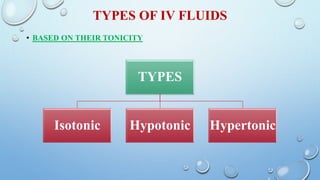
TYPES OF IV FLUIDS
• BASED ON THEIR TONICITY
TYPES
Isotonic Hypotonic Hypertonic
• BASED ON THEIR PURPOSE
Nutrient
solutions
Electrolyte
solutions
Alkalinizing
solutions
Acidifying
solutions
Volume
expanders
CRYSTALLOIDS
•Crystalloid IV solutions contain small molecules that
flow easily across semipermeable membranes.
ISOTONIC IV FLUIDS
•Same concentration of solutes as blood plasma.
•Isotonic solutions expand both the intracellular fluid and
extracellular fluid spaces, equally.
•Do not alter the osmolality of the vascular compartment.
•Isotonic iv fluids have a total osmolality close to that of
the ECF and do not cause red blood cells to shrink or
swell.
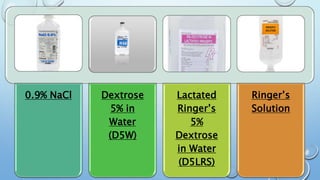
0.9% NaCl Dextrose
5% in
Water
(D5W)
Lactated
Ringer’s
5%
Dextrose
in Water
(D5LRS)
Ringer’s
Solution
0.9% NACL (NORMAL SALINE SOLUTION, NSS)
• Is a crystalloid isotonic IV fluid that contains
• water
• sodium (154 meq/L)
• chloride (154 meq/L).
• It has an osmolality of 308 mosm/L and gives no calories.
It is called normal saline solution because the percentage
of sodium chloride dissolved in the solution is similar to
the usual concentration of sodium and chloride in the
intravascular space.
Normal saline is the isotonic solution of choice for
expanding the extracellular fluid volume because it does
not enter the intracellular fluid. It is administered to
correct extracellular fluid volume deficit because it
remains within the ECF.
 INDICATION - To replace large sodium losses such as in burn injuries
and trauma.
 CONTRAINDICATION - For heart failure, pulmonary edema, and renal
impairment, or conditions that cause sodium retention as it may risk fluid
volume overload.
DEXTROSE 5% IN WATER (D5W)
• Serum osmolality of 252 mosm/L.
 D5w is initially an isotonic solution and provides free water when dextrose
is metabolized (making it a hypotonic solution), expanding the ECF and the
ICF. It is administered to supply water and to correct an increase in serum
osmolality.
 A liter of D5w provides fewer than 200 kcal and contains 50g of glucose.
It should not be used for fluid resuscitation because
hyper-glycemia can result.
It should also be avoided to be used in clients at risk
for increased intracranial pressure as it can cause
cerebral edema.
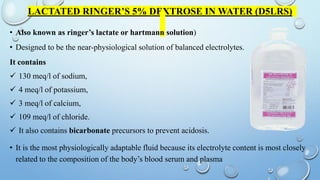
LACTATED RINGER’S 5% DEXTROSE IN WATER (D5LRS)
• Also known as ringer’s lactate or hartmann solution)
• Designed to be the near-physiological solution of balanced electrolytes.
It contains
 130 meq/l of sodium,
 4 meq/l of potassium,
 3 meq/l of calcium,
 109 meq/l of chloride.
 It also contains bicarbonate precursors to prevent acidosis.
• It is the most physiologically adaptable fluid because its electrolyte content is most closely
related to the composition of the body’s blood serum and plasma
• USE
• To correct dehydration
• Sodium depletion
• Replace GI tract fluid losses
• Fluid losses due to burns, fistula drainage, and trauma.
• It is the choice for first-line fluid resuscitation for certain
patients. It is often administered to patients with metabolic
acidosis.
• CONTRAINDICATION
• Lactated ringer’s solution is metabolized in the liver, which converts the
lactate to bicarbonate, it should not be given to patients who cannot
metabolize lactate (E.G., Liver disease, lactic acidosis).
• It should be used in caution for patients with heart failure and renal failure.
RINGER’S SOLUTION
• Ringer’s solution is another isotonic iv solution that has
content similar to lactated ringer’s solution but does not
contain lactate.
HYPOTONIC IV FLUIDS
Hypotonic IV solutions have a lower osmolality and contain fewer
solutes than plasma.
They cause fluid shifts from the ECF into the ICF to achieve
homeostasis, therefore, causing cells to swell and may even rupture.
 Iv solutions are considered hypotonic if the total electrolyte content is
less than 250 meq/l.
 Use –
To provide free water for excretion of body wastes,
Treat cellular dehydration
Replace the cellular fluid.
0.45% Sodium Chloride (0.45% NaCl)
0.33% Sodium Chloride (0.33% NaCl)
0.225% Sodium Chloride (0.225% NaCl)
2.5% Dextrose in Water (D2.5W)
0.45% SODIUM CHLORIDE (0.45% NACL)
• Also known as half-strength normal saline
Used for replacing water in patients who have hypovolemia with
hypernatremia.
Excess use may lead to hyponatremia due to the dilution of sodium,
especially in patients who are prone to water retention.
Osmolality - 154 mosm/L and contains 77 meq/L sodium and
chloride.
Use - to treat hypernatremia and other hyperosmolar conditions.
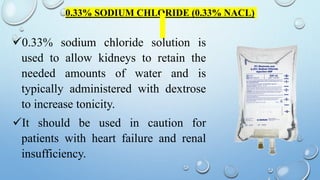
0.33% SODIUM CHLORIDE (0.33% NACL)
0.33% sodium chloride solution is
used to allow kidneys to retain the
needed amounts of water and is
typically administered with dextrose
to increase tonicity.
It should be used in caution for
patients with heart failure and renal
insufficiency.
0.225% SODIUM CHLORIDE (0.225% NACL)
• 0.225% sodium chloride solution is often used as a maintenance fluid for
pediatric patients as it is the most hypotonic IV fluid available at 77
mosm/L.
• Used together with dextrose.
2.5% DEXTROSE IN WATER (D2.5W)
This solution is used to treat dehydration and
decreased the levels of sodium and potassium.
It should not be administered with blood
products as it can cause haemolysis of red
blood cells.
HYPERTONIC IV FLUIDS
Have a greater concentration of solutes (375 meq/L and greater)
than plasma and cause fluids to move out of the cells and into the
ECF in order to normalize the concentration of particles between
two compartments.
This effect causes cells to shrink and may disrupt their function.
Known as volume expanders as they draw water out of the
intracellular space, increasing extracellular fluid volume.
Hypertonic Sodium Chloride IV Fluids
Hypertonic Dextrose Solutions
Dextrose 10% in Water (D10W)
Dextrose 20% in Water (D20W)
Dextrose 50% in Water (D50W)
HYPERTONIC SODIUM CHLORIDE IV FLUIDS
• Contain a higher concentration of sodium and chloride than
normally contained in plasma.
• Infusion of hypertonic sodium chloride solution shifts fluids from
the intracellular space into the intravascular and interstitial spaces.
3% sodium
chloride 5% sodium
chloride
HYPERTONIC DEXTROSE SOLUTIONS
 Isotonic solutions that contain 5% dextrose (e.G., D5NSS, D5LRS) are
slightly hypertonic since they exceed the total osmolality of the ECF.
 Use - provide kilocalories for the patient in the short term.
 Higher concentrations of dextrose (i.E., D50W) are strong hypertonic
solutions and must be administered into central veins so that they can be
diluted by rapid blood flow.
DEXTROSE 10% IN WATER (D10W)
 Used in the treatment of ketosis of starvation and
provides calories (380 kcal/L), free water, and no
electrolytes.
 It should be administered using a central line if
possible and should not be infused using the same
line as blood products as it can cause RBC
haemolysis.
DEXTROSE 20% IN WATER (D20W)
Dextrose 20% in water (D20W) is
hypertonic IV solution an osmotic
diuretic that causes fluid shifts
between various compartments to
promote diuresis.
DEXTROSE 50% IN WATER (D50W)
 Another hypertonic IV solution used commonly is dextrose 50% in
water (D50W) which is used to treat severe hypoglycemia and is
administered rapidly via IV bolus.
COLLOIDS
Colloids contain large molecules that do
not pass through semipermeable membranes.
Colloids are IV fluids that contain solutes of
high molecular weight, technically, they are
hypertonic solutions, which when infused,
exert an osmotic pull of fluids from interstitial
and extracellular spaces.
ELECTROLYTES
• Electrolytes are minerals in body fluids that carry
an electric charge. Electrolytes affect the amount
of water, the acidity of blood (PH), muscle
function, and other important processes in the
body.
SODIUM (NA+)
• Normal serum level 135-145 mmol/L
• Function
• Maintains extracellular function (ECF) osmolarity
• Influences water distribution
• Affects concentration, excretion and absorption of potassium and chloride
• Helps regulate acid-base balance
• Aids nerve and muscle fibre impulse transmission
Hyponatraemia Hypernatraemia
• Fatigue • Thirst
• Muscle weakness • Fever
• Muscle twitching • Flushed skin
• Decreased skin
turgor
• Oliguria
• Headache • Disorientation
• Tremor • Dry sticky
membranes
• Seizures
POTASSIUM (K+)
• Normal serum level 3.5 – 5.0 mmol/L
• Function
• Maintains cell electro-neutrality
• Maintains cell osmolarity
• Assists in conduction of nerve impulses
• Directly affects cardiac muscle contraction (repolarisation in the action potential)
• Plays a major role in acid-base balance
• Sodium – potassium gradient plays a major role in fluid balance between
extracellular (ECF) and intracellular (ICF) compartments
Hypokalaemia Hyperkalaemia
• Decreased peristalsis, skeletal
muscle and cardiac, muscle function
• Muscle weakness
• Muscle weakness or
irritability/cramps
• Nausea
• Decreased reflexes • Diarrhoea
• Fatigue • Oliguria
• Rapid, weak irregular pulse • Paraesthesia (altered sensation) of
the face, tongue, hands and feet
• Cardiac arrhythmias/cardiac arrest • Cardiac arrhythmias/cardiac arrest
• Decreased blood pressure
• Decreased bowel motility
CALCIUM (CA++)
• Normal serum level 2.15-2.55 mmol/L
• Function
• Enhances bone strength and durability
• Helps maintain cell-membrane structure, function and permeability
• Affects activation, excitation and contraction of sino-atrial node (intrinsic cardiac
pacemaker), cardiac and skeletal muscles
• Participates in neurotransmitter release at synapses
• Helps activate specific steps in blood coagulation
• Activates serum complement in immune system function
Hypocalcaemia Hypercalcaemia
• Muscle tremor • Lethargy
• Muscle cramps • Fatigue
• Tetany • Depression
• Tonic-clonic seizures • Confusion
• Parasthesia • Headache
• Bleeding • Muscle flaccidity
• Arrhythmias • Nausea, vomiting
• Hypotension • Anorexia
• Numbness or tingling in fingers,
toes and around the mouth
• Constipation
• Hypertension
• Polyuria
• Cardiac arrhythmias and ECG
changes (shortened QT interval and
widened T wave
CHLORIDE (CL-)
• Normal serum level 95-110 mmol/L
• Function
• Maintains serum osmolarity
• Combines with major cations to create important compounds, such as
sodium chloride (nacl), hydrochloride (hcl), potassium chloride kcl)
and calcium chloride (cacl2) which contribute to acid/base and/or
electrolyte balance
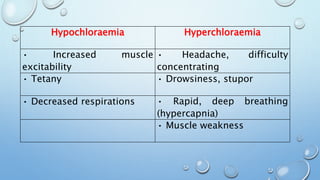
Hypochloraemia Hyperchloraemia
• Increased muscle
excitability
• Headache, difficulty
concentrating
• Tetany • Drowsiness, stupor
• Decreased respirations • Rapid, deep breathing
(hypercapnia)
• Muscle weakness
PHOSPHATE (PO4)
• Normal serum level 0.8-1.5 mmol/L
• Function
• Helps maintain bones and teeth
• Helps maintain cell integrity
• Plays a major role in acid-base balance (as a urinary buffer)
• Promotes energy transfer to cells
• Plays essential role in muscle, red blood cell and neurological function
Hypophosphataemia Hyperphosphataemia
• Parasthesia (circumoral and
peripheral)
• Renal failure
• Lethargy • Vague neuro-excitability to
tetany and seizures
• Speech defects (such as
stuttering)
• Arrhythmias and muscle
twitching with sudden rise in
phosphate (PO4) level
• Muscle pain and tenderness
MAGNESIUM (MG++)
• Normal serum level 0.70-1.05 mol/L
• Function
• Activates intracellular enzymes; active in carbohydrate and
protein metabolism
• Acts on myo-neural vasodilation
• Facilitates na+ and K+ movement across all membranes
• Influences ca++ levels
Hypomagnesaemia Hypermagnesaemia
• Dizziness • Drowsiness
• Confusion • Lethargy
• Seizures • Coma
• Tremor • Arrhythmias
• Leg and foot cramps • Hypotension
• Hyperirritability • Vague neuromuscular changes
(such as tremor)
• Arrhythmias • Vague GI symptoms (such as
nausea)
• Vasomotor changes • Peripheral vasodilation
• Anorexia • Facial flushing
• Nausea • Sense of warmth
IV fluids and Electrolytes.pptx

IV fluids and Electrolytes.pptx

  • 1.
    IV FLUIDS AND ELECTROLYTES MS.DRASHTI PATEL NURSING TUTOR
  • 2.
    INTRODUCTION • Intravenous fluids,also known as intravenous solutions, are supplemental fluids used in intravenous therapy to restore or maintain normal fluid volume and electrolyte balance when the oral route is not possible.
  • 3.
    TYPES OF IVFLUIDS • BASED ON THEIR TONICITY TYPES Isotonic Hypotonic Hypertonic
  • 4.
    • BASED ONTHEIR PURPOSE Nutrient solutions Electrolyte solutions Alkalinizing solutions Acidifying solutions Volume expanders
  • 5.
    CRYSTALLOIDS •Crystalloid IV solutionscontain small molecules that flow easily across semipermeable membranes.
  • 7.
    ISOTONIC IV FLUIDS •Sameconcentration of solutes as blood plasma. •Isotonic solutions expand both the intracellular fluid and extracellular fluid spaces, equally. •Do not alter the osmolality of the vascular compartment. •Isotonic iv fluids have a total osmolality close to that of the ECF and do not cause red blood cells to shrink or swell.
  • 8.
    0.9% NaCl Dextrose 5%in Water (D5W) Lactated Ringer’s 5% Dextrose in Water (D5LRS) Ringer’s Solution
  • 9.
    0.9% NACL (NORMALSALINE SOLUTION, NSS) • Is a crystalloid isotonic IV fluid that contains • water • sodium (154 meq/L) • chloride (154 meq/L). • It has an osmolality of 308 mosm/L and gives no calories.
  • 10.
    It is callednormal saline solution because the percentage of sodium chloride dissolved in the solution is similar to the usual concentration of sodium and chloride in the intravascular space. Normal saline is the isotonic solution of choice for expanding the extracellular fluid volume because it does not enter the intracellular fluid. It is administered to correct extracellular fluid volume deficit because it remains within the ECF.
  • 11.
     INDICATION -To replace large sodium losses such as in burn injuries and trauma.  CONTRAINDICATION - For heart failure, pulmonary edema, and renal impairment, or conditions that cause sodium retention as it may risk fluid volume overload.
  • 12.
    DEXTROSE 5% INWATER (D5W) • Serum osmolality of 252 mosm/L.  D5w is initially an isotonic solution and provides free water when dextrose is metabolized (making it a hypotonic solution), expanding the ECF and the ICF. It is administered to supply water and to correct an increase in serum osmolality.  A liter of D5w provides fewer than 200 kcal and contains 50g of glucose.
  • 13.
    It should notbe used for fluid resuscitation because hyper-glycemia can result. It should also be avoided to be used in clients at risk for increased intracranial pressure as it can cause cerebral edema.
  • 14.
    LACTATED RINGER’S 5%DEXTROSE IN WATER (D5LRS) • Also known as ringer’s lactate or hartmann solution) • Designed to be the near-physiological solution of balanced electrolytes. It contains  130 meq/l of sodium,  4 meq/l of potassium,  3 meq/l of calcium,  109 meq/l of chloride.  It also contains bicarbonate precursors to prevent acidosis. • It is the most physiologically adaptable fluid because its electrolyte content is most closely related to the composition of the body’s blood serum and plasma
  • 15.
    • USE • Tocorrect dehydration • Sodium depletion • Replace GI tract fluid losses • Fluid losses due to burns, fistula drainage, and trauma. • It is the choice for first-line fluid resuscitation for certain patients. It is often administered to patients with metabolic acidosis.
  • 16.
    • CONTRAINDICATION • Lactatedringer’s solution is metabolized in the liver, which converts the lactate to bicarbonate, it should not be given to patients who cannot metabolize lactate (E.G., Liver disease, lactic acidosis). • It should be used in caution for patients with heart failure and renal failure.
  • 17.
    RINGER’S SOLUTION • Ringer’ssolution is another isotonic iv solution that has content similar to lactated ringer’s solution but does not contain lactate.
  • 19.
    HYPOTONIC IV FLUIDS HypotonicIV solutions have a lower osmolality and contain fewer solutes than plasma. They cause fluid shifts from the ECF into the ICF to achieve homeostasis, therefore, causing cells to swell and may even rupture.
  • 20.
     Iv solutionsare considered hypotonic if the total electrolyte content is less than 250 meq/l.  Use – To provide free water for excretion of body wastes, Treat cellular dehydration Replace the cellular fluid.
  • 21.
    0.45% Sodium Chloride(0.45% NaCl) 0.33% Sodium Chloride (0.33% NaCl) 0.225% Sodium Chloride (0.225% NaCl) 2.5% Dextrose in Water (D2.5W)
  • 22.
    0.45% SODIUM CHLORIDE(0.45% NACL) • Also known as half-strength normal saline Used for replacing water in patients who have hypovolemia with hypernatremia. Excess use may lead to hyponatremia due to the dilution of sodium, especially in patients who are prone to water retention. Osmolality - 154 mosm/L and contains 77 meq/L sodium and chloride. Use - to treat hypernatremia and other hyperosmolar conditions.
  • 23.
    0.33% SODIUM CHLORIDE(0.33% NACL) 0.33% sodium chloride solution is used to allow kidneys to retain the needed amounts of water and is typically administered with dextrose to increase tonicity. It should be used in caution for patients with heart failure and renal insufficiency.
  • 24.
    0.225% SODIUM CHLORIDE(0.225% NACL) • 0.225% sodium chloride solution is often used as a maintenance fluid for pediatric patients as it is the most hypotonic IV fluid available at 77 mosm/L. • Used together with dextrose.
  • 25.
    2.5% DEXTROSE INWATER (D2.5W) This solution is used to treat dehydration and decreased the levels of sodium and potassium. It should not be administered with blood products as it can cause haemolysis of red blood cells.
  • 27.
    HYPERTONIC IV FLUIDS Havea greater concentration of solutes (375 meq/L and greater) than plasma and cause fluids to move out of the cells and into the ECF in order to normalize the concentration of particles between two compartments. This effect causes cells to shrink and may disrupt their function. Known as volume expanders as they draw water out of the intracellular space, increasing extracellular fluid volume.
  • 28.
    Hypertonic Sodium ChlorideIV Fluids Hypertonic Dextrose Solutions Dextrose 10% in Water (D10W) Dextrose 20% in Water (D20W) Dextrose 50% in Water (D50W)
  • 29.
    HYPERTONIC SODIUM CHLORIDEIV FLUIDS • Contain a higher concentration of sodium and chloride than normally contained in plasma. • Infusion of hypertonic sodium chloride solution shifts fluids from the intracellular space into the intravascular and interstitial spaces. 3% sodium chloride 5% sodium chloride
  • 30.
    HYPERTONIC DEXTROSE SOLUTIONS Isotonic solutions that contain 5% dextrose (e.G., D5NSS, D5LRS) are slightly hypertonic since they exceed the total osmolality of the ECF.  Use - provide kilocalories for the patient in the short term.  Higher concentrations of dextrose (i.E., D50W) are strong hypertonic solutions and must be administered into central veins so that they can be diluted by rapid blood flow.
  • 31.
    DEXTROSE 10% INWATER (D10W)  Used in the treatment of ketosis of starvation and provides calories (380 kcal/L), free water, and no electrolytes.  It should be administered using a central line if possible and should not be infused using the same line as blood products as it can cause RBC haemolysis.
  • 32.
    DEXTROSE 20% INWATER (D20W) Dextrose 20% in water (D20W) is hypertonic IV solution an osmotic diuretic that causes fluid shifts between various compartments to promote diuresis.
  • 33.
    DEXTROSE 50% INWATER (D50W)  Another hypertonic IV solution used commonly is dextrose 50% in water (D50W) which is used to treat severe hypoglycemia and is administered rapidly via IV bolus.
  • 35.
    COLLOIDS Colloids contain largemolecules that do not pass through semipermeable membranes. Colloids are IV fluids that contain solutes of high molecular weight, technically, they are hypertonic solutions, which when infused, exert an osmotic pull of fluids from interstitial and extracellular spaces.
  • 36.
    ELECTROLYTES • Electrolytes areminerals in body fluids that carry an electric charge. Electrolytes affect the amount of water, the acidity of blood (PH), muscle function, and other important processes in the body.
  • 37.
    SODIUM (NA+) • Normalserum level 135-145 mmol/L • Function • Maintains extracellular function (ECF) osmolarity • Influences water distribution • Affects concentration, excretion and absorption of potassium and chloride • Helps regulate acid-base balance • Aids nerve and muscle fibre impulse transmission
  • 38.
    Hyponatraemia Hypernatraemia • Fatigue• Thirst • Muscle weakness • Fever • Muscle twitching • Flushed skin • Decreased skin turgor • Oliguria • Headache • Disorientation • Tremor • Dry sticky membranes • Seizures
  • 39.
    POTASSIUM (K+) • Normalserum level 3.5 – 5.0 mmol/L • Function • Maintains cell electro-neutrality • Maintains cell osmolarity • Assists in conduction of nerve impulses • Directly affects cardiac muscle contraction (repolarisation in the action potential) • Plays a major role in acid-base balance • Sodium – potassium gradient plays a major role in fluid balance between extracellular (ECF) and intracellular (ICF) compartments
  • 40.
    Hypokalaemia Hyperkalaemia • Decreasedperistalsis, skeletal muscle and cardiac, muscle function • Muscle weakness • Muscle weakness or irritability/cramps • Nausea • Decreased reflexes • Diarrhoea • Fatigue • Oliguria • Rapid, weak irregular pulse • Paraesthesia (altered sensation) of the face, tongue, hands and feet • Cardiac arrhythmias/cardiac arrest • Cardiac arrhythmias/cardiac arrest • Decreased blood pressure • Decreased bowel motility
  • 41.
    CALCIUM (CA++) • Normalserum level 2.15-2.55 mmol/L • Function • Enhances bone strength and durability • Helps maintain cell-membrane structure, function and permeability • Affects activation, excitation and contraction of sino-atrial node (intrinsic cardiac pacemaker), cardiac and skeletal muscles • Participates in neurotransmitter release at synapses • Helps activate specific steps in blood coagulation • Activates serum complement in immune system function
  • 42.
    Hypocalcaemia Hypercalcaemia • Muscletremor • Lethargy • Muscle cramps • Fatigue • Tetany • Depression • Tonic-clonic seizures • Confusion • Parasthesia • Headache • Bleeding • Muscle flaccidity • Arrhythmias • Nausea, vomiting • Hypotension • Anorexia • Numbness or tingling in fingers, toes and around the mouth • Constipation • Hypertension • Polyuria • Cardiac arrhythmias and ECG changes (shortened QT interval and widened T wave
  • 43.
    CHLORIDE (CL-) • Normalserum level 95-110 mmol/L • Function • Maintains serum osmolarity • Combines with major cations to create important compounds, such as sodium chloride (nacl), hydrochloride (hcl), potassium chloride kcl) and calcium chloride (cacl2) which contribute to acid/base and/or electrolyte balance
  • 44.
    Hypochloraemia Hyperchloraemia • Increasedmuscle excitability • Headache, difficulty concentrating • Tetany • Drowsiness, stupor • Decreased respirations • Rapid, deep breathing (hypercapnia) • Muscle weakness
  • 45.
    PHOSPHATE (PO4) • Normalserum level 0.8-1.5 mmol/L • Function • Helps maintain bones and teeth • Helps maintain cell integrity • Plays a major role in acid-base balance (as a urinary buffer) • Promotes energy transfer to cells • Plays essential role in muscle, red blood cell and neurological function
  • 46.
    Hypophosphataemia Hyperphosphataemia • Parasthesia(circumoral and peripheral) • Renal failure • Lethargy • Vague neuro-excitability to tetany and seizures • Speech defects (such as stuttering) • Arrhythmias and muscle twitching with sudden rise in phosphate (PO4) level • Muscle pain and tenderness
  • 47.
    MAGNESIUM (MG++) • Normalserum level 0.70-1.05 mol/L • Function • Activates intracellular enzymes; active in carbohydrate and protein metabolism • Acts on myo-neural vasodilation • Facilitates na+ and K+ movement across all membranes • Influences ca++ levels
  • 48.
    Hypomagnesaemia Hypermagnesaemia • Dizziness• Drowsiness • Confusion • Lethargy • Seizures • Coma • Tremor • Arrhythmias • Leg and foot cramps • Hypotension • Hyperirritability • Vague neuromuscular changes (such as tremor) • Arrhythmias • Vague GI symptoms (such as nausea) • Vasomotor changes • Peripheral vasodilation • Anorexia • Facial flushing • Nausea • Sense of warmth