Antacids
Unit 2
Antacids
Antacids are meant for neutralizing the gastric PH in stomach. It
inhibits the extra hydrochloric acid secretion in stomach and neutralizes
the increasing level of hydrochloric acid.
Classification of Antacids:
On the basis of acting site it is divided into two categories
1. H2-receptor antagonist— Cimetidine, Ranitidine, Femotidine.
2. Proton Pump Inhibitor- Esomeprazole, Omeprazole, Pantoprazole
• On the basis of inorganic elemental nature it is divided into many
categories-
1. Calcium containing antacids— Calcium carbonate, Tribasic calcium
phosphate
2. Magnesium containing antacids— Magnesium hydroxide, magnesium
carbonate, magnesium oxide, magnesium trisilicate.
3. Aluminium containing antacids— Aluminium hydroxide, aluminium
phosphate, aluminium carbonate, dihydroxy aluminium sodium
carbonate.
4. Sodium containing antacids— Sodium bicarbonate.
Aluminium Hydroxide Gel
• Chemical formula— Al(OH)3
• Molar mass—78.00g/mol.
• Introduction—It is also known as Aluminic acid, hydrated Alumina. It
is the basic inorganic compounds which are reacts with the HCl and
work quickly by lowering the acidic PH of gastric cavity.
• Pharmaceutical preparation— Suspension, syrup, tablet, capsule,
bolus.
• Brand/Market Name— Digene, Gelusil, Vicid, Alqure, Asinil-T.
Properties
• Color and state—It is the white or pale yellow color amorphous
powder.
• Odor and taste—it is the odorless with mucilaginous taste.
• Solubility—It is insoluble in water but soluble in acidic as well as basic
medium
Storage condition— It is stored in well closed air resistance unopened
container and keeps away from incompatible materials at room
temperature and also away from the light and moisture.
Uses/Application
• Aluminium hydroxide is used to treat the gastric problem by
neutralizing the increasing PH. It also provides relieve in heartburn,
upset stomach, sour stomach.
• Aluminium hydroxide is also used to reduce phosphate level in people
with certain kidney conditions
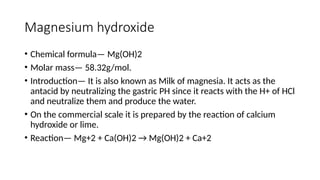
Magnesium hydroxide
• Chemical formula— Mg(OH)2
• Molar mass— 58.32g/mol.
• Introduction— It is also known as Milk of magnesia. It acts as the
antacid by neutralizing the gastric PH since it reacts with the H+ of HCl
and neutralize them and produce the water.
• On the commercial scale it is prepared by the reaction of calcium
hydroxide or lime.
• Reaction— Mg+2 + Ca(OH)2 → Mg(OH)2 + Ca+2
Properties
• Color and state—It is the white color crystalline solid or powder.
• Odor and taste—It is the odorless with milky taste or chalky taste.
• Solubility—It is slightly soluble in Water.
• Pharmaceutical preparation— Suspension, syrup, tablet, capsule
• Brand/Market Name— Digene, Gelusil, Antanil plus, Cremaffin,
Maalox
• Storage condition— It is stored in well closed air resistance unopened
container and keeps away from incompatible materials at room
temperature and also away from the light and moisture
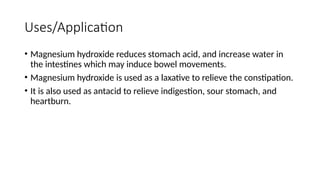
Uses/Application
• Magnesium hydroxide reduces stomach acid, and increase water in
the intestines which may induce bowel movements.
• Magnesium hydroxide is used as a laxative to relieve the constipation.
• It is also used as antacid to relieve indigestion, sour stomach, and
heartburn.
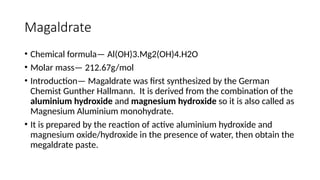
Magaldrate
• Chemical formula— Al(OH)3.Mg2(OH)4.H2O
• Molar mass— 212.67g/mol
• Introduction— Magaldrate was first synthesized by the German
Chemist Gunther Hallmann. It is derived from the combination of the
aluminium hydroxide and magnesium hydroxide so it is also called as
Magnesium Aluminium monohydrate.
• It is prepared by the reaction of active aluminium hydroxide and
magnesium oxide/hydroxide in the presence of water, then obtain the
megaldrate paste.
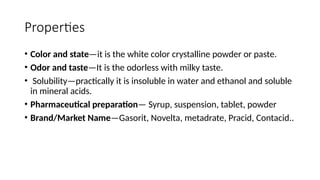
Properties
• Color and state—it is the white color crystalline powder or paste.
• Odor and taste—It is the odorless with milky taste.
• Solubility—practically it is insoluble in water and ethanol and soluble
in mineral acids.
• Pharmaceutical preparation— Syrup, suspension, tablet, powder
• Brand/Market Name—Gasorit, Novelta, metadrate, Pracid, Contacid..
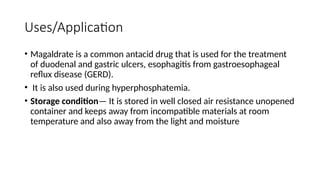
Uses/Application
• Magaldrate is a common antacid drug that is used for the treatment
of duodenal and gastric ulcers, esophagitis from gastroesophageal
reflux disease (GERD).
• It is also used during hyperphosphatemia.
• Storage condition— It is stored in well closed air resistance unopened
container and keeps away from incompatible materials at room
temperature and also away from the light and moisture
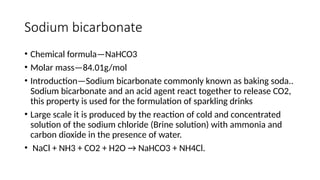
Sodium bicarbonate
• Chemical formula—NaHCO3
• Molar mass—84.01g/mol
• Introduction—Sodium bicarbonate commonly known as baking soda..
Sodium bicarbonate and an acid agent react together to release CO2,
this property is used for the formulation of sparkling drinks
• Large scale it is produced by the reaction of cold and concentrated
solution of the sodium chloride (Brine solution) with ammonia and
carbon dioxide in the presence of water.
• NaCl + NH3 + CO2 + H2O → NaHCO3 + NH4Cl.
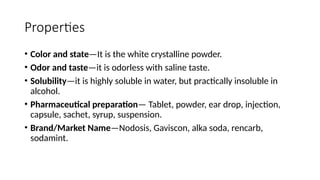
Properties
• Color and state—It is the white crystalline powder.
• Odor and taste—it is odorless with saline taste.
• Solubility—it is highly soluble in water, but practically insoluble in
alcohol.
• Pharmaceutical preparation— Tablet, powder, ear drop, injection,
capsule, sachet, syrup, suspension.
• Brand/Market Name—Nodosis, Gaviscon, alka soda, rencarb,
sodamint.
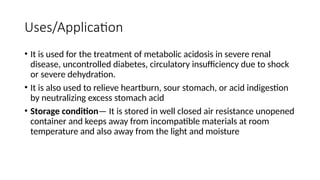
Uses/Application
• It is used for the treatment of metabolic acidosis in severe renal
disease, uncontrolled diabetes, circulatory insufficiency due to shock
or severe dehydration.
• It is also used to relieve heartburn, sour stomach, or acid indigestion
by neutralizing excess stomach acid
• Storage condition— It is stored in well closed air resistance unopened
container and keeps away from incompatible materials at room
temperature and also away from the light and moisture
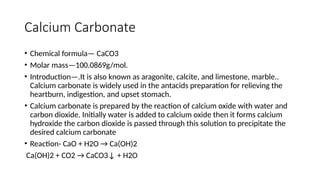
Calcium Carbonate
• Chemical formula— CaCO3
• Molar mass—100.0869g/mol.
• Introduction—.It is also known as aragonite, calcite, and limestone, marble..
Calcium carbonate is widely used in the antacids preparation for relieving the
heartburn, indigestion, and upset stomach.
• Calcium carbonate is prepared by the reaction of calcium oxide with water and
carbon dioxide. Initially water is added to calcium oxide then it forms calcium
hydroxide the carbon dioxide is passed through this solution to precipitate the
desired calcium carbonate
• Reaction- CaO + H2O → Ca(OH)2
Ca(OH)2 + CO2 → CaCO3↓ + H2O
Properties
• Color and state— it is the whitish or milky crystalline powder.
• Odor and taste— it is odorless with bitter taste.
• Solubility— it is practically insoluble in water and ethanol.
• Pharmaceutical preparation— Tablet, syrup, capsule, pills, Tooth
paste, tooth powder, oral drop.
• Brand/Market Name— Shelcal, calvitan, Acidocid SF, calcimax P etc.
• Storage condition—It is stored in well closed air resistance unopened
container and keep away from incompatible materials at room
temperature and also away from the light and moisture.
Uses/Application
• It is used for water treatment. In water treatment it forms the
complexes with other harmful metals.
• Calcium plays a vital role for the growth and maturation of the body
like muscles, bones, teeth, and organs.
• Calcium carbonates acts as antacid and neutralizes the acidic PH and
prevents the indigestion, heartburn, and gastric problems.

topic diploma 1st year antacids presentation

  • 1.
  • 2.
    Antacids Antacids are meantfor neutralizing the gastric PH in stomach. It inhibits the extra hydrochloric acid secretion in stomach and neutralizes the increasing level of hydrochloric acid. Classification of Antacids: On the basis of acting site it is divided into two categories 1. H2-receptor antagonist— Cimetidine, Ranitidine, Femotidine. 2. Proton Pump Inhibitor- Esomeprazole, Omeprazole, Pantoprazole
  • 3.
    • On thebasis of inorganic elemental nature it is divided into many categories- 1. Calcium containing antacids— Calcium carbonate, Tribasic calcium phosphate 2. Magnesium containing antacids— Magnesium hydroxide, magnesium carbonate, magnesium oxide, magnesium trisilicate. 3. Aluminium containing antacids— Aluminium hydroxide, aluminium phosphate, aluminium carbonate, dihydroxy aluminium sodium carbonate. 4. Sodium containing antacids— Sodium bicarbonate.
  • 4.
    Aluminium Hydroxide Gel •Chemical formula— Al(OH)3 • Molar mass—78.00g/mol. • Introduction—It is also known as Aluminic acid, hydrated Alumina. It is the basic inorganic compounds which are reacts with the HCl and work quickly by lowering the acidic PH of gastric cavity. • Pharmaceutical preparation— Suspension, syrup, tablet, capsule, bolus. • Brand/Market Name— Digene, Gelusil, Vicid, Alqure, Asinil-T.
  • 5.
    Properties • Color andstate—It is the white or pale yellow color amorphous powder. • Odor and taste—it is the odorless with mucilaginous taste. • Solubility—It is insoluble in water but soluble in acidic as well as basic medium Storage condition— It is stored in well closed air resistance unopened container and keeps away from incompatible materials at room temperature and also away from the light and moisture.
  • 6.
    Uses/Application • Aluminium hydroxideis used to treat the gastric problem by neutralizing the increasing PH. It also provides relieve in heartburn, upset stomach, sour stomach. • Aluminium hydroxide is also used to reduce phosphate level in people with certain kidney conditions
  • 7.
    Magnesium hydroxide • Chemicalformula— Mg(OH)2 • Molar mass— 58.32g/mol. • Introduction— It is also known as Milk of magnesia. It acts as the antacid by neutralizing the gastric PH since it reacts with the H+ of HCl and neutralize them and produce the water. • On the commercial scale it is prepared by the reaction of calcium hydroxide or lime. • Reaction— Mg+2 + Ca(OH)2 → Mg(OH)2 + Ca+2
  • 8.
    Properties • Color andstate—It is the white color crystalline solid or powder. • Odor and taste—It is the odorless with milky taste or chalky taste. • Solubility—It is slightly soluble in Water. • Pharmaceutical preparation— Suspension, syrup, tablet, capsule • Brand/Market Name— Digene, Gelusil, Antanil plus, Cremaffin, Maalox • Storage condition— It is stored in well closed air resistance unopened container and keeps away from incompatible materials at room temperature and also away from the light and moisture
  • 9.
    Uses/Application • Magnesium hydroxidereduces stomach acid, and increase water in the intestines which may induce bowel movements. • Magnesium hydroxide is used as a laxative to relieve the constipation. • It is also used as antacid to relieve indigestion, sour stomach, and heartburn.
  • 10.
    Magaldrate • Chemical formula—Al(OH)3.Mg2(OH)4.H2O • Molar mass— 212.67g/mol • Introduction— Magaldrate was first synthesized by the German Chemist Gunther Hallmann. It is derived from the combination of the aluminium hydroxide and magnesium hydroxide so it is also called as Magnesium Aluminium monohydrate. • It is prepared by the reaction of active aluminium hydroxide and magnesium oxide/hydroxide in the presence of water, then obtain the megaldrate paste.
  • 11.
    Properties • Color andstate—it is the white color crystalline powder or paste. • Odor and taste—It is the odorless with milky taste. • Solubility—practically it is insoluble in water and ethanol and soluble in mineral acids. • Pharmaceutical preparation— Syrup, suspension, tablet, powder • Brand/Market Name—Gasorit, Novelta, metadrate, Pracid, Contacid..
  • 12.
    Uses/Application • Magaldrate isa common antacid drug that is used for the treatment of duodenal and gastric ulcers, esophagitis from gastroesophageal reflux disease (GERD). • It is also used during hyperphosphatemia. • Storage condition— It is stored in well closed air resistance unopened container and keeps away from incompatible materials at room temperature and also away from the light and moisture
  • 13.
    Sodium bicarbonate • Chemicalformula—NaHCO3 • Molar mass—84.01g/mol • Introduction—Sodium bicarbonate commonly known as baking soda.. Sodium bicarbonate and an acid agent react together to release CO2, this property is used for the formulation of sparkling drinks • Large scale it is produced by the reaction of cold and concentrated solution of the sodium chloride (Brine solution) with ammonia and carbon dioxide in the presence of water. • NaCl + NH3 + CO2 + H2O → NaHCO3 + NH4Cl.
  • 14.
    Properties • Color andstate—It is the white crystalline powder. • Odor and taste—it is odorless with saline taste. • Solubility—it is highly soluble in water, but practically insoluble in alcohol. • Pharmaceutical preparation— Tablet, powder, ear drop, injection, capsule, sachet, syrup, suspension. • Brand/Market Name—Nodosis, Gaviscon, alka soda, rencarb, sodamint.
  • 15.
    Uses/Application • It isused for the treatment of metabolic acidosis in severe renal disease, uncontrolled diabetes, circulatory insufficiency due to shock or severe dehydration. • It is also used to relieve heartburn, sour stomach, or acid indigestion by neutralizing excess stomach acid • Storage condition— It is stored in well closed air resistance unopened container and keeps away from incompatible materials at room temperature and also away from the light and moisture
  • 16.
    Calcium Carbonate • Chemicalformula— CaCO3 • Molar mass—100.0869g/mol. • Introduction—.It is also known as aragonite, calcite, and limestone, marble.. Calcium carbonate is widely used in the antacids preparation for relieving the heartburn, indigestion, and upset stomach. • Calcium carbonate is prepared by the reaction of calcium oxide with water and carbon dioxide. Initially water is added to calcium oxide then it forms calcium hydroxide the carbon dioxide is passed through this solution to precipitate the desired calcium carbonate • Reaction- CaO + H2O → Ca(OH)2 Ca(OH)2 + CO2 → CaCO3↓ + H2O
  • 17.
    Properties • Color andstate— it is the whitish or milky crystalline powder. • Odor and taste— it is odorless with bitter taste. • Solubility— it is practically insoluble in water and ethanol. • Pharmaceutical preparation— Tablet, syrup, capsule, pills, Tooth paste, tooth powder, oral drop. • Brand/Market Name— Shelcal, calvitan, Acidocid SF, calcimax P etc. • Storage condition—It is stored in well closed air resistance unopened container and keep away from incompatible materials at room temperature and also away from the light and moisture.
  • 18.
    Uses/Application • It isused for water treatment. In water treatment it forms the complexes with other harmful metals. • Calcium plays a vital role for the growth and maturation of the body like muscles, bones, teeth, and organs. • Calcium carbonates acts as antacid and neutralizes the acidic PH and prevents the indigestion, heartburn, and gastric problems.