Operating System
Main Memory
Memory Management
Memory Accessing
- Registers
- Cache
- Main Memory
Stall
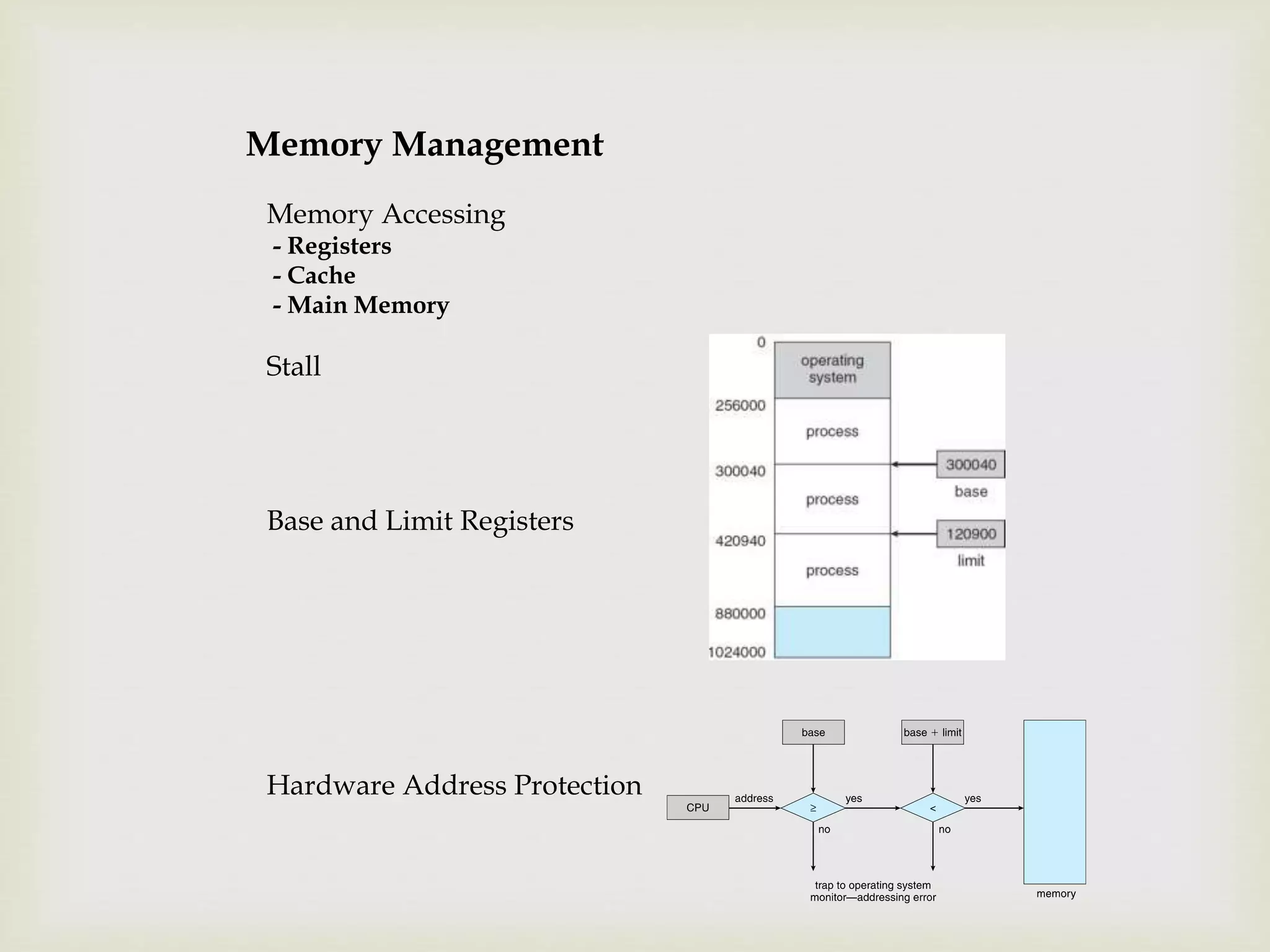
Hardware Address Protection
Base and Limit Registers
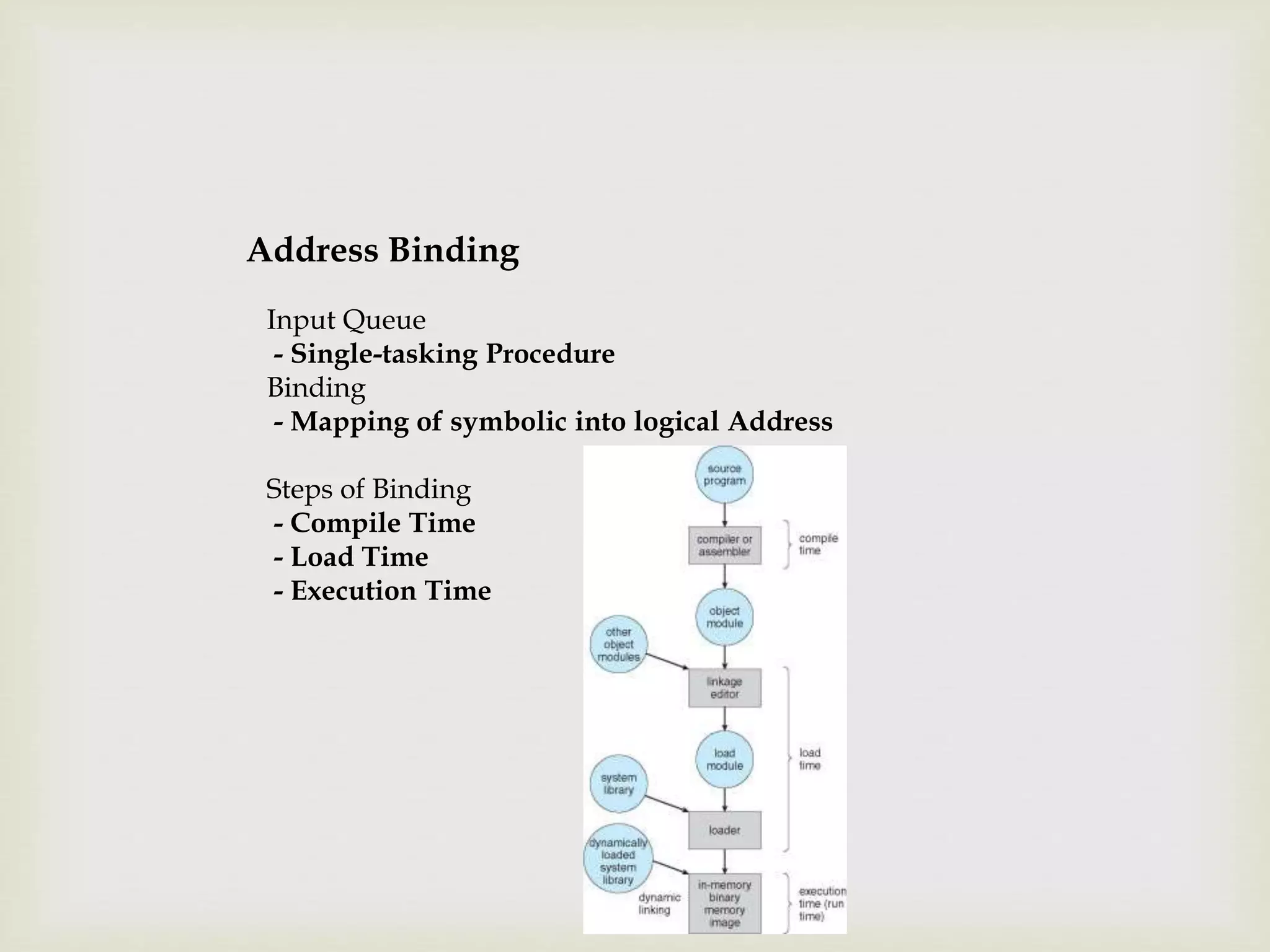
Address Binding
Input Queue
- Single-tasking Procedure
Binding
- Mapping of symbolic into logical Address
Steps of Binding
- Compile Time
- Load Time
- Execution Time
Logical vs Physical Address Space
Logical Address
- Logical Address Space
Physical Address
- Physical Address Space
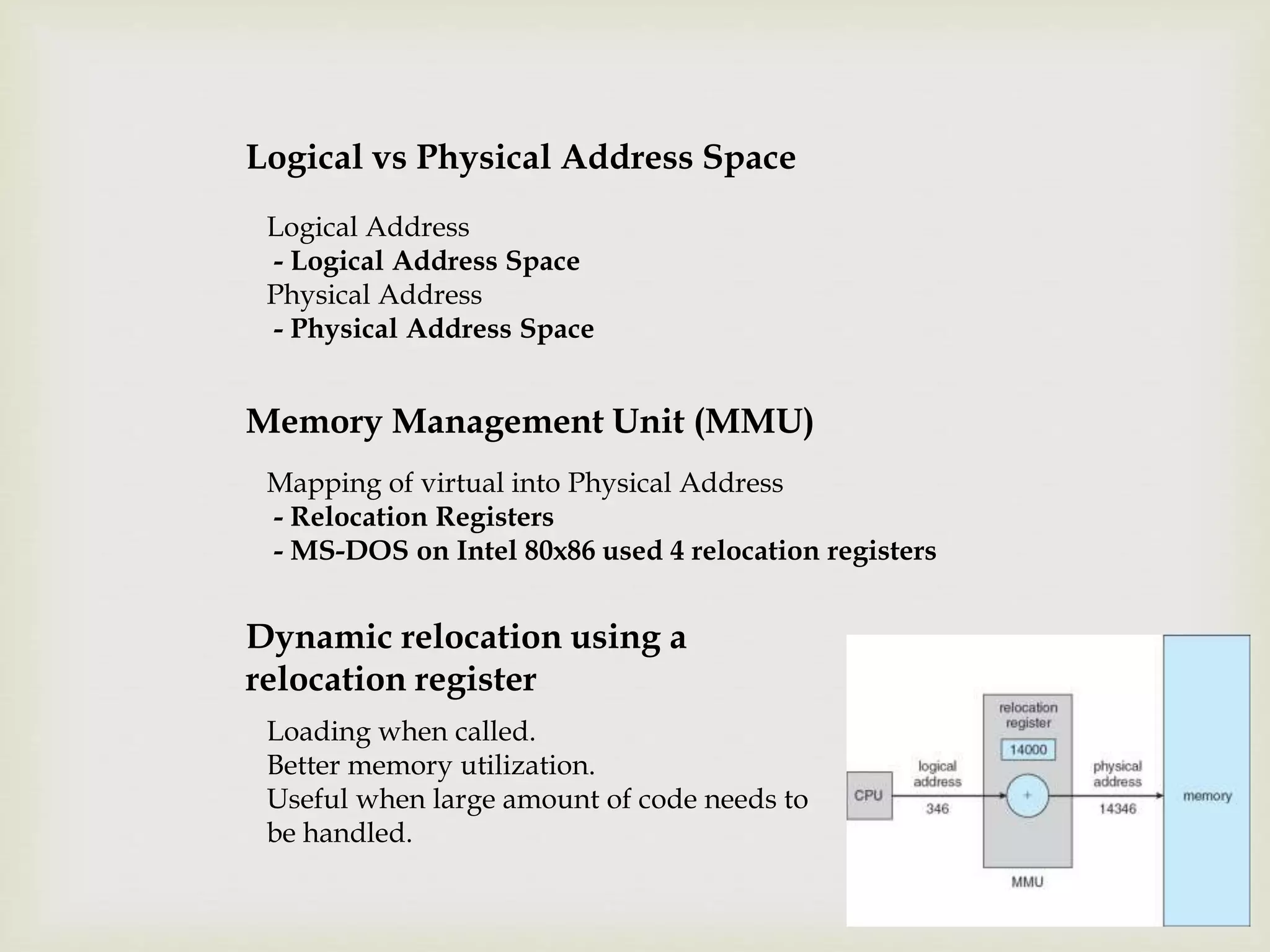
Memory Management Unit (MMU)
Loading when called.
Better memory utilization.
Useful when large amount of code needs to
be handled.
Dynamic relocation using a
relocation register
Mapping of virtual into Physical Address
- Relocation Registers
- MS-DOS on Intel 80x86 used 4 relocation registers
Dynamic Linking
Static linking
Stub Program
Libraries
- shared libraries
Swapping
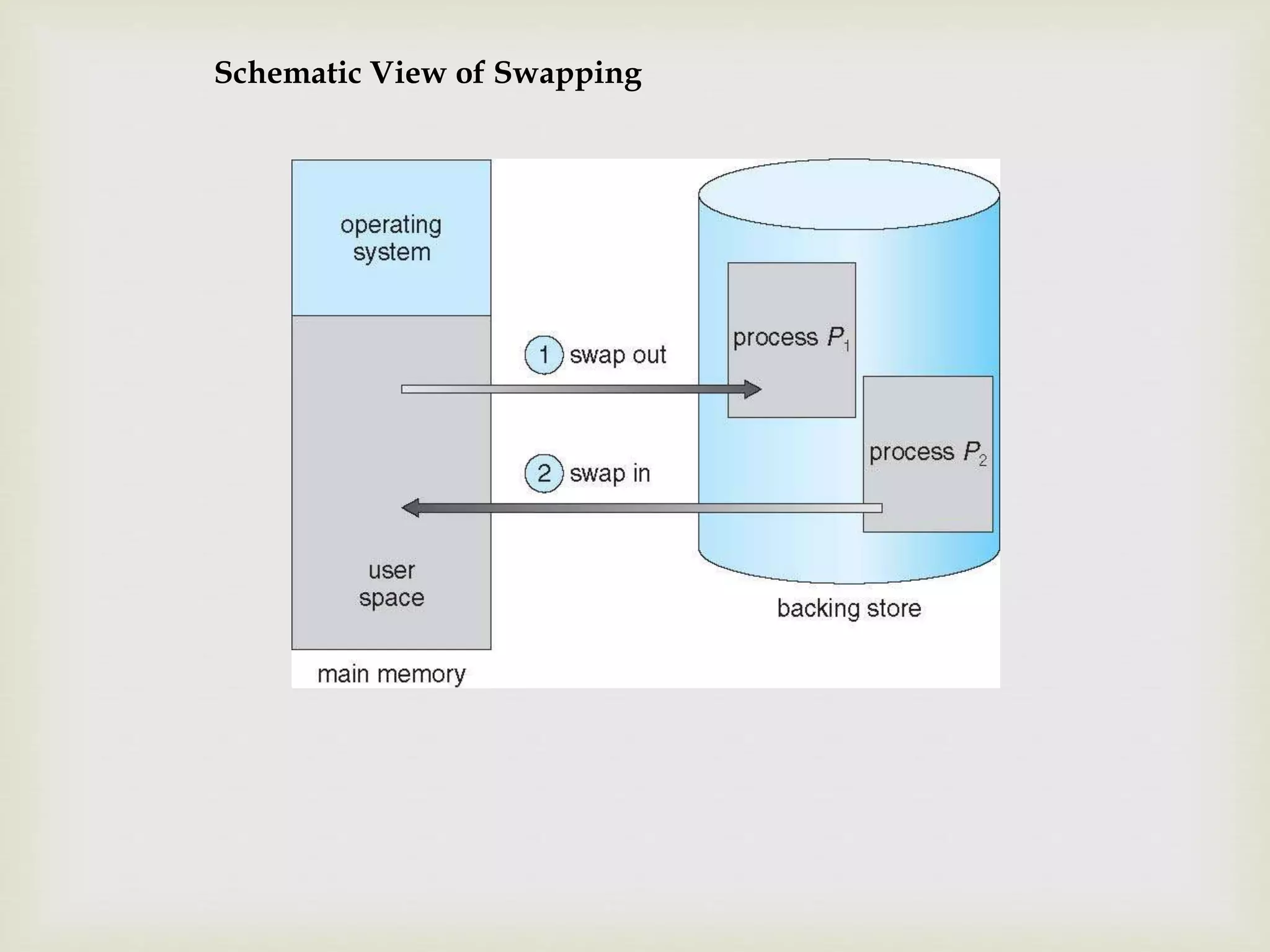
A process can be swapped temporarily out of memory to a backing
store, and then brought back into memory for continued execution
Standard Swapping
Standard swapping involves moving processes between main memory
and Baking store.
• Backing store
• Roll out, roll in
• transfer time
• ready queue
Schematic View of Swapping
Context Switch Time including Swapping
• If next processes to be put on CPU is not in memory, need to swap out
a process and swap in target process
• Context switch time can then be very high
• 100MB process swapping to hard disk with transfer rate of 50MB/sec
• Swapping is constrained by other factors as well.
Pending I/O
Double buffering
Standard swapping not used in modern operating systems
Swapping on Mobile Systems
• Not typically supported
• Flash memory based
• Small amount of space
• Limited number of write cycles
• Poor throughput between flash memory and CPU on
mobile platform
• Instead use other methods to free memory if low
iOS asks
Read-only data
Failure to free
application state
Contiguous Memory Allocation
The main memory must accommodate
both the operating system and the
various user processes.
Main memory usually into two partitions.
- Resident operating system.
- User processes.
- single contiguous section.
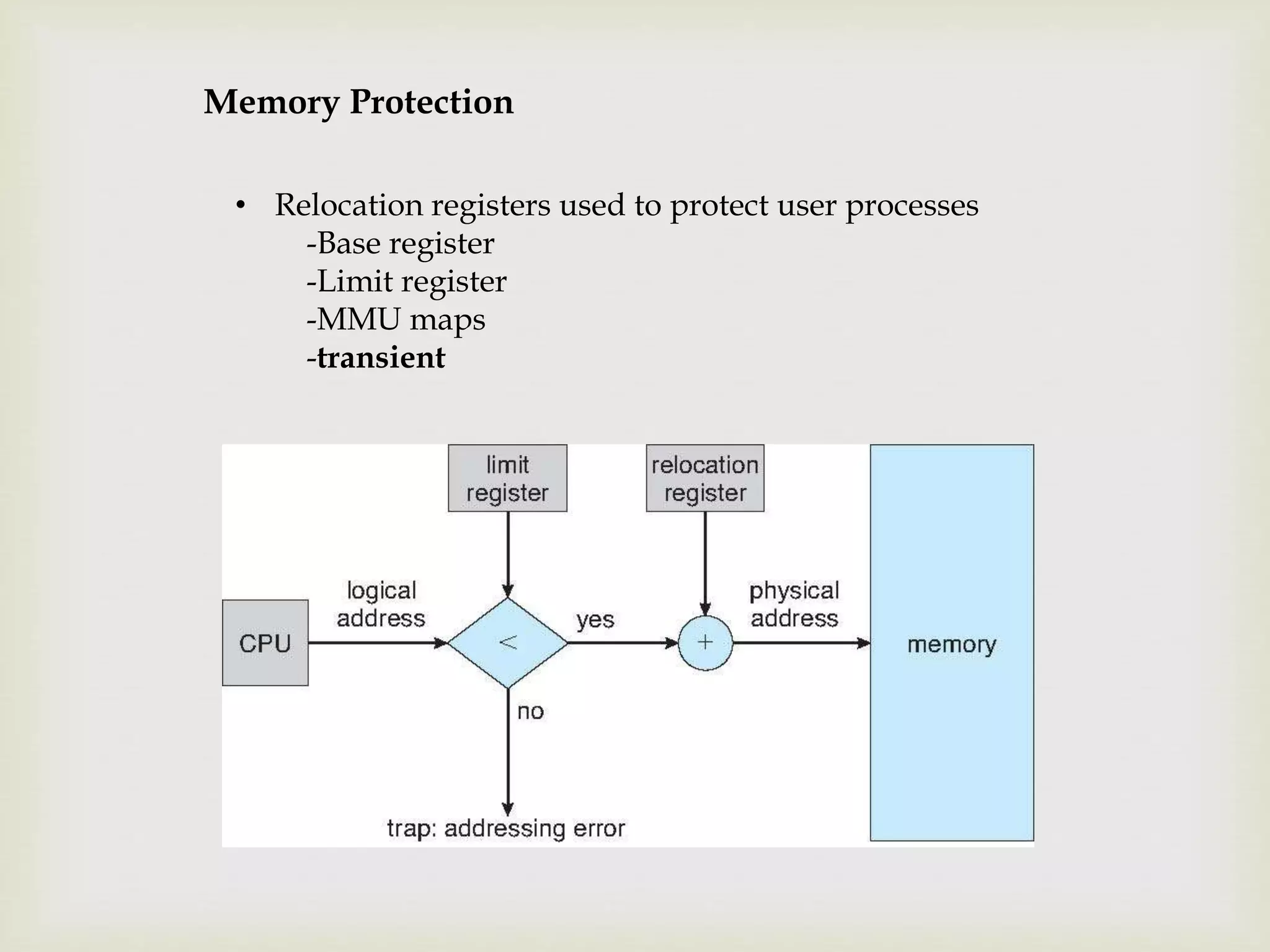
• Relocation registers used to protect user processes
-Base register
-Limit register
-MMU maps
-transient
Memory Protection
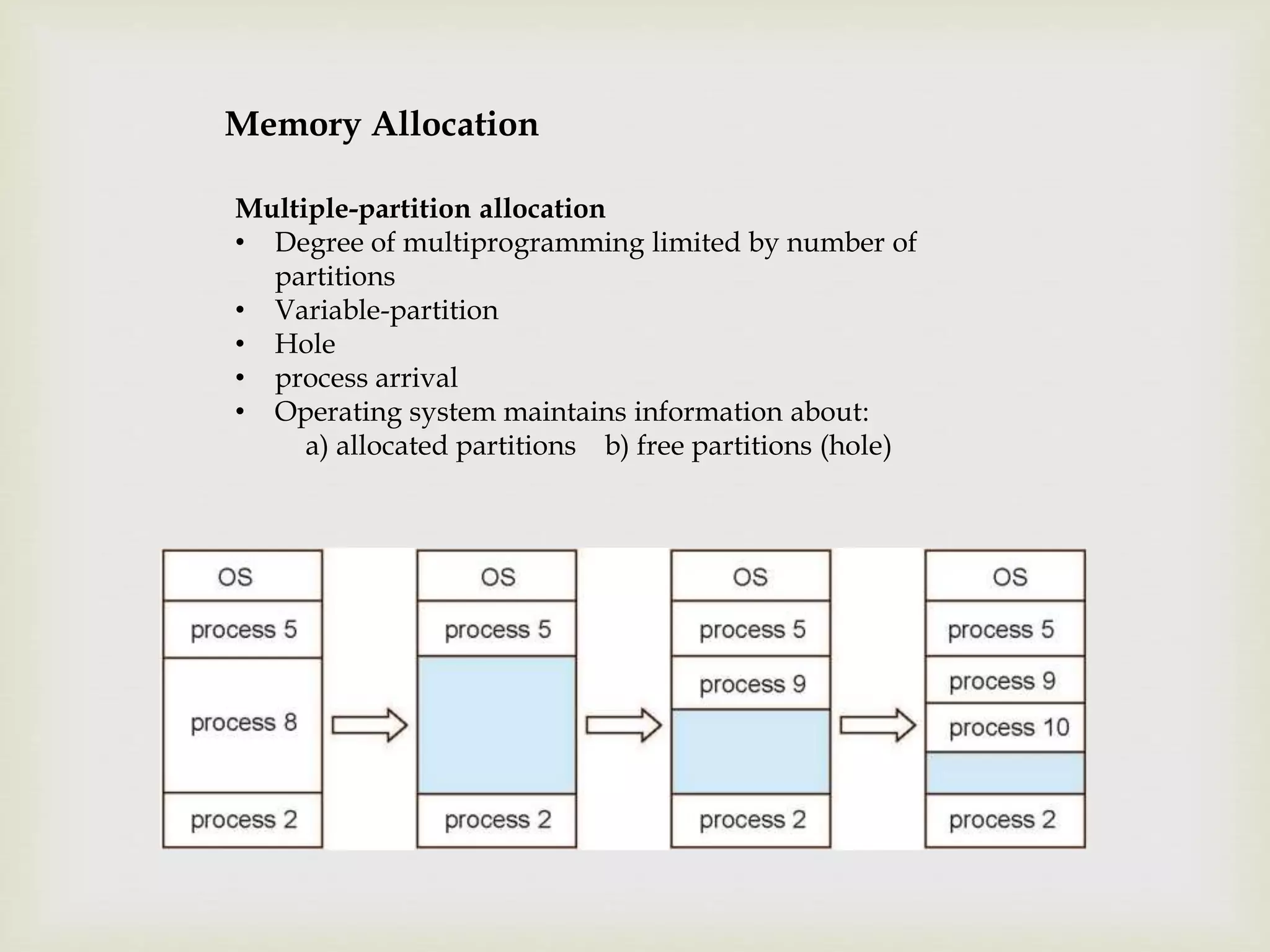
Memory Allocation
Multiple-partition allocation
• Degree of multiprogramming limited by number of
partitions
• Variable-partition
• Hole
• process arrival
• Operating system maintains information about:
a) allocated partitions b) free partitions (hole)
Dynamic Storage-Allocation Problem
• which concerns how to satisfy a request of size n from a
list of free holes.
• First-fit
• Best-fit
• Worst-fit
Fragmentation
• External Fragmentation
• Internal Fragmentation
Reduce external fragmentation by compaction
• Shuffle
• Compaction
• I/O problem
Segmentation
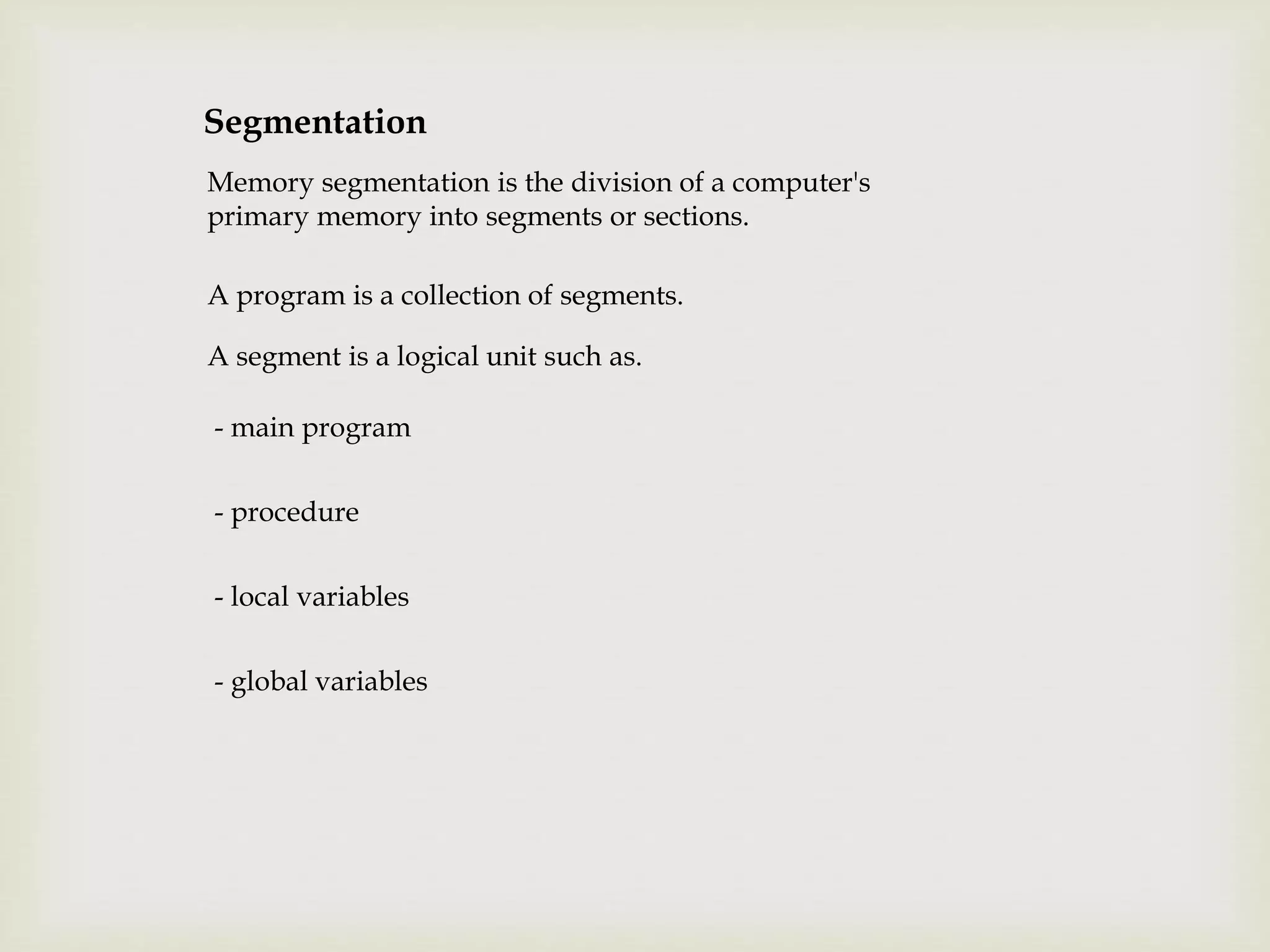
Memory segmentation is the division of a computer's
primary memory into segments or sections.
A program is a collection of segments.
A segment is a logical unit such as.
- main program
- procedure
- local variables
- global variables
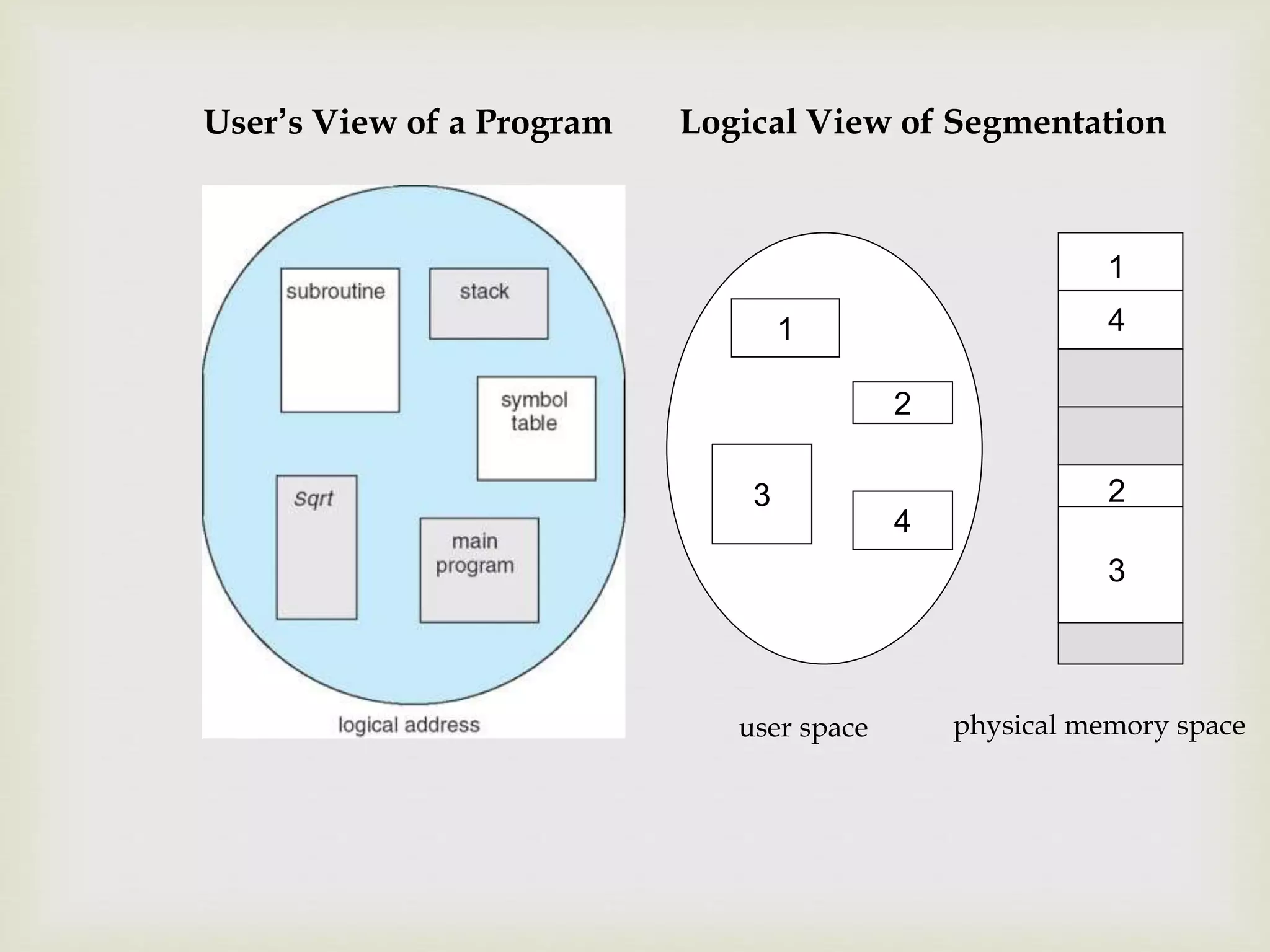
User’s View of a Program Logical View of Segmentation
1
3
2
4
1
4
2
3
user space physical memory space
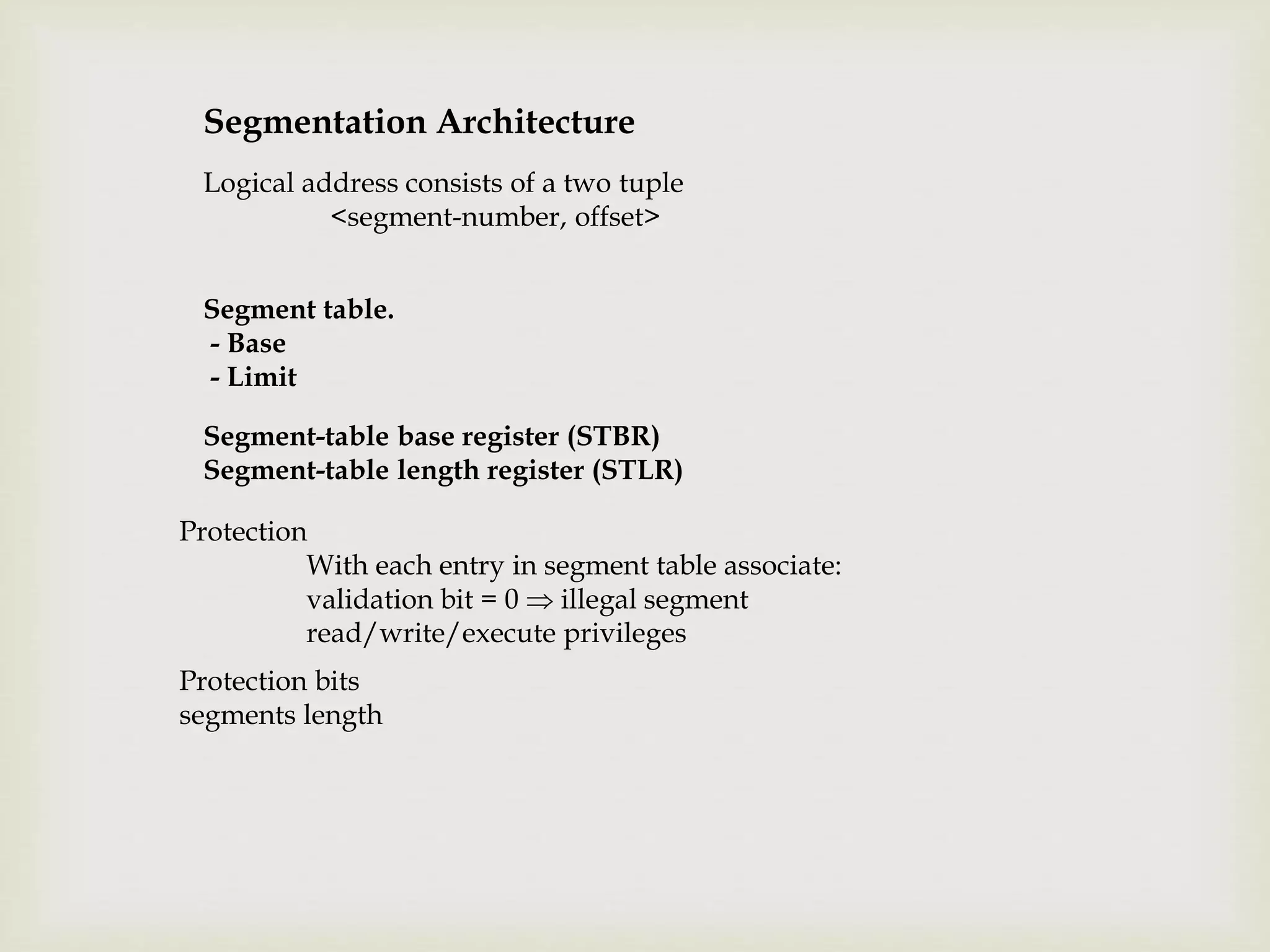
Segmentation Architecture
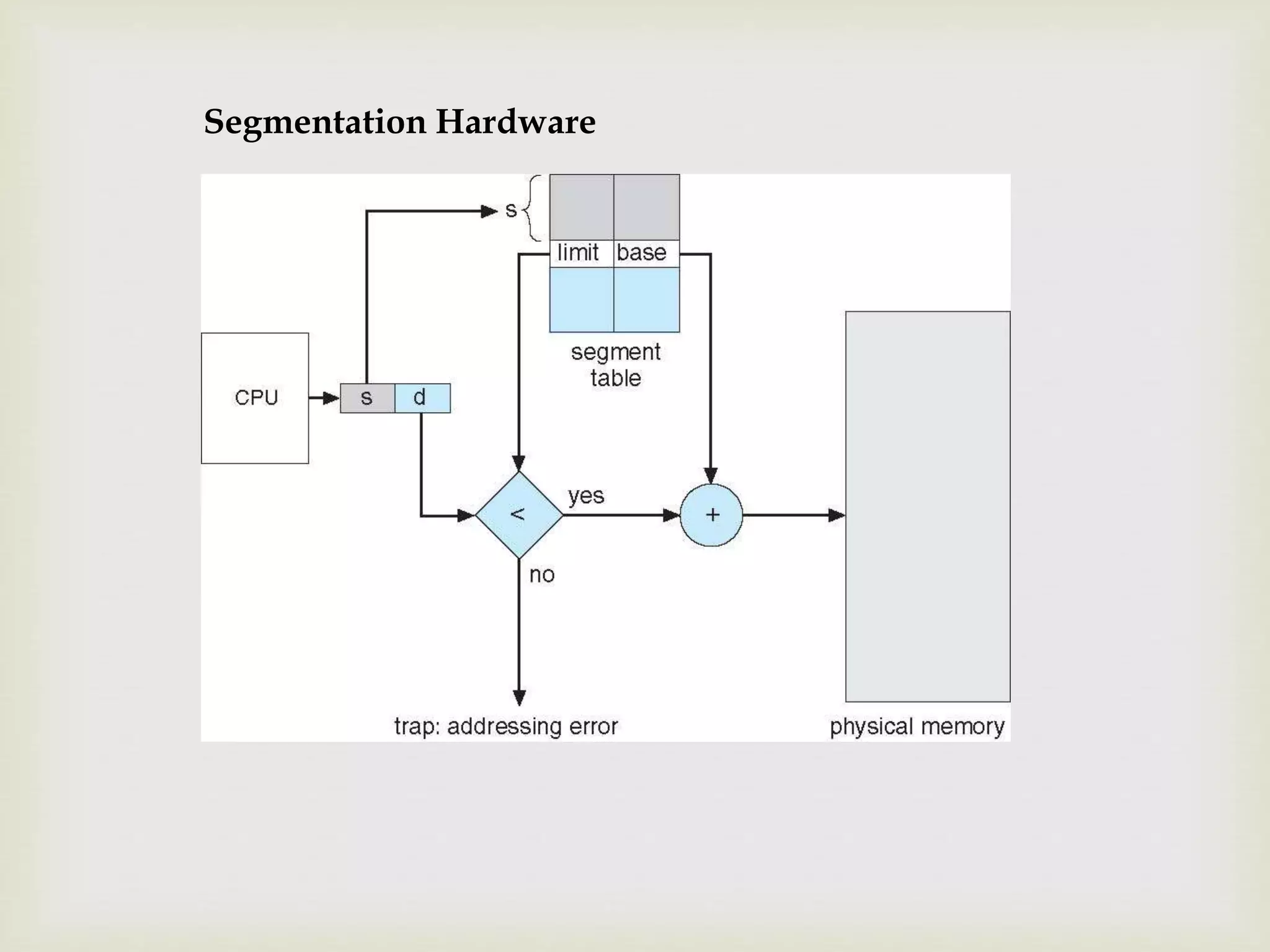
Logical address consists of a two tuple
<segment-number, offset>
Segment table.
- Base
- Limit
Segment-table base register (STBR)
Segment-table length register (STLR)
Protection
With each entry in segment table associate:
validation bit = 0  illegal segment
read/write/execute privileges
Protection bits
segments length
Segmentation Hardware
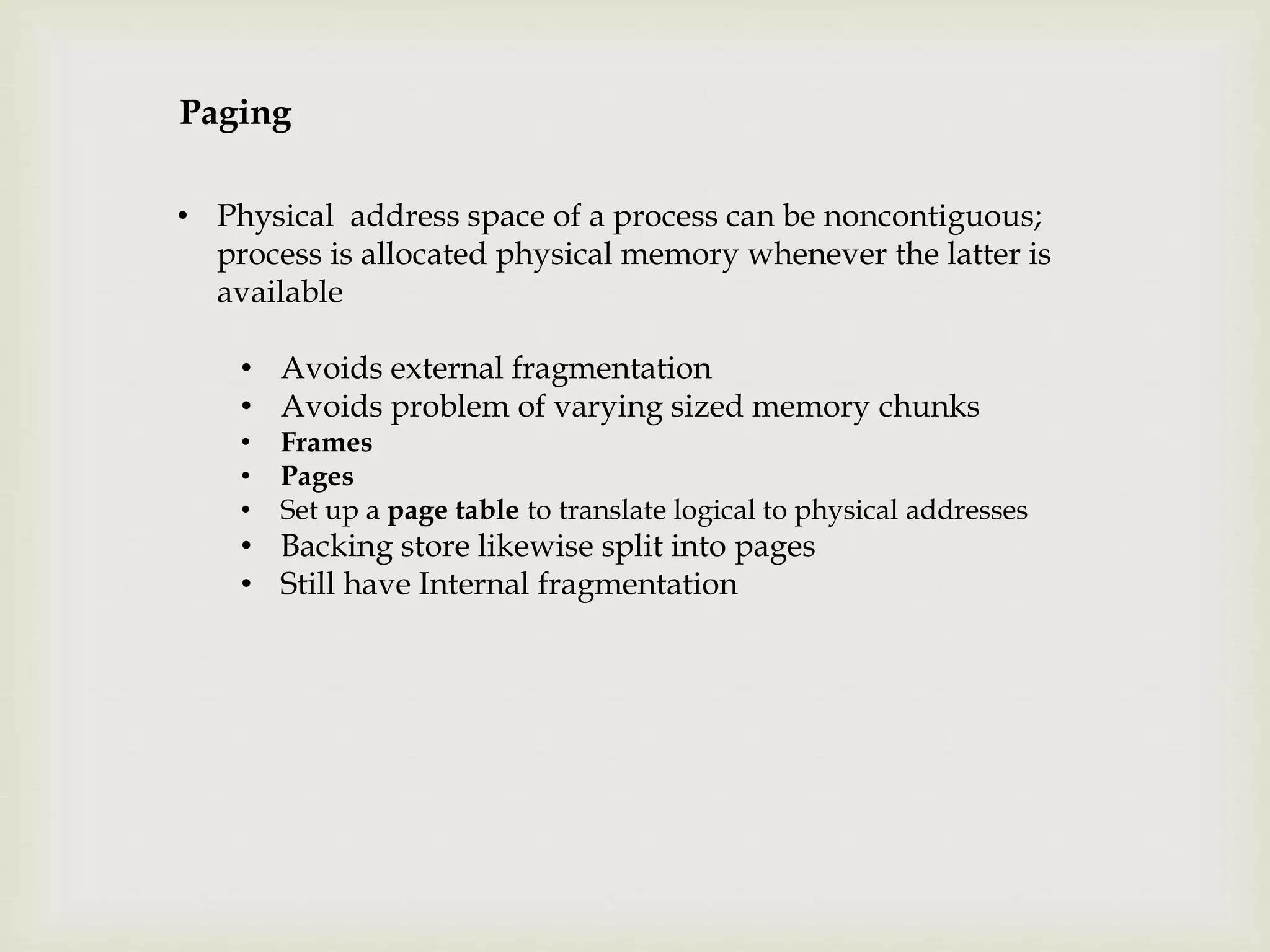
Paging
• Physical address space of a process can be noncontiguous;
process is allocated physical memory whenever the latter is
available
• Avoids external fragmentation
• Avoids problem of varying sized memory chunks
• Frames
• Pages
• Set up a page table to translate logical to physical addresses
• Backing store likewise split into pages
• Still have Internal fragmentation
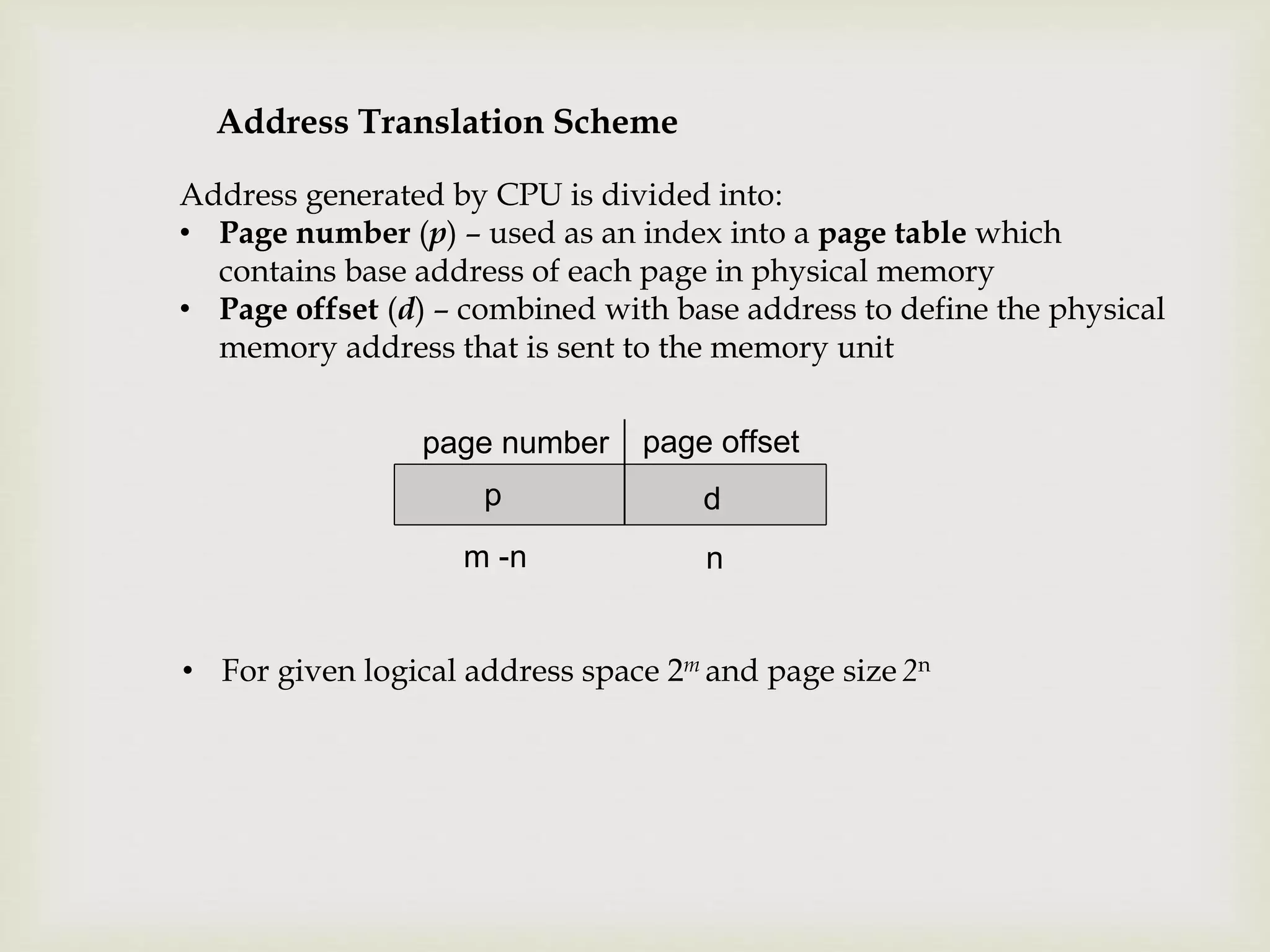
Address Translation Scheme
Address generated by CPU is divided into:
• Page number (p) – used as an index into a page table which
contains base address of each page in physical memory
• Page offset (d) – combined with base address to define the physical
memory address that is sent to the memory unit
page number page offset
p d
m -n n
• For given logical address space 2m and page size 2n
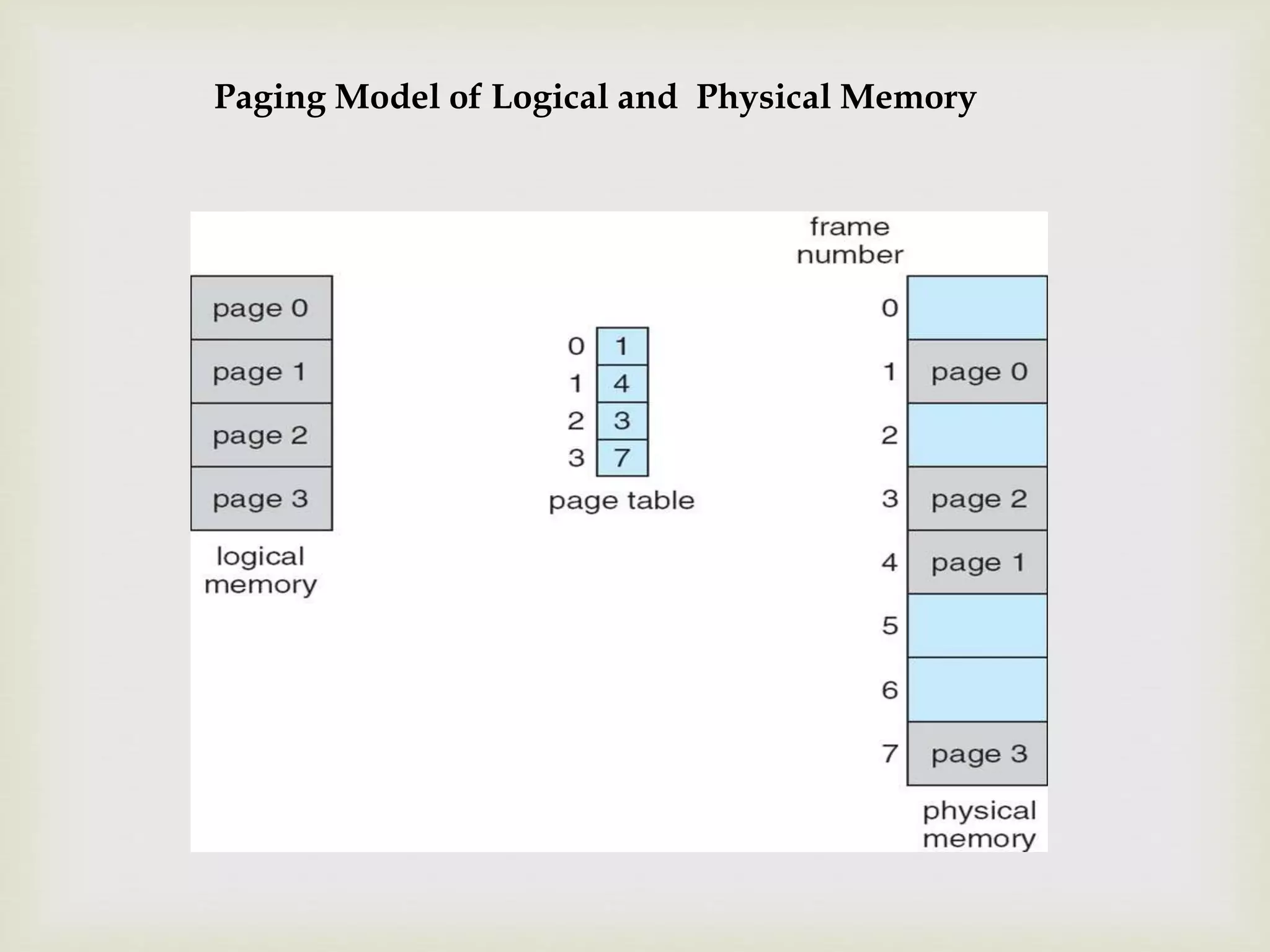
Paging Model of Logical and Physical Memory
Paging Hardware
• Each operating system has its own methods for storing page
tables.
• Some allocate a page table for each process.
• When the dispatcher is told to start a process, it must reload the user
registers and define the correct hardware page-table values from the
stored user page table.
• The hardware implementation of the page table can be
done in several ways.
In the simplest case
The page table is implemented as a set of
dedicated registers.
• Page-table base register (PTBR) points to the
page table.
Page-table Base Register (PTBR)
• The standard solution to this problem is to
use a special, small, fastlookup hardware
cache called a translation look-aside buffer
(TLB).
• The percentage of times that the page number of
interest is found in the TLB is called the hit ratio.
Protection
Memory protection in a paged environment is accomplished by protection bits
associated with each frame.
• One bit can define a page to be read–write or read-
only.
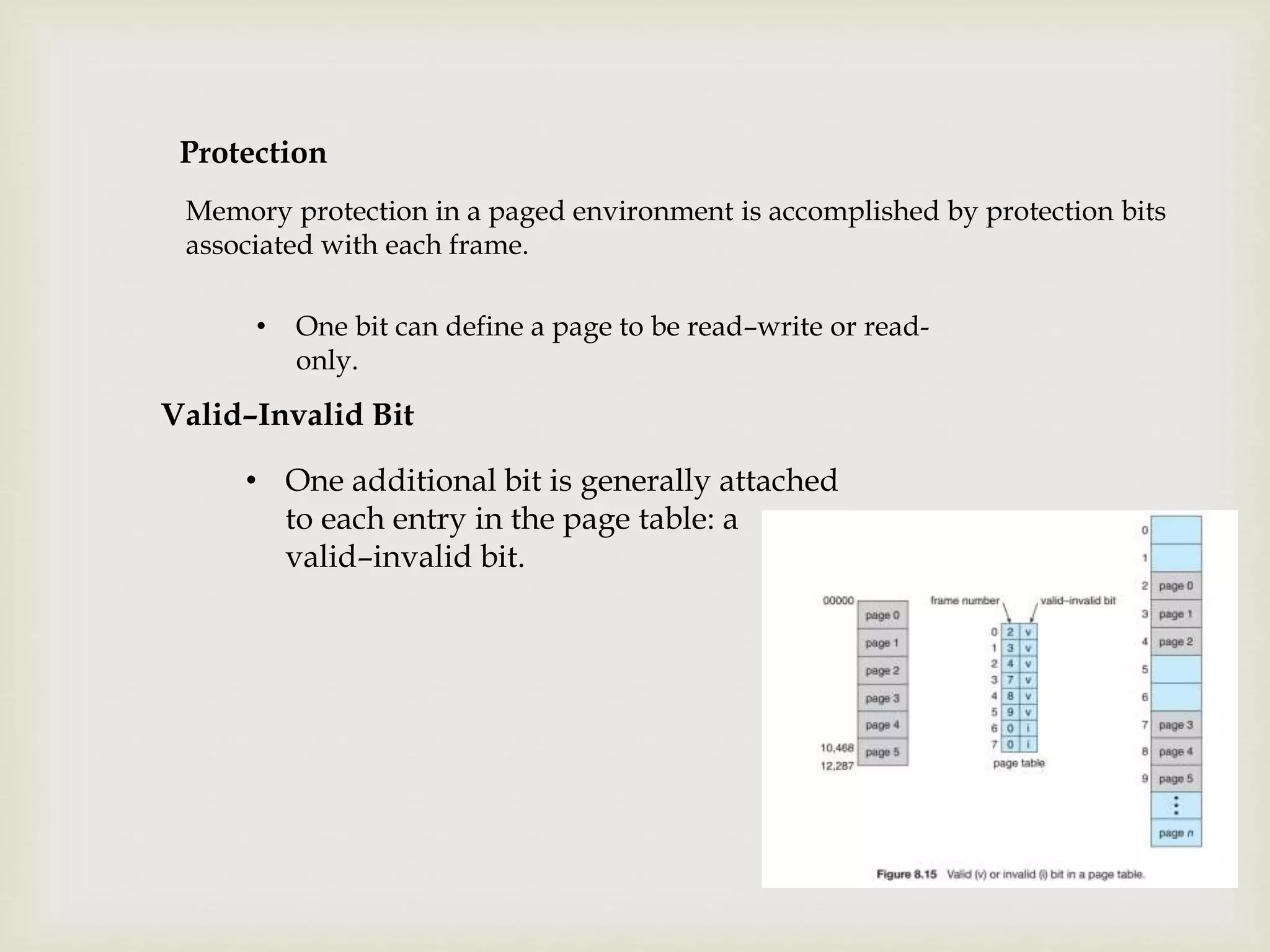
Valid–Invalid Bit
• One additional bit is generally attached
to each entry in the page table: a
valid–invalid bit.
Shared Pages
• An advantage of paging is the possibility of
sharing common code.
• This consideration is particularly important in a
time-sharing environment.
• If the text editor consists of 150 KB of code and 50 KB of data space,
we need 8,000 KB to support the 40 users.
• If the code is reentrant code (or pure code),
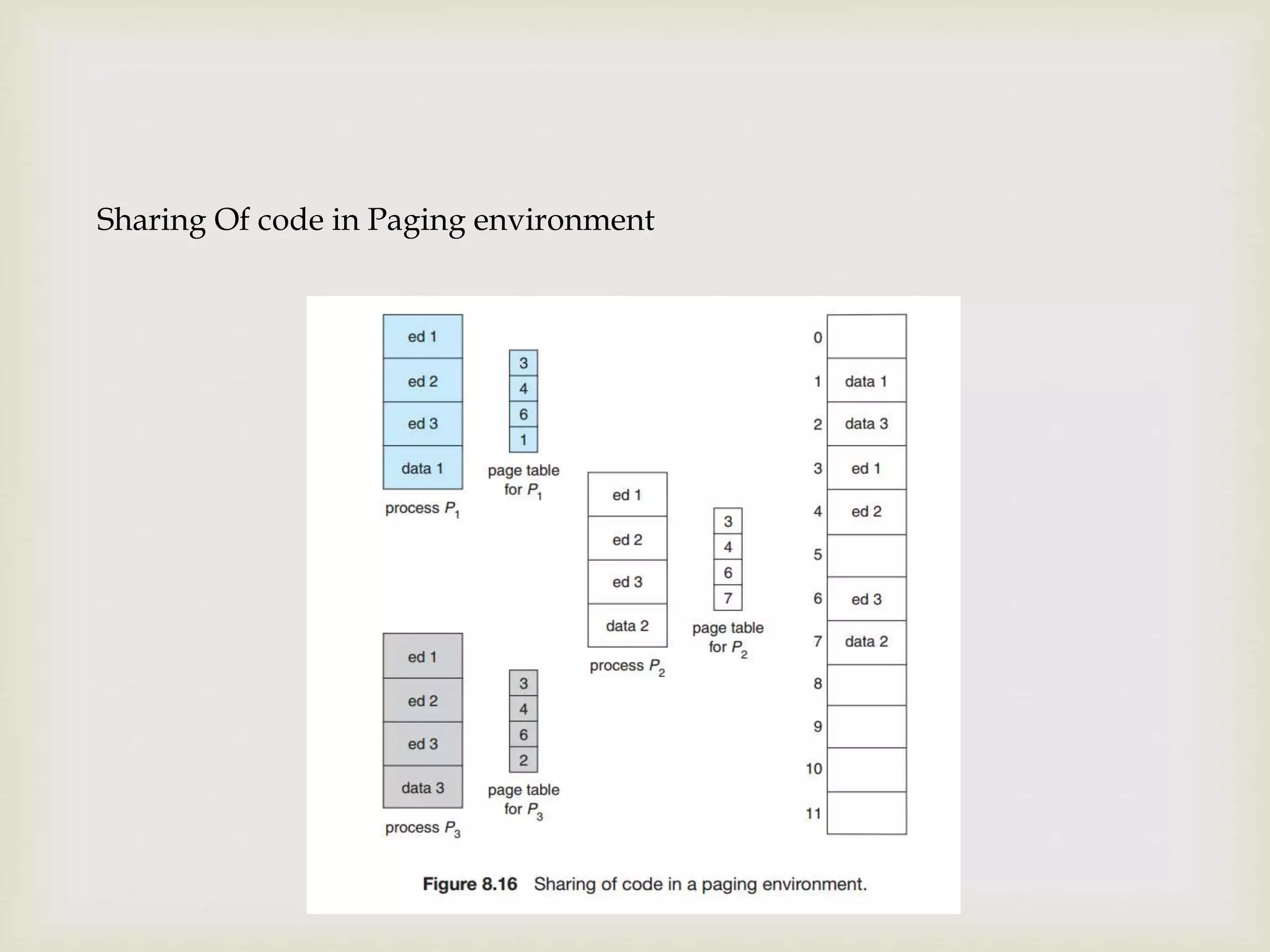
Sharing Of code in Paging environment

Main Memory

  • 1.
  • 2.
    Memory Management Memory Accessing -Registers - Cache - Main Memory Stall Hardware Address Protection Base and Limit Registers
  • 3.
    Address Binding Input Queue -Single-tasking Procedure Binding - Mapping of symbolic into logical Address Steps of Binding - Compile Time - Load Time - Execution Time
  • 4.
    Logical vs PhysicalAddress Space Logical Address - Logical Address Space Physical Address - Physical Address Space Memory Management Unit (MMU) Loading when called. Better memory utilization. Useful when large amount of code needs to be handled. Dynamic relocation using a relocation register Mapping of virtual into Physical Address - Relocation Registers - MS-DOS on Intel 80x86 used 4 relocation registers
  • 5.
    Dynamic Linking Static linking StubProgram Libraries - shared libraries
  • 6.
    Swapping A process canbe swapped temporarily out of memory to a backing store, and then brought back into memory for continued execution Standard Swapping Standard swapping involves moving processes between main memory and Baking store. • Backing store • Roll out, roll in • transfer time • ready queue
  • 7.
  • 8.
    Context Switch Timeincluding Swapping • If next processes to be put on CPU is not in memory, need to swap out a process and swap in target process • Context switch time can then be very high • 100MB process swapping to hard disk with transfer rate of 50MB/sec • Swapping is constrained by other factors as well. Pending I/O Double buffering Standard swapping not used in modern operating systems
  • 9.
    Swapping on MobileSystems • Not typically supported • Flash memory based • Small amount of space • Limited number of write cycles • Poor throughput between flash memory and CPU on mobile platform • Instead use other methods to free memory if low iOS asks Read-only data Failure to free application state
  • 10.
    Contiguous Memory Allocation Themain memory must accommodate both the operating system and the various user processes. Main memory usually into two partitions. - Resident operating system. - User processes. - single contiguous section.
  • 11.
    • Relocation registersused to protect user processes -Base register -Limit register -MMU maps -transient Memory Protection
  • 12.
    Memory Allocation Multiple-partition allocation •Degree of multiprogramming limited by number of partitions • Variable-partition • Hole • process arrival • Operating system maintains information about: a) allocated partitions b) free partitions (hole)
  • 13.
    Dynamic Storage-Allocation Problem •which concerns how to satisfy a request of size n from a list of free holes. • First-fit • Best-fit • Worst-fit
  • 14.
    Fragmentation • External Fragmentation •Internal Fragmentation Reduce external fragmentation by compaction • Shuffle • Compaction • I/O problem
  • 15.
    Segmentation Memory segmentation isthe division of a computer's primary memory into segments or sections. A program is a collection of segments. A segment is a logical unit such as. - main program - procedure - local variables - global variables
  • 16.
    User’s View ofa Program Logical View of Segmentation 1 3 2 4 1 4 2 3 user space physical memory space
  • 17.
    Segmentation Architecture Logical addressconsists of a two tuple <segment-number, offset> Segment table. - Base - Limit Segment-table base register (STBR) Segment-table length register (STLR) Protection With each entry in segment table associate: validation bit = 0  illegal segment read/write/execute privileges Protection bits segments length
  • 18.
  • 19.
    Paging • Physical addressspace of a process can be noncontiguous; process is allocated physical memory whenever the latter is available • Avoids external fragmentation • Avoids problem of varying sized memory chunks • Frames • Pages • Set up a page table to translate logical to physical addresses • Backing store likewise split into pages • Still have Internal fragmentation
  • 20.
    Address Translation Scheme Addressgenerated by CPU is divided into: • Page number (p) – used as an index into a page table which contains base address of each page in physical memory • Page offset (d) – combined with base address to define the physical memory address that is sent to the memory unit page number page offset p d m -n n • For given logical address space 2m and page size 2n
  • 21.
    Paging Model ofLogical and Physical Memory
  • 22.
    Paging Hardware • Eachoperating system has its own methods for storing page tables. • Some allocate a page table for each process. • When the dispatcher is told to start a process, it must reload the user registers and define the correct hardware page-table values from the stored user page table. • The hardware implementation of the page table can be done in several ways. In the simplest case The page table is implemented as a set of dedicated registers.
  • 23.
    • Page-table baseregister (PTBR) points to the page table. Page-table Base Register (PTBR) • The standard solution to this problem is to use a special, small, fastlookup hardware cache called a translation look-aside buffer (TLB). • The percentage of times that the page number of interest is found in the TLB is called the hit ratio.
  • 24.
    Protection Memory protection ina paged environment is accomplished by protection bits associated with each frame. • One bit can define a page to be read–write or read- only. Valid–Invalid Bit • One additional bit is generally attached to each entry in the page table: a valid–invalid bit.
  • 25.
    Shared Pages • Anadvantage of paging is the possibility of sharing common code. • This consideration is particularly important in a time-sharing environment. • If the text editor consists of 150 KB of code and 50 KB of data space, we need 8,000 KB to support the 40 users. • If the code is reentrant code (or pure code),
  • 26.
    Sharing Of codein Paging environment