• Definition
• Properties
• Indications and Contraindications
• Dress for the patient and therapist
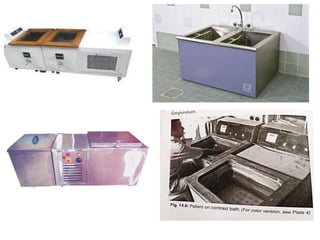
• Hydrotherapy equipments
• Types of hydrotherapy
i. Contrast bath
ii. Whirlpool bath
iii. Hubbard tank
• Safety features
• Hygiene of patient
• Maintenance
• Reference
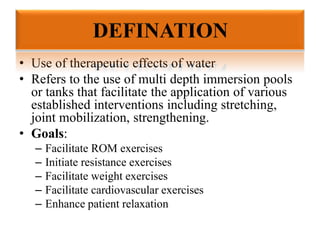
• Use of therapeutic effects of water
• Refers to the use of multi depth immersion pools
or tanks that facilitate the application of various
established interventions including stretching,
joint mobilization, strengthening.
• Goals:
– Facilitate ROM exercises
– Initiate resistance exercises
– Facilitate weight exercises
– Facilitate cardiovascular exercises
– Enhance patient relaxation
• Upward force that works opposite to gravity
• Provides resistance to movement when an
extremity is moved against the force of
buoyancy. This helps to strengthen muscles
Buoyancy
• Pressure exerted by the water on immersed
objects
• Increased pressure reduces or limits effusion,
assist venous return, induces bradycardia etc
Hydrostatic
Pressure
• Friction occurring between molecules of
liquid resulting in resistance to flow
• Water’s resistance creates resistance with all
active movements
Viscosity
• Have the patient remove the clothing as
necessary
– Rolled up sleeves and pants will often get wet
• Remove all bandages, tape, brace, etc
• Appropriate swim wear
• Swimming cap for long hair
• Relaxation
• Detoxification
• Assist wound healing
• Stiffness of whole body or limbs
• Menstrual irregularities
• Increased swelling of the extremities
• Muscular problems: muscle spasm, weakness etc
• Bony or skeletal problems: Arthritis, post fracture
stiffness etc
• Neurological problems: paralytic conditions
• Treatment of burn
• People with poor circulation or low vitality should not be subjected to
extremes of temperature
• Diabetes should avoid any heat treatments to their legs
• Extreme fragile skin
• Skin condition which are irritated by moisture
• Area of numbness
• Respiratory dysfunction, vital capacity of less than 1 liter( normal-5L)
• Danger of bleeding and hemorrhage
• Severe kidney diseases
• Severe angina
• Inflammatory diseases in the acute stage
• Water and air borne diseases. e.g: influenza, GIT infections, cholera etc
• Avoiding treatment with hydrotherapy soon after
having a meal
• People having AIDS shouldn’t be allowed to the
pool if they have any recent cut.
• If person is mentally retarded
• If the person is wearing contact lens.
• Patient have fear of water.
• Patient have epilepsy.
• If the person is wearing an hearing aids.
• An essential element of most hydrotherapy treatment allows a
therapist to bring water into contact with the clients body in
carefully controlled way
• Hydrotherapy equipment's varies with treatment. Eg: Hydro-tech
used for massage and bodywork uses hydro-balloon
• Following are some information you need to consider when
choosing hydrotherapy equipment's:
– Client comfort
– Design( therapist friendly, effective control of water ∆re
– Hygiene and safe
– Education( Installation, how to use, treatment , menu
planning)
– Durability(Problem free, adequate warranty, easy to repair)
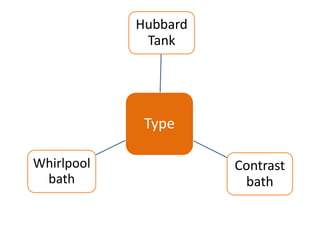
Type
Hubbard
Tank
Contrast
bath
Whirlpool
bath
• Treatment involves both hot and cold therapy on same
body part.
• Causes sensory stimulation due to activation of both
cutaneous hot and cold receptor
• Helps to modulate pain, decrease local edema and
increase circulation
– For pain relief, start and end with hot water
– For edema, start and end with cold water
• Method of application
• Indications:
– Post traumatic swelling, pain due to swelling, chronic
inflammation
• Contraindications
– Advanced vascular disease, arterial insufficiency, diabetes
mellitus
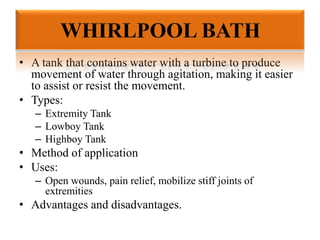
• A tank that contains water with a turbine to produce
movement of water through agitation, making it easier
to assist or resist the movement.
• Types:
– Extremity Tank
– Lowboy Tank
– Highboy Tank
• Method of application
• Uses:
– Open wounds, pain relief, mobilize stiff joints of
extremities
• Advantages and disadvantages.
• Specially designed full immersion tank and mainly for
patients who are unable to stand.
• Mainly designed for underwater exercises
– Has jets for hydrotherapy massage
– Support bars for doing exercise
• Wide top and bottom, narrow middle which allow room
for exercises for the extremities and PT assist the
patients
• Patients are usually lowered on a stretcher by an over
head hydraulic hoist.
• Equipped with 2 turbines that can be moved around the
perimeter.
• Client showers before the hydrotherapy treatment.
• Protection from slippery surfaces.
– One precaution, use anti-slip mats
– Whenever possible, assist the patient
• SCALD protection
– A feature that prevents ∆re from becoming too hot.
• Pressure balancing
– Feature that prevents fluctuation in water pressure
when water is used elsewhere.
• Cleaning
• Disinfection
• Drying hydrotherapy equipment and room
surface
• Keep it clean and polished, avoid abrasive
cleaner/ stainless still causing tiny grooves in
which Staphylococcus can grow.
• Wipe of the benches and clean the floor
• Drain the tank at the end of the day after
cleaning the turbine shaft
• Holistic Pain relief: How to ease muscles, joints and other
painful conditions: Leon Chaitou(pg 91)
• Hydrotherapy for health and wellness, theory programs and
treatment: Richard Edison(pg 133,164,210)
• Physiotherapy in medical conditions: Suraj Kumar and Anoop
Aggarwal(pg118)
• Introduction to physical therapy, 3rd edition: Michael A.
Pagliarulo(pg 206)
• Pedretti’s occupational therapy(Practice skill for physical
dysfunction) 6th edition(pg 1066)
• Physical therapy for children: Suzann K. Camphill, Darl W.
Vander Linden, Robert J. Palisano(pg 1028)
• Therapeutic Modalities in Rehabilitation, 3rd edition: William
E. Prentice(pg 29)
• Therapeutic modalities (the art and science): Kenneth L.
Knight, David O. Draper(pg 202)
• Tidy’s physiotherapy, 14th edition, South Asia Edition: Stuart
Porter(pg 445)
• Natural spa and Hydrotherapy(theory and practice): An L.
Michina, Sandra R Anderson(pg 78)
• Electrotherapy simplified(pg 271): Basanta Kumar Nanda
Hydrotherapy

Hydrotherapy

  • 2.
    • Definition • Properties •Indications and Contraindications • Dress for the patient and therapist • Hydrotherapy equipments • Types of hydrotherapy i. Contrast bath ii. Whirlpool bath iii. Hubbard tank • Safety features • Hygiene of patient • Maintenance • Reference
  • 3.
    • Use oftherapeutic effects of water • Refers to the use of multi depth immersion pools or tanks that facilitate the application of various established interventions including stretching, joint mobilization, strengthening. • Goals: – Facilitate ROM exercises – Initiate resistance exercises – Facilitate weight exercises – Facilitate cardiovascular exercises – Enhance patient relaxation
  • 4.
    • Upward forcethat works opposite to gravity • Provides resistance to movement when an extremity is moved against the force of buoyancy. This helps to strengthen muscles Buoyancy • Pressure exerted by the water on immersed objects • Increased pressure reduces or limits effusion, assist venous return, induces bradycardia etc Hydrostatic Pressure • Friction occurring between molecules of liquid resulting in resistance to flow • Water’s resistance creates resistance with all active movements Viscosity
  • 5.
    • Have thepatient remove the clothing as necessary – Rolled up sleeves and pants will often get wet • Remove all bandages, tape, brace, etc • Appropriate swim wear • Swimming cap for long hair
  • 7.
    • Relaxation • Detoxification •Assist wound healing • Stiffness of whole body or limbs • Menstrual irregularities • Increased swelling of the extremities • Muscular problems: muscle spasm, weakness etc • Bony or skeletal problems: Arthritis, post fracture stiffness etc • Neurological problems: paralytic conditions • Treatment of burn
  • 8.
    • People withpoor circulation or low vitality should not be subjected to extremes of temperature • Diabetes should avoid any heat treatments to their legs • Extreme fragile skin • Skin condition which are irritated by moisture • Area of numbness • Respiratory dysfunction, vital capacity of less than 1 liter( normal-5L) • Danger of bleeding and hemorrhage • Severe kidney diseases • Severe angina • Inflammatory diseases in the acute stage • Water and air borne diseases. e.g: influenza, GIT infections, cholera etc
  • 9.
    • Avoiding treatmentwith hydrotherapy soon after having a meal • People having AIDS shouldn’t be allowed to the pool if they have any recent cut. • If person is mentally retarded • If the person is wearing contact lens. • Patient have fear of water. • Patient have epilepsy. • If the person is wearing an hearing aids.
  • 10.
    • An essentialelement of most hydrotherapy treatment allows a therapist to bring water into contact with the clients body in carefully controlled way • Hydrotherapy equipment's varies with treatment. Eg: Hydro-tech used for massage and bodywork uses hydro-balloon • Following are some information you need to consider when choosing hydrotherapy equipment's: – Client comfort – Design( therapist friendly, effective control of water ∆re – Hygiene and safe – Education( Installation, how to use, treatment , menu planning) – Durability(Problem free, adequate warranty, easy to repair)
  • 12.
  • 13.
    • Treatment involvesboth hot and cold therapy on same body part. • Causes sensory stimulation due to activation of both cutaneous hot and cold receptor • Helps to modulate pain, decrease local edema and increase circulation – For pain relief, start and end with hot water – For edema, start and end with cold water • Method of application • Indications: – Post traumatic swelling, pain due to swelling, chronic inflammation • Contraindications – Advanced vascular disease, arterial insufficiency, diabetes mellitus
  • 15.
    • A tankthat contains water with a turbine to produce movement of water through agitation, making it easier to assist or resist the movement. • Types: – Extremity Tank – Lowboy Tank – Highboy Tank • Method of application • Uses: – Open wounds, pain relief, mobilize stiff joints of extremities • Advantages and disadvantages.
  • 18.
    • Specially designedfull immersion tank and mainly for patients who are unable to stand. • Mainly designed for underwater exercises – Has jets for hydrotherapy massage – Support bars for doing exercise • Wide top and bottom, narrow middle which allow room for exercises for the extremities and PT assist the patients • Patients are usually lowered on a stretcher by an over head hydraulic hoist. • Equipped with 2 turbines that can be moved around the perimeter.
  • 20.
    • Client showersbefore the hydrotherapy treatment. • Protection from slippery surfaces. – One precaution, use anti-slip mats – Whenever possible, assist the patient • SCALD protection – A feature that prevents ∆re from becoming too hot. • Pressure balancing – Feature that prevents fluctuation in water pressure when water is used elsewhere.
  • 21.
    • Cleaning • Disinfection •Drying hydrotherapy equipment and room surface
  • 22.
    • Keep itclean and polished, avoid abrasive cleaner/ stainless still causing tiny grooves in which Staphylococcus can grow. • Wipe of the benches and clean the floor • Drain the tank at the end of the day after cleaning the turbine shaft
  • 23.
    • Holistic Painrelief: How to ease muscles, joints and other painful conditions: Leon Chaitou(pg 91) • Hydrotherapy for health and wellness, theory programs and treatment: Richard Edison(pg 133,164,210) • Physiotherapy in medical conditions: Suraj Kumar and Anoop Aggarwal(pg118) • Introduction to physical therapy, 3rd edition: Michael A. Pagliarulo(pg 206) • Pedretti’s occupational therapy(Practice skill for physical dysfunction) 6th edition(pg 1066) • Physical therapy for children: Suzann K. Camphill, Darl W. Vander Linden, Robert J. Palisano(pg 1028)
  • 24.
    • Therapeutic Modalitiesin Rehabilitation, 3rd edition: William E. Prentice(pg 29) • Therapeutic modalities (the art and science): Kenneth L. Knight, David O. Draper(pg 202) • Tidy’s physiotherapy, 14th edition, South Asia Edition: Stuart Porter(pg 445) • Natural spa and Hydrotherapy(theory and practice): An L. Michina, Sandra R Anderson(pg 78) • Electrotherapy simplified(pg 271): Basanta Kumar Nanda