MAGNETIC REEL
TAPE
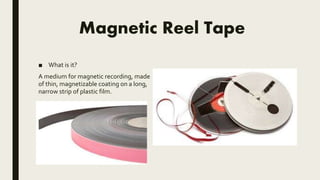
Magnetic Reel Tape
■ What is it?
A medium for magnetic recording, made
of thin, magnetizable coating on a long,
narrow strip of plastic film.
Oberlin Smith
(1880)
An American Engineer
Published one of the earliest works
dealing with magnetic recording.
“Some Possible Forms of the
Phonograph”
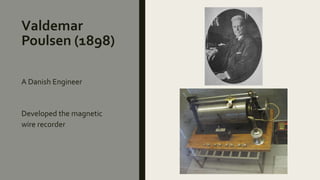
Valdemar
Poulsen (1898)
A Danish Engineer
Developed the magnetic
wire recorder
Fritz
Pfleumer
(1928)
A German-Austrian engineer
Invented magnetic tape for
recording sound, based the
invention ofValdemar Poulsen in
1898 and Oberlin Smith in 1888.
Used a ferric oxide powder coating
on a long strip of paper.
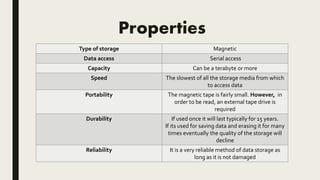
Properties
Type of storage Magnetic
Data access Serial access
Capacity Can be a terabyte or more
Speed The slowest of all the storage media from which
to access data
Portability The magnetic tape is fairly small. However, in
order to be read, an external tape drive is
required
Durability If used once it will last typically for 15 years.
If its used for saving data and erasing it for many
times eventually the quality of the storage will
decline
Reliability It is a very reliable method of data storage as
long as it is not damaged
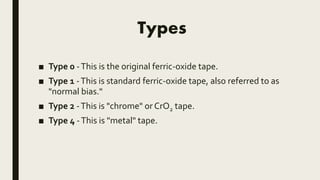
Types
■ Type 0 -This is the original ferric-oxide tape.
■ Type 1 -This is standard ferric-oxide tape, also referred to as
"normal bias."
■ Type 2 -This is "chrome" or CrO2 tape.
■ Type 4 -This is "metal" tape.
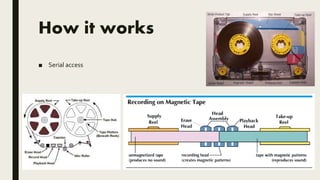
How it works
■ Serial access
Types of
Magnetic Reel
Tape
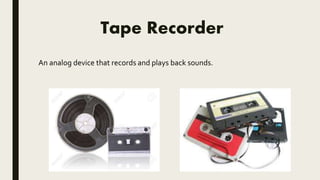
Tape Recorder
An analog device that records and plays back sounds.
Videotape
■ Used for storing motion images and usually sound, as
opposed to film or random-access digital media.
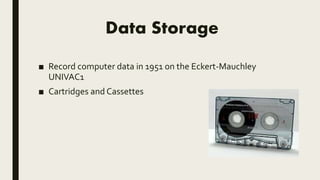
Data Storage
■ Record computer data in 1951 on the Eckert-Mauchley
UNIVAC1
■ Cartridges and Cassettes
Advantages
and
Disadvantages
Advantages
■ Cheap
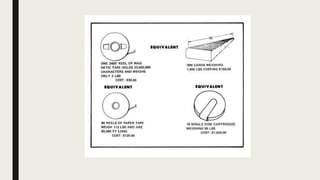
■ Can store large amounts of data
■ Can be set up to do the back up
overnight or over the weekend
■ Easy to edit using a traditional
linear-editing system
Disadvantages
■ Serial access
■ Need a special place of equipment to
record and read the data on the tape
■ The data may be corrupted if the
tape is placed near a strong
magnetic field
■ Slow access compared to disc
■ That each successive copy of a tape
loses quality compared to the
original.
■ It has a tendency to stretch out over
time, causing the quality of the data
to deteriorate.
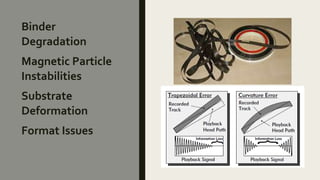
Causes of
Magnetic tape
failure
Binder
Degradation
Magnetic Particle
Instabilities
Substrate
Deformation
Format Issues
References
■ http://www.tvhandbook.com/history/history_recording.htm (Tape recording
technology)
■ http://www.tech-ict.com/gsc_new/computer (Magnetic tape)
■ http://www.tpub.com/wets/book2397a.htm (Causes of magnetic tape failure)
■ http://electronics.howstuffworks.com/gadgets/audio-music/cassette.htm (HowTape
Recorders Work)
■ “Magnetic Materials”. Memory of the world. Safeguarding the documentary heritage.
A guide to standard, recommended practices and reference literature related to the
presentation of documents of all kinds. ONESCO. 1998. C11. 98/W5/4
■ RadioTelevision Electronics, Popular Mechanics,April 1954, p.157

Magnetic reel tape

  • 1.
  • 2.
    Magnetic Reel Tape ■What is it? A medium for magnetic recording, made of thin, magnetizable coating on a long, narrow strip of plastic film.
  • 3.
    Oberlin Smith (1880) An AmericanEngineer Published one of the earliest works dealing with magnetic recording. “Some Possible Forms of the Phonograph”
  • 4.
    Valdemar Poulsen (1898) A DanishEngineer Developed the magnetic wire recorder
  • 5.
    Fritz Pfleumer (1928) A German-Austrian engineer Inventedmagnetic tape for recording sound, based the invention ofValdemar Poulsen in 1898 and Oberlin Smith in 1888. Used a ferric oxide powder coating on a long strip of paper.
  • 7.
    Properties Type of storageMagnetic Data access Serial access Capacity Can be a terabyte or more Speed The slowest of all the storage media from which to access data Portability The magnetic tape is fairly small. However, in order to be read, an external tape drive is required Durability If used once it will last typically for 15 years. If its used for saving data and erasing it for many times eventually the quality of the storage will decline Reliability It is a very reliable method of data storage as long as it is not damaged
  • 8.
    Types ■ Type 0-This is the original ferric-oxide tape. ■ Type 1 -This is standard ferric-oxide tape, also referred to as "normal bias." ■ Type 2 -This is "chrome" or CrO2 tape. ■ Type 4 -This is "metal" tape.
  • 9.
    How it works ■Serial access
  • 10.
  • 11.
    Tape Recorder An analogdevice that records and plays back sounds.
  • 12.
    Videotape ■ Used forstoring motion images and usually sound, as opposed to film or random-access digital media.
  • 13.
    Data Storage ■ Recordcomputer data in 1951 on the Eckert-Mauchley UNIVAC1 ■ Cartridges and Cassettes
  • 14.
  • 15.
    Advantages ■ Cheap ■ Canstore large amounts of data ■ Can be set up to do the back up overnight or over the weekend ■ Easy to edit using a traditional linear-editing system Disadvantages ■ Serial access ■ Need a special place of equipment to record and read the data on the tape ■ The data may be corrupted if the tape is placed near a strong magnetic field ■ Slow access compared to disc ■ That each successive copy of a tape loses quality compared to the original. ■ It has a tendency to stretch out over time, causing the quality of the data to deteriorate.
  • 17.
  • 18.
  • 20.
    References ■ http://www.tvhandbook.com/history/history_recording.htm (Taperecording technology) ■ http://www.tech-ict.com/gsc_new/computer (Magnetic tape) ■ http://www.tpub.com/wets/book2397a.htm (Causes of magnetic tape failure) ■ http://electronics.howstuffworks.com/gadgets/audio-music/cassette.htm (HowTape Recorders Work) ■ “Magnetic Materials”. Memory of the world. Safeguarding the documentary heritage. A guide to standard, recommended practices and reference literature related to the presentation of documents of all kinds. ONESCO. 1998. C11. 98/W5/4 ■ RadioTelevision Electronics, Popular Mechanics,April 1954, p.157