MAGNETIC TAPES
01 Secondary Storage 02
Working
03
Magnetic Tapes- Introduction
04
Features
05
Advantages &
Disadvantages
06 Conclusion
Secondary storage, also known as auxiliary storage, is a non-volatile
storage method that retains data for long-term use.
It's used to store data and programs that aren't accessed frequently,
such as files, applications, and the operating system.
Secondary storage devices include hard disk drives (HDDs),
magnetic tapes, magnetic disks etc.
What is secondary storage?
SECONDARY
STORAGE
MAGNETIC TAPES -
INTRODUCTION
Magnetic tape is a medium for magnetic
recording.
Made of thin magnetizable coating on a
long, narrow strip of plastic film.
It was developed in Germany, based on
magnetic wire recording.
It is widely used in audio and video
recording devices.
FEATURES OF MAGNETIC TAPES
Sequential Memory Storage.
Popular for large data sets.
Record data by magnetization.
Can store and erase data.
Can read the data several times.
WORKING OF
MAGNETIC TAPES
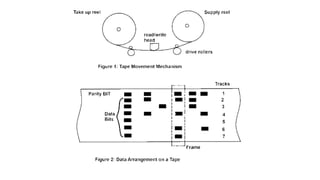
Bits are recorded as magnetic spots on the tape along several
tracks. Usually, seven or nine bits are recorded simultaneously
to form a character together with a parity bit. Read /write
heads are mounted one in each tracks so that data can be
reacorded and read as a sequence of characters.
Magnetic tape can be stopped, started to move forward or in
reverse, or can be rewound.
Cost - Magnetic tape is one of the the low-cost
storage media. Therefore, backing up data on tape is
very cheap.
Storage capacity - It is very large.
Portability - It is easily poratable
Reusable - It can remove a specific data and save
another data at the same place. Therefore it can be
reused.
ADVANTAGES
Access time - Accessing a record requires accessing all the
records before the required record. So access time is very large
in magnetic tape.
Non-flexibility - Magnetic tape is not flexible.
Transmission speed - The cost of data transfer is moderate in
magnetic tape.
Vulnerable to damage - Magnetic tapes are highly vulnerable
to damage from dust or careless handling.
DISADVANTAGES
CONCLUSION
Magnetic tape storage is currently the most secure, energy efficient
and cost-effective solution for storing enormous amounts of back-up
and archival data, as well as for new applications such as Big data
and cloud computing.
THANK YOU

Powerpoint presentation about magnetic tapes

  • 1.
  • 2.
    01 Secondary Storage02 Working 03 Magnetic Tapes- Introduction 04 Features 05 Advantages & Disadvantages 06 Conclusion
  • 3.
    Secondary storage, alsoknown as auxiliary storage, is a non-volatile storage method that retains data for long-term use. It's used to store data and programs that aren't accessed frequently, such as files, applications, and the operating system. Secondary storage devices include hard disk drives (HDDs), magnetic tapes, magnetic disks etc. What is secondary storage? SECONDARY STORAGE
  • 4.
    MAGNETIC TAPES - INTRODUCTION Magnetictape is a medium for magnetic recording. Made of thin magnetizable coating on a long, narrow strip of plastic film. It was developed in Germany, based on magnetic wire recording. It is widely used in audio and video recording devices.
  • 5.
    FEATURES OF MAGNETICTAPES Sequential Memory Storage. Popular for large data sets. Record data by magnetization. Can store and erase data. Can read the data several times.
  • 6.
    WORKING OF MAGNETIC TAPES Bitsare recorded as magnetic spots on the tape along several tracks. Usually, seven or nine bits are recorded simultaneously to form a character together with a parity bit. Read /write heads are mounted one in each tracks so that data can be reacorded and read as a sequence of characters. Magnetic tape can be stopped, started to move forward or in reverse, or can be rewound.
  • 8.
    Cost - Magnetictape is one of the the low-cost storage media. Therefore, backing up data on tape is very cheap. Storage capacity - It is very large. Portability - It is easily poratable Reusable - It can remove a specific data and save another data at the same place. Therefore it can be reused. ADVANTAGES
  • 9.
    Access time -Accessing a record requires accessing all the records before the required record. So access time is very large in magnetic tape. Non-flexibility - Magnetic tape is not flexible. Transmission speed - The cost of data transfer is moderate in magnetic tape. Vulnerable to damage - Magnetic tapes are highly vulnerable to damage from dust or careless handling. DISADVANTAGES
  • 10.
    CONCLUSION Magnetic tape storageis currently the most secure, energy efficient and cost-effective solution for storing enormous amounts of back-up and archival data, as well as for new applications such as Big data and cloud computing.
  • 11.