PREPARED BY
P.NANDA KUMAR
Assistant Professor/CSE
CAHCET
8/22/2011 School of Computing, Department of IT 1
8/22/2011 School of Computing, Department of IT 2
CONTENTS
ļ‚—Safety and Risk
ļ‚—Assessment of Safety and Risk
ļ‚—Risk-Benefit Analysis
ļ‚—Reducing Risk
ļ‚—Case Studies
8/22/2011 School of Computing, Department of IT 3
Safety and Risk
ļ‚— A thing is ā€œsafeā€ if its risk are judged to be acceptable.
ļ‚—Common understanding of Safety
ļ‚—Under estimate the risk
ļ‚—Over estimate the risk
ļ‚—No judgment on whether the risk is acceptable
• Safety is a matter of how people would find
risks as acceptable or unacceptable if they
knew the risks and were basing their
judgments on their most settled value
perspectives.
Risk
ļ‚—A ā€œriskā€ is a potential that something unwanted and
harmful may occur.
ļ‚—Categories
ļ‚—Experimental risk connected with the
introduction of new technology
ļ‚—Risk associated with new or expanded applications of
familiar technology
ļ‚—Risks arising from misapplied attempts at disaster
control
Acceptability of Risk
ļ‚—A risk is acceptable when those affected are generally
no longer apprehensive about it.
• Apprehensiveness depends on how the risk
is perceived
• Elements of Risk Perception
ļ‚— Is the risk assumed voluntarily?
ļ‚— Effect of knowledge
ļ‚— Job related pressures
ļ‚— Are potential victims identifiable before hand
Elements of Risk Perception
ļ‚—Voluntarism and Control
ļ‚—Voluntary Risk
ļ‚— People take up the risk fully knowing the hazards involved.
ļ‚— Motor racing, living near a chemical plant are some
examples
ļ‚—Level of Control
ļ‚— People display unrealistic confidence when they believe
hazards to be under their control
ļ‚— Motor Racing, Skiing, bungee jumping are examples where
people indulge in these hazardous sports under the assumed
level of control
Elements of Risk Perception
ļ‚—Effect of Information – Case Study
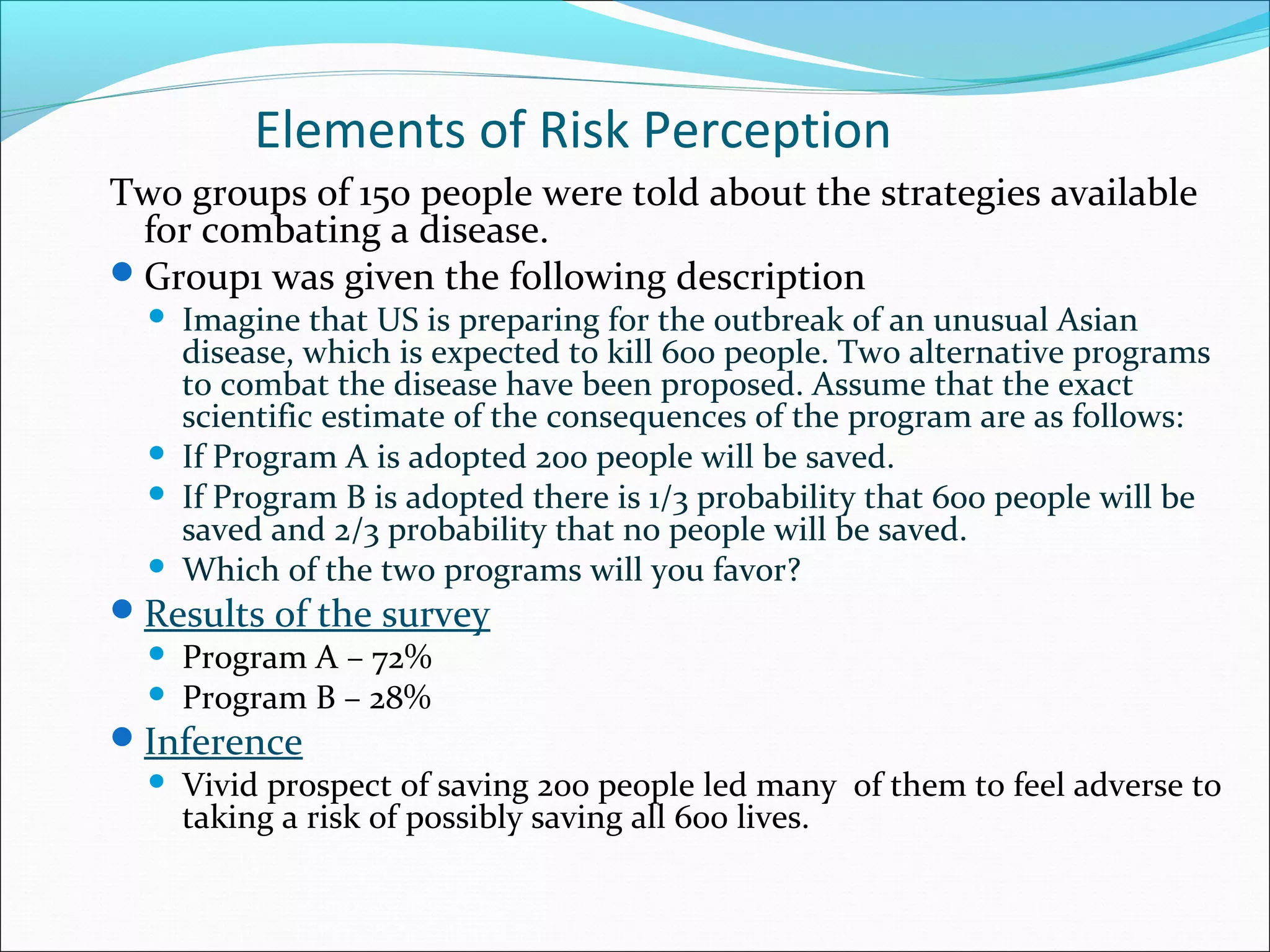
ļ‚—Two groups of 150 people were told about the strategies
available for combating a disease.
ļ‚—Group1 was given the following description
ļ‚— Imagine that US is preparing for the outbreak of an unusual Asian
disease, which is expected to kill 600 people. Two alternative
programs to combat the disease have been proposed. Assume that
the exact scientific estimate of the consequences of the program are
as follows:
ļ‚— If Program A is adopted 200 people will be saved.
ļ‚— If Program B is adopted there is 1/3 probability that 600 people will
be saved and 2/3 probability that no people will be saved.
ļ‚— Which of the two programs will you favor?
Elements of Risk Perception
Two groups of 150 people were told about the strategies available
for combating a disease.
ļ‚—Group1 was given the following description
ļ‚— Imagine that US is preparing for the outbreak of an unusual Asian
disease, which is expected to kill 600 people. Two alternative programs
to combat the disease have been proposed. Assume that the exact
scientific estimate of the consequences of the program are as follows:
ļ‚— If Program A is adopted 200 people will be saved.
ļ‚— If Program B is adopted there is 1/3 probability that 600 people will be
saved and 2/3 probability that no people will be saved.
ļ‚— Which of the two programs will you favor?
ļ‚—Results of the survey
ļ‚— Program A – 72%
ļ‚— Program B – 28%
ļ‚—Inference
ļ‚— Vivid prospect of saving 200 people led many of them to feel adverse to
taking a risk of possibly saving all 600 lives.
Elements of Risk Perception
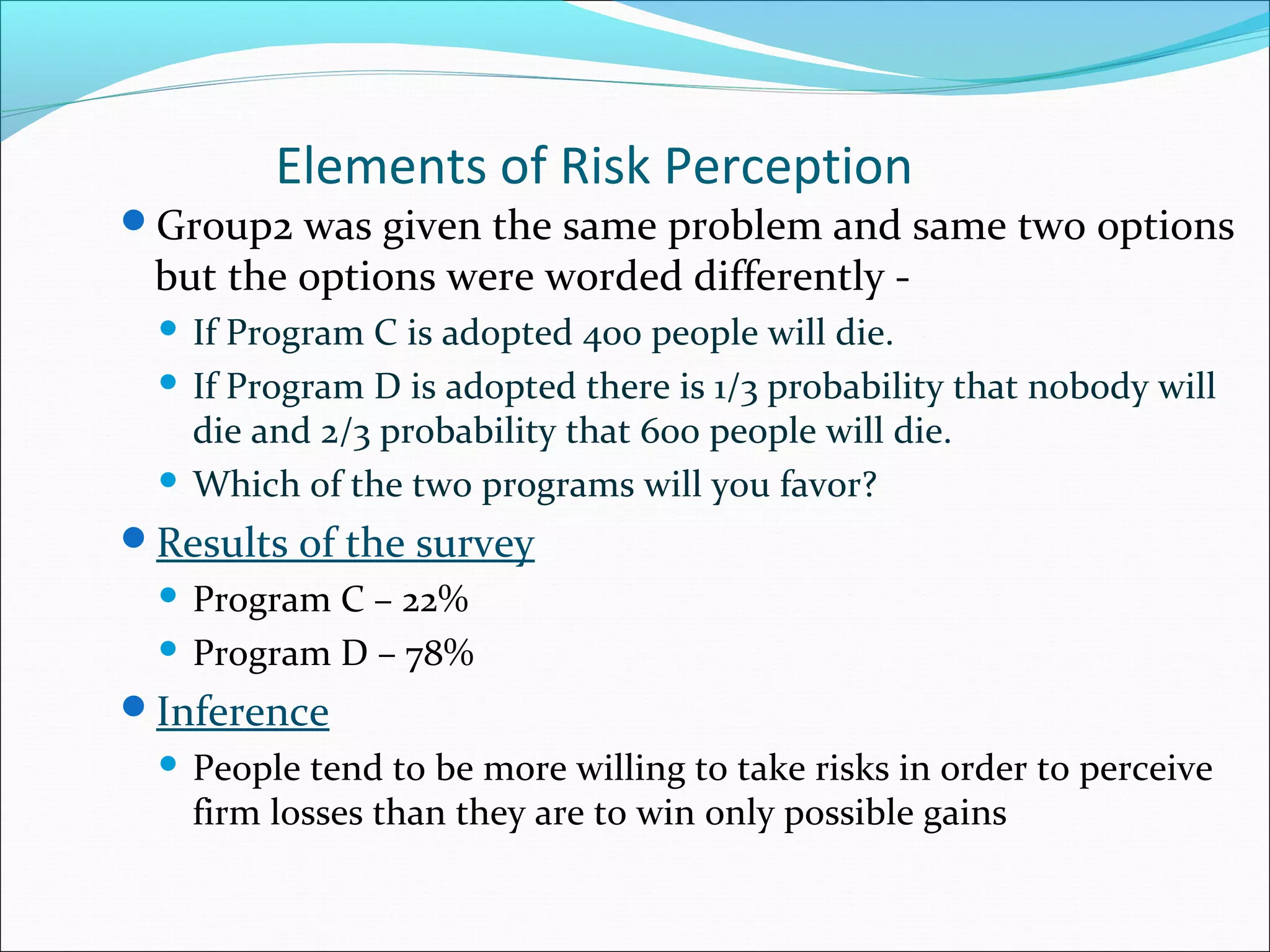
ļ‚—Group2 was given the same problem and same two options
but the options were worded differently -
ļ‚— If Program C is adopted 400 people will die.
ļ‚— If Program D is adopted there is 1/3 probability that nobody will
die and 2/3 probability that 600 people will die.
ļ‚— Which of the two programs will you favor?
ļ‚—Results of the survey
ļ‚— Program C – 22%
ļ‚— Program D – 78%
ļ‚—Inference
ļ‚— People tend to be more willing to take risks in order to perceive
firm losses than they are to win only possible gains
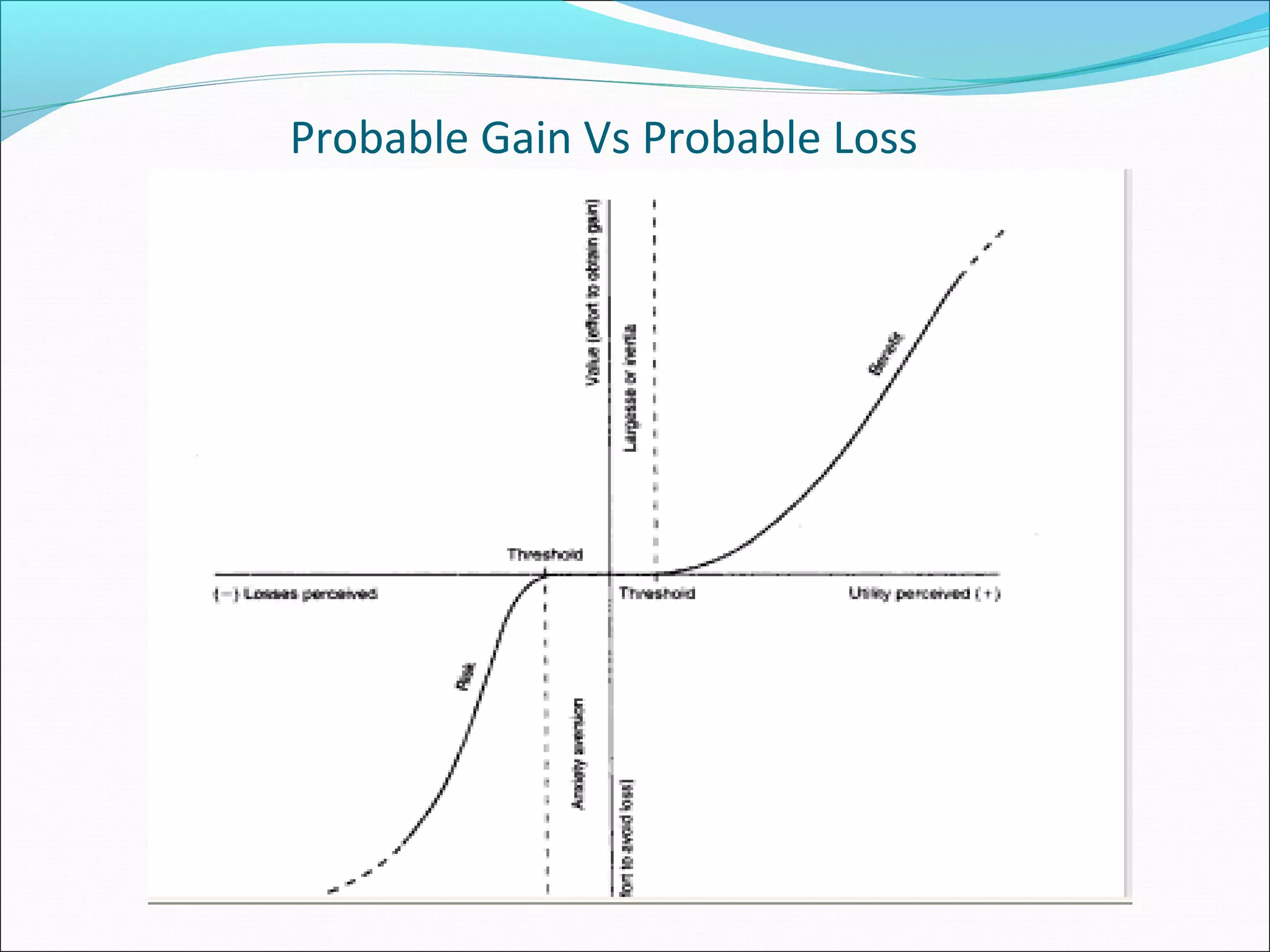
Probable Gain Vs Probable Loss
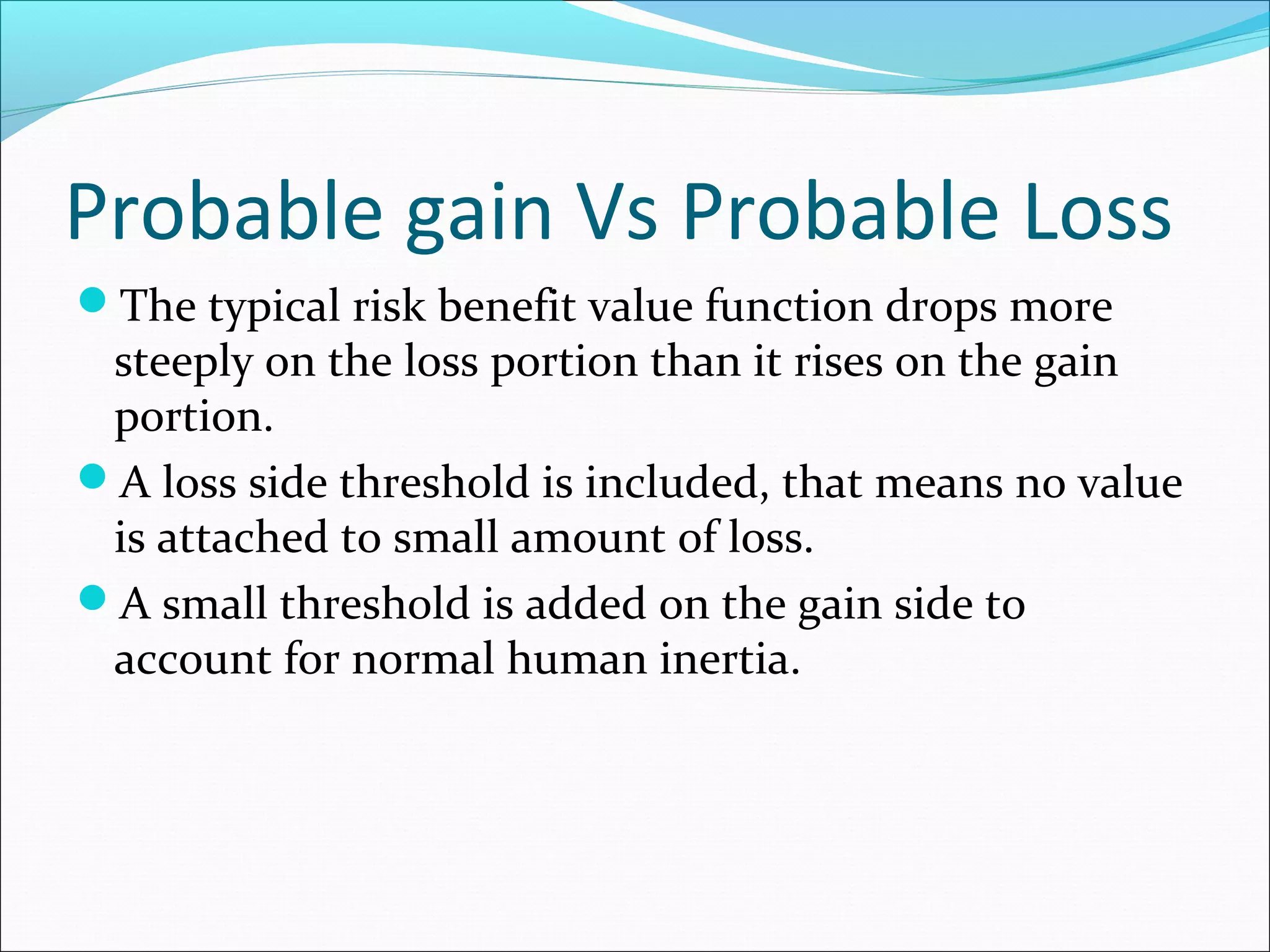
Probable gain Vs Probable Loss
ļ‚—The typical risk benefit value function drops more
steeply on the loss portion than it rises on the gain
portion.
ļ‚—A loss side threshold is included, that means no value
is attached to small amount of loss.
ļ‚—A small threshold is added on the gain side to
account for normal human inertia.
Job Related Risks
ļ‚—Exposures to risk on a job is in a sense voluntary
ļ‚—Often employees have little choice other than to stick
with what is for them
ļ‚—Engineers who design and equip work stations must
take into account the attitude towards safety shown
by other co workers
Magnitude and Proximity
ļ‚—Our reaction to risk is affected by a dread of possible
mishap in terms of magnitude and proximity
ļ‚—Friends being affected is more keenly looked upon
than a risk affecting strangers
ļ‚—Misperceptions of numbers can easily make us
overlook losses that are far greater than the numbers
reveal by themselves
Lessons for the engineers
ļ‚—Engineers face two problems
ļ‚—Overly optimistic attitude – things that are familiar presents
no real risk
ļ‚—Overly pessimistic attitude – dread people feel when an
accident kills in large numbers, even though such accidents
occur infrequently
• This is a misperception of legitimate
concern expressed publicly by thoughtful
citizens
• Barrier to education attempt is that people’s
beliefs change slowly and are extraordinarily
resistant to new information.
Assessment of safety and risk
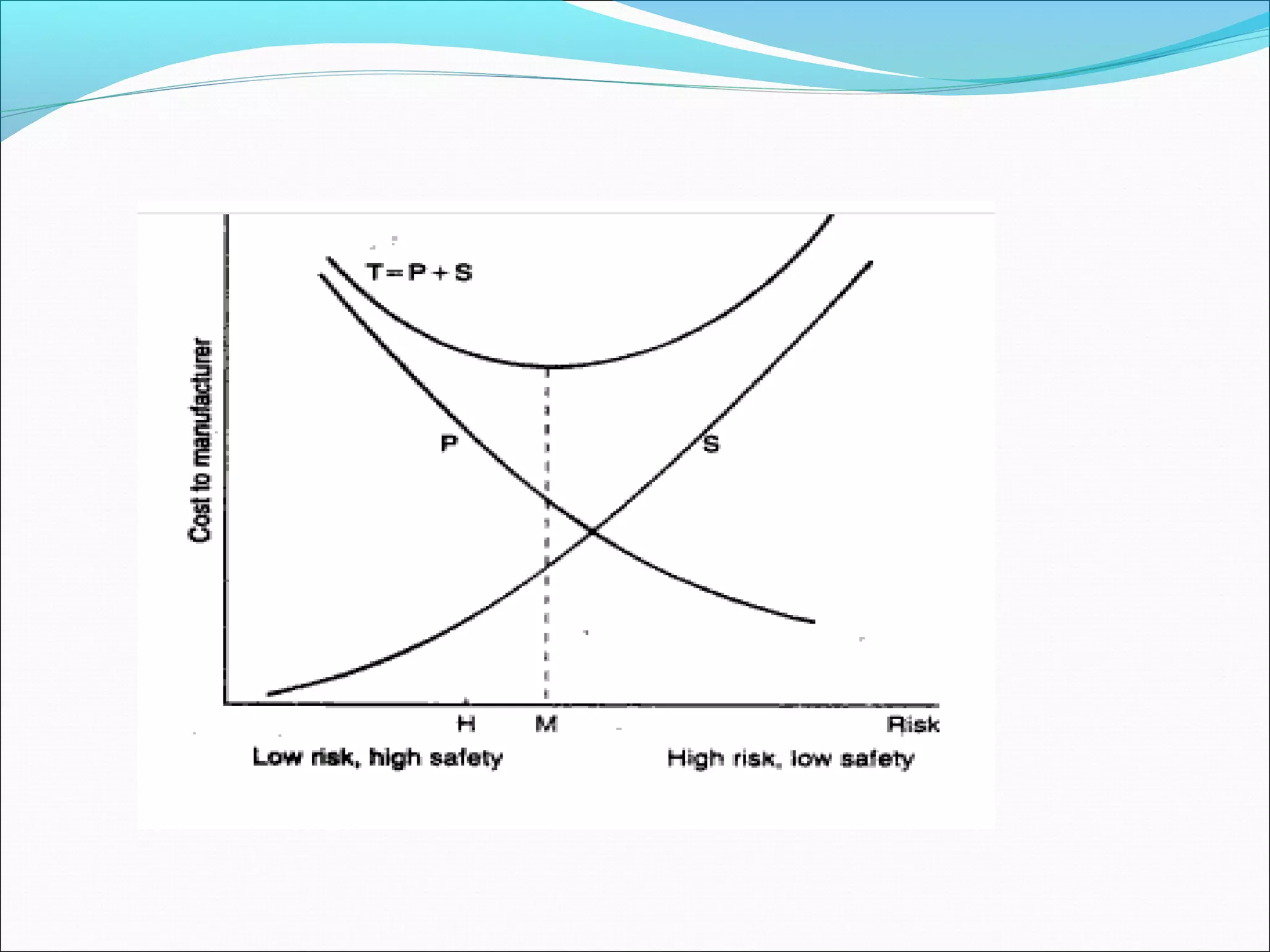
ļ‚—Improvement to safety is accomplished by an increase
in cost
ļ‚—Primary Cost – Production Cost
ļ‚—Secondary Cost – Warranty expenses, Losses of
customer goodwill etc.
ļ‚—High Safety(Low Risk) – High Primary Cost- Low
Secondary Cost
ļ‚—High Risk (Low Safety) – Low Primary Cost – High
Secondary Cost
Uncertainties in Design
ļ‚—Engineers have traditionally coped with such
uncertainties about materials or components.
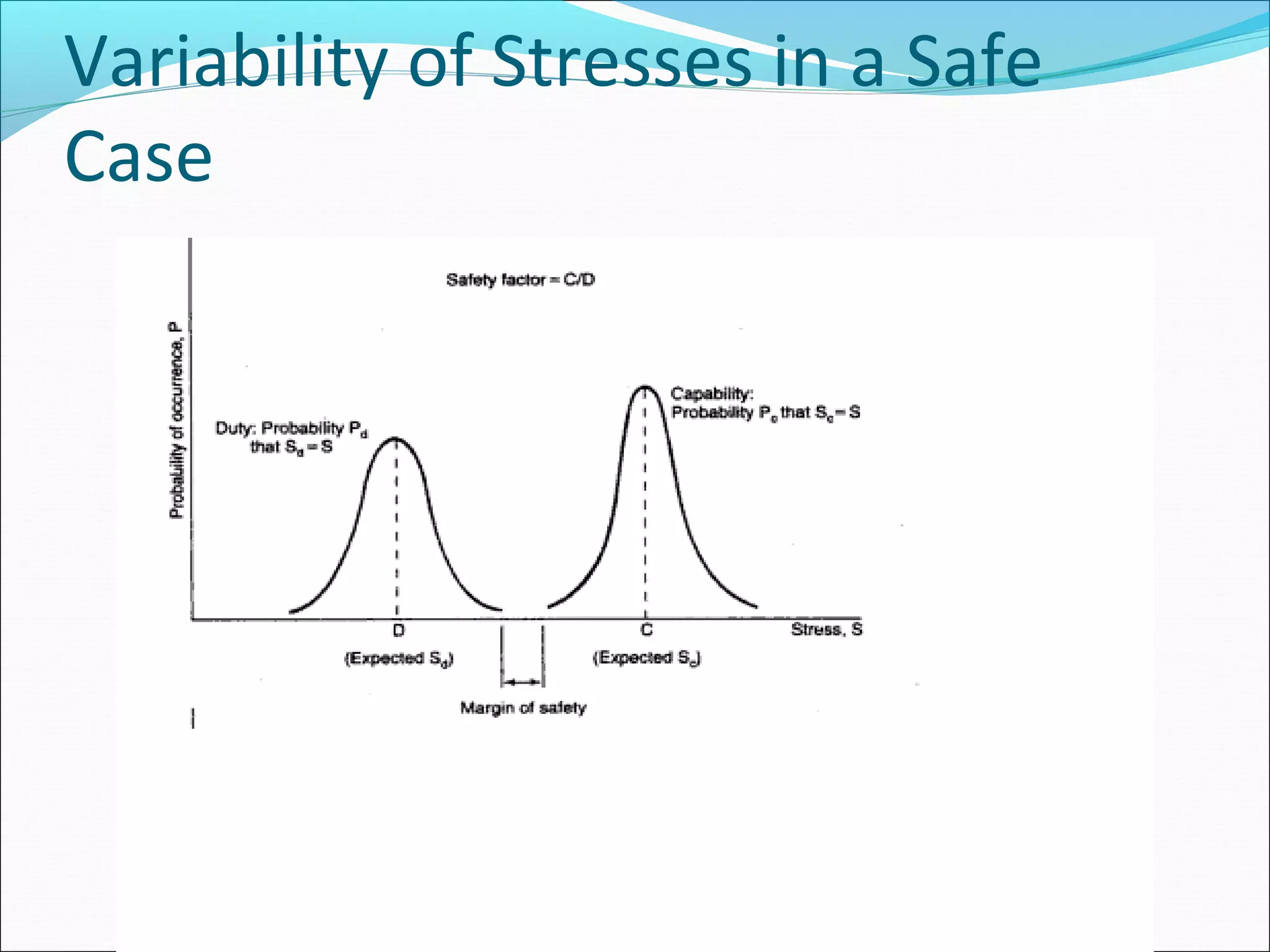
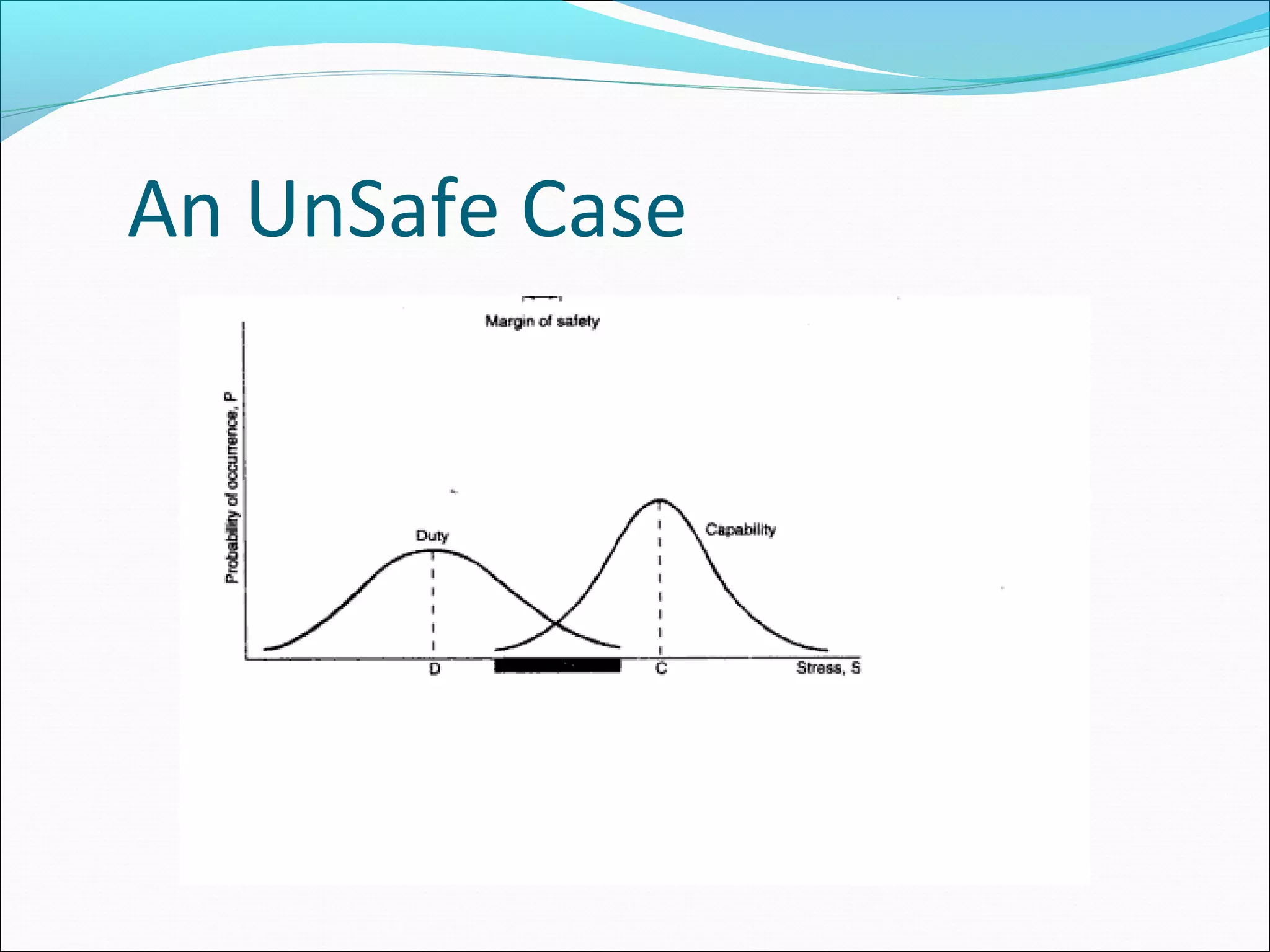
ļ‚—A product may be said to be safe if its capability
exceeds its duty.
ļ‚—The stress calculated by the engineer for a given
condition of loading and the stress which ultimately
materializes at that loading may vary quite a bit.
ļ‚—The stress exposure varies because of differences in
load, environmental conditions or the manner in
which the product is used.
Variability of Stresses in a Safe
Case
An UnSafe Case
Testing for Safety
What can an engineer do to ensure safety?
ļ‚— Rely on experience
ļ‚— Experience gained by one engineer may not be passed to other engineers
ļ‚— Another way of gaining experience is through tests
ļ‚— More usual procedure is to subject prototypes to testing
ļ‚— There should be routine ā€œQuality assuranceā€ executed for ensuring
safety
ļ‚— Problems Faced
ļ‚— Time Pressure
ļ‚— Duplication of Test Data
ļ‚— Outright Fraud – Testers are bribed to pass faulty items
Testing Approaches
ļ‚—Scenario Analysis
ļ‚—Starts from a given event and studies from the different
consequences that might evolve from it.
ļ‚—Failure modes and effects analysis [FMEA]
ļ‚—Examines the failure modes of each component without
focusing on causes or relationships among the
elements.
ļ‚—Fault Tree analysis [FTA]
ļ‚—One proposes a system failure and then traces the
events back to possible causes at the component level
ļ‚—Event Tree analysis
ļ‚—Reverse of FTA and a more mathematically oriented
version of scenario analysis.
Fault Tree Technique
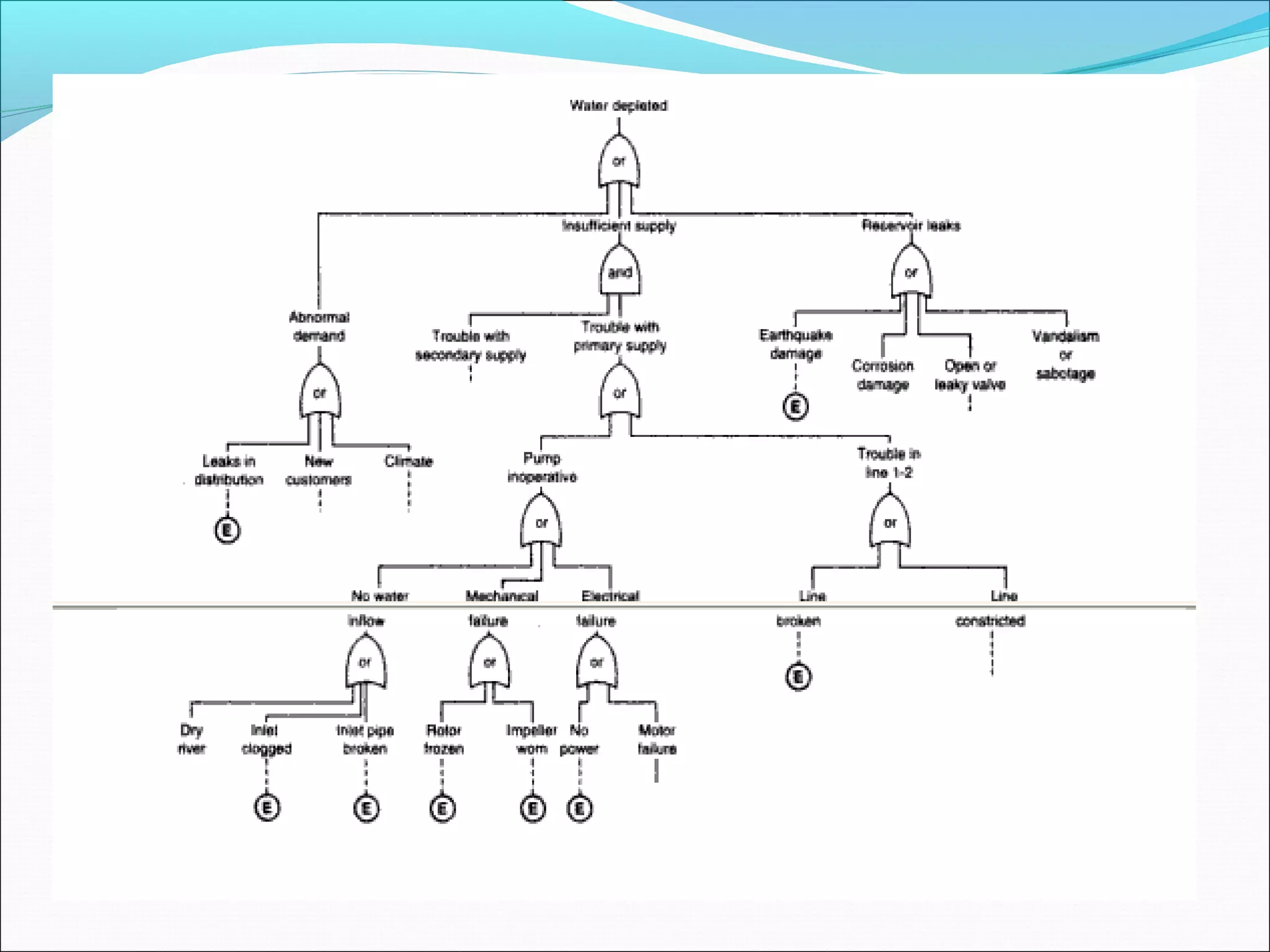
ļ‚—Example: A water system plant
ļ‚—Start with the system failure on the top and work down
through failures in various subsystems, components
and outside factors or events that could have caused
the problem.
ļ‚—Sometimes one and the other event must all occur for
that next event to happen
ļ‚—Probability figures can be attached to each events
ļ‚—Strength of FTA lies in its qualitative aspects.
Risk Benefit Analysis
ļ‚—Is the product worth the risk connected with its use
ļ‚—What are the benefits?
ļ‚—Do the benefits overweight the risks?
ļ‚—We should multiply the magnitude of potential loss
by the probability of its occurrence and similarly with
the gain
ļ‚—We are willing to take certain level of risk as long as
the project promises certain range of benefits
Continued….
An engineer must keep in mind the following ethical
questions while doing a risk benefit analysis –
ļ‚—Under what conditions is someone entitled to impose
risk on someone
ļ‚—Is anyone’s rights violated?
ļ‚—Are people provided with safer alternatives?
Personal Risk and Public Risk
ļ‚—Personal Risk
ļ‚—An individual decides whether or not to participate in a
risky activity
ļ‚—One could possibly respond by the amount of life
insurance taken out by the individual
• Public Risk
ļ‚— More easily determined because individual
differences tend to even out as larger number
of people are concerned
Incentives to reduce risk
ļ‚—Engineers should give top priority to product safety
ļ‚—Engineers should realize that reducing risk is not an
impossible task even under financial and time
constraints
ļ‚—Engineers should have a different perception on
design problem, focusing on the safety
ļ‚—Engineers should remove misconceptions that
militate against application of the extra thought
and effort required to make a product safe.
Liability
ļ‚—Engineers should be aware of strict liability
ļ‚—Although it is impossible to test every product the
engineer must weight the chances of a defect causing a
serious injury against the cost of eliminating or
minimizing defects in the product
ļ‚—Adhering to accepted practices and observing standards
is just not sufficient. They must be used creatively and
judgmentally
ļ‚—There is a great need to take safety and emergency
measures seriously in large scale engineering ventures
Case Study – Three Mile Island
ļ‚—The case is about a nuclear power plant
ļ‚—A pump was transferring the drained water from the main
containment building to the adjacent auxiliary building, but
not into the holding tanks as intended
Key Learnings
ļ‚—Need for disaster planning and open mindedness
ļ‚— Open mindedness refers to not allowing a pre occupation with rules
to prevent close examination of safety problems that may not be
covered by the rules
ļ‚—Inadequate training to the operators is hazardous
ļ‚—Instruments should give the operators adequate indication
on the reactors’ true operating conditions
Case Study – Chernobyl
ļ‚—The case is about a thermal plant
ļ‚—One of the new reactors was put under test
ļ‚—In preparation for the test the reactor operators had
disconnected the emergency core-cooling system so that its
power consumption would not affect the test results
ļ‚—There was a huge radioactive fallout which and attributed to
6000-8000 deaths
Key Learnings
ļ‚—Procedure should be clearly defined for testing reactors
ļ‚—Need for training the people on handling emergency
situations
ļ‚—Need for a local monitoring system to be installed in every
country for proactively identifying such mishaps
Safe Exit
ļ‚—It is impossible to build a completely safe product or a
one that will never fail
ļ‚—The best one can do is to assure that when a product
fails
ļ‚— It will fail safely
ļ‚— It can be abandoned safely
ļ‚— User can safely escape the product
ļ‚—These three conditions are referred to ā€œSafe Exitā€. Examples ships
needs life boats. Buildings need fire escape spaces.
ļ‚—Provisions are also required for safe disposal of dangerous
products and materials
BIBLIOGRAPHY
ļ‚—Text Book
ļ‚—Mike Martin and Roland Schinzinger, Ethics in
Engineering, Mcgraw Hill, New York, 1996.
ļ‚—Reference Books
ļ‚—M.Govindarajan, S.Natarajan, V.S.SenthilKumar,
Engineering Ethics, PHI, 2004.
ļ‚—Charles D.Fleddermann, Engineering Ethics, Prentice
Hall, New Mexico, 1999.
ļ‚—R.S.Naagarazan, Professional Ethics and Human Values,
New Age International Publishers, 2006.
8/22/2011 School of Computing, Department of IT 33
Review questions
ļ‚—Compare ā€˜safety’ and ā€˜risk’
ļ‚—List two advantages of fault-tree analysis
ļ‚—Name a few techniques to reduce risks.
ļ‚—When is testing ā€˜inappropriate’?
ļ‚—What is meant be ā€˜safe exit’ in the study of
safety.
ļ‚—Compare fault tree and event-tree analysis for
risk assessment.
8/22/2011 School of Computing, Department of IT 34
THANK YOU
8/22/2011 School of Computing, Department of IT 35

Unit-3 Professional Ethics in Engineering

  • 1.
    PREPARED BY P.NANDA KUMAR AssistantProfessor/CSE CAHCET 8/22/2011 School of Computing, Department of IT 1
  • 2.
    8/22/2011 School ofComputing, Department of IT 2
  • 3.
    CONTENTS ļ‚—Safety and Risk ļ‚—Assessmentof Safety and Risk ļ‚—Risk-Benefit Analysis ļ‚—Reducing Risk ļ‚—Case Studies 8/22/2011 School of Computing, Department of IT 3
  • 4.
    Safety and Risk ļ‚—A thing is ā€œsafeā€ if its risk are judged to be acceptable. ļ‚—Common understanding of Safety ļ‚—Under estimate the risk ļ‚—Over estimate the risk ļ‚—No judgment on whether the risk is acceptable • Safety is a matter of how people would find risks as acceptable or unacceptable if they knew the risks and were basing their judgments on their most settled value perspectives.
  • 5.
    Risk ļ‚—A ā€œriskā€ isa potential that something unwanted and harmful may occur. ļ‚—Categories ļ‚—Experimental risk connected with the introduction of new technology ļ‚—Risk associated with new or expanded applications of familiar technology ļ‚—Risks arising from misapplied attempts at disaster control
  • 6.
    Acceptability of Risk ļ‚—Arisk is acceptable when those affected are generally no longer apprehensive about it. • Apprehensiveness depends on how the risk is perceived • Elements of Risk Perception ļ‚— Is the risk assumed voluntarily? ļ‚— Effect of knowledge ļ‚— Job related pressures ļ‚— Are potential victims identifiable before hand
  • 7.
    Elements of RiskPerception ļ‚—Voluntarism and Control ļ‚—Voluntary Risk ļ‚— People take up the risk fully knowing the hazards involved. ļ‚— Motor racing, living near a chemical plant are some examples ļ‚—Level of Control ļ‚— People display unrealistic confidence when they believe hazards to be under their control ļ‚— Motor Racing, Skiing, bungee jumping are examples where people indulge in these hazardous sports under the assumed level of control
  • 8.
    Elements of RiskPerception ļ‚—Effect of Information – Case Study ļ‚—Two groups of 150 people were told about the strategies available for combating a disease. ļ‚—Group1 was given the following description ļ‚— Imagine that US is preparing for the outbreak of an unusual Asian disease, which is expected to kill 600 people. Two alternative programs to combat the disease have been proposed. Assume that the exact scientific estimate of the consequences of the program are as follows: ļ‚— If Program A is adopted 200 people will be saved. ļ‚— If Program B is adopted there is 1/3 probability that 600 people will be saved and 2/3 probability that no people will be saved. ļ‚— Which of the two programs will you favor?
  • 9.
    Elements of RiskPerception Two groups of 150 people were told about the strategies available for combating a disease. ļ‚—Group1 was given the following description ļ‚— Imagine that US is preparing for the outbreak of an unusual Asian disease, which is expected to kill 600 people. Two alternative programs to combat the disease have been proposed. Assume that the exact scientific estimate of the consequences of the program are as follows: ļ‚— If Program A is adopted 200 people will be saved. ļ‚— If Program B is adopted there is 1/3 probability that 600 people will be saved and 2/3 probability that no people will be saved. ļ‚— Which of the two programs will you favor? ļ‚—Results of the survey ļ‚— Program A – 72% ļ‚— Program B – 28% ļ‚—Inference ļ‚— Vivid prospect of saving 200 people led many of them to feel adverse to taking a risk of possibly saving all 600 lives.
  • 10.
    Elements of RiskPerception ļ‚—Group2 was given the same problem and same two options but the options were worded differently - ļ‚— If Program C is adopted 400 people will die. ļ‚— If Program D is adopted there is 1/3 probability that nobody will die and 2/3 probability that 600 people will die. ļ‚— Which of the two programs will you favor? ļ‚—Results of the survey ļ‚— Program C – 22% ļ‚— Program D – 78% ļ‚—Inference ļ‚— People tend to be more willing to take risks in order to perceive firm losses than they are to win only possible gains
  • 11.
    Probable Gain VsProbable Loss
  • 12.
    Probable gain VsProbable Loss ļ‚—The typical risk benefit value function drops more steeply on the loss portion than it rises on the gain portion. ļ‚—A loss side threshold is included, that means no value is attached to small amount of loss. ļ‚—A small threshold is added on the gain side to account for normal human inertia.
  • 13.
    Job Related Risks ļ‚—Exposuresto risk on a job is in a sense voluntary ļ‚—Often employees have little choice other than to stick with what is for them ļ‚—Engineers who design and equip work stations must take into account the attitude towards safety shown by other co workers
  • 14.
    Magnitude and Proximity ļ‚—Ourreaction to risk is affected by a dread of possible mishap in terms of magnitude and proximity ļ‚—Friends being affected is more keenly looked upon than a risk affecting strangers ļ‚—Misperceptions of numbers can easily make us overlook losses that are far greater than the numbers reveal by themselves
  • 15.
    Lessons for theengineers ļ‚—Engineers face two problems ļ‚—Overly optimistic attitude – things that are familiar presents no real risk ļ‚—Overly pessimistic attitude – dread people feel when an accident kills in large numbers, even though such accidents occur infrequently • This is a misperception of legitimate concern expressed publicly by thoughtful citizens • Barrier to education attempt is that people’s beliefs change slowly and are extraordinarily resistant to new information.
  • 16.
    Assessment of safetyand risk ļ‚—Improvement to safety is accomplished by an increase in cost ļ‚—Primary Cost – Production Cost ļ‚—Secondary Cost – Warranty expenses, Losses of customer goodwill etc. ļ‚—High Safety(Low Risk) – High Primary Cost- Low Secondary Cost ļ‚—High Risk (Low Safety) – Low Primary Cost – High Secondary Cost
  • 18.
    Uncertainties in Design ļ‚—Engineershave traditionally coped with such uncertainties about materials or components. ļ‚—A product may be said to be safe if its capability exceeds its duty. ļ‚—The stress calculated by the engineer for a given condition of loading and the stress which ultimately materializes at that loading may vary quite a bit. ļ‚—The stress exposure varies because of differences in load, environmental conditions or the manner in which the product is used.
  • 19.
  • 20.
  • 21.
    Testing for Safety Whatcan an engineer do to ensure safety? ļ‚— Rely on experience ļ‚— Experience gained by one engineer may not be passed to other engineers ļ‚— Another way of gaining experience is through tests ļ‚— More usual procedure is to subject prototypes to testing ļ‚— There should be routine ā€œQuality assuranceā€ executed for ensuring safety ļ‚— Problems Faced ļ‚— Time Pressure ļ‚— Duplication of Test Data ļ‚— Outright Fraud – Testers are bribed to pass faulty items
  • 22.
    Testing Approaches ļ‚—Scenario Analysis ļ‚—Startsfrom a given event and studies from the different consequences that might evolve from it. ļ‚—Failure modes and effects analysis [FMEA] ļ‚—Examines the failure modes of each component without focusing on causes or relationships among the elements. ļ‚—Fault Tree analysis [FTA] ļ‚—One proposes a system failure and then traces the events back to possible causes at the component level ļ‚—Event Tree analysis ļ‚—Reverse of FTA and a more mathematically oriented version of scenario analysis.
  • 23.
    Fault Tree Technique ļ‚—Example:A water system plant ļ‚—Start with the system failure on the top and work down through failures in various subsystems, components and outside factors or events that could have caused the problem. ļ‚—Sometimes one and the other event must all occur for that next event to happen ļ‚—Probability figures can be attached to each events ļ‚—Strength of FTA lies in its qualitative aspects.
  • 25.
    Risk Benefit Analysis RiskBenefit Analysis ļ‚—Is the product worth the risk connected with its use ļ‚—What are the benefits? ļ‚—Do the benefits overweight the risks? ļ‚—We should multiply the magnitude of potential loss by the probability of its occurrence and similarly with the gain ļ‚—We are willing to take certain level of risk as long as the project promises certain range of benefits
  • 26.
    Continued…. An engineer mustkeep in mind the following ethical questions while doing a risk benefit analysis – ļ‚—Under what conditions is someone entitled to impose risk on someone ļ‚—Is anyone’s rights violated? ļ‚—Are people provided with safer alternatives?
  • 27.
    Personal Risk andPublic Risk ļ‚—Personal Risk ļ‚—An individual decides whether or not to participate in a risky activity ļ‚—One could possibly respond by the amount of life insurance taken out by the individual • Public Risk ļ‚— More easily determined because individual differences tend to even out as larger number of people are concerned
  • 28.
    Incentives to reducerisk ļ‚—Engineers should give top priority to product safety ļ‚—Engineers should realize that reducing risk is not an impossible task even under financial and time constraints ļ‚—Engineers should have a different perception on design problem, focusing on the safety ļ‚—Engineers should remove misconceptions that militate against application of the extra thought and effort required to make a product safe.
  • 29.
    Liability ļ‚—Engineers should beaware of strict liability ļ‚—Although it is impossible to test every product the engineer must weight the chances of a defect causing a serious injury against the cost of eliminating or minimizing defects in the product ļ‚—Adhering to accepted practices and observing standards is just not sufficient. They must be used creatively and judgmentally ļ‚—There is a great need to take safety and emergency measures seriously in large scale engineering ventures
  • 30.
    Case Study –Three Mile Island ļ‚—The case is about a nuclear power plant ļ‚—A pump was transferring the drained water from the main containment building to the adjacent auxiliary building, but not into the holding tanks as intended Key Learnings ļ‚—Need for disaster planning and open mindedness ļ‚— Open mindedness refers to not allowing a pre occupation with rules to prevent close examination of safety problems that may not be covered by the rules ļ‚—Inadequate training to the operators is hazardous ļ‚—Instruments should give the operators adequate indication on the reactors’ true operating conditions
  • 31.
    Case Study –Chernobyl ļ‚—The case is about a thermal plant ļ‚—One of the new reactors was put under test ļ‚—In preparation for the test the reactor operators had disconnected the emergency core-cooling system so that its power consumption would not affect the test results ļ‚—There was a huge radioactive fallout which and attributed to 6000-8000 deaths Key Learnings ļ‚—Procedure should be clearly defined for testing reactors ļ‚—Need for training the people on handling emergency situations ļ‚—Need for a local monitoring system to be installed in every country for proactively identifying such mishaps
  • 32.
    Safe Exit ļ‚—It isimpossible to build a completely safe product or a one that will never fail ļ‚—The best one can do is to assure that when a product fails ļ‚— It will fail safely ļ‚— It can be abandoned safely ļ‚— User can safely escape the product ļ‚—These three conditions are referred to ā€œSafe Exitā€. Examples ships needs life boats. Buildings need fire escape spaces. ļ‚—Provisions are also required for safe disposal of dangerous products and materials
  • 33.
    BIBLIOGRAPHY ļ‚—Text Book ļ‚—Mike Martinand Roland Schinzinger, Ethics in Engineering, Mcgraw Hill, New York, 1996. ļ‚—Reference Books ļ‚—M.Govindarajan, S.Natarajan, V.S.SenthilKumar, Engineering Ethics, PHI, 2004. ļ‚—Charles D.Fleddermann, Engineering Ethics, Prentice Hall, New Mexico, 1999. ļ‚—R.S.Naagarazan, Professional Ethics and Human Values, New Age International Publishers, 2006. 8/22/2011 School of Computing, Department of IT 33
  • 34.
    Review questions ļ‚—Compare ā€˜safety’and ā€˜risk’ ļ‚—List two advantages of fault-tree analysis ļ‚—Name a few techniques to reduce risks. ļ‚—When is testing ā€˜inappropriate’? ļ‚—What is meant be ā€˜safe exit’ in the study of safety. ļ‚—Compare fault tree and event-tree analysis for risk assessment. 8/22/2011 School of Computing, Department of IT 34
  • 35.
    THANK YOU 8/22/2011 Schoolof Computing, Department of IT 35