BY: JALEES UL HASSAN
PHD (PHYSICS) SCHOLAR
UNIVERSITY OF ENGINEERING & TECHNOLOGY LAHORE, PAKISTAN
1
PURPOSE OF PRESENTATION
• History of Storage Devices
• Working of magnetic storage devices
2
The most important thing about memory is not being able to store
information but being able to find it later
The idea of recording and playing back sound by recording a magnetic signal on a
conductive medium was first thought of by American Oberlin Smith in 1888 [1]
1888 – Idea of recording
[1] D. Morton, “Linked references are available on JSTOR for this article : Armour Research Foundation and the Wire
Recorder : How Academic Entrepreneurs Fail,” vol. 39, no. 2, pp. 213–244, 2016.
3
The first magnetic recorder was invented in 1898 by Valdemar Poulsen in which a
magnetic recording is made on thin steel wire of 1 mm diameter and 100m long.
Disk type gramophone, built in the period 1905-09
0.5 mm thick
130 mm Diameter
Velocity of the disk 0.5 m/s
1898 – First wire magnetic recorder
[2] Danish Museum of Science and Technology
4
30 – 50 min
Fig 1. Wire Recorder Fig 2. Wire Recorder Fig 3. Disk Recorder
1928 – Steel tape magnetic recorder
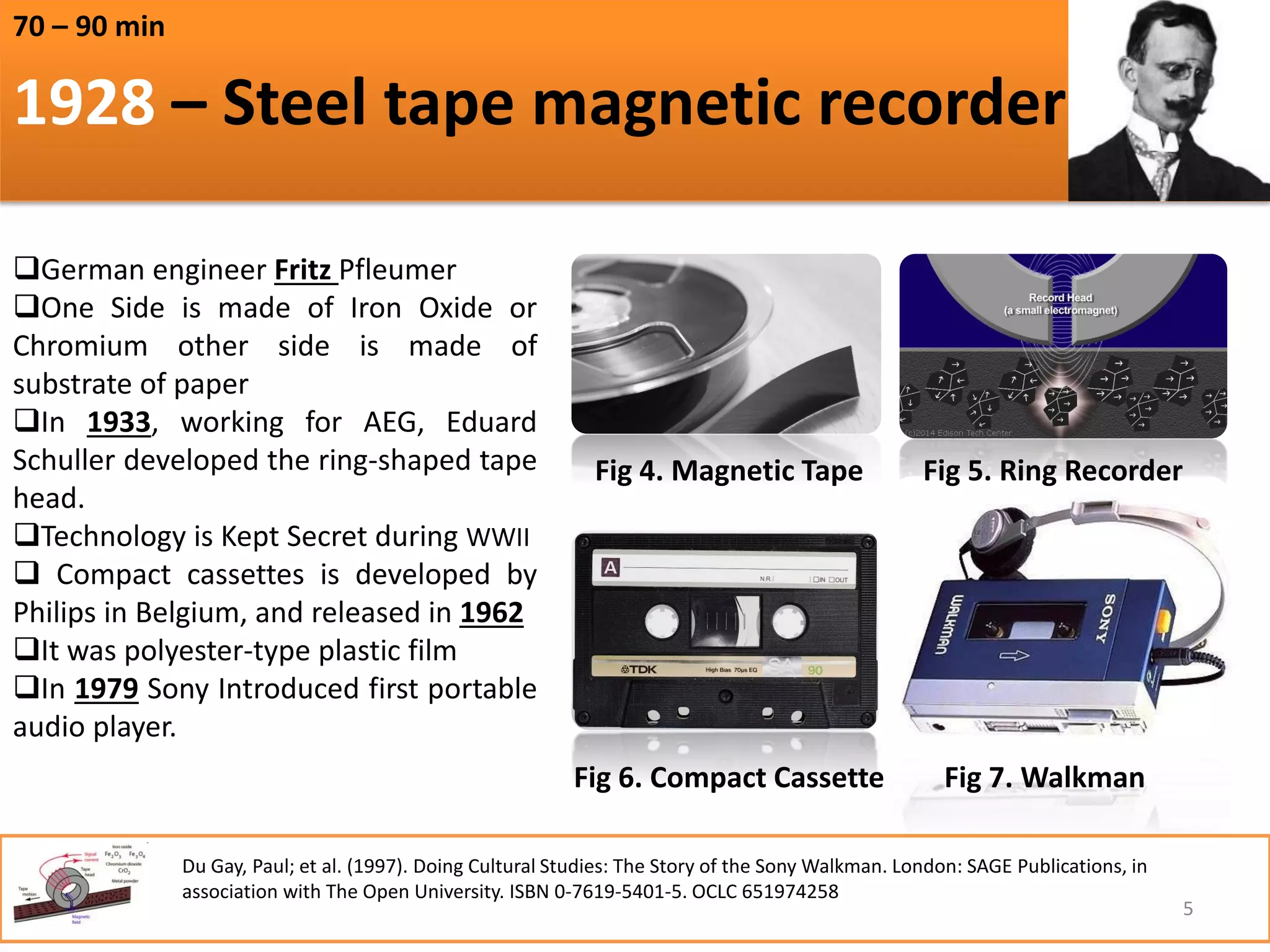
German engineer Fritz Pfleumer
One Side is made of Iron Oxide or
Chromium other side is made of
substrate of paper
In 1933, working for AEG, Eduard
Schuller developed the ring-shaped tape
head.
Technology is Kept Secret during WWII
 Compact cassettes is developed by
Philips in Belgium, and released in 1962
It was polyester-type plastic film
In 1979 Sony Introduced first portable
audio player.
Du Gay, Paul; et al. (1997). Doing Cultural Studies: The Story of the Sony Walkman. London: SAGE Publications, in
association with The Open University. ISBN 0-7619-5401-5. OCLC 651974258
5
70 – 90 min
Fig 5. Ring RecorderFig 4. Magnetic Tape
Fig 6. Compact Cassette Fig 7. Walkman
1932 – Magnetic drum memory
 Invented by Gustav Tauschek in 1932 in Austria
 Drums were widely used in the 1950s and into the 1960s as computer memory
 Random Access Memory
 Coated by Ferromagnetic material
 Many Rows of Read/Write heads
 Storage Capacity 62.5 Kilobytes
Drawbacks
 High Seek Time
 Optimum Programming
Datamation, September 1967, p.25, "For Bendix and Ramo-Wooldridge, the G-20 and RW-400 were parallel core
machines rather than serial drum machines of the type already in their product lines."
6
62.5 Kb
Fig 8. Drum Memory
1940 – Delay line Memory
Invented by J. Presper Eckert
Sequential Accessed Memory
Idea comes in 1920s
Used in computers since 1940s
access time about 222 ms
high speed of sound in mercury
Weight, Cost, toxicity, Temp
Types of DLM
Mercury delay lines
Magnetostrictive delay lines
Piezoelectric delay lines
Electric delay lines
U.S. Patent 2,629,827
7
512 Bits
Fig 9. Dely Line Memory
1940 – Delay line Memory
U.S. Patent 2,629,827
8
512 Bits
1940 – Delay line Memory
MAGNETOSTRICTION is a property of ferromagnetic materials which causes them
to expand or contract in response to a magnetic field.
9
1946 – Villiams Tube
 Freddie Williams and Tom Kilburn
 first random-access digital storage
device
grid of dots on a cathode ray tube
Faster Than delay line memory
System is affected by any nearby
electrical fields
Store about 1024 to 2560 bits of
data
Selectron tube memory device
Early computers at Manchester University", Resurrection, The Computer Conservation Society, 1 (4), Summer
1992, ISSN 0958-7403, retrieved 7 July 2010
10
1024 – 2560 Bits
1 – 2.5 Kb
Fig 11. Villiams Tube
1950 – Magnetic core memory
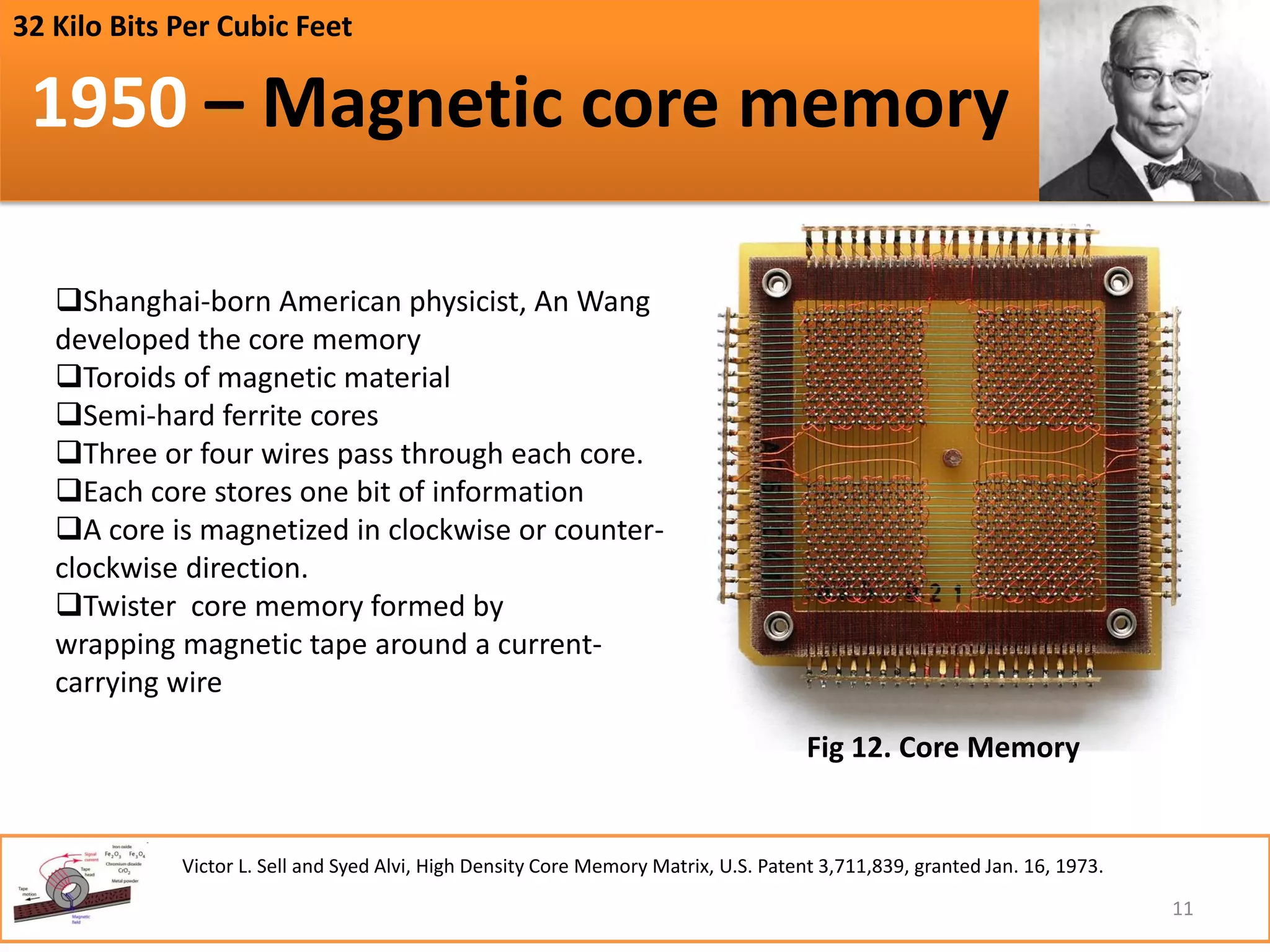
Shanghai-born American physicist, An Wang
developed the core memory
Toroids of magnetic material
Semi-hard ferrite cores
Three or four wires pass through each core.
Each core stores one bit of information
A core is magnetized in clockwise or counter-
clockwise direction.
Twister core memory formed by
wrapping magnetic tape around a current-
carrying wire
Victor L. Sell and Syed Alvi, High Density Core Memory Matrix, U.S. Patent 3,711,839, granted Jan. 16, 1973.
11
32 Kilo Bits Per Cubic Feet
Fig 12. Core Memory
1950 – Magnetic core memory
Victor L. Sell and Syed Alvi, High Density Core Memory Matrix, U.S. Patent 3,711,839, granted Jan. 16, 1973.
12
32 Kilo Bits Per Cubic Feet
Fig 13a. Core Memory
Fig 12a. C.W.M
Fig 12b. C.C.M
1950 – Magnetic core memory
Creighton D. Barnes, et. al., Magnetic core storage device having a single winding for both the sensing and inhibit
function, U.S. Patent 3,329,940, granted July 4, 1967.
13
X & Y are derive lines
S is Sense Line
Z is inhibit Line
Material of core should have high
degree of magnetic remanence and
low coercitivity.
Fig 13b. Core Memory
Coating of magnetic tape
Ji, Li Na (June 2013). "Study on Preparation Process and Properties of Polyethylene Terephthalate (PET)". Applied
Mechanics and Materials. 312: 406–410
14
Paper - Rejected by moist
Cellulose Acetate - Rejected by Vinegar Syndrome
Polyvinyl chloride (PVC) – Reject by Release of HCL
Polyethylene terephthalate
Polyethylene naphthalate
1951 –Tape Drive
Tape Drive 1st Used by Univac
thin metal strip of 0.5-inch
 nickel-plated phosphor bronze
12,800 characters per second
IBM used ferrous-oxide
coated tape
"IBM Archives: Fifty years of storage innovation". 03.ibm.com.
https://www.ibm.com/ibm/history/exhibits/storage/storage_fifty.html Retrieved 2019-04-10
15
224 kb – 2Mb
In 2018 IBM TS1160 20 TB
Fig 14. Tap Drive
1951 –Tape Drive
16
1952 - Video tape recorder
 Charles Ginsburg invent VTR of
Much wider bandwidth
6 MHz vs 20 kHz
Dr. Norikazu Sawazaki developed a
prototype helical scan video tape
recorder
Sony introduced portable VTR 1971
"Toshiba Science Museum : World's First Helical Scan Video Tape Recorder". toshiba-mirai-kagakukan.jp.
http://toshiba-mirai-kagakukan.jp/en/learn/history/ichigoki/1959vtr/index.htm Retrieved on 2019-04-10
17
Fig 15. Video Recorder Fig 16. Helical Scan
1956 – Hard Disk
 Invented by Reynold B. Johnson.
 It has fifty 24-inch Diameter Disks
 Data transfer rate is 8,800 Character/sec
 Aluminum alloy or a mixture of glass and ceramic
is used as substrate
Aluminum is non-magnetic, lightweight and
grindable precisely.
Glass technology has the better heat resistance
Interior kept in a partial vacuum
Spin at 1200 rpm
Size 3.75 – 5 MB
Kean, David W., "IBM San Jose, A quarter century of innovation", 1977.
Arpaci-Dusseau, Remzi H.; Arpaci-Dusseau, Andrea C. (2014). "Operating Systems: Three Easy Pieces, Chapter: Hard Disk
Drives" (PDF). Arpaci-Dusseau Books. 18
3.75 – 5 MB
Fig 17. HDD
Fig 18. Hard Disk
1956 – Hard Disk
Kean, David W., "IBM San Jose, A quarter century of innovation", 1977.
Arpaci-Dusseau, Remzi H.; Arpaci-Dusseau, Andrea C. (2014). "Operating Systems: Three Easy Pieces, Chapter: Hard Disk
Drives" (PDF). Arpaci-Dusseau Books. 19
3.75 – 5 MB
Bits of data are arranged in
concentric, circular paths
called tracks
Each track is broken up into
smaller areas called sectors
Part of the hard drive stores
a map of sectors that have
already been used up and
others that are still free
In Windows, this map is
called the File Allocation
Table or FAT
Fig 19. Disk Recorder
1966 - DRAM
1966 Robert H. Dennard
Dynamic random-access memory
semiconductor memory
stores each bit of data in a
separate tiny capacitor within
an integrated circuit
The capacitor can either be
charged or discharged; these two
states are taken to represent the two
values of a bit, conventionally called
0 and 1.
S. Mittal, "A Survey of Architectural Techniques For DRAM Power ManagementArchived 2018-05-08 at the Wayback
Machine", IJHPSA, 4(2), 110-119, 2012.
20
Less than 1 Kb
Fig 20. DRAM
1966 - DRAM cell
Fig 20a. DRAM
Fig 20b. DRAM
Fig 20c. DRAM
Fig 20d. DRAM
1970 – Bubble Memory
Inventd by Andrew Bobeck
Bubble formed in garnets (2-30um)
Wide range of temperature
Only a couple of square inches in size
Gadolinium gallium garnet (GGG) is
used as substrate.
Non-volatile computer memory
Bubbles or domains, each storing
one bit of data
Bubbles or domains are moveable
Replace Core, Tape, Disks
Texas Instruments Introduces Portable Computer Terminal: Model Said to Be First With Mass Memory and Using Bubble
Memory Device". Wall Street Journal. New York, N.Y.: Dow Jones & Company Inc. Apr 18, 1977. p. 13. ISSN 0099-9660.
22
4,096 bits
Fig 21. Bubbles
Fig 22. Bubble Memory
1970 – Bubble Memory
Texas Instruments Introduces Portable Computer Terminal: Model Said to Be First With Mass Memory and Using Bubble
Memory Device". Wall Street Journal. New York, N.Y.: Dow Jones & Company Inc. Apr 18, 1977. p. 13. ISSN 0099-9660.
23
4,096 bits
Function driver: convert the digital
input control signals to the required
current pulses.
Sense amplifier: Convert the output
to standard TTL levels.
Triangular current: Two field coils
require this current to synchronized
with coil drivers and diode array
current that is driven with digital input
signals.
Function Timing Generator: These
signals provide control for five basic
operations: generate, replicate,
annihilate, transfer-in, and transfer-
out. The function-timing generator also
initiates the rotating magnetic field. Fig 23. Bubble Mem.
1970 – Bubble Memory
Texas Instruments Introduces Portable Computer Terminal: Model Said to Be First With Mass Memory and Using Bubble
Memory Device". Wall Street Journal. New York, N.Y.: Dow Jones & Company Inc. Apr 18, 1977. p. 13. ISSN 0099-9660.
24
4,096 bits
When magnetized sequentially
by a magnetic field rotating in
the same plane, these chevron
propagation patterns set up
magnetic polarities that attract
the bubble domain and
establish motion
Fig 24. Shevron Part
1971 – Floppy
Developed in the late 1960
Commercially available in 1971
Even now use for BIOS updates
Perform a recovery
Now still some Government Agencies use
old machineries which contain floppy Drives.
USA upgrades their devices in 2017
8 inch is diameter
Storage capacity 360 Kb
1987 – Magnetic Optical Disk is introduced
1994 – Zip Drives & Zip Disks are introduced
Capacities of 100 MB, 250 MB and 750 MB
https://www.nytimes.com/1990/03/14/business/business-technology-the-evolution-of-the-floppy-disk-for-pc-s.html
25
Fig 25. Floppy Fig 26. MOD
Fig 27. Zip Drive
1980 – Compact Disk
Optical recording technology was
invented by David Paul Gregg and James
Russell in 1958 and first patented in 1961
Compact Discs replaced floppy disks
Phase-change or Phase-shift material
U.S. Patent 3,501,586 Analog to digital to optical photographic recording and playback system, March 1970.
26
Fig 28. Working of CD
1984 – Flash Memory
Electronic (solid-state) Storage
non-volatile computer storage medium
Toshiba developed flash memory in 1980s
NAND and NOR logic gates Flash
Mittal, Sparsh; Vetter, Jeffrey S. (2016). "A Survey of Software Techniques for Using Non-Volatile Memories for Storage
and Main Memory Systems". IEEE Transactions on Parallel and Distributed Systems. 27 (5): 1537–
1550. doi:10.1109/TPDS.2015.2442980. 27
Fig 29. Working of Flash Memory
1994 – Beginning of Micro Drives
1994 – Scandisk Devleop Flash Compact
1997 - MultiMediaCard used for solid-state
storage by SanDisk and Siemens
Microdrive is a registered trademark for miniature,
1-inch hard disks produced by IBM and Hitachi
The standard was introduced in August 1999 by
joint efforts between SanDisk, Panasonic and Toshiba
as an improvement over MultiMediaCards (MMC)
Mittal, Sparsh; Vetter, Jeffrey S. (2016). "A Survey of Software Techniques for Using Non-Volatile Memories for Storage
and Main Memory Systems". IEEE Transactions on Parallel and Distributed Systems. 27 (5): 1537–
1550. doi:10.1109/TPDS.2015.2442980. 28
Fig 30. Micro Drive Fig 31. Scan Disk Fig 32. Standard Drives
1995 – DVD
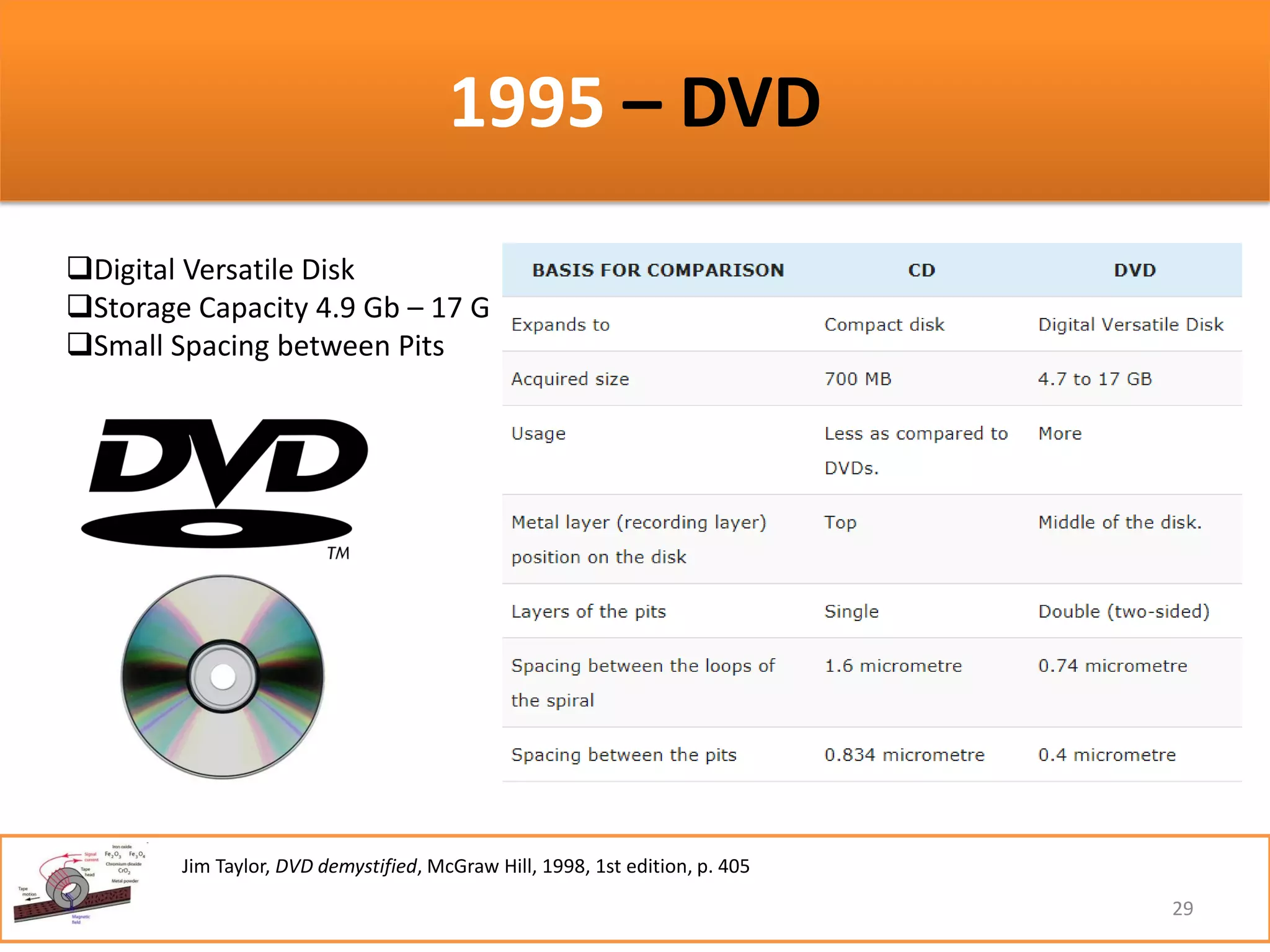
Digital Versatile Disk
Storage Capacity 4.9 Gb – 17 Gb
Small Spacing between Pits
Jim Taylor, DVD demystified, McGraw Hill, 1998, 1st edition, p. 405
29
2003 – Blue Ray & HD-DVD
Blue laser used to read the disc
Information to be stored at a greater density
Used to Store HD video of 720p, 1080p, 2Kp and 4Kp
Used to Store VG for the PlayStation 3, 4 and Xbox.
Blu-ray and HD DVD commercially available in 2006.
On February 19, 2008, war ended when
Toshiba officially announced that it would stop the
development of the HD DVD
"Toshiba Announces Discontinuation of HD DVD Businesses" (Press release). Toshiba. February 19, 2008.
Retrieved February 26, 2008.
30
2003 – Blue Ray & HD-DVD
https://en.wikipedia.org/wiki/Comparison_of_high_definition_optical_disc_formats
31
Fig 33. Comparison of Technology
2019 – Present Days
In 2018, both Samsung and
Toshiba introduce to market
30.72TB SSDs
Nimbus Data announces and
reportedly ships 100TB drives, a
capacity HDDs are not expected to
reach until 2025.
Samsung introduced an m.2 SSD
with speeds of 3500MB/S
32
Fig 34. SSD
2018 – Present Days
SSD VS Tape Drive
Lower cost per GB
Tape Drive Use less power
Easy to transport/move
Long Term data storage
Virus Free
Used for Cloud Storage
Google Use for Email Storage
https://www.overlandstorage.com/blog/?p=323
33
In 2018 IBM TS1160 20 TB
Year ? – Future Devices
Helium Hard Drives
Holographic
34
THANK
YOU
35

Storage devices

  • 1.
    BY: JALEES ULHASSAN PHD (PHYSICS) SCHOLAR UNIVERSITY OF ENGINEERING & TECHNOLOGY LAHORE, PAKISTAN 1
  • 2.
    PURPOSE OF PRESENTATION •History of Storage Devices • Working of magnetic storage devices 2 The most important thing about memory is not being able to store information but being able to find it later
  • 3.
    The idea ofrecording and playing back sound by recording a magnetic signal on a conductive medium was first thought of by American Oberlin Smith in 1888 [1] 1888 – Idea of recording [1] D. Morton, “Linked references are available on JSTOR for this article : Armour Research Foundation and the Wire Recorder : How Academic Entrepreneurs Fail,” vol. 39, no. 2, pp. 213–244, 2016. 3
  • 4.
    The first magneticrecorder was invented in 1898 by Valdemar Poulsen in which a magnetic recording is made on thin steel wire of 1 mm diameter and 100m long. Disk type gramophone, built in the period 1905-09 0.5 mm thick 130 mm Diameter Velocity of the disk 0.5 m/s 1898 – First wire magnetic recorder [2] Danish Museum of Science and Technology 4 30 – 50 min Fig 1. Wire Recorder Fig 2. Wire Recorder Fig 3. Disk Recorder
  • 5.
    1928 – Steeltape magnetic recorder German engineer Fritz Pfleumer One Side is made of Iron Oxide or Chromium other side is made of substrate of paper In 1933, working for AEG, Eduard Schuller developed the ring-shaped tape head. Technology is Kept Secret during WWII  Compact cassettes is developed by Philips in Belgium, and released in 1962 It was polyester-type plastic film In 1979 Sony Introduced first portable audio player. Du Gay, Paul; et al. (1997). Doing Cultural Studies: The Story of the Sony Walkman. London: SAGE Publications, in association with The Open University. ISBN 0-7619-5401-5. OCLC 651974258 5 70 – 90 min Fig 5. Ring RecorderFig 4. Magnetic Tape Fig 6. Compact Cassette Fig 7. Walkman
  • 6.
    1932 – Magneticdrum memory  Invented by Gustav Tauschek in 1932 in Austria  Drums were widely used in the 1950s and into the 1960s as computer memory  Random Access Memory  Coated by Ferromagnetic material  Many Rows of Read/Write heads  Storage Capacity 62.5 Kilobytes Drawbacks  High Seek Time  Optimum Programming Datamation, September 1967, p.25, "For Bendix and Ramo-Wooldridge, the G-20 and RW-400 were parallel core machines rather than serial drum machines of the type already in their product lines." 6 62.5 Kb Fig 8. Drum Memory
  • 7.
    1940 – Delayline Memory Invented by J. Presper Eckert Sequential Accessed Memory Idea comes in 1920s Used in computers since 1940s access time about 222 ms high speed of sound in mercury Weight, Cost, toxicity, Temp Types of DLM Mercury delay lines Magnetostrictive delay lines Piezoelectric delay lines Electric delay lines U.S. Patent 2,629,827 7 512 Bits Fig 9. Dely Line Memory
  • 8.
    1940 – Delayline Memory U.S. Patent 2,629,827 8 512 Bits
  • 9.
    1940 – Delayline Memory MAGNETOSTRICTION is a property of ferromagnetic materials which causes them to expand or contract in response to a magnetic field. 9
  • 10.
    1946 – VilliamsTube  Freddie Williams and Tom Kilburn  first random-access digital storage device grid of dots on a cathode ray tube Faster Than delay line memory System is affected by any nearby electrical fields Store about 1024 to 2560 bits of data Selectron tube memory device Early computers at Manchester University", Resurrection, The Computer Conservation Society, 1 (4), Summer 1992, ISSN 0958-7403, retrieved 7 July 2010 10 1024 – 2560 Bits 1 – 2.5 Kb Fig 11. Villiams Tube
  • 11.
    1950 – Magneticcore memory Shanghai-born American physicist, An Wang developed the core memory Toroids of magnetic material Semi-hard ferrite cores Three or four wires pass through each core. Each core stores one bit of information A core is magnetized in clockwise or counter- clockwise direction. Twister core memory formed by wrapping magnetic tape around a current- carrying wire Victor L. Sell and Syed Alvi, High Density Core Memory Matrix, U.S. Patent 3,711,839, granted Jan. 16, 1973. 11 32 Kilo Bits Per Cubic Feet Fig 12. Core Memory
  • 12.
    1950 – Magneticcore memory Victor L. Sell and Syed Alvi, High Density Core Memory Matrix, U.S. Patent 3,711,839, granted Jan. 16, 1973. 12 32 Kilo Bits Per Cubic Feet Fig 13a. Core Memory Fig 12a. C.W.M Fig 12b. C.C.M
  • 13.
    1950 – Magneticcore memory Creighton D. Barnes, et. al., Magnetic core storage device having a single winding for both the sensing and inhibit function, U.S. Patent 3,329,940, granted July 4, 1967. 13 X & Y are derive lines S is Sense Line Z is inhibit Line Material of core should have high degree of magnetic remanence and low coercitivity. Fig 13b. Core Memory
  • 14.
    Coating of magnetictape Ji, Li Na (June 2013). "Study on Preparation Process and Properties of Polyethylene Terephthalate (PET)". Applied Mechanics and Materials. 312: 406–410 14 Paper - Rejected by moist Cellulose Acetate - Rejected by Vinegar Syndrome Polyvinyl chloride (PVC) – Reject by Release of HCL Polyethylene terephthalate Polyethylene naphthalate
  • 15.
    1951 –Tape Drive TapeDrive 1st Used by Univac thin metal strip of 0.5-inch  nickel-plated phosphor bronze 12,800 characters per second IBM used ferrous-oxide coated tape "IBM Archives: Fifty years of storage innovation". 03.ibm.com. https://www.ibm.com/ibm/history/exhibits/storage/storage_fifty.html Retrieved 2019-04-10 15 224 kb – 2Mb In 2018 IBM TS1160 20 TB Fig 14. Tap Drive
  • 16.
  • 17.
    1952 - Videotape recorder  Charles Ginsburg invent VTR of Much wider bandwidth 6 MHz vs 20 kHz Dr. Norikazu Sawazaki developed a prototype helical scan video tape recorder Sony introduced portable VTR 1971 "Toshiba Science Museum : World's First Helical Scan Video Tape Recorder". toshiba-mirai-kagakukan.jp. http://toshiba-mirai-kagakukan.jp/en/learn/history/ichigoki/1959vtr/index.htm Retrieved on 2019-04-10 17 Fig 15. Video Recorder Fig 16. Helical Scan
  • 18.
    1956 – HardDisk  Invented by Reynold B. Johnson.  It has fifty 24-inch Diameter Disks  Data transfer rate is 8,800 Character/sec  Aluminum alloy or a mixture of glass and ceramic is used as substrate Aluminum is non-magnetic, lightweight and grindable precisely. Glass technology has the better heat resistance Interior kept in a partial vacuum Spin at 1200 rpm Size 3.75 – 5 MB Kean, David W., "IBM San Jose, A quarter century of innovation", 1977. Arpaci-Dusseau, Remzi H.; Arpaci-Dusseau, Andrea C. (2014). "Operating Systems: Three Easy Pieces, Chapter: Hard Disk Drives" (PDF). Arpaci-Dusseau Books. 18 3.75 – 5 MB Fig 17. HDD Fig 18. Hard Disk
  • 19.
    1956 – HardDisk Kean, David W., "IBM San Jose, A quarter century of innovation", 1977. Arpaci-Dusseau, Remzi H.; Arpaci-Dusseau, Andrea C. (2014). "Operating Systems: Three Easy Pieces, Chapter: Hard Disk Drives" (PDF). Arpaci-Dusseau Books. 19 3.75 – 5 MB Bits of data are arranged in concentric, circular paths called tracks Each track is broken up into smaller areas called sectors Part of the hard drive stores a map of sectors that have already been used up and others that are still free In Windows, this map is called the File Allocation Table or FAT Fig 19. Disk Recorder
  • 20.
    1966 - DRAM 1966Robert H. Dennard Dynamic random-access memory semiconductor memory stores each bit of data in a separate tiny capacitor within an integrated circuit The capacitor can either be charged or discharged; these two states are taken to represent the two values of a bit, conventionally called 0 and 1. S. Mittal, "A Survey of Architectural Techniques For DRAM Power ManagementArchived 2018-05-08 at the Wayback Machine", IJHPSA, 4(2), 110-119, 2012. 20 Less than 1 Kb Fig 20. DRAM
  • 21.
    1966 - DRAMcell Fig 20a. DRAM Fig 20b. DRAM Fig 20c. DRAM Fig 20d. DRAM
  • 22.
    1970 – BubbleMemory Inventd by Andrew Bobeck Bubble formed in garnets (2-30um) Wide range of temperature Only a couple of square inches in size Gadolinium gallium garnet (GGG) is used as substrate. Non-volatile computer memory Bubbles or domains, each storing one bit of data Bubbles or domains are moveable Replace Core, Tape, Disks Texas Instruments Introduces Portable Computer Terminal: Model Said to Be First With Mass Memory and Using Bubble Memory Device". Wall Street Journal. New York, N.Y.: Dow Jones & Company Inc. Apr 18, 1977. p. 13. ISSN 0099-9660. 22 4,096 bits Fig 21. Bubbles Fig 22. Bubble Memory
  • 23.
    1970 – BubbleMemory Texas Instruments Introduces Portable Computer Terminal: Model Said to Be First With Mass Memory and Using Bubble Memory Device". Wall Street Journal. New York, N.Y.: Dow Jones & Company Inc. Apr 18, 1977. p. 13. ISSN 0099-9660. 23 4,096 bits Function driver: convert the digital input control signals to the required current pulses. Sense amplifier: Convert the output to standard TTL levels. Triangular current: Two field coils require this current to synchronized with coil drivers and diode array current that is driven with digital input signals. Function Timing Generator: These signals provide control for five basic operations: generate, replicate, annihilate, transfer-in, and transfer- out. The function-timing generator also initiates the rotating magnetic field. Fig 23. Bubble Mem.
  • 24.
    1970 – BubbleMemory Texas Instruments Introduces Portable Computer Terminal: Model Said to Be First With Mass Memory and Using Bubble Memory Device". Wall Street Journal. New York, N.Y.: Dow Jones & Company Inc. Apr 18, 1977. p. 13. ISSN 0099-9660. 24 4,096 bits When magnetized sequentially by a magnetic field rotating in the same plane, these chevron propagation patterns set up magnetic polarities that attract the bubble domain and establish motion Fig 24. Shevron Part
  • 25.
    1971 – Floppy Developedin the late 1960 Commercially available in 1971 Even now use for BIOS updates Perform a recovery Now still some Government Agencies use old machineries which contain floppy Drives. USA upgrades their devices in 2017 8 inch is diameter Storage capacity 360 Kb 1987 – Magnetic Optical Disk is introduced 1994 – Zip Drives & Zip Disks are introduced Capacities of 100 MB, 250 MB and 750 MB https://www.nytimes.com/1990/03/14/business/business-technology-the-evolution-of-the-floppy-disk-for-pc-s.html 25 Fig 25. Floppy Fig 26. MOD Fig 27. Zip Drive
  • 26.
    1980 – CompactDisk Optical recording technology was invented by David Paul Gregg and James Russell in 1958 and first patented in 1961 Compact Discs replaced floppy disks Phase-change or Phase-shift material U.S. Patent 3,501,586 Analog to digital to optical photographic recording and playback system, March 1970. 26 Fig 28. Working of CD
  • 27.
    1984 – FlashMemory Electronic (solid-state) Storage non-volatile computer storage medium Toshiba developed flash memory in 1980s NAND and NOR logic gates Flash Mittal, Sparsh; Vetter, Jeffrey S. (2016). "A Survey of Software Techniques for Using Non-Volatile Memories for Storage and Main Memory Systems". IEEE Transactions on Parallel and Distributed Systems. 27 (5): 1537– 1550. doi:10.1109/TPDS.2015.2442980. 27 Fig 29. Working of Flash Memory
  • 28.
    1994 – Beginningof Micro Drives 1994 – Scandisk Devleop Flash Compact 1997 - MultiMediaCard used for solid-state storage by SanDisk and Siemens Microdrive is a registered trademark for miniature, 1-inch hard disks produced by IBM and Hitachi The standard was introduced in August 1999 by joint efforts between SanDisk, Panasonic and Toshiba as an improvement over MultiMediaCards (MMC) Mittal, Sparsh; Vetter, Jeffrey S. (2016). "A Survey of Software Techniques for Using Non-Volatile Memories for Storage and Main Memory Systems". IEEE Transactions on Parallel and Distributed Systems. 27 (5): 1537– 1550. doi:10.1109/TPDS.2015.2442980. 28 Fig 30. Micro Drive Fig 31. Scan Disk Fig 32. Standard Drives
  • 29.
    1995 – DVD DigitalVersatile Disk Storage Capacity 4.9 Gb – 17 Gb Small Spacing between Pits Jim Taylor, DVD demystified, McGraw Hill, 1998, 1st edition, p. 405 29
  • 30.
    2003 – BlueRay & HD-DVD Blue laser used to read the disc Information to be stored at a greater density Used to Store HD video of 720p, 1080p, 2Kp and 4Kp Used to Store VG for the PlayStation 3, 4 and Xbox. Blu-ray and HD DVD commercially available in 2006. On February 19, 2008, war ended when Toshiba officially announced that it would stop the development of the HD DVD "Toshiba Announces Discontinuation of HD DVD Businesses" (Press release). Toshiba. February 19, 2008. Retrieved February 26, 2008. 30
  • 31.
    2003 – BlueRay & HD-DVD https://en.wikipedia.org/wiki/Comparison_of_high_definition_optical_disc_formats 31 Fig 33. Comparison of Technology
  • 32.
    2019 – PresentDays In 2018, both Samsung and Toshiba introduce to market 30.72TB SSDs Nimbus Data announces and reportedly ships 100TB drives, a capacity HDDs are not expected to reach until 2025. Samsung introduced an m.2 SSD with speeds of 3500MB/S 32 Fig 34. SSD
  • 33.
    2018 – PresentDays SSD VS Tape Drive Lower cost per GB Tape Drive Use less power Easy to transport/move Long Term data storage Virus Free Used for Cloud Storage Google Use for Email Storage https://www.overlandstorage.com/blog/?p=323 33 In 2018 IBM TS1160 20 TB
  • 34.
    Year ? –Future Devices Helium Hard Drives Holographic 34
  • 35.