



Information Technology for Managers Session 3 By  Prof. Arun Mishra
Learning Objectives In this chapter your will learn about: Classification of Secondary Storage. Magnetic Tape Magnetic Disk Optical Disk Memory Storage Devices.
Limitations of Primary Storage
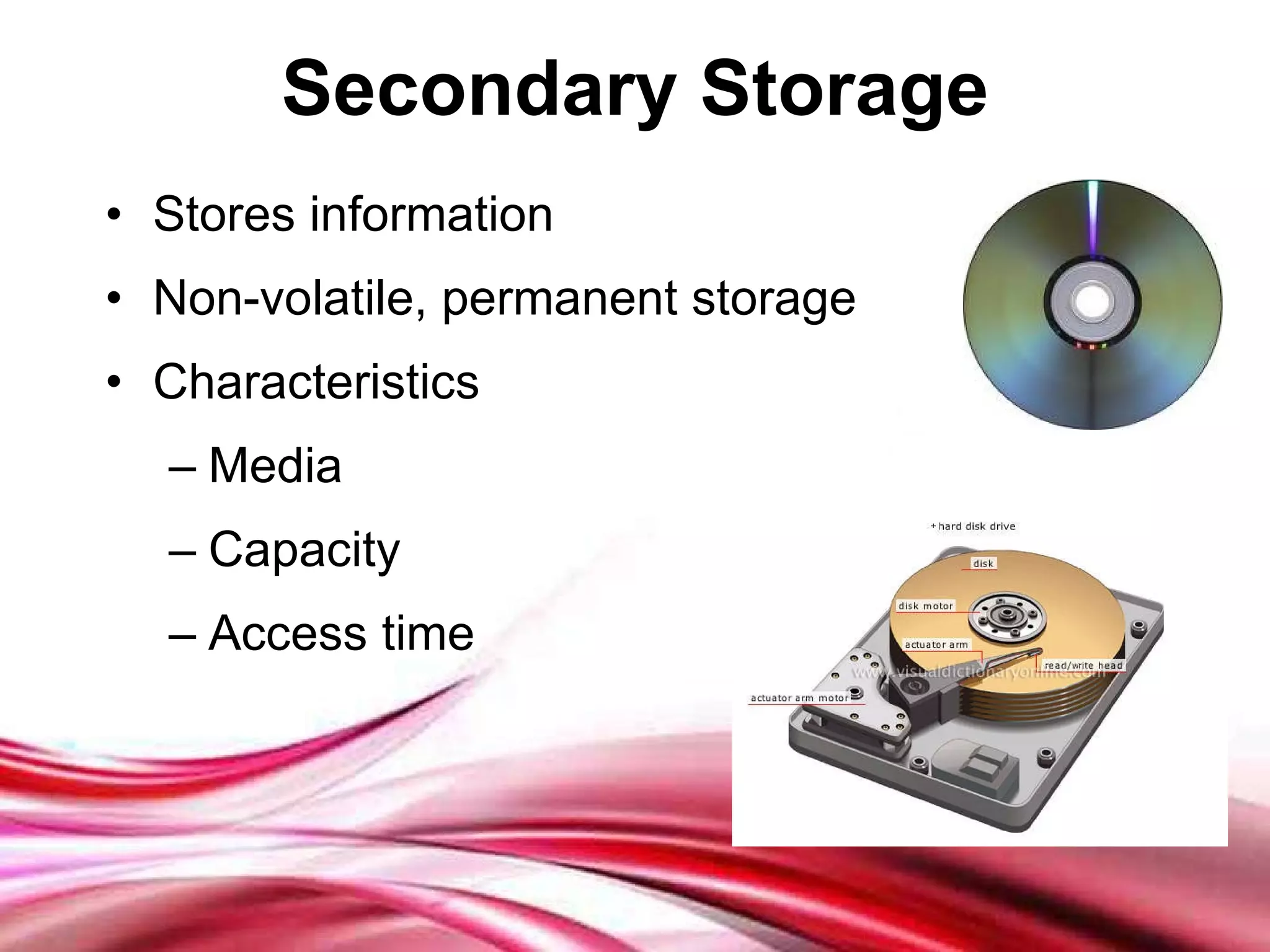
Secondary Storage Stores information Non-volatile, permanent storage Characteristics Media Capacity Access time
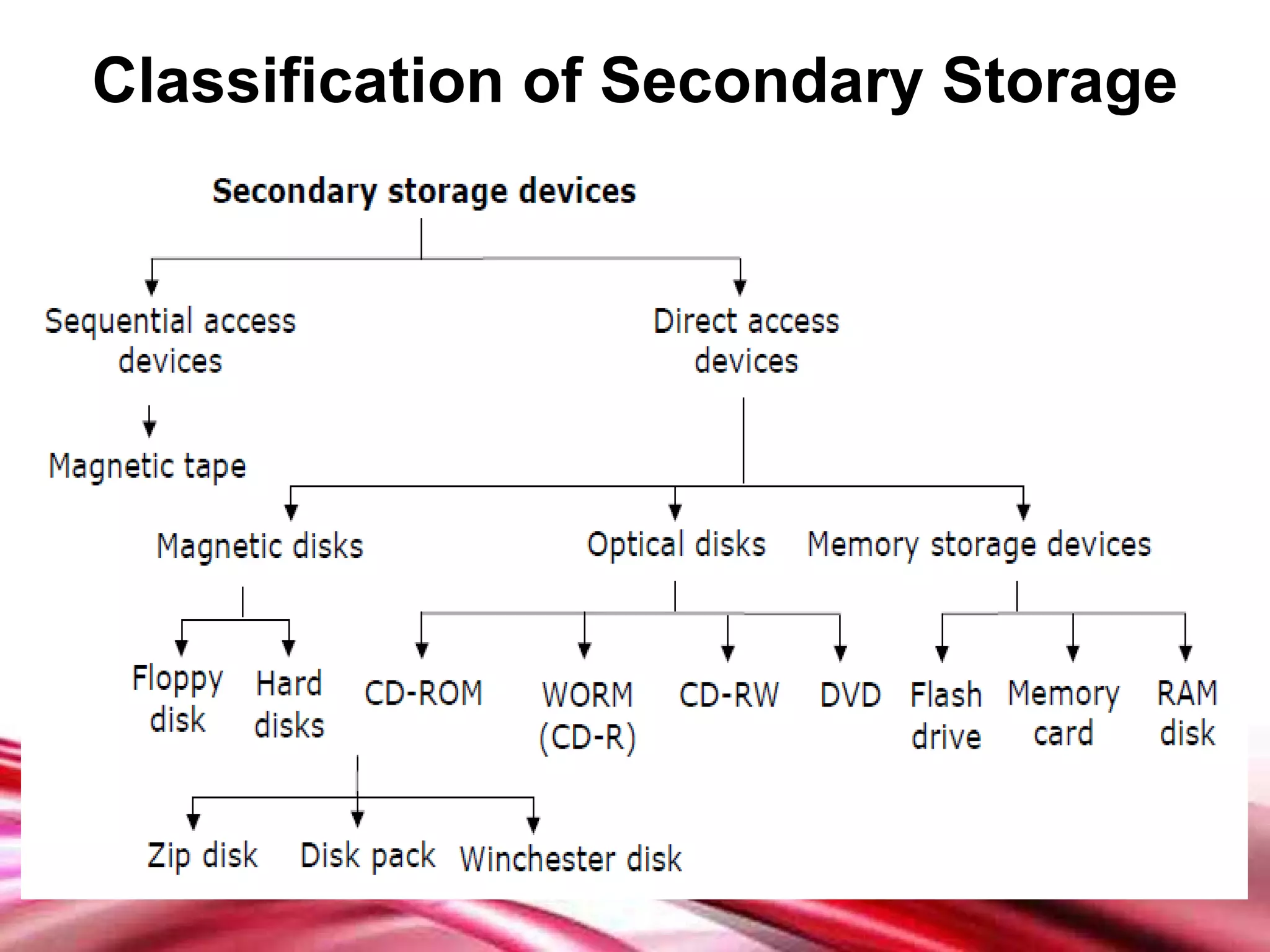
Classification of Secondary Storage
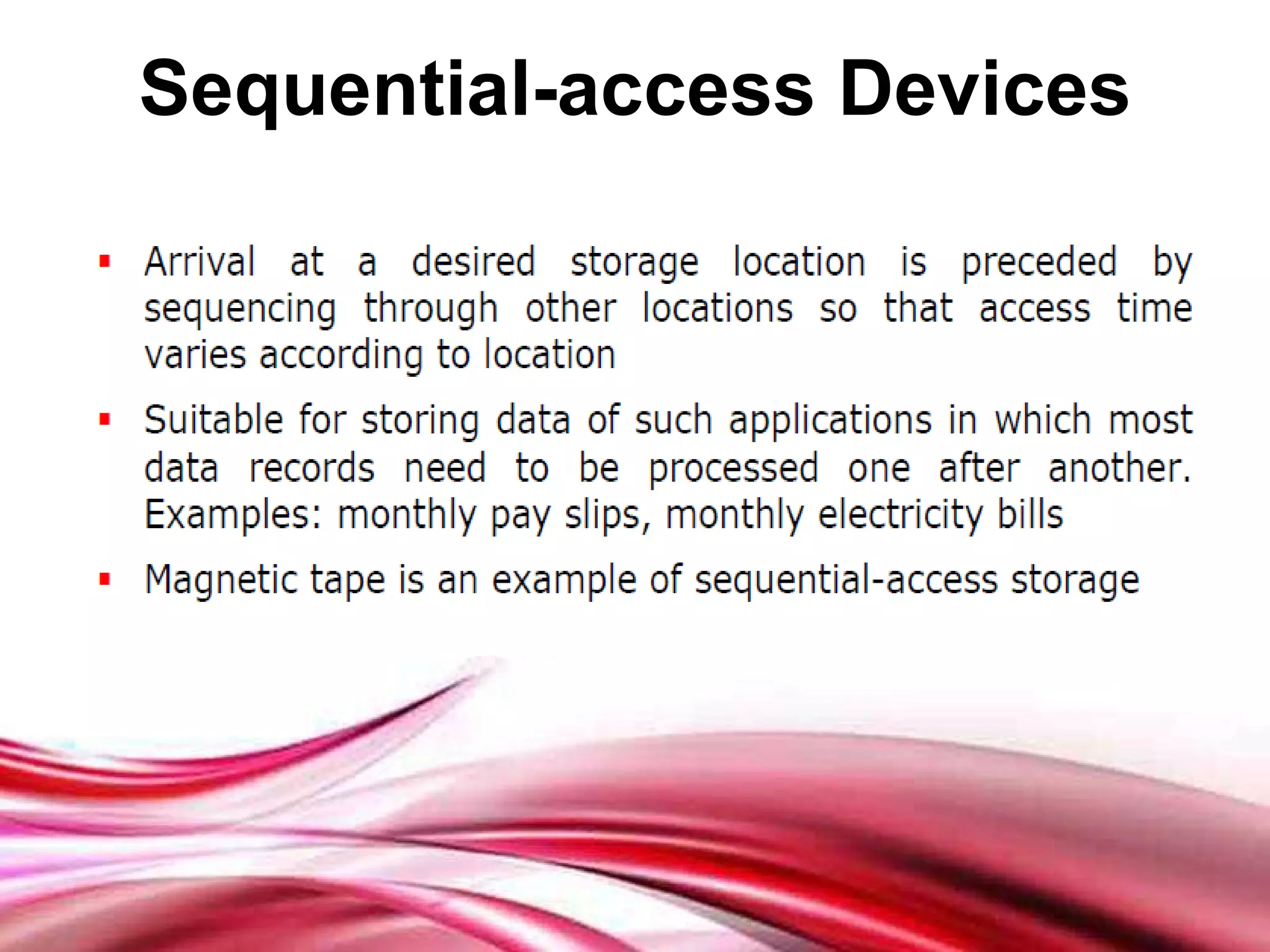
Sequential-access Devices
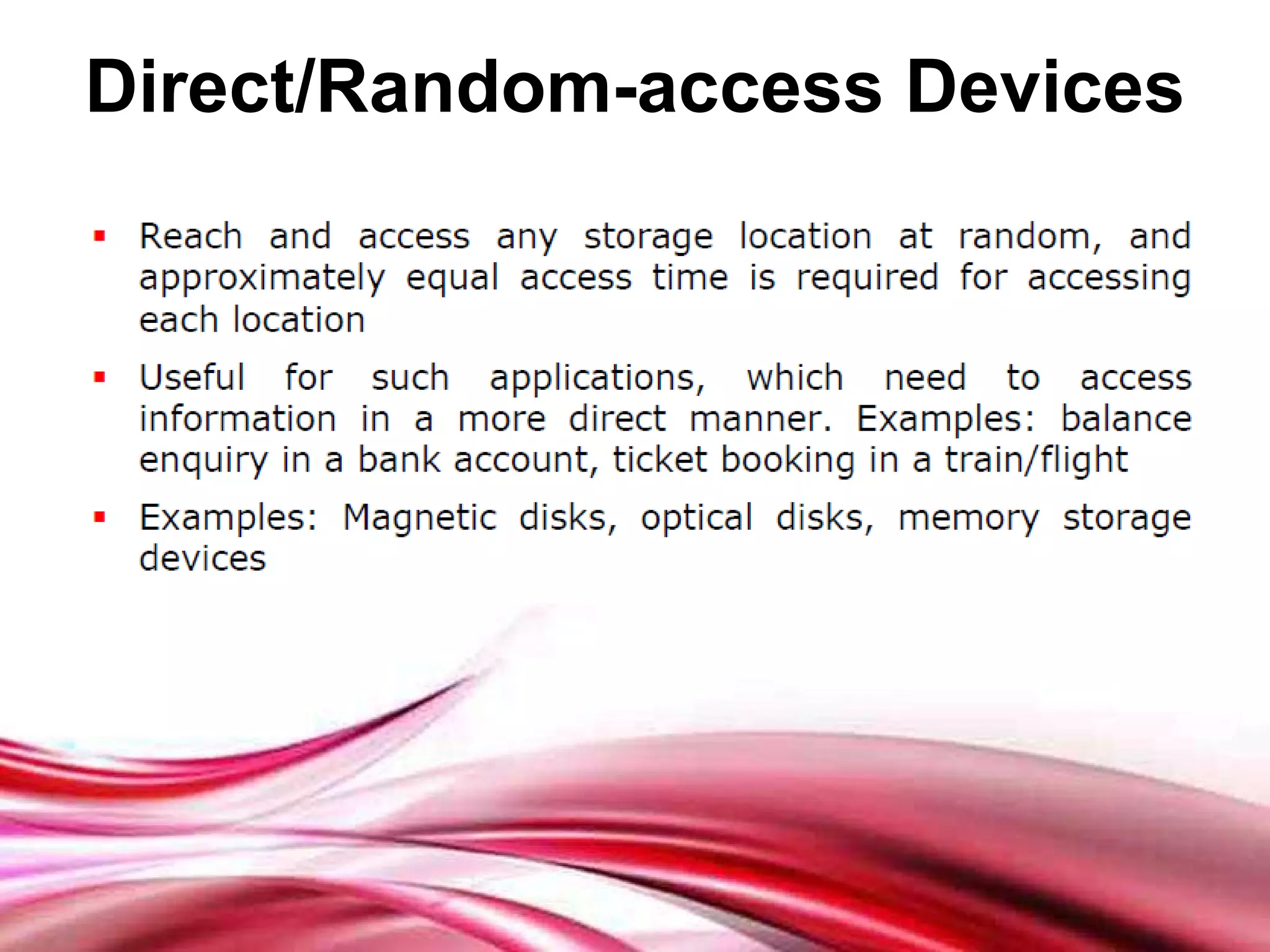
Direct/Random-access Devices
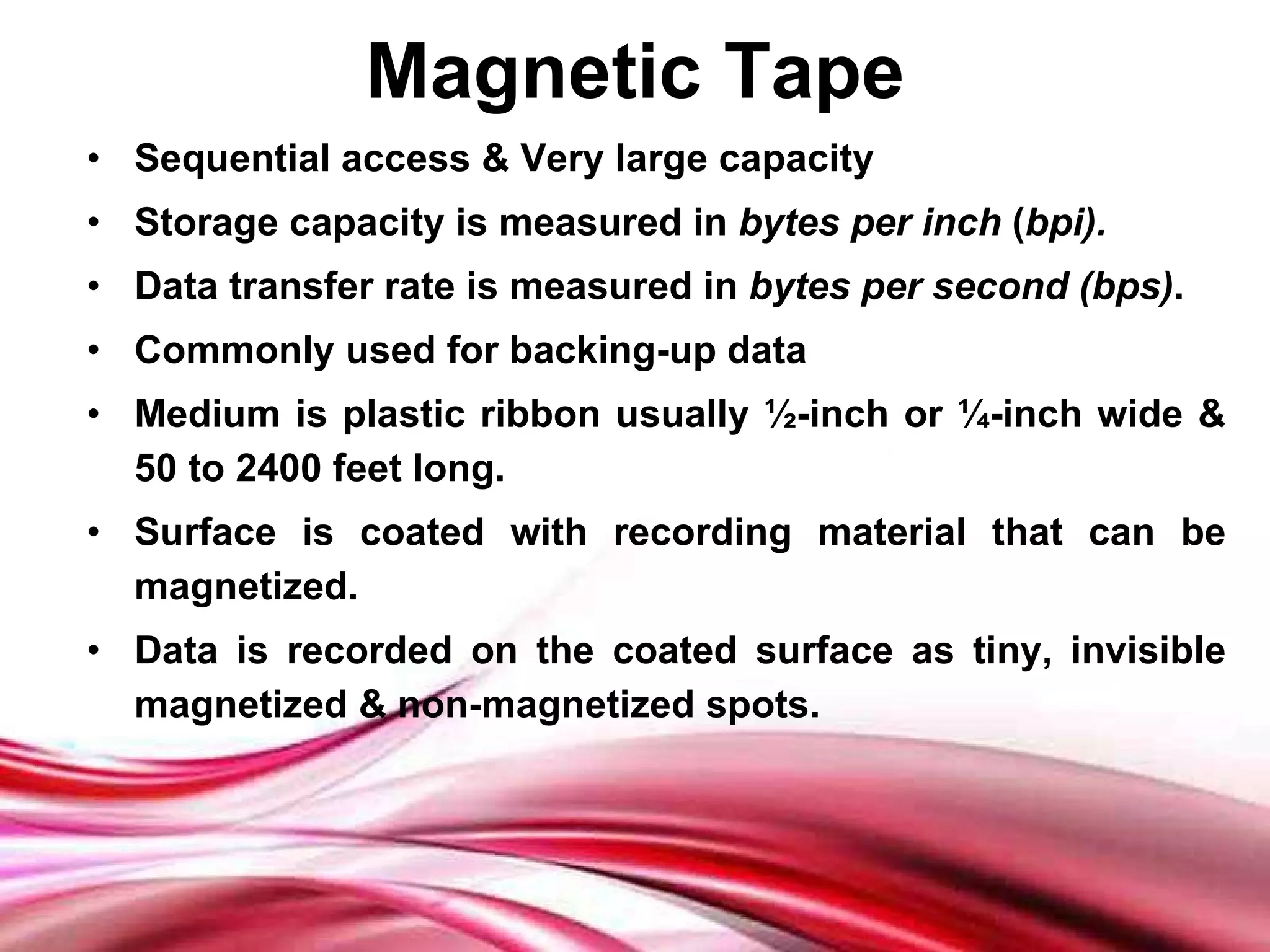
Magnetic Tape Sequential access & Very large capacity Storage capacity is measured in  bytes per inch  ( bpi). Data transfer rate is measured in  bytes per second (bps) . Commonly used for backing-up data Medium is plastic ribbon usually ½-inch or ¼-inch wide & 50 to 2400 feet long. Surface is coated with recording material that can be magnetized. Data is recorded on the coated surface as tiny, invisible magnetized & non-magnetized spots.
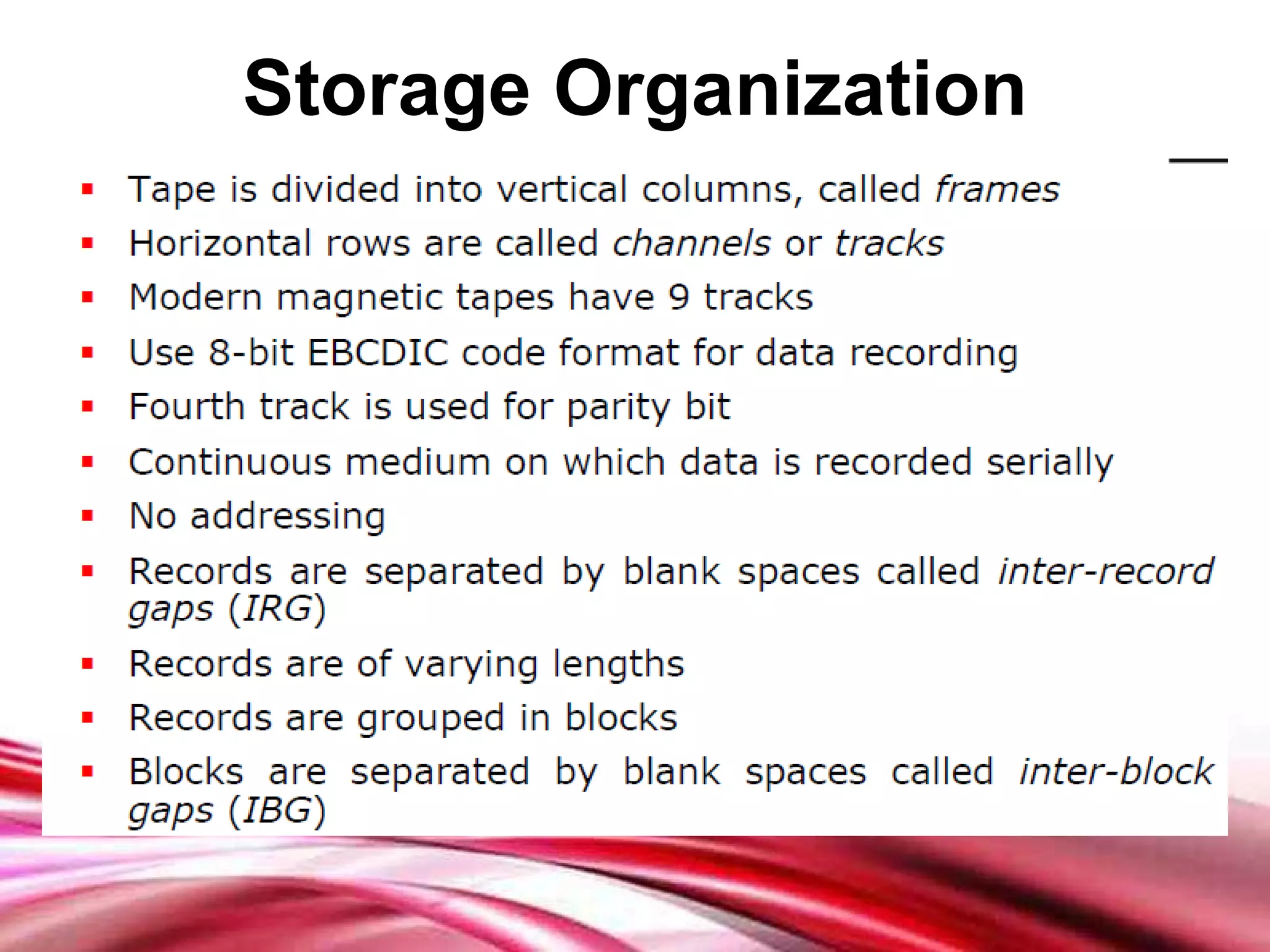
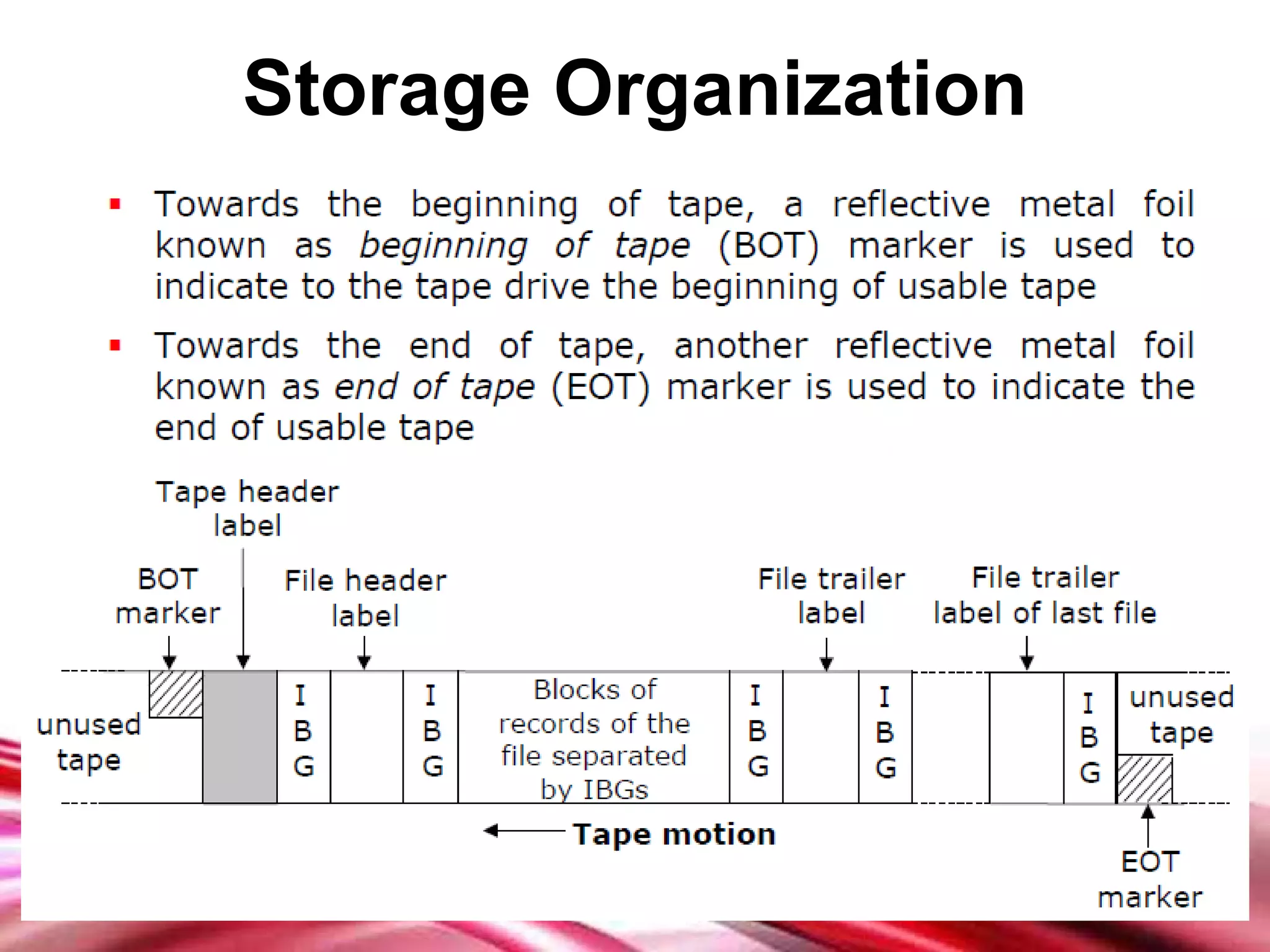
Storage Organization
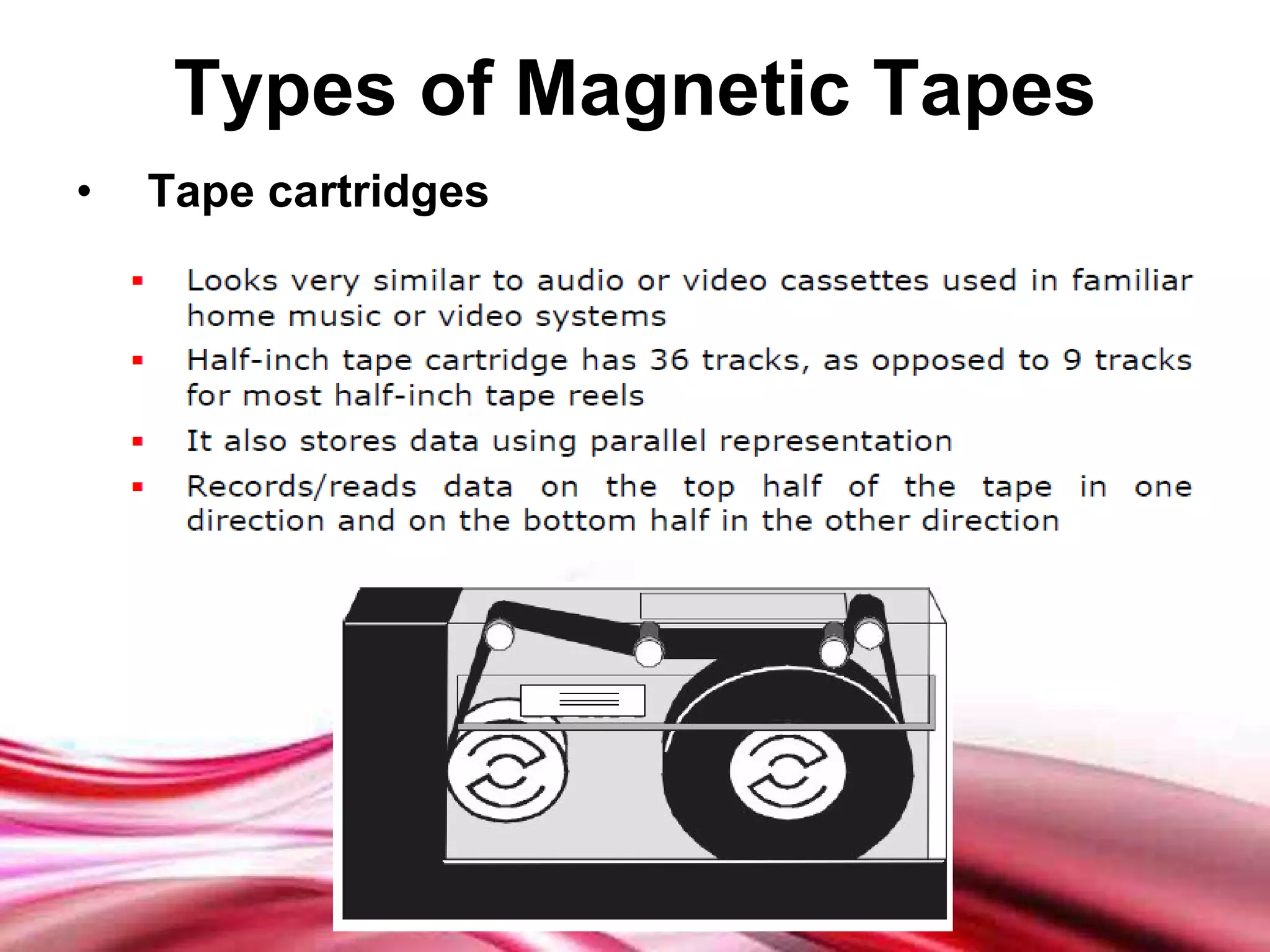
Types of Magnetic Tapes Tape cartridges
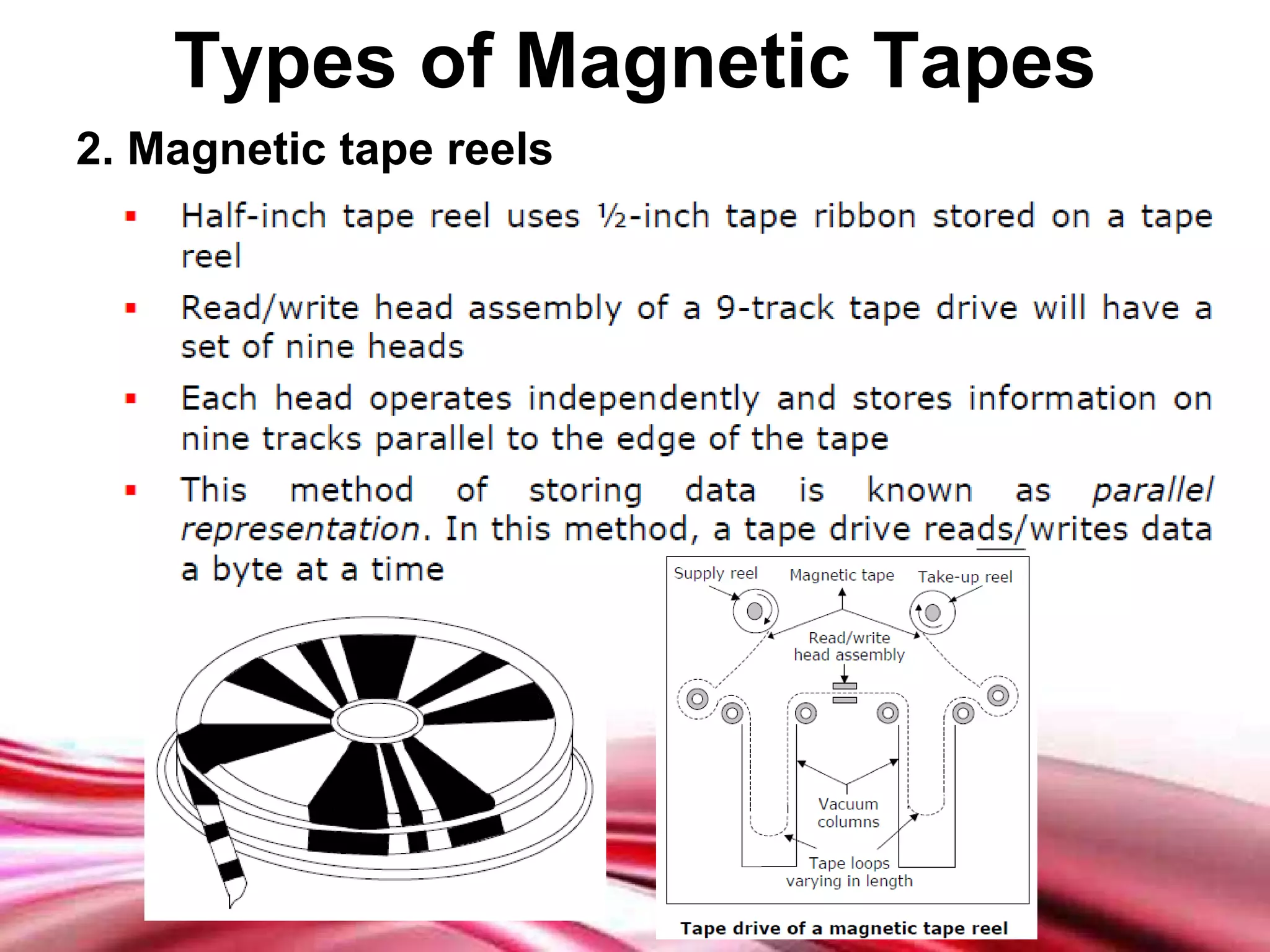
Types of Magnetic Tapes 2. Magnetic tape reels
Magnetic Disks
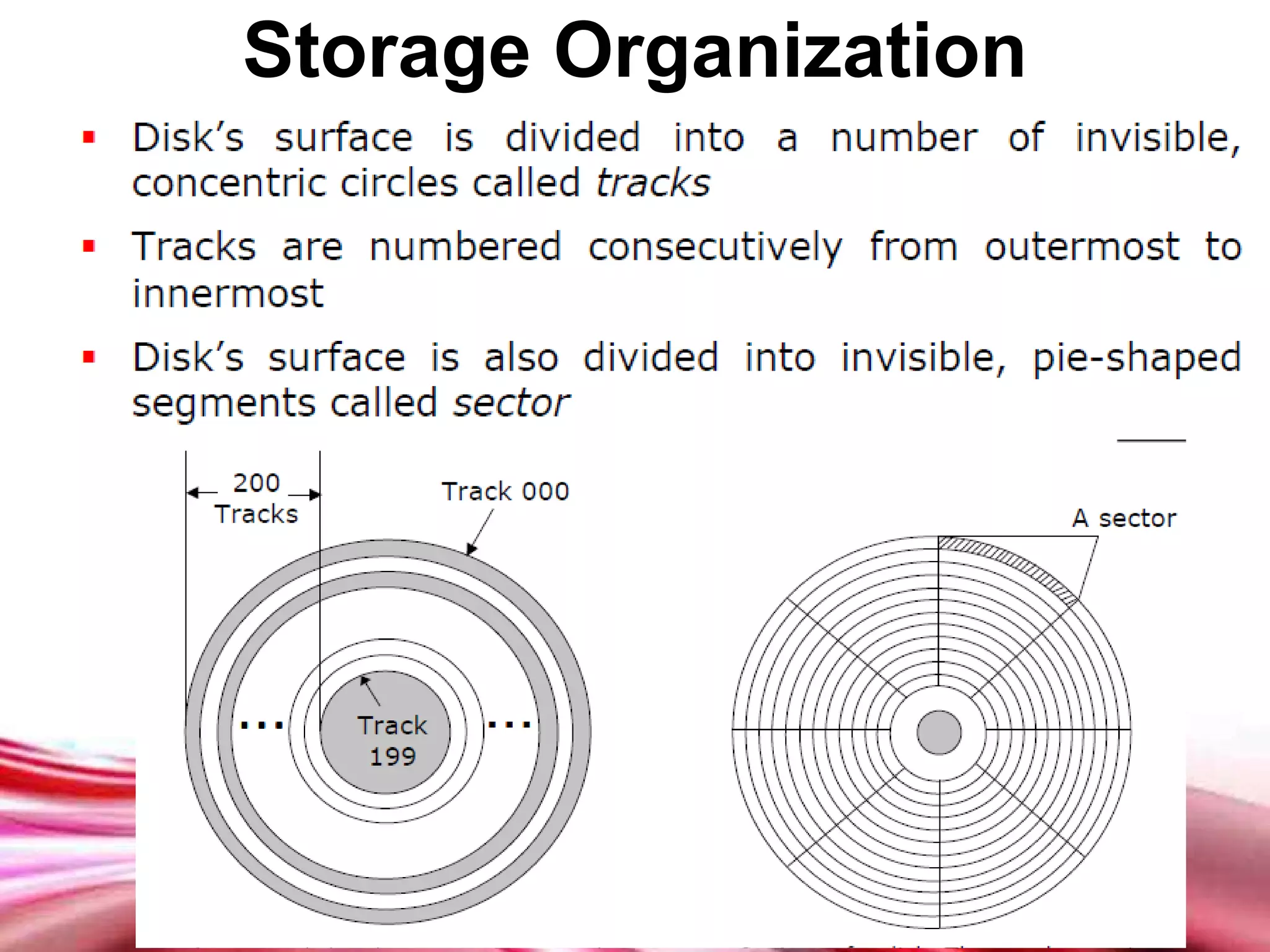
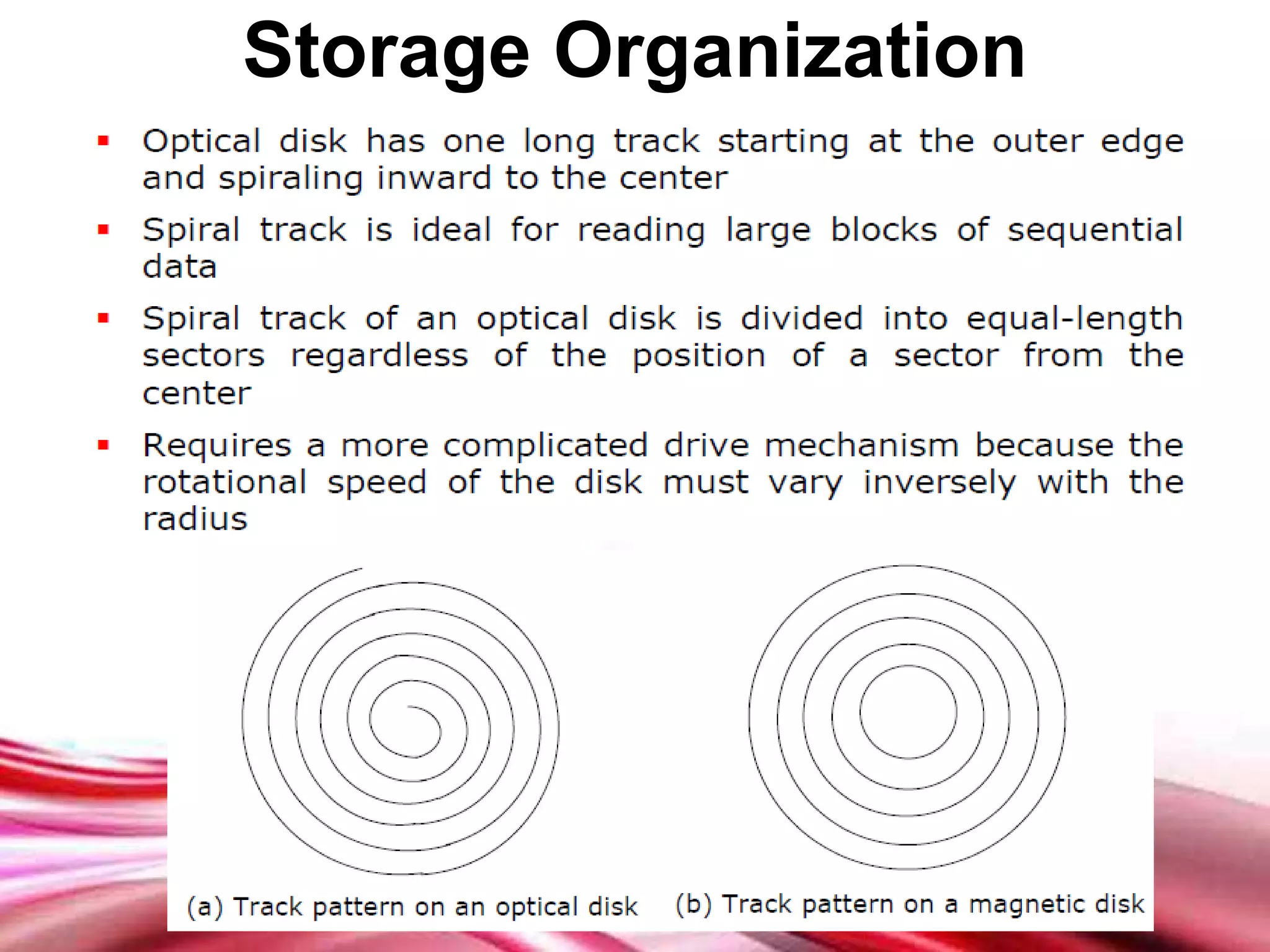
Storage Organization
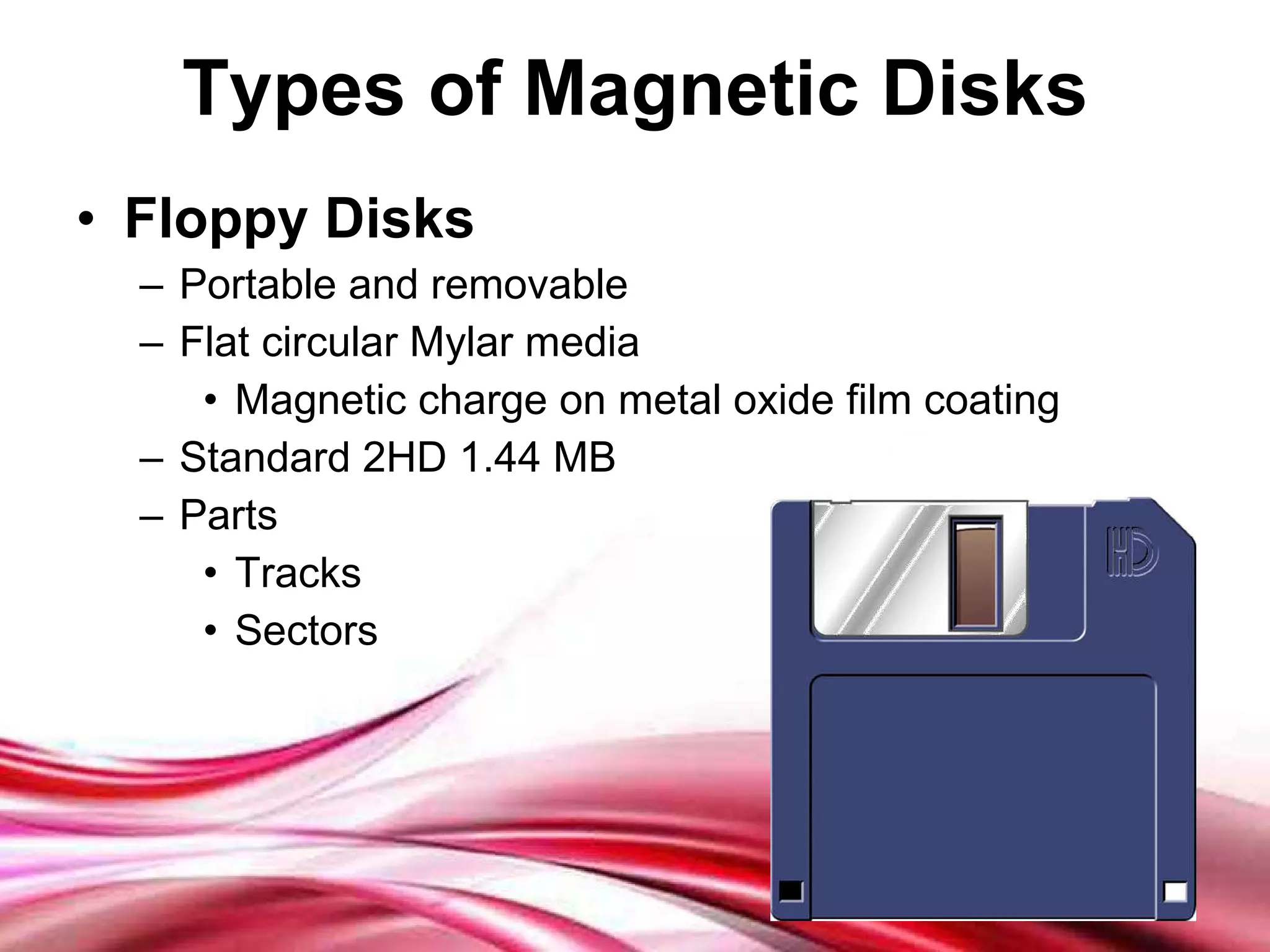
Types of Magnetic Disks Floppy Disks Portable and removable Flat circular Mylar media Magnetic charge on metal oxide film coating Standard 2HD 1.44 MB Parts Tracks Sectors
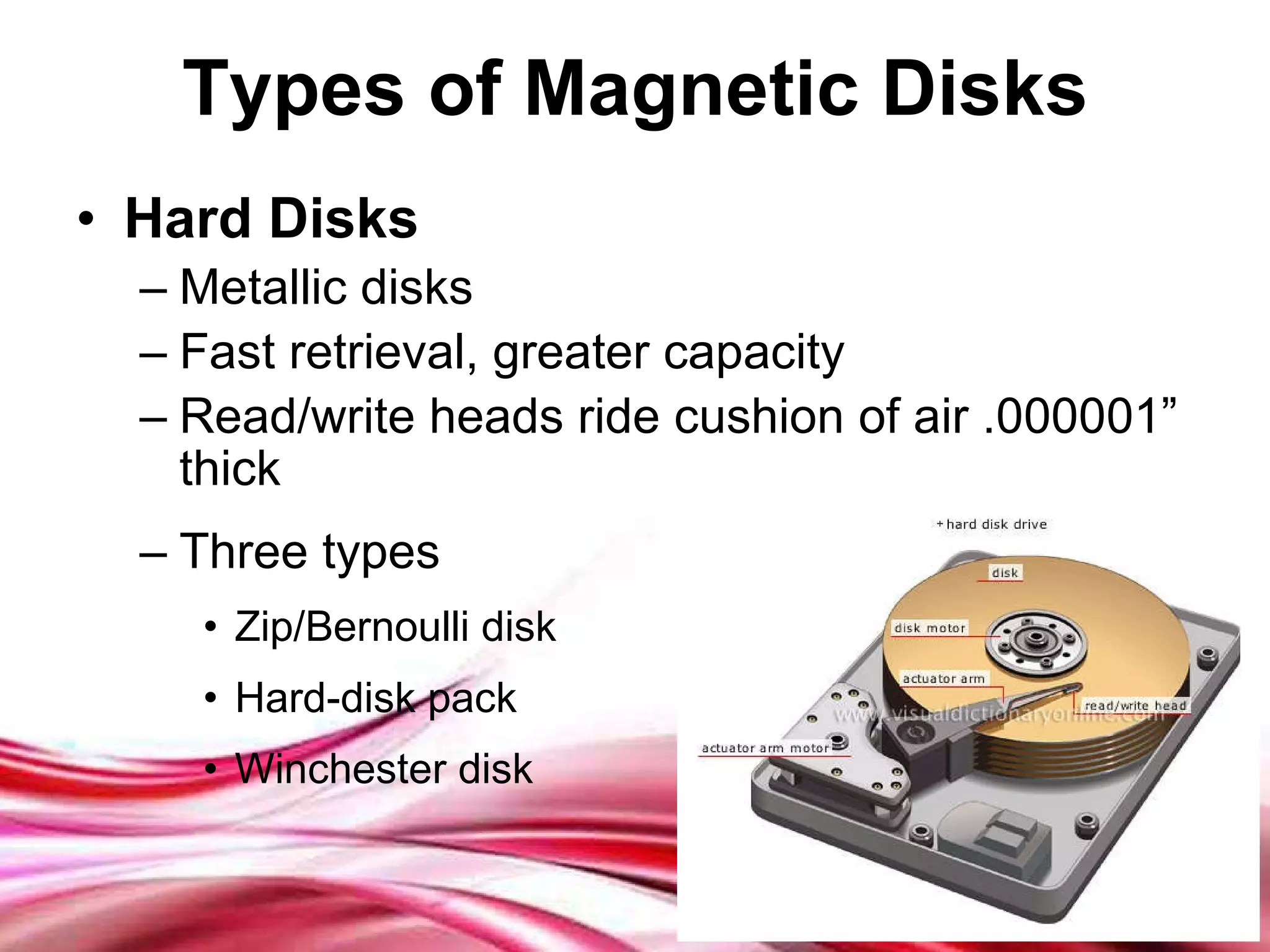
Types of Magnetic Disks Hard Disks Metallic disks Fast retrieval, greater capacity Read/write heads ride cushion of air .000001” thick Three types Zip/Bernoulli disk Hard-disk pack Winchester disk
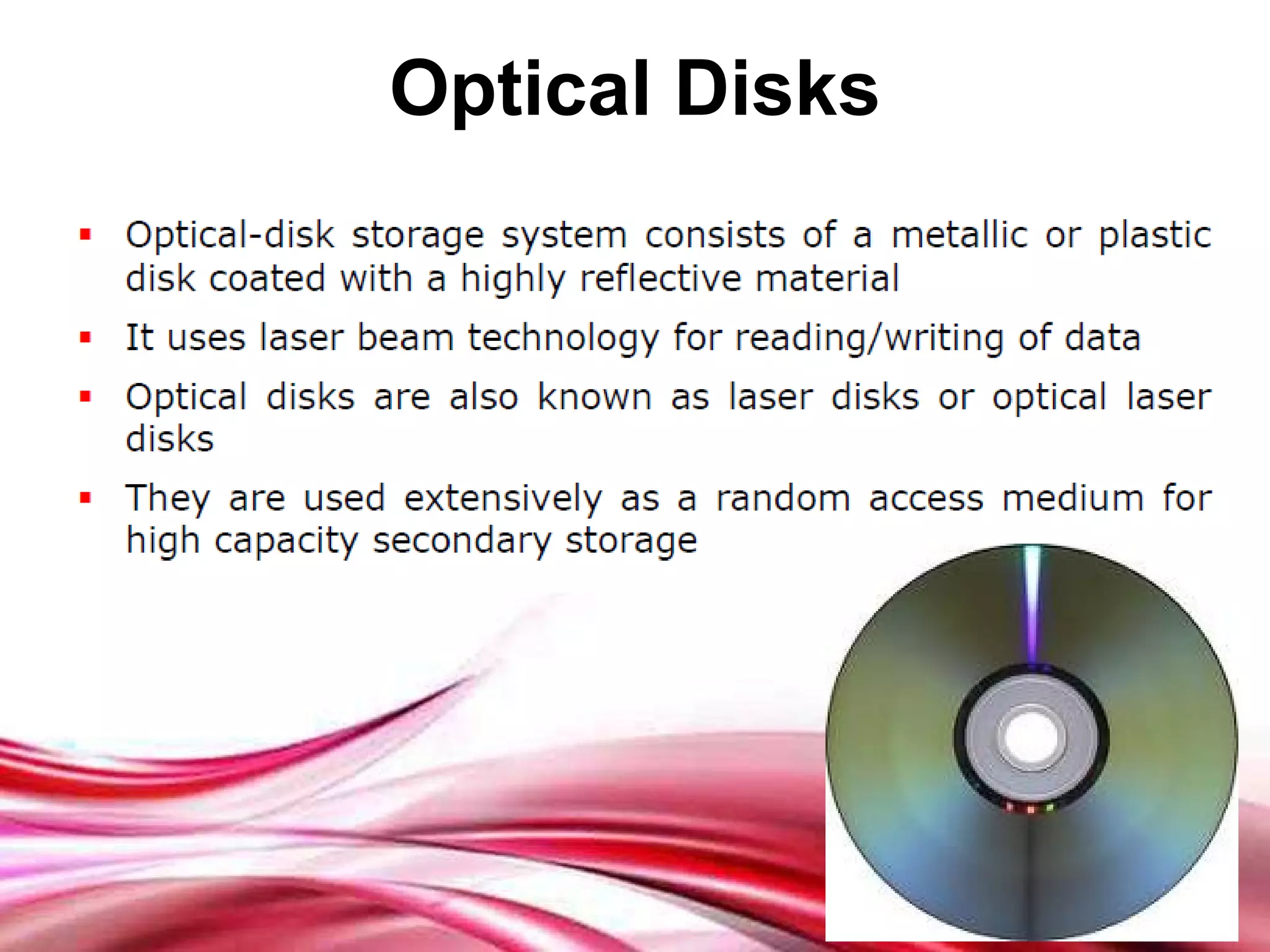
Optical Disks
Storage Organization
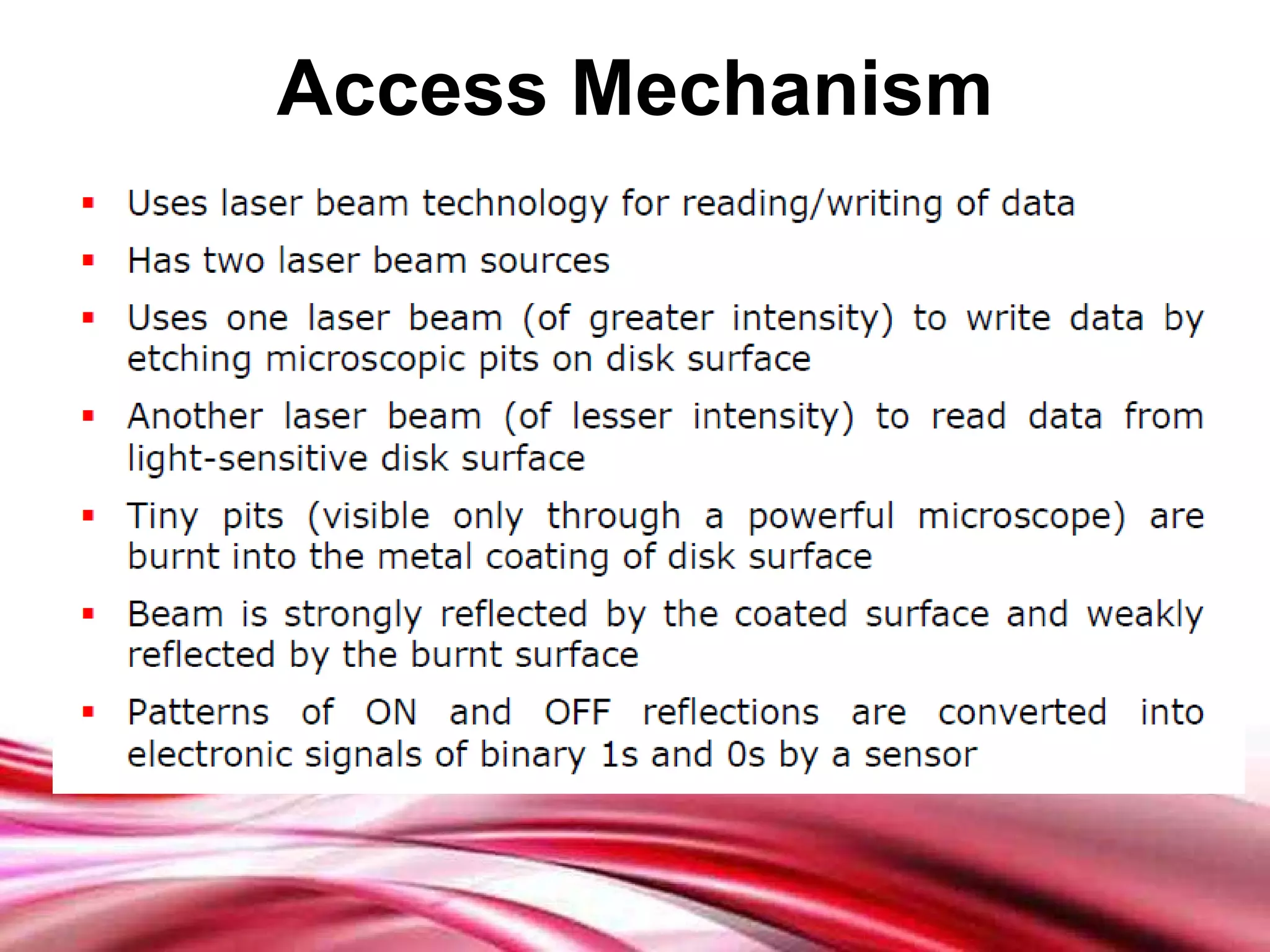
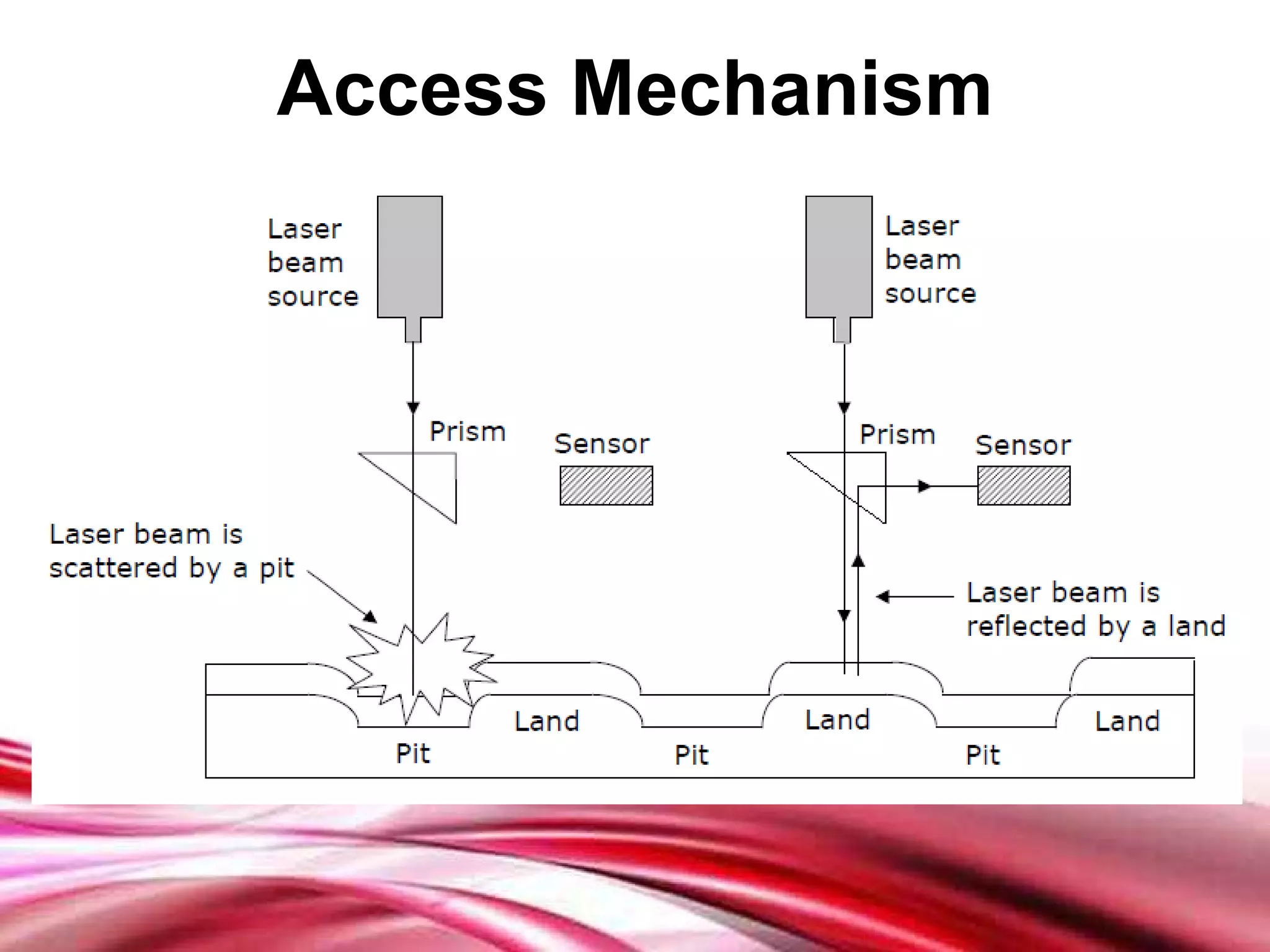
Access Mechanism
Access Mechanism
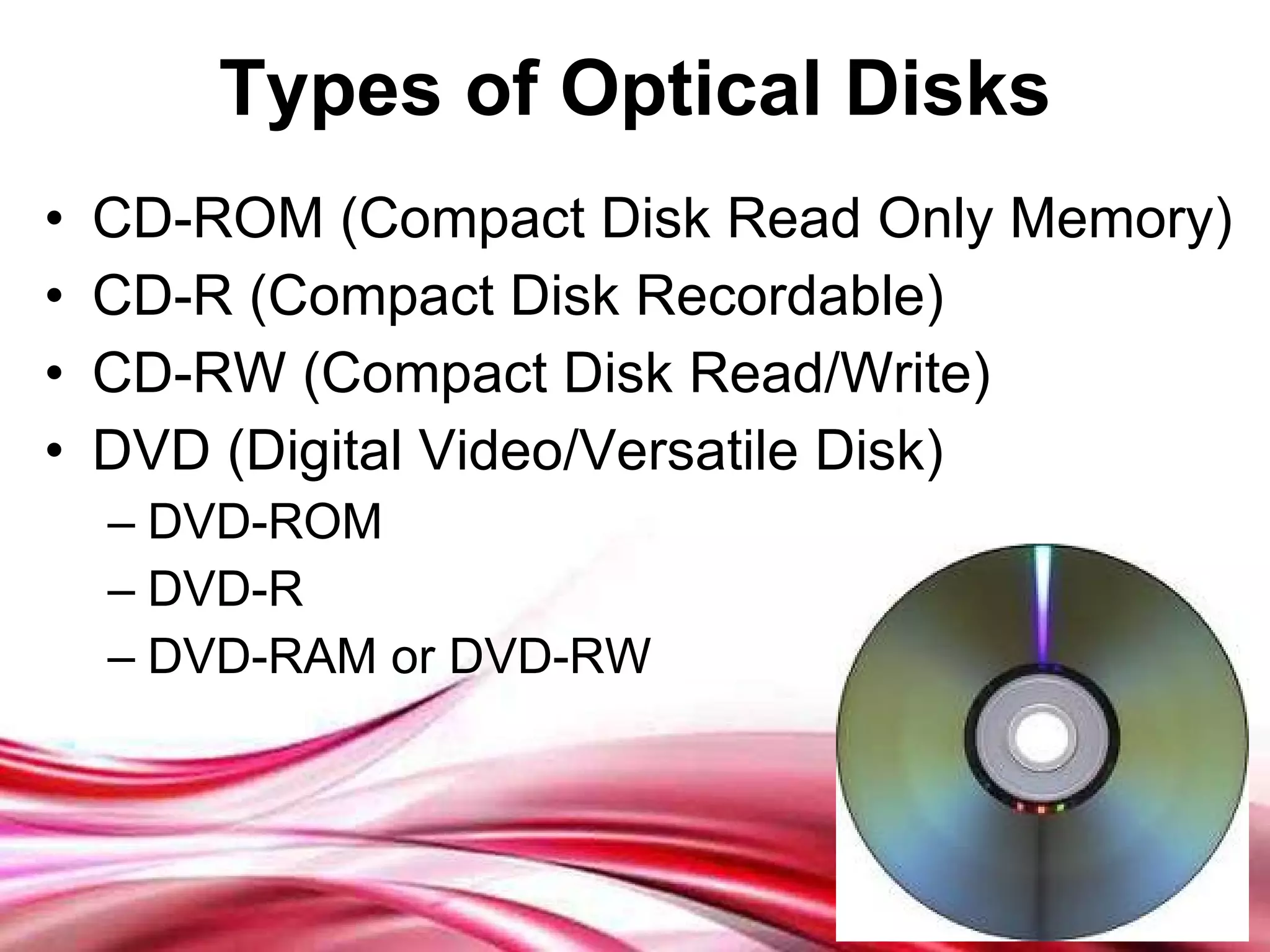
Types of Optical Disks CD-ROM (Compact Disk Read Only Memory) CD-R (Compact Disk Recordable) CD-RW (Compact Disk Read/Write) DVD (Digital Video/Versatile Disk) DVD-ROM DVD-R  DVD-RAM or DVD-RW
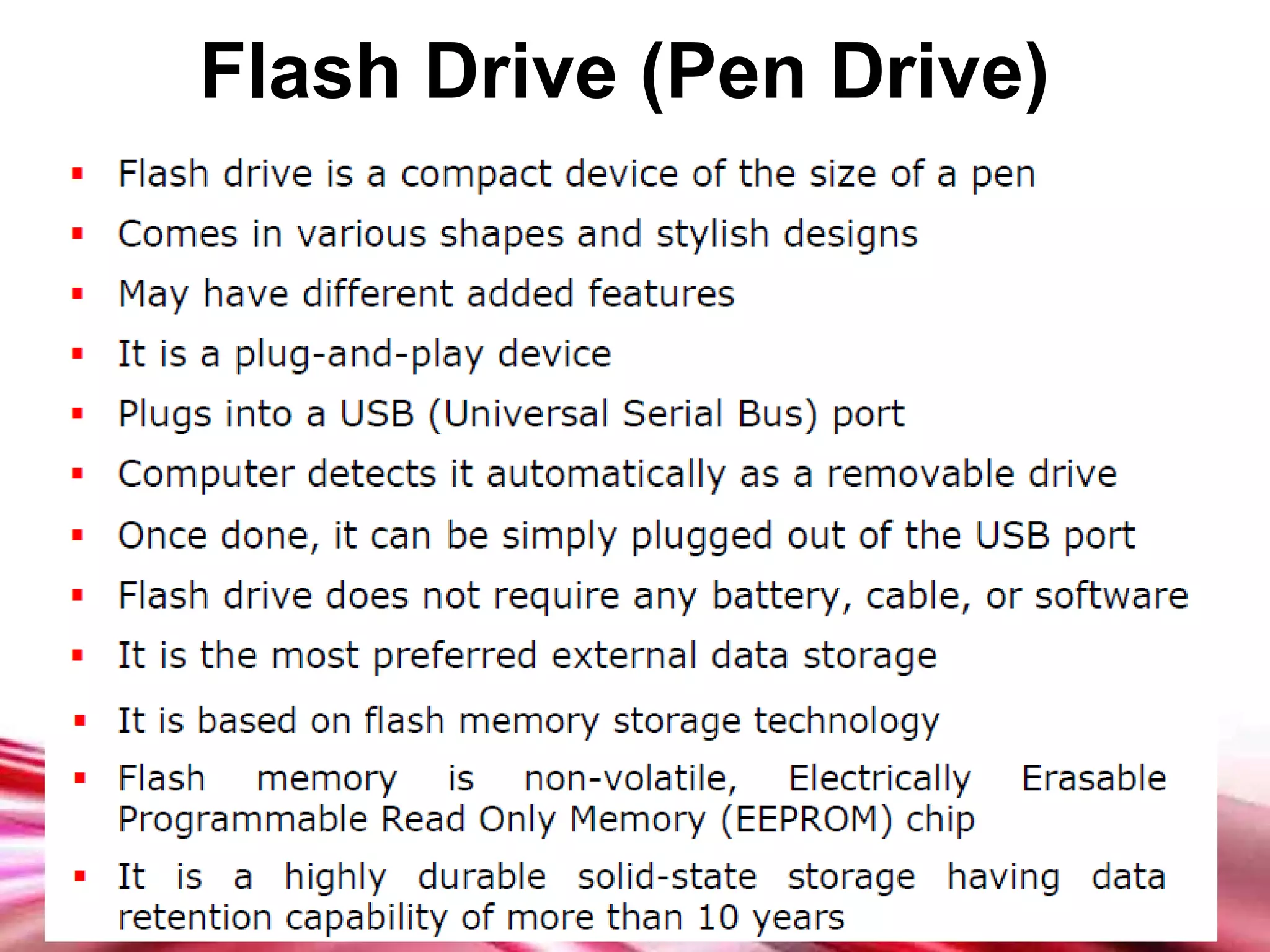
Memory Storage Devices There are three types of memory storage devices: Flash Drive (Pen Drive) Memory Card (SD/MMC) RAM Disk
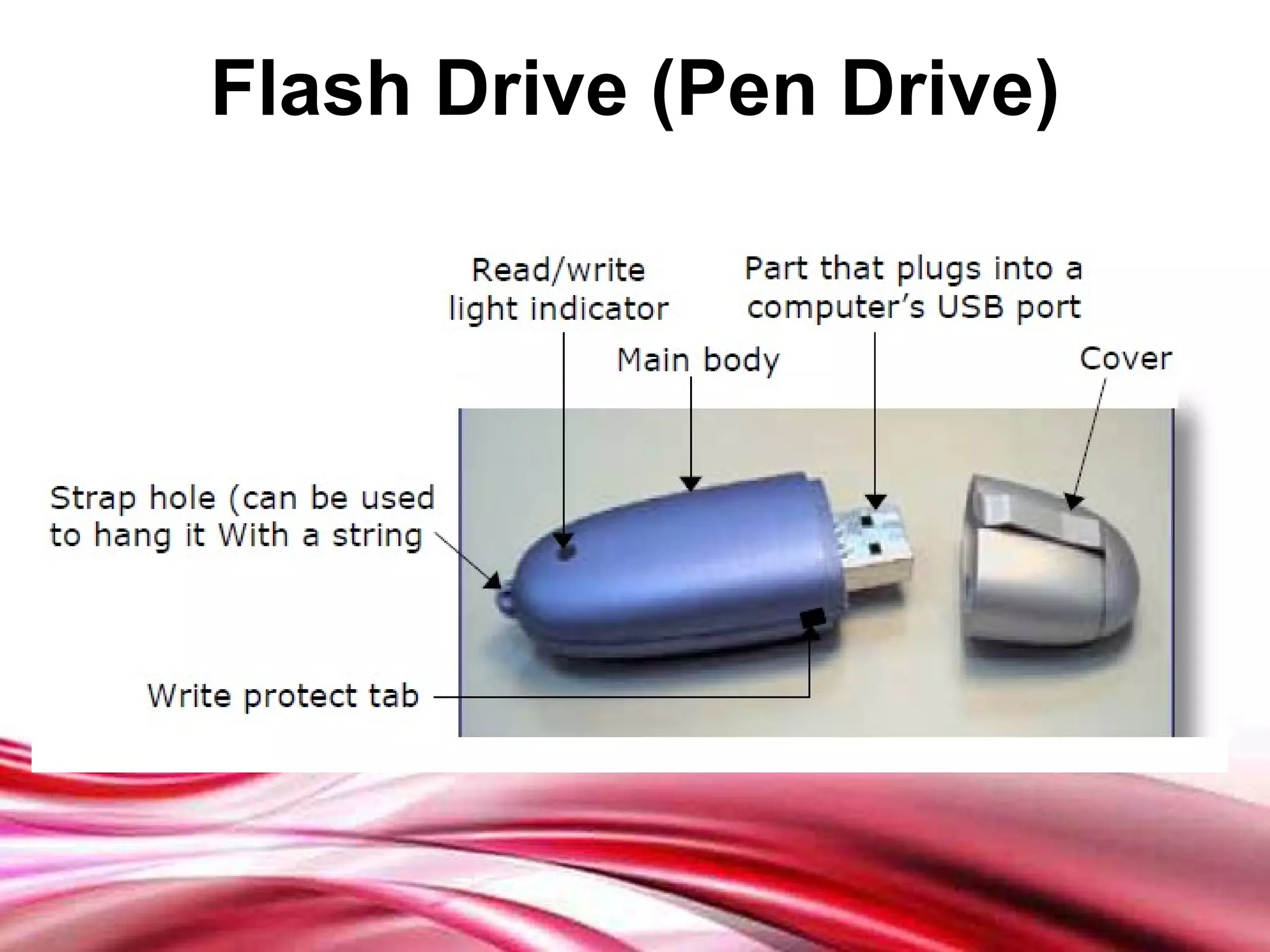
Flash Drive (Pen Drive)
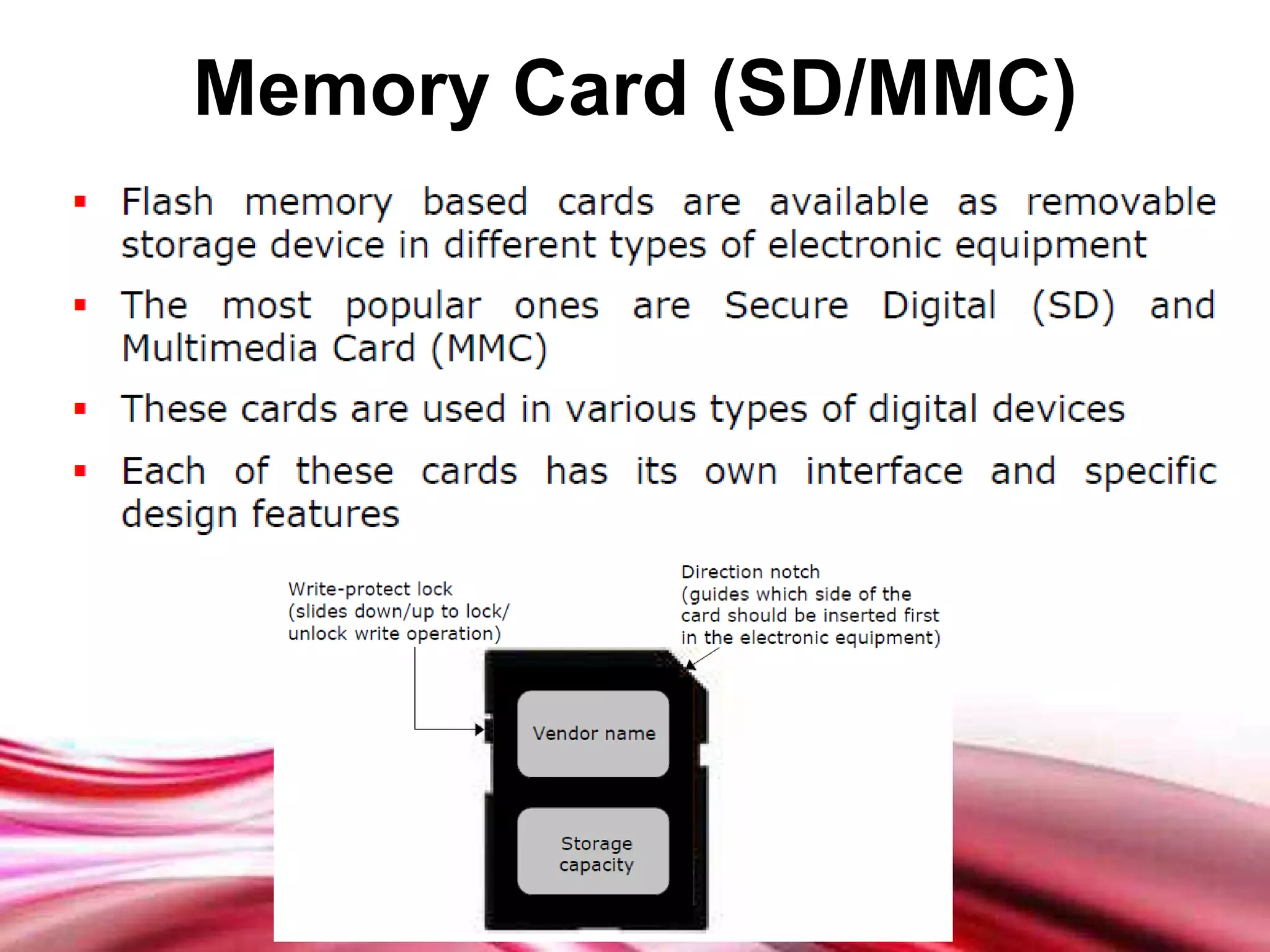
Memory Card (SD/MMC)
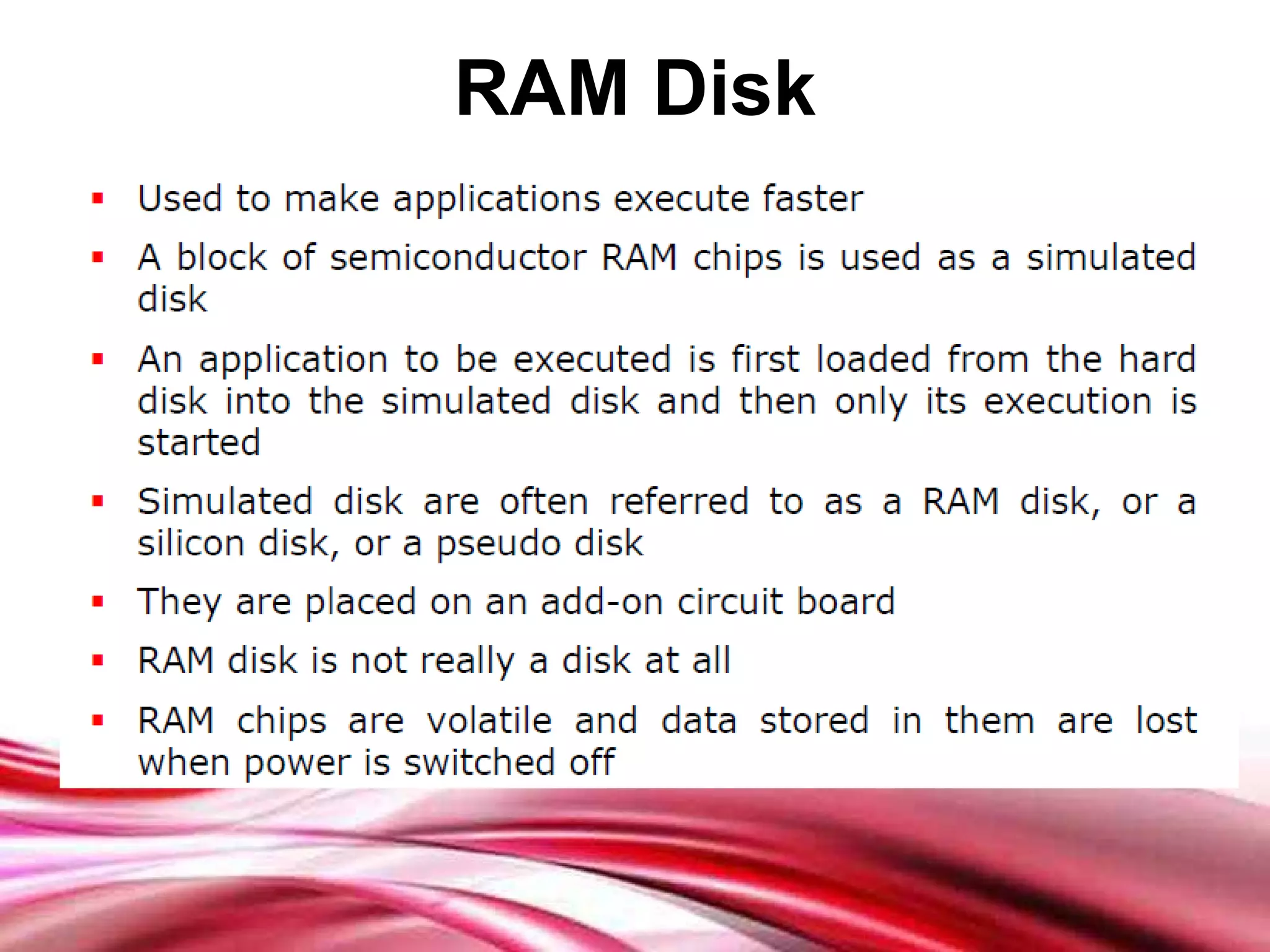
RAM Disk


Lecture 3

Editor's Notes

  • #5 Secondary storage is – stores programs and data nonvolatile as opposed to volatile (temporary) storage (RAM) which is lost when power shut off to computer. Media – actual physical material that hold data Capacity – amount of data the storage medium can hold Access time – amount of time to retrieve and write data
  • #9 Sequential access because they have to be fast forwarded or rewound before a specific location can be reached. A common sequential access method of Two forms of tape storage Magnetic tape cartridges, also called magnetic tape streamers Magnetic tape reels Tapes are run on magnetic tape drives or magnetic tape units