www.wjpps.com Vol 5, Issue 4, 2016. 2456
Savale et al. World Journal of Pharmacy and Pharmaceutical Sciences
FORMULATION AND EVALUATION OF METFORMIN HCL
GASTRORETENTIVE FLOATING SUSTAINED RELEASED TABLET
Sagar Kishor Savale1
*, Prakash Mali2
, Vishnu Satpute2
and Siddhartha Savdekar3
1
Department of Pharmaceutics, R. C. Patel Institute of Pharmaceutical Education and
Research, Shirpur 425405, Dist. Dhule Maharashtra State, India.
2
Department of Quality Assurance, R. C. Patel Institute of Pharmaceutical Education and
Research, Shirpur 425405, Dist. Dhule Maharashtra State, India.
3
Department of Pharmacy, R. C. Patel Institute of Pharmaceutical Education and
Research, Shirpur 425405, Dist. Dhule Maharashtra State, India.
ABSTRACT
The Metformin HCL Gastroretentive Floating Sustained released
Tablet is formulated by the Wet Granulation technique. This Tablet is
containing both Effervescent as well as Non Effervescent system. The
HPMC K 100 Swellable polymer is responsible for the Floating. (Non
Effervescent system) and The Sodium Bicarbonate is responsible for
the effervescent system. A combination of HPMC K 100 and Xanthum
Gum shows better sustained release activity. The Prepared
Gastroretentive Floating Sustained released Tablet is Evaluated In
terms of bulk density, tapped density, angle of repose, Carr’s Index
and, weight variation test, friability test and in vitro study, Total
Floating Time. The result associated in Optimized batch is good to
Satisfactory and having a good free flowing property. The weight
variation and friability these values are within the pharmacopeia limit.
The in vitro Dissolution studies shows Maximum percentage of release of drug (99.25) with
in end of 8 Hours.
KEYWORDS: Gastroretentive, Floating, Sustained released, Effervescent, Non effervescent.
INTRODUCTION
The Oral Route of administration is one of the specific route of administration having more
patient acceptance or convenience. The Metformin HCL is oral Sustained Floating tablet is
WORLD JOURNAL OF PHARMACY AND PHARMACEUTICAL SCIENCES
SJIF Impact Factor 6.041
Volume 5, Issue 4, 2456-2466 Research Article ISSN 2278 – 4357
*Corresponding Author
Sagar Kishor Savale
Department of
Pharmaceutics, R. C. Patel
Institute of
Pharmaceutical Education
and Research, Shirpur
425405, Dist. Dhule
Maharashtra State, India.
Article Received on
22 Feb 2016,
Revised on 13 March 2016,
Accepted on 03 April 2016
DOI: 10.20959/wjpps20164-6589
www.wjpps.com Vol 5, Issue 4, 2016. 2457
Savale et al. World Journal of Pharmacy and Pharmaceutical Sciences
made by wet Granulation Method. This are the tablet is mainly float on the surface of liquid
medium or float on the liquid medium. The floating tablet having density is less than 1 and
the tablet containing Effervescent as well as Non effervescent system in which the swellable
polymer such as HPMC K 100 and Xanthum gum is responsible for the floating of tablet
(Non Effervescent system) and the tablet containing Sodium Bicarbonate (act as base) come
into contact with GI Fluid Effervescent is generated (Effervescent system) Bulk of the Drug
is reduced, the Tablet is Floated. This are the Tablet is release in prolonged action in
extended Period of Time. The Metformin HCL Tablet is Antihyperglycemic agent to reduce
the blood sugar level and it is mainly used for the Type II Diabetes Mellitus.[1,2,3,4]
MATERIAL AND METHOD
Material
Metformin HCL and all Formulation Excipient or Polymer (PVP K30, HPMC K100,
Xanthum Gum, Sodium Bicarbonate, and Talc) was obtained from Pharmaceutics Laboratory
of R. C. Patel Institute of Pharmaceutical Education and Research, Shirpur 425405,
Maharashtra State, one of the NBA and NAAC accredited and AICTE approved institutes in
India.
Method
The parameters of Authentication and Preformulation is carried out by pure drug Metformin
HCL for Maintaining their Quality, Purity and Standard.
AUTHENTICATION PARAMETERS
Melting Point Method
Melting Point determination is one of the preformulation property in which the temperature at
which it changes state from solid to liquid at atmospheric pressure. At the melting process the
solid and liquid can exist equilibrium. The Melting point of Metformin HCL pure drug is
determine by using two types of method one is Conventional method and another is Digital
method.
Log P Value
Log p value is determined by using Partition Coefficient Phenomenon. In which The 1 gm of
drug is added in separating funnel containing equal portion of 25 ml of Octanol and 25 ml of
Water. The separating funnel is Shake 20 – 25 min. and stabilized the mixture. After
stabilizing the mixture to remove water phase from separating funnel and filter it. Take
www.wjpps.com Vol 5, Issue 4, 2016. 2458
Savale et al. World Journal of Pharmacy and Pharmaceutical Sciences
Absorbance of Filtrate and calculate the log p value (concentration of drug soluble in water
phase divided by concentration of drug soluble in organic phase).
Solubility Studies
The Term Solubility is defined as maximum amount of solute that can be dissolved in a given
amount of solvent to form a homogenous system at specified temperature and Specific
Pressure to from Saturated Solution.
Procedure
 To Prepare a different solutions Water, PH 1.2 Acidic Buffer, PH 6.8 Phosphate Buffer,
PH 7.4 Phosphate Buffer.
 The drug material is added in to above solutions till Supersaturated Solution is from.
 The Mixture can Placed in Orbital Shaker for 24 hrs. After 24 hrs. Filter the mixture Take
Filtrate and Give Absorbance.
 To detect the Concentration of Drug is Soluble in Different Solutions.
Calibration Curve of Metformin HCL
Calibration Curve is determined by using UV Spectrophotometric methods. In which 10 mg
drug is added in 100 ml of water (100 μg/ml Solution). To Prepared different Dilutions (0, 2,
4, 6, 8, 10, 12) of above solution (100 μg/ml Solution). Take Absorbance in respective λmax
240 nm.
PREFORMULATION STUDIES
Drug-Excipient Compatibility Studies
Drug is an active part of dosages form and it is mainly responsible for therapeutic value and
Excipient substances which are included along with drugs being formulated in a dosage form
so as to impart specific qualities to them. It is important for determination of Stability of the
dosage forms. It’s also used for development of new drug delivery system as well as
investigation of new drug Product.
Procedure
The Equal portion of Drug and Excipient (1:1 ratio) is added in Ampules and the Ampules
are placed in Stability Chamber for one Weak, After One Weak the Drug Excipient
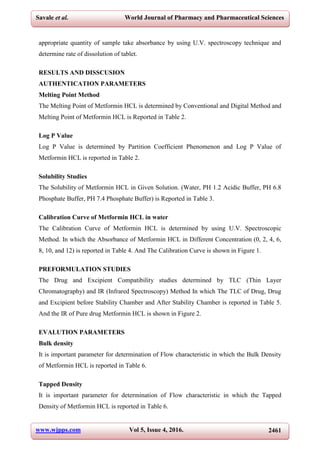
Compatibility Study is Determine by using TLC (Thin Layer Chromatography) (In TLC
www.wjpps.com Vol 5, Issue 4, 2016. 2459
Savale et al. World Journal of Pharmacy and Pharmaceutical Sciences
mobile phase is methanol: water: glacial acetic acid), IR (Infrared Spectroscopy) (In IR 1:9
ratio (drug : KBR).
METHOD OF FORMULATION
The Metformin HCL Floating Tablet is formulated by the Wet Granulation Method. The
Metformin HCL, HPMC K100, Xanthum Gum, Sodium Bicarbonate, is weighed accurately
and adds in Mortal and Pastel for their proper mixing. To prepared binder solution of PVP K
30 in isopropyl alcohol (1 gm 10 ml I.P.A.) and add in mix. Till Dough mass is formed. The
prepared dough mass is passing through the mesh 12 sieve granules are prepared and the
prepared granules are dried in oven for 10 - 15 min. After drying the granules add
Lubricating agent such as Talc and passed into mesh 40 sieve, fine granules are prepared. The
Compression is done by using the 8 station signal or multi rotatory tablet punching machine.
The all formulation ingredients are reported in Table 1.
EVALUTION PARAMETERS[5,6,7,8,9,10,11,12]
Bulk density
It is a ratio of weight mass and Bulk Volume is known as Bulk Density. Amount of Powder is
Weighed Separately and transferred into 100 ml of measuring cylinder, initial volume of
Powder Material is measured and calculated bulk density according to following formula.
Bulk density = Mass / Volume
Tapped Density
It is a Ratio of weight Mass and Tapped Volume is known as Tapped Density. Tapped
density is Important Evaluation Parameter is determined by placing a graduated cylinder
containing a known mass of powder Undergoes Tapping in Manually (100 Tapes) as well As
Using a Mechanical apparatus under powder bed volume has reached a minimum volume.
The Tapped Density is calculated by following Formula.
Tapped density = Weight of Powder/ tapped volume of Powder
Compressibility Index or Carr’s Index
The Calculation of Compressibility index is based on the Tapped density and Bulk density. It
is a ratio of Tapped density and Bulk Density i.e. Compressibility Index.
www.wjpps.com Vol 5, Issue 4, 2016. 2460
Savale et al. World Journal of Pharmacy and Pharmaceutical Sciences
Angle of Repose
It defines as the Pile surface of Powder is known as Angle of Repose. In this method of
determination of angle of repose in which the angle of repose is to pour the powder a conical
on a level, flat surface and measure the included angle. The Following Formula for
determination of angle of repose.
θ -Tan -1 (h/r)
Where,
θ - Angle of repose,
h - Height of the powder cone,
r - Radius of the powder cone.
Friability Test
The friability of 20 tablets was determined Using Friability Tester. 20 tablets from each
formulation were weighed and tested at a speed of 25 rpm for 4 min. After removing of
tablets were re-weighed and friability percentage was calculated. To give an initial weight of
20 tablet Minimized these wt. by friability after the 20 tablet, divided by friability after 20
tablets multiply by 100, to get the appropriate friability of the 20 tablets.
Weight variation test
Weight variation was carried out to ensure that, each of tablets contains the proper amount of
drug. The test was carried out by weighing the 20 tablets individually using analytical
balance, then calculating the average weight, and comparing the individual tablet weights to
the average. The percentage of weight variation is calculated by using the following formula.
Weight variation - [X‫/٭‬ X] × 100
X - Actual weight of the tablet
X -‫٭‬ Average weight of the tablet
In vitro drug release studies
It is a Process in which Solid Material Dissolved in Liquid Medium per Unit Time Period. It
is mainly based on Sink Condition. Dissolution of Floating Tablet is determined by Paddle
Type (USP II) of Dissolution Apparatus. The tablet was added into cylindrical vessel
containing 900 ml PH 1.2 Acidic media having 75 rpm for 8 hours and tem. 37±0.5˚C having
1, 2, 3, 4, 5, 6, 7, 8 hour of interval. After every 1 hour. 5 ml sample was Withdrawn and
www.wjpps.com Vol 5, Issue 4, 2016. 2461
Savale et al. World Journal of Pharmacy and Pharmaceutical Sciences
appropriate quantity of sample take absorbance by using U.V. spectroscopy technique and
determine rate of dissolution of tablet.
RESULTS AND DISSCUSION
AUTHENTICATION PARAMETERS
Melting Point Method
The Melting Point of Metformin HCL is determined by Conventional and Digital Method and
Melting Point of Metformin HCL is Reported in Table 2.
Log P Value
Log P Value is determined by Partition Coefficient Phenomenon and Log P Value of
Metformin HCL is reported in Table 2.
Solubility Studies
The Solubility of Metformin HCL in Given Solution. (Water, PH 1.2 Acidic Buffer, PH 6.8
Phosphate Buffer, PH 7.4 Phosphate Buffer) is Reported in Table 3.
Calibration Curve of Metformin HCL in water
The Calibration Curve of Metformin HCL is determined by using U.V. Spectroscopic
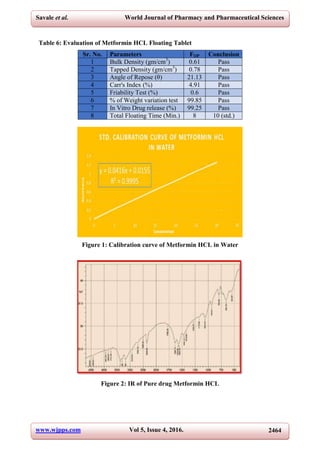
Method. In which the Absorbance of Metformin HCL in Different Concentration (0, 2, 4, 6,
8, 10, and 12) is reported in Table 4. And The Calibration Curve is shown in Figure 1.
PREFORMULATION STUDIES
The Drug and Excipient Compatibility studies determined by TLC (Thin Layer
Chromatography) and IR (Infrared Spectroscopy) Method In which The TLC of Drug, Drug
and Excipient before Stability Chamber and After Stability Chamber is reported in Table 5.
And the IR of Pure drug Metformin HCL is shown in Figure 2.
EVALUTION PARAMETERS
Bulk density
It is important parameter for determination of Flow characteristic in which the Bulk Density
of Metformin HCL is reported in Table 6.
Tapped Density
It is important parameter for determination of Flow characteristic in which the Tapped
Density of Metformin HCL is reported in Table 6.
www.wjpps.com Vol 5, Issue 4, 2016. 2462
Savale et al. World Journal of Pharmacy and Pharmaceutical Sciences
Compressibility Index or Carr’s Index
The compressibility index is determined on the basis of Tapped density and bulk density and
it is important for determination of flow characteristic in which the Compressibility Index or
Carr’s Index of Metformin HCL is reported in Table 6.
Angle of Repose
It is important flow property for determination of flow of material and the value associated in
angle of repose is less than 40° is indicate good flow property in which angle of repose of
Metformin HCL tablet is reported in Table 6.
Hardness or Crushing strength
The hardness is determined by using a conventional or digital hardness tester in which the
hardness of Metformin HCL tablet is reported in Table 6.
Friability Test
The Friability of Tablet is always less than 1% and the Friability of Metformin HCL is
reported in Table 6.
Weight variation test
All 20 Gastroretentive Floating Sustained released tablet is passed the weight variation test as
per pharmacopoeial limits.
The weights of all 20 tablets are uniform and the weight variation of Metformin HCL is
reported in Table 6.
In vitro drug release studies
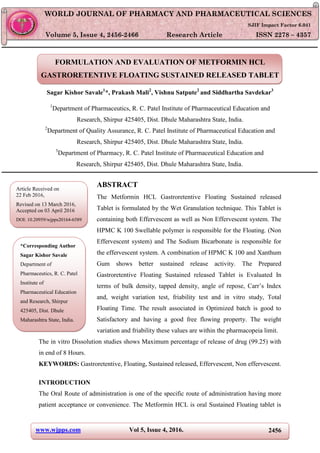
The In vitro drug release studies of Metformin HCL Floating tablet is determined in PH 1.2
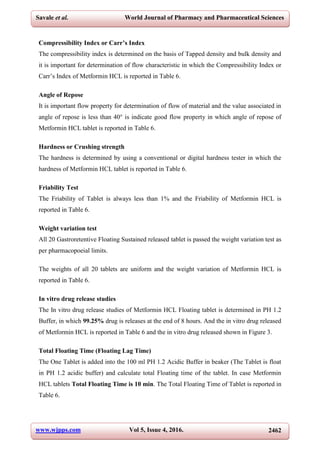
Buffer, in which 99.25% drug is releases at the end of 8 hours. And the in vitro drug released
of Metformin HCL is reported in Table 6 and the in vitro drug released shown in Figure 3.
Total Floating Time (Floating Lag Time)
The One Tablet is added into the 100 ml PH 1.2 Acidic Buffer in beaker (The Tablet is float
in PH 1.2 acidic buffer) and calculate total Floating time of the tablet. In case Metformin
HCL tablets Total Floating Time is 10 min. The Total Floating Time of Tablet is reported in
Table 6.
www.wjpps.com Vol 5, Issue 4, 2016. 2463
Savale et al. World Journal of Pharmacy and Pharmaceutical Sciences
Table1: Formulation Ingredients of Metformin HCL Floating Tablet
Sr. No. Ingredient (mg / Tablet) F1 F2 FOP
1 Metformin HCL (mg) 300 300 300
2 PVP K30 (mg) 3 4 5
3 HPMC K100 (mg) 50 130 150
4 Xanthum Gum (mg) 5 10 15
5 Sodium Bicarbonate (mg) 30 30 30
6 Talc (mg) 5 5 5
Total wt. of One Tablet (mg) 393 479 505
Table 2: Melting Point and Log P Value of Metformin HCL
Sr.No. Parameters Result Std.
1 Melting Point (˚c) 223 - 225˚c 223 - 226˚c
2 Log p Value 0.4 0.5
Table 3: Solubility of Metformin HCL in different solvents
Sr. No. Medium Concentration of drug Soluble (mg /ml)
1 Water 16.99
2 PH 1.2 Acidic Buffer 8.23
3 PH 6.8 Phosphate Buffer 4.28
4 PH 7.4 Phosphate Buffer 3.82
Result Class of drug BCS Class III
Table 4: Calibration of Metformin HCL in Water
Concentration Absorbance
0 0
2 0.228
4 0.439
6 0.651
8 0.85
10 1.061
12 1.25
Table 5: TLC of Drug and Drug and Excipient
Sr. No.
Samples
(Pure From of Drug material)
(Drug + Excipient Mixture)
Retention factor of
drug Before the
Stability Chamber
Retention factor of
drug After the
Stability Chamber
1 Pure Drug Metformin HCL 0.75 0.77
2 Metformin HCL + PVP K30 0.78 0.76
3 Metformin HCL + HPMC K100 0.79 0.83
4 Metformin HCL + Xanthum Gum 0.77 0.79
5
Metformin HCL + Sodium
Bicarbonate
0.76 0.77
6 Metformin HCL + Talc 0.75 0.78
www.wjpps.com Vol 5, Issue 4, 2016. 2464
Savale et al. World Journal of Pharmacy and Pharmaceutical Sciences
Table 6: Evaluation of Metformin HCL Floating Tablet
Sr. No. Parameters FOP Conclusion
1 Bulk Density (gm/cm3
) 0.61 Pass
2 Tapped Density (gm/cm3
) 0.78 Pass
3 Angle of Repose (θ) 21.13 Pass
4 Carr's Index (%) 4.91 Pass
5 Friability Test (%) 0.6 Pass
6 % of Weight variation test 99.85 Pass
7 In Vitro Drug release (%) 99.25 Pass
8 Total Floating Time (Min.) 8 10 (std.)
Figure 1: Calibration curve of Metformin HCL in Water
Figure 2: IR of Pure drug Metformin HCL
www.wjpps.com Vol 5, Issue 4, 2016. 2465
Savale et al. World Journal of Pharmacy and Pharmaceutical Sciences
Figure 3: In vitro drug release of Metformin HCL in PH 1.2 Acidic buffer
CONCLUSION
The Metformin HCL Floating Tablet is formulated by the Wet Granulation Method, having
density less than 1. The tablet is Gastroretentive floating sustained released tablet containing
both Effervescent as well as Non Effervescent system. The HPMC K 100 Swellable polymer
is responsible for the Floating. (Non Effervescent system) and The Sodium Bicarbonate is
responsible for the effervescent system. The result associated in Optimized batch is good to
Satisfactory and having a good free flowing property. The hardness, weight variation, and
friability these values are within the pharmacopeia limit. The in vitro Dissolution Studies
shows Maximum percentage of release of drug.
ACKNOWLEDGEMENT
The authors are grateful to Hon. Principal, SES’s, R. C. Patel Institute of Pharmaceutical
Education and Research, Dr. S. J. Surana sir. A special gratitude to Dr. H.S. Mahajan sir
Head, Dept. of Pharmaceutics and Quality assurance. Finally, we grateful to Dr. S.S.
Chalikwar sir Associate Professor, Department of Pharmaceutics and quality assurance.
Without whom and their constant caring and loving support we would be unable to achieve
this advancement and precious stage of our life.
REFERENCE
1. Shashank R. Joshi. Metformin. Old Wine in New Bottle‐Evolving Technology and
Therapy in Diabetes. JAPI, 2005; 53: 963‐971.
www.wjpps.com Vol 5, Issue 4, 2016. 2466
Savale et al. World Journal of Pharmacy and Pharmaceutical Sciences
2. Brijesh S. Dave, Avani F. Amin and Madhabhai M. Patel: “Gastroretentive Drug Delivery
System of Ranitidine Hydrochloride. Formulation and In- vitro Evaluation” AAPS
Pharmscitech, 2004; 5(2): 34–45.
3. Dunn CJ, Peters DH. “Metformin. A review of its pharmacological properties and
therapeutic use in non-insulin-dependent diabetes mellitus”. Drugs, May, 1995; 49(5):
721–49.
4. Shivakumar H N., Desai B G., Patel M., “Optimization Of Gastroretentive System For
Oral Controlled Delivery Of Cinnarizine Using Response Surface Methodology”. Ars
Pharm, 2007; 48(1): 55-81.
5. Manoj N. Gambhire., Kshitij W. Ambade., Sushma D. Kurmi, Vilasrao J. Kadam.,
“Development And In-Vitro Evaluation Of An Oral Floating Matrix Tablets Formulation
Of Diltiazem HCL ”, AAPS Pharm Sci Tech., 2007; 8(3): 73–85.
6. Dasarath M.Patel., Natvarlal M.Patel., Nitesh N.Pandya., “Gastro Retentive Drug
Delivery System Of Carbamazepine: Formulation Optimization Using Simplex Lattice
Design”. AAPS Pharm Sci., 2007; 8(1): 11.
7. Girish S. Sonar, Devendra K. Jain, Dhananjay M. More, “Bilayer And Floating
Bioadhesive Tablet Of Rosiglitazone Maleate” Asian J. Pharm. Sci., 2007; 2(4): 161-169.
8. Ali, J., Hasan, S., Ali, M.: “Formulation and Development of Gastroretentive Drug
Delivery System For Of loxacin”. Methods Find Exp Clin Pharmacol, 2006; 28(7):
433 – 445.
9. Abubakr O. Nur; Jun S. Zhang: “Captopril Floating and/or Bioadhesive Tablets: Design
and Release Kinetics” Drug Dev. And Ind. Pharm., 2000; 26(9): 965–969.
10. Mahesh Chavanpatil, Paras Jain, Pradeep Vavia, “Development Of Sustained Release
Gastroretentive Drug Delivery System For Ofloxacin - In- vitro And In-Vivo Evaluation”
Int. J. Pharm., 2005; 304(1-2): 178-184.
11. Deshpande A A., Shah N H., Rhodes C T., Malick W., “Development of A Novel
Controlled Release System For Gastric Retention”. Pharm. Res., 1997; 14(6): 815-819.
12. Praneeth kumar S. “Formulation and evaluation of floating drug delivery of
metoprololsuccinate”, Aaps pharmsci tech, 2009; 1: 1-315. Int. J. Drug Dev. & Res.,
April-June, 2011; 3(2): 290-300.

Floating tablet

  • 1.
    www.wjpps.com Vol 5,Issue 4, 2016. 2456 Savale et al. World Journal of Pharmacy and Pharmaceutical Sciences FORMULATION AND EVALUATION OF METFORMIN HCL GASTRORETENTIVE FLOATING SUSTAINED RELEASED TABLET Sagar Kishor Savale1 *, Prakash Mali2 , Vishnu Satpute2 and Siddhartha Savdekar3 1 Department of Pharmaceutics, R. C. Patel Institute of Pharmaceutical Education and Research, Shirpur 425405, Dist. Dhule Maharashtra State, India. 2 Department of Quality Assurance, R. C. Patel Institute of Pharmaceutical Education and Research, Shirpur 425405, Dist. Dhule Maharashtra State, India. 3 Department of Pharmacy, R. C. Patel Institute of Pharmaceutical Education and Research, Shirpur 425405, Dist. Dhule Maharashtra State, India. ABSTRACT The Metformin HCL Gastroretentive Floating Sustained released Tablet is formulated by the Wet Granulation technique. This Tablet is containing both Effervescent as well as Non Effervescent system. The HPMC K 100 Swellable polymer is responsible for the Floating. (Non Effervescent system) and The Sodium Bicarbonate is responsible for the effervescent system. A combination of HPMC K 100 and Xanthum Gum shows better sustained release activity. The Prepared Gastroretentive Floating Sustained released Tablet is Evaluated In terms of bulk density, tapped density, angle of repose, Carr’s Index and, weight variation test, friability test and in vitro study, Total Floating Time. The result associated in Optimized batch is good to Satisfactory and having a good free flowing property. The weight variation and friability these values are within the pharmacopeia limit. The in vitro Dissolution studies shows Maximum percentage of release of drug (99.25) with in end of 8 Hours. KEYWORDS: Gastroretentive, Floating, Sustained released, Effervescent, Non effervescent. INTRODUCTION The Oral Route of administration is one of the specific route of administration having more patient acceptance or convenience. The Metformin HCL is oral Sustained Floating tablet is WORLD JOURNAL OF PHARMACY AND PHARMACEUTICAL SCIENCES SJIF Impact Factor 6.041 Volume 5, Issue 4, 2456-2466 Research Article ISSN 2278 – 4357 *Corresponding Author Sagar Kishor Savale Department of Pharmaceutics, R. C. Patel Institute of Pharmaceutical Education and Research, Shirpur 425405, Dist. Dhule Maharashtra State, India. Article Received on 22 Feb 2016, Revised on 13 March 2016, Accepted on 03 April 2016 DOI: 10.20959/wjpps20164-6589
  • 2.
    www.wjpps.com Vol 5,Issue 4, 2016. 2457 Savale et al. World Journal of Pharmacy and Pharmaceutical Sciences made by wet Granulation Method. This are the tablet is mainly float on the surface of liquid medium or float on the liquid medium. The floating tablet having density is less than 1 and the tablet containing Effervescent as well as Non effervescent system in which the swellable polymer such as HPMC K 100 and Xanthum gum is responsible for the floating of tablet (Non Effervescent system) and the tablet containing Sodium Bicarbonate (act as base) come into contact with GI Fluid Effervescent is generated (Effervescent system) Bulk of the Drug is reduced, the Tablet is Floated. This are the Tablet is release in prolonged action in extended Period of Time. The Metformin HCL Tablet is Antihyperglycemic agent to reduce the blood sugar level and it is mainly used for the Type II Diabetes Mellitus.[1,2,3,4] MATERIAL AND METHOD Material Metformin HCL and all Formulation Excipient or Polymer (PVP K30, HPMC K100, Xanthum Gum, Sodium Bicarbonate, and Talc) was obtained from Pharmaceutics Laboratory of R. C. Patel Institute of Pharmaceutical Education and Research, Shirpur 425405, Maharashtra State, one of the NBA and NAAC accredited and AICTE approved institutes in India. Method The parameters of Authentication and Preformulation is carried out by pure drug Metformin HCL for Maintaining their Quality, Purity and Standard. AUTHENTICATION PARAMETERS Melting Point Method Melting Point determination is one of the preformulation property in which the temperature at which it changes state from solid to liquid at atmospheric pressure. At the melting process the solid and liquid can exist equilibrium. The Melting point of Metformin HCL pure drug is determine by using two types of method one is Conventional method and another is Digital method. Log P Value Log p value is determined by using Partition Coefficient Phenomenon. In which The 1 gm of drug is added in separating funnel containing equal portion of 25 ml of Octanol and 25 ml of Water. The separating funnel is Shake 20 – 25 min. and stabilized the mixture. After stabilizing the mixture to remove water phase from separating funnel and filter it. Take
  • 3.
    www.wjpps.com Vol 5,Issue 4, 2016. 2458 Savale et al. World Journal of Pharmacy and Pharmaceutical Sciences Absorbance of Filtrate and calculate the log p value (concentration of drug soluble in water phase divided by concentration of drug soluble in organic phase). Solubility Studies The Term Solubility is defined as maximum amount of solute that can be dissolved in a given amount of solvent to form a homogenous system at specified temperature and Specific Pressure to from Saturated Solution. Procedure  To Prepare a different solutions Water, PH 1.2 Acidic Buffer, PH 6.8 Phosphate Buffer, PH 7.4 Phosphate Buffer.  The drug material is added in to above solutions till Supersaturated Solution is from.  The Mixture can Placed in Orbital Shaker for 24 hrs. After 24 hrs. Filter the mixture Take Filtrate and Give Absorbance.  To detect the Concentration of Drug is Soluble in Different Solutions. Calibration Curve of Metformin HCL Calibration Curve is determined by using UV Spectrophotometric methods. In which 10 mg drug is added in 100 ml of water (100 μg/ml Solution). To Prepared different Dilutions (0, 2, 4, 6, 8, 10, 12) of above solution (100 μg/ml Solution). Take Absorbance in respective λmax 240 nm. PREFORMULATION STUDIES Drug-Excipient Compatibility Studies Drug is an active part of dosages form and it is mainly responsible for therapeutic value and Excipient substances which are included along with drugs being formulated in a dosage form so as to impart specific qualities to them. It is important for determination of Stability of the dosage forms. It’s also used for development of new drug delivery system as well as investigation of new drug Product. Procedure The Equal portion of Drug and Excipient (1:1 ratio) is added in Ampules and the Ampules are placed in Stability Chamber for one Weak, After One Weak the Drug Excipient Compatibility Study is Determine by using TLC (Thin Layer Chromatography) (In TLC
  • 4.
    www.wjpps.com Vol 5,Issue 4, 2016. 2459 Savale et al. World Journal of Pharmacy and Pharmaceutical Sciences mobile phase is methanol: water: glacial acetic acid), IR (Infrared Spectroscopy) (In IR 1:9 ratio (drug : KBR). METHOD OF FORMULATION The Metformin HCL Floating Tablet is formulated by the Wet Granulation Method. The Metformin HCL, HPMC K100, Xanthum Gum, Sodium Bicarbonate, is weighed accurately and adds in Mortal and Pastel for their proper mixing. To prepared binder solution of PVP K 30 in isopropyl alcohol (1 gm 10 ml I.P.A.) and add in mix. Till Dough mass is formed. The prepared dough mass is passing through the mesh 12 sieve granules are prepared and the prepared granules are dried in oven for 10 - 15 min. After drying the granules add Lubricating agent such as Talc and passed into mesh 40 sieve, fine granules are prepared. The Compression is done by using the 8 station signal or multi rotatory tablet punching machine. The all formulation ingredients are reported in Table 1. EVALUTION PARAMETERS[5,6,7,8,9,10,11,12] Bulk density It is a ratio of weight mass and Bulk Volume is known as Bulk Density. Amount of Powder is Weighed Separately and transferred into 100 ml of measuring cylinder, initial volume of Powder Material is measured and calculated bulk density according to following formula. Bulk density = Mass / Volume Tapped Density It is a Ratio of weight Mass and Tapped Volume is known as Tapped Density. Tapped density is Important Evaluation Parameter is determined by placing a graduated cylinder containing a known mass of powder Undergoes Tapping in Manually (100 Tapes) as well As Using a Mechanical apparatus under powder bed volume has reached a minimum volume. The Tapped Density is calculated by following Formula. Tapped density = Weight of Powder/ tapped volume of Powder Compressibility Index or Carr’s Index The Calculation of Compressibility index is based on the Tapped density and Bulk density. It is a ratio of Tapped density and Bulk Density i.e. Compressibility Index.
  • 5.
    www.wjpps.com Vol 5,Issue 4, 2016. 2460 Savale et al. World Journal of Pharmacy and Pharmaceutical Sciences Angle of Repose It defines as the Pile surface of Powder is known as Angle of Repose. In this method of determination of angle of repose in which the angle of repose is to pour the powder a conical on a level, flat surface and measure the included angle. The Following Formula for determination of angle of repose. θ -Tan -1 (h/r) Where, θ - Angle of repose, h - Height of the powder cone, r - Radius of the powder cone. Friability Test The friability of 20 tablets was determined Using Friability Tester. 20 tablets from each formulation were weighed and tested at a speed of 25 rpm for 4 min. After removing of tablets were re-weighed and friability percentage was calculated. To give an initial weight of 20 tablet Minimized these wt. by friability after the 20 tablet, divided by friability after 20 tablets multiply by 100, to get the appropriate friability of the 20 tablets. Weight variation test Weight variation was carried out to ensure that, each of tablets contains the proper amount of drug. The test was carried out by weighing the 20 tablets individually using analytical balance, then calculating the average weight, and comparing the individual tablet weights to the average. The percentage of weight variation is calculated by using the following formula. Weight variation - [X‫/٭‬ X] × 100 X - Actual weight of the tablet X -‫٭‬ Average weight of the tablet In vitro drug release studies It is a Process in which Solid Material Dissolved in Liquid Medium per Unit Time Period. It is mainly based on Sink Condition. Dissolution of Floating Tablet is determined by Paddle Type (USP II) of Dissolution Apparatus. The tablet was added into cylindrical vessel containing 900 ml PH 1.2 Acidic media having 75 rpm for 8 hours and tem. 37±0.5˚C having 1, 2, 3, 4, 5, 6, 7, 8 hour of interval. After every 1 hour. 5 ml sample was Withdrawn and
  • 6.
    www.wjpps.com Vol 5,Issue 4, 2016. 2461 Savale et al. World Journal of Pharmacy and Pharmaceutical Sciences appropriate quantity of sample take absorbance by using U.V. spectroscopy technique and determine rate of dissolution of tablet. RESULTS AND DISSCUSION AUTHENTICATION PARAMETERS Melting Point Method The Melting Point of Metformin HCL is determined by Conventional and Digital Method and Melting Point of Metformin HCL is Reported in Table 2. Log P Value Log P Value is determined by Partition Coefficient Phenomenon and Log P Value of Metformin HCL is reported in Table 2. Solubility Studies The Solubility of Metformin HCL in Given Solution. (Water, PH 1.2 Acidic Buffer, PH 6.8 Phosphate Buffer, PH 7.4 Phosphate Buffer) is Reported in Table 3. Calibration Curve of Metformin HCL in water The Calibration Curve of Metformin HCL is determined by using U.V. Spectroscopic Method. In which the Absorbance of Metformin HCL in Different Concentration (0, 2, 4, 6, 8, 10, and 12) is reported in Table 4. And The Calibration Curve is shown in Figure 1. PREFORMULATION STUDIES The Drug and Excipient Compatibility studies determined by TLC (Thin Layer Chromatography) and IR (Infrared Spectroscopy) Method In which The TLC of Drug, Drug and Excipient before Stability Chamber and After Stability Chamber is reported in Table 5. And the IR of Pure drug Metformin HCL is shown in Figure 2. EVALUTION PARAMETERS Bulk density It is important parameter for determination of Flow characteristic in which the Bulk Density of Metformin HCL is reported in Table 6. Tapped Density It is important parameter for determination of Flow characteristic in which the Tapped Density of Metformin HCL is reported in Table 6.
  • 7.
    www.wjpps.com Vol 5,Issue 4, 2016. 2462 Savale et al. World Journal of Pharmacy and Pharmaceutical Sciences Compressibility Index or Carr’s Index The compressibility index is determined on the basis of Tapped density and bulk density and it is important for determination of flow characteristic in which the Compressibility Index or Carr’s Index of Metformin HCL is reported in Table 6. Angle of Repose It is important flow property for determination of flow of material and the value associated in angle of repose is less than 40° is indicate good flow property in which angle of repose of Metformin HCL tablet is reported in Table 6. Hardness or Crushing strength The hardness is determined by using a conventional or digital hardness tester in which the hardness of Metformin HCL tablet is reported in Table 6. Friability Test The Friability of Tablet is always less than 1% and the Friability of Metformin HCL is reported in Table 6. Weight variation test All 20 Gastroretentive Floating Sustained released tablet is passed the weight variation test as per pharmacopoeial limits. The weights of all 20 tablets are uniform and the weight variation of Metformin HCL is reported in Table 6. In vitro drug release studies The In vitro drug release studies of Metformin HCL Floating tablet is determined in PH 1.2 Buffer, in which 99.25% drug is releases at the end of 8 hours. And the in vitro drug released of Metformin HCL is reported in Table 6 and the in vitro drug released shown in Figure 3. Total Floating Time (Floating Lag Time) The One Tablet is added into the 100 ml PH 1.2 Acidic Buffer in beaker (The Tablet is float in PH 1.2 acidic buffer) and calculate total Floating time of the tablet. In case Metformin HCL tablets Total Floating Time is 10 min. The Total Floating Time of Tablet is reported in Table 6.
  • 8.
    www.wjpps.com Vol 5,Issue 4, 2016. 2463 Savale et al. World Journal of Pharmacy and Pharmaceutical Sciences Table1: Formulation Ingredients of Metformin HCL Floating Tablet Sr. No. Ingredient (mg / Tablet) F1 F2 FOP 1 Metformin HCL (mg) 300 300 300 2 PVP K30 (mg) 3 4 5 3 HPMC K100 (mg) 50 130 150 4 Xanthum Gum (mg) 5 10 15 5 Sodium Bicarbonate (mg) 30 30 30 6 Talc (mg) 5 5 5 Total wt. of One Tablet (mg) 393 479 505 Table 2: Melting Point and Log P Value of Metformin HCL Sr.No. Parameters Result Std. 1 Melting Point (˚c) 223 - 225˚c 223 - 226˚c 2 Log p Value 0.4 0.5 Table 3: Solubility of Metformin HCL in different solvents Sr. No. Medium Concentration of drug Soluble (mg /ml) 1 Water 16.99 2 PH 1.2 Acidic Buffer 8.23 3 PH 6.8 Phosphate Buffer 4.28 4 PH 7.4 Phosphate Buffer 3.82 Result Class of drug BCS Class III Table 4: Calibration of Metformin HCL in Water Concentration Absorbance 0 0 2 0.228 4 0.439 6 0.651 8 0.85 10 1.061 12 1.25 Table 5: TLC of Drug and Drug and Excipient Sr. No. Samples (Pure From of Drug material) (Drug + Excipient Mixture) Retention factor of drug Before the Stability Chamber Retention factor of drug After the Stability Chamber 1 Pure Drug Metformin HCL 0.75 0.77 2 Metformin HCL + PVP K30 0.78 0.76 3 Metformin HCL + HPMC K100 0.79 0.83 4 Metformin HCL + Xanthum Gum 0.77 0.79 5 Metformin HCL + Sodium Bicarbonate 0.76 0.77 6 Metformin HCL + Talc 0.75 0.78
  • 9.
    www.wjpps.com Vol 5,Issue 4, 2016. 2464 Savale et al. World Journal of Pharmacy and Pharmaceutical Sciences Table 6: Evaluation of Metformin HCL Floating Tablet Sr. No. Parameters FOP Conclusion 1 Bulk Density (gm/cm3 ) 0.61 Pass 2 Tapped Density (gm/cm3 ) 0.78 Pass 3 Angle of Repose (θ) 21.13 Pass 4 Carr's Index (%) 4.91 Pass 5 Friability Test (%) 0.6 Pass 6 % of Weight variation test 99.85 Pass 7 In Vitro Drug release (%) 99.25 Pass 8 Total Floating Time (Min.) 8 10 (std.) Figure 1: Calibration curve of Metformin HCL in Water Figure 2: IR of Pure drug Metformin HCL
  • 10.
    www.wjpps.com Vol 5,Issue 4, 2016. 2465 Savale et al. World Journal of Pharmacy and Pharmaceutical Sciences Figure 3: In vitro drug release of Metformin HCL in PH 1.2 Acidic buffer CONCLUSION The Metformin HCL Floating Tablet is formulated by the Wet Granulation Method, having density less than 1. The tablet is Gastroretentive floating sustained released tablet containing both Effervescent as well as Non Effervescent system. The HPMC K 100 Swellable polymer is responsible for the Floating. (Non Effervescent system) and The Sodium Bicarbonate is responsible for the effervescent system. The result associated in Optimized batch is good to Satisfactory and having a good free flowing property. The hardness, weight variation, and friability these values are within the pharmacopeia limit. The in vitro Dissolution Studies shows Maximum percentage of release of drug. ACKNOWLEDGEMENT The authors are grateful to Hon. Principal, SES’s, R. C. Patel Institute of Pharmaceutical Education and Research, Dr. S. J. Surana sir. A special gratitude to Dr. H.S. Mahajan sir Head, Dept. of Pharmaceutics and Quality assurance. Finally, we grateful to Dr. S.S. Chalikwar sir Associate Professor, Department of Pharmaceutics and quality assurance. Without whom and their constant caring and loving support we would be unable to achieve this advancement and precious stage of our life. REFERENCE 1. Shashank R. Joshi. Metformin. Old Wine in New Bottle‐Evolving Technology and Therapy in Diabetes. JAPI, 2005; 53: 963‐971.
  • 11.
    www.wjpps.com Vol 5,Issue 4, 2016. 2466 Savale et al. World Journal of Pharmacy and Pharmaceutical Sciences 2. Brijesh S. Dave, Avani F. Amin and Madhabhai M. Patel: “Gastroretentive Drug Delivery System of Ranitidine Hydrochloride. Formulation and In- vitro Evaluation” AAPS Pharmscitech, 2004; 5(2): 34–45. 3. Dunn CJ, Peters DH. “Metformin. A review of its pharmacological properties and therapeutic use in non-insulin-dependent diabetes mellitus”. Drugs, May, 1995; 49(5): 721–49. 4. Shivakumar H N., Desai B G., Patel M., “Optimization Of Gastroretentive System For Oral Controlled Delivery Of Cinnarizine Using Response Surface Methodology”. Ars Pharm, 2007; 48(1): 55-81. 5. Manoj N. Gambhire., Kshitij W. Ambade., Sushma D. Kurmi, Vilasrao J. Kadam., “Development And In-Vitro Evaluation Of An Oral Floating Matrix Tablets Formulation Of Diltiazem HCL ”, AAPS Pharm Sci Tech., 2007; 8(3): 73–85. 6. Dasarath M.Patel., Natvarlal M.Patel., Nitesh N.Pandya., “Gastro Retentive Drug Delivery System Of Carbamazepine: Formulation Optimization Using Simplex Lattice Design”. AAPS Pharm Sci., 2007; 8(1): 11. 7. Girish S. Sonar, Devendra K. Jain, Dhananjay M. More, “Bilayer And Floating Bioadhesive Tablet Of Rosiglitazone Maleate” Asian J. Pharm. Sci., 2007; 2(4): 161-169. 8. Ali, J., Hasan, S., Ali, M.: “Formulation and Development of Gastroretentive Drug Delivery System For Of loxacin”. Methods Find Exp Clin Pharmacol, 2006; 28(7): 433 – 445. 9. Abubakr O. Nur; Jun S. Zhang: “Captopril Floating and/or Bioadhesive Tablets: Design and Release Kinetics” Drug Dev. And Ind. Pharm., 2000; 26(9): 965–969. 10. Mahesh Chavanpatil, Paras Jain, Pradeep Vavia, “Development Of Sustained Release Gastroretentive Drug Delivery System For Ofloxacin - In- vitro And In-Vivo Evaluation” Int. J. Pharm., 2005; 304(1-2): 178-184. 11. Deshpande A A., Shah N H., Rhodes C T., Malick W., “Development of A Novel Controlled Release System For Gastric Retention”. Pharm. Res., 1997; 14(6): 815-819. 12. Praneeth kumar S. “Formulation and evaluation of floating drug delivery of metoprololsuccinate”, Aaps pharmsci tech, 2009; 1: 1-315. Int. J. Drug Dev. & Res., April-June, 2011; 3(2): 290-300.