Mycetoma
Sundar Khadka,
Microbiologist
HIV Reference Unit, NPHL
Introduction
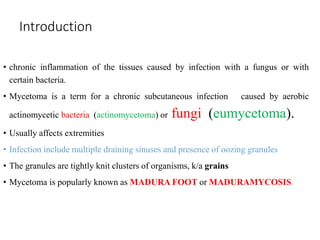
• chronic inflammation of the tissues caused by infection with a fungus or with
certain bacteria.
• Mycetoma is a term for a chronic subcutaneous infection caused by aerobic
actinomycetic bacteria (actinomycetoma) or fungi (eumycetoma).
• Usually affects extremities
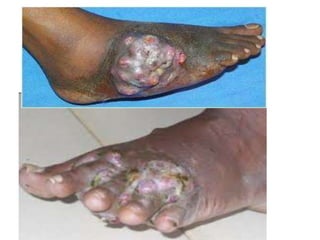
• Infection include multiple draining sinuses and presence of oozing granules
• The granules are tightly knit clusters of organisms, k/a grains
• Mycetoma is popularly known as MADURA FOOT or MADURAMYCOSIS.
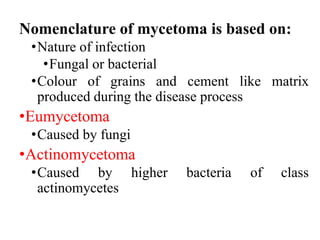
Nomenclature of mycetoma is based on:
•Nature of infection
•Fungal or bacterial
•Colour of grains and cement like matrix
produced during the disease process
•Eumycetoma
•Caused by fungi
•Actinomycetoma
•Caused by higher bacteria of class
actinomycetes
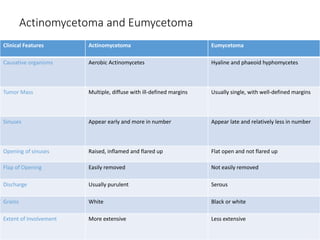
Actinomycetoma and Eumycetoma
Clinical Features Actinomycetoma Eumycetoma
Causative organisms Aerobic Actinomycetes Hyaline and phaeoid hyphomycetes
Tumor Mass Multiple, diffuse with ill-defined margins Usually single, with well-defined margins
Sinuses Appear early and more in number Appear late and relatively less in number
Opening of sinuses Raised, inflamed and flared up Flat open and not flared up
Flap of Opening Easily removed Not easily removed
Discharge Usually purulent Serous
Grains White Black or white
Extent of Involvement More extensive Less extensive
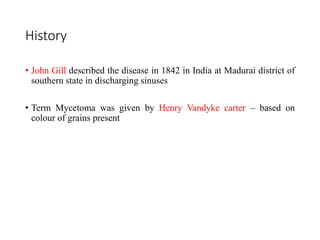
History
• John Gill described the disease in 1842 in India at Madurai district of
southern state in discharging sinuses
• Term Mycetoma was given by Henry Vandyke carter – based on
colour of grains present
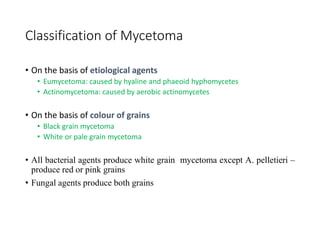
Classification of Mycetoma
• On the basis of etiological agents
• Eumycetoma: caused by hyaline and phaeoid hyphomycetes
• Actinomycetoma: caused by aerobic actinomycetes
• On the basis of colour of grains
• Black grain mycetoma
• White or pale grain mycetoma
• All bacterial agents produce white grain mycetoma except A. pelletieri –
produce red or pink grains
• Fungal agents produce both grains
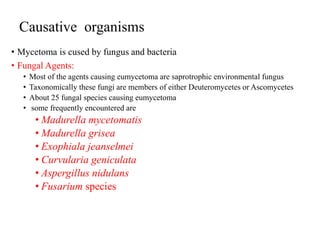
Causative organisms
• Mycetoma is cused by fungus and bacteria
• Fungal Agents:
• Most of the agents causing eumycetoma are saprotrophic environmental fungus
• Taxonomically these fungi are members of either Deuteromycetes or Ascomycetes
• About 25 fungal species causing eumycetoma
• some frequently encountered are
• Madurella mycetomatis
• Madurella grisea
• Exophiala jeanselmei
• Curvularia geniculata
• Aspergillus nidulans
• Fusarium species
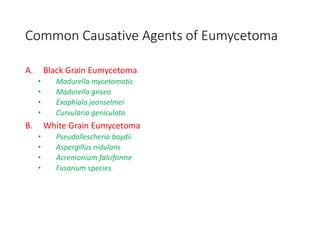
Common Causative Agents of Eumycetoma
A. Black Grain Eumycetoma
• Madurella mycetomatis
• Madurella grisea
• Exophiala jeanselmei
• Curvularia geniculata
B. White Grain Eumycetoma
• Pseudallescheria boydii
• Aspergillus nidulans
• Acremonium falciforme
• Fusarium species
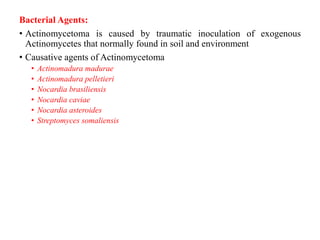
Bacterial Agents:
• Actinomycetoma is caused by traumatic inoculation of exogenous
Actinomycetes that normally found in soil and environment
• Causative agents of Actinomycetoma
• Actinomadura madurae
• Actinomadura pelletieri
• Nocardia brasiliensis
• Nocardia caviae
• Nocardia asteroides
• Streptomyces somaliensis
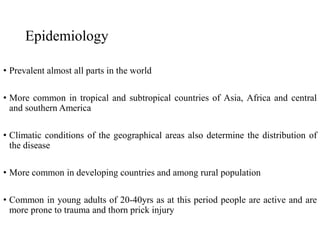
Epidemiology
• Prevalent almost all parts in the world
• More common in tropical and subtropical countries of Asia, Africa and central
and southern America
• Climatic conditions of the geographical areas also determine the distribution of
the disease
• More common in developing countries and among rural population
• Common in young adults of 20-40yrs as at this period people are active and are
more prone to trauma and thorn prick injury
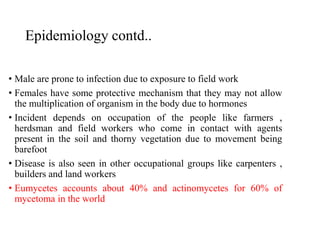
Epidemiology contd..
• Male are prone to infection due to exposure to field work
• Females have some protective mechanism that they may not allow
the multiplication of organism in the body due to hormones
• Incident depends on occupation of the people like farmers ,
herdsman and field workers who come in contact with agents
present in the soil and thorny vegetation due to movement being
barefoot
• Disease is also seen in other occupational groups like carpenters ,
builders and land workers
• Eumycetes accounts about 40% and actinomycetes for 60% of
mycetoma in the world
Pathogenesis and Pathology
• Mycetoma usually occurs by introduction of causative agent present in
saprotrophic soil source into subcutaneous tissue
• Probably by accidental trauma by throns or splinter injury
• In rural area habitual use of wicks for removal of ear wax may be
responsible for mycetoma of ear
• Mycetoma of back occurs in people who carry goods like woods , grain
bags, stone contaminated with soil saprophytes
• Head and neck mycetoma is seen in people who usually carry bundles of
wood on head and neck
• After causative agent introduced into skin disease evolves slowly
• Organisms are usually found in the centre of microabscess formed by
polymorphonuclear cells
• Main characteristic of mycetoma infection is presence of large aggregates of
filaments of causative organism which are at centre of it’s inflammatory
activity
Clinical Features
• May differ depending upon
• etiological agents
• anatomical site
• age of lesion
• Size , shape and color of grains
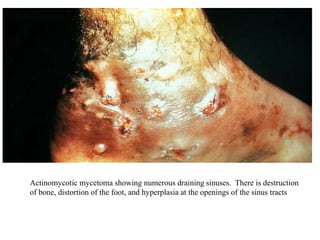
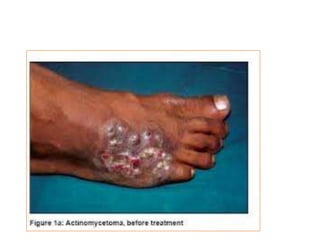
• Painless localized swollen lesions with multiple discharging sinuses and
progressive destruction of tissue is common in all types of mycetoma
• Sinuses discharge purulent fluid following secondary bacterial infection
362
Actinomycotic mycetoma showing numerous draining sinuses. There is destruction
of bone, distortion of the foot, and hyperplasia at the openings of the sinus tracts
Mycetoma
• Mycetoma is basically characterized by triad of clinical features :
• Tumor like swelling ie. Tumefaction
• Formation of multiple draining sinuses
• Grains oozing from sinuses
• In host tissue org forms compact mass of colonies ie. Grains of about
0.5-2 mm in diameter
• Color depends upon organism involved
• Actinomadura madurae produces large grain mycetoma
• Nocardia species produce small grain mycetoma
• Mainly feet is affected
• Infection on other parts of body involve are hands, shoulders, buttocks
and scalp
• Site of infection reflects occupation
• Disease has also been seen as recurrence in amputated patients also
• Disease progress slowly takes years to form characteristic lesions after
infection
• Lesions are firm, painless, localized subcutaneous nodules spread and
destroy surrounding structures
• Hematogenous spread has also been seen in infection cused by Nocardia
and Streptomyces species
• If buttock and trunk are infected ,spread is more rapid and extensive
• Rare threat to life but causes serious incapacity
Diagnosis
Diagnosis of mycetoma
• Clinically
• X rays & ultrasonography are used to assess for evidence of bone
involvement.
• CT scan may be more sensitive in the early stages
• MRI scans can provide a better assessment of the degree of bone
and soft tissue involvement, and may be useful in evaluating the
differential diagnosis of the swelling.
• Laboratory diagnosis
Laboratory Diagnosis
• Detailed and proper history about occupation, trauma , geographical area of the
patient is valuable in diagnosis
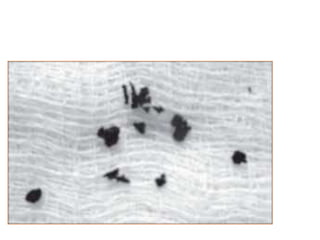
• Clinical sample is usually grains or granules
• Pus , exudates or biopsy may also be taken
• Lesion are thoroughly cleaned with antiseptics and grains are collected by
pressing sinus from periphery
• Enhances discharge with granules which are collected on sterile gauze
• Alternately they can be collected with the help of loop
• If more grains are needed flap of orifice of sinuses are opened and grins are
collected in sterile petridish
• Gross examination of grains is very imp
• They can characterize certain etiological agents
• Observation of size, shape, texture, color of grains is help to diagnosis
• But final diagnosis always depends on direct demonstration and culture of the
organism
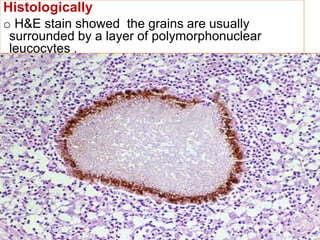
Histologically
o H&E stain showed the grains are usually
surrounded by a layer of polymorphonuclear
leucocytes .
oOutside the neutrophils zone there is granulation
tissue containing macrophages, lymphocytes,
plasma cells and few neutrophils. The
mononuclear cells increase in number towards the
periphery of the lesion. The outermost zone of the
lesion consists of fibrous tissue.
Fine needle aspiration:-
oMycetoma can be accurately diagnosed by
Fine Needle Aspiration (FNA) cytology and cell
block technique. Mycetoma lesions have a
distinct appearance in a cytology smear typical
to that seen in histopathological sections
1. Direct Examination
• Characteristics of grains , color, texture, size, and presence of hyaline or
phaeoid hyphae are deciding points for diagnosis
• Grains should be washed several times in sterile saline
• Crushed with sterile glass rod and cultured on different media
• Grains contain either actinomycetes or fungi in KOH wet mount or on
histopathological examination
KOH Preparation
• Add few drops of KOH and grains on glass slide
• Put coverslip
• Crush them gently by applying pressure over coverslip with glass rod or
handle of loop
• Leave the wet mount for few hours in petridish with moist filter paper
• Examine under microscope to look for characteristic hyphae
•Actinomycotic grains show thin filaments with diameter 0.5-
1um with coccoid or bacillary forms
• For diagnosis of actinomycetoma as causative organisms
• bacterial origin routine bacterial procedures are done
• Gram stain shows Gram positive branching filmentous bacteria embedded in
grain material
• Modified acid fast staining (Kinyoun’s method ) with 1% sulfuric acid shows
pink colored filamentous bacteria ie Nocardia whereas other actinomycetes
are not acid fast
oDuring the active phase of the disease, the sinuses
discharge grains of a color that depends on the type of
organism;
 M. mycetomi → black, hard& large
 A. madurae → white, soft& large
 A. pelletieri → red, small& soft
S. somaliensis → yellow, small& hard.
The grains are of variable size and consistency
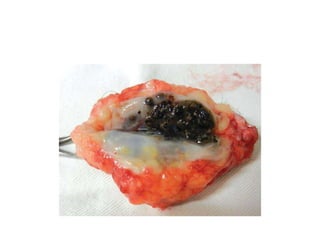
lesion after excision with black grains
inside
Mycetoma grains
• Eumycotic grains show thick 2-6um wide hyphae with large
swollen cells upto 15um at margin with or without
chlamydospores
• Direct examination in wet mount shows septate hyphae in grain
material then special fungal stains should be done to confirm
diagnosis
• In PAS stain hyphae are seen PAS positive
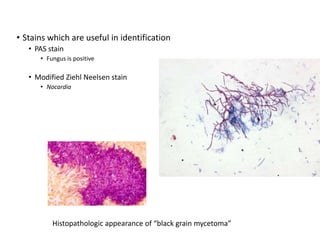
• Stains which are useful in identification
• PAS stain
• Fungus is positive
• Modified Ziehl Neelsen stain
• Nocardia
Histopathologic appearance of “black grain mycetoma”
Culture
• For Actinomycetoma
• Filaments are crushed and washed with normal saline several times without
antibiotics
• Inoculated in
•SDA
•Blood Agar
•L-J Medium
•BHI agar
• Incubate at 250C and 37 0C
• For Eumycetoma
• Grains are washed several times with normal saline with
antibiotics (Streptopenicillin, Penicillin)
• Inoculated in
•SDA with Chloramphenical and Gentamicin
•Modified SDA; Emmon’s medium (SDA with
Actidione)
• Incubate at 250C, 370C and 440C
Madurella mycetomatis in Sabouraud's dextrose
agar with brown pigment
3.immunodiagnosis
• Complement fixation test
• Immunodoffusion
• Counterimmunoelectrophoresis
• ELISA
• Skin tests have not been diagnostically useful
4.Animal pathogenicity
• Grains containing lesions of mycetoma are not produced with causative
organisms in experimental animals
• Animals used are guinea pig, mice and goat
• Suspected org is injected intravenously
• Scattered, delicate, Gram positive and acid fast filaments can be seen in
inflammatory lesions and exudate
Molecular testing
•PCR
Treatment and prophylaxis
• Management of mycetoma is highly challenging for the clinicians
• Many drugs have been tried with variable results
• For Eumycetoma
• Oral Ketoconazole 200mg twice daily and Itraconazole 100mg twice daily for
8-24 months
• Amphotericin B is recommended for Madurella and Fusarium species
• For Actinomycetoma
• Cotrimoxazole
• Amoxycillin
• Clavulanate
• Amikacin
THANK YOU

CLS Mycetoma.pptx

  • 1.
  • 3.
    Introduction • chronic inflammationof the tissues caused by infection with a fungus or with certain bacteria. • Mycetoma is a term for a chronic subcutaneous infection caused by aerobic actinomycetic bacteria (actinomycetoma) or fungi (eumycetoma). • Usually affects extremities • Infection include multiple draining sinuses and presence of oozing granules • The granules are tightly knit clusters of organisms, k/a grains • Mycetoma is popularly known as MADURA FOOT or MADURAMYCOSIS.
  • 4.
    Nomenclature of mycetomais based on: •Nature of infection •Fungal or bacterial •Colour of grains and cement like matrix produced during the disease process •Eumycetoma •Caused by fungi •Actinomycetoma •Caused by higher bacteria of class actinomycetes
  • 5.
    Actinomycetoma and Eumycetoma ClinicalFeatures Actinomycetoma Eumycetoma Causative organisms Aerobic Actinomycetes Hyaline and phaeoid hyphomycetes Tumor Mass Multiple, diffuse with ill-defined margins Usually single, with well-defined margins Sinuses Appear early and more in number Appear late and relatively less in number Opening of sinuses Raised, inflamed and flared up Flat open and not flared up Flap of Opening Easily removed Not easily removed Discharge Usually purulent Serous Grains White Black or white Extent of Involvement More extensive Less extensive
  • 6.
    History • John Gilldescribed the disease in 1842 in India at Madurai district of southern state in discharging sinuses • Term Mycetoma was given by Henry Vandyke carter – based on colour of grains present
  • 7.
    Classification of Mycetoma •On the basis of etiological agents • Eumycetoma: caused by hyaline and phaeoid hyphomycetes • Actinomycetoma: caused by aerobic actinomycetes • On the basis of colour of grains • Black grain mycetoma • White or pale grain mycetoma • All bacterial agents produce white grain mycetoma except A. pelletieri – produce red or pink grains • Fungal agents produce both grains
  • 8.
    Causative organisms • Mycetomais cused by fungus and bacteria • Fungal Agents: • Most of the agents causing eumycetoma are saprotrophic environmental fungus • Taxonomically these fungi are members of either Deuteromycetes or Ascomycetes • About 25 fungal species causing eumycetoma • some frequently encountered are • Madurella mycetomatis • Madurella grisea • Exophiala jeanselmei • Curvularia geniculata • Aspergillus nidulans • Fusarium species
  • 9.
    Common Causative Agentsof Eumycetoma A. Black Grain Eumycetoma • Madurella mycetomatis • Madurella grisea • Exophiala jeanselmei • Curvularia geniculata B. White Grain Eumycetoma • Pseudallescheria boydii • Aspergillus nidulans • Acremonium falciforme • Fusarium species
  • 10.
    Bacterial Agents: • Actinomycetomais caused by traumatic inoculation of exogenous Actinomycetes that normally found in soil and environment • Causative agents of Actinomycetoma • Actinomadura madurae • Actinomadura pelletieri • Nocardia brasiliensis • Nocardia caviae • Nocardia asteroides • Streptomyces somaliensis
  • 11.
    Epidemiology • Prevalent almostall parts in the world • More common in tropical and subtropical countries of Asia, Africa and central and southern America • Climatic conditions of the geographical areas also determine the distribution of the disease • More common in developing countries and among rural population • Common in young adults of 20-40yrs as at this period people are active and are more prone to trauma and thorn prick injury
  • 12.
    Epidemiology contd.. • Maleare prone to infection due to exposure to field work • Females have some protective mechanism that they may not allow the multiplication of organism in the body due to hormones • Incident depends on occupation of the people like farmers , herdsman and field workers who come in contact with agents present in the soil and thorny vegetation due to movement being barefoot • Disease is also seen in other occupational groups like carpenters , builders and land workers • Eumycetes accounts about 40% and actinomycetes for 60% of mycetoma in the world
  • 13.
    Pathogenesis and Pathology •Mycetoma usually occurs by introduction of causative agent present in saprotrophic soil source into subcutaneous tissue • Probably by accidental trauma by throns or splinter injury • In rural area habitual use of wicks for removal of ear wax may be responsible for mycetoma of ear • Mycetoma of back occurs in people who carry goods like woods , grain bags, stone contaminated with soil saprophytes
  • 14.
    • Head andneck mycetoma is seen in people who usually carry bundles of wood on head and neck • After causative agent introduced into skin disease evolves slowly • Organisms are usually found in the centre of microabscess formed by polymorphonuclear cells • Main characteristic of mycetoma infection is presence of large aggregates of filaments of causative organism which are at centre of it’s inflammatory activity
  • 15.
    Clinical Features • Maydiffer depending upon • etiological agents • anatomical site • age of lesion • Size , shape and color of grains • Painless localized swollen lesions with multiple discharging sinuses and progressive destruction of tissue is common in all types of mycetoma • Sinuses discharge purulent fluid following secondary bacterial infection
  • 16.
    362 Actinomycotic mycetoma showingnumerous draining sinuses. There is destruction of bone, distortion of the foot, and hyperplasia at the openings of the sinus tracts
  • 17.
  • 18.
    • Mycetoma isbasically characterized by triad of clinical features : • Tumor like swelling ie. Tumefaction • Formation of multiple draining sinuses • Grains oozing from sinuses • In host tissue org forms compact mass of colonies ie. Grains of about 0.5-2 mm in diameter • Color depends upon organism involved • Actinomadura madurae produces large grain mycetoma • Nocardia species produce small grain mycetoma
  • 19.
    • Mainly feetis affected • Infection on other parts of body involve are hands, shoulders, buttocks and scalp • Site of infection reflects occupation • Disease has also been seen as recurrence in amputated patients also • Disease progress slowly takes years to form characteristic lesions after infection
  • 20.
    • Lesions arefirm, painless, localized subcutaneous nodules spread and destroy surrounding structures • Hematogenous spread has also been seen in infection cused by Nocardia and Streptomyces species • If buttock and trunk are infected ,spread is more rapid and extensive • Rare threat to life but causes serious incapacity
  • 21.
    Diagnosis Diagnosis of mycetoma •Clinically • X rays & ultrasonography are used to assess for evidence of bone involvement. • CT scan may be more sensitive in the early stages • MRI scans can provide a better assessment of the degree of bone and soft tissue involvement, and may be useful in evaluating the differential diagnosis of the swelling. • Laboratory diagnosis
  • 22.
    Laboratory Diagnosis • Detailedand proper history about occupation, trauma , geographical area of the patient is valuable in diagnosis • Clinical sample is usually grains or granules • Pus , exudates or biopsy may also be taken • Lesion are thoroughly cleaned with antiseptics and grains are collected by pressing sinus from periphery • Enhances discharge with granules which are collected on sterile gauze • Alternately they can be collected with the help of loop • If more grains are needed flap of orifice of sinuses are opened and grins are collected in sterile petridish
  • 23.
    • Gross examinationof grains is very imp • They can characterize certain etiological agents • Observation of size, shape, texture, color of grains is help to diagnosis • But final diagnosis always depends on direct demonstration and culture of the organism
  • 24.
    Histologically o H&E stainshowed the grains are usually surrounded by a layer of polymorphonuclear leucocytes . oOutside the neutrophils zone there is granulation tissue containing macrophages, lymphocytes, plasma cells and few neutrophils. The mononuclear cells increase in number towards the periphery of the lesion. The outermost zone of the lesion consists of fibrous tissue. Fine needle aspiration:- oMycetoma can be accurately diagnosed by Fine Needle Aspiration (FNA) cytology and cell block technique. Mycetoma lesions have a distinct appearance in a cytology smear typical to that seen in histopathological sections
  • 25.
    1. Direct Examination •Characteristics of grains , color, texture, size, and presence of hyaline or phaeoid hyphae are deciding points for diagnosis • Grains should be washed several times in sterile saline • Crushed with sterile glass rod and cultured on different media • Grains contain either actinomycetes or fungi in KOH wet mount or on histopathological examination
  • 26.
    KOH Preparation • Addfew drops of KOH and grains on glass slide • Put coverslip • Crush them gently by applying pressure over coverslip with glass rod or handle of loop • Leave the wet mount for few hours in petridish with moist filter paper • Examine under microscope to look for characteristic hyphae
  • 27.
    •Actinomycotic grains showthin filaments with diameter 0.5- 1um with coccoid or bacillary forms • For diagnosis of actinomycetoma as causative organisms • bacterial origin routine bacterial procedures are done • Gram stain shows Gram positive branching filmentous bacteria embedded in grain material • Modified acid fast staining (Kinyoun’s method ) with 1% sulfuric acid shows pink colored filamentous bacteria ie Nocardia whereas other actinomycetes are not acid fast
  • 28.
    oDuring the activephase of the disease, the sinuses discharge grains of a color that depends on the type of organism;  M. mycetomi → black, hard& large  A. madurae → white, soft& large  A. pelletieri → red, small& soft S. somaliensis → yellow, small& hard. The grains are of variable size and consistency
  • 29.
    lesion after excisionwith black grains inside
  • 30.
  • 31.
    • Eumycotic grainsshow thick 2-6um wide hyphae with large swollen cells upto 15um at margin with or without chlamydospores • Direct examination in wet mount shows septate hyphae in grain material then special fungal stains should be done to confirm diagnosis • In PAS stain hyphae are seen PAS positive
  • 32.
    • Stains whichare useful in identification • PAS stain • Fungus is positive • Modified Ziehl Neelsen stain • Nocardia Histopathologic appearance of “black grain mycetoma”
  • 33.
    Culture • For Actinomycetoma •Filaments are crushed and washed with normal saline several times without antibiotics • Inoculated in •SDA •Blood Agar •L-J Medium •BHI agar • Incubate at 250C and 37 0C
  • 34.
    • For Eumycetoma •Grains are washed several times with normal saline with antibiotics (Streptopenicillin, Penicillin) • Inoculated in •SDA with Chloramphenical and Gentamicin •Modified SDA; Emmon’s medium (SDA with Actidione) • Incubate at 250C, 370C and 440C
  • 35.
    Madurella mycetomatis inSabouraud's dextrose agar with brown pigment
  • 36.
    3.immunodiagnosis • Complement fixationtest • Immunodoffusion • Counterimmunoelectrophoresis • ELISA • Skin tests have not been diagnostically useful
  • 37.
    4.Animal pathogenicity • Grainscontaining lesions of mycetoma are not produced with causative organisms in experimental animals • Animals used are guinea pig, mice and goat • Suspected org is injected intravenously • Scattered, delicate, Gram positive and acid fast filaments can be seen in inflammatory lesions and exudate
  • 38.
  • 39.
    Treatment and prophylaxis •Management of mycetoma is highly challenging for the clinicians • Many drugs have been tried with variable results • For Eumycetoma • Oral Ketoconazole 200mg twice daily and Itraconazole 100mg twice daily for 8-24 months • Amphotericin B is recommended for Madurella and Fusarium species • For Actinomycetoma • Cotrimoxazole • Amoxycillin • Clavulanate • Amikacin
  • 40.