1
EFFECTIVE
LESSON
PLANNING
B
a
c
h
e
l
o
r
o
f
E
l
e
m
e
n
t
a
r
y
E
d
u
c
a
t
i
o
n
T
e
a
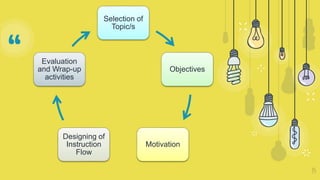
c
h
i
n
g
S
o
c
i
a
l
S
t
u
d
i
e
s
i
n
E
l
e
m
e
n
t
a
r
y
G
r
a
d
e
s
Geramy B. Espina
Resource Speaker
According to Deped Order
No. 70, s. 2012:
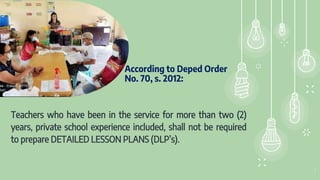
Teachers who have been in the service for more than two (2)
years, private school experience included, shall not be required
to prepare DETAILED LESSON PLANS (DLP’s).
2
Meaning:
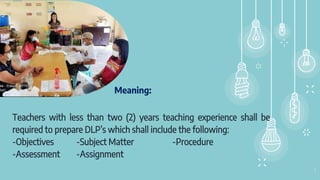
Teachers with less than two (2) years teaching experience shall be
required to prepare DLP’s which shall include the following:
-Objectives -Subject Matter -Procedure
-Assessment -Assignment
3
OBJECTIVES OF CONDUCTING
THIS WORKSHOP ON LESSON
PLANNING:
1. DEFINE what a Lesson Plan is.
2. IDENTIFY the different components of a
Lesson Plan.
3. DIFFERENTIATE the different kinds of
Lesson Plan.
4. PREPARE a Lesson Plan.
4
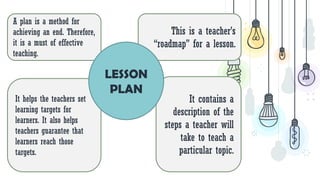
This is a teacher’s
“roadmap” for a lesson.
It contains a
description of the
steps a teacher will
take to teach a
particular topic.
A plan is a method for
achieving an end. Therefore,
it is a must of effective
teaching.
It helps the teachers set
learning targets for
learners. It also helps
teachers guarantee that
learners reach those
targets.
LESSON
PLAN
COMPONENTS
OF
LESSON PLAN
1
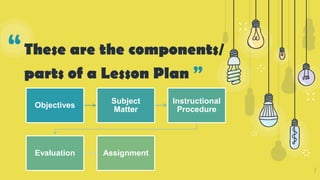
“These are the components/
parts of a Lesson Plan ”
7
Objectives
Subject
Matter
Instructional
Procedure
Evaluation Assignment
8
OBJECTIVES
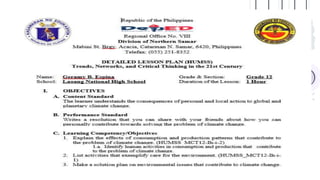
A. Content Standard
B. Performance Standard
C. Learning Competency/
Objectives
This part of DLP describes the
“kinds of content knowledge and
processes the teachers hope their
students will leran from
instruction.”
SUBJECT MATTER:
1. Topic
2. References
3. Materials:
4. Value Aims
This part of DLP contains the
specific content that the lesson
aims to teach. Materials,
references and other implied
values should be included.
10
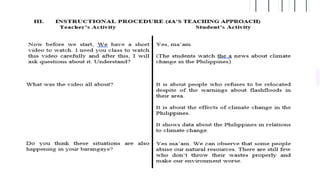
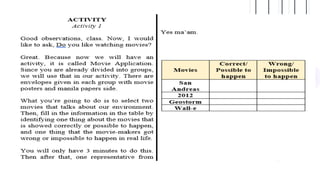
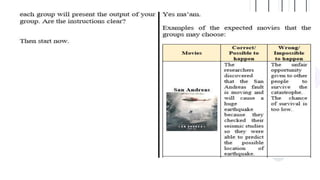
INSTRUCTIONAL PROCEDURE
(4A’S TEACHING APPROACH)
Motivation
1. Activity
2. Analysis
3. Abstraction
4. Application
This part of DLP details the
steps and activities the
teachers and the students will
do during the lesson towards
achievement of the lesson’s
objective.
11
INSTRUCTIONAL PROCEDURE
(4A’S TEACHING APPROACH)
Motivation
1. Activity
2. Analysis
3. Abstraction
4. Application
The procedure describes the
learning experiences that
learners will go through in
understanding and mastering
the lesson’s content.
12
INSTRUCTIONAL PROCEDURE
(4A’S TEACHING APPROACH)
Motivation
1. Activity
2. Analysis
3. Abstraction
4. Application
Flexibility is encouraged in
the implementation of the
DLP procedure. Changes in
the procedure is allowed
based on time constraints or
when adjustments in teaching
are needed to ensure learners’
understanding.
13
EVALUATION:
(Should meet the
objectives set at the
beginning of the
lesson.)
Formative assessment of student learning may be
done before, during , and after a lesson and should
be carried out to measure attainment of the lesson
objectives.
14
ASSIGNMENT/
HOMEWORK:
(Should allow the students to
master what was learned
during the lesson.)
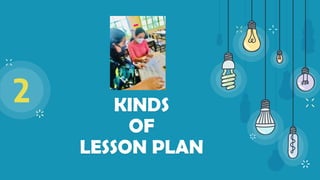
KINDS
OF
LESSON PLAN
2
“
16
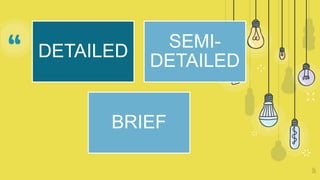
DETAILED
SEMI-
DETAILED
BRIEF
17
Detailed Lesson Plan
1
In this plan, both teacher’s and
students activities are presented.
18
Semi-Detailed Lesson Plan
2
This plan is less intricate than the
detailed LP. Some LP does not have
student activities, and in some cases,
they include it but with little notes.
19
Brief Lesson Plan
3
This plan focuses more on the flow of
instruction. It is not necessary to
write the students activities.
3 TEACHING
MODELS USED IN
LESSON PLAN
21
Teaching models are larger than
a particular strategy, method, or
tactic. These are overall approaches
to instruction that do not only help
teachers in planning instruction, but
also guide them in acquiring
information, developing skills,
internalizing values, and engaging
in other forms of learning activities.
22
(This can be found in
the Instructional
Procedure of the LP,
regardless of its type.)
23
TEACHING MODEL:
Discovery Learning
This teaching model is based on the idea
that content is not given to learners in
finished form. Rather, it is discovered by
learners before they can internalize it.
In Discovery Learning, the major task of
the learner is to discover something and
not merely to learn the content.
24
TEACHING MODEL:
Discovery Learning
Purposes:
1. To provide students with opportunities
to think independently;
2. To help students discover how
knowledge becomes known; and
3. To promote higher-order or critical
thinking skills such as analysis,
synthesis, and evaluation.
25
TEACHING MODEL:
Discovery Learning
Phases of Instruction:
1. Selecting the problem.
2. Proposing possible solutions.
3. Collecting data.
4. Analyzing and interpreting data.
5. Testing conclusions.
26
TEACHING MODEL:
Inquiry Learning
This teaching model is commonly known as
the inquiry process which is the application of
scientific method to teaching. This is the chief
method used by scientists.
Purpose:
1. To help students develop skills in observing
and being alert for discrepancies.
27
TEACHING MODEL:
Inquiry Learning
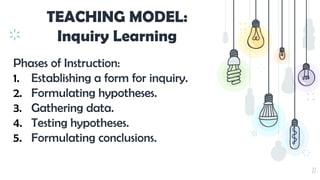
Phases of Instruction:
1. Establishing a form for inquiry.
2. Formulating hypotheses.
3. Gathering data.
4. Testing hypotheses.
5. Formulating conclusions.
28
TEACHING MODEL:
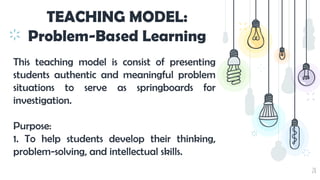
Problem-Based Learning
This teaching model is consist of presenting
students authentic and meaningful problem
situations to serve as springboards for
investigation.
Purpose:
1. To help students develop their thinking,
problem-solving, and intellectual skills.
29
TEACHING MODEL:
Problem-Based Learning
Phases of Instruction:
1. Orienting students to the problem.
2. Organizing students for study.
3. Assisting independent and group
investigation.
4. Presenting Exhibits.
5. Analyzing and evaluating the problem-
solving process.
30
TEACHING MODEL:
Cooperative Learning
This teaching model is based on the idea that
learners work together in small group and
are rewarded for their collective
accomplishments.
Purpose:
1. To promote diversity of learners.
2. To teach students skills of cooperation
and collaboration.
31
TEACHING MODEL:
Cooperative Learning
Phases of Instruction:
1. Identification of topics.
2. Formation of learning teams.
3. Investigation of topics.
4. Preparation of presentation.
5. Presentation to the whole class.
32
TEACHING MODEL:
4 A’s TEACHING APPROACH
This teaching model follows a logical
sequencing of learning activities from the
mood-setting activity to the closing activity.
Learning experiences in the cognitive, affective,
and psychomotor domains are embedded
simultaneously in the development of the
lessons, therefore, creating wholeness in the
teaching-learning process.
33
TEACHING MODEL:
4 A’s TEACHING APPROACH
Purpose:
1. To provide experiential learning in
small groups and class activities.
Phases of Instruction:
1. Activity 2. Analysis
3. Abstraction 4. Application
4
PREPARATION
OF LESSON PLAN
“
35
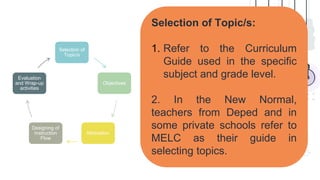
Selection of
Topic/s
Objectives
Motivation
Designing of
Instruction
Flow
Evaluation
and Wrap-up
activities
Selection of
Topic/s
Objectives
Motivation
Designing of
Instruction
Flow
Evaluation
and Wrap-up
activities
Selection of Topic/s:
1. Refer to the Curriculum
Guide used in the specific
subject and grade level.
2. In the New Normal,
teachers from Deped and in
some private schools refer to
MELC as their guide in
selecting topics.
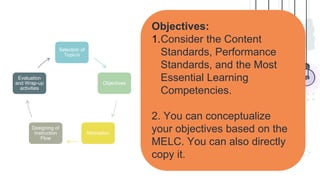
Objectives:
1.Consider the Content
Standards, Performance
Standards, and the Most
Essential Learning
Competencies.
2. You can conceptualize
your objectives based on the
MELC. You can also directly
copy it.
Selection of
Topic/s
Objectives
Motivation
Designing of
Instruction
Flow
Evaluation
and Wrap-up
activities
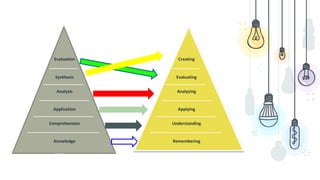
Knowledge
Comprehension
Application
Analysis
Synthesis
Evaluation
Remembering
Understanding
Applying
Analyzing
Evaluating
Creating
1956 2001
(Based on Pohl, 2000, Learning to Think, Thinking to Learn, p. 8)
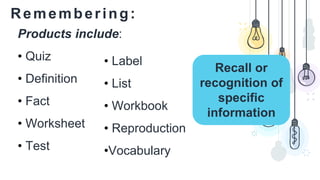
Remembering:
Recall or
recognition of
specific
information
Products include:
• Quiz
• Definition
• Fact
• Worksheet
• Test
• Label
• List
• Workbook
• Reproduction
•Vocabulary
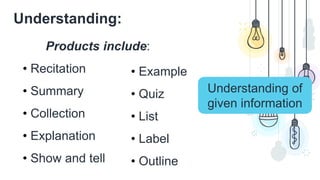
Understanding:
Understanding of
given information
Products include:
• Recitation
• Summary
• Collection
• Explanation
• Show and tell
• Example
• Quiz
• List
• Label
• Outline
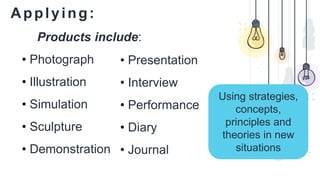
Applying:
Using strategies,
concepts,
principles and
theories in new
situations
Products include:
• Photograph
• Illustration
• Simulation
• Sculpture
• Demonstration
• Presentation
• Interview
• Performance
• Diary
• Journal
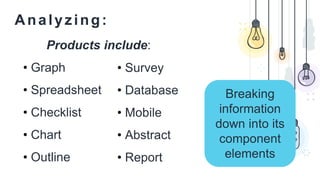
Analyzing:
Breaking
information
down into its
component
elements
Products include:
• Graph
• Spreadsheet
• Checklist
• Chart
• Outline
• Survey
• Database
• Mobile
• Abstract
• Report
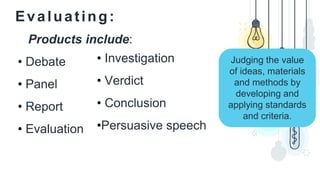
Evaluating:
Products include:
• Debate
• Panel
• Report
• Evaluation
• Investigation
• Verdict
• Conclusion
•Persuasive speech
Judging the value
of ideas, materials
and methods by
developing and
applying standards
and criteria.
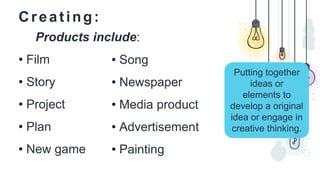
Creating:
Putting together
ideas or
elements to
develop a original
idea or engage in
creative thinking.
Products include:
• Film
• Story
• Project
• Plan
• New game
• Song
• Newspaper
• Media product
• Advertisement
• Painting
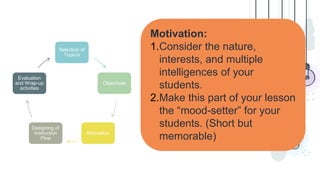
Motivation:
1.Consider the nature,
interests, and multiple
intelligences of your
students.
2.Make this part of your lesson
the “mood-setter” for your
students. (Short but
memorable)
Selection of
Topic/s
Objectives
Motivation
Designing of
Instruction
Flow
Evaluation
and Wrap-up
activities
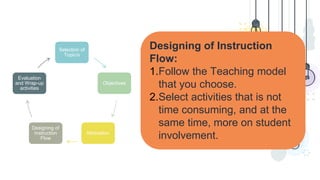
Designing of Instruction
Flow:
1.Follow the Teaching model
that you choose.
2.Select activities that is not
time consuming, and at the
same time, more on student
involvement.
Selection of
Topic/s
Objectives
Motivation
Designing of
Instruction
Flow
Evaluation
and Wrap-up
activities
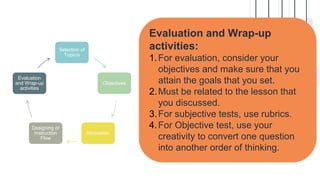
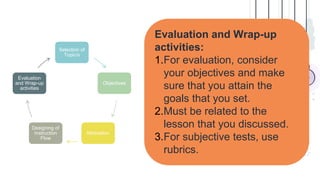
Evaluation and Wrap-up
activities:
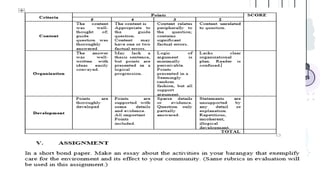
1.For evaluation, consider your
objectives and make sure that you
attain the goals that you set.
2.Must be related to the lesson that
you discussed.
3.For subjective tests, use rubrics.
4.For Objective test, use your
creativity to convert one question
into another order of thinking.
Selection of
Topic/s
Objectives
Motivation
Designing of
Instruction
Flow
Evaluation
and Wrap-up
activities
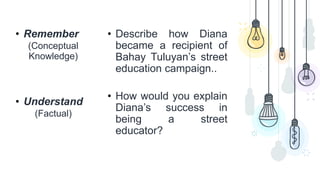
• Remember
(Conceptual
Knowledge)
• Understand
(Factual)
• Describe how Diana
became a recipient of
Bahay Tuluyan’s street
education campaign..
• How would you explain
Diana’s success in
being a street
educator?
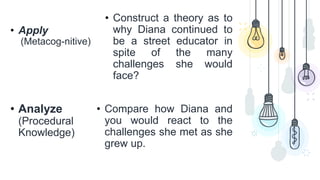
• Apply
(Metacog-nitive)
• Construct a theory as to
why Diana continued to
be a street educator in
spite of the many
challenges she would
face?
• Analyze
(Procedural
Knowledge)
• Compare how Diana and
you would react to the
challenges she met as she
grew up.
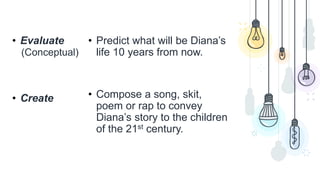
• Evaluate
(Conceptual)
• Create
• Predict what will be Diana’s
life 10 years from now.
• Compose a song, skit,
poem or rap to convey
Diana’s story to the children
of the 21st century.
Evaluation and Wrap-up
activities:
1.For evaluation, consider
your objectives and make
sure that you attain the
goals that you set.
2.Must be related to the
lesson that you discussed.
3.For subjective tests, use
rubrics.
Selection of
Topic/s
Objectives
Motivation
Designing of
Instruction
Flow
Evaluation
and Wrap-up
activities
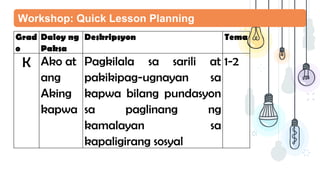
Workshop: Quick Lesson Planning
Grad
o
Daloy ng
Paksa
Deskripsyon Tema
K Ako at
ang
Aking
kapwa
Pagkilala sa sarili at
pakikipag-ugnayan sa
kapwa bilang pundasyon
sa paglinang ng
kamalayan sa
kapaligirang sosyal
1-2
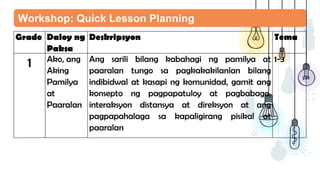
Workshop: Quick Lesson Planning
Grado Daloy ng
Paksa
Deskripsyon Tema
1 Ako, ang
Aking
Pamilya
at
Paaralan
Ang sarili bilang kabahagi ng pamilya at
paaralan tungo sa pagkakakilanlan bilang
indibidwal at kasapi ng komunidad, gamit ang
konsepto ng pagpapatuloy at pagbabago,
interaksyon distansya at direksyon at ang
pagpapahalaga sa kapaligirang pisikal at
paaralan
1-3
Workshop: Quick Lesson Planning
Grado Daloy ng
Paksa
Deskripsyon Tema
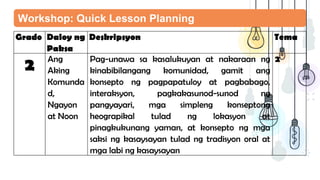
2 Ang
Aking
Komunda
d,
Ngayon
at Noon
Pag-unawa sa kasalukuyan at nakaraan ng
kinabibilangang komunidad, gamit ang
konsepto ng pagpapatuloy at pagbabago,
interaksyon, pagkakasunod-sunod ng
pangyayari, mga simpleng konseptong
heograpikal tulad ng lokasyon at
pinagkukunang yaman, at konsepto ng mga
saksi ng kasaysayan tulad ng tradisyon oral at
mga labi ng kasaysayan
2
Workshop: Quick Lesson Planning
Grado Daloy ng
Paksa
Deskripsyon Tema
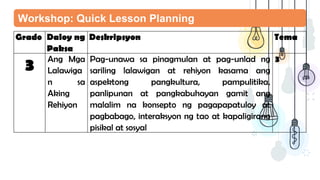
3 Ang Mga
Lalawiga
n sa
Aking
Rehiyon
Pag-unawa sa pinagmulan at pag-unlad ng
sariling lalawigan at rehiyon kasama ang
aspektong pangkultura, pampulitika,
panlipunan at pangkabuhayan gamit ang
malalim na konsepto ng pagapapatuloy at
pagbabago, interaksyon ng tao at kapaligirang
pisikal at sosyal
3
Workshop: Quick Lesson Planning
Grado Daloy ng
Paksa
Deskripsyon Tema
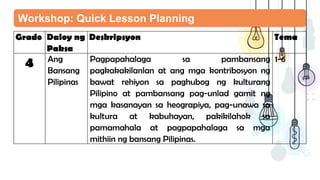
4 Ang
Bansang
Pilipinas
Pagpapahalaga sa pambansang
pagkakakilanlan at ang mga kontribosyon ng
bawat rehiyon sa paghubog ng kulturang
Pilipino at pambansang pag-unlad gamit ng
mga kasanayan sa heograpiya, pag-unawa sa
kultura at kabuhayan, pakikilahok sa
pamamahala at pagpapahalaga sa mga
mithiin ng bansang Pilipinas.
1-6
Workshop: Quick Lesson Planning
Grado Daloy ng
Paksa
Deskripsyon Tema
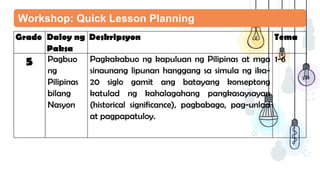
5 Pagbuo
ng
Pilipinas
bilang
Nasyon
Pagkakabuo ng kapuluan ng Pilipinas at mga
sinaunang lipunan hanggang sa simula ng ika-
20 siglo gamit ang batayang konseptong
katulad ng kahalagahang pangkasaysayan
(historical significance), pagbabago, pag-unlad
at pagpapatuloy.
1-6
Workshop: Quick Lesson Planning
Grado Daloy ng
Paksa
Deskripsyon Tema
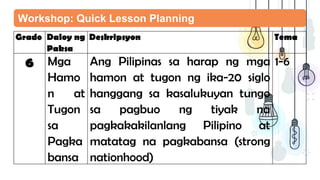
6 Mga
Hamo
n at
Tugon
sa
Pagka
bansa
Ang Pilipinas sa harap ng mga
hamon at tugon ng ika-20 siglo
hanggang sa kasalukuyan tungo
sa pagbuo ng tiyak na
pagkakakilanlang Pilipino at
matatag na pagkabansa (strong
nationhood)
1-6
References:
• Clements, D.; C. Gilliland and P. Holko. (1992). Thinking in Themes: An Approach Through the
Learning Centre. Melbourne: Oxford University Press.
• Crawford, Jean (ed.) (1991). Achieveing Excellence: Units of Work for levels P-8. Carlton
South, Vic.: Education Shop, Ministry of Education and Training, Victoria.
• Crosby, N. and E. Martin. (1981). Don’t Teach! Let Me Learn. Book 3. Cheltenham, Vic.: Hawker
Brownlow.
• Dalton, Joan. (1986). Extending Children’s Special Abilities: Strategies for Primary Classrooms.
Victoria: Department of School Education, Victoria.
• McGrath, Helen & Toni Noble (2001). Seven Ways at Once.
• O’Tuel, Frances S. And Ruth K (1993). Bullard. Developing Higher Order Thinking in the Content
Areas K – 12.
75
THANK
YOU!

LESSON PLANNING Tips.pptx

  • 1.
  • 2.
    According to DepedOrder No. 70, s. 2012: Teachers who have been in the service for more than two (2) years, private school experience included, shall not be required to prepare DETAILED LESSON PLANS (DLP’s). 2
  • 3.
    Meaning: Teachers with lessthan two (2) years teaching experience shall be required to prepare DLP’s which shall include the following: -Objectives -Subject Matter -Procedure -Assessment -Assignment 3
  • 4.
    OBJECTIVES OF CONDUCTING THISWORKSHOP ON LESSON PLANNING: 1. DEFINE what a Lesson Plan is. 2. IDENTIFY the different components of a Lesson Plan. 3. DIFFERENTIATE the different kinds of Lesson Plan. 4. PREPARE a Lesson Plan. 4
  • 5.
    This is ateacher’s “roadmap” for a lesson. It contains a description of the steps a teacher will take to teach a particular topic. A plan is a method for achieving an end. Therefore, it is a must of effective teaching. It helps the teachers set learning targets for learners. It also helps teachers guarantee that learners reach those targets. LESSON PLAN
  • 6.
  • 7.
    “These are thecomponents/ parts of a Lesson Plan ” 7 Objectives Subject Matter Instructional Procedure Evaluation Assignment
  • 8.
    8 OBJECTIVES A. Content Standard B.Performance Standard C. Learning Competency/ Objectives This part of DLP describes the “kinds of content knowledge and processes the teachers hope their students will leran from instruction.”
  • 9.
    SUBJECT MATTER: 1. Topic 2.References 3. Materials: 4. Value Aims This part of DLP contains the specific content that the lesson aims to teach. Materials, references and other implied values should be included.
  • 10.
    10 INSTRUCTIONAL PROCEDURE (4A’S TEACHINGAPPROACH) Motivation 1. Activity 2. Analysis 3. Abstraction 4. Application This part of DLP details the steps and activities the teachers and the students will do during the lesson towards achievement of the lesson’s objective.
  • 11.
    11 INSTRUCTIONAL PROCEDURE (4A’S TEACHINGAPPROACH) Motivation 1. Activity 2. Analysis 3. Abstraction 4. Application The procedure describes the learning experiences that learners will go through in understanding and mastering the lesson’s content.
  • 12.
    12 INSTRUCTIONAL PROCEDURE (4A’S TEACHINGAPPROACH) Motivation 1. Activity 2. Analysis 3. Abstraction 4. Application Flexibility is encouraged in the implementation of the DLP procedure. Changes in the procedure is allowed based on time constraints or when adjustments in teaching are needed to ensure learners’ understanding.
  • 13.
    13 EVALUATION: (Should meet the objectivesset at the beginning of the lesson.) Formative assessment of student learning may be done before, during , and after a lesson and should be carried out to measure attainment of the lesson objectives.
  • 14.
    14 ASSIGNMENT/ HOMEWORK: (Should allow thestudents to master what was learned during the lesson.)
  • 15.
  • 16.
  • 17.
    17 Detailed Lesson Plan 1 Inthis plan, both teacher’s and students activities are presented.
  • 18.
    18 Semi-Detailed Lesson Plan 2 Thisplan is less intricate than the detailed LP. Some LP does not have student activities, and in some cases, they include it but with little notes.
  • 19.
    19 Brief Lesson Plan 3 Thisplan focuses more on the flow of instruction. It is not necessary to write the students activities.
  • 20.
    3 TEACHING MODELS USEDIN LESSON PLAN
  • 21.
    21 Teaching models arelarger than a particular strategy, method, or tactic. These are overall approaches to instruction that do not only help teachers in planning instruction, but also guide them in acquiring information, developing skills, internalizing values, and engaging in other forms of learning activities.
  • 22.
    22 (This can befound in the Instructional Procedure of the LP, regardless of its type.)
  • 23.
    23 TEACHING MODEL: Discovery Learning Thisteaching model is based on the idea that content is not given to learners in finished form. Rather, it is discovered by learners before they can internalize it. In Discovery Learning, the major task of the learner is to discover something and not merely to learn the content.
  • 24.
    24 TEACHING MODEL: Discovery Learning Purposes: 1.To provide students with opportunities to think independently; 2. To help students discover how knowledge becomes known; and 3. To promote higher-order or critical thinking skills such as analysis, synthesis, and evaluation.
  • 25.
    25 TEACHING MODEL: Discovery Learning Phasesof Instruction: 1. Selecting the problem. 2. Proposing possible solutions. 3. Collecting data. 4. Analyzing and interpreting data. 5. Testing conclusions.
  • 26.
    26 TEACHING MODEL: Inquiry Learning Thisteaching model is commonly known as the inquiry process which is the application of scientific method to teaching. This is the chief method used by scientists. Purpose: 1. To help students develop skills in observing and being alert for discrepancies.
  • 27.
    27 TEACHING MODEL: Inquiry Learning Phasesof Instruction: 1. Establishing a form for inquiry. 2. Formulating hypotheses. 3. Gathering data. 4. Testing hypotheses. 5. Formulating conclusions.
  • 28.
    28 TEACHING MODEL: Problem-Based Learning Thisteaching model is consist of presenting students authentic and meaningful problem situations to serve as springboards for investigation. Purpose: 1. To help students develop their thinking, problem-solving, and intellectual skills.
  • 29.
    29 TEACHING MODEL: Problem-Based Learning Phasesof Instruction: 1. Orienting students to the problem. 2. Organizing students for study. 3. Assisting independent and group investigation. 4. Presenting Exhibits. 5. Analyzing and evaluating the problem- solving process.
  • 30.
    30 TEACHING MODEL: Cooperative Learning Thisteaching model is based on the idea that learners work together in small group and are rewarded for their collective accomplishments. Purpose: 1. To promote diversity of learners. 2. To teach students skills of cooperation and collaboration.
  • 31.
    31 TEACHING MODEL: Cooperative Learning Phasesof Instruction: 1. Identification of topics. 2. Formation of learning teams. 3. Investigation of topics. 4. Preparation of presentation. 5. Presentation to the whole class.
  • 32.
    32 TEACHING MODEL: 4 A’sTEACHING APPROACH This teaching model follows a logical sequencing of learning activities from the mood-setting activity to the closing activity. Learning experiences in the cognitive, affective, and psychomotor domains are embedded simultaneously in the development of the lessons, therefore, creating wholeness in the teaching-learning process.
  • 33.
    33 TEACHING MODEL: 4 A’sTEACHING APPROACH Purpose: 1. To provide experiential learning in small groups and class activities. Phases of Instruction: 1. Activity 2. Analysis 3. Abstraction 4. Application
  • 34.
  • 35.
  • 36.
    Selection of Topic/s Objectives Motivation Designing of Instruction Flow Evaluation andWrap-up activities Selection of Topic/s: 1. Refer to the Curriculum Guide used in the specific subject and grade level. 2. In the New Normal, teachers from Deped and in some private schools refer to MELC as their guide in selecting topics.
  • 39.
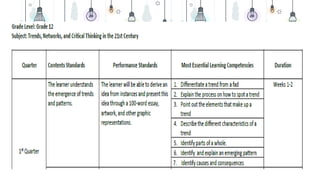
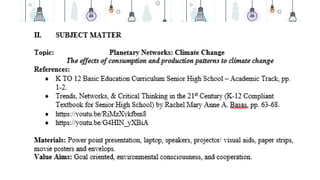
    Objectives: 1.Consider the Content Standards,Performance Standards, and the Most Essential Learning Competencies. 2. You can conceptualize your objectives based on the MELC. You can also directly copy it. Selection of Topic/s Objectives Motivation Designing of Instruction Flow Evaluation and Wrap-up activities
  • 41.
  • 42.
    Remembering: Recall or recognition of specific information Productsinclude: • Quiz • Definition • Fact • Worksheet • Test • Label • List • Workbook • Reproduction •Vocabulary
  • 43.
    Understanding: Understanding of given information Productsinclude: • Recitation • Summary • Collection • Explanation • Show and tell • Example • Quiz • List • Label • Outline
  • 44.
    Applying: Using strategies, concepts, principles and theoriesin new situations Products include: • Photograph • Illustration • Simulation • Sculpture • Demonstration • Presentation • Interview • Performance • Diary • Journal
  • 45.
    Analyzing: Breaking information down into its component elements Productsinclude: • Graph • Spreadsheet • Checklist • Chart • Outline • Survey • Database • Mobile • Abstract • Report
  • 46.
    Evaluating: Products include: • Debate •Panel • Report • Evaluation • Investigation • Verdict • Conclusion •Persuasive speech Judging the value of ideas, materials and methods by developing and applying standards and criteria.
  • 47.
    Creating: Putting together ideas or elementsto develop a original idea or engage in creative thinking. Products include: • Film • Story • Project • Plan • New game • Song • Newspaper • Media product • Advertisement • Painting
  • 48.
    Motivation: 1.Consider the nature, interests,and multiple intelligences of your students. 2.Make this part of your lesson the “mood-setter” for your students. (Short but memorable) Selection of Topic/s Objectives Motivation Designing of Instruction Flow Evaluation and Wrap-up activities
  • 50.
    Designing of Instruction Flow: 1.Followthe Teaching model that you choose. 2.Select activities that is not time consuming, and at the same time, more on student involvement. Selection of Topic/s Objectives Motivation Designing of Instruction Flow Evaluation and Wrap-up activities
  • 60.
    Evaluation and Wrap-up activities: 1.Forevaluation, consider your objectives and make sure that you attain the goals that you set. 2.Must be related to the lesson that you discussed. 3.For subjective tests, use rubrics. 4.For Objective test, use your creativity to convert one question into another order of thinking. Selection of Topic/s Objectives Motivation Designing of Instruction Flow Evaluation and Wrap-up activities
  • 61.
    • Remember (Conceptual Knowledge) • Understand (Factual) •Describe how Diana became a recipient of Bahay Tuluyan’s street education campaign.. • How would you explain Diana’s success in being a street educator?
  • 62.
    • Apply (Metacog-nitive) • Constructa theory as to why Diana continued to be a street educator in spite of the many challenges she would face? • Analyze (Procedural Knowledge) • Compare how Diana and you would react to the challenges she met as she grew up.
  • 63.
    • Evaluate (Conceptual) • Create •Predict what will be Diana’s life 10 years from now. • Compose a song, skit, poem or rap to convey Diana’s story to the children of the 21st century.
  • 65.
    Evaluation and Wrap-up activities: 1.Forevaluation, consider your objectives and make sure that you attain the goals that you set. 2.Must be related to the lesson that you discussed. 3.For subjective tests, use rubrics. Selection of Topic/s Objectives Motivation Designing of Instruction Flow Evaluation and Wrap-up activities
  • 67.
    Workshop: Quick LessonPlanning Grad o Daloy ng Paksa Deskripsyon Tema K Ako at ang Aking kapwa Pagkilala sa sarili at pakikipag-ugnayan sa kapwa bilang pundasyon sa paglinang ng kamalayan sa kapaligirang sosyal 1-2
  • 68.
    Workshop: Quick LessonPlanning Grado Daloy ng Paksa Deskripsyon Tema 1 Ako, ang Aking Pamilya at Paaralan Ang sarili bilang kabahagi ng pamilya at paaralan tungo sa pagkakakilanlan bilang indibidwal at kasapi ng komunidad, gamit ang konsepto ng pagpapatuloy at pagbabago, interaksyon distansya at direksyon at ang pagpapahalaga sa kapaligirang pisikal at paaralan 1-3
  • 69.
    Workshop: Quick LessonPlanning Grado Daloy ng Paksa Deskripsyon Tema 2 Ang Aking Komunda d, Ngayon at Noon Pag-unawa sa kasalukuyan at nakaraan ng kinabibilangang komunidad, gamit ang konsepto ng pagpapatuloy at pagbabago, interaksyon, pagkakasunod-sunod ng pangyayari, mga simpleng konseptong heograpikal tulad ng lokasyon at pinagkukunang yaman, at konsepto ng mga saksi ng kasaysayan tulad ng tradisyon oral at mga labi ng kasaysayan 2
  • 70.
    Workshop: Quick LessonPlanning Grado Daloy ng Paksa Deskripsyon Tema 3 Ang Mga Lalawiga n sa Aking Rehiyon Pag-unawa sa pinagmulan at pag-unlad ng sariling lalawigan at rehiyon kasama ang aspektong pangkultura, pampulitika, panlipunan at pangkabuhayan gamit ang malalim na konsepto ng pagapapatuloy at pagbabago, interaksyon ng tao at kapaligirang pisikal at sosyal 3
  • 71.
    Workshop: Quick LessonPlanning Grado Daloy ng Paksa Deskripsyon Tema 4 Ang Bansang Pilipinas Pagpapahalaga sa pambansang pagkakakilanlan at ang mga kontribosyon ng bawat rehiyon sa paghubog ng kulturang Pilipino at pambansang pag-unlad gamit ng mga kasanayan sa heograpiya, pag-unawa sa kultura at kabuhayan, pakikilahok sa pamamahala at pagpapahalaga sa mga mithiin ng bansang Pilipinas. 1-6
  • 72.
    Workshop: Quick LessonPlanning Grado Daloy ng Paksa Deskripsyon Tema 5 Pagbuo ng Pilipinas bilang Nasyon Pagkakabuo ng kapuluan ng Pilipinas at mga sinaunang lipunan hanggang sa simula ng ika- 20 siglo gamit ang batayang konseptong katulad ng kahalagahang pangkasaysayan (historical significance), pagbabago, pag-unlad at pagpapatuloy. 1-6
  • 73.
    Workshop: Quick LessonPlanning Grado Daloy ng Paksa Deskripsyon Tema 6 Mga Hamo n at Tugon sa Pagka bansa Ang Pilipinas sa harap ng mga hamon at tugon ng ika-20 siglo hanggang sa kasalukuyan tungo sa pagbuo ng tiyak na pagkakakilanlang Pilipino at matatag na pagkabansa (strong nationhood) 1-6
  • 74.
    References: • Clements, D.;C. Gilliland and P. Holko. (1992). Thinking in Themes: An Approach Through the Learning Centre. Melbourne: Oxford University Press. • Crawford, Jean (ed.) (1991). Achieveing Excellence: Units of Work for levels P-8. Carlton South, Vic.: Education Shop, Ministry of Education and Training, Victoria. • Crosby, N. and E. Martin. (1981). Don’t Teach! Let Me Learn. Book 3. Cheltenham, Vic.: Hawker Brownlow. • Dalton, Joan. (1986). Extending Children’s Special Abilities: Strategies for Primary Classrooms. Victoria: Department of School Education, Victoria. • McGrath, Helen & Toni Noble (2001). Seven Ways at Once. • O’Tuel, Frances S. And Ruth K (1993). Bullard. Developing Higher Order Thinking in the Content Areas K – 12.
  • 75.

Editor's Notes

  • #76 There is an intimate connection between our inner state and what we do in our outer spheres –Ann Mische