Why do weneed Lesson Plan?
It helps teachers identify the intended objectives, well as the
appropriate instructional materials needed to achieve the
objectives. Further, it will help teachers decide on the
assessment tool to be used in identifying the progress of
children. The success of the learning process depends on how
systematically it was prepared and how the teacher was in
his/her strategy.
3.
1. Setting ofObjective
The stated objectives should be anchored on the
three domains that need to be developed:
cognitive, affective and psychomotor. The teacher
can use available taxonomy in creating specific,
measurable, attainable, result-oriented, and time-
bounded objectives.
4.
2. Stating theSubject Matter
This part involves the content and concept that the
teacher has to present to the class. Other elements of
this part include references, materials, and skill. Stating
the reference used is important to validate the concept
that is involved in the lessons. Furthermore, a teacher
must use materials that are appropriate and can
motivate the pupils.
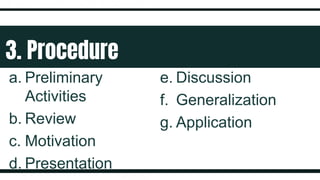
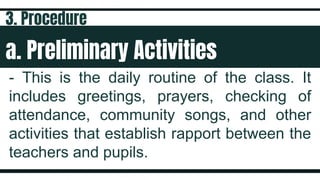
a. Preliminary Activities
-This is the daily routine of the class. It
includes greetings, prayers, checking of
attendance, community songs, and other
activities that establish rapport between the
teachers and pupils.
3. Procedure
7.
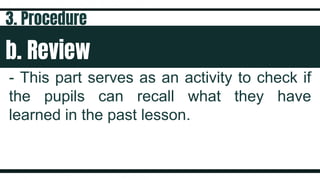
b. Review
- Thispart serves as an activity to check if
the pupils can recall what they have
learned in the past lesson.
3. Procedure
8.
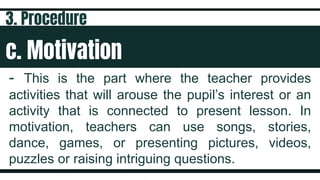
c. Motivation
- Thisis the part where the teacher provides
activities that will arouse the pupil’s interest or an
activity that is connected to present lesson. In
motivation, teachers can use songs, stories,
dance, games, or presenting pictures, videos,
puzzles or raising intriguing questions.
3. Procedure
9.
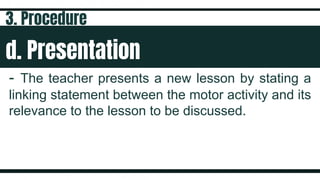
d. Presentation
- Theteacher presents a new lesson by stating a
linking statement between the motor activity and its
relevance to the lesson to be discussed.
3. Procedure
10.
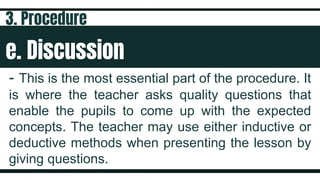
e. Discussion
- Thisis the most essential part of the procedure. It
is where the teacher asks quality questions that
enable the pupils to come up with the expected
concepts. The teacher may use either inductive or
deductive methods when presenting the lesson by
giving questions.
3. Procedure
11.
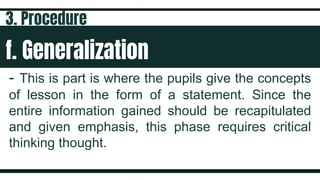
f. Generalization
- Thisis part is where the pupils give the concepts
of lesson in the form of a statement. Since the
entire information gained should be recapitulated
and given emphasis, this phase requires critical
thinking thought.
3. Procedure
12.
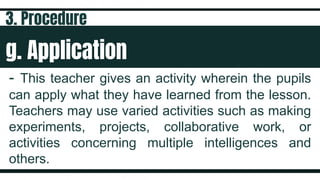
g. Application
- Thisteacher gives an activity wherein the pupils
can apply what they have learned from the lesson.
Teachers may use varied activities such as making
experiments, projects, collaborative work, or
activities concerning multiple intelligences and
others.
3. Procedure
13.
4. Evaluation
The teachergives an assessment based on
the concept learned. This is the way of
evaluating the progress of children and how
much they understood the lesson. Essential
information is given to teachers through the
use of evaluation.
14.
4. Evaluation
Through usingappropriate classroom
assessment strategies and techniques,
teachers can increase their pupils’ motivation
and show them how well they have learned the
lesson.
15.
5. Assignment
The assignmentis an activity that pupils need
to do after class at their home. It aims to help
reinforce what they have learned inside the
classroom or to gather other information
beyond what was taught in the class.