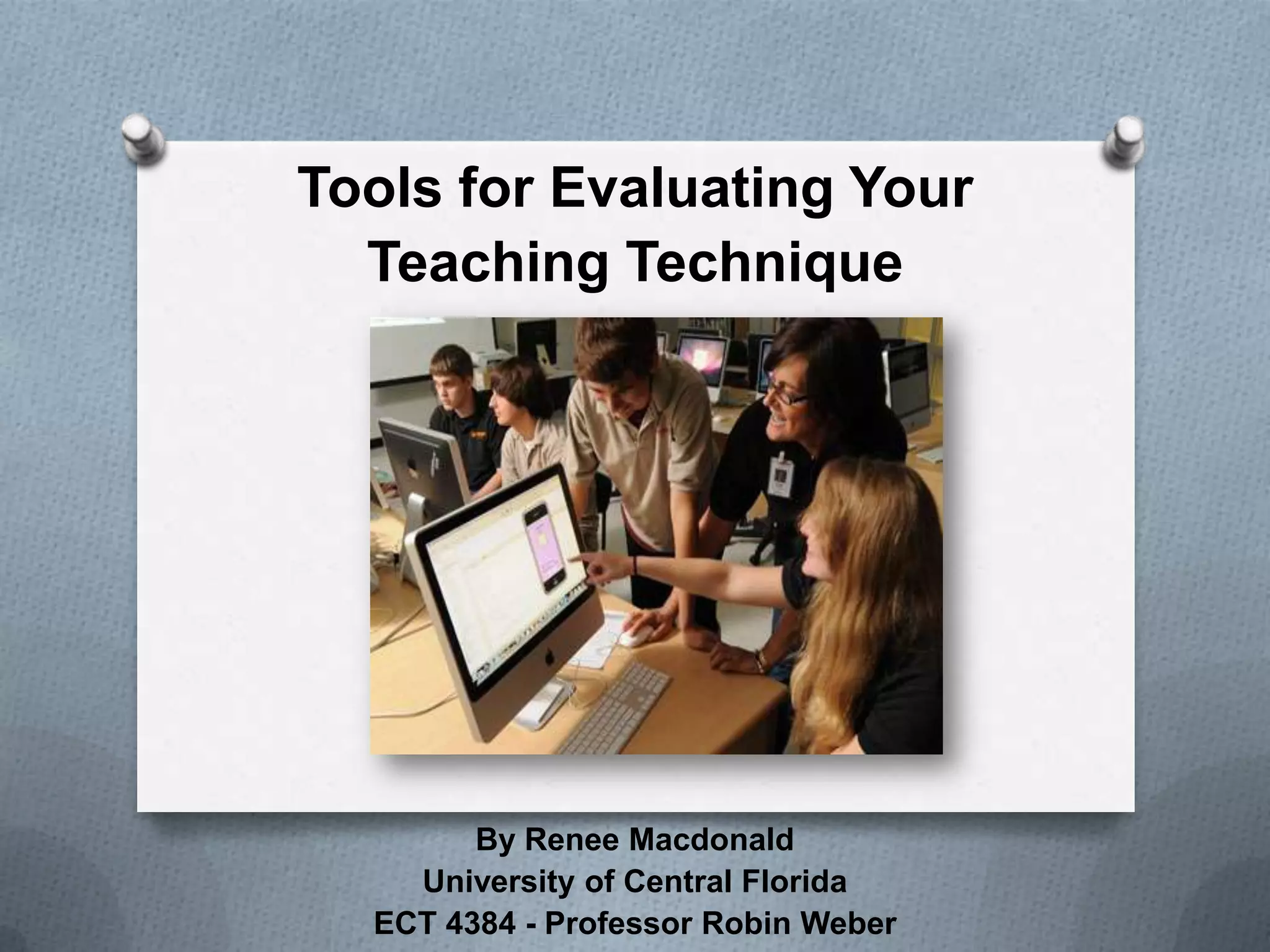
Tools for Evaluating Your
  Teaching Technique


        By Renee Macdonald
    University of Central Florida
  ECT 4384 - Professor Robin Weber
Objectives
At the end of this presentation, teachers should be
able to:
O Describe summative and formative assessment.
O Explain the key parts of a rubric.
O Identify tools for evaluating the effectiveness of a
  teaching technique.
O Summarize the steps of Gagne’s “Nine Events of
  Learning”.

University of Florida, Center for Instructional Knowledge and Training.
(10/3/2011). Gagne's 9 Events of Instruction. Retrieved Oct 12, 2012 from:
http://www.citt.ufl.edu/toolbox/toolbox_gagne9Events.php
Did your teaching technique work?
What worked and what needs improvement?
How do you evaluate learning outcomes?

Tools for evaluating your teaching
technique:
1. Instructional Design Checklist:
Gagne’s 9 Steps of Learning
2. Summative (Traditional) Assessment.
Examples are multiple choice, fill-in-the blank,
true/false, short answer and essay questions.
3. Formative (Alternative or Authentic) Assessment. Examples are
project-based, portfolio, checklists, rating scales, rubrics, and
teacher observation.
4. Marzano’s “Evidence” of Learning.
5. Kilpatrick’s Revised Evaluation Model
Gagne’s 9 Steps of Learning
Effective teaching begins with effective lesson design, which
benefits from the research about how people learn. Utilizing
Gagne’s 9 Events of Instruction provides a guide to developing a
successful lesson and a logical way to evaluate teaching
strategies.


.
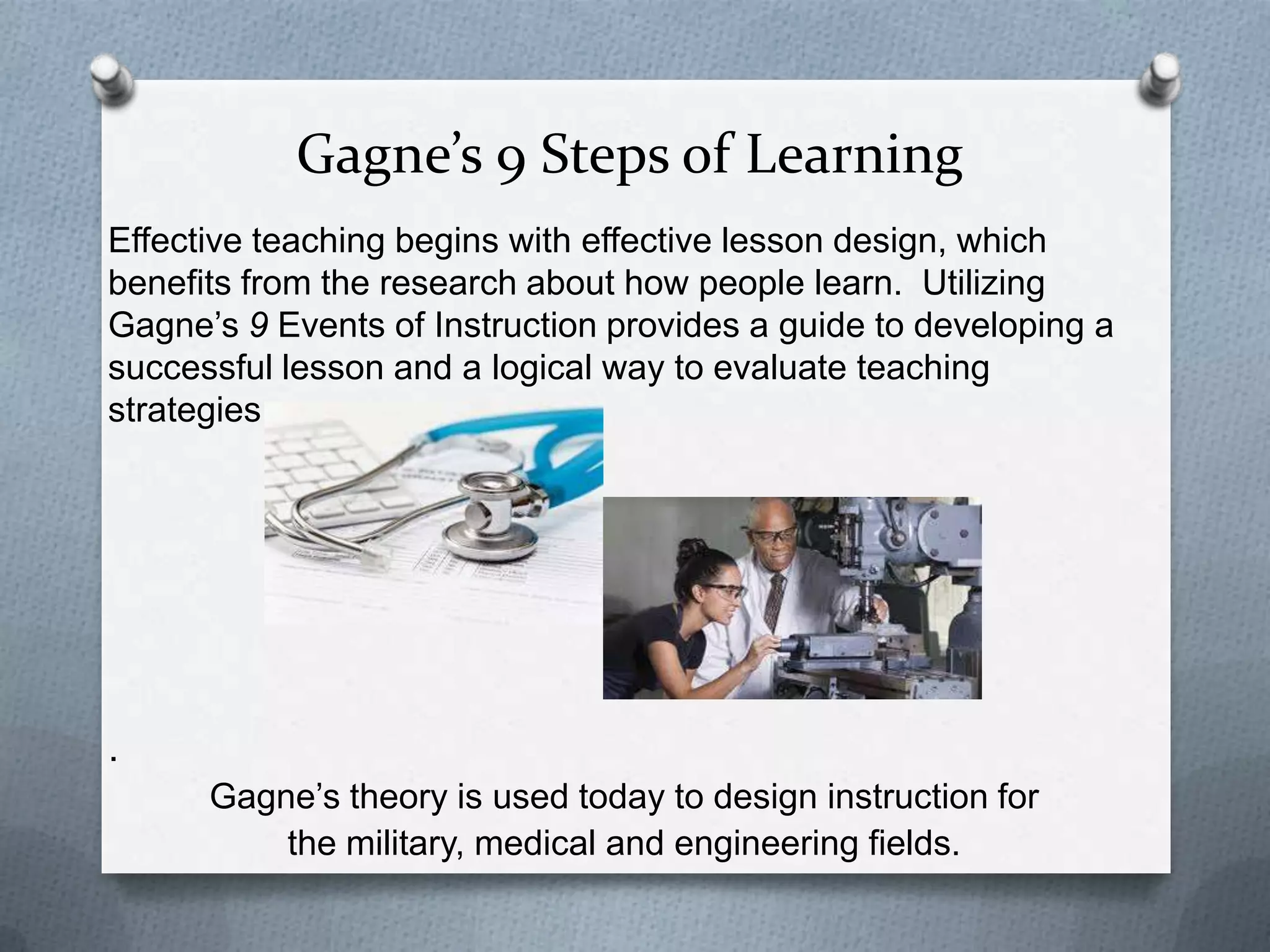
      Gagne’s theory is used today to design instruction for
          the military, medical and engineering fields.
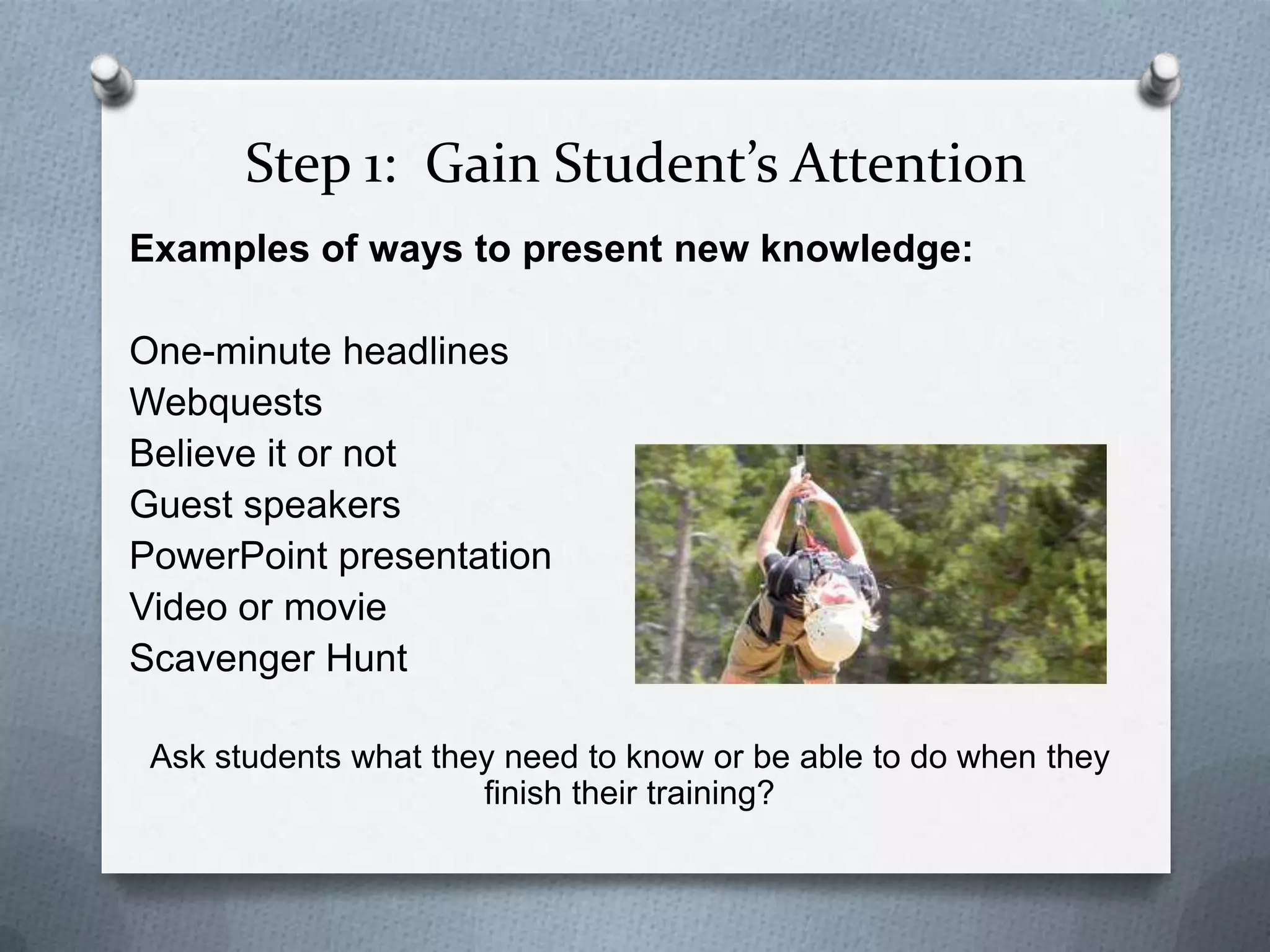
Step 1: Gain Student’s Attention
Examples of ways to present new knowledge:

One-minute headlines
Webquests
Believe it or not
Guest speakers
PowerPoint presentation
Video or movie
Scavenger Hunt

 Ask students what they need to know or be able to do when they
                      finish their training?
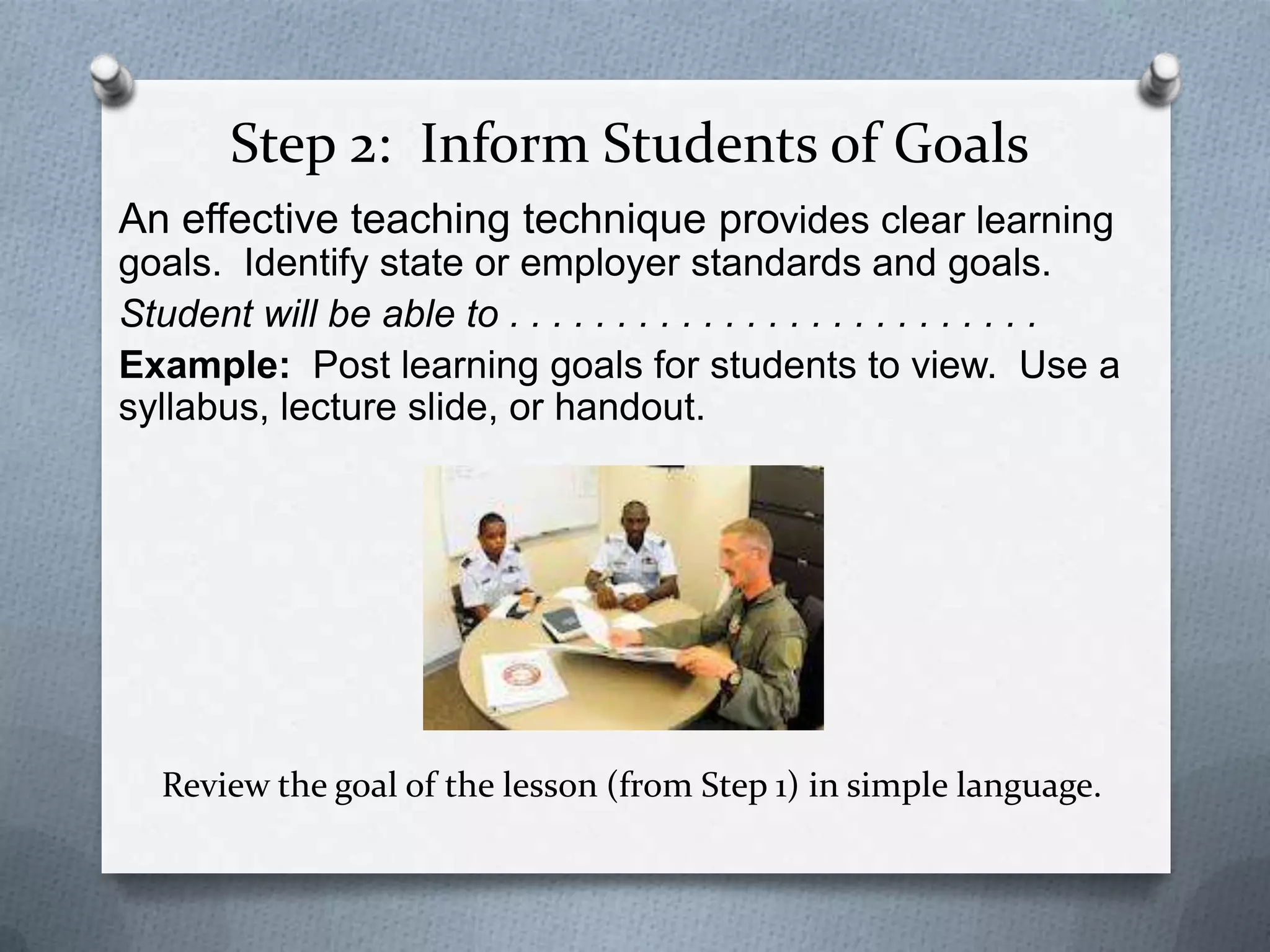
Step 2: Inform Students of Goals
An effective teaching technique provides clear learning
goals. Identify state or employer standards and goals.
Student will be able to . . . . . . . . . . . . . . . . . . . . . . . . .
Example: Post learning goals for students to view. Use a
syllabus, lecture slide, or handout.


   Review the goal of the lesson (from Step 1) in simple language.
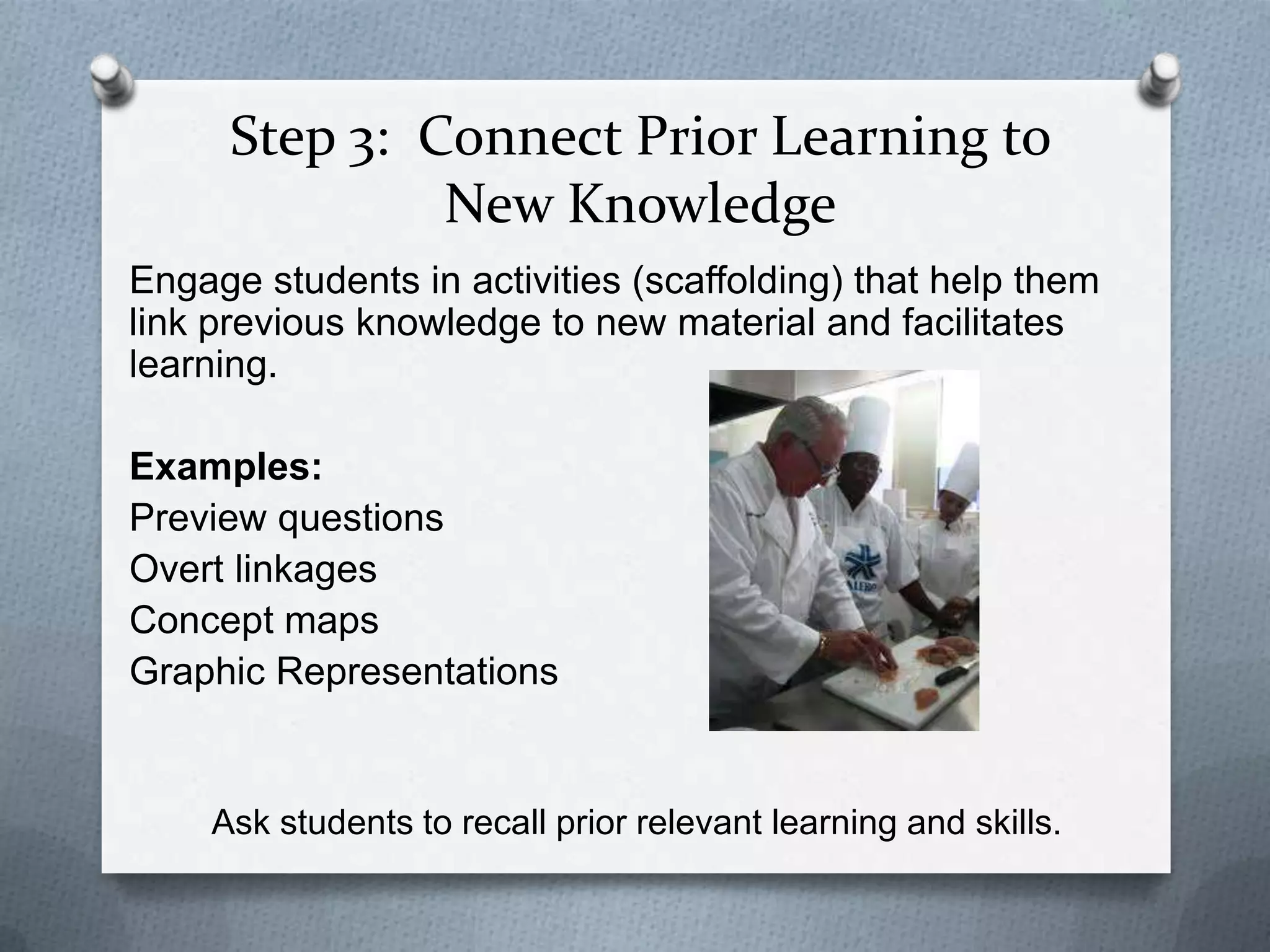
Step 3: Connect Prior Learning to
               New Knowledge
Engage students in activities (scaffolding) that help them
link previous knowledge to new material and facilitates
learning.

Examples:
Preview questions
Overt linkages
Concept maps
Graphic Representations


    Ask students to recall prior relevant learning and skills.
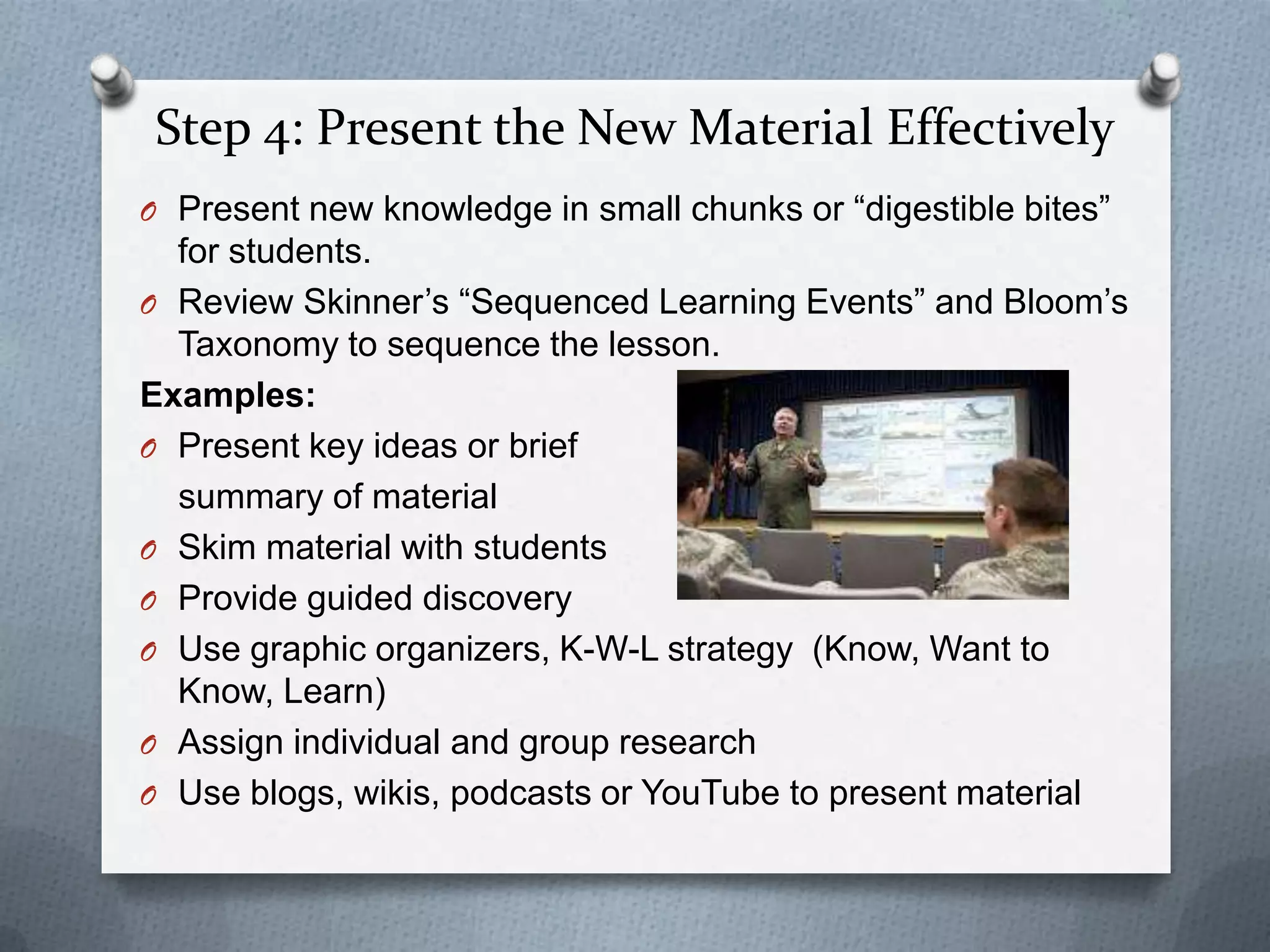
Step 4: Present the New Material Effectively
O Present new knowledge in small chunks or “digestible bites”
  for students.
O Review Skinner’s “Sequenced Learning Events” and Bloom’s
  Taxonomy to sequence the lesson.
Examples:
O Present key ideas or brief
  summary of material
O Skim material with students
O Provide guided discovery
O Use graphic organizers, K-W-L strategy (Know, Want to
  Know, Learn)
O Assign individual and group research
O Use blogs, wikis, podcasts or YouTube to present material
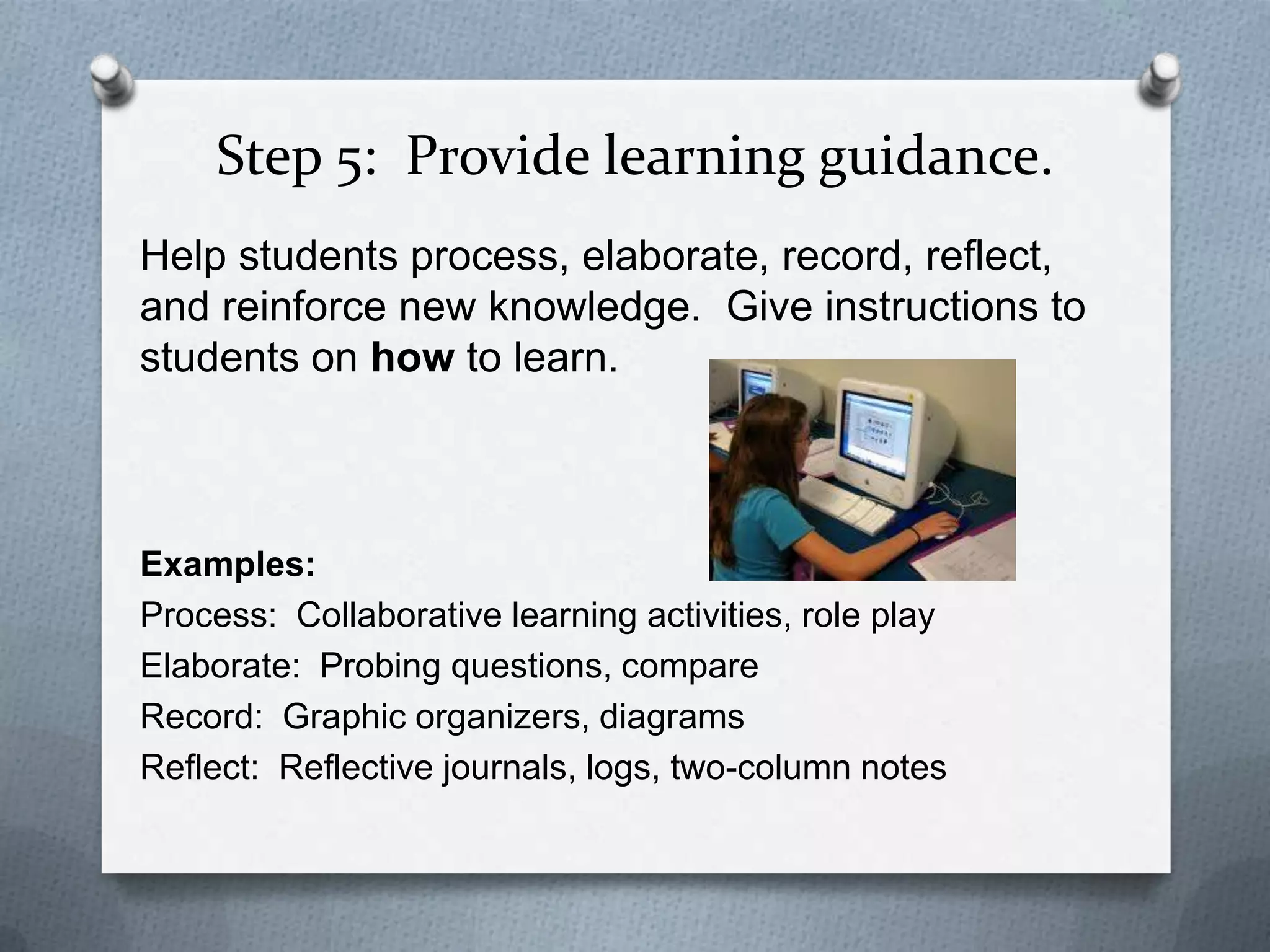
Step 5: Provide learning guidance.
Help students process, elaborate, record, reflect,
and reinforce new knowledge. Give instructions to
students on how to learn.


Examples:
Process: Collaborative learning activities, role play
Elaborate: Probing questions, compare
Record: Graphic organizers, diagrams
Reflect: Reflective journals, logs, two-column notes
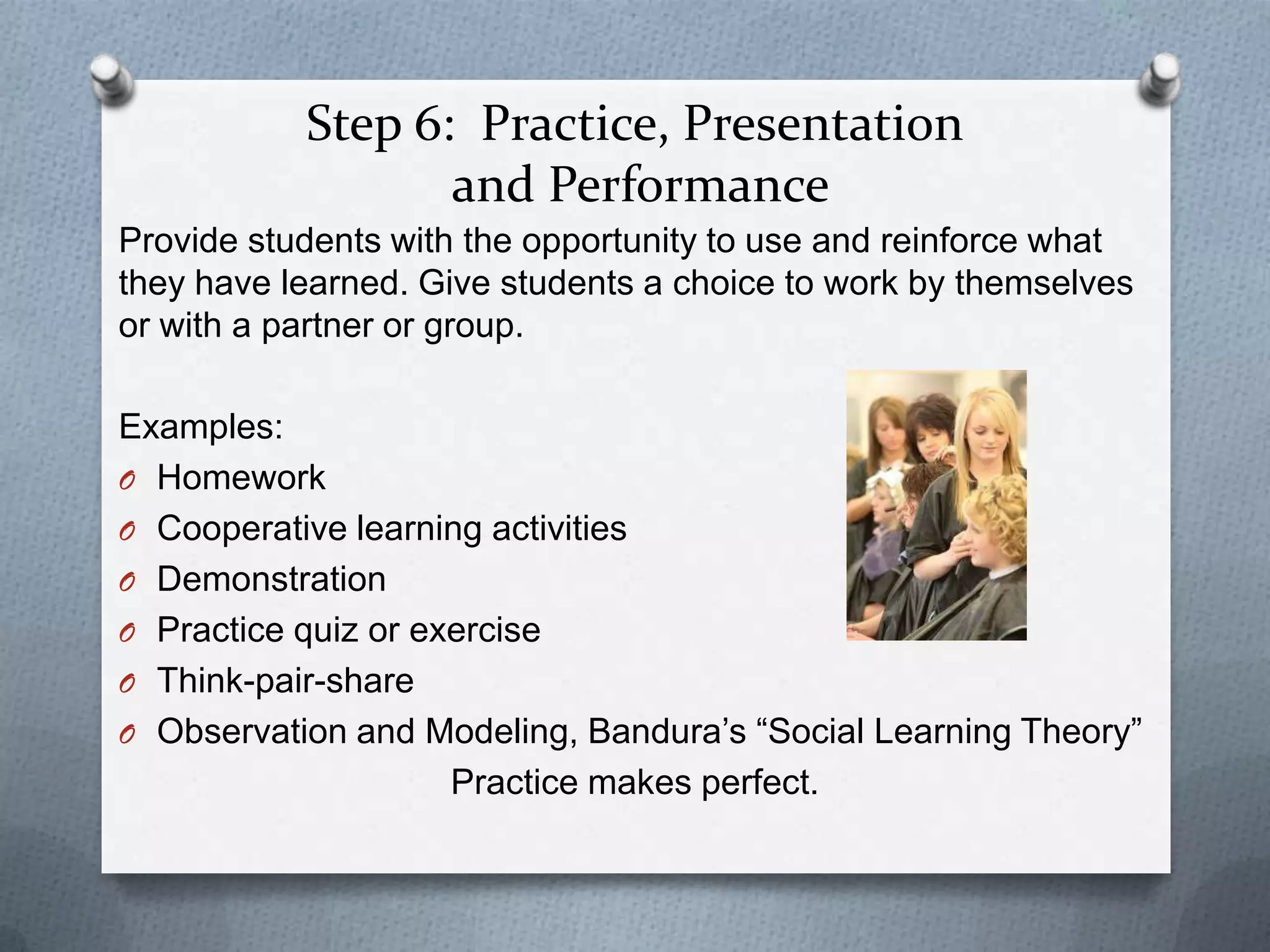
Step 6: Practice, Presentation
                  and Performance
Provide students with the opportunity to use and reinforce what
they have learned. Give students a choice to work by themselves
or with a partner or group.

Examples:
O Homework
O Cooperative learning activities
O Demonstration
O Practice quiz or exercise
O Think-pair-share
O Observation and Modeling, Bandura’s “Social Learning Theory”
                     Practice makes perfect.
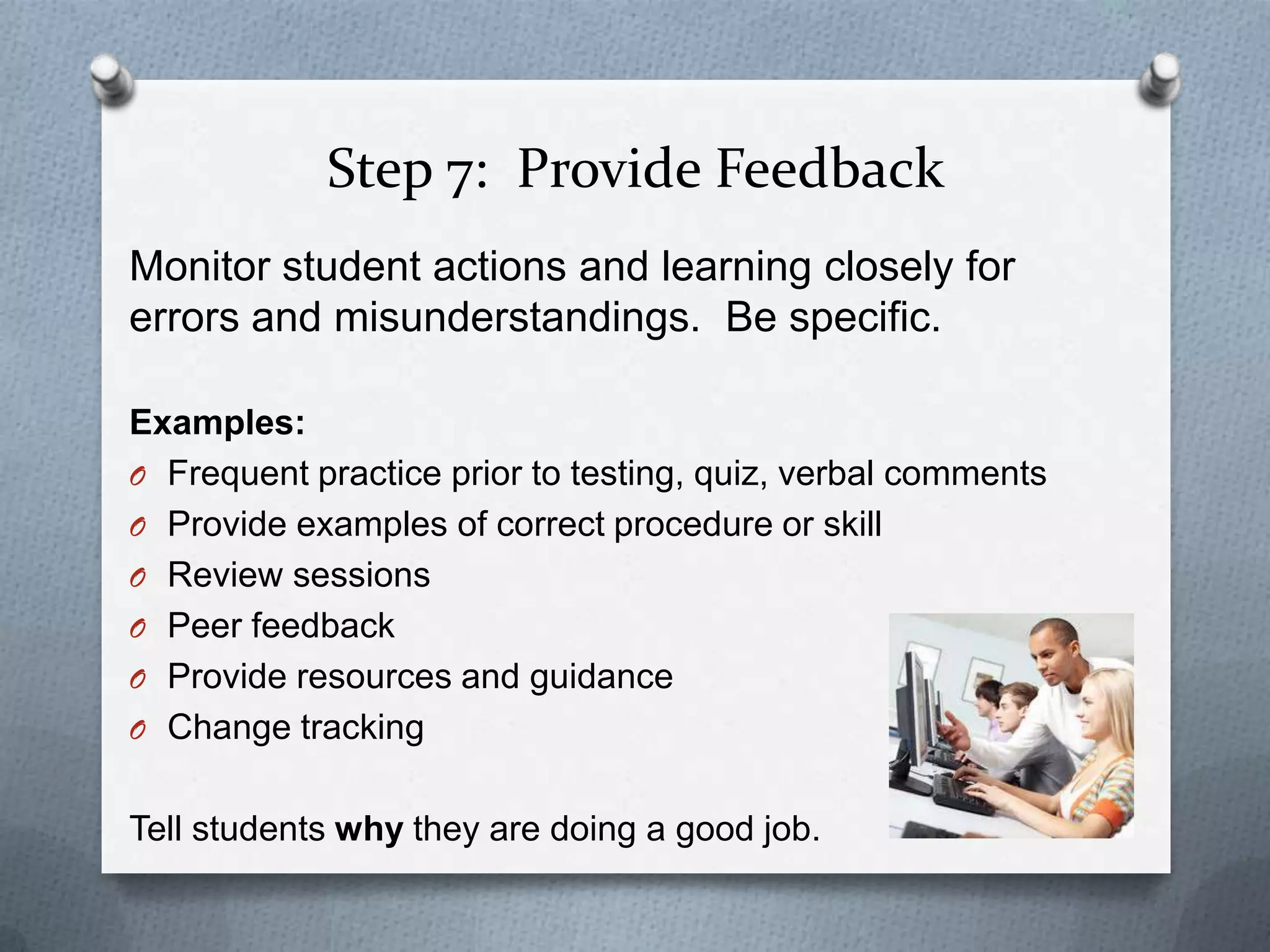
Step 7: Provide Feedback
Monitor student actions and learning closely for
errors and misunderstandings. Be specific.

Examples:
O Frequent practice prior to testing, quiz, verbal comments
O Provide examples of correct procedure or skill
O Review sessions
O Peer feedback
O Provide resources and guidance
O Change tracking


Tell students why they are doing a good job.
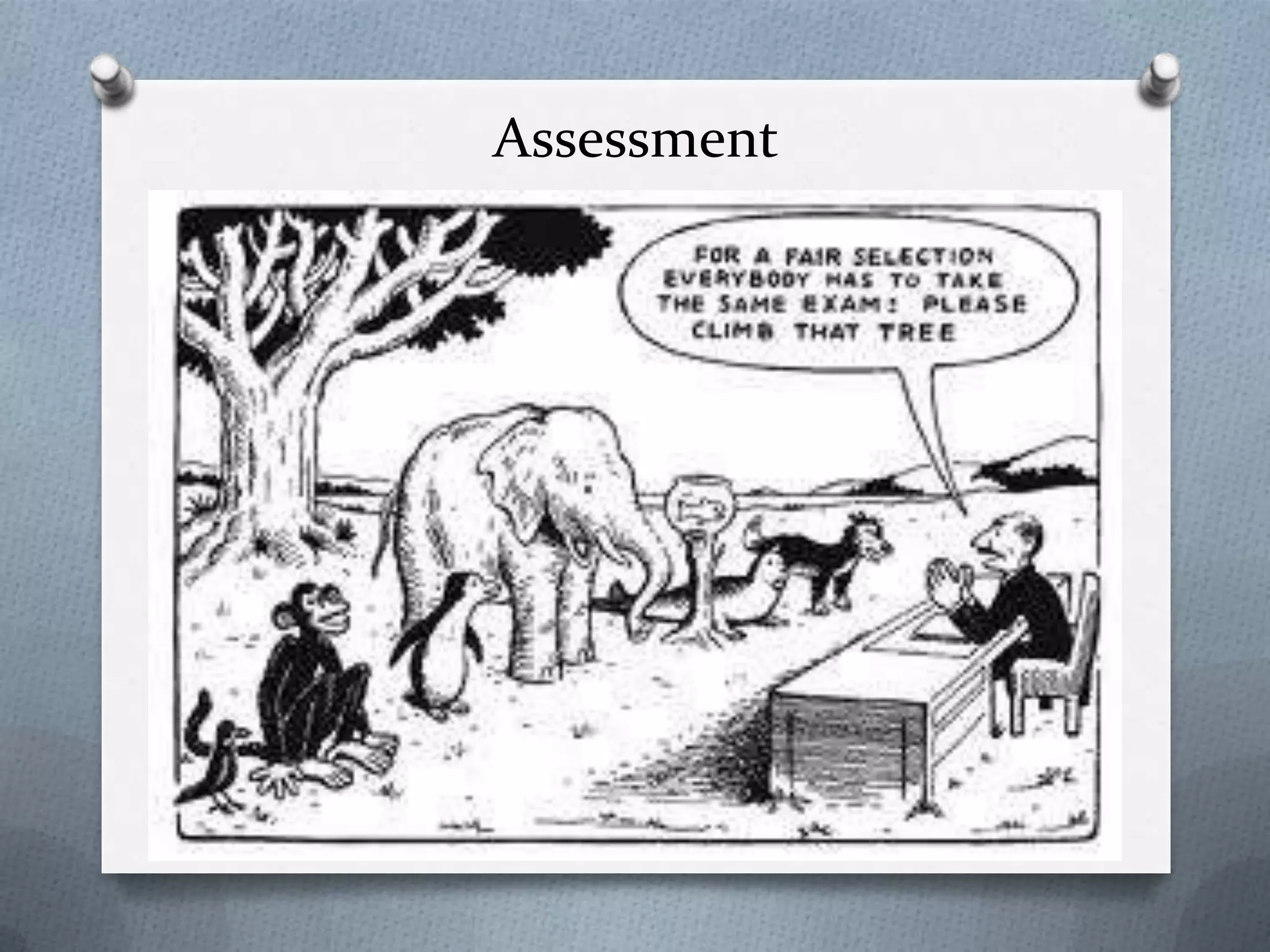
Assessment
Step 8. Assessment
The effectiveness of a teaching technique is
evaluated in terms of improving student achievement
and identifies causes of success or difficulty.
Assessments help teachers adjust their teaching
practice for individual students and for the class as a
whole.

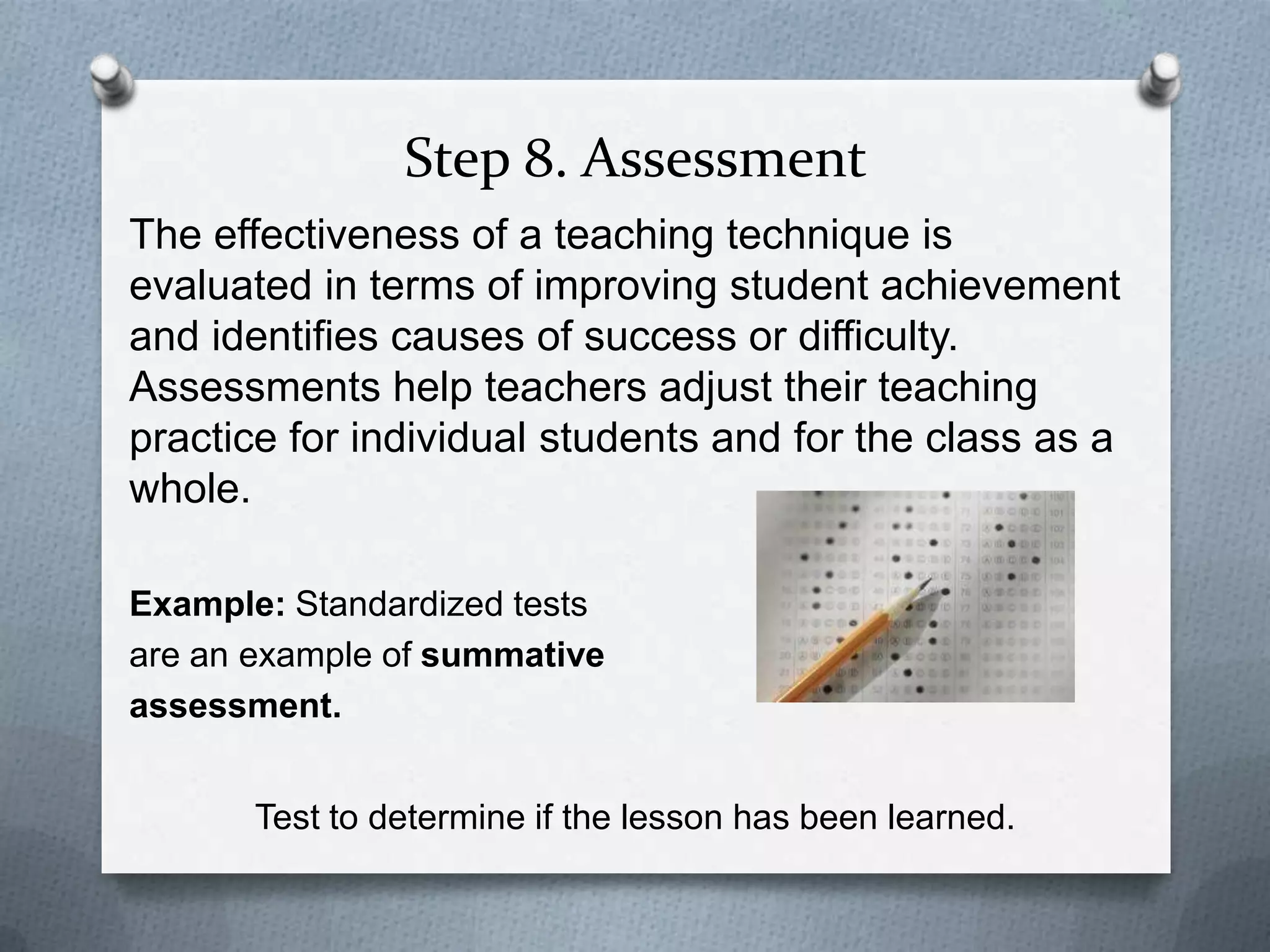
Example: Standardized tests
are an example of summative
assessment.


       Test to determine if the lesson has been learned.
Formative assessment is self-monitoring,
     encourages students to improve and
        promotes life-long learning.


                                http://www.khanacademy.org/


Formative assessment is interactive during the learning process
in order to modify teaching and provide frequent feedback to
students.
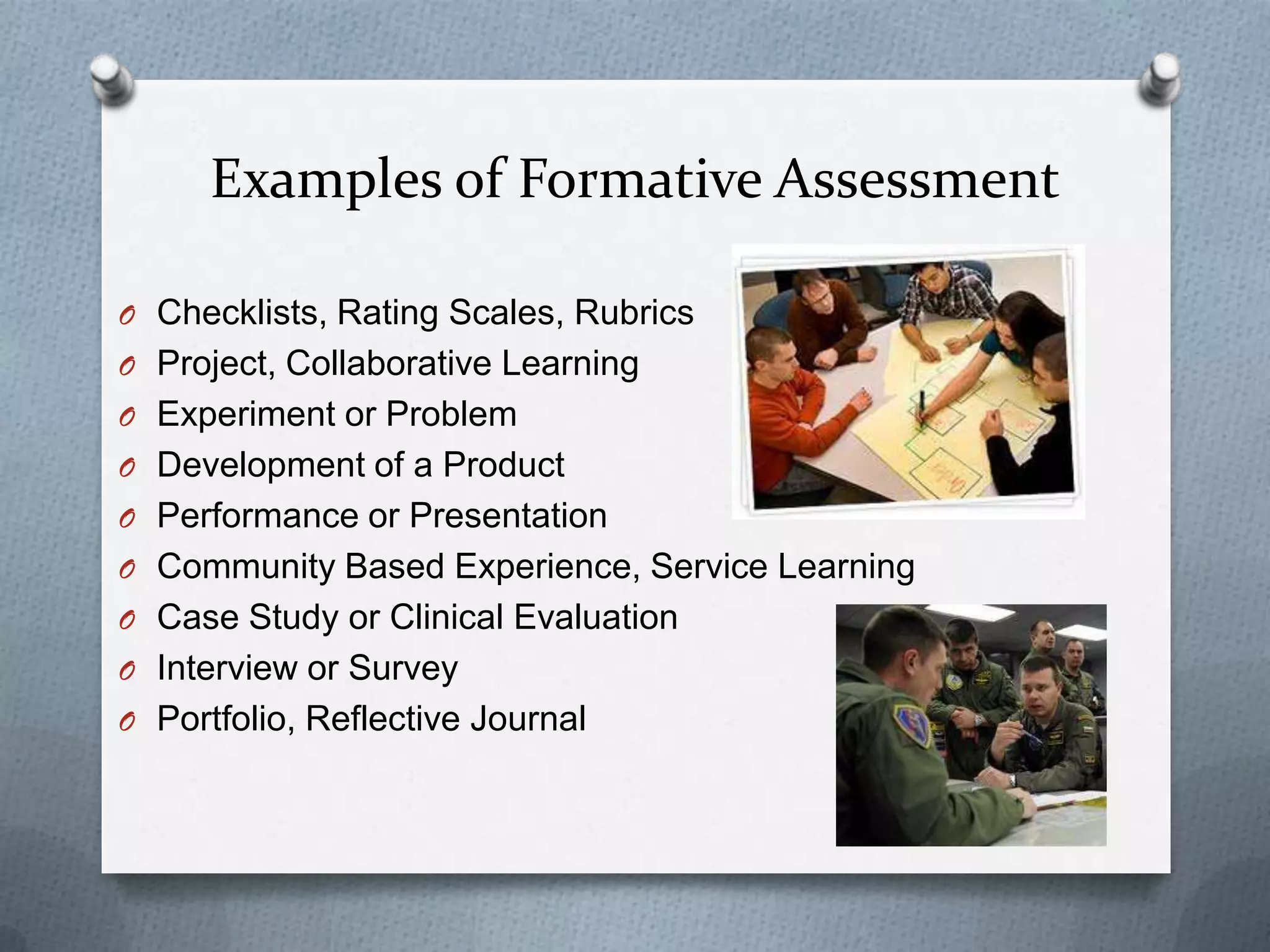
Examples of Formative Assessment

O Checklists, Rating Scales, Rubrics
O Project, Collaborative Learning
O Experiment or Problem
O Development of a Product
O Performance or Presentation
O Community Based Experience, Service Learning
O Case Study or Clinical Evaluation
O Interview or Survey
O Portfolio, Reflective Journal
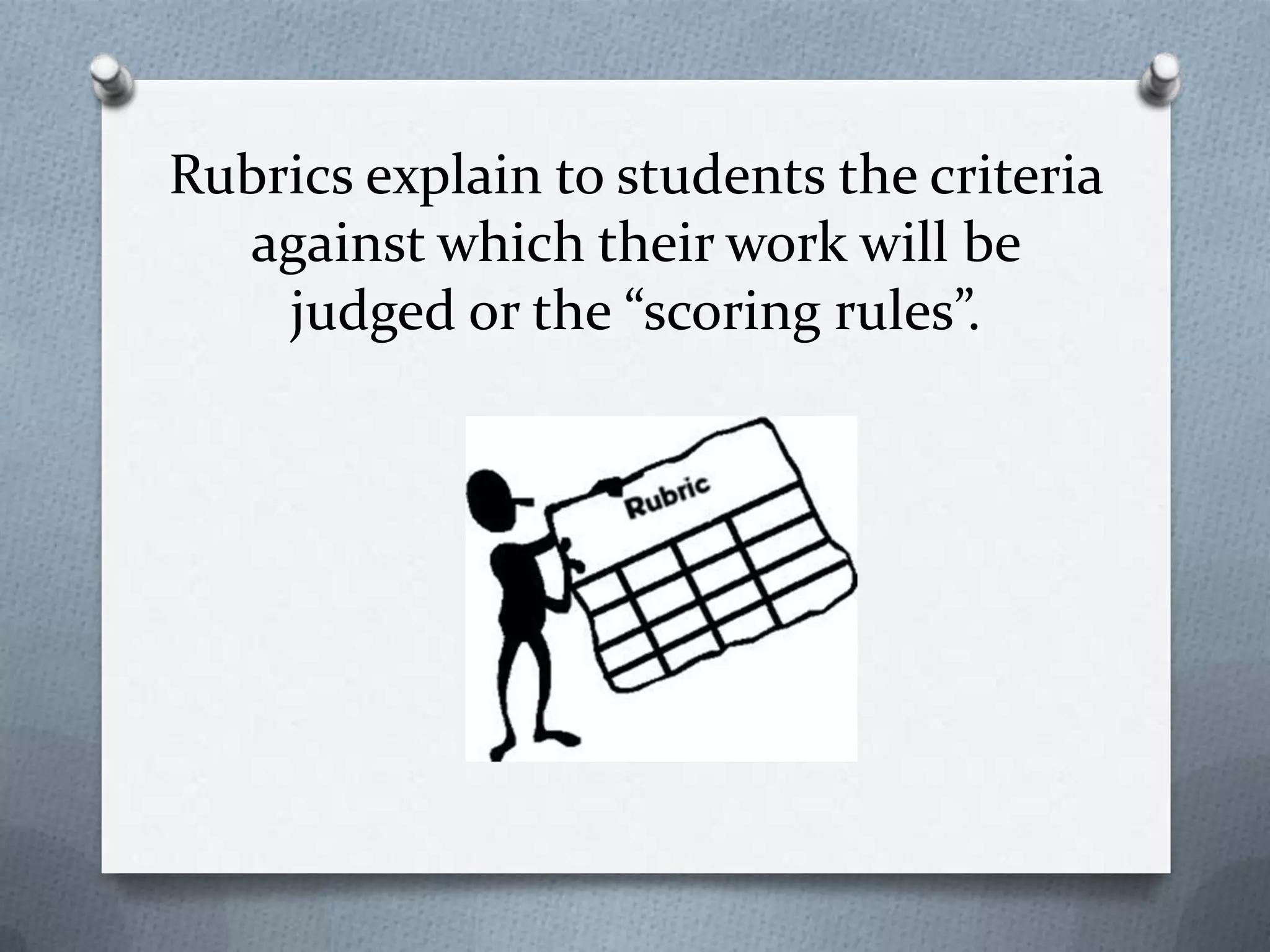
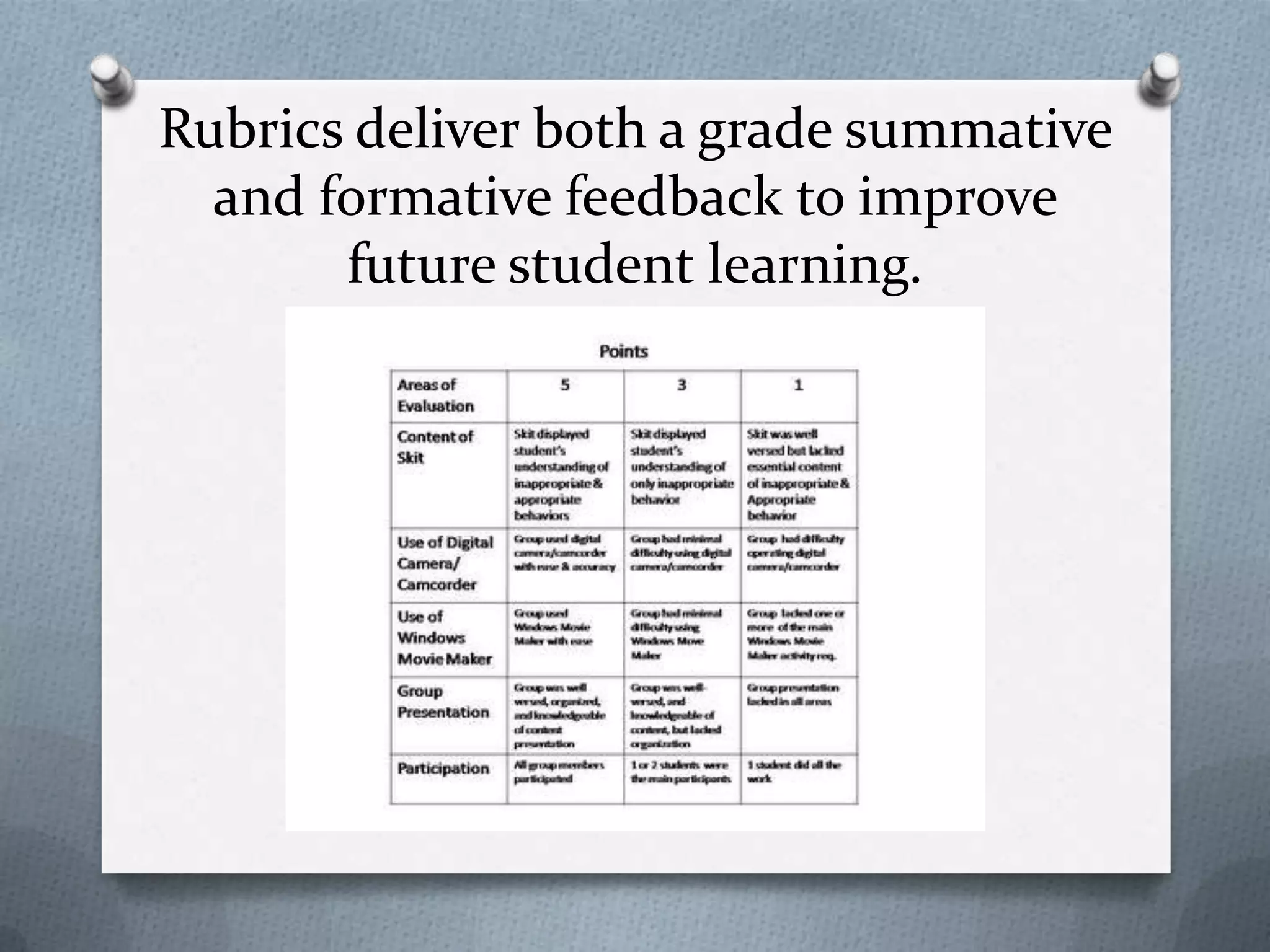
Rubrics explain to students the criteria
  against which their work will be
    judged or the “scoring rules”.
Rubrics deliver both a grade summative
  and formative feedback to improve
       future student learning.
Parts of a Rubric
O Criteria –Define the goals (content objectives) to be met and
  describe the criteria for judging the task or project (process
  objectives), what you want graded. (Left column of rubric)

O Scale-Levels of competency-Set the scale for student’s
  competency from successful to unsuccessful or excellent to
  poor, for each required criteria. (Top row of rubric)

O Assignment of value-Describe the characteristics of behavior,
  assignment or project to be completed and assign a numeric or
  grade for each level. (The rows)
Step 9: Retention and Transfer
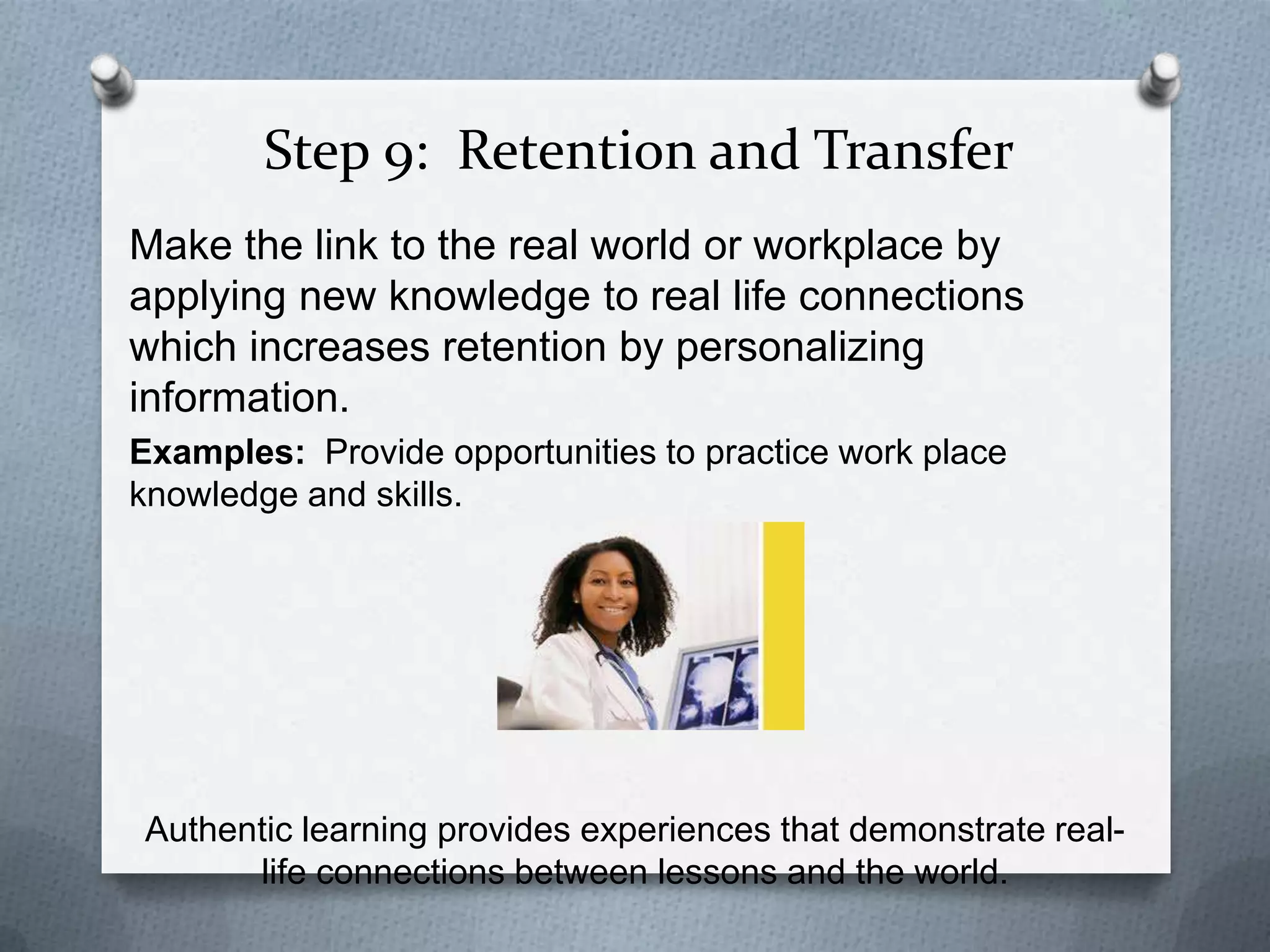
Make the link to the real world or workplace by
applying new knowledge to real life connections
which increases retention by personalizing
information.
Examples: Provide opportunities to practice work place
knowledge and skills.


Authentic learning provides experiences that demonstrate real-
      life connections between lessons and the world.
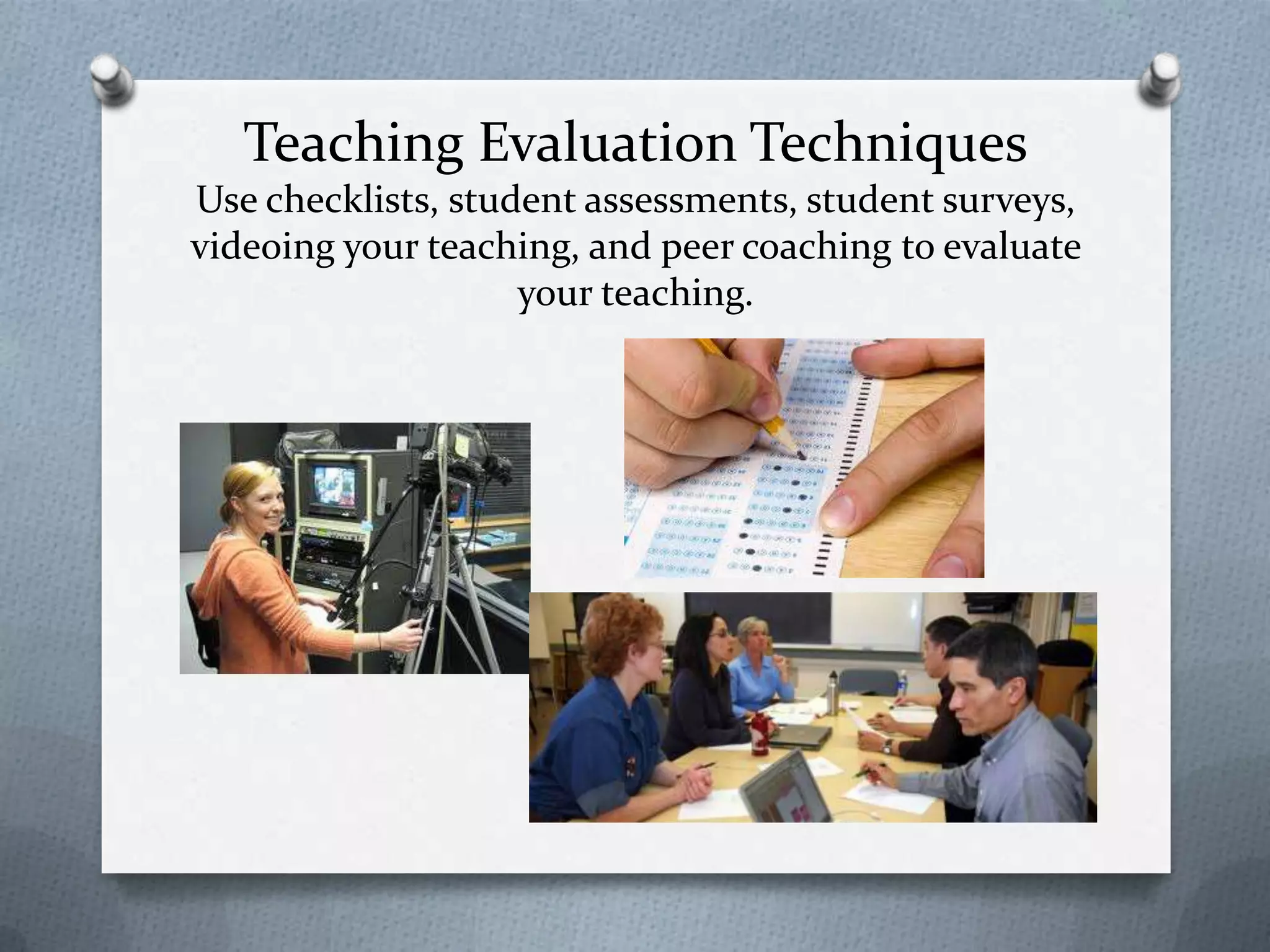
Teaching Evaluation Techniques
Use checklists, student assessments, student surveys,
videoing your teaching, and peer coaching to evaluate
                    your teaching.
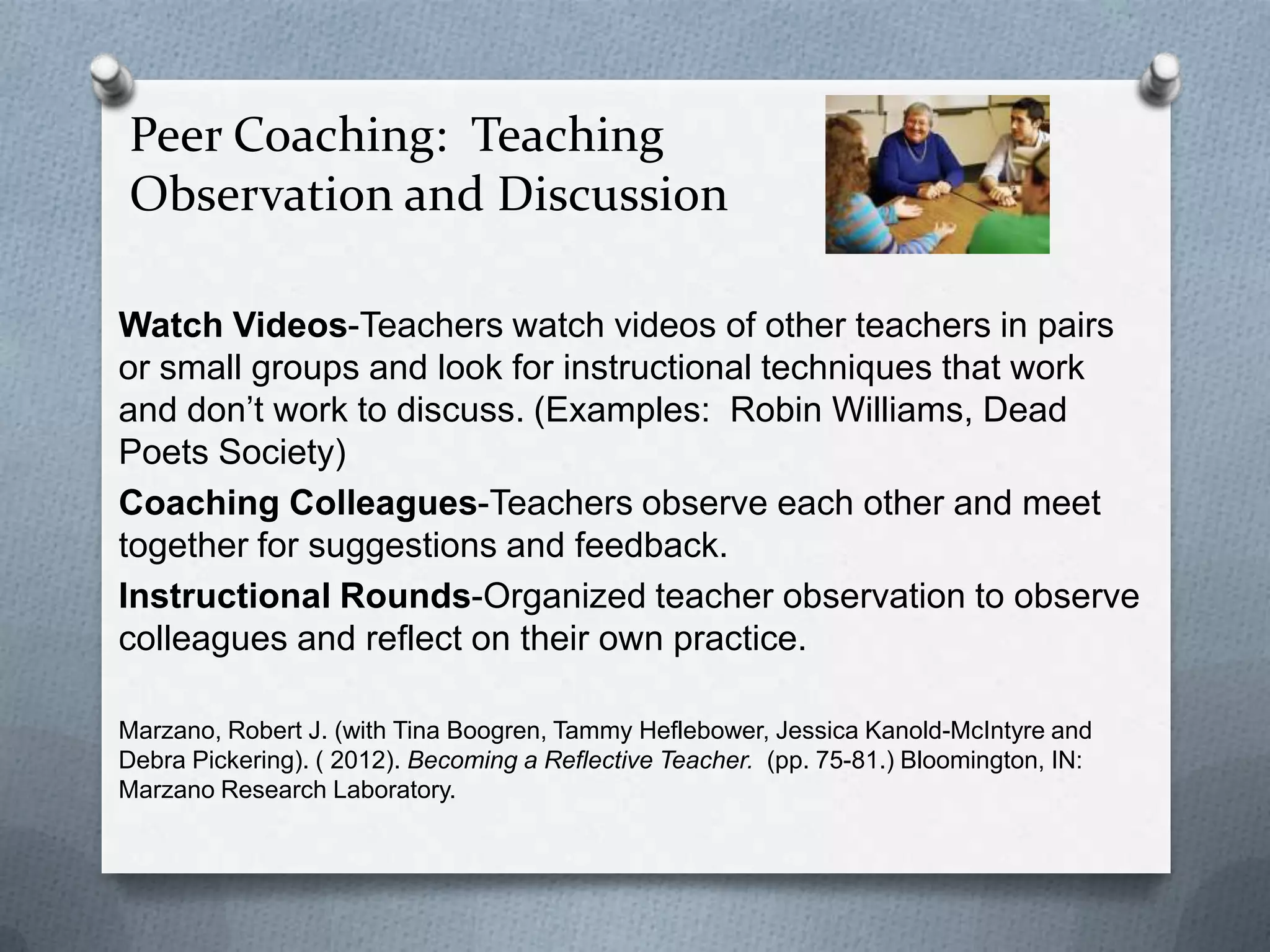
Peer Coaching: Teaching
Observation and Discussion

Watch Videos-Teachers watch videos of other teachers in pairs
or small groups and look for instructional techniques that work
and don’t work to discuss. (Examples: Robin Williams, Dead
Poets Society)
Coaching Colleagues-Teachers observe each other and meet
together for suggestions and feedback.
Instructional Rounds-Organized teacher observation to observe
colleagues and reflect on their own practice.

Marzano, Robert J. (with Tina Boogren, Tammy Heflebower, Jessica Kanold-McIntyre and
Debra Pickering). ( 2012). Becoming a Reflective Teacher. (pp. 75-81.) Bloomington, IN:
Marzano Research Laboratory.
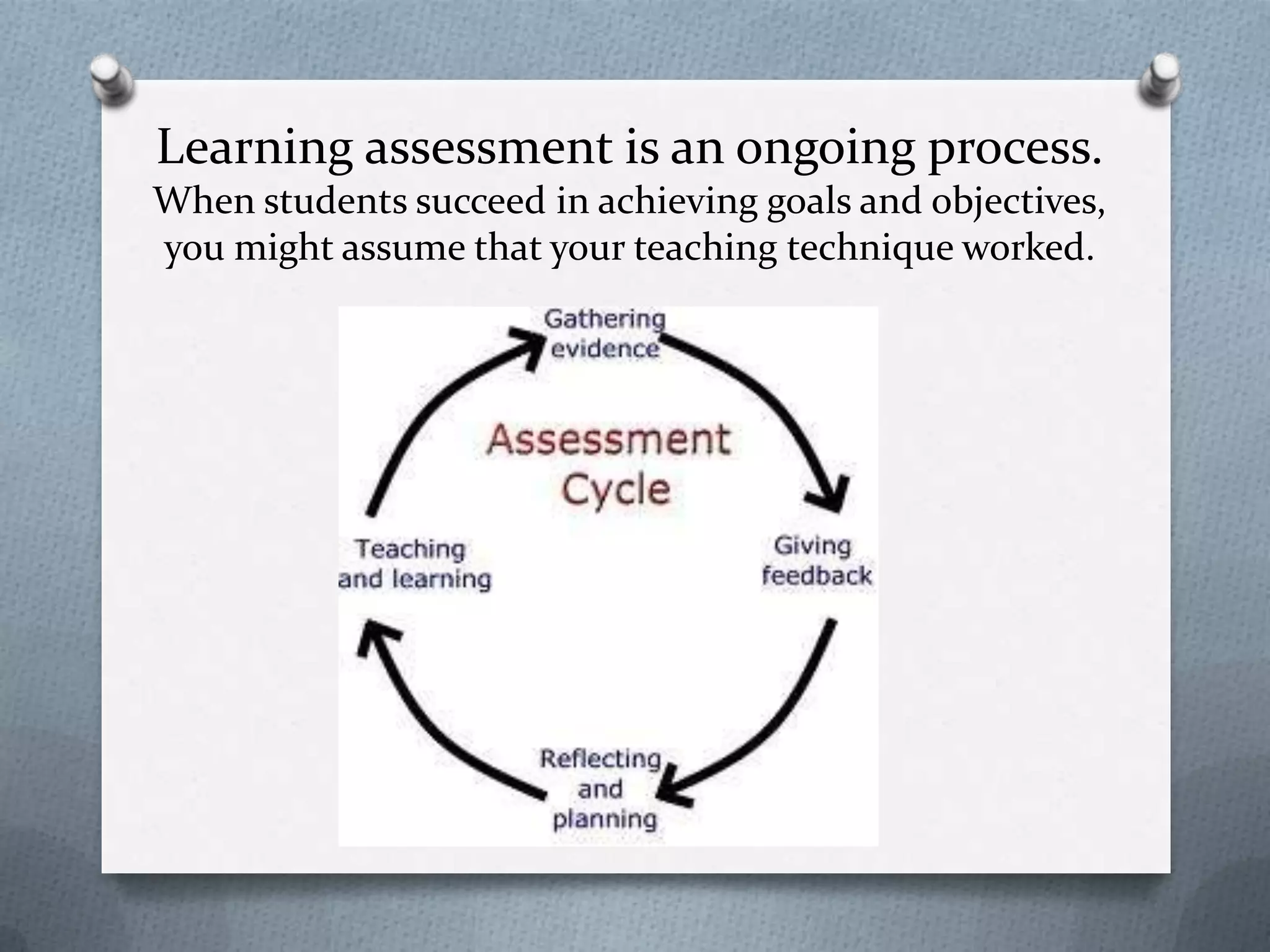
Learning assessment is an ongoing process.
When students succeed in achieving goals and objectives,
you might assume that your teaching technique worked.
Make Changes
When students do not achieve goals and objectives,
changes should be made in teaching and learning
process.
Reevaluation after changes are made will ensure
that the changes were helpful to student learning.
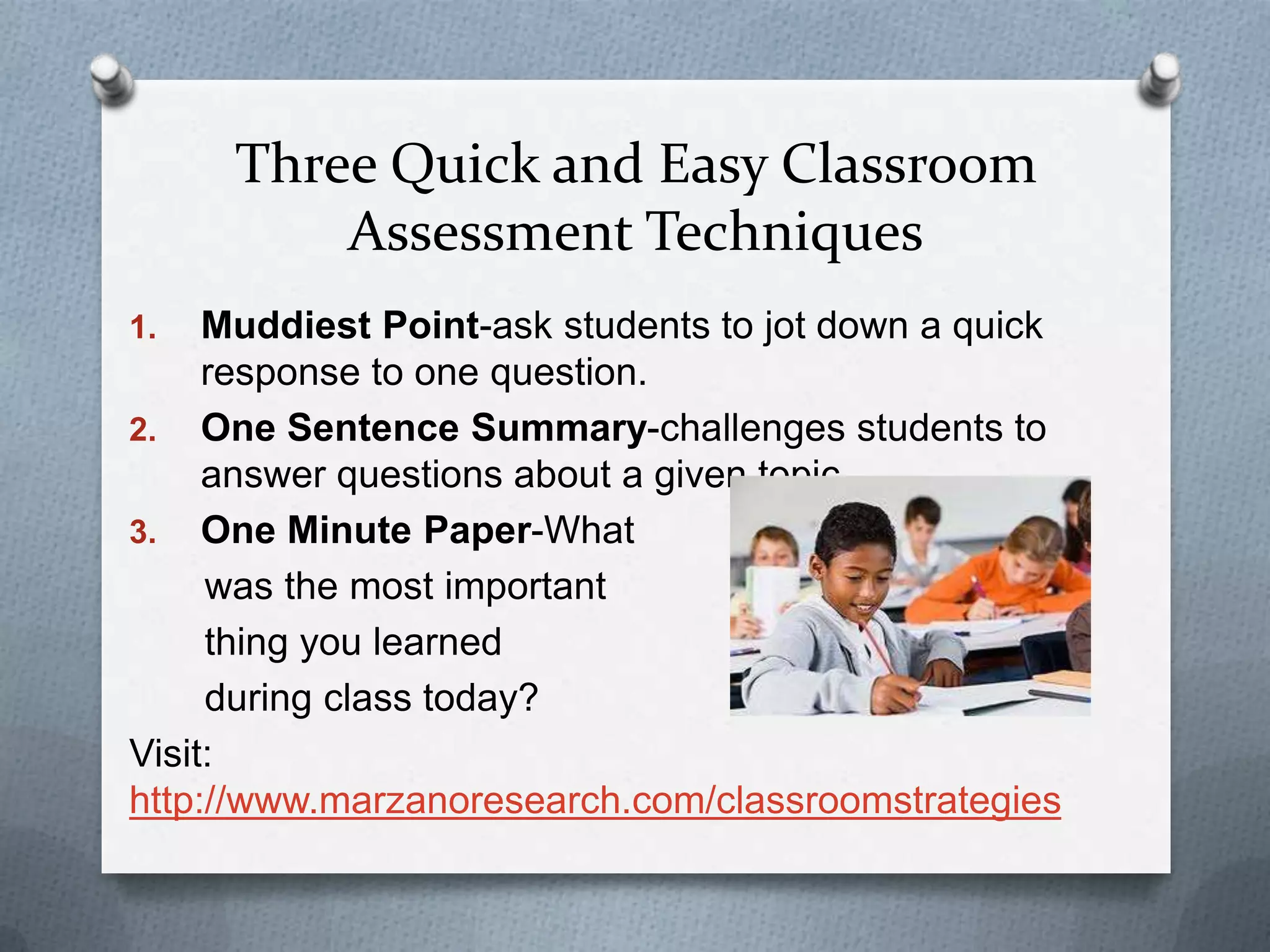
Three Quick and Easy Classroom
         Assessment Techniques
1.   Muddiest Point-ask students to jot down a quick
     response to one question.
2. One Sentence Summary-challenges students to
     answer questions about a given topic.
3. One Minute Paper-What
     was the most important
     thing you learned
     during class today?
Visit:
http://www.marzanoresearch.com/classroomstrategies
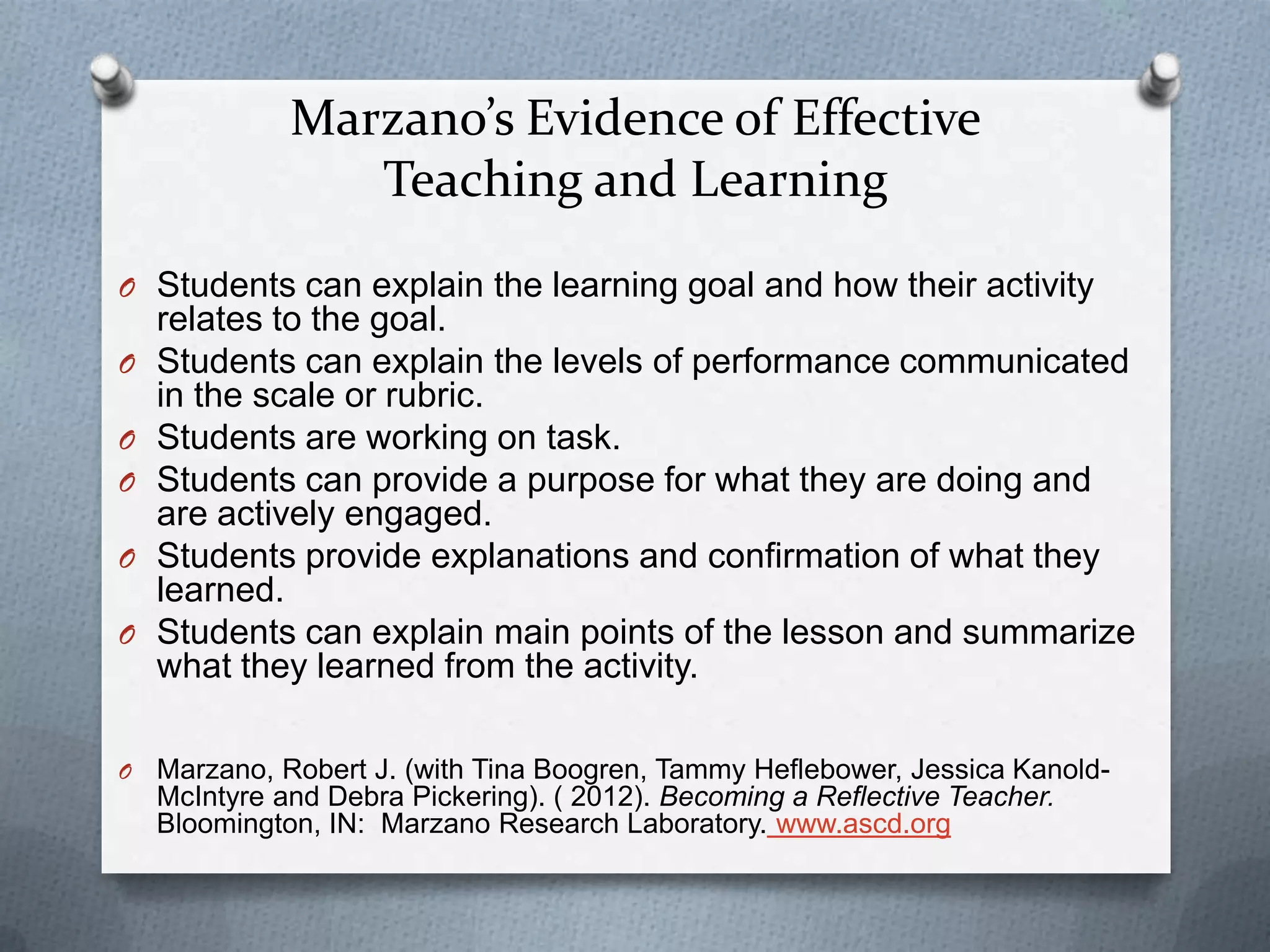
Marzano’s Evidence of Effective
                 Teaching and Learning
O Students can explain the learning goal and how their activity
    relates to the goal.
O   Students can explain the levels of performance communicated
    in the scale or rubric.
O   Students are working on task.
O   Students can provide a purpose for what they are doing and
    are actively engaged.
O   Students provide explanations and confirmation of what they
    learned.
O   Students can explain main points of the lesson and summarize
    what they learned from the activity.

O   Marzano, Robert J. (with Tina Boogren, Tammy Heflebower, Jessica Kanold-
    McIntyre and Debra Pickering). ( 2012). Becoming a Reflective Teacher.
    Bloomington, IN: Marzano Research Laboratory. www.ascd.org
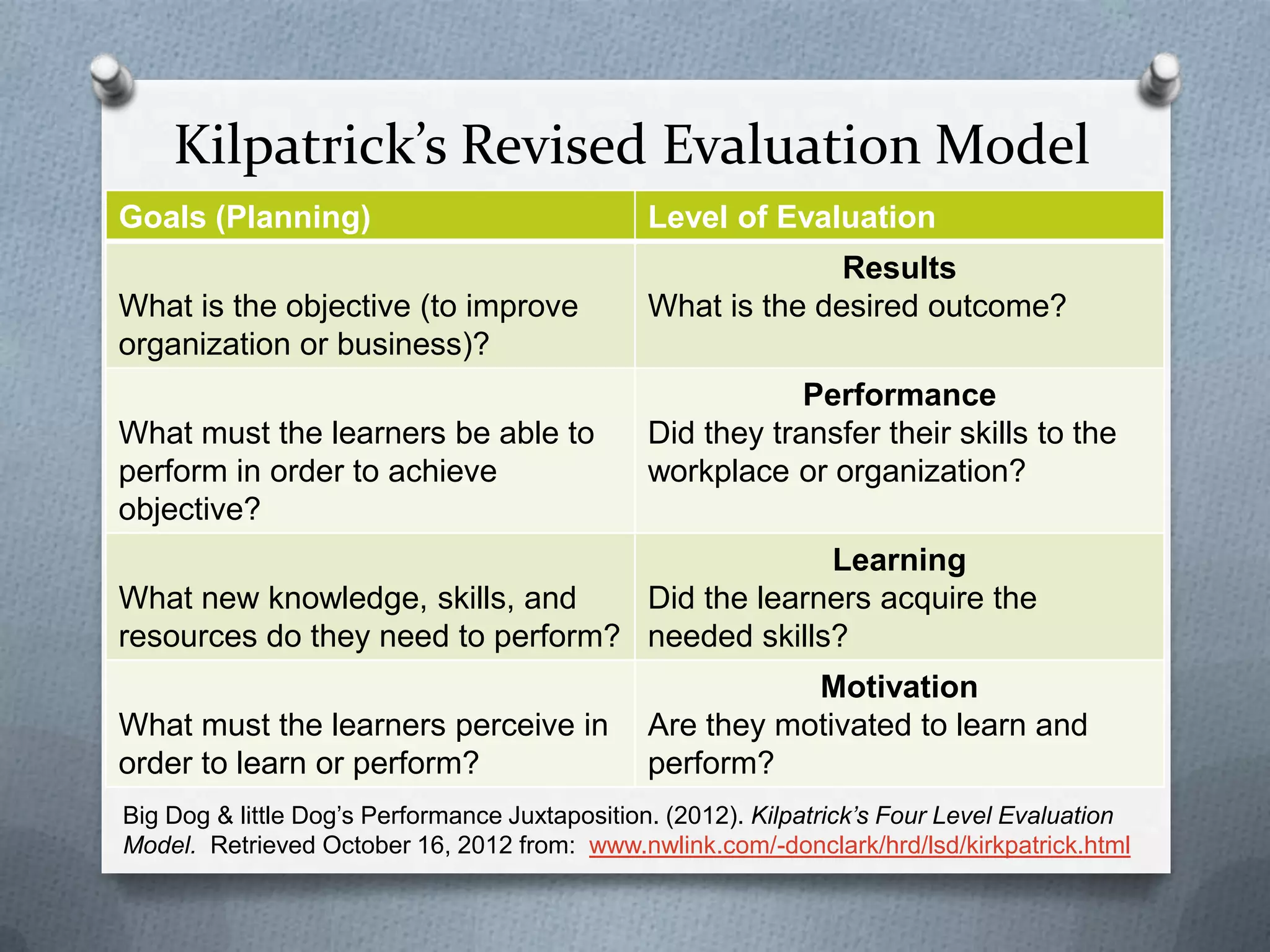
Kilpatrick’s Revised Evaluation Model
Goals (Planning)                               Level of Evaluation
                                                             Results
What is the objective (to improve              What is the desired outcome?
organization or business)?
                                                           Performance
What must the learners be able to              Did they transfer their skills to the
perform in order to achieve                    workplace or organization?
objective?
                                                Learning
What new knowledge, skills, and    Did the learners acquire the
resources do they need to perform? needed skills?
                                                          Motivation
What must the learners perceive in             Are they motivated to learn and
order to learn or perform?                     perform?
Big Dog & little Dog’s Performance Juxtaposition. (2012). Kilpatrick’s Four Level Evaluation
Model. Retrieved October 16, 2012 from: www.nwlink.com/-donclark/hrd/lsd/kirkpatrick.html
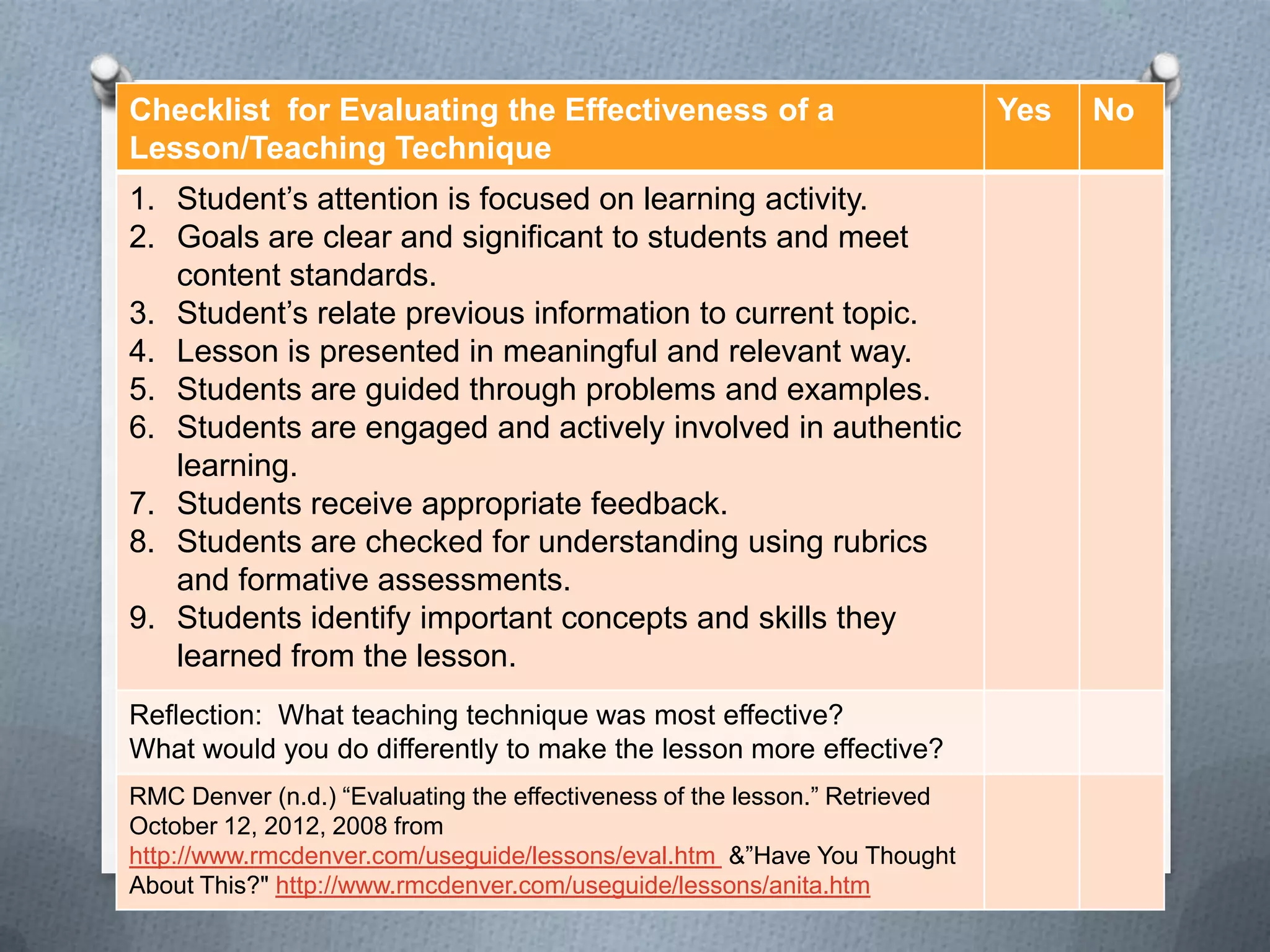
Checklist for Evaluating the Effectiveness of a                             Yes   No
Lesson/Teaching Technique
1. Student’s attention is focused on learning activity.
2. Goals are clear and significant to students and meet
   content standards.
3. Student’s relate previous information to current topic.
4. Lesson is presented in meaningful and relevant way.
5. Students are guided through problems and examples.
6. Students are engaged and actively involved in authentic
   learning.
7. Students receive appropriate feedback.
8. Students are checked for understanding using rubrics
   and formative assessments.
9. Students identify important concepts and skills they
   learned from the lesson.
Reflection: What teaching technique was most effective?
What would you do differently to make the lesson more effective?
RMC Denver (n.d.) “Evaluating the effectiveness of the lesson.” Retrieved
October 12, 2012, 2008 from
http://www.rmcdenver.com/useguide/lessons/eval.htm &”Have You Thought
About This?" http://www.rmcdenver.com/useguide/lessons/anita.htm
The End
References
O Brookhart, Susan M. (2010). How to Assess Higher-Order Thinking
  Skills in Your Classroom. Alexandria, VA : Association for Supervision
  and Curriculum Development.
This book describes methods for assessing analysis, logic and reasoning,
judgment, problem solving and creative thinking.
O Dodge, Judith. (2009). 25 Quick Formative Assessments for a
  Differentiated Classroom. USA: Scholastic.
O Fisher, Douglas and Frey, Nancy. (2007). Check for Understanding.
  Formative Assessment Techniques for Your Classroom. Alexandria,
  VA : Association for Supervision and Curriculum Development.
O Marzano, Robert J. (with Tina Boogren, Tammy Heflebower, Jessica
  Kanold-McIntyre and Debra Pickering). ( 2012). Becoming a Reflective
  Teacher. Bloomington, IN: Marzano Research Laboratory.
O Wiggins, Grant and McTighe, Jay., (2005). Understanding by Design.
  Alexandria, VA : Association for Supervision and Curriculum
  Development.

Tools for evaluating the effectiveness of your teaching technique 1

  • 1.
    Tools for EvaluatingYour Teaching Technique By Renee Macdonald University of Central Florida ECT 4384 - Professor Robin Weber
  • 2.
    Objectives At the endof this presentation, teachers should be able to: O Describe summative and formative assessment. O Explain the key parts of a rubric. O Identify tools for evaluating the effectiveness of a teaching technique. O Summarize the steps of Gagne’s “Nine Events of Learning”. University of Florida, Center for Instructional Knowledge and Training. (10/3/2011). Gagne's 9 Events of Instruction. Retrieved Oct 12, 2012 from: http://www.citt.ufl.edu/toolbox/toolbox_gagne9Events.php
  • 3.
    Did your teachingtechnique work? What worked and what needs improvement? How do you evaluate learning outcomes? Tools for evaluating your teaching technique: 1. Instructional Design Checklist: Gagne’s 9 Steps of Learning 2. Summative (Traditional) Assessment. Examples are multiple choice, fill-in-the blank, true/false, short answer and essay questions. 3. Formative (Alternative or Authentic) Assessment. Examples are project-based, portfolio, checklists, rating scales, rubrics, and teacher observation. 4. Marzano’s “Evidence” of Learning. 5. Kilpatrick’s Revised Evaluation Model
  • 4.
    Gagne’s 9 Stepsof Learning Effective teaching begins with effective lesson design, which benefits from the research about how people learn. Utilizing Gagne’s 9 Events of Instruction provides a guide to developing a successful lesson and a logical way to evaluate teaching strategies. . Gagne’s theory is used today to design instruction for the military, medical and engineering fields.
  • 5.
    Step 1: GainStudent’s Attention Examples of ways to present new knowledge: One-minute headlines Webquests Believe it or not Guest speakers PowerPoint presentation Video or movie Scavenger Hunt Ask students what they need to know or be able to do when they finish their training?
  • 6.
    Step 2: InformStudents of Goals An effective teaching technique provides clear learning goals. Identify state or employer standards and goals. Student will be able to . . . . . . . . . . . . . . . . . . . . . . . . . Example: Post learning goals for students to view. Use a syllabus, lecture slide, or handout. Review the goal of the lesson (from Step 1) in simple language.
  • 7.
    Step 3: ConnectPrior Learning to New Knowledge Engage students in activities (scaffolding) that help them link previous knowledge to new material and facilitates learning. Examples: Preview questions Overt linkages Concept maps Graphic Representations Ask students to recall prior relevant learning and skills.
  • 8.
    Step 4: Presentthe New Material Effectively O Present new knowledge in small chunks or “digestible bites” for students. O Review Skinner’s “Sequenced Learning Events” and Bloom’s Taxonomy to sequence the lesson. Examples: O Present key ideas or brief summary of material O Skim material with students O Provide guided discovery O Use graphic organizers, K-W-L strategy (Know, Want to Know, Learn) O Assign individual and group research O Use blogs, wikis, podcasts or YouTube to present material
  • 9.
    Step 5: Providelearning guidance. Help students process, elaborate, record, reflect, and reinforce new knowledge. Give instructions to students on how to learn. Examples: Process: Collaborative learning activities, role play Elaborate: Probing questions, compare Record: Graphic organizers, diagrams Reflect: Reflective journals, logs, two-column notes
  • 10.
    Step 6: Practice,Presentation and Performance Provide students with the opportunity to use and reinforce what they have learned. Give students a choice to work by themselves or with a partner or group. Examples: O Homework O Cooperative learning activities O Demonstration O Practice quiz or exercise O Think-pair-share O Observation and Modeling, Bandura’s “Social Learning Theory” Practice makes perfect.
  • 11.
    Step 7: ProvideFeedback Monitor student actions and learning closely for errors and misunderstandings. Be specific. Examples: O Frequent practice prior to testing, quiz, verbal comments O Provide examples of correct procedure or skill O Review sessions O Peer feedback O Provide resources and guidance O Change tracking Tell students why they are doing a good job.
  • 12.
  • 13.
    Step 8. Assessment Theeffectiveness of a teaching technique is evaluated in terms of improving student achievement and identifies causes of success or difficulty. Assessments help teachers adjust their teaching practice for individual students and for the class as a whole. Example: Standardized tests are an example of summative assessment. Test to determine if the lesson has been learned.
  • 14.
    Formative assessment isself-monitoring, encourages students to improve and promotes life-long learning. http://www.khanacademy.org/ Formative assessment is interactive during the learning process in order to modify teaching and provide frequent feedback to students.
  • 15.
    Examples of FormativeAssessment O Checklists, Rating Scales, Rubrics O Project, Collaborative Learning O Experiment or Problem O Development of a Product O Performance or Presentation O Community Based Experience, Service Learning O Case Study or Clinical Evaluation O Interview or Survey O Portfolio, Reflective Journal
  • 16.
    Rubrics explain tostudents the criteria against which their work will be judged or the “scoring rules”.
  • 17.
    Rubrics deliver botha grade summative and formative feedback to improve future student learning.
  • 18.
    Parts of aRubric O Criteria –Define the goals (content objectives) to be met and describe the criteria for judging the task or project (process objectives), what you want graded. (Left column of rubric) O Scale-Levels of competency-Set the scale for student’s competency from successful to unsuccessful or excellent to poor, for each required criteria. (Top row of rubric) O Assignment of value-Describe the characteristics of behavior, assignment or project to be completed and assign a numeric or grade for each level. (The rows)
  • 19.
    Step 9: Retentionand Transfer Make the link to the real world or workplace by applying new knowledge to real life connections which increases retention by personalizing information. Examples: Provide opportunities to practice work place knowledge and skills. Authentic learning provides experiences that demonstrate real- life connections between lessons and the world.
  • 20.
    Teaching Evaluation Techniques Usechecklists, student assessments, student surveys, videoing your teaching, and peer coaching to evaluate your teaching.
  • 21.
    Peer Coaching: Teaching Observationand Discussion Watch Videos-Teachers watch videos of other teachers in pairs or small groups and look for instructional techniques that work and don’t work to discuss. (Examples: Robin Williams, Dead Poets Society) Coaching Colleagues-Teachers observe each other and meet together for suggestions and feedback. Instructional Rounds-Organized teacher observation to observe colleagues and reflect on their own practice. Marzano, Robert J. (with Tina Boogren, Tammy Heflebower, Jessica Kanold-McIntyre and Debra Pickering). ( 2012). Becoming a Reflective Teacher. (pp. 75-81.) Bloomington, IN: Marzano Research Laboratory.
  • 22.
    Learning assessment isan ongoing process. When students succeed in achieving goals and objectives, you might assume that your teaching technique worked.
  • 23.
    Make Changes When studentsdo not achieve goals and objectives, changes should be made in teaching and learning process. Reevaluation after changes are made will ensure that the changes were helpful to student learning.
  • 24.
    Three Quick andEasy Classroom Assessment Techniques 1. Muddiest Point-ask students to jot down a quick response to one question. 2. One Sentence Summary-challenges students to answer questions about a given topic. 3. One Minute Paper-What was the most important thing you learned during class today? Visit: http://www.marzanoresearch.com/classroomstrategies
  • 25.
    Marzano’s Evidence ofEffective Teaching and Learning O Students can explain the learning goal and how their activity relates to the goal. O Students can explain the levels of performance communicated in the scale or rubric. O Students are working on task. O Students can provide a purpose for what they are doing and are actively engaged. O Students provide explanations and confirmation of what they learned. O Students can explain main points of the lesson and summarize what they learned from the activity. O Marzano, Robert J. (with Tina Boogren, Tammy Heflebower, Jessica Kanold- McIntyre and Debra Pickering). ( 2012). Becoming a Reflective Teacher. Bloomington, IN: Marzano Research Laboratory. www.ascd.org
  • 26.
    Kilpatrick’s Revised EvaluationModel Goals (Planning) Level of Evaluation Results What is the objective (to improve What is the desired outcome? organization or business)? Performance What must the learners be able to Did they transfer their skills to the perform in order to achieve workplace or organization? objective? Learning What new knowledge, skills, and Did the learners acquire the resources do they need to perform? needed skills? Motivation What must the learners perceive in Are they motivated to learn and order to learn or perform? perform? Big Dog & little Dog’s Performance Juxtaposition. (2012). Kilpatrick’s Four Level Evaluation Model. Retrieved October 16, 2012 from: www.nwlink.com/-donclark/hrd/lsd/kirkpatrick.html
  • 27.
    Checklist for Evaluatingthe Effectiveness of a Yes No Lesson/Teaching Technique 1. Student’s attention is focused on learning activity. 2. Goals are clear and significant to students and meet content standards. 3. Student’s relate previous information to current topic. 4. Lesson is presented in meaningful and relevant way. 5. Students are guided through problems and examples. 6. Students are engaged and actively involved in authentic learning. 7. Students receive appropriate feedback. 8. Students are checked for understanding using rubrics and formative assessments. 9. Students identify important concepts and skills they learned from the lesson. Reflection: What teaching technique was most effective? What would you do differently to make the lesson more effective? RMC Denver (n.d.) “Evaluating the effectiveness of the lesson.” Retrieved October 12, 2012, 2008 from http://www.rmcdenver.com/useguide/lessons/eval.htm &”Have You Thought About This?" http://www.rmcdenver.com/useguide/lessons/anita.htm
  • 28.
  • 29.
    References O Brookhart, SusanM. (2010). How to Assess Higher-Order Thinking Skills in Your Classroom. Alexandria, VA : Association for Supervision and Curriculum Development. This book describes methods for assessing analysis, logic and reasoning, judgment, problem solving and creative thinking. O Dodge, Judith. (2009). 25 Quick Formative Assessments for a Differentiated Classroom. USA: Scholastic. O Fisher, Douglas and Frey, Nancy. (2007). Check for Understanding. Formative Assessment Techniques for Your Classroom. Alexandria, VA : Association for Supervision and Curriculum Development. O Marzano, Robert J. (with Tina Boogren, Tammy Heflebower, Jessica Kanold-McIntyre and Debra Pickering). ( 2012). Becoming a Reflective Teacher. Bloomington, IN: Marzano Research Laboratory. O Wiggins, Grant and McTighe, Jay., (2005). Understanding by Design. Alexandria, VA : Association for Supervision and Curriculum Development.