Optom. SIMI AFROZ
A.I.I.M.S, New Delhi
Optom Student’s Power
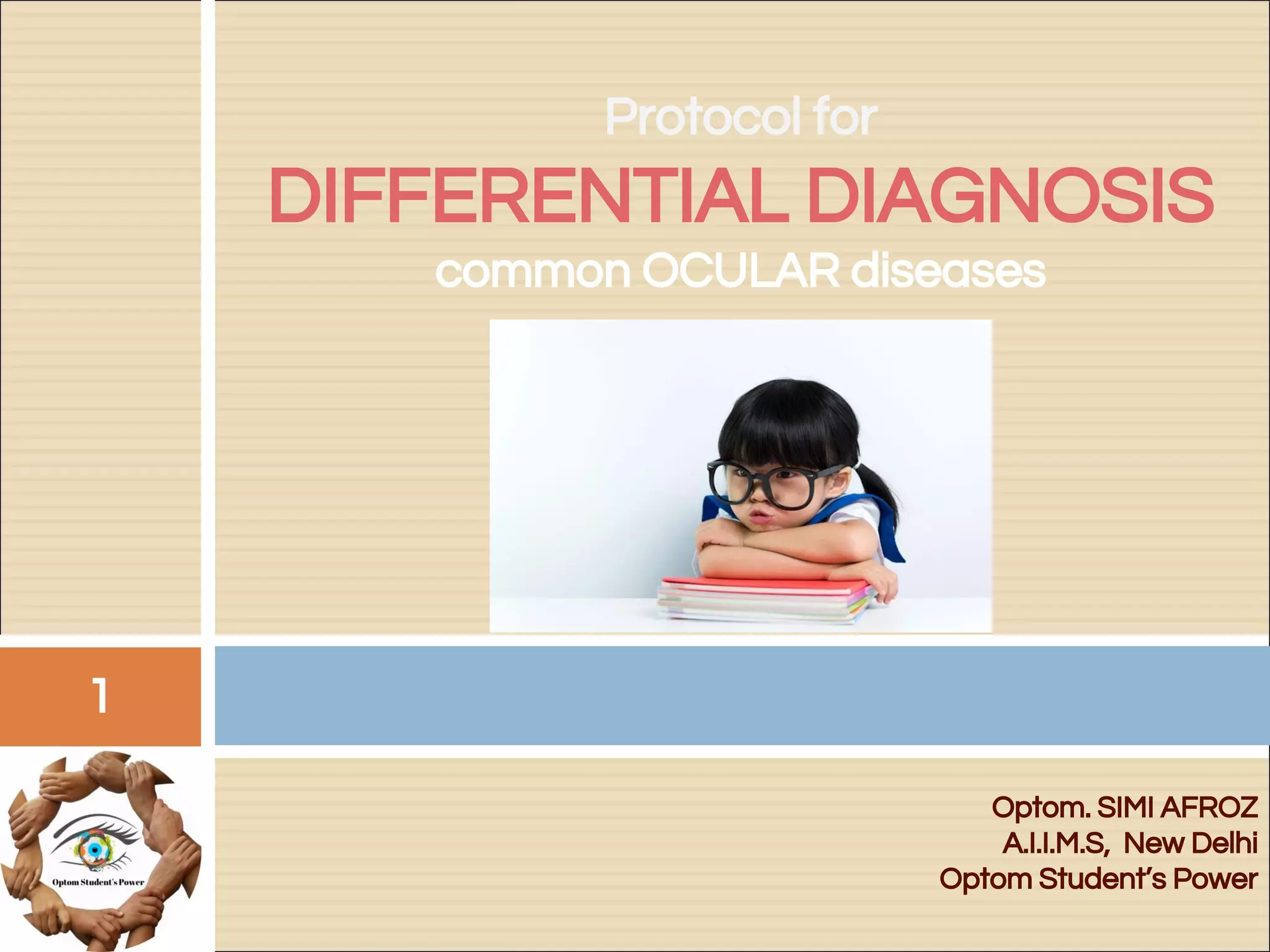
Protocol for
DIFFERENTIAL DIAGNOSIS
common OCULAR diseases
1
Definition
● Differential: A difference between two values
on a scale.
● Diagnosis: Identification of the nature and
cause of problem.
● Differential diagnosis (Ddx)
The process of differentiating between two or
more conditions which share similar signs or
symptoms.
★ Develope a systematic,routine method for
differential diagnosis generation.
2
Rules: what is a Ddx?
❖ Recognize a collection of signs and
symptoms.
❖ Recall basic pathophysiology.
❖ Restate in terms of disease.
❖ Reconnect with the initial complaints.
❖ Framing the probability test.
3
Sagacious Diagnostic Errors
4
Errors
● faulty hypothesis
generation.
● faulty context formulation.
● Faulty information
gathering.
○ inaccurate
assessment
○ wrong interpretation of
tests
● premature closure of
diagnosis
● “No fault” errors
4
Examples
● Hmm...DOV for near -
presbyopia?
● “35 years old? I thought
you said 45 years old.”
● “ its just u need
refraction.”
● “oh! you are myopic…”
● “This is (+) so you are
having …..”
● “This is(-) so it is not that…”
● “ I am always correct….”
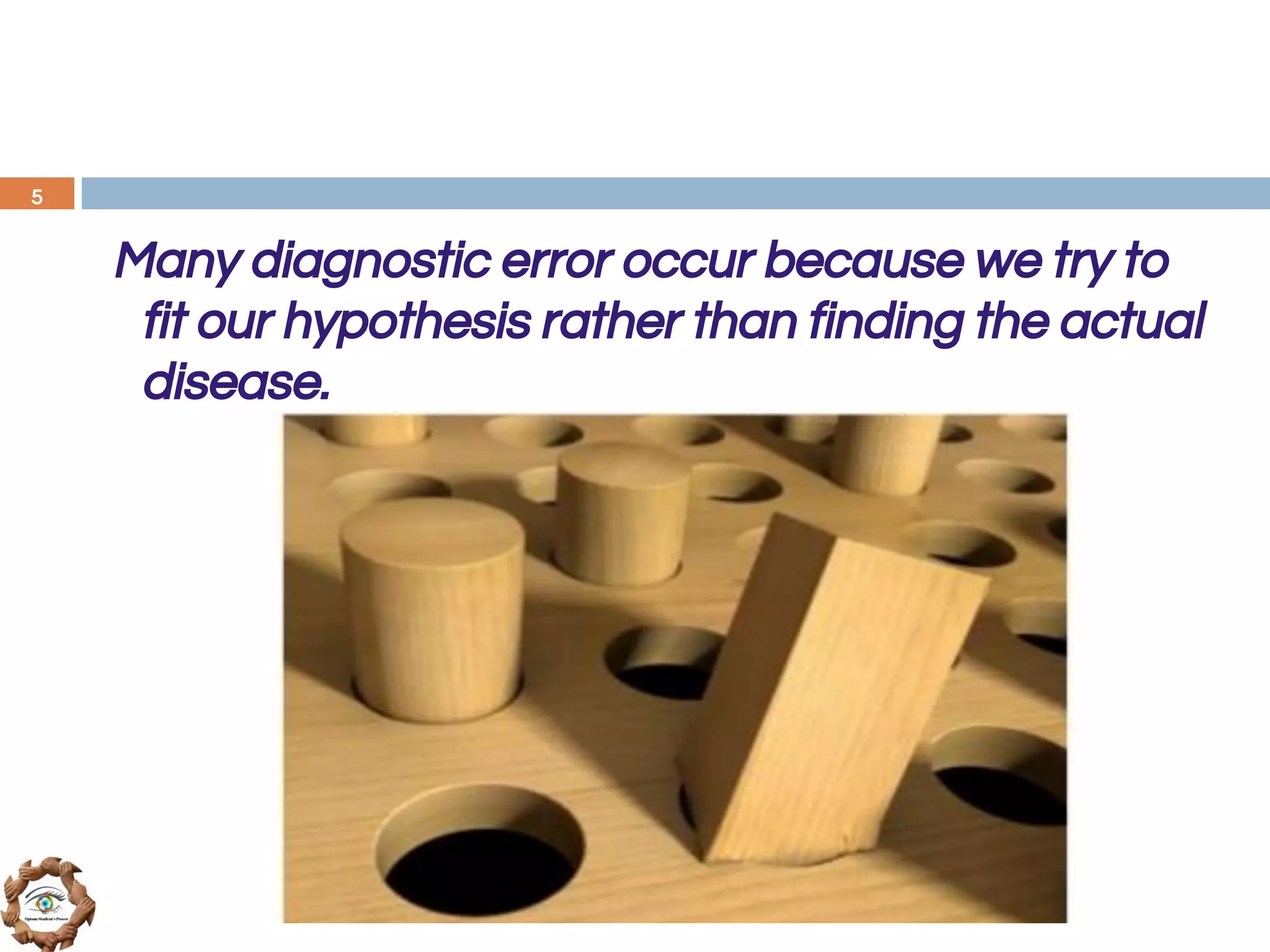
Many diagnostic error occur because we try to
fit our hypothesis rather than finding the actual
disease.
5
6
Step one: History taking
A careful meticulous approach to history taking is the
foundation of successful clinical diagnosis. Begins by
asking:
● Demographic data: name age, sex, occupation,etc.
● Chief complaints: always be recorded in a
chronological order with their duration.
● History of present illness: make notes of following
points - mode of onset with duration, severity,
progression, accompaniment of each symptom.
● History of past illness: similar ocular complaints in past,
similar complains in other eye, trauma to eye in past,
any ocular surgery in past, any systemic disease in
past, drug intake.
● Family history: in heratable ocular disorders.
7
Step two : ocular examination
◻ testing of visual acuity: monocular and binocular
measurement of distance and near visual acuity and if
subject is having glasses then with glasses also.
◻ external ocular examination:
⬜ inspection in diffuse light: preliminary examination of
eyeballs.
⬜ Focal illumination examination: detailed
examination under magnification.
◻ Fundus examination:
⬜ media
⬜ optic disc; shape, size, margins,colour, cup - disc
ratio,neovascularization,etc
⬜ macula
⬜ retinal blood vessels
8
Step three: Reconnection
summarize your finding accordingly.
9
Step four : Special Tests
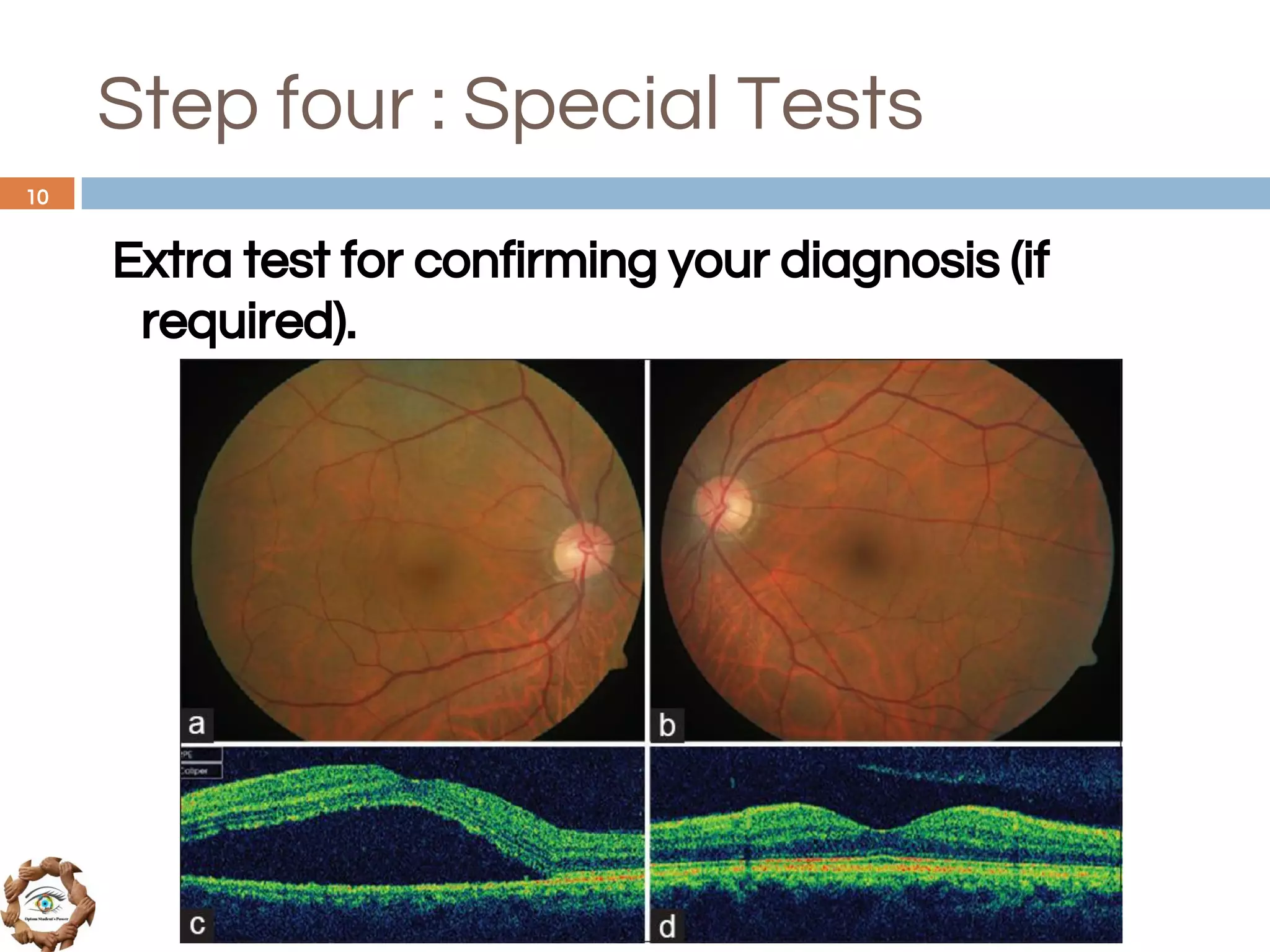
Extra test for confirming your diagnosis (if
required).
10
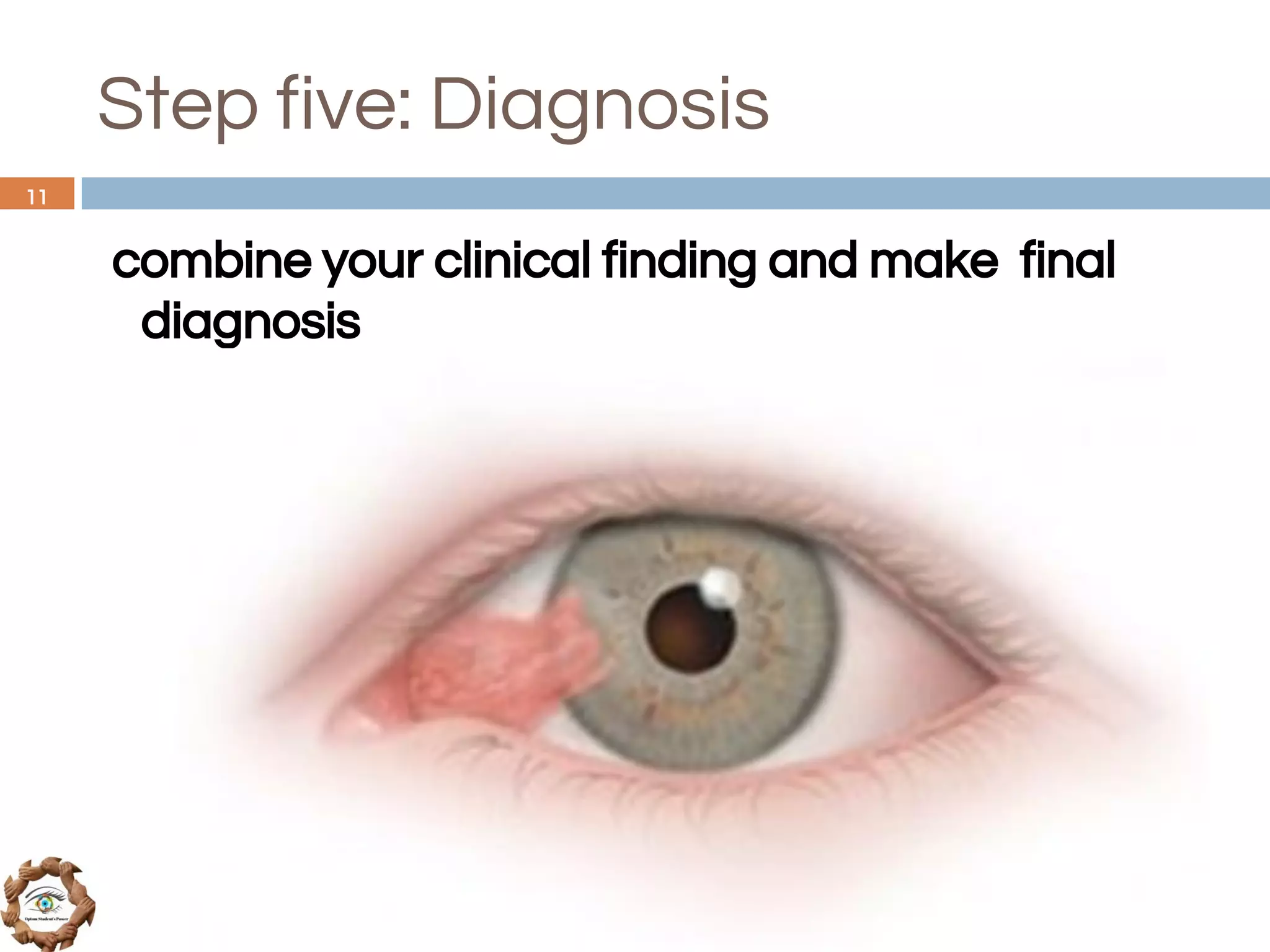
Step five: Diagnosis
combine your clinical finding and make final
diagnosis
11
Common ocular symptoms and
their causes
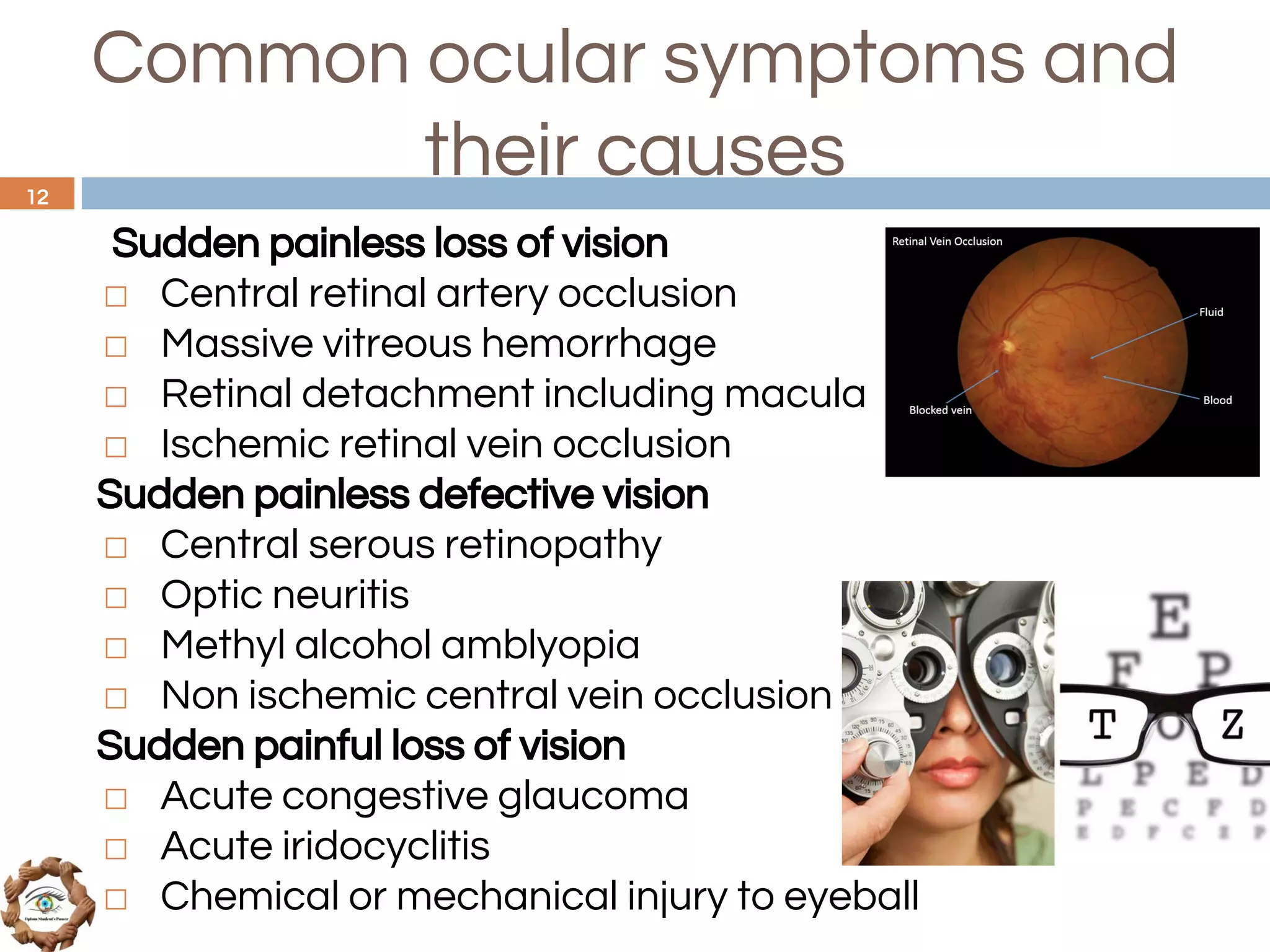
Sudden painless loss of vision
◻ Central retinal artery occlusion
◻ Massive vitreous hemorrhage
◻ Retinal detachment including macula
◻ Ischemic retinal vein occlusion
Sudden painless defective vision
◻ Central serous retinopathy
◻ Optic neuritis
◻ Methyl alcohol amblyopia
◻ Non ischemic central vein occlusion
Sudden painful loss of vision
◻ Acute congestive glaucoma
◻ Acute iridocyclitis
◻ Chemical or mechanical injury to eyeball
12
Cont...
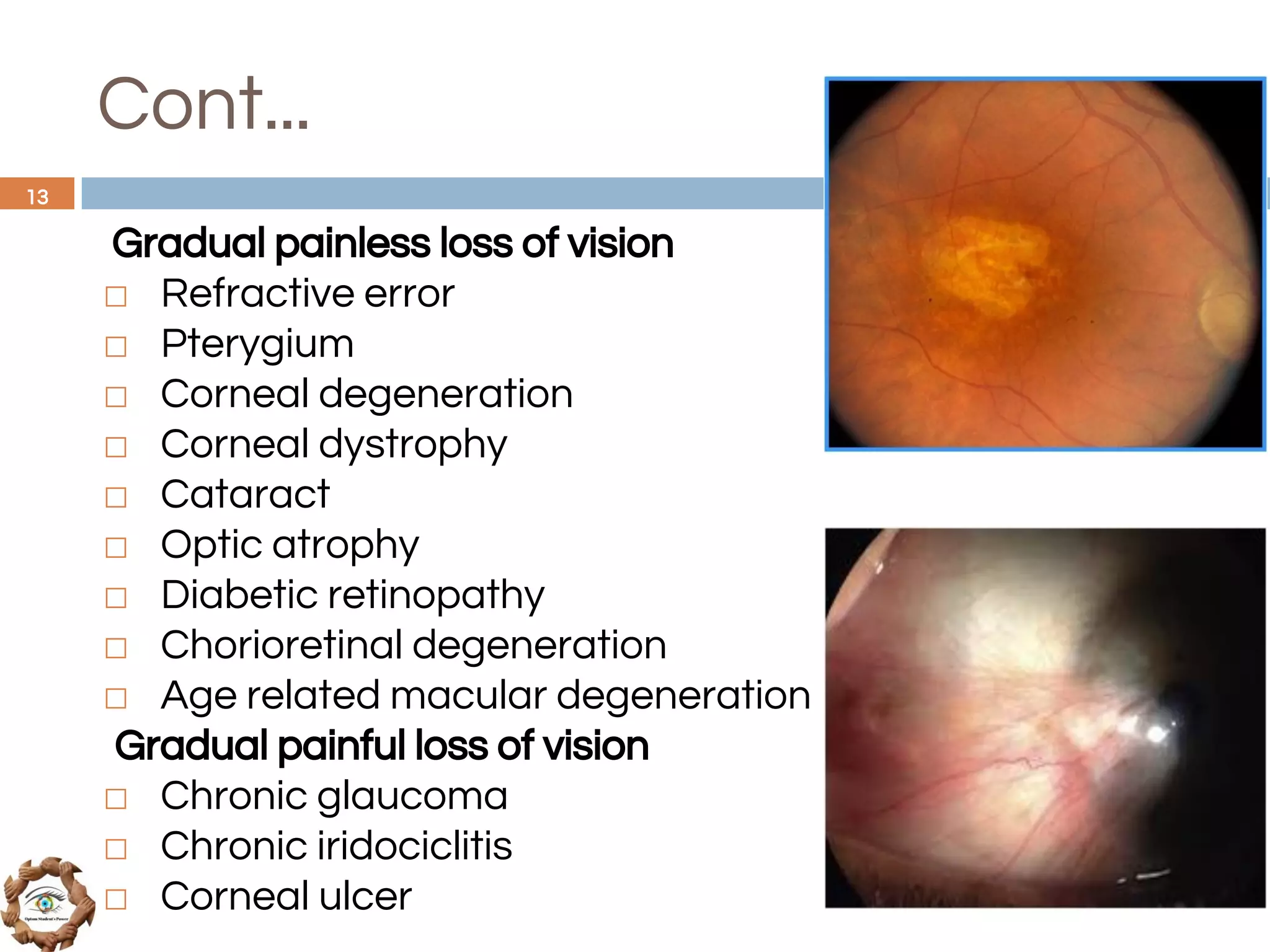
Gradual painless loss of vision
◻ Refractive error
◻ Pterygium
◻ Corneal degeneration
◻ Corneal dystrophy
◻ Cataract
◻ Optic atrophy
◻ Diabetic retinopathy
◻ Chorioretinal degeneration
◻ Age related macular degeneration
Gradual painful loss of vision
◻ Chronic glaucoma
◻ Chronic iridociclitis
◻ Corneal ulcer
13
Cont...
Amaurosis faux
◻ Papilloedema
◻ Giant cell arteritis
◻ Migraine
◻ Hypertension
◻ Carotid artery disease
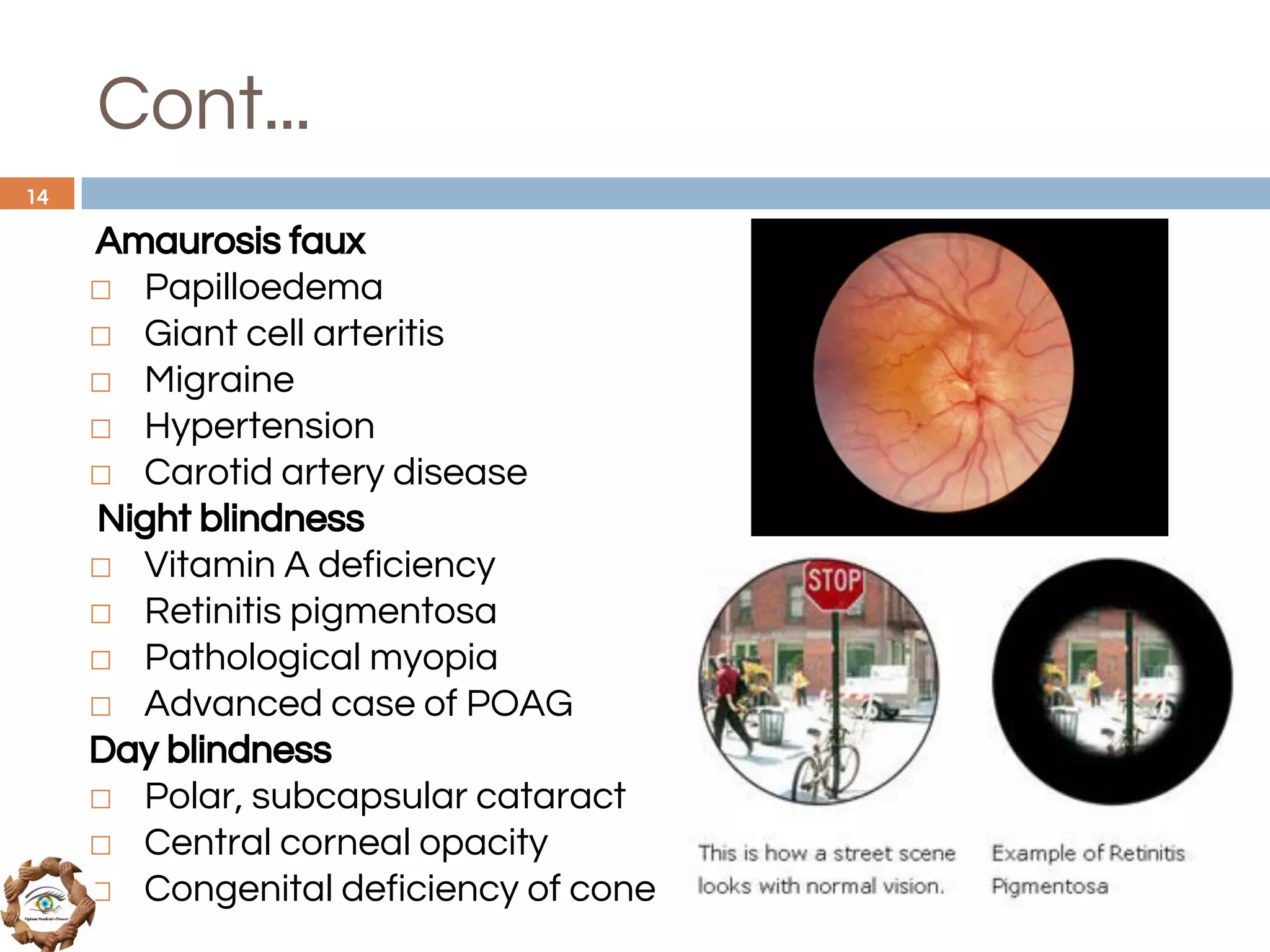
Night blindness
◻ Vitamin A deficiency
◻ Retinitis pigmentosa
◻ Pathological myopia
◻ Advanced case of POAG
Day blindness
◻ Polar, subcapsular cataract
◻ Central corneal opacity
◻ Congenital deficiency of cone
14
Cont...
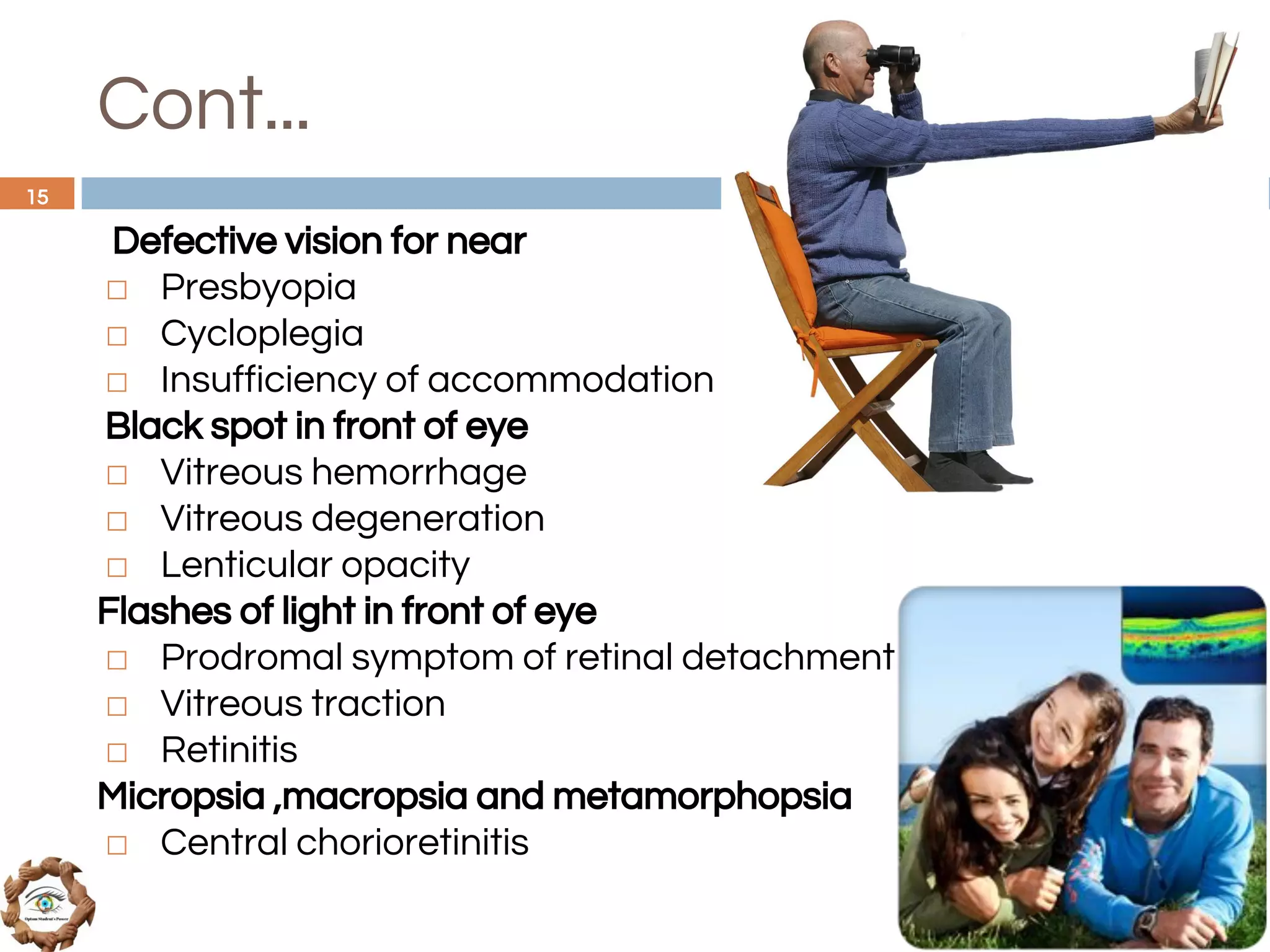
Defective vision for near
◻ Presbyopia
◻ Cycloplegia
◻ Insufficiency of accommodation
Black spot in front of eye
◻ Vitreous hemorrhage
◻ Vitreous degeneration
◻ Lenticular opacity
Flashes of light in front of eye
◻ Prodromal symptom of retinal detachment
◻ Vitreous traction
◻ Retinitis
Micropsia ,macropsia and metamorphopsia
◻ Central chorioretinitis
15
Cont...
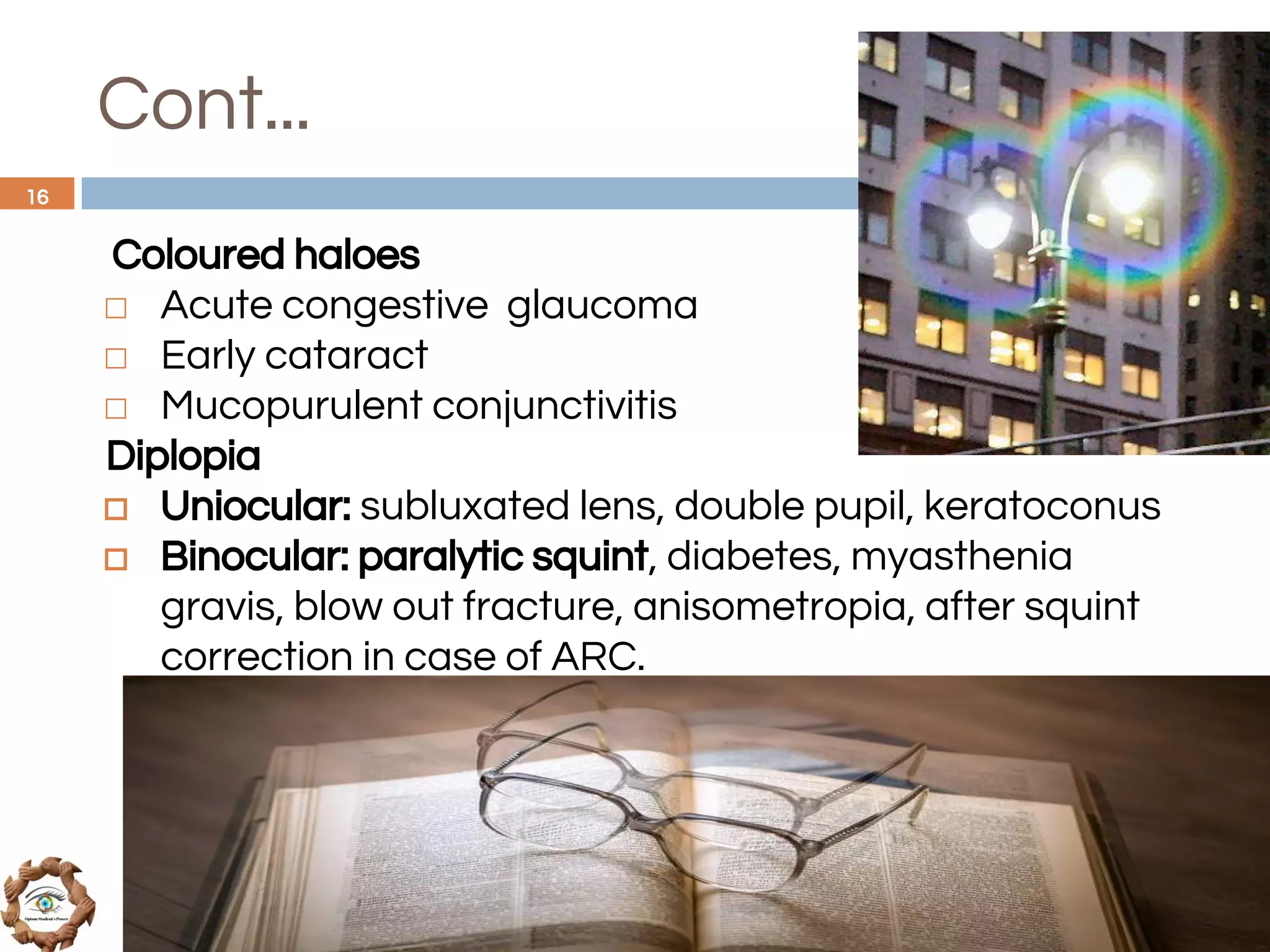
Coloured haloes
◻ Acute congestive glaucoma
◻ Early cataract
◻ Mucopurulent conjunctivitis
Diplopia
◻ Uniocular: subluxated lens, double pupil, keratoconus
◻ Binocular: paralytic squint, diabetes, myasthenia
gravis, blow out fracture, anisometropia, after squint
correction in case of ARC.
16
Common ocular signs and their
causes
Conjunctiva
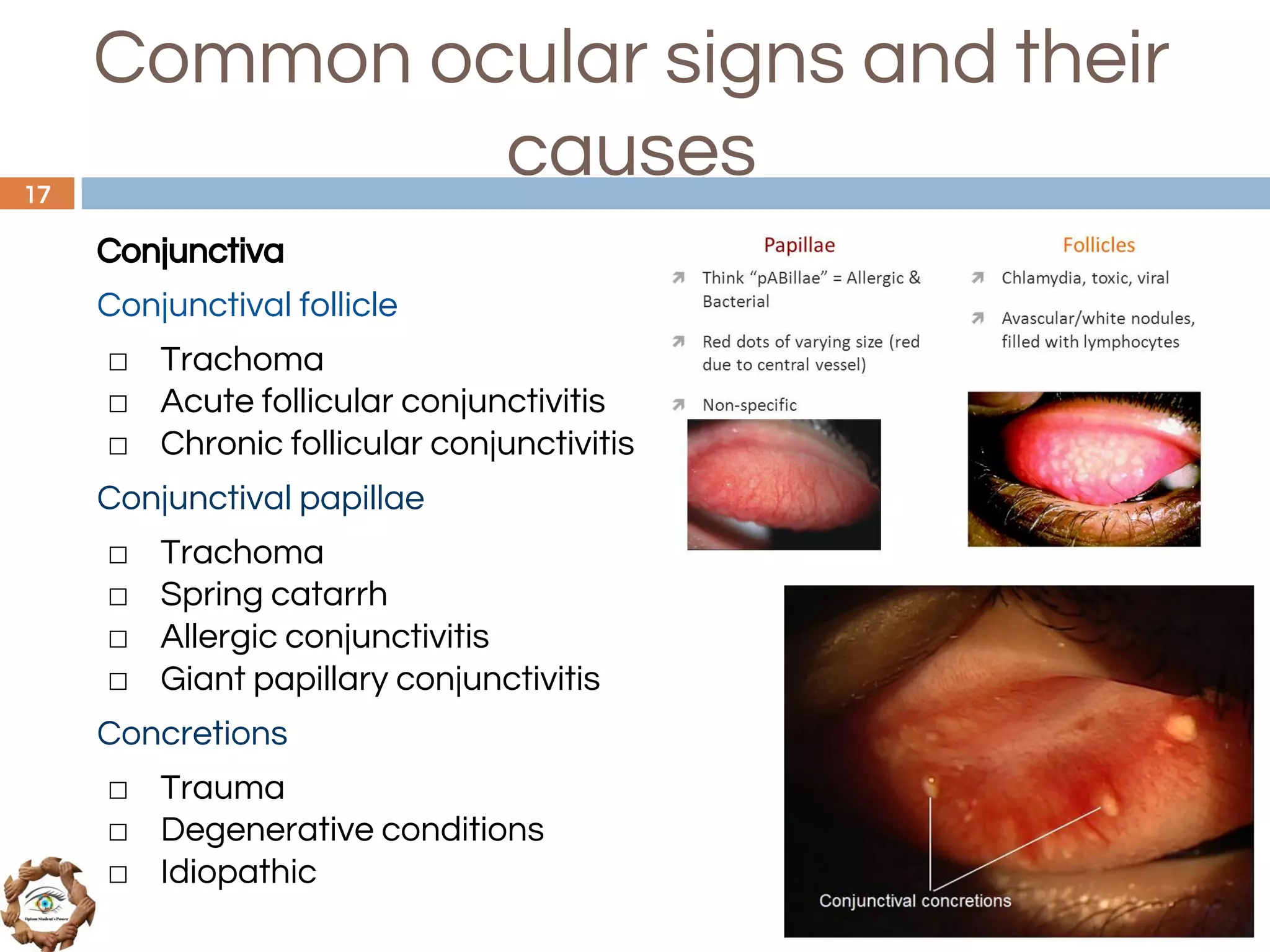
Conjunctival follicle
◻ Trachoma
◻ Acute follicular conjunctivitis
◻ Chronic follicular conjunctivitis
Conjunctival papillae
◻ Trachoma
◻ Spring catarrh
◻ Allergic conjunctivitis
◻ Giant papillary conjunctivitis
Concretions
◻ Trauma
◻ Degenerative conditions
◻ Idiopathic
17
Cont...
Cornea
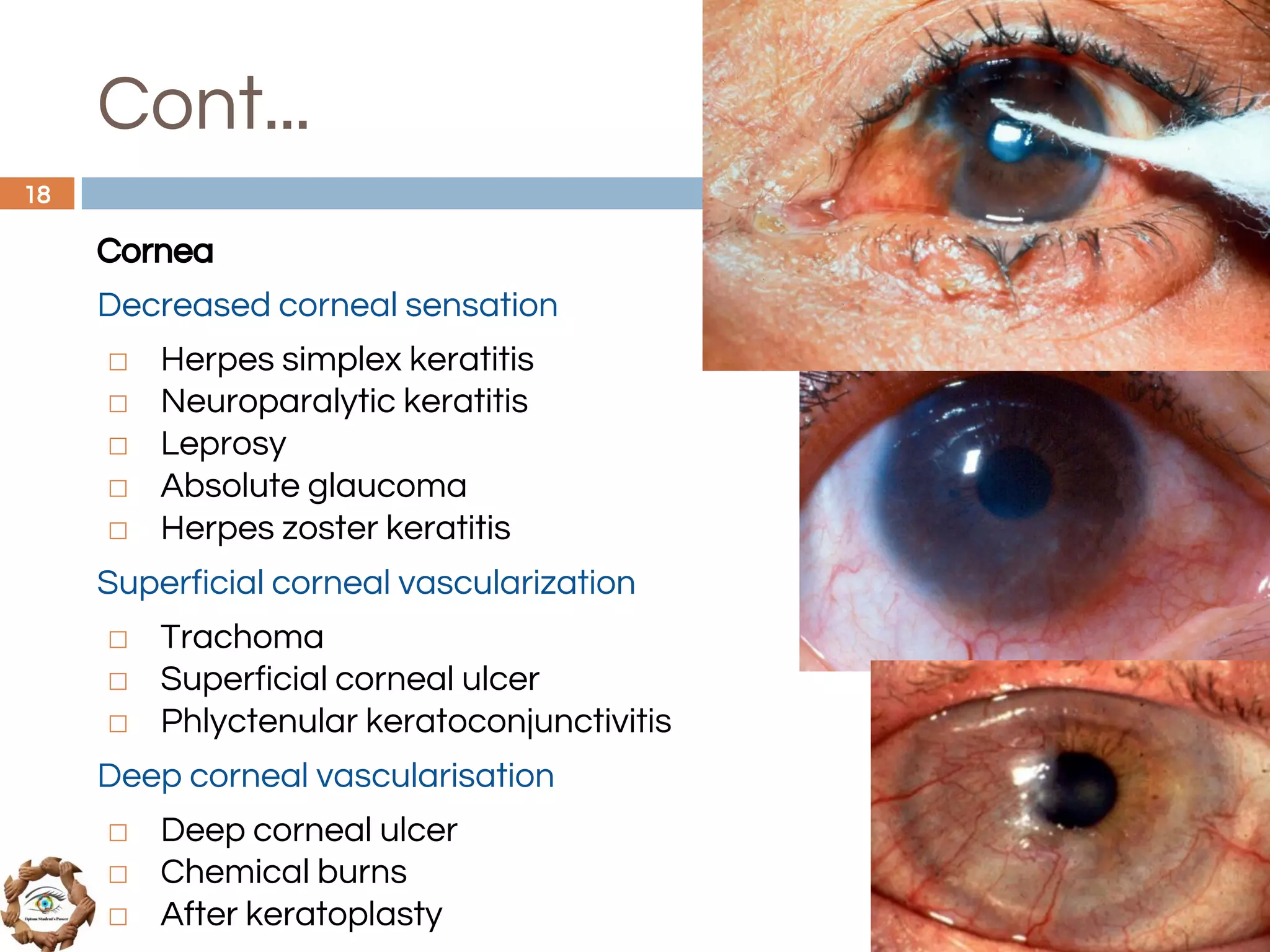
Decreased corneal sensation
◻ Herpes simplex keratitis
◻ Neuroparalytic keratitis
◻ Leprosy
◻ Absolute glaucoma
◻ Herpes zoster keratitis
Superficial corneal vascularization
◻ Trachoma
◻ Superficial corneal ulcer
◻ Phlyctenular keratoconjunctivitis
Deep corneal vascularisation
◻ Deep corneal ulcer
◻ Chemical burns
◻ After keratoplasty
18
Cont...
Increased corneal thickness
◻ Corneal edema
Abnormal corneal surface
◻ Keratoconus
◻ Corneal ulcer
◻ Corneal aberrations
Anterior Chamber
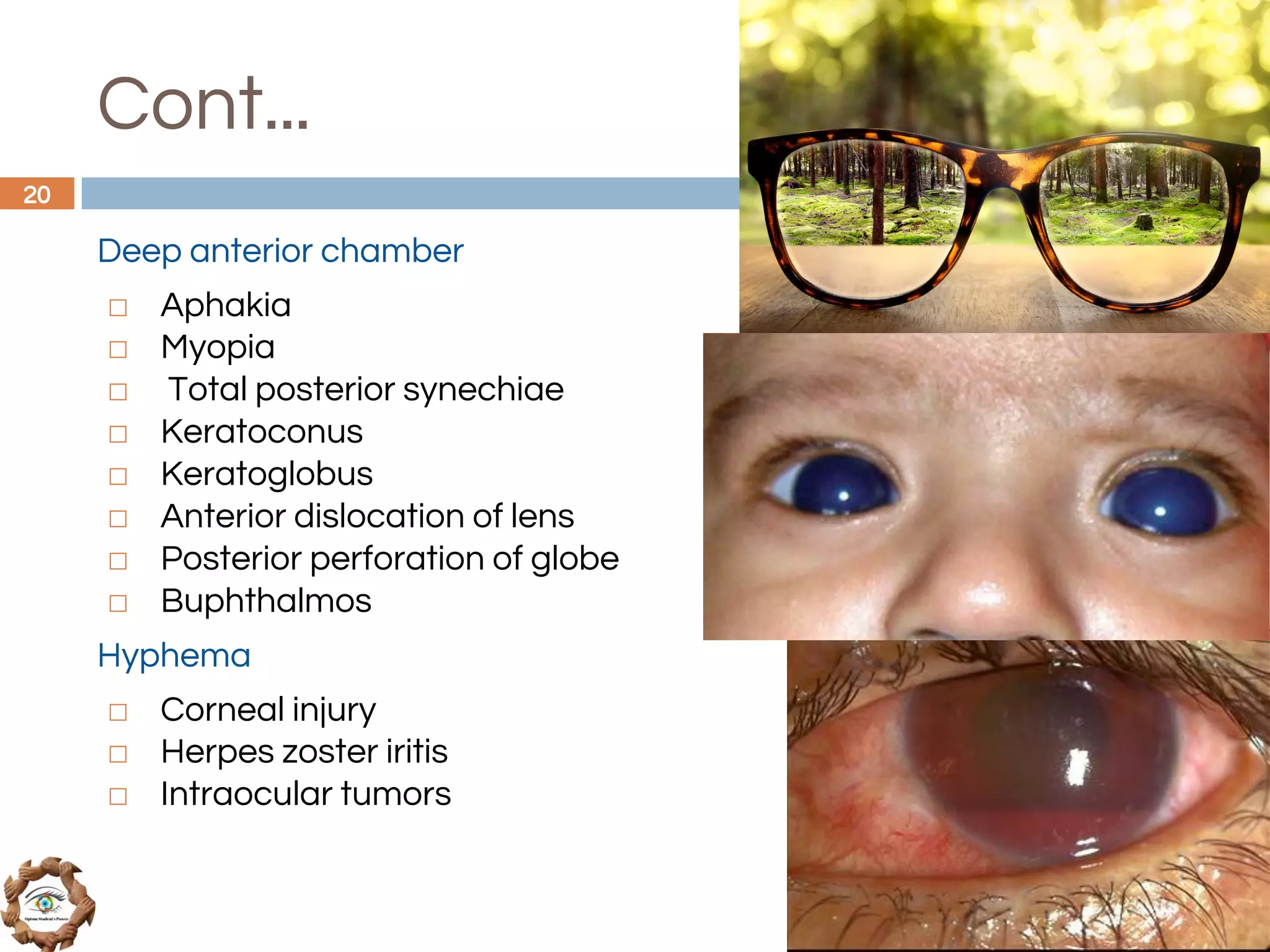
Shallow anterior chamber
◻ PACG
◻ Hypermetropia
◻ Leaking wound
◻ Corneal perforation
◻ Iris bombe formation
◻ Adherent leucoma
19
Cont...
Deep anterior chamber
◻ Aphakia
◻ Myopia
◻ Total posterior synechiae
◻ Keratoconus
◻ Keratoglobus
◻ Anterior dislocation of lens
◻ Posterior perforation of globe
◻ Buphthalmos
Hyphema
◻ Corneal injury
◻ Herpes zoster iritis
◻ Intraocular tumors
20
Cont...
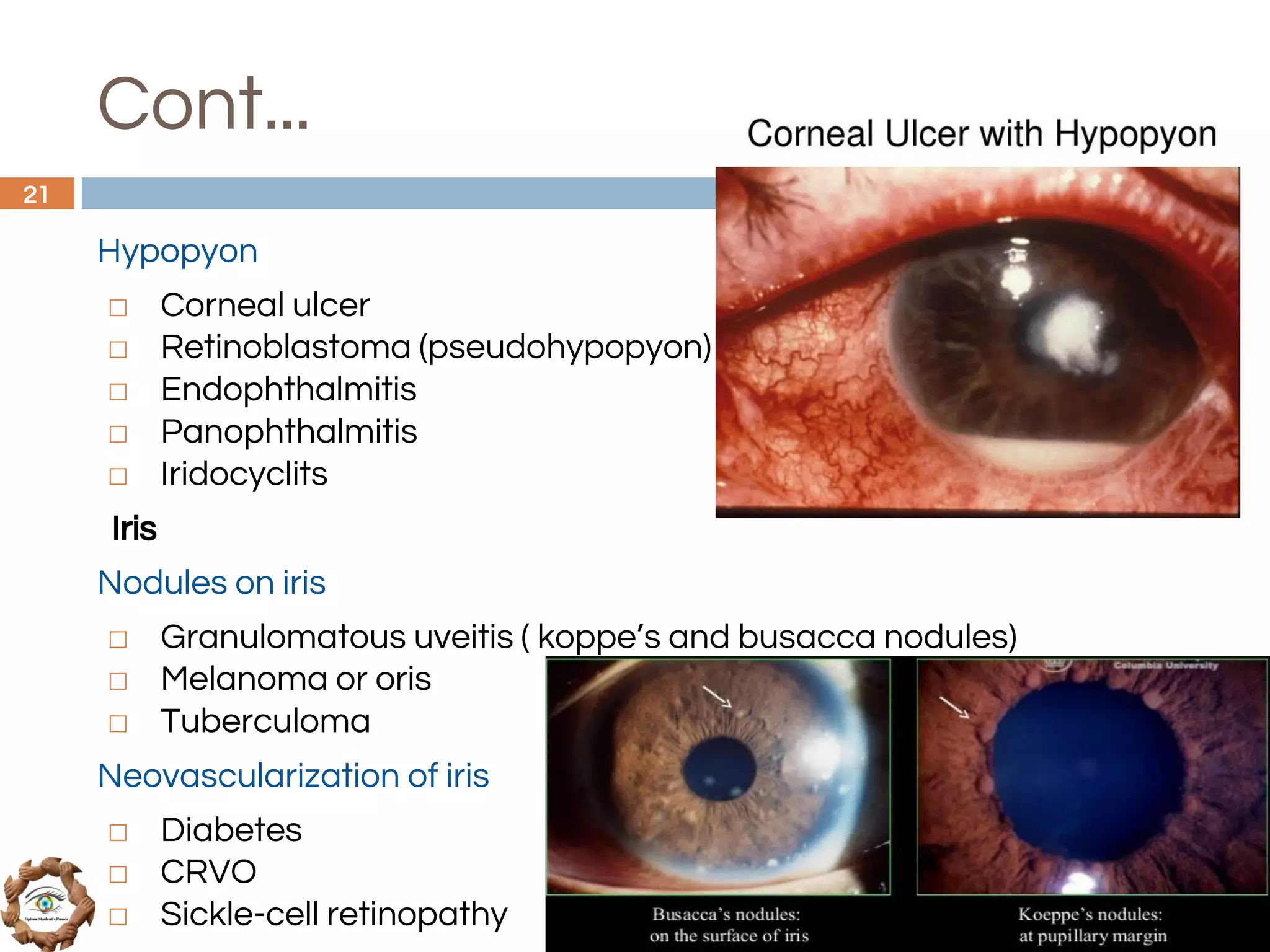
Hypopyon
◻ Corneal ulcer
◻ Retinoblastoma (pseudohypopyon)
◻ Endophthalmitis
◻ Panophthalmitis
◻ Iridocyclits
Iris
Nodules on iris
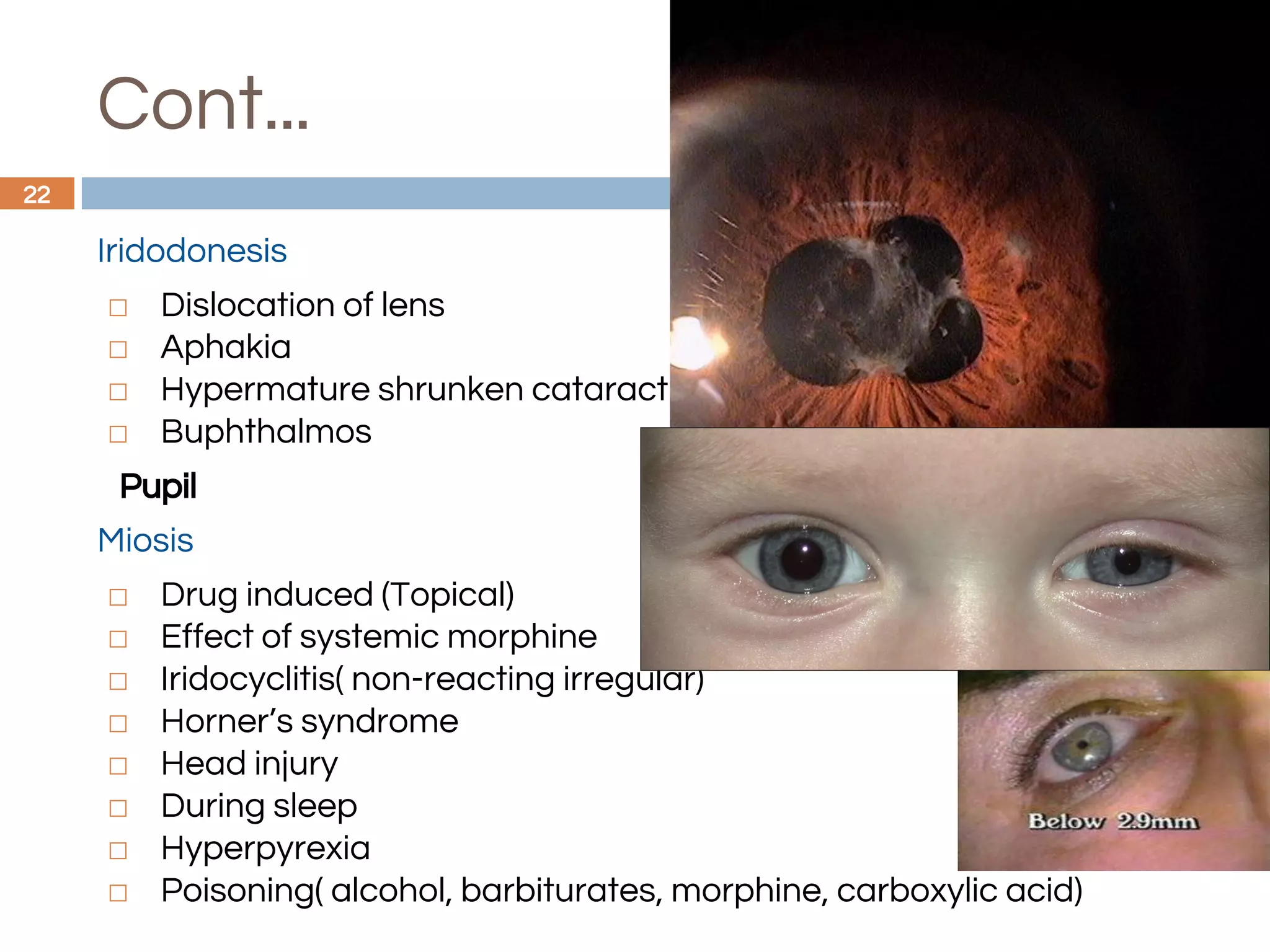
◻ Granulomatous uveitis ( koppe’s and busacca nodules)
◻ Melanoma or oris
◻ Tuberculoma
Neovascularization of iris
◻ Diabetes
◻ CRVO
◻ Sickle-cell retinopathy
21
Cont...
Iridodonesis
◻ Dislocation of lens
◻ Aphakia
◻ Hypermature shrunken cataract
◻ Buphthalmos
Pupil
Miosis
◻ Drug induced (Topical)
◻ Effect of systemic morphine
◻ Iridocyclitis( non-reacting irregular)
◻ Horner’s syndrome
◻ Head injury
◻ During sleep
◻ Hyperpyrexia
◻ Poisoning( alcohol, barbiturates, morphine, carboxylic acid)
22
Cont...
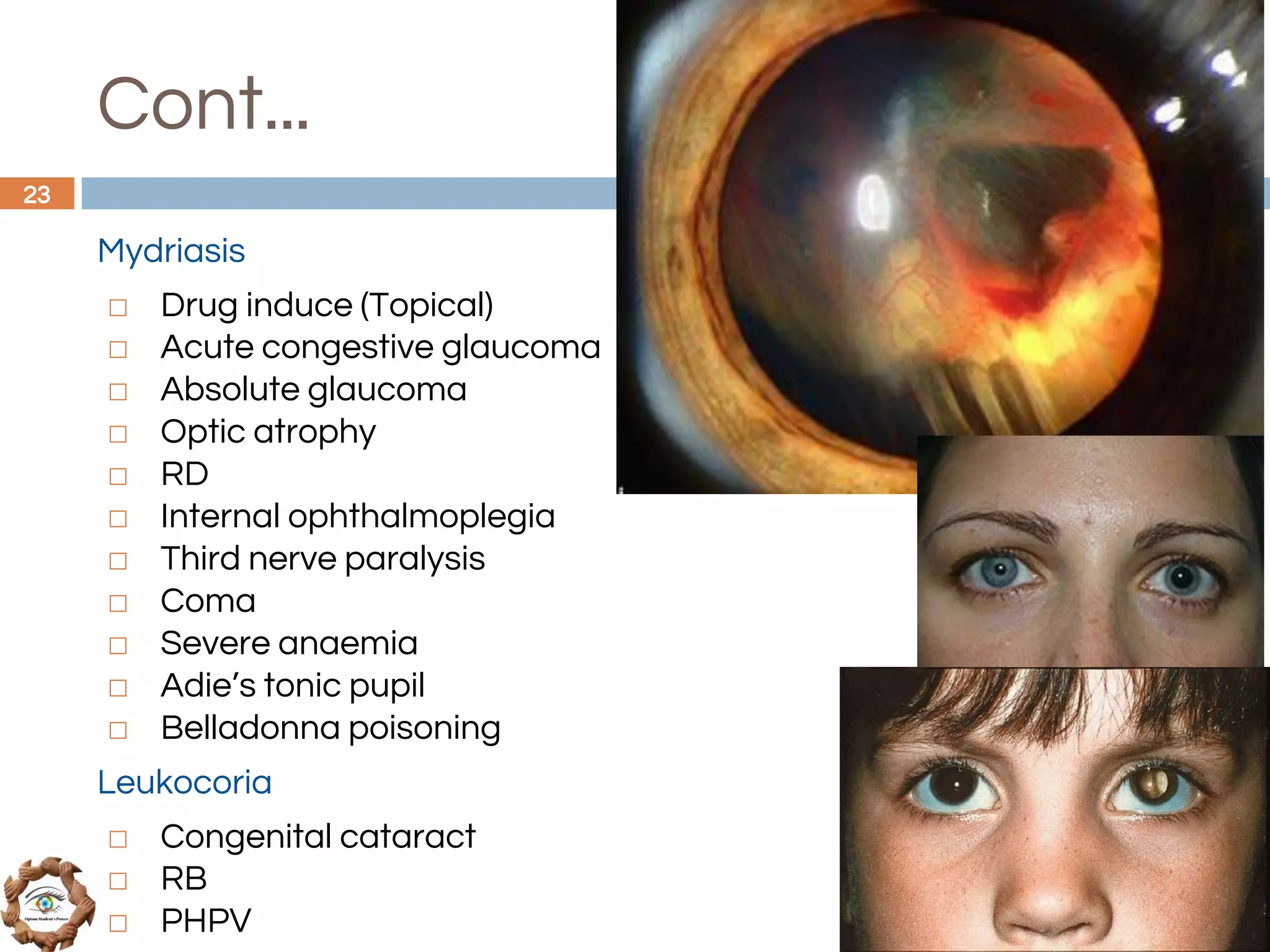
Mydriasis
◻ Drug induce (Topical)
◻ Acute congestive glaucoma
◻ Absolute glaucoma
◻ Optic atrophy
◻ RD
◻ Internal ophthalmoplegia
◻ Third nerve paralysis
◻ Coma
◻ Severe anaemia
◻ Adie’s tonic pupil
◻ Belladonna poisoning
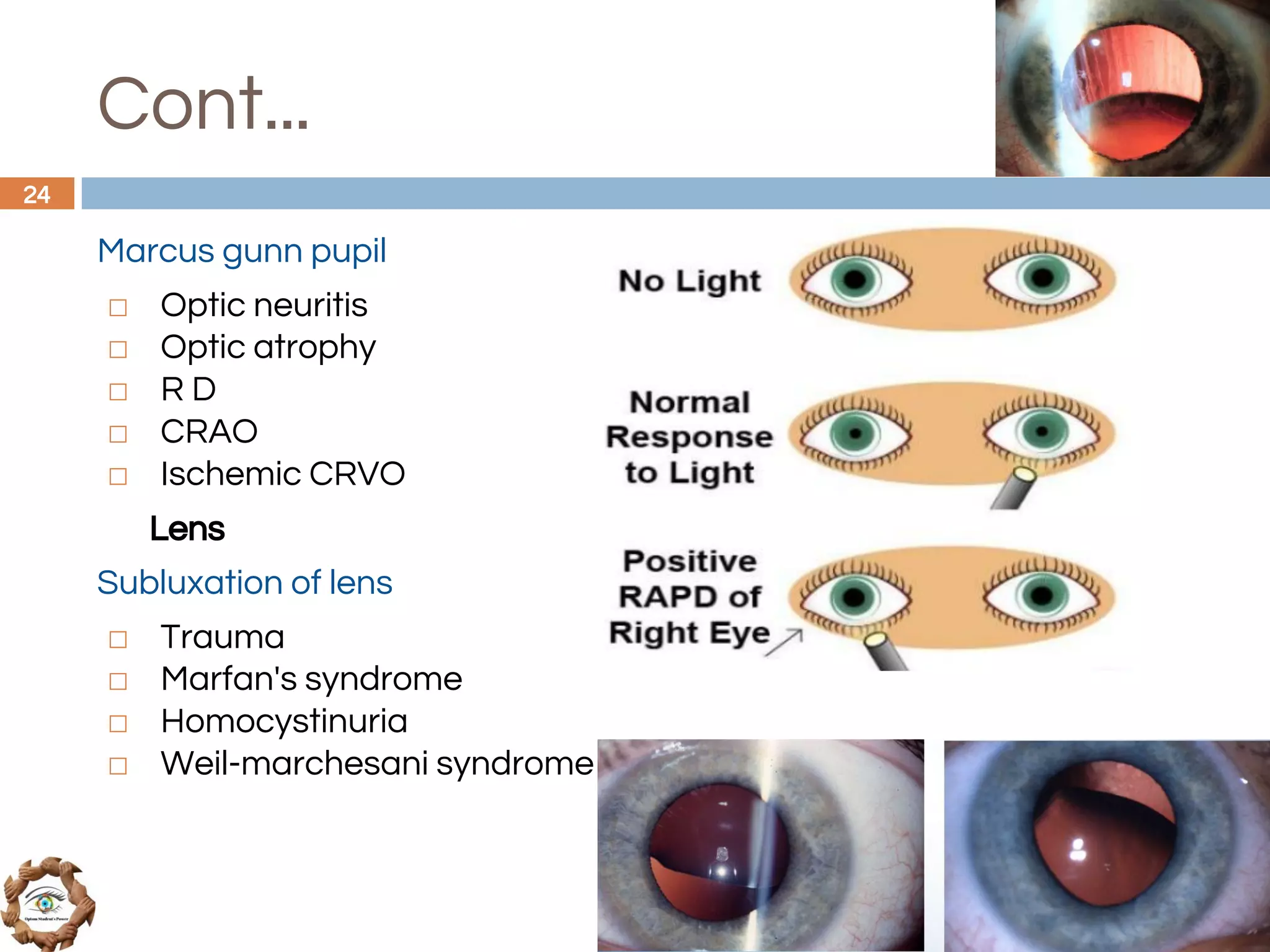
Leukocoria
◻ Congenital cataract
◻ RB
◻ PHPV
23
Cont...
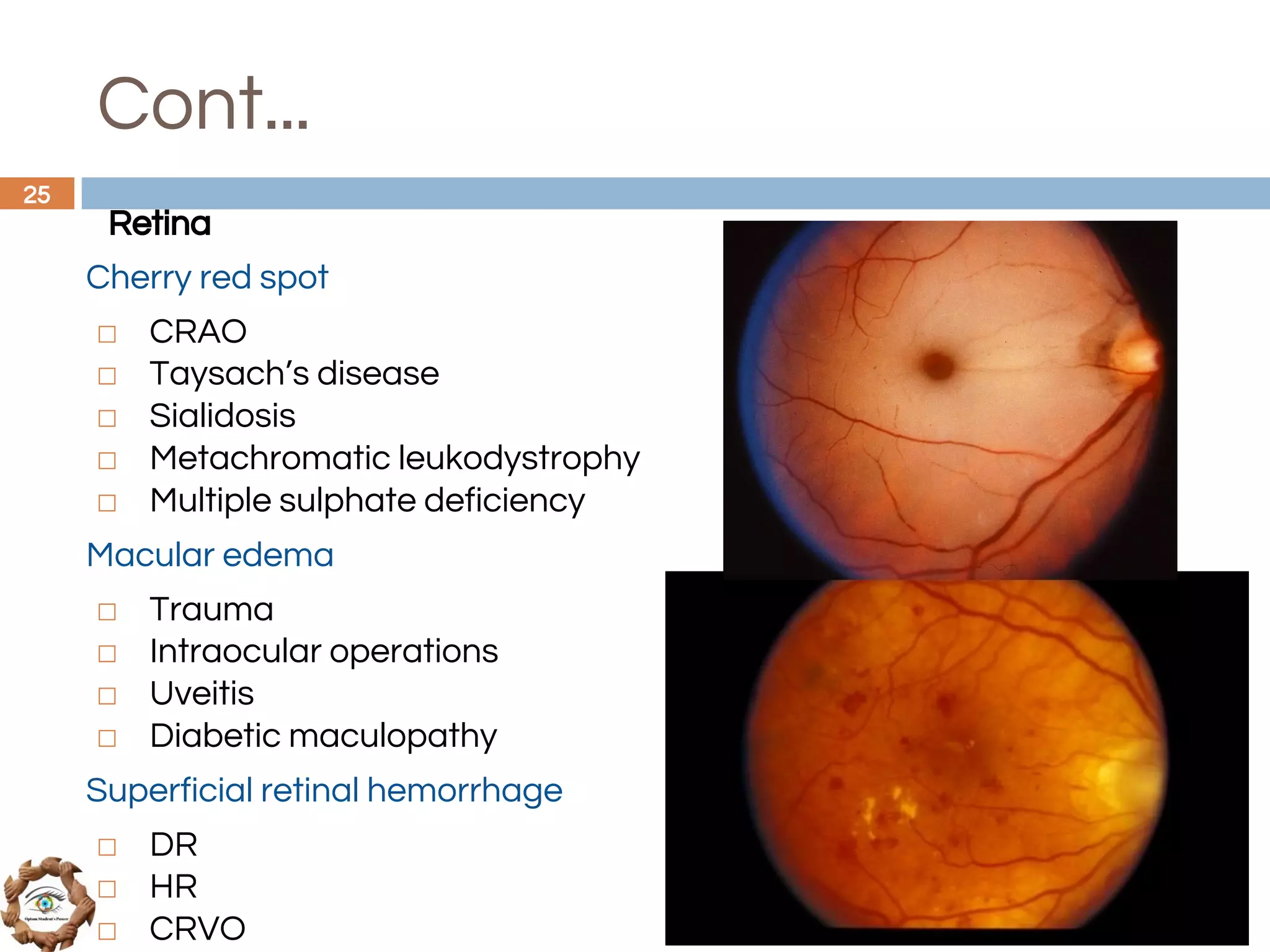
Marcus gunn pupil
◻ Optic neuritis
◻ Optic atrophy
◻ R D
◻ CRAO
◻ Ischemic CRVO
Lens
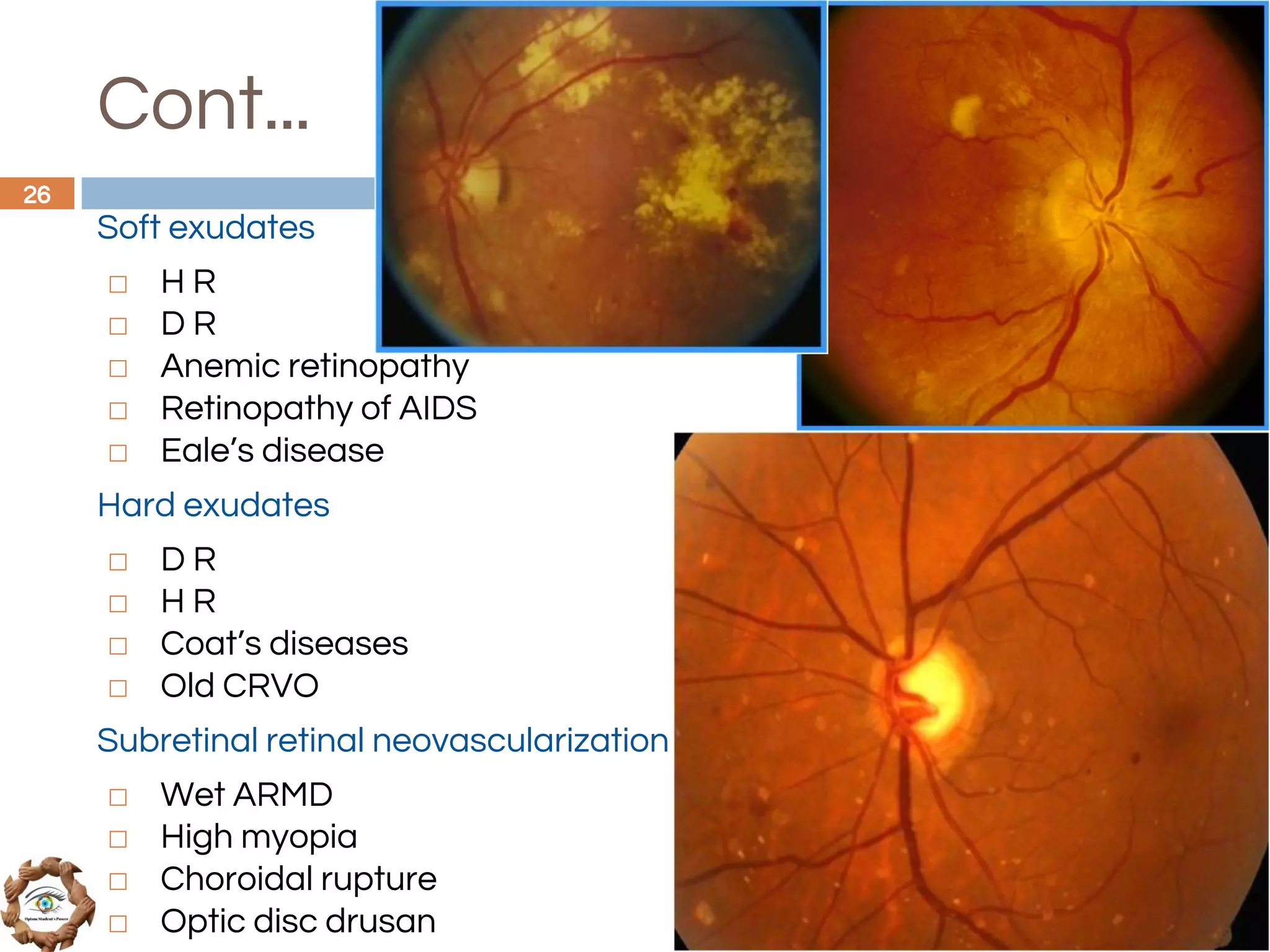
Subluxation of lens
◻ Trauma
◻ Marfan's syndrome
◻ Homocystinuria
◻ Weil-marchesani syndrome
24
Cont...
Retina
Cherry red spot
◻ CRAO
◻ Taysach’s disease
◻ Sialidosis
◻ Metachromatic leukodystrophy
◻ Multiple sulphate deficiency
Macular edema
◻ Trauma
◻ Intraocular operations
◻ Uveitis
◻ Diabetic maculopathy
Superficial retinal hemorrhage
◻ DR
◻ HR
◻ CRVO
25
Cont...
Soft exudates
◻ H R
◻ D R
◻ Anemic retinopathy
◻ Retinopathy of AIDS
◻ Eale’s disease
Hard exudates
◻ D R
◻ H R
◻ Coat’s diseases
◻ Old CRVO
Subretinal retinal neovascularization
◻ Wet ARMD
◻ High myopia
◻ Choroidal rupture
◻ Optic disc drusan
26
Cont...
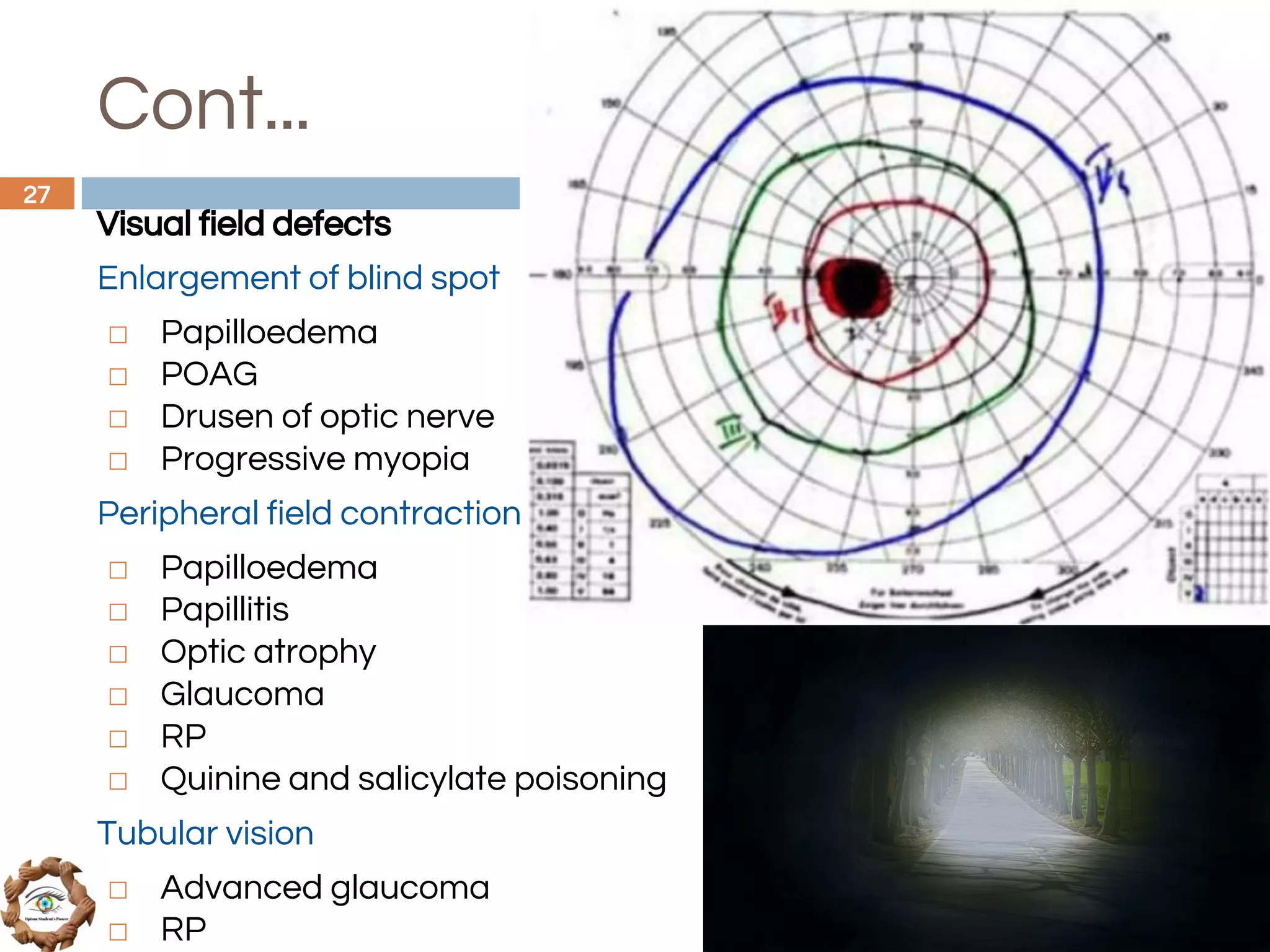
Visual field defects
Enlargement of blind spot
◻ Papilloedema
◻ POAG
◻ Drusen of optic nerve
◻ Progressive myopia
Peripheral field contraction
◻ Papilloedema
◻ Papillitis
◻ Optic atrophy
◻ Glaucoma
◻ RP
◻ Quinine and salicylate poisoning
Tubular vision
◻ Advanced glaucoma
◻ RP
27
Cont...
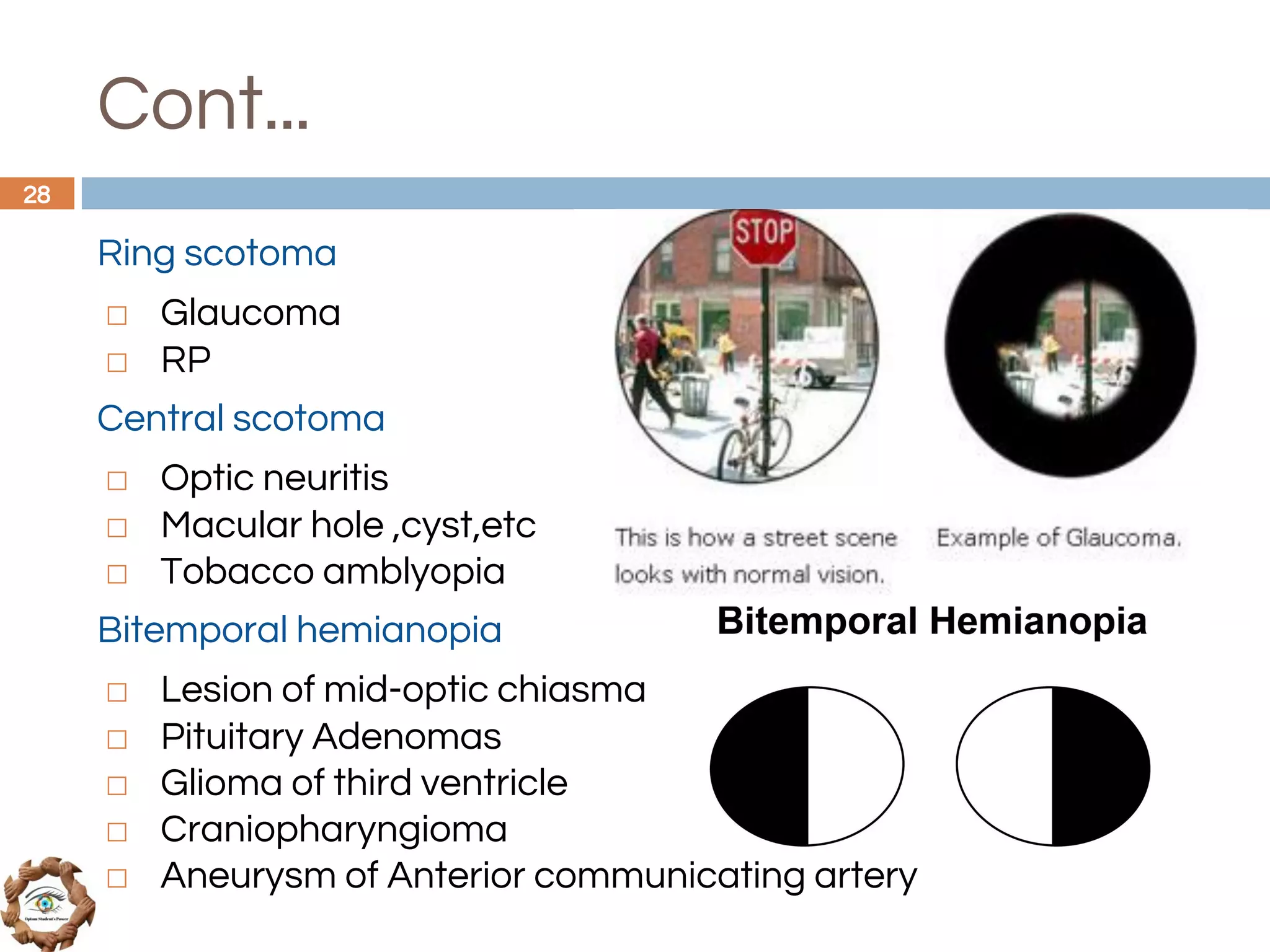
Ring scotoma
◻ Glaucoma
◻ RP
Central scotoma
◻ Optic neuritis
◻ Macular hole ,cyst,etc
◻ Tobacco amblyopia
Bitemporal hemianopia
◻ Lesion of mid-optic chiasma
◻ Pituitary Adenomas
◻ Glioma of third ventricle
◻ Craniopharyngioma
◻ Aneurysm of Anterior communicating artery
28
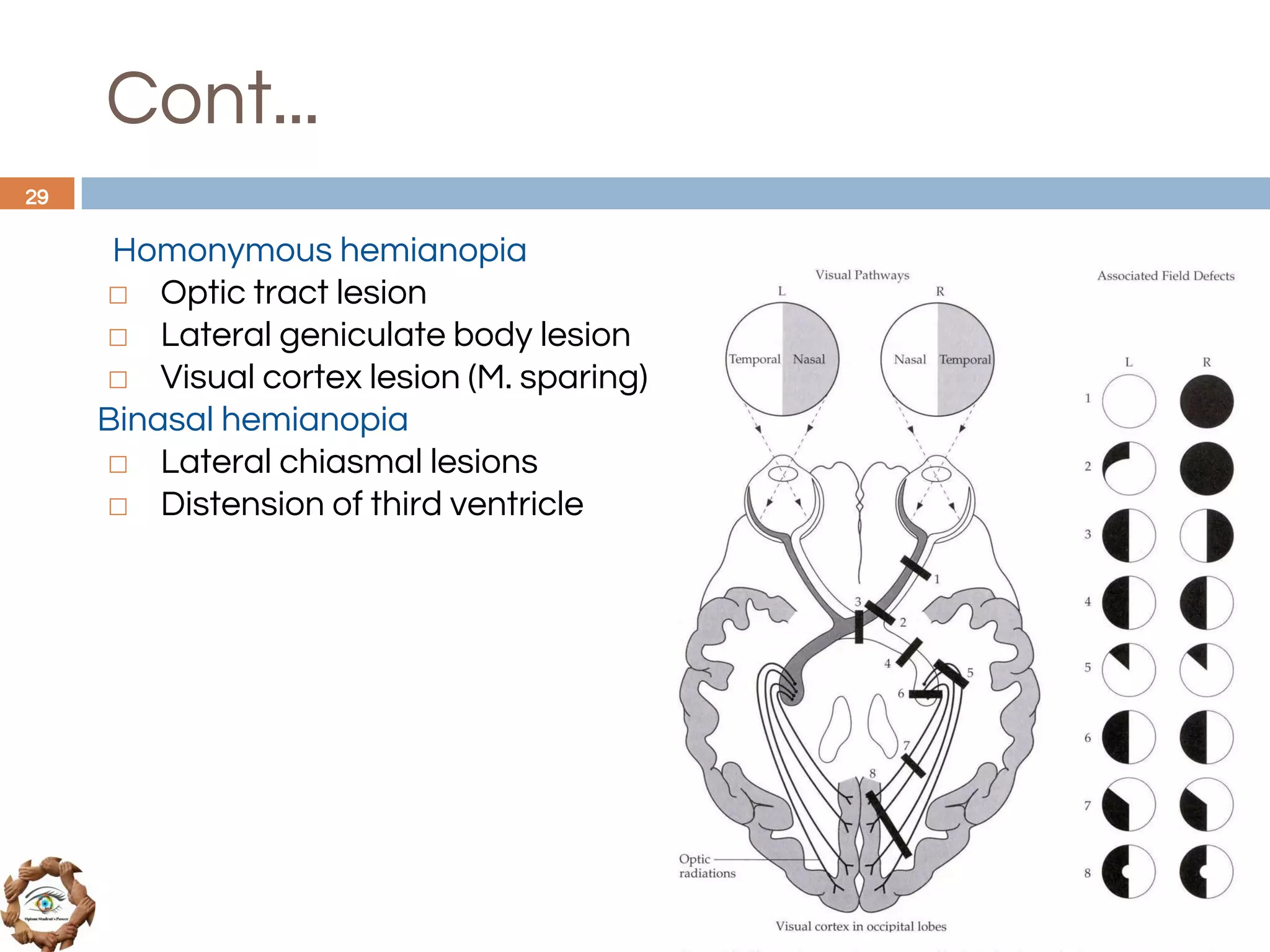
Homonymous hemianopia
◻ Optic tract lesion
◻ Lateral geniculate body lesion
◻ Visual cortex lesion (M. sparing)
Binasal hemianopia
◻ Lateral chiasmal lesions
◻ Distension of third ventricle
29
Cont...
examples of case
study
30
Case - 1
A 32 yr old female (homemaker) come with the complains of
DOV for near especially while stitching with good general
health.
ON examination:
Visual acuity at distance without correction
OD 20/20 OS 20/20
• Visual acuity at near without correction
OD 20/80 OS 20/80
• Entrance tests (color vision, cover test, Randot 2, NPC, EOMs, pupils,
screening visual fields) normal
• Retinoscopy with cycloplegia (H.A. 2%)
OD +1.50 OS +1.50
• Distance subjective refraction
OD +1.00 20/20 OS +1.00 20/20
31
Cont..
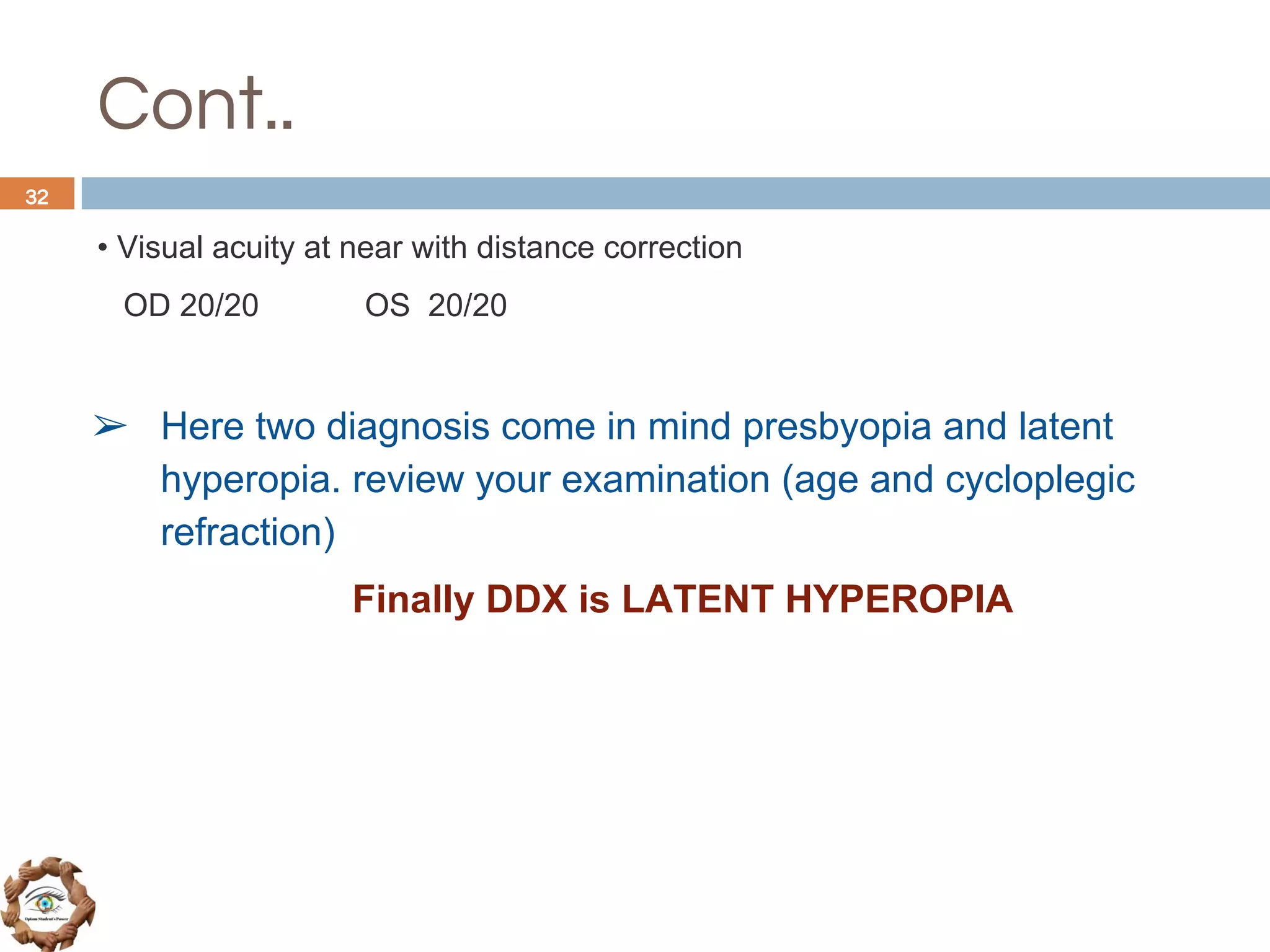
• Visual acuity at near with distance correction
OD 20/20 OS 20/20
➢ Here two diagnosis come in mind presbyopia and latent
hyperopia. review your examination (age and cycloplegic
refraction)
Finally DDX is LATENT HYPEROPIA
32
case- 2
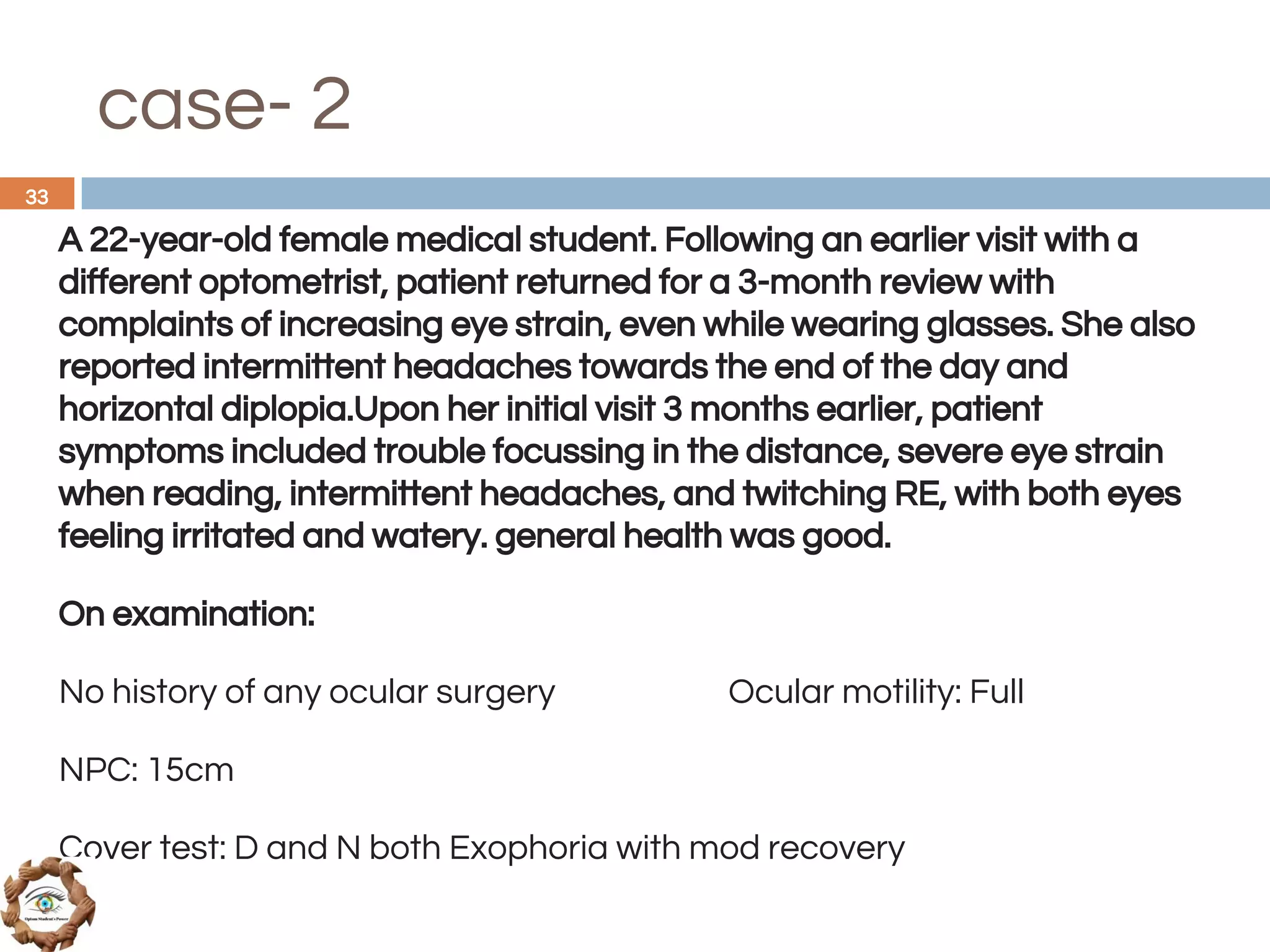
A 22-year-old female medical student. Following an earlier visit with a
different optometrist, patient returned for a 3-month review with
complaints of increasing eye strain, even while wearing glasses. She also
reported intermittent headaches towards the end of the day and
horizontal diplopia.Upon her initial visit 3 months earlier, patient
symptoms included trouble focussing in the distance, severe eye strain
when reading, intermittent headaches, and twitching RE, with both eyes
feeling irritated and watery. general health was good.
On examination:
No history of any ocular surgery Ocular motility: Full
NPC: 15cm
Cover test: D and N both Exophoria with mod recovery
33
Cont...
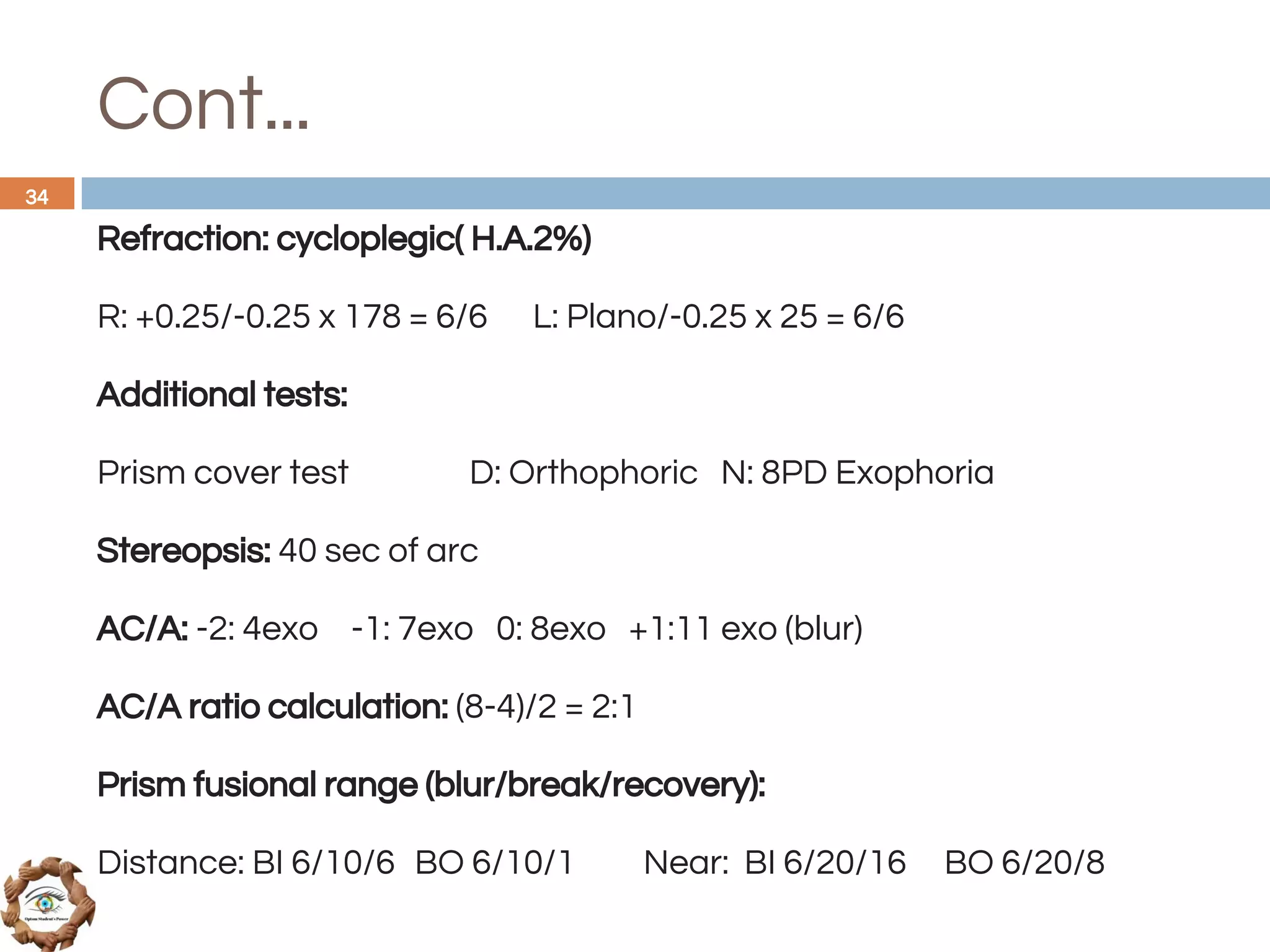
Refraction: cycloplegic( H.A.2%)
R: +0.25/-0.25 x 178 = 6/6 L: Plano/-0.25 x 25 = 6/6
Additional tests:
Prism cover test D: Orthophoric N: 8PD Exophoria
Stereopsis: 40 sec of arc
AC/A: -2: 4exo -1: 7exo 0: 8exo +1:11 exo (blur)
AC/A ratio calculation: (8-4)/2 = 2:1
Prism fusional range (blur/break/recovery):
Distance: BI 6/10/6 BO 6/10/1 Near: BI 6/20/16 BO 6/20/8
34
Cont...
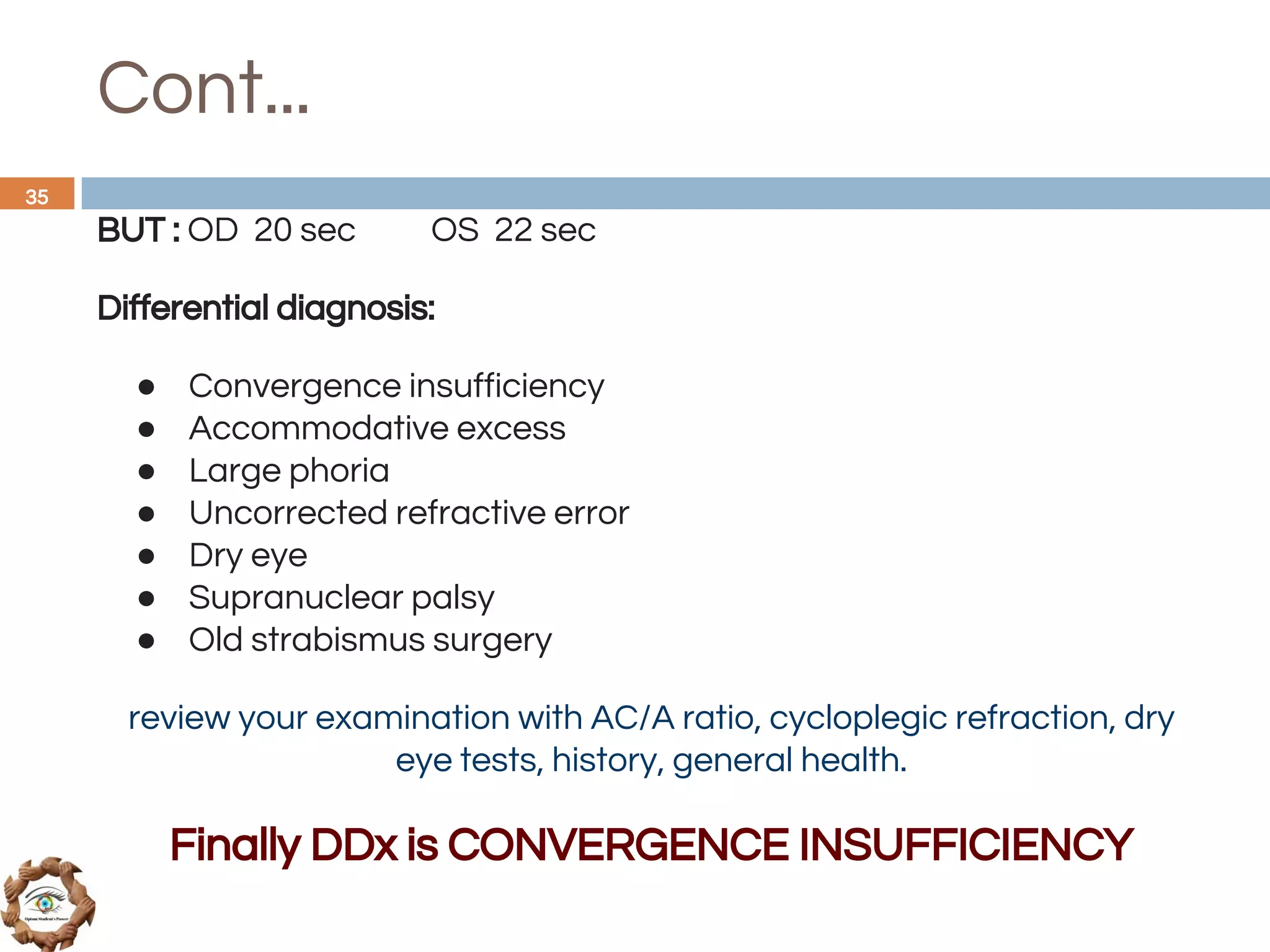
BUT : OD 20 sec OS 22 sec
Differential diagnosis:
● Convergence insufficiency
● Accommodative excess
● Large phoria
● Uncorrected refractive error
● Dry eye
● Supranuclear palsy
● Old strabismus surgery
review your examination with AC/A ratio, cycloplegic refraction, dry
eye tests, history, general health.
Finally DDx is CONVERGENCE INSUFFICIENCY
35
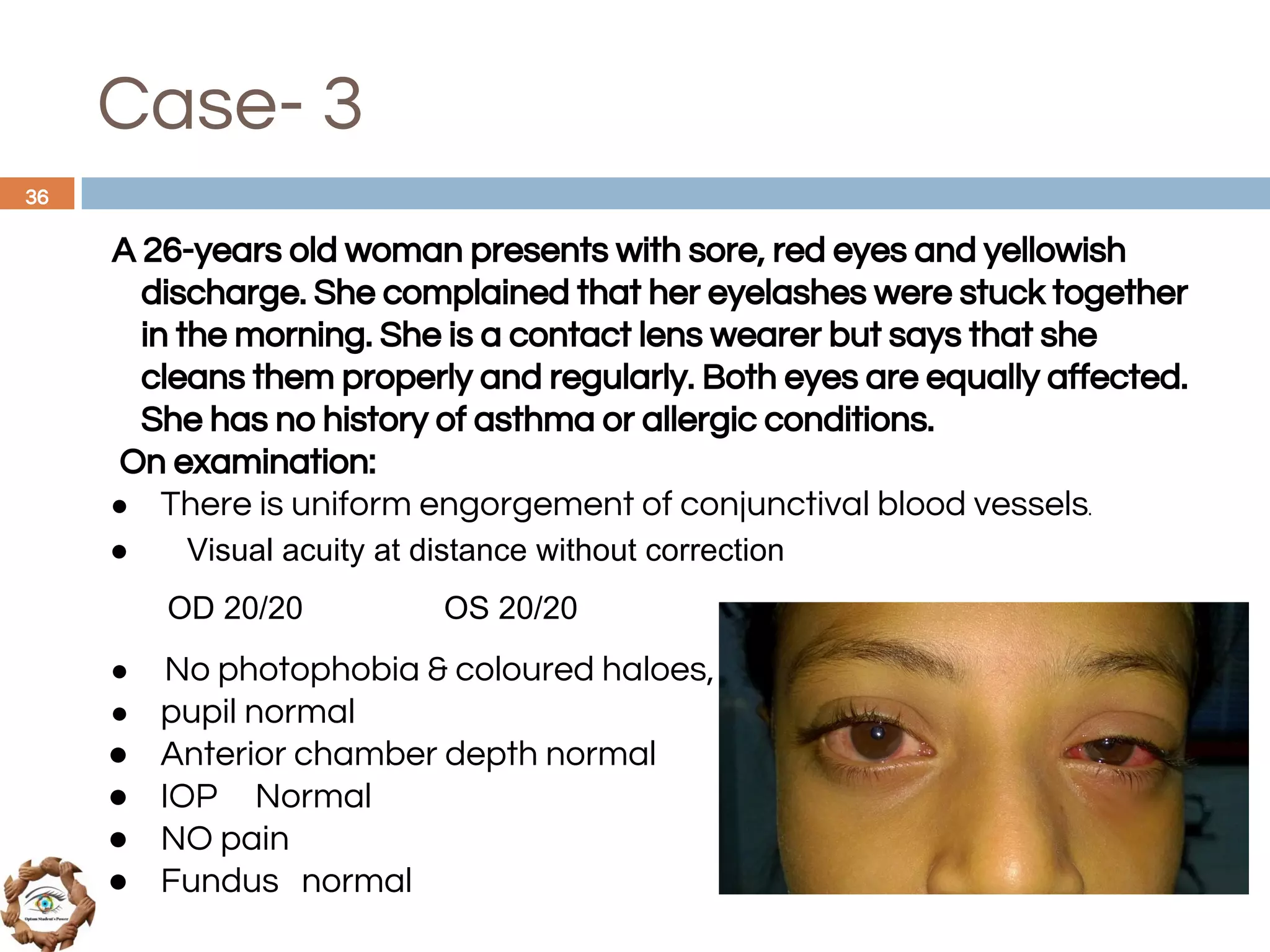
Case- 3
A 26-years old woman presents with sore, red eyes and yellowish
discharge. She complained that her eyelashes were stuck together
in the morning. She is a contact lens wearer but says that she
cleans them properly and regularly. Both eyes are equally affected.
She has no history of asthma or allergic conditions.
On examination:
● There is uniform engorgement of conjunctival blood vessels.
● Visual acuity at distance without correction
OD 20/20 OS 20/20
● No photophobia & coloured haloes,
● pupil normal
● Anterior chamber depth normal
● IOP Normal
● NO pain
● Fundus normal
36
Cont...
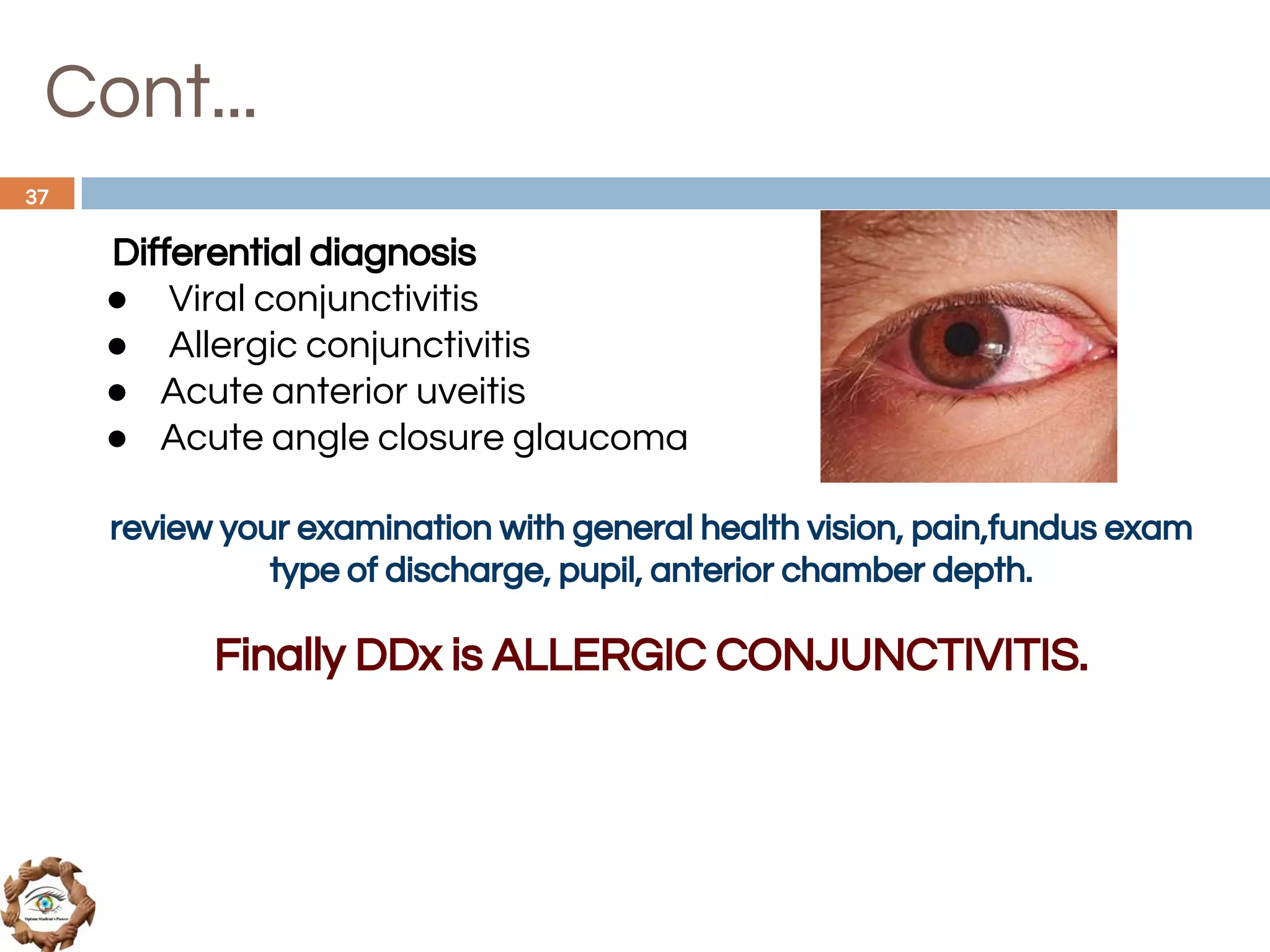
Differential diagnosis
● Viral conjunctivitis
● Allergic conjunctivitis
● Acute anterior uveitis
● Acute angle closure glaucoma
review your examination with general health vision, pain,fundus exam
type of discharge, pupil, anterior chamber depth.
Finally DDx is ALLERGIC CONJUNCTIVITIS.
37
38
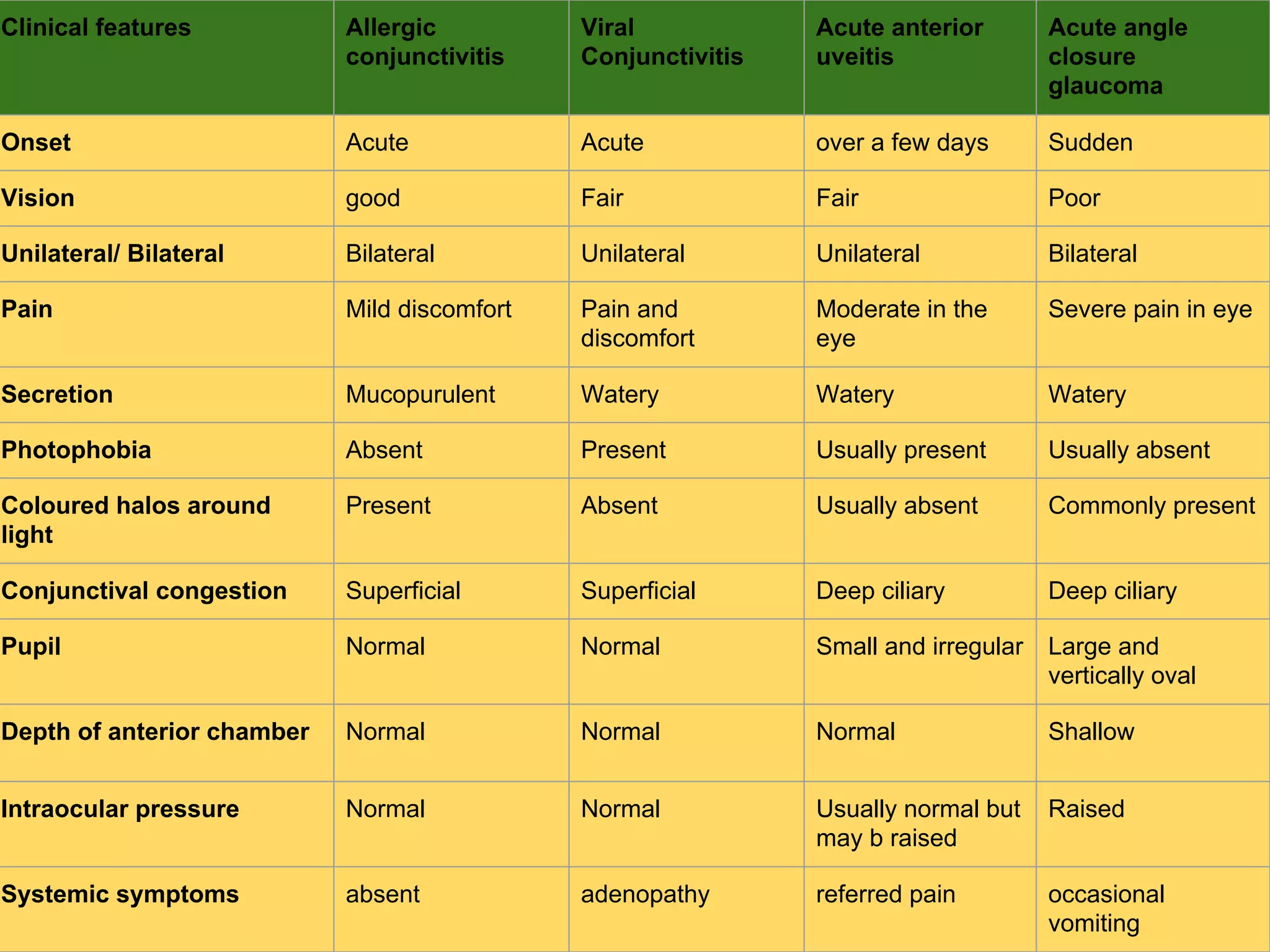
Clinical features Allergic
conjunctivitis
Viral
Conjunctivitis
Acute anterior
uveitis
Acute angle
closure
glaucoma
Onset Acute Acute over a few days Sudden
Vision good Fair Fair Poor
Unilateral/ Bilateral Bilateral Unilateral Unilateral Bilateral
Pain Mild discomfort Pain and
discomfort
Moderate in the
eye
Severe pain in eye
Secretion Mucopurulent Watery Watery Watery
Photophobia Absent Present Usually present Usually absent
Coloured halos around
light
Present Absent Usually absent Commonly present
Conjunctival congestion Superficial Superficial Deep ciliary Deep ciliary
Pupil Normal Normal Small and irregular Large and
vertically oval
Depth of anterior chamber Normal Normal Normal Shallow
Intraocular pressure Normal Normal Usually normal but
may b raised
Raised
Systemic symptoms absent adenopathy referred pain occasional
vomiting
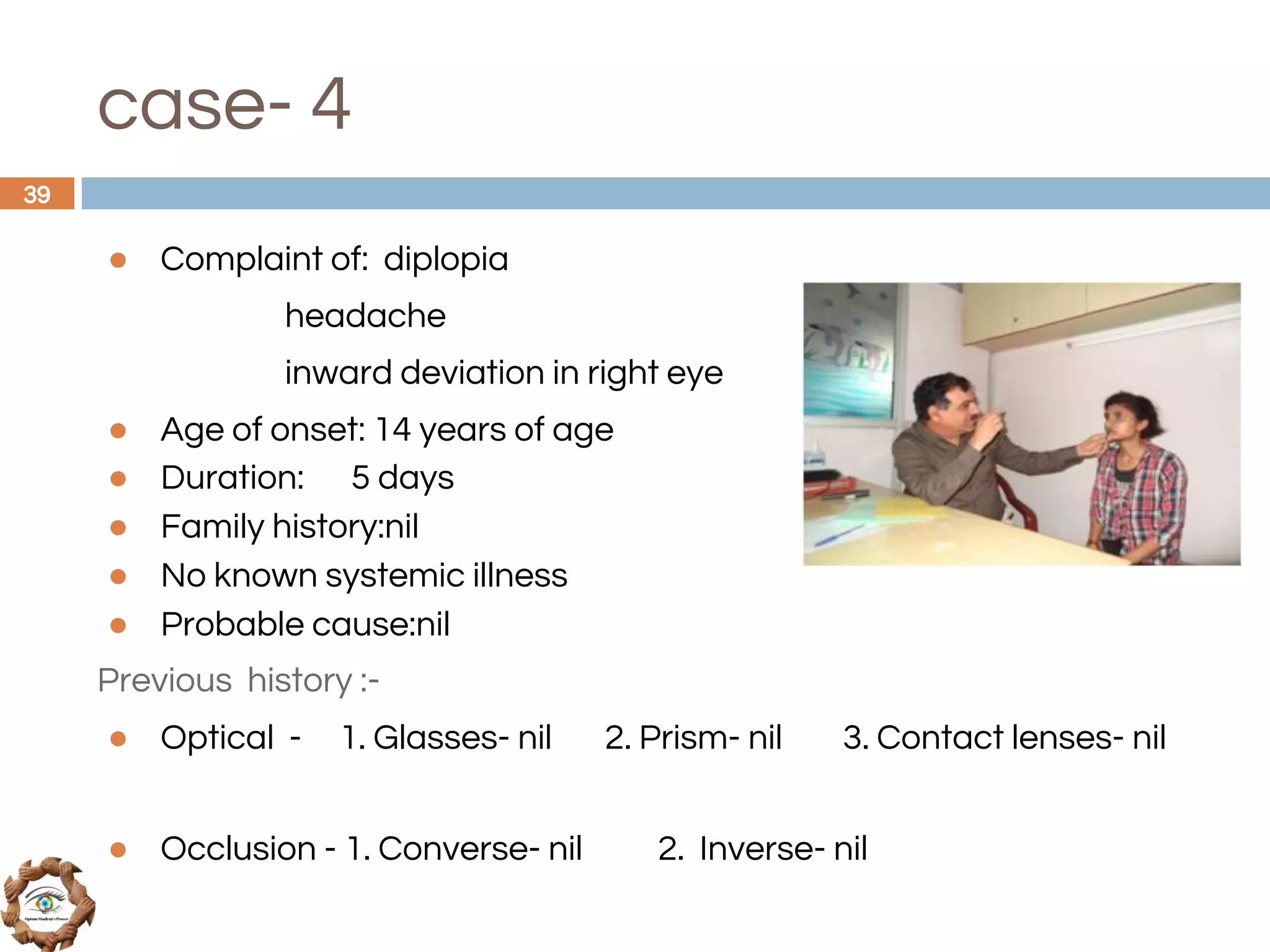
case- 4
● Complaint of: diplopia
headache
inward deviation in right eye
● Age of onset: 14 years of age
● Duration: 5 days
● Family history:nil
● No known systemic illness
● Probable cause:nil
Previous history :-
● Optical - 1. Glasses- nil 2. Prism- nil 3. Contact lenses- nil
● Occlusion - 1. Converse- nil 2. Inverse- nil
39
Cont….
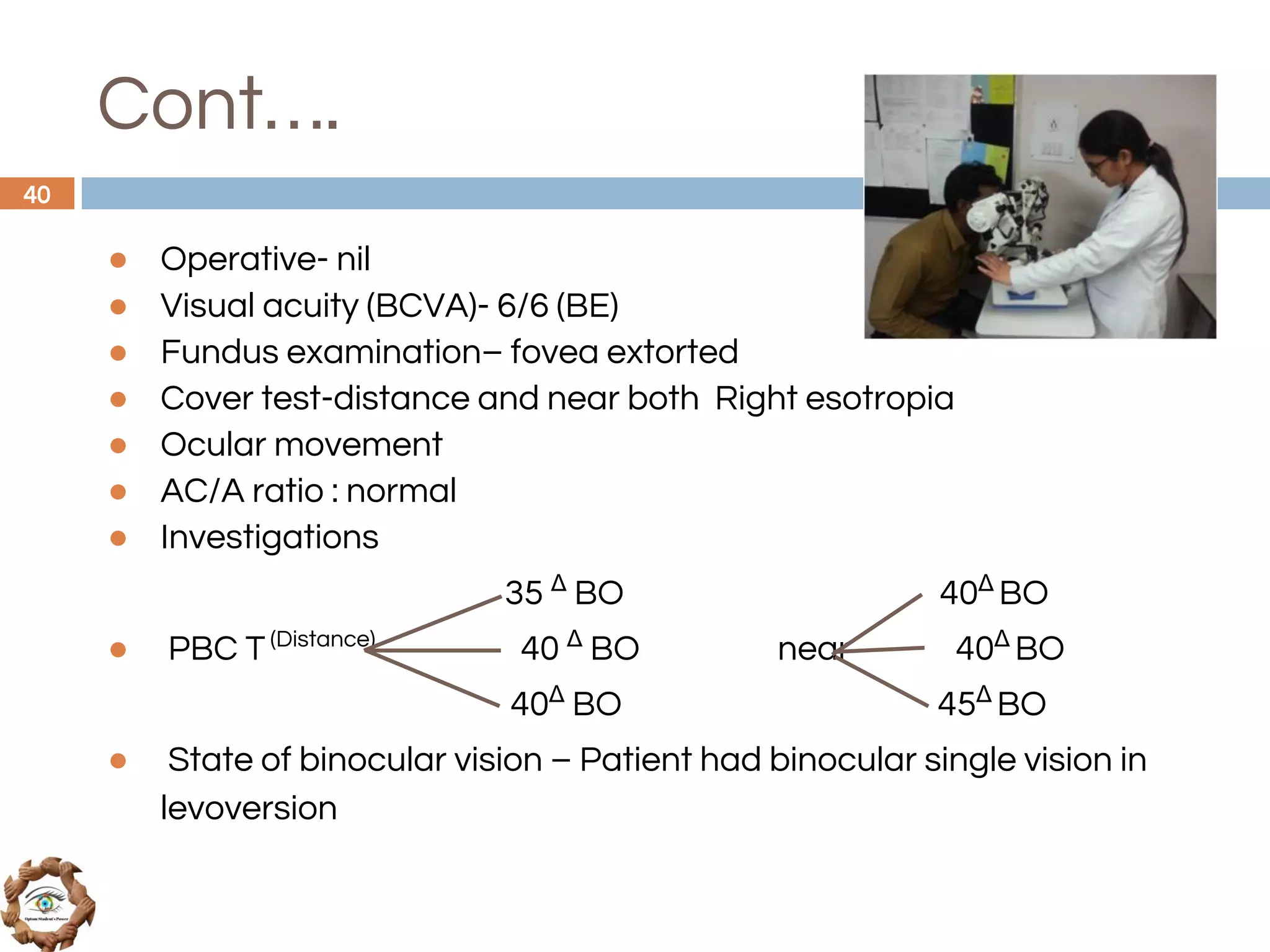
● Operative- nil
● Visual acuity (BCVA)- 6/6 (BE)
● Fundus examination– fovea extorted
● Cover test-distance and near both Right esotropia
● Ocular movement
● AC/A ratio : normal
● Investigations
35 Δ
BO 40Δ
BO
● PBC T(Distance)
40 Δ
BO near 40Δ
BO
40Δ
BO 45Δ
BO
● State of binocular vision – Patient had binocular single vision in
levoversion
40
Cont...
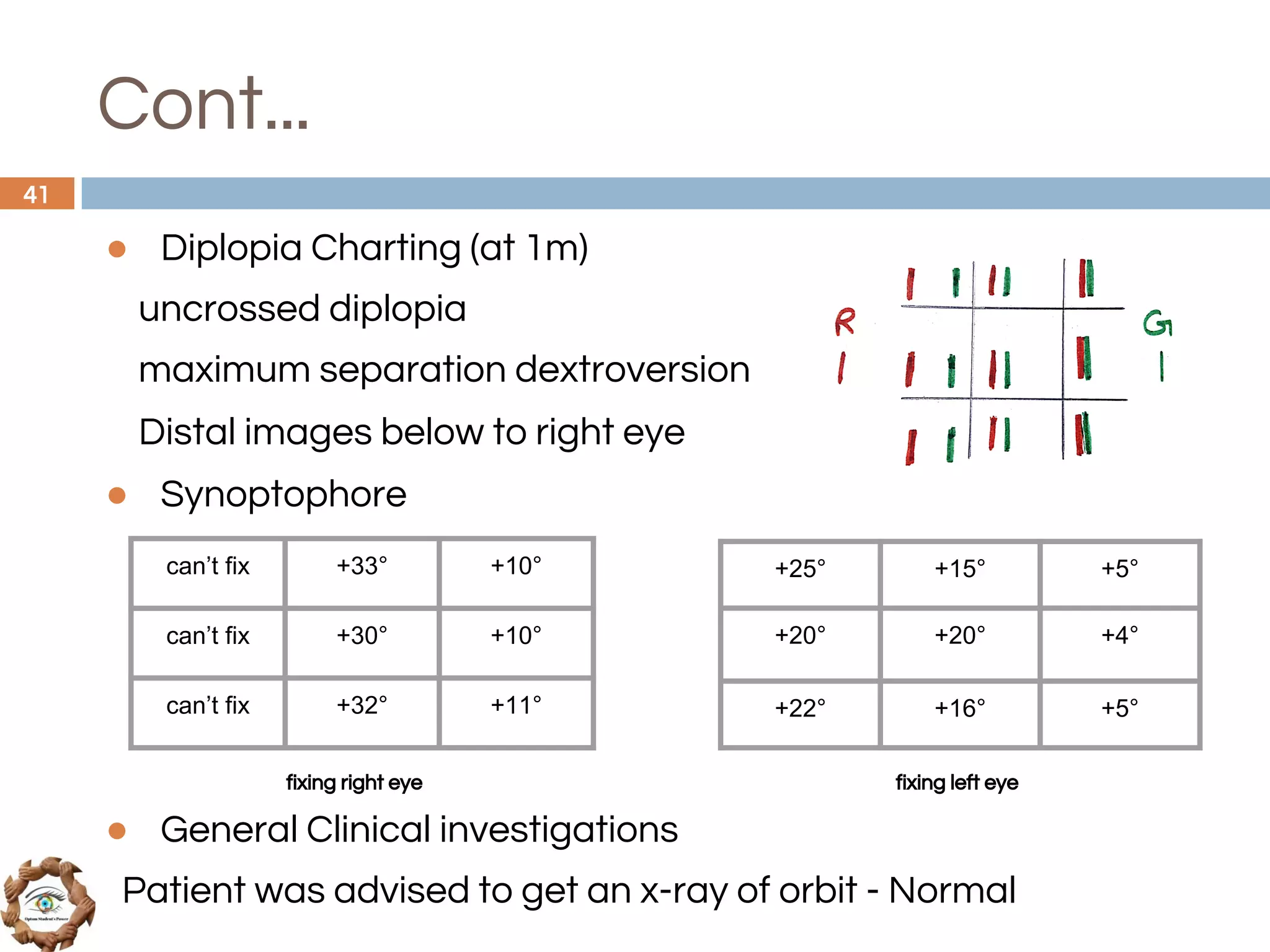
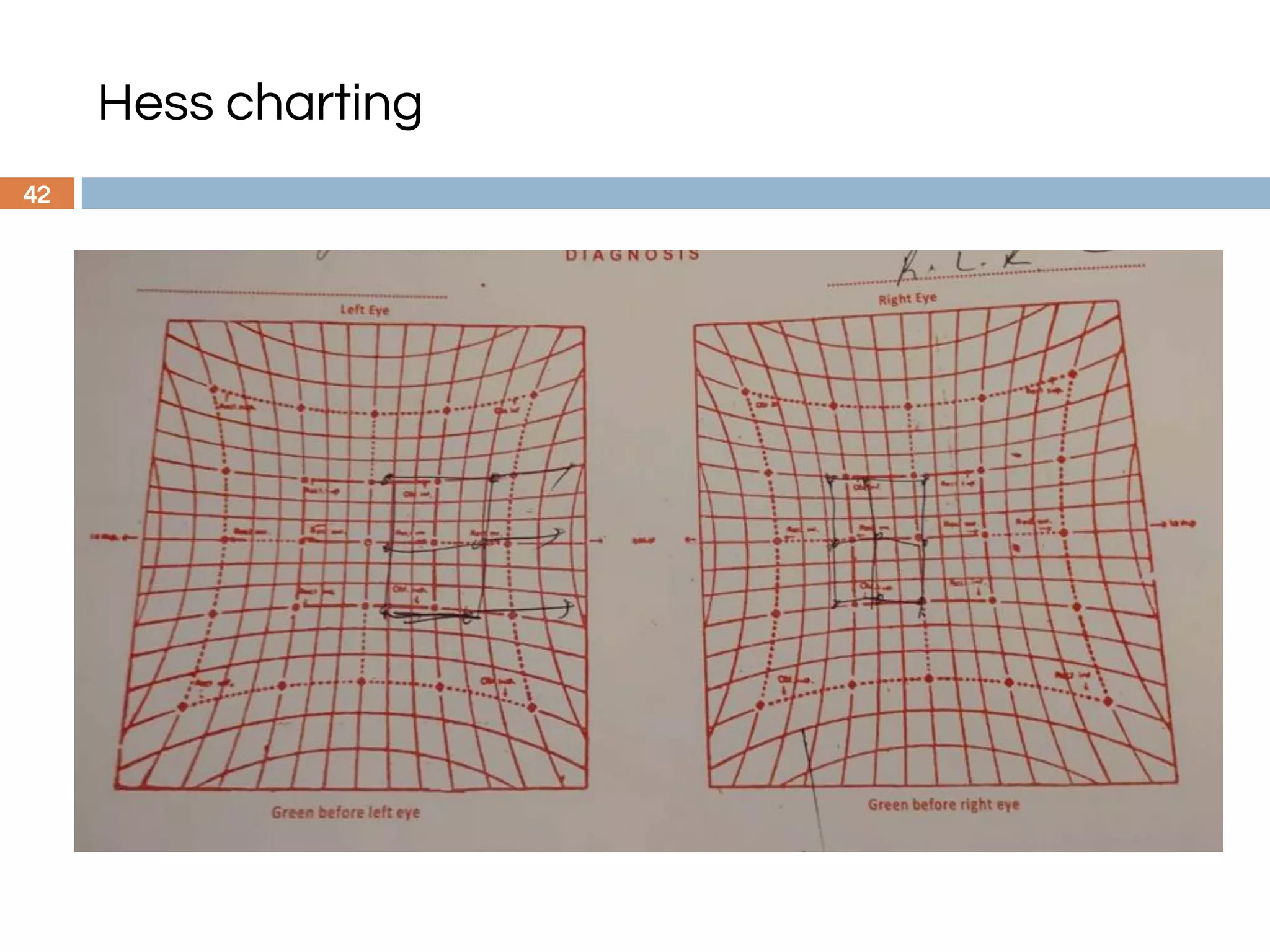
● Diplopia Charting (at 1m)
uncrossed diplopia
maximum separation dextroversion
Distal images below to right eye
● Synoptophore
fixing right eye fixing left eye
● General Clinical investigations
Patient was advised to get an x-ray of orbit - Normal
41
can’t fix +33° +10°
can’t fix +30° +10°
can’t fix +32° +11°
+25° +15° +5°
+20° +20° +4°
+22° +16° +5°
Hess charting
42
differential diagnosis
● Right 6th nerve palsy
● Right esotropia
● Right eso duane's retraction syndrome
review your examination with general health, vision,deviation in 9
cardinal position,fundus exam,ocular movements, PBCT, Diplopia
charting.
Finally DDx is Right 6th nerve palsy
43
THANK
YOU

Protocol for differential diagnosis of common ocular diseases

  • 1.
    Optom. SIMI AFROZ A.I.I.M.S,New Delhi Optom Student’s Power Protocol for DIFFERENTIAL DIAGNOSIS common OCULAR diseases 1
  • 2.
    Definition ● Differential: Adifference between two values on a scale. ● Diagnosis: Identification of the nature and cause of problem. ● Differential diagnosis (Ddx) The process of differentiating between two or more conditions which share similar signs or symptoms. ★ Develope a systematic,routine method for differential diagnosis generation. 2
  • 3.
    Rules: what isa Ddx? ❖ Recognize a collection of signs and symptoms. ❖ Recall basic pathophysiology. ❖ Restate in terms of disease. ❖ Reconnect with the initial complaints. ❖ Framing the probability test. 3
  • 4.
    Sagacious Diagnostic Errors 4 Errors ●faulty hypothesis generation. ● faulty context formulation. ● Faulty information gathering. ○ inaccurate assessment ○ wrong interpretation of tests ● premature closure of diagnosis ● “No fault” errors 4 Examples ● Hmm...DOV for near - presbyopia? ● “35 years old? I thought you said 45 years old.” ● “ its just u need refraction.” ● “oh! you are myopic…” ● “This is (+) so you are having …..” ● “This is(-) so it is not that…” ● “ I am always correct….”
  • 5.
    Many diagnostic erroroccur because we try to fit our hypothesis rather than finding the actual disease. 5
  • 6.
  • 7.
    Step one: Historytaking A careful meticulous approach to history taking is the foundation of successful clinical diagnosis. Begins by asking: ● Demographic data: name age, sex, occupation,etc. ● Chief complaints: always be recorded in a chronological order with their duration. ● History of present illness: make notes of following points - mode of onset with duration, severity, progression, accompaniment of each symptom. ● History of past illness: similar ocular complaints in past, similar complains in other eye, trauma to eye in past, any ocular surgery in past, any systemic disease in past, drug intake. ● Family history: in heratable ocular disorders. 7
  • 8.
    Step two :ocular examination ◻ testing of visual acuity: monocular and binocular measurement of distance and near visual acuity and if subject is having glasses then with glasses also. ◻ external ocular examination: ⬜ inspection in diffuse light: preliminary examination of eyeballs. ⬜ Focal illumination examination: detailed examination under magnification. ◻ Fundus examination: ⬜ media ⬜ optic disc; shape, size, margins,colour, cup - disc ratio,neovascularization,etc ⬜ macula ⬜ retinal blood vessels 8
  • 9.
    Step three: Reconnection summarizeyour finding accordingly. 9
  • 10.
    Step four :Special Tests Extra test for confirming your diagnosis (if required). 10
  • 11.
    Step five: Diagnosis combineyour clinical finding and make final diagnosis 11
  • 12.
    Common ocular symptomsand their causes Sudden painless loss of vision ◻ Central retinal artery occlusion ◻ Massive vitreous hemorrhage ◻ Retinal detachment including macula ◻ Ischemic retinal vein occlusion Sudden painless defective vision ◻ Central serous retinopathy ◻ Optic neuritis ◻ Methyl alcohol amblyopia ◻ Non ischemic central vein occlusion Sudden painful loss of vision ◻ Acute congestive glaucoma ◻ Acute iridocyclitis ◻ Chemical or mechanical injury to eyeball 12
  • 13.
    Cont... Gradual painless lossof vision ◻ Refractive error ◻ Pterygium ◻ Corneal degeneration ◻ Corneal dystrophy ◻ Cataract ◻ Optic atrophy ◻ Diabetic retinopathy ◻ Chorioretinal degeneration ◻ Age related macular degeneration Gradual painful loss of vision ◻ Chronic glaucoma ◻ Chronic iridociclitis ◻ Corneal ulcer 13
  • 14.
    Cont... Amaurosis faux ◻ Papilloedema ◻Giant cell arteritis ◻ Migraine ◻ Hypertension ◻ Carotid artery disease Night blindness ◻ Vitamin A deficiency ◻ Retinitis pigmentosa ◻ Pathological myopia ◻ Advanced case of POAG Day blindness ◻ Polar, subcapsular cataract ◻ Central corneal opacity ◻ Congenital deficiency of cone 14
  • 15.
    Cont... Defective vision fornear ◻ Presbyopia ◻ Cycloplegia ◻ Insufficiency of accommodation Black spot in front of eye ◻ Vitreous hemorrhage ◻ Vitreous degeneration ◻ Lenticular opacity Flashes of light in front of eye ◻ Prodromal symptom of retinal detachment ◻ Vitreous traction ◻ Retinitis Micropsia ,macropsia and metamorphopsia ◻ Central chorioretinitis 15
  • 16.
    Cont... Coloured haloes ◻ Acutecongestive glaucoma ◻ Early cataract ◻ Mucopurulent conjunctivitis Diplopia ◻ Uniocular: subluxated lens, double pupil, keratoconus ◻ Binocular: paralytic squint, diabetes, myasthenia gravis, blow out fracture, anisometropia, after squint correction in case of ARC. 16
  • 17.
    Common ocular signsand their causes Conjunctiva Conjunctival follicle ◻ Trachoma ◻ Acute follicular conjunctivitis ◻ Chronic follicular conjunctivitis Conjunctival papillae ◻ Trachoma ◻ Spring catarrh ◻ Allergic conjunctivitis ◻ Giant papillary conjunctivitis Concretions ◻ Trauma ◻ Degenerative conditions ◻ Idiopathic 17
  • 18.
    Cont... Cornea Decreased corneal sensation ◻Herpes simplex keratitis ◻ Neuroparalytic keratitis ◻ Leprosy ◻ Absolute glaucoma ◻ Herpes zoster keratitis Superficial corneal vascularization ◻ Trachoma ◻ Superficial corneal ulcer ◻ Phlyctenular keratoconjunctivitis Deep corneal vascularisation ◻ Deep corneal ulcer ◻ Chemical burns ◻ After keratoplasty 18
  • 19.
    Cont... Increased corneal thickness ◻Corneal edema Abnormal corneal surface ◻ Keratoconus ◻ Corneal ulcer ◻ Corneal aberrations Anterior Chamber Shallow anterior chamber ◻ PACG ◻ Hypermetropia ◻ Leaking wound ◻ Corneal perforation ◻ Iris bombe formation ◻ Adherent leucoma 19
  • 20.
    Cont... Deep anterior chamber ◻Aphakia ◻ Myopia ◻ Total posterior synechiae ◻ Keratoconus ◻ Keratoglobus ◻ Anterior dislocation of lens ◻ Posterior perforation of globe ◻ Buphthalmos Hyphema ◻ Corneal injury ◻ Herpes zoster iritis ◻ Intraocular tumors 20
  • 21.
    Cont... Hypopyon ◻ Corneal ulcer ◻Retinoblastoma (pseudohypopyon) ◻ Endophthalmitis ◻ Panophthalmitis ◻ Iridocyclits Iris Nodules on iris ◻ Granulomatous uveitis ( koppe’s and busacca nodules) ◻ Melanoma or oris ◻ Tuberculoma Neovascularization of iris ◻ Diabetes ◻ CRVO ◻ Sickle-cell retinopathy 21
  • 22.
    Cont... Iridodonesis ◻ Dislocation oflens ◻ Aphakia ◻ Hypermature shrunken cataract ◻ Buphthalmos Pupil Miosis ◻ Drug induced (Topical) ◻ Effect of systemic morphine ◻ Iridocyclitis( non-reacting irregular) ◻ Horner’s syndrome ◻ Head injury ◻ During sleep ◻ Hyperpyrexia ◻ Poisoning( alcohol, barbiturates, morphine, carboxylic acid) 22
  • 23.
    Cont... Mydriasis ◻ Drug induce(Topical) ◻ Acute congestive glaucoma ◻ Absolute glaucoma ◻ Optic atrophy ◻ RD ◻ Internal ophthalmoplegia ◻ Third nerve paralysis ◻ Coma ◻ Severe anaemia ◻ Adie’s tonic pupil ◻ Belladonna poisoning Leukocoria ◻ Congenital cataract ◻ RB ◻ PHPV 23
  • 24.
    Cont... Marcus gunn pupil ◻Optic neuritis ◻ Optic atrophy ◻ R D ◻ CRAO ◻ Ischemic CRVO Lens Subluxation of lens ◻ Trauma ◻ Marfan's syndrome ◻ Homocystinuria ◻ Weil-marchesani syndrome 24
  • 25.
    Cont... Retina Cherry red spot ◻CRAO ◻ Taysach’s disease ◻ Sialidosis ◻ Metachromatic leukodystrophy ◻ Multiple sulphate deficiency Macular edema ◻ Trauma ◻ Intraocular operations ◻ Uveitis ◻ Diabetic maculopathy Superficial retinal hemorrhage ◻ DR ◻ HR ◻ CRVO 25
  • 26.
    Cont... Soft exudates ◻ HR ◻ D R ◻ Anemic retinopathy ◻ Retinopathy of AIDS ◻ Eale’s disease Hard exudates ◻ D R ◻ H R ◻ Coat’s diseases ◻ Old CRVO Subretinal retinal neovascularization ◻ Wet ARMD ◻ High myopia ◻ Choroidal rupture ◻ Optic disc drusan 26
  • 27.
    Cont... Visual field defects Enlargementof blind spot ◻ Papilloedema ◻ POAG ◻ Drusen of optic nerve ◻ Progressive myopia Peripheral field contraction ◻ Papilloedema ◻ Papillitis ◻ Optic atrophy ◻ Glaucoma ◻ RP ◻ Quinine and salicylate poisoning Tubular vision ◻ Advanced glaucoma ◻ RP 27
  • 28.
    Cont... Ring scotoma ◻ Glaucoma ◻RP Central scotoma ◻ Optic neuritis ◻ Macular hole ,cyst,etc ◻ Tobacco amblyopia Bitemporal hemianopia ◻ Lesion of mid-optic chiasma ◻ Pituitary Adenomas ◻ Glioma of third ventricle ◻ Craniopharyngioma ◻ Aneurysm of Anterior communicating artery 28
  • 29.
    Homonymous hemianopia ◻ Optictract lesion ◻ Lateral geniculate body lesion ◻ Visual cortex lesion (M. sparing) Binasal hemianopia ◻ Lateral chiasmal lesions ◻ Distension of third ventricle 29 Cont...
  • 30.
  • 31.
    Case - 1 A32 yr old female (homemaker) come with the complains of DOV for near especially while stitching with good general health. ON examination: Visual acuity at distance without correction OD 20/20 OS 20/20 • Visual acuity at near without correction OD 20/80 OS 20/80 • Entrance tests (color vision, cover test, Randot 2, NPC, EOMs, pupils, screening visual fields) normal • Retinoscopy with cycloplegia (H.A. 2%) OD +1.50 OS +1.50 • Distance subjective refraction OD +1.00 20/20 OS +1.00 20/20 31
  • 32.
    Cont.. • Visual acuityat near with distance correction OD 20/20 OS 20/20 ➢ Here two diagnosis come in mind presbyopia and latent hyperopia. review your examination (age and cycloplegic refraction) Finally DDX is LATENT HYPEROPIA 32
  • 33.
    case- 2 A 22-year-oldfemale medical student. Following an earlier visit with a different optometrist, patient returned for a 3-month review with complaints of increasing eye strain, even while wearing glasses. She also reported intermittent headaches towards the end of the day and horizontal diplopia.Upon her initial visit 3 months earlier, patient symptoms included trouble focussing in the distance, severe eye strain when reading, intermittent headaches, and twitching RE, with both eyes feeling irritated and watery. general health was good. On examination: No history of any ocular surgery Ocular motility: Full NPC: 15cm Cover test: D and N both Exophoria with mod recovery 33
  • 34.
    Cont... Refraction: cycloplegic( H.A.2%) R:+0.25/-0.25 x 178 = 6/6 L: Plano/-0.25 x 25 = 6/6 Additional tests: Prism cover test D: Orthophoric N: 8PD Exophoria Stereopsis: 40 sec of arc AC/A: -2: 4exo -1: 7exo 0: 8exo +1:11 exo (blur) AC/A ratio calculation: (8-4)/2 = 2:1 Prism fusional range (blur/break/recovery): Distance: BI 6/10/6 BO 6/10/1 Near: BI 6/20/16 BO 6/20/8 34
  • 35.
    Cont... BUT : OD20 sec OS 22 sec Differential diagnosis: ● Convergence insufficiency ● Accommodative excess ● Large phoria ● Uncorrected refractive error ● Dry eye ● Supranuclear palsy ● Old strabismus surgery review your examination with AC/A ratio, cycloplegic refraction, dry eye tests, history, general health. Finally DDx is CONVERGENCE INSUFFICIENCY 35
  • 36.
    Case- 3 A 26-yearsold woman presents with sore, red eyes and yellowish discharge. She complained that her eyelashes were stuck together in the morning. She is a contact lens wearer but says that she cleans them properly and regularly. Both eyes are equally affected. She has no history of asthma or allergic conditions. On examination: ● There is uniform engorgement of conjunctival blood vessels. ● Visual acuity at distance without correction OD 20/20 OS 20/20 ● No photophobia & coloured haloes, ● pupil normal ● Anterior chamber depth normal ● IOP Normal ● NO pain ● Fundus normal 36
  • 37.
    Cont... Differential diagnosis ● Viralconjunctivitis ● Allergic conjunctivitis ● Acute anterior uveitis ● Acute angle closure glaucoma review your examination with general health vision, pain,fundus exam type of discharge, pupil, anterior chamber depth. Finally DDx is ALLERGIC CONJUNCTIVITIS. 37
  • 38.
    38 Clinical features Allergic conjunctivitis Viral Conjunctivitis Acuteanterior uveitis Acute angle closure glaucoma Onset Acute Acute over a few days Sudden Vision good Fair Fair Poor Unilateral/ Bilateral Bilateral Unilateral Unilateral Bilateral Pain Mild discomfort Pain and discomfort Moderate in the eye Severe pain in eye Secretion Mucopurulent Watery Watery Watery Photophobia Absent Present Usually present Usually absent Coloured halos around light Present Absent Usually absent Commonly present Conjunctival congestion Superficial Superficial Deep ciliary Deep ciliary Pupil Normal Normal Small and irregular Large and vertically oval Depth of anterior chamber Normal Normal Normal Shallow Intraocular pressure Normal Normal Usually normal but may b raised Raised Systemic symptoms absent adenopathy referred pain occasional vomiting
  • 39.
    case- 4 ● Complaintof: diplopia headache inward deviation in right eye ● Age of onset: 14 years of age ● Duration: 5 days ● Family history:nil ● No known systemic illness ● Probable cause:nil Previous history :- ● Optical - 1. Glasses- nil 2. Prism- nil 3. Contact lenses- nil ● Occlusion - 1. Converse- nil 2. Inverse- nil 39
  • 40.
    Cont…. ● Operative- nil ●Visual acuity (BCVA)- 6/6 (BE) ● Fundus examination– fovea extorted ● Cover test-distance and near both Right esotropia ● Ocular movement ● AC/A ratio : normal ● Investigations 35 Δ BO 40Δ BO ● PBC T(Distance) 40 Δ BO near 40Δ BO 40Δ BO 45Δ BO ● State of binocular vision – Patient had binocular single vision in levoversion 40
  • 41.
    Cont... ● Diplopia Charting(at 1m) uncrossed diplopia maximum separation dextroversion Distal images below to right eye ● Synoptophore fixing right eye fixing left eye ● General Clinical investigations Patient was advised to get an x-ray of orbit - Normal 41 can’t fix +33° +10° can’t fix +30° +10° can’t fix +32° +11° +25° +15° +5° +20° +20° +4° +22° +16° +5°
  • 42.
  • 43.
    differential diagnosis ● Right6th nerve palsy ● Right esotropia ● Right eso duane's retraction syndrome review your examination with general health, vision,deviation in 9 cardinal position,fundus exam,ocular movements, PBCT, Diplopia charting. Finally DDx is Right 6th nerve palsy 43
  • 44.