INDUSTRIAL LIGHTING
LIGHTING
Good lighting enables workers in factory
buildings to carry out their visual tasks easily,
quickly and without fatigue and to move about in
work areas safely. It also helps in cutting down
wastage and rejects, in utilising floor space
efficiently and in boosting morale and thus in
improving the overall performance of the factory.
INSTITUTUIONS AND RULES
 ILLUMINATION ENGINEERING SOCIETY
 NIOSH- NATIONAL INSTITUTE OF
OCCUPATIONAL SAFETY AND HEALTH
 ISI- INDIAN STANDARDS INSTITUTION
 INDIAN FACTORIES ACT
ILLUMINATION LEVELS
 Task Illumination - The quantity of light at a workplace
depends upon the visual task so that the individual worker
can see the task clearly, accurately and without eye
strain.
 lux -defined as lumens of flux per ms of the surface of the
task
 Based on visibility parameters
 size of the task,
 brightness,
 Brightness contrast
 visual capacity in terms of time required to see the task,
 Unless the precise height and location of the task is
known or specified then this to be provided on a
horizontal working plane at the level of 85 cm above the
floor level
 For reasons of economy, recommended values is for the
task or tasks only.
CHARACTERISTICS OF GOOD LIGHTING
 Glare - Glare is caused due to an uneven
distribution of light sources or due to excessive
contrast or abrupt changes in brightness in space
and time or by seeing light sources or sun directly
or after reflection from polished surfaces.
 Uniformity of Distribution - It is usually desirable to provide
reasonably uniform general illumination over the entire work
area.
 A gradual transition of brightness with diversity ratio of not less
than O.7 from one area to the other within the field of vision
not only ensures reasonable uniformity but also minimises
glare.
 Maximum and minimum illumination at any point should not be
more than one-sixth above or below the average level in the
area.
 Brightness Contrast - The brightness of an object
depends upon the amount of light flux incident and
proportion of that light reflected or transmitted in the
direction of the eye.
 Excessive brightness ratios, even though not
severe enough to cause glare, may be seriously
detrimental to lighting quality.
 Direction of Lighting and Diffusion – The light gets
diffused when it flows from various random directions.
 It is measured in terms of the absence of sharp shadows.
 The degree of diffusion desirable for a task depends upon
the type of work to be performed.
 Colour and Colour Rendering - The efficiency of
performance of visual tasks is independent of
colour of light or of the object, provided the
brightness and the brightness contrast remain the
same.
 The appearance of coloured surfaces depends on
their spectral reflection characteristics and the
spectral composition of the light illuminating them,
and is therefore different for light sources of
different spectral composition.
 Strosboscopic Effect and flicker from Discharge
Lamps
 Rotating machinery or other objects appear to slow down in
speed
 light output varies with alternating current and this produces
certain effects known as flicker
 Colour Dynamics
 A good white paint reflects 80 percent or more of the light
DAYLIGHTING
 Daylighting is preferable to artificial lighting
 Solar illumination ( direct sunlight being excluded ) and sky
radiation
 Direct sunlight over moving machinery in factory floors during
certain hours of the day can cause undesirable visual fatigue
and may become a source of danger
PRINCIPLES OF DAYLIGHTING
DESIGN
Clear Design Sky
 Relative amount of sky radiation depends on the
position of the sun defined by its altitude
 latitude of the locality
 the day of the year and
 the time of the day
 It is the clear sky opposite the sun corresponding to
solar altitude of 150
 Daylight Factor
 Daylight at a point indoors is usually measured, as a ratio
of the total illumination which would be received at the
same moment out-of-doors from an unobstructed view of
clear design sky
 Direct sky visible from the point ( excluding direct sun )
 External surfaces reflecting light directly to the point
 Internal surfaces reflecting and inter-reflecting light to the point.
Daylight Fenestration
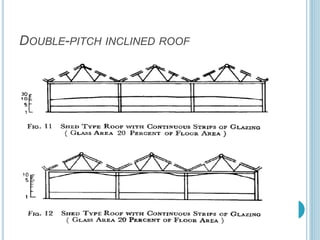
 Buildings with skylight,
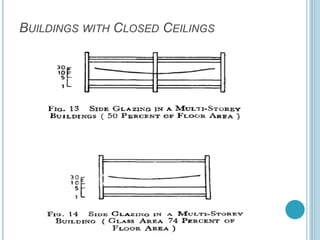
 Buildings with closed ceilings ( multi-storeyed buildings )
 High -bay large span structures.
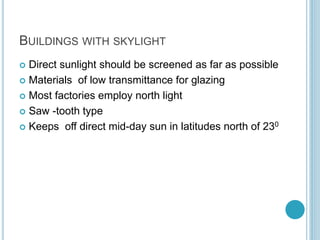
BUILDINGS WITH SKYLIGHT
 Direct sunlight should be screened as far as possible
 Materials of low transmittance for glazing
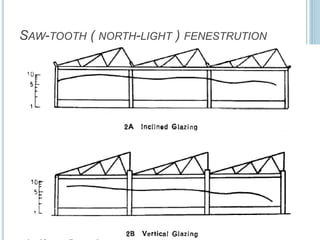
 Most factories employ north light
 Saw -tooth type
 Keeps off direct mid-day sun in latitudes north of 230
SAW-TOOTH ( NORTH-LIGHT ) FENESTRUTION
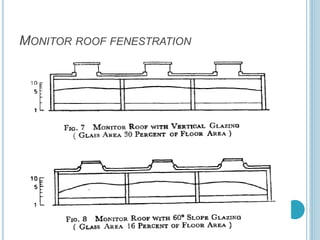
MONITOR ROOF FENESTRATION
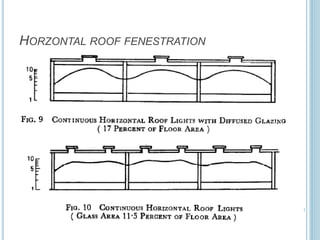
HORZONTAL ROOF FENESTRATION
DOUBLE-PITCH INCLINED ROOF
BUILDINGS WITH CLOSED CEILINGS
ARTIFICIAL LIGHTING
 Permanent Supplementary Lighting (PSALI )
 Quality
 Layout
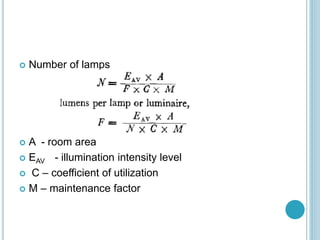
 Number of lamps
 A - room area
 EAV - illumination intensity level
 C – coefficient of utilization
 M – maintenance factor

Industrial lighting

  • 1.
  • 2.
    LIGHTING Good lighting enablesworkers in factory buildings to carry out their visual tasks easily, quickly and without fatigue and to move about in work areas safely. It also helps in cutting down wastage and rejects, in utilising floor space efficiently and in boosting morale and thus in improving the overall performance of the factory.
  • 3.
    INSTITUTUIONS AND RULES ILLUMINATION ENGINEERING SOCIETY  NIOSH- NATIONAL INSTITUTE OF OCCUPATIONAL SAFETY AND HEALTH  ISI- INDIAN STANDARDS INSTITUTION  INDIAN FACTORIES ACT
  • 4.
    ILLUMINATION LEVELS  TaskIllumination - The quantity of light at a workplace depends upon the visual task so that the individual worker can see the task clearly, accurately and without eye strain.  lux -defined as lumens of flux per ms of the surface of the task  Based on visibility parameters  size of the task,  brightness,  Brightness contrast  visual capacity in terms of time required to see the task,
  • 7.
     Unless theprecise height and location of the task is known or specified then this to be provided on a horizontal working plane at the level of 85 cm above the floor level  For reasons of economy, recommended values is for the task or tasks only.
  • 8.
    CHARACTERISTICS OF GOODLIGHTING  Glare - Glare is caused due to an uneven distribution of light sources or due to excessive contrast or abrupt changes in brightness in space and time or by seeing light sources or sun directly or after reflection from polished surfaces.
  • 9.
     Uniformity ofDistribution - It is usually desirable to provide reasonably uniform general illumination over the entire work area.  A gradual transition of brightness with diversity ratio of not less than O.7 from one area to the other within the field of vision not only ensures reasonable uniformity but also minimises glare.  Maximum and minimum illumination at any point should not be more than one-sixth above or below the average level in the area.
  • 10.
     Brightness Contrast- The brightness of an object depends upon the amount of light flux incident and proportion of that light reflected or transmitted in the direction of the eye.  Excessive brightness ratios, even though not severe enough to cause glare, may be seriously detrimental to lighting quality.
  • 11.
     Direction ofLighting and Diffusion – The light gets diffused when it flows from various random directions.  It is measured in terms of the absence of sharp shadows.  The degree of diffusion desirable for a task depends upon the type of work to be performed.
  • 12.
     Colour andColour Rendering - The efficiency of performance of visual tasks is independent of colour of light or of the object, provided the brightness and the brightness contrast remain the same.  The appearance of coloured surfaces depends on their spectral reflection characteristics and the spectral composition of the light illuminating them, and is therefore different for light sources of different spectral composition.
  • 13.
     Strosboscopic Effectand flicker from Discharge Lamps  Rotating machinery or other objects appear to slow down in speed  light output varies with alternating current and this produces certain effects known as flicker  Colour Dynamics  A good white paint reflects 80 percent or more of the light
  • 14.
    DAYLIGHTING  Daylighting ispreferable to artificial lighting  Solar illumination ( direct sunlight being excluded ) and sky radiation  Direct sunlight over moving machinery in factory floors during certain hours of the day can cause undesirable visual fatigue and may become a source of danger
  • 15.
    PRINCIPLES OF DAYLIGHTING DESIGN ClearDesign Sky  Relative amount of sky radiation depends on the position of the sun defined by its altitude  latitude of the locality  the day of the year and  the time of the day  It is the clear sky opposite the sun corresponding to solar altitude of 150
  • 16.
     Daylight Factor Daylight at a point indoors is usually measured, as a ratio of the total illumination which would be received at the same moment out-of-doors from an unobstructed view of clear design sky  Direct sky visible from the point ( excluding direct sun )  External surfaces reflecting light directly to the point  Internal surfaces reflecting and inter-reflecting light to the point.
  • 17.
    Daylight Fenestration  Buildingswith skylight,  Buildings with closed ceilings ( multi-storeyed buildings )  High -bay large span structures.
  • 18.
    BUILDINGS WITH SKYLIGHT Direct sunlight should be screened as far as possible  Materials of low transmittance for glazing  Most factories employ north light  Saw -tooth type  Keeps off direct mid-day sun in latitudes north of 230
  • 19.
  • 20.
  • 21.
  • 22.
  • 23.
  • 24.
    ARTIFICIAL LIGHTING  PermanentSupplementary Lighting (PSALI )  Quality  Layout
  • 25.
     Number oflamps  A - room area  EAV - illumination intensity level  C – coefficient of utilization  M – maintenance factor