MILLING AND TURNING OPERATIONS
JUTUR SAI KRISHNA
MILLING OPERATIONS
INTRODUCTION :
•Milling is the machining process of using rotary cutters to
remove material from a work piece advancing (or feeding) in a
direction at an angle with the axis of the tool.
•It covers a wide variety of different operations and machines, on
scales from small individual parts to large, heavy-duty gang
milling operations.
•It is one of the most commonly used processes in industry and
machine shops today for machining parts to precise sizes and
shapes.
PRINCIPLE OF MILLING MACHINE:
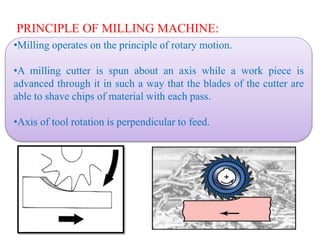
•Milling operates on the principle of rotary motion.
•A milling cutter is spun about an axis while a work piece is
advanced through it in such a way that the blades of the cutter are
able to shave chips of material with each pass.
•Axis of tool rotation is perpendicular to feed.
HORIZANTAL MILLING MACHINE :
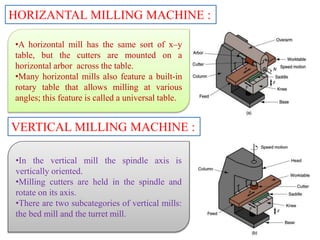
•A horizontal mill has the same sort of x–y
table, but the cutters are mounted on a
horizontal arbor across the table.
•Many horizontal mills also feature a built-in
rotary table that allows milling at various
angles; this feature is called a universal table.
VERTICAL MILLING MACHINE :
•In the vertical mill the spindle axis is
vertically oriented.
•Milling cutters are held in the spindle and
rotate on its axis.
•There are two subcategories of vertical mills:
the bed mill and the turret mill.
OPERATIONS PERFORMED ON MILLING MACHINE :
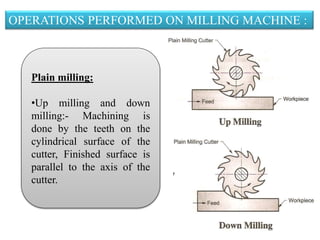
Plain milling:
•Up milling and down
milling:- Machining is
done by the teeth on the
cylindrical surface of the
cutter, Finished surface is
parallel to the axis of the
cutter.
OPERATIONS PERFORMED ON MILLING MACHINE :
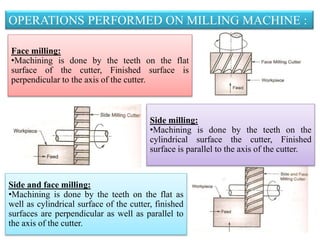
Face milling:
•Machining is done by the teeth on the flat
surface of the cutter, Finished surface is
perpendicular to the axis of the cutter.
Side and face milling:
•Machining is done by the teeth on the flat as
well as cylindrical surface of the cutter, finished
surfaces are perpendicular as well as parallel to
the axis of the cutter.
Side milling:
•Machining is done by the teeth on the
cylindrical surface the cutter, Finished
surface is parallel to the axis of the cutter.
OPERATIONS PERFORMED ON MILLING MACHINE :
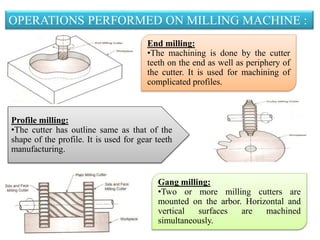
Profile milling:
•The cutter has outline same as that of the
shape of the profile. It is used for gear teeth
manufacturing.
End milling:
•The machining is done by the cutter
teeth on the end as well as periphery of
the cutter. It is used for machining of
complicated profiles.
Gang milling:
•Two or more milling cutters are
mounted on the arbor. Horizontal and
vertical surfaces are machined
simultaneously.
OPERATIONS PERFORMED ON MILLING MACHINE :
Saw milling( Slitting):
•The thickness of cutter is
small.(0.75 to 5 mm) It is used
for cutting deep slots or for
cutting off operations.
Keyway milling:
•Keyways can be prepared by
using side and face milling
cutter on horizontal milling
machine or end milling cutter
on vertical milling machine.
TURNING OPERATIONS
INTRODUCTION :
•This operation is one of the most basic machining processes.
That is, the part is rotated while a single point cutting tool is
moved parallel to the axis of rotation.
•Turning can be done on the external surface of the part as well as
internally (boring).
•The tool's axes of movement may be literally a straight line, or
they may be along some set of curves or angles, but they are
essentially linear.
•Performed on a machine tool called a lathe.
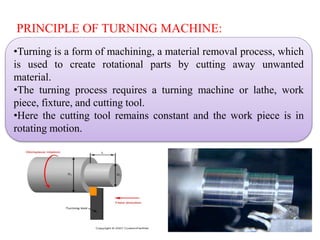
PRINCIPLE OF TURNING MACHINE:
•Turning is a form of machining, a material removal process, which
is used to create rotational parts by cutting away unwanted
material.
•The turning process requires a turning machine or lathe, work
piece, fixture, and cutting tool.
•Here the cutting tool remains constant and the work piece is in
rotating motion.
TURNING OPERATIONS:
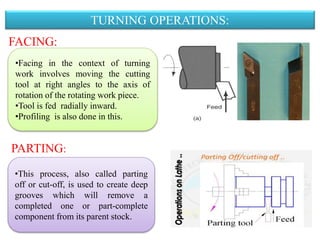
FACING:
•Facing in the context of turning
work involves moving the cutting
tool at right angles to the axis of
rotation of the rotating work piece.
•Tool is fed radially inward.
•Profiling is also done in this.
PARTING:
•This process, also called parting
off or cut-off, is used to create deep
grooves which will remove a
completed one or part-complete
component from its parent stock.
TURNING OPERATIONS:
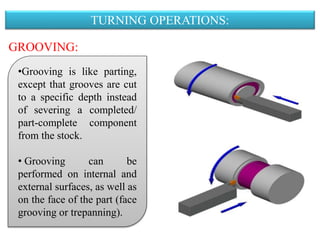
GROOVING:
•Grooving is like parting,
except that grooves are cut
to a specific depth instead
of severing a completed/
part-complete component
from the stock.
• Grooving can be
performed on internal and
external surfaces, as well as
on the face of the part (face
grooving or trepanning).
TURNING OPERATIONS:
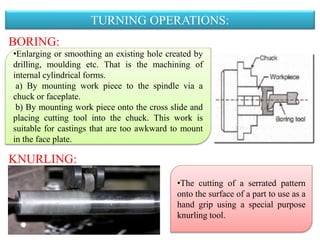
BORING:
•Enlarging or smoothing an existing hole created by
drilling, moulding etc. That is the machining of
internal cylindrical forms.
a) By mounting work piece to the spindle via a
chuck or faceplate.
b) By mounting work piece onto the cross slide and
placing cutting tool into the chuck. This work is
suitable for castings that are too awkward to mount
in the face plate.
KNURLING:
•The cutting of a serrated pattern
onto the surface of a part to use as a
hand grip using a special purpose
knurling tool.
TURNING OPERATIONS:
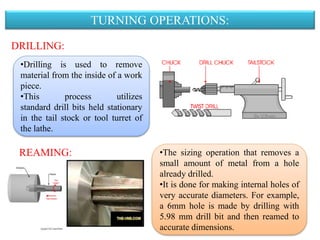
DRILLING:
•Drilling is used to remove
material from the inside of a work
piece.
•This process utilizes
standard drill bits held stationary
in the tail stock or tool turret of
the lathe.
REAMING: •The sizing operation that removes a
small amount of metal from a hole
already drilled.
•It is done for making internal holes of
very accurate diameters. For example,
a 6mm hole is made by drilling with
5.98 mm drill bit and then reamed to
accurate dimensions.
TURNING OPERATIONS:
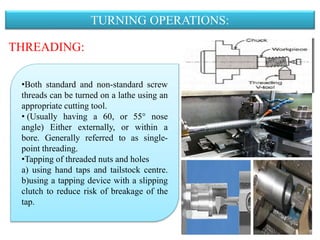
THREADING:
•Both standard and non-standard screw
threads can be turned on a lathe using an
appropriate cutting tool.
• (Usually having a 60, or 55° nose
angle) Either externally, or within a
bore. Generally referred to as single-
point threading.
•Tapping of threaded nuts and holes
a) using hand taps and tailstock centre.
b)using a tapping device with a slipping
clutch to reduce risk of breakage of the
tap.
TURNING OPERATIONS:
TAPER TURNING:
•The taper turning is an operation
of producing a conical surface by
gradual reduction in the diameter
of a cylindrical work piece.
POLYGONAL TURNING:
•In which non-circular forms are
machined without interrupting the
rotation of the raw material.
THANK YOU

Milling and turning operations

  • 1.
    MILLING AND TURNINGOPERATIONS JUTUR SAI KRISHNA
  • 2.
    MILLING OPERATIONS INTRODUCTION : •Millingis the machining process of using rotary cutters to remove material from a work piece advancing (or feeding) in a direction at an angle with the axis of the tool. •It covers a wide variety of different operations and machines, on scales from small individual parts to large, heavy-duty gang milling operations. •It is one of the most commonly used processes in industry and machine shops today for machining parts to precise sizes and shapes.
  • 3.
    PRINCIPLE OF MILLINGMACHINE: •Milling operates on the principle of rotary motion. •A milling cutter is spun about an axis while a work piece is advanced through it in such a way that the blades of the cutter are able to shave chips of material with each pass. •Axis of tool rotation is perpendicular to feed.
  • 4.
    HORIZANTAL MILLING MACHINE: •A horizontal mill has the same sort of x–y table, but the cutters are mounted on a horizontal arbor across the table. •Many horizontal mills also feature a built-in rotary table that allows milling at various angles; this feature is called a universal table. VERTICAL MILLING MACHINE : •In the vertical mill the spindle axis is vertically oriented. •Milling cutters are held in the spindle and rotate on its axis. •There are two subcategories of vertical mills: the bed mill and the turret mill.
  • 5.
    OPERATIONS PERFORMED ONMILLING MACHINE : Plain milling: •Up milling and down milling:- Machining is done by the teeth on the cylindrical surface of the cutter, Finished surface is parallel to the axis of the cutter.
  • 6.
    OPERATIONS PERFORMED ONMILLING MACHINE : Face milling: •Machining is done by the teeth on the flat surface of the cutter, Finished surface is perpendicular to the axis of the cutter. Side and face milling: •Machining is done by the teeth on the flat as well as cylindrical surface of the cutter, finished surfaces are perpendicular as well as parallel to the axis of the cutter. Side milling: •Machining is done by the teeth on the cylindrical surface the cutter, Finished surface is parallel to the axis of the cutter.
  • 7.
    OPERATIONS PERFORMED ONMILLING MACHINE : Profile milling: •The cutter has outline same as that of the shape of the profile. It is used for gear teeth manufacturing. End milling: •The machining is done by the cutter teeth on the end as well as periphery of the cutter. It is used for machining of complicated profiles. Gang milling: •Two or more milling cutters are mounted on the arbor. Horizontal and vertical surfaces are machined simultaneously.
  • 8.
    OPERATIONS PERFORMED ONMILLING MACHINE : Saw milling( Slitting): •The thickness of cutter is small.(0.75 to 5 mm) It is used for cutting deep slots or for cutting off operations. Keyway milling: •Keyways can be prepared by using side and face milling cutter on horizontal milling machine or end milling cutter on vertical milling machine.
  • 9.
    TURNING OPERATIONS INTRODUCTION : •Thisoperation is one of the most basic machining processes. That is, the part is rotated while a single point cutting tool is moved parallel to the axis of rotation. •Turning can be done on the external surface of the part as well as internally (boring). •The tool's axes of movement may be literally a straight line, or they may be along some set of curves or angles, but they are essentially linear. •Performed on a machine tool called a lathe.
  • 10.
    PRINCIPLE OF TURNINGMACHINE: •Turning is a form of machining, a material removal process, which is used to create rotational parts by cutting away unwanted material. •The turning process requires a turning machine or lathe, work piece, fixture, and cutting tool. •Here the cutting tool remains constant and the work piece is in rotating motion.
  • 11.
    TURNING OPERATIONS: FACING: •Facing inthe context of turning work involves moving the cutting tool at right angles to the axis of rotation of the rotating work piece. •Tool is fed radially inward. •Profiling is also done in this. PARTING: •This process, also called parting off or cut-off, is used to create deep grooves which will remove a completed one or part-complete component from its parent stock.
  • 12.
    TURNING OPERATIONS: GROOVING: •Grooving islike parting, except that grooves are cut to a specific depth instead of severing a completed/ part-complete component from the stock. • Grooving can be performed on internal and external surfaces, as well as on the face of the part (face grooving or trepanning).
  • 13.
    TURNING OPERATIONS: BORING: •Enlarging orsmoothing an existing hole created by drilling, moulding etc. That is the machining of internal cylindrical forms. a) By mounting work piece to the spindle via a chuck or faceplate. b) By mounting work piece onto the cross slide and placing cutting tool into the chuck. This work is suitable for castings that are too awkward to mount in the face plate. KNURLING: •The cutting of a serrated pattern onto the surface of a part to use as a hand grip using a special purpose knurling tool.
  • 14.
    TURNING OPERATIONS: DRILLING: •Drilling isused to remove material from the inside of a work piece. •This process utilizes standard drill bits held stationary in the tail stock or tool turret of the lathe. REAMING: •The sizing operation that removes a small amount of metal from a hole already drilled. •It is done for making internal holes of very accurate diameters. For example, a 6mm hole is made by drilling with 5.98 mm drill bit and then reamed to accurate dimensions.
  • 15.
    TURNING OPERATIONS: THREADING: •Both standardand non-standard screw threads can be turned on a lathe using an appropriate cutting tool. • (Usually having a 60, or 55° nose angle) Either externally, or within a bore. Generally referred to as single- point threading. •Tapping of threaded nuts and holes a) using hand taps and tailstock centre. b)using a tapping device with a slipping clutch to reduce risk of breakage of the tap.
  • 16.
    TURNING OPERATIONS: TAPER TURNING: •Thetaper turning is an operation of producing a conical surface by gradual reduction in the diameter of a cylindrical work piece. POLYGONAL TURNING: •In which non-circular forms are machined without interrupting the rotation of the raw material.
  • 17.