ENERGY CONSERVATION
Topic “Boiler”[ 1 ]
BOILER
 A boiler is an enclosed vessel that provides a means
for combustion heat to be transferred into water until
it becomes heated water or steam.
 The hot water or steam under pressure is then usable
for transferring the heat to a process.
 Heat is transferred from one body to another by
means of:
 (1) radiation
 (2) convection
 (3) conduction
1-Mar-19 Engr. Ahsanullah Soomro 2
3
Introduction
BURNER
WATER
SOURCE
BRINE
SOFTENERS
CHEMICAL FEED
FUEL
BLOW DOWN
SEPARATOR
VENT
VENTEXHAUST GAS
STEAM TO
PROCESS
STACK DEAERATOR
PUMPS
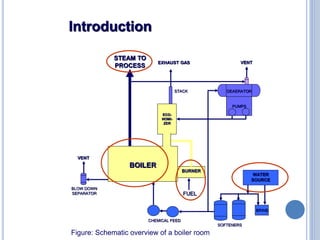
Figure: Schematic overview of a boiler room
BOILER
ECO-
NOMI-
ZER
BOILER
 The boiler system comprises of:
 feed water system,
 steam system and
 fuel system.
 The feed water system
 provides water to the boiler and regulates it automatically
to meet the steam demand. Various valves provide
access for maintenance and repair.
 The steam system
 collects and controls the steam produced in the boiler.
Steam is directed through a piping system to the point of
use.
1-Mar-19 4Engr. Ahsanullah Soomro
BOILER
 The fuel system
 includes all equipment used to provide fuel to generate
the necessary heat.
 The equipment required in the fuel system depends on
the type of fuel used in the system.
 The two sources of feed water are:
 (1) Condensate or condensed steam returned
from the processes and
 (2) Makeup water (treated raw water) which must
come from outside the boiler room and plant
processes.
1-Mar-19 5Engr. Ahsanullah Soomro
6
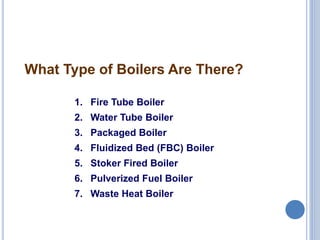
1. Fire Tube Boiler
2. Water Tube Boiler
3. Packaged Boiler
4. Fluidized Bed (FBC) Boiler
5. Stoker Fired Boiler
6. Pulverized Fuel Boiler
7. Waste Heat Boiler
What Type of Boilers Are There?
7
Type of Boilers
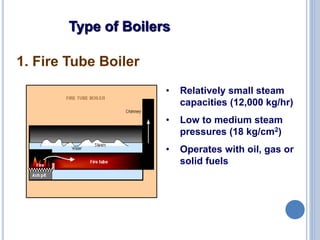
1. Fire Tube Boiler
• Relatively small steam
capacities (12,000 kg/hr)
• Low to medium steam
pressures (18 kg/cm2)
• Operates with oil, gas or
solid fuels
8
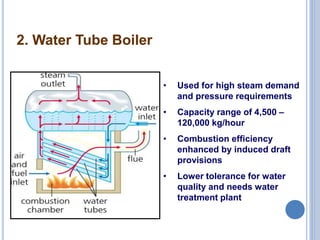
2. Water Tube Boiler
• Used for high steam demand
and pressure requirements
• Capacity range of 4,500 –
120,000 kg/hour
• Combustion efficiency
enhanced by induced draft
provisions
• Lower tolerance for water
quality and needs water
treatment plant
9
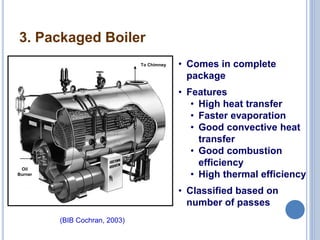
(BIB Cochran, 2003)
3. Packaged Boiler
Oil
Burner
To Chimney • Comes in complete
package
• Features
• High heat transfer
• Faster evaporation
• Good convective heat
transfer
• Good combustion
efficiency
• High thermal efficiency
• Classified based on
number of passes
10
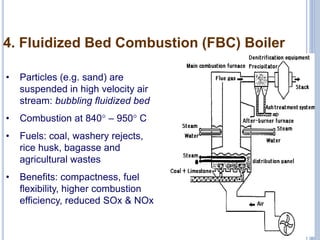
4. Fluidized Bed Combustion (FBC) Boiler
• Particles (e.g. sand) are
suspended in high velocity air
stream: bubbling fluidized bed
• Combustion at 840° – 950° C
• Fuels: coal, washery rejects,
rice husk, bagasse and
agricultural wastes
• Benefits: compactness, fuel
flexibility, higher combustion
efficiency, reduced SOx & NOx
11
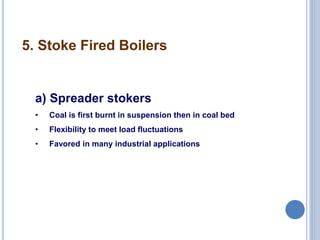
a) Spreader stokers
• Coal is first burnt in suspension then in coal bed
• Flexibility to meet load fluctuations
• Favored in many industrial applications
5. Stoke Fired Boilers
12
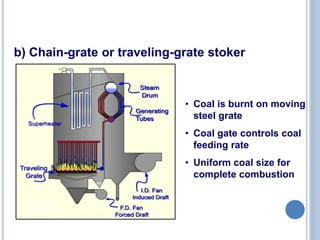
b) Chain-grate or traveling-grate stoker
• Coal is burnt on moving
steel grate
• Coal gate controls coal
feeding rate
• Uniform coal size for
complete combustion
13
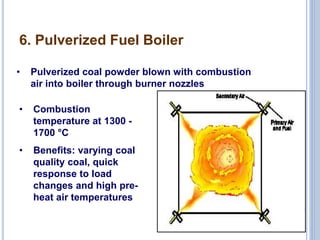
Tangential firing
6. Pulverized Fuel Boiler
• Pulverized coal powder blown with combustion
air into boiler through burner nozzles
• Combustion
temperature at 1300 -
1700 °C
• Benefits: varying coal
quality coal, quick
response to load
changes and high pre-
heat air temperatures
14
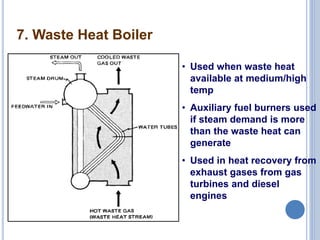
7. Waste Heat Boiler
• Used when waste heat
available at medium/high
temp
• Auxiliary fuel burners used
if steam demand is more
than the waste heat can
generate
• Used in heat recovery from
exhaust gases from gas
turbines and diesel
engines
15
1. Boiler
2. Boiler blow down
3. Boiler feed water treatment
Boiler Assessment
16
Assessment of a Boiler
Boiler performance
• Causes of poor boiler performance
-Poor combustion
-Heat transfer surface fouling
-Poor operation and maintenance
-Deteriorating fuel and water quality
• Heat balance: identify heat losses
• Boiler efficiency: determine
deviation from best efficiency
17
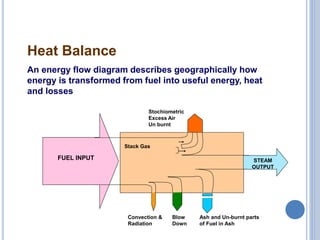
Heat Balance
An energy flow diagram describes geographically how
energy is transformed from fuel into useful energy, heat
and losses
Stochiometric
Excess Air
Un burnt
FUEL INPUT STEAM
OUTPUT
Stack Gas
Ash and Un-burnt parts
of Fuel in Ash
Blow
Down
Convection &
Radiation
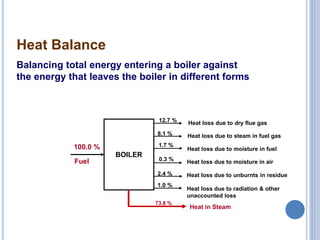
Heat Balance
Balancing total energy entering a boiler against
the energy that leaves the boiler in different forms
Heat in Steam
BOILER
Heat loss due to dry flue gas
Heat loss due to steam in fuel gas
Heat loss due to moisture in fuel
Heat loss due to unburnts in residue
Heat loss due to moisture in air
Heat loss due to radiation & other
unaccounted loss
12.7 %
8.1 %
1.7 %
0.3 %
2.4 %
1.0 %
73.8 %
100.0 %
Fuel
19
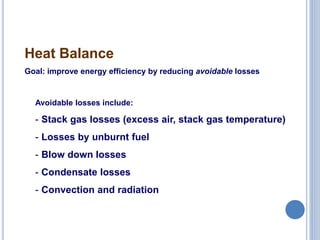
Heat Balance
Goal: improve energy efficiency by reducing avoidable losses
Avoidable losses include:
- Stack gas losses (excess air, stack gas temperature)
- Losses by unburnt fuel
- Blow down losses
- Condensate losses
- Convection and radiation
[ 20 ]
PERFORMANCE EVALUATION OF
BOILERS
PERFORMANCE EVALUATION OF
BOILERS
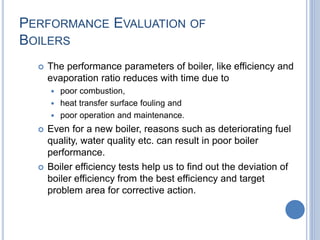
 The performance parameters of boiler, like efficiency and
evaporation ratio reduces with time due to
 poor combustion,
 heat transfer surface fouling and
 poor operation and maintenance.
 Even for a new boiler, reasons such as deteriorating fuel
quality, water quality etc. can result in poor boiler
performance.
 Boiler efficiency tests help us to find out the deviation of
boiler efficiency from the best efficiency and target
problem area for corrective action.
1-Mar-19 21Engr. Ahsanullah Soomro
PERFORMANCE EVALUATION OF
BOILERS
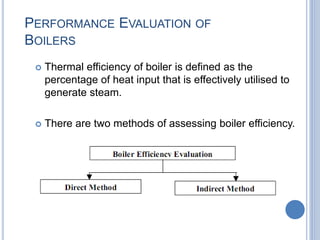
 Thermal efficiency of boiler is defined as the
percentage of heat input that is effectively utilised to
generate steam.
 There are two methods of assessing boiler efficiency.
1-Mar-19 22Engr. Ahsanullah Soomro
PERFORMANCE EVALUATION OF BOILERS
Direct Method
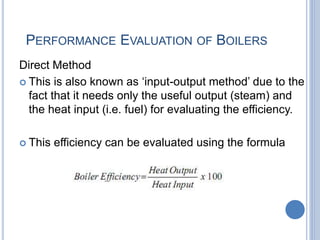
 This is also known as ‘input-output method’ due to the
fact that it needs only the useful output (steam) and
the heat input (i.e. fuel) for evaluating the efficiency.
 This efficiency can be evaluated using the formula
Engr. Ahsanullah Soomro
PERFORMANCE EVALUATION OF
BOILERS
 Parameters to be monitored for the calculation of
boiler efficiency by direct method are :
 Quantity of steam generated per hour (Q) in kg/hr.
 Quantity of fuel used per hour (q) in kg/hr.
 The working pressure (in kg/cm2) and superheat temperature (oC), if
any
 The temperature of feed water (oC)
 Type of fuel and gross calorific value of the fuel (GCV) in kcal/kg of fuel
1-Mar-19 24Engr. Ahsanullah Soomro
PERFORMANCE EVALUATION OF BOILERS
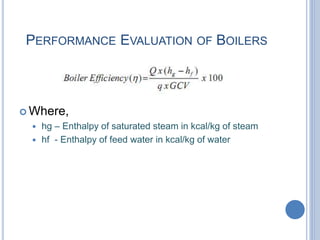
 Where,
 hg – Enthalpy of saturated steam in kcal/kg of steam
 hf - Enthalpy of feed water in kcal/kg of water
Engr. Ahsanullah Soomro
DIRECT METHOD
 Advantages of direct method:
 Plant people can evaluate quickly the efficiency
of boilers
 Requires few parameters for computation
 Needs few instruments for monitoring
 Disadvantages of direct method:
 Does not give clues to the operator as to why
efficiency of system is lower
 Does not calculate various losses accountable
for various efficiency levels
INDIRECT METHOD
 Indirect method is also called as heat loss method.
 The efficiency can be arrived at, by subtracting the heat
loss fractions from 100.
 The principle losses that occur in a boiler are:
 Loss of heat due to dry fluegas
 Loss of heat due to moisture in fuel and combustion air
 Loss of heat due to combustion of hydrogen
 Loss of heat due to radiation
 Loss of heat due to unburnt fuel
INDIRECT METHOD
 The data required for calculation of boiler efficiency
using indirect method are:
 Ultimate analysis of fuel (H2, O2, S, C, moisture content, ash
content)
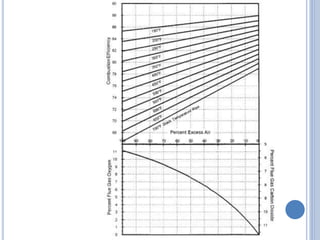
 Percentage of Oxygen or CO2 in the flue gas
 Flue gas temperature in 0C (Tf)
 Ambient temperature in 0C (Ta) & humidity of air in kg/kg of dry
air.
 GCV of fuel in kcal/kg
 Percentage combustible in ash (in case of solid fuels)
 GCV of ash in kcal/kg (in case of solid fuels)
INDIRECT METHOD
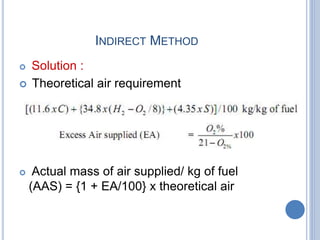
 Solution :
 Theoretical air requirement
 Actual mass of air supplied/ kg of fuel
(AAS) = {1 + EA/100} x theoretical air
INDIRECT METHOD
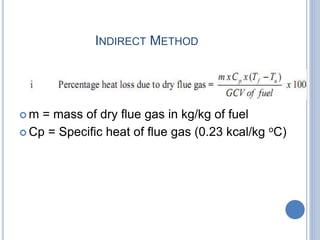
 m = mass of dry flue gas in kg/kg of fuel
 Cp = Specific heat of flue gas (0.23 kcal/kg oC)
INDIRECT METHOD
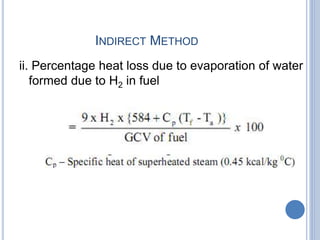
ii. Percentage heat loss due to evaporation of water
formed due to H2 in fuel
INDIRECT METHOD
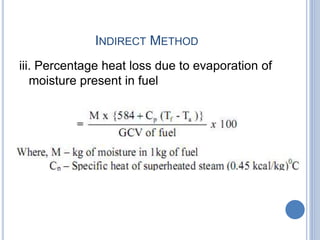
iii. Percentage heat loss due to evaporation of
moisture present in fuel
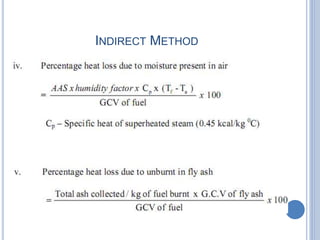
INDIRECT METHOD
INDIRECT METHOD
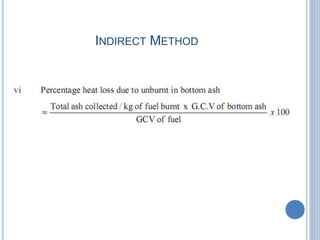
INDIRECT METHOD
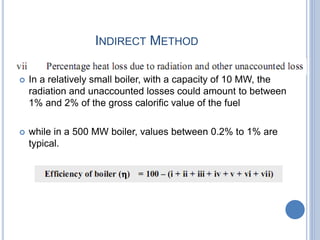
 In a relatively small boiler, with a capacity of 10 MW, the
radiation and unaccounted losses could amount to between
1% and 2% of the gross calorific value of the fuel
 while in a 500 MW boiler, values between 0.2% to 1% are
typical.
[ 37 ]
ENERGY CONSERVATION
OPPORTUNITIES
ENERGY CONSERVATION OPPORTUNITIES
1. Stack Temperature
2. Feed Water Preheating using Economiser
3. Combustion Air Preheat
4. Incomplete Combustion
5. Excess Air Control
6. Radiation and Convection Heat Loss
7. Automatic Blowdown Control
8. Reduction of Scaling and Soot Losses
9. Proper Boiler Scheduling
10. Boiler Replacement
ENERGY CONSERVATION OPPORTUNITIES
1. Stack Temperature
 The stack temperature should be as low as possible.
 However, it should not be so low that water vapor in the exhaust
condenses on the stack walls.
 This is important in fuels containing significant Sulphur as low
temperature can lead to Sulphur dew point corrosion.
 Stack temperatures greater than 200°C indicates potential for
recovery of waste heat.
 It also indicate the scaling of heat transfer/recovery equipment
and hence the urgency of taking an early shut down for water /
flue side cleaning.
ENERGY CONSERVATION OPPORTUNITIES
2. Feed Water Preheating using Economiser
 Typically, the flue gases leaving a modern 3-pass shell boiler are at
temperatures of 200 to 300 oC.
 Thus, there is a potential to recover heat from these gases.
 The flue gas exit temperature from a boiler is usually maintained at
a minimum of 200 oC, so that the sulphur oxides in the flue gas do
not condense and cause corrosion in heat transfer surfaces.
 When a clean fuel such as natural gas, LPG or gas oil is used, the
economy of heat recovery must be worked out, as the flue gas
temperature may be well below 200oC.
ENERGY CONSERVATION OPPORTUNITIES
2. Feed Water Preheating using Economiser
 The potential for energy saving depends on the type of
boiler installed and the fuel used.
 For a typically older model shell boiler, with a flue gas exit
temperature of 260oC, an economizer could be used to
reduce it to 200oC, increasing the feed water temperature
by 15oC.
 Increase in overall thermal efficiency would be in the order
of 3%.
 For a modern 3-pass shell boiler firing natural gas with a
flue gas exit temperature of 140oC a condensing
economizer would reduce the exit temperature to 65oC
increasing thermal efficiency by 5%.
ENERGY CONSERVATION OPPORTUNITIES
3. Combustion Air Preheat
 Combustion air preheating is an alternative to feed-water
heating.
 In order to improve thermal efficiency by 1%, the combustion air
temperature must be raised by 20 oC.
 Most gas and oil burners used in a boiler plant are not designed
for high air preheat temperatures.
 Modern burners can withstand much higher combustion air
preheat,
ENERGY CONSERVATION OPPORTUNITIES
4. Incomplete Combustion
 Incomplete combustion can arise from a shortage of air or poor
distribution of fuel.
 It is usually obvious from the colour or smoke, and must be
corrected immediately.
 In the case of oil and gas fired systems, CO or smoke (for oil fired
systems only) with normal or high excess air indicates burner
system problems.
 A more frequent cause of incomplete combustion is the poor mixing
of fuel and air at the burner.
ENERGY CONSERVATION OPPORTUNITIES
4. Incomplete Combustion
 With coal firing, unburned carbon can comprise a big loss. It
occurs as carbon-in-ash and may amount to more than 2% of the
heat supplied to the boiler.
 Non uniform fuel size could be one of the reasons for incomplete
combustion.
 In chain grate stokers, large lumps will not burn out completely,
while small pieces and fines may block the air passage, thus
causing poor air distribution.
ENERGY CONSERVATION OPPORTUNITIES
5. Excess Air Control
 Excess air is required in all practical cases to ensure complete
combustion
 The optimum excess air level for maximum boiler efficiency
occurs when the sum of the losses due to incomplete
combustion and loss due to heat in flue gases is minimum.
 This level varies with furnace design, type of burner, fuel and
process variables.
 It can be determined by conducting tests with different air fuel
ratios.
ENERGY CONSERVATION OPPORTUNITIES
5. Excess Air Control
 Controlling excess air to an optimum level always results in
reduction in flue gas losses; for every 1% reduction in excess air
there is approximately 0.6% rise in efficiency.
 Portable oxygen analysers and draft gauges can be used to make
periodic readings to guide the operator to manually adjust the
flow of air for optimum operation.
 Excess air reduction up to 20% is feasible.
ENERGY CONSERVATION OPPORTUNITIES
6. Radiation and Convection Heat Loss
 The external surfaces of a shell boiler are hotter than the
surroundings.
 The surfaces thus lose heat to the surroundings depending on
the surface area and the difference in temperature between the
surface and the surroundings.
 Repairing or augmenting insulation can reduce heat loss
through boiler walls and piping.
ENERGY CONSERVATION OPPORTUNITIES
7. Automatic Blowdown Control
 Uncontrolled continuous blowdown is very wasteful.
 Automatic blowdown controls can be installed that sense and
respond to boiler water conductivity and pH.
 A 10% blow down in a 15 kg/cm2 boiler results in 3% efficiency
loss.
ENERGY CONSERVATION OPPORTUNITIES
8. Reduction of Scaling and Soot Losses
 In oil and coal-fired boilers, soot buildup on tubes acts as an
insulator against heat transfer.
 Also same result will occur due to scaling on the water side.
 High exit gas temperatures at normal excess air indicate poor
heat transfer performance.
 Waterside deposits require a review of water treatment
procedures and tube cleaning to remove deposits.
 An estimated 1% efficiency loss occurs with every 22oC
increase in stack temperature.
ENERGY CONSERVATION OPPORTUNITIES
9. Proper Boiler Scheduling
 Since, the optimum efficiency of boilers occurs at 65-85% of
full load,
 it is usually more efficient, on the whole, to operate a fewer
number of boilers at higher loads, than to operate a large
number at low loads.
ENERGY CONSERVATION OPPORTUNITIES
10. Boiler Replacement
 The potential savings from replacing a boiler depend on
the anticipated change in overall efficiency.
 Since boiler plants traditionally have a useful life of well
over 25 years, replacement must be carefully studied.
[ 52 ]
Engr. Ahsanullah Soomro

Energy conservation boiler

  • 1.
  • 2.
    BOILER  A boileris an enclosed vessel that provides a means for combustion heat to be transferred into water until it becomes heated water or steam.  The hot water or steam under pressure is then usable for transferring the heat to a process.  Heat is transferred from one body to another by means of:  (1) radiation  (2) convection  (3) conduction 1-Mar-19 Engr. Ahsanullah Soomro 2
  • 3.
    3 Introduction BURNER WATER SOURCE BRINE SOFTENERS CHEMICAL FEED FUEL BLOW DOWN SEPARATOR VENT VENTEXHAUSTGAS STEAM TO PROCESS STACK DEAERATOR PUMPS Figure: Schematic overview of a boiler room BOILER ECO- NOMI- ZER
  • 4.
    BOILER  The boilersystem comprises of:  feed water system,  steam system and  fuel system.  The feed water system  provides water to the boiler and regulates it automatically to meet the steam demand. Various valves provide access for maintenance and repair.  The steam system  collects and controls the steam produced in the boiler. Steam is directed through a piping system to the point of use. 1-Mar-19 4Engr. Ahsanullah Soomro
  • 5.
    BOILER  The fuelsystem  includes all equipment used to provide fuel to generate the necessary heat.  The equipment required in the fuel system depends on the type of fuel used in the system.  The two sources of feed water are:  (1) Condensate or condensed steam returned from the processes and  (2) Makeup water (treated raw water) which must come from outside the boiler room and plant processes. 1-Mar-19 5Engr. Ahsanullah Soomro
  • 6.
    6 1. Fire TubeBoiler 2. Water Tube Boiler 3. Packaged Boiler 4. Fluidized Bed (FBC) Boiler 5. Stoker Fired Boiler 6. Pulverized Fuel Boiler 7. Waste Heat Boiler What Type of Boilers Are There?
  • 7.
    7 Type of Boilers 1.Fire Tube Boiler • Relatively small steam capacities (12,000 kg/hr) • Low to medium steam pressures (18 kg/cm2) • Operates with oil, gas or solid fuels
  • 8.
    8 2. Water TubeBoiler • Used for high steam demand and pressure requirements • Capacity range of 4,500 – 120,000 kg/hour • Combustion efficiency enhanced by induced draft provisions • Lower tolerance for water quality and needs water treatment plant
  • 9.
    9 (BIB Cochran, 2003) 3.Packaged Boiler Oil Burner To Chimney • Comes in complete package • Features • High heat transfer • Faster evaporation • Good convective heat transfer • Good combustion efficiency • High thermal efficiency • Classified based on number of passes
  • 10.
    10 4. Fluidized BedCombustion (FBC) Boiler • Particles (e.g. sand) are suspended in high velocity air stream: bubbling fluidized bed • Combustion at 840° – 950° C • Fuels: coal, washery rejects, rice husk, bagasse and agricultural wastes • Benefits: compactness, fuel flexibility, higher combustion efficiency, reduced SOx & NOx
  • 11.
    11 a) Spreader stokers •Coal is first burnt in suspension then in coal bed • Flexibility to meet load fluctuations • Favored in many industrial applications 5. Stoke Fired Boilers
  • 12.
    12 b) Chain-grate ortraveling-grate stoker • Coal is burnt on moving steel grate • Coal gate controls coal feeding rate • Uniform coal size for complete combustion
  • 13.
    13 Tangential firing 6. PulverizedFuel Boiler • Pulverized coal powder blown with combustion air into boiler through burner nozzles • Combustion temperature at 1300 - 1700 °C • Benefits: varying coal quality coal, quick response to load changes and high pre- heat air temperatures
  • 14.
    14 7. Waste HeatBoiler • Used when waste heat available at medium/high temp • Auxiliary fuel burners used if steam demand is more than the waste heat can generate • Used in heat recovery from exhaust gases from gas turbines and diesel engines
  • 15.
    15 1. Boiler 2. Boilerblow down 3. Boiler feed water treatment Boiler Assessment
  • 16.
    16 Assessment of aBoiler Boiler performance • Causes of poor boiler performance -Poor combustion -Heat transfer surface fouling -Poor operation and maintenance -Deteriorating fuel and water quality • Heat balance: identify heat losses • Boiler efficiency: determine deviation from best efficiency
  • 17.
    17 Heat Balance An energyflow diagram describes geographically how energy is transformed from fuel into useful energy, heat and losses Stochiometric Excess Air Un burnt FUEL INPUT STEAM OUTPUT Stack Gas Ash and Un-burnt parts of Fuel in Ash Blow Down Convection & Radiation
  • 18.
    Heat Balance Balancing totalenergy entering a boiler against the energy that leaves the boiler in different forms Heat in Steam BOILER Heat loss due to dry flue gas Heat loss due to steam in fuel gas Heat loss due to moisture in fuel Heat loss due to unburnts in residue Heat loss due to moisture in air Heat loss due to radiation & other unaccounted loss 12.7 % 8.1 % 1.7 % 0.3 % 2.4 % 1.0 % 73.8 % 100.0 % Fuel
  • 19.
    19 Heat Balance Goal: improveenergy efficiency by reducing avoidable losses Avoidable losses include: - Stack gas losses (excess air, stack gas temperature) - Losses by unburnt fuel - Blow down losses - Condensate losses - Convection and radiation
  • 20.
    [ 20 ] PERFORMANCEEVALUATION OF BOILERS
  • 21.
    PERFORMANCE EVALUATION OF BOILERS The performance parameters of boiler, like efficiency and evaporation ratio reduces with time due to  poor combustion,  heat transfer surface fouling and  poor operation and maintenance.  Even for a new boiler, reasons such as deteriorating fuel quality, water quality etc. can result in poor boiler performance.  Boiler efficiency tests help us to find out the deviation of boiler efficiency from the best efficiency and target problem area for corrective action. 1-Mar-19 21Engr. Ahsanullah Soomro
  • 22.
    PERFORMANCE EVALUATION OF BOILERS Thermal efficiency of boiler is defined as the percentage of heat input that is effectively utilised to generate steam.  There are two methods of assessing boiler efficiency. 1-Mar-19 22Engr. Ahsanullah Soomro
  • 23.
    PERFORMANCE EVALUATION OFBOILERS Direct Method  This is also known as ‘input-output method’ due to the fact that it needs only the useful output (steam) and the heat input (i.e. fuel) for evaluating the efficiency.  This efficiency can be evaluated using the formula Engr. Ahsanullah Soomro
  • 24.
    PERFORMANCE EVALUATION OF BOILERS Parameters to be monitored for the calculation of boiler efficiency by direct method are :  Quantity of steam generated per hour (Q) in kg/hr.  Quantity of fuel used per hour (q) in kg/hr.  The working pressure (in kg/cm2) and superheat temperature (oC), if any  The temperature of feed water (oC)  Type of fuel and gross calorific value of the fuel (GCV) in kcal/kg of fuel 1-Mar-19 24Engr. Ahsanullah Soomro
  • 25.
    PERFORMANCE EVALUATION OFBOILERS  Where,  hg – Enthalpy of saturated steam in kcal/kg of steam  hf - Enthalpy of feed water in kcal/kg of water Engr. Ahsanullah Soomro
  • 26.
    DIRECT METHOD  Advantagesof direct method:  Plant people can evaluate quickly the efficiency of boilers  Requires few parameters for computation  Needs few instruments for monitoring  Disadvantages of direct method:  Does not give clues to the operator as to why efficiency of system is lower  Does not calculate various losses accountable for various efficiency levels
  • 27.
    INDIRECT METHOD  Indirectmethod is also called as heat loss method.  The efficiency can be arrived at, by subtracting the heat loss fractions from 100.  The principle losses that occur in a boiler are:  Loss of heat due to dry fluegas  Loss of heat due to moisture in fuel and combustion air  Loss of heat due to combustion of hydrogen  Loss of heat due to radiation  Loss of heat due to unburnt fuel
  • 28.
    INDIRECT METHOD  Thedata required for calculation of boiler efficiency using indirect method are:  Ultimate analysis of fuel (H2, O2, S, C, moisture content, ash content)  Percentage of Oxygen or CO2 in the flue gas  Flue gas temperature in 0C (Tf)  Ambient temperature in 0C (Ta) & humidity of air in kg/kg of dry air.  GCV of fuel in kcal/kg  Percentage combustible in ash (in case of solid fuels)  GCV of ash in kcal/kg (in case of solid fuels)
  • 29.
    INDIRECT METHOD  Solution:  Theoretical air requirement  Actual mass of air supplied/ kg of fuel (AAS) = {1 + EA/100} x theoretical air
  • 30.
    INDIRECT METHOD  m= mass of dry flue gas in kg/kg of fuel  Cp = Specific heat of flue gas (0.23 kcal/kg oC)
  • 31.
    INDIRECT METHOD ii. Percentageheat loss due to evaporation of water formed due to H2 in fuel
  • 32.
    INDIRECT METHOD iii. Percentageheat loss due to evaporation of moisture present in fuel
  • 33.
  • 34.
  • 35.
    INDIRECT METHOD  Ina relatively small boiler, with a capacity of 10 MW, the radiation and unaccounted losses could amount to between 1% and 2% of the gross calorific value of the fuel  while in a 500 MW boiler, values between 0.2% to 1% are typical.
  • 37.
    [ 37 ] ENERGYCONSERVATION OPPORTUNITIES
  • 38.
    ENERGY CONSERVATION OPPORTUNITIES 1.Stack Temperature 2. Feed Water Preheating using Economiser 3. Combustion Air Preheat 4. Incomplete Combustion 5. Excess Air Control 6. Radiation and Convection Heat Loss 7. Automatic Blowdown Control 8. Reduction of Scaling and Soot Losses 9. Proper Boiler Scheduling 10. Boiler Replacement
  • 39.
    ENERGY CONSERVATION OPPORTUNITIES 1.Stack Temperature  The stack temperature should be as low as possible.  However, it should not be so low that water vapor in the exhaust condenses on the stack walls.  This is important in fuels containing significant Sulphur as low temperature can lead to Sulphur dew point corrosion.  Stack temperatures greater than 200°C indicates potential for recovery of waste heat.  It also indicate the scaling of heat transfer/recovery equipment and hence the urgency of taking an early shut down for water / flue side cleaning.
  • 40.
    ENERGY CONSERVATION OPPORTUNITIES 2.Feed Water Preheating using Economiser  Typically, the flue gases leaving a modern 3-pass shell boiler are at temperatures of 200 to 300 oC.  Thus, there is a potential to recover heat from these gases.  The flue gas exit temperature from a boiler is usually maintained at a minimum of 200 oC, so that the sulphur oxides in the flue gas do not condense and cause corrosion in heat transfer surfaces.  When a clean fuel such as natural gas, LPG or gas oil is used, the economy of heat recovery must be worked out, as the flue gas temperature may be well below 200oC.
  • 41.
    ENERGY CONSERVATION OPPORTUNITIES 2.Feed Water Preheating using Economiser  The potential for energy saving depends on the type of boiler installed and the fuel used.  For a typically older model shell boiler, with a flue gas exit temperature of 260oC, an economizer could be used to reduce it to 200oC, increasing the feed water temperature by 15oC.  Increase in overall thermal efficiency would be in the order of 3%.  For a modern 3-pass shell boiler firing natural gas with a flue gas exit temperature of 140oC a condensing economizer would reduce the exit temperature to 65oC increasing thermal efficiency by 5%.
  • 42.
    ENERGY CONSERVATION OPPORTUNITIES 3.Combustion Air Preheat  Combustion air preheating is an alternative to feed-water heating.  In order to improve thermal efficiency by 1%, the combustion air temperature must be raised by 20 oC.  Most gas and oil burners used in a boiler plant are not designed for high air preheat temperatures.  Modern burners can withstand much higher combustion air preheat,
  • 43.
    ENERGY CONSERVATION OPPORTUNITIES 4.Incomplete Combustion  Incomplete combustion can arise from a shortage of air or poor distribution of fuel.  It is usually obvious from the colour or smoke, and must be corrected immediately.  In the case of oil and gas fired systems, CO or smoke (for oil fired systems only) with normal or high excess air indicates burner system problems.  A more frequent cause of incomplete combustion is the poor mixing of fuel and air at the burner.
  • 44.
    ENERGY CONSERVATION OPPORTUNITIES 4.Incomplete Combustion  With coal firing, unburned carbon can comprise a big loss. It occurs as carbon-in-ash and may amount to more than 2% of the heat supplied to the boiler.  Non uniform fuel size could be one of the reasons for incomplete combustion.  In chain grate stokers, large lumps will not burn out completely, while small pieces and fines may block the air passage, thus causing poor air distribution.
  • 45.
    ENERGY CONSERVATION OPPORTUNITIES 5.Excess Air Control  Excess air is required in all practical cases to ensure complete combustion  The optimum excess air level for maximum boiler efficiency occurs when the sum of the losses due to incomplete combustion and loss due to heat in flue gases is minimum.  This level varies with furnace design, type of burner, fuel and process variables.  It can be determined by conducting tests with different air fuel ratios.
  • 46.
    ENERGY CONSERVATION OPPORTUNITIES 5.Excess Air Control  Controlling excess air to an optimum level always results in reduction in flue gas losses; for every 1% reduction in excess air there is approximately 0.6% rise in efficiency.  Portable oxygen analysers and draft gauges can be used to make periodic readings to guide the operator to manually adjust the flow of air for optimum operation.  Excess air reduction up to 20% is feasible.
  • 47.
    ENERGY CONSERVATION OPPORTUNITIES 6.Radiation and Convection Heat Loss  The external surfaces of a shell boiler are hotter than the surroundings.  The surfaces thus lose heat to the surroundings depending on the surface area and the difference in temperature between the surface and the surroundings.  Repairing or augmenting insulation can reduce heat loss through boiler walls and piping.
  • 48.
    ENERGY CONSERVATION OPPORTUNITIES 7.Automatic Blowdown Control  Uncontrolled continuous blowdown is very wasteful.  Automatic blowdown controls can be installed that sense and respond to boiler water conductivity and pH.  A 10% blow down in a 15 kg/cm2 boiler results in 3% efficiency loss.
  • 49.
    ENERGY CONSERVATION OPPORTUNITIES 8.Reduction of Scaling and Soot Losses  In oil and coal-fired boilers, soot buildup on tubes acts as an insulator against heat transfer.  Also same result will occur due to scaling on the water side.  High exit gas temperatures at normal excess air indicate poor heat transfer performance.  Waterside deposits require a review of water treatment procedures and tube cleaning to remove deposits.  An estimated 1% efficiency loss occurs with every 22oC increase in stack temperature.
  • 50.
    ENERGY CONSERVATION OPPORTUNITIES 9.Proper Boiler Scheduling  Since, the optimum efficiency of boilers occurs at 65-85% of full load,  it is usually more efficient, on the whole, to operate a fewer number of boilers at higher loads, than to operate a large number at low loads.
  • 51.
    ENERGY CONSERVATION OPPORTUNITIES 10.Boiler Replacement  The potential savings from replacing a boiler depend on the anticipated change in overall efficiency.  Since boiler plants traditionally have a useful life of well over 25 years, replacement must be carefully studied.
  • 52.
    [ 52 ] Engr.Ahsanullah Soomro