Machine Tools and Machining
ME 210 (3-0-0-3)

Vikrant Sharma
Assistant Professor
Mechanical Engineering Department
FET, MITS
vsharma.et@mitsuniversity.ac.in
9887342424
Course Objective











Understanding the basic parameters in the metal cutting
operation.
Different types of chips formed in metal cutting.
Select cutting tool material for metal cutting.
Understand tool wear and tool life.
Determine cutting forces.

Understand classification of various machine tools.
Understand different components of the machine tools and their
functions.
Identify various methods used to generate different types of
surfaces.

Vikrant Sharma FET, MITS

ME 210
Books








Rao P N, “Manufacturing Technology”
Lindberg Roy, “Processes and materials of manufacturing”
Ostwald Phillip, “ Manufacturing Processes and Systems”
Chapman, “Workshop Technology”
DeGarmo, “Materials and Processes in Manufacturing”
Kalpakjian, “Manufacturing Engineering & Technology”

Vikrant Sharma FET, MITS

ME 210
Manufacturing:
Manufacturing is an industrial activity that
changes the form of raw materials to create
product.
Manufacture is derived from the Latin, manu
factus, means “made by hand”.
Manufacturing is value addition processes. It is
process of conversion of low utility and low value
into a product of high utility and more value of
required shape, size and dimension.

Vikrant Sharma FET, MITS
210

ME
Lump of
iron /steel
(Raw Material)
Product

Processes

Vikrant Sharma FET, MITS
210

ME
Manufacturing is science & technology for producing
objects


Effectively



Efficiently



Economically

Vikrant Sharma FET, MITS

ME 210
This can be achieved through


Proper selection & application of existing processes &
systems.
 Proper selection & use of
materials, tools, machine, environment etc.
 Improvement of existing material & processes
 Development of new
material, processes, machine, technology etc.

Vikrant Sharma FET, MITS

ME 210
raw
material

finished
product
Conversion Process

Selection of optimum process is based on some objective






manufacturing time
production rate
manufacturing cost
profit
profit rate

Vikrant Sharma FET, MITS

ME 210
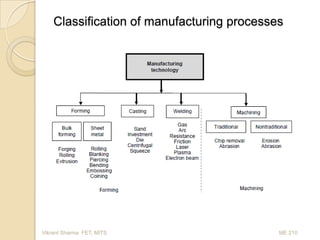
Classification of manufacturing processes

Vikrant Sharma FET, MITS

ME 210
Vikrant Sharma FET, MITS

ME 210
Machining :
Machining is an essential process of finishing by which
jobs of desired dimensions and surface finish are
produce by gradually removing the excess material
from the preformed blank in the form of chips with the
help of cutting tools move past the work surface.

Machine Tool :
A machine tool is a non portable power operating device
or system of devices in which energy is expanded to
produce job of desired size by gradually removing the
excess material from the preformed blank in the form of
chips with the help of cutting tools move past the work
surface.

Vikrant Sharma FET, MITS
210

ME
Machining Requirement

Power
Blank
Machine
Fixture

m/c process

Product
Analysis

Tools

Environment

Correction

Vikrant Sharma FET, MITS
210

ME
Major functional component of machine tools:







Device for holding job and tools
Drive(s) for providing power and motions
Kinematics system(s) to transmit motion
Automation and control system
Structure/body

Vikrant Sharma FET, MITS

ME 210
Machining is a process of gradual removal of excess
material from the preformed blanks in the form of chips.
The form of the chips is an important index of machining
because it directly or indirectly indicates :
 Nature and behavior of the work material under
machining condition
 Specific energy requirement (amount of energy required
to remove unit volume of work material) in machining
work.
 Nature and degree of interaction at the chip-tool
interfaces.

Vikrant Sharma FET, MITS
210

ME
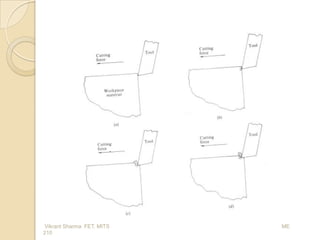
Mechanism of chip formation

Vikrant Sharma FET, MITS
210

ME
Vikrant Sharma FET, MITS
210

ME
Vikrant Sharma FET, MITS
210

ME
Vikrant Sharma FET, MITS
210

ME
Chip formation
There are three types of chips that are commonly
produced in cutting,


Œdiscontinuous chips
 • continuous chips
 Ž continuous chips with built up edge

Vikrant Sharma FET, MITS

ME 210
Discontinuous chips :


When relatively brittle materials (e.g., cast irons) are
machined at low cutting speeds, the chips often form
into separate segments.
 This tends to impart an irregular texture to the
machined surface. High tool–chip friction and large feed
and depth of cut promote the formation of this chip type.

Vikrant Sharma FET, MITS
210

ME
Continuous chips :


When ductile work materials are cut at high speeds and
relatively small feeds and depths, long continuous chips
are formed.
 A good surface finish typically results when this chip
type is formed. A sharp cutting edge on the tool and low
tool–chip friction encourage the formation of continuous
chips.
 Long, continuous chips (as in turning) can cause
problems with regard to chip disposal and/or tangling
about the tool. To solve these problems, turning tools
are often equipped with chip breakers

Vikrant Sharma FET, MITS
210

ME
Vikrant Sharma FET, MITS
210

ME
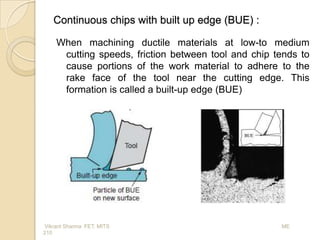
Continuous chips with built up edge (BUE) :
When machining ductile materials at low-to medium
cutting speeds, friction between tool and chip tends to
cause portions of the work material to adhere to the
rake face of the tool near the cutting edge. This
formation is called a built-up edge (BUE)

Vikrant Sharma FET, MITS
210

ME

Machine Tool & Machining ME 210_1

  • 1.
    Machine Tools andMachining ME 210 (3-0-0-3) Vikrant Sharma Assistant Professor Mechanical Engineering Department FET, MITS vsharma.et@mitsuniversity.ac.in 9887342424
  • 2.
    Course Objective         Understanding thebasic parameters in the metal cutting operation. Different types of chips formed in metal cutting. Select cutting tool material for metal cutting. Understand tool wear and tool life. Determine cutting forces. Understand classification of various machine tools. Understand different components of the machine tools and their functions. Identify various methods used to generate different types of surfaces. Vikrant Sharma FET, MITS ME 210
  • 3.
    Books       Rao P N,“Manufacturing Technology” Lindberg Roy, “Processes and materials of manufacturing” Ostwald Phillip, “ Manufacturing Processes and Systems” Chapman, “Workshop Technology” DeGarmo, “Materials and Processes in Manufacturing” Kalpakjian, “Manufacturing Engineering & Technology” Vikrant Sharma FET, MITS ME 210
  • 4.
    Manufacturing: Manufacturing is anindustrial activity that changes the form of raw materials to create product. Manufacture is derived from the Latin, manu factus, means “made by hand”. Manufacturing is value addition processes. It is process of conversion of low utility and low value into a product of high utility and more value of required shape, size and dimension. Vikrant Sharma FET, MITS 210 ME
  • 5.
    Lump of iron /steel (RawMaterial) Product Processes Vikrant Sharma FET, MITS 210 ME
  • 6.
    Manufacturing is science& technology for producing objects  Effectively  Efficiently  Economically Vikrant Sharma FET, MITS ME 210
  • 7.
    This can beachieved through  Proper selection & application of existing processes & systems.  Proper selection & use of materials, tools, machine, environment etc.  Improvement of existing material & processes  Development of new material, processes, machine, technology etc. Vikrant Sharma FET, MITS ME 210
  • 8.
    raw material finished product Conversion Process Selection ofoptimum process is based on some objective      manufacturing time production rate manufacturing cost profit profit rate Vikrant Sharma FET, MITS ME 210
  • 9.
    Classification of manufacturingprocesses Vikrant Sharma FET, MITS ME 210
  • 10.
  • 11.
    Machining : Machining isan essential process of finishing by which jobs of desired dimensions and surface finish are produce by gradually removing the excess material from the preformed blank in the form of chips with the help of cutting tools move past the work surface. Machine Tool : A machine tool is a non portable power operating device or system of devices in which energy is expanded to produce job of desired size by gradually removing the excess material from the preformed blank in the form of chips with the help of cutting tools move past the work surface. Vikrant Sharma FET, MITS 210 ME
  • 12.
  • 13.
    Major functional componentof machine tools:      Device for holding job and tools Drive(s) for providing power and motions Kinematics system(s) to transmit motion Automation and control system Structure/body Vikrant Sharma FET, MITS ME 210
  • 14.
    Machining is aprocess of gradual removal of excess material from the preformed blanks in the form of chips. The form of the chips is an important index of machining because it directly or indirectly indicates :  Nature and behavior of the work material under machining condition  Specific energy requirement (amount of energy required to remove unit volume of work material) in machining work.  Nature and degree of interaction at the chip-tool interfaces. Vikrant Sharma FET, MITS 210 ME
  • 15.
    Mechanism of chipformation Vikrant Sharma FET, MITS 210 ME
  • 16.
  • 17.
  • 18.
  • 19.
    Chip formation There arethree types of chips that are commonly produced in cutting,  Œdiscontinuous chips  • continuous chips  Ž continuous chips with built up edge Vikrant Sharma FET, MITS ME 210
  • 20.
    Discontinuous chips :  Whenrelatively brittle materials (e.g., cast irons) are machined at low cutting speeds, the chips often form into separate segments.  This tends to impart an irregular texture to the machined surface. High tool–chip friction and large feed and depth of cut promote the formation of this chip type. Vikrant Sharma FET, MITS 210 ME
  • 21.
    Continuous chips :  Whenductile work materials are cut at high speeds and relatively small feeds and depths, long continuous chips are formed.  A good surface finish typically results when this chip type is formed. A sharp cutting edge on the tool and low tool–chip friction encourage the formation of continuous chips.  Long, continuous chips (as in turning) can cause problems with regard to chip disposal and/or tangling about the tool. To solve these problems, turning tools are often equipped with chip breakers Vikrant Sharma FET, MITS 210 ME
  • 22.
  • 23.
    Continuous chips withbuilt up edge (BUE) : When machining ductile materials at low-to medium cutting speeds, friction between tool and chip tends to cause portions of the work material to adhere to the rake face of the tool near the cutting edge. This formation is called a built-up edge (BUE) Vikrant Sharma FET, MITS 210 ME