Project Work
TOPIC: VOLTAGE GATED SODIUM ION CHANNEL
USHA
M.SC. BIOINFORMATICS
Types of channel
Ligand gated ion channel : These channels open when two or more molecules like
neurotransmitter, secreted from nerve terminal bind to the channel
Voltage gated ion channel : Open in response to step changes in the electric field
Mechanically gated ion channel : Open in response to pressure from outside on the membrane
or some kind of deformations
Sodium Channels are
Trans membrane proteins responsible for the voltage-dependent increase in sodium
permeability
Responsible for initiations of actions potentials in neurons and other excitable cells
Target for drugs used in the treatment of epilepsy, cardiac arrhythmias
Structure
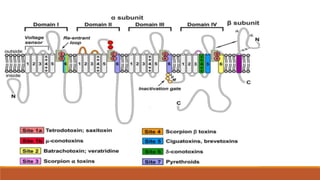
Composed of α, β subunits
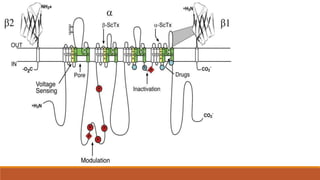
Α subunit consist four homologous domain, each with 6 α helical trans membrane subunits
An α subunit form core of the channel and function on its own
Β subunit displays altered voltage dependence and cellular localizations
Highly conserved S4 subunit act as a voltage sensors domain
Consist inactivation gate
Selectivity filter
Structure of α subunit
Mainly consist 6 subunits in each homologous domain
Ion conductions is carried out mainly through pore which is selective in nature
Pore domain is divided into two portions i.e. external part and inner pore
External portions is formed by P-loops that connect S5-S6 subunits
Inner pore is formed by the combined S5-S6 subunits from each domain
All subunits are linked to each other
Structure of β subunit
Subunit β1 is non-covalently bounded, has four cysteine in its extracellular domain that
contribute Ig like fold
Subunit β1 abundantly present in muscles, heart, and brain
Subunit β2 is covalently bounded, has five extracellular cysteine and form a disulphide bond to
the α subunit
Subunit β2 forms a single intracellular carboxyl terminal domain and a large glycosylated
extracellular domain
Functioning of β subunits is to modulate the kinetics of activations
Selective for sodium ion
Selective filter is made up of negatively charged amino acid residue, which attract only positively
charged sodium ion instead of negative ions like chloride
Pore size is about 0.5 nm, which is enough for passage of a single sodium ion with water
molecule
States of sodium ion channel
Resting stage : At this stage, activations gate is closed and inactivation gate is open
Activated stage : Passage of sodium ion takes place in this stage, gate is open in activation stage.
Inactivated stage : Channel remains closed in this stage, no passage of ion
Function
Mediate fast depolarization
Conduct electrical impulses throughout nerves, muscles and heart
Target for various type of drug and neurotoxin
Responsible for hormonal secretions
Sodium channel blockers
Tetrodotoxin (TTX) and Saxitoxin
Lipid soluble grayanotoxins
Scorpion Toxin
Ketamine
Procainamide
Amioderonn
Key features of sodium ion channel
Voltage dependent activations
Rapid inactivation
Selective ion conductance
Sodium channel activations
Change in transmembrane potentials results in conformations change in sodium channel
Change in conformations of S4 helices leading to the opening of channel
Rearrangement of S5 and S6 helices
Result in ion conduction
References
Hille B: Ion Channels of Excitable Membranes. third ed. Sunderland, MA: Sinauer Associates;
2001.
Catterall WA: From ionic currents to molecular mechanisms: the structure and function of
voltage-gated sodium channels. Neuron 2000, 26:13-25.
Stock L, Delemotte L, Carnevale V, Treptow W, Klein ML: Conduction in a biological sodium
selective channel. J Phys Chem B 2013, 117:3782-3789.
Michael L.klein.;Treptow.W.;Carnevale.V.;Conductions in a biological sodium
channel.J.phys.chem.B 2013,117,3782-3789.
Barber.F.;Raju.S.G.;Carnevale.;Klein.L.;Hinge-bending motions in the pore domain of a bacterial
voltage-gated sodium channel.J.bbamem.2012.
Klein.l.Michael.;Treptow.;Computer Simulations of Voltage-Gated Cation Channel.J.phys.chem
Lett.2013;3;1017-1023.
References
Kuyucak;Mahdavi.S.;Mechanism of Ion Permations in Mammalian Voltage-Gated Sodium
Channel.journal.pone.2015.
Delemotte.L.;Tarek.;Omega Currents in Voltage-Gatrd Ion Channel.vol.46.2013,2755-2762.
Gong.Haipeng.;Li.Yang.;Theoretical and simulations studies on Voltage-Gated sodium
Channel.2015.
Klein.L.;Carnevale.;Small molecule modulations of voltage gated sodium channel.2017, 43,156-
162.
Gong.Haipeng.;Li.Yang.;Liu.Huihui.;The mechanism of Sodium-Potassium selectivity in
mammalian Voltage-Gated Sodium Channel Based on Molecular Dynamics
Simulations.2013.;Biophysical.jouranal.104,2401-2409.
Duclohier.Herve.;Structure-Function studies on the voltage-gated sodium
channel.2009.;Biochimica et Biophysica Acta.2374-2379.
Thankyou

Sodium Ion Channel

  • 1.
    Project Work TOPIC: VOLTAGEGATED SODIUM ION CHANNEL USHA M.SC. BIOINFORMATICS
  • 2.
    Types of channel Ligandgated ion channel : These channels open when two or more molecules like neurotransmitter, secreted from nerve terminal bind to the channel Voltage gated ion channel : Open in response to step changes in the electric field Mechanically gated ion channel : Open in response to pressure from outside on the membrane or some kind of deformations
  • 3.
    Sodium Channels are Transmembrane proteins responsible for the voltage-dependent increase in sodium permeability Responsible for initiations of actions potentials in neurons and other excitable cells Target for drugs used in the treatment of epilepsy, cardiac arrhythmias
  • 4.
    Structure Composed of α,β subunits Α subunit consist four homologous domain, each with 6 α helical trans membrane subunits An α subunit form core of the channel and function on its own Β subunit displays altered voltage dependence and cellular localizations Highly conserved S4 subunit act as a voltage sensors domain Consist inactivation gate Selectivity filter
  • 5.
    Structure of αsubunit Mainly consist 6 subunits in each homologous domain Ion conductions is carried out mainly through pore which is selective in nature Pore domain is divided into two portions i.e. external part and inner pore External portions is formed by P-loops that connect S5-S6 subunits Inner pore is formed by the combined S5-S6 subunits from each domain All subunits are linked to each other
  • 7.
    Structure of βsubunit Subunit β1 is non-covalently bounded, has four cysteine in its extracellular domain that contribute Ig like fold Subunit β1 abundantly present in muscles, heart, and brain Subunit β2 is covalently bounded, has five extracellular cysteine and form a disulphide bond to the α subunit Subunit β2 forms a single intracellular carboxyl terminal domain and a large glycosylated extracellular domain Functioning of β subunits is to modulate the kinetics of activations
  • 8.
    Selective for sodiumion Selective filter is made up of negatively charged amino acid residue, which attract only positively charged sodium ion instead of negative ions like chloride Pore size is about 0.5 nm, which is enough for passage of a single sodium ion with water molecule
  • 9.
    States of sodiumion channel Resting stage : At this stage, activations gate is closed and inactivation gate is open Activated stage : Passage of sodium ion takes place in this stage, gate is open in activation stage. Inactivated stage : Channel remains closed in this stage, no passage of ion
  • 10.
    Function Mediate fast depolarization Conductelectrical impulses throughout nerves, muscles and heart Target for various type of drug and neurotoxin Responsible for hormonal secretions
  • 13.
    Sodium channel blockers Tetrodotoxin(TTX) and Saxitoxin Lipid soluble grayanotoxins Scorpion Toxin Ketamine Procainamide Amioderonn
  • 14.
    Key features ofsodium ion channel Voltage dependent activations Rapid inactivation Selective ion conductance
  • 15.
    Sodium channel activations Changein transmembrane potentials results in conformations change in sodium channel Change in conformations of S4 helices leading to the opening of channel Rearrangement of S5 and S6 helices Result in ion conduction
  • 16.
    References Hille B: IonChannels of Excitable Membranes. third ed. Sunderland, MA: Sinauer Associates; 2001. Catterall WA: From ionic currents to molecular mechanisms: the structure and function of voltage-gated sodium channels. Neuron 2000, 26:13-25. Stock L, Delemotte L, Carnevale V, Treptow W, Klein ML: Conduction in a biological sodium selective channel. J Phys Chem B 2013, 117:3782-3789. Michael L.klein.;Treptow.W.;Carnevale.V.;Conductions in a biological sodium channel.J.phys.chem.B 2013,117,3782-3789. Barber.F.;Raju.S.G.;Carnevale.;Klein.L.;Hinge-bending motions in the pore domain of a bacterial voltage-gated sodium channel.J.bbamem.2012. Klein.l.Michael.;Treptow.;Computer Simulations of Voltage-Gated Cation Channel.J.phys.chem Lett.2013;3;1017-1023.
  • 17.
    References Kuyucak;Mahdavi.S.;Mechanism of IonPermations in Mammalian Voltage-Gated Sodium Channel.journal.pone.2015. Delemotte.L.;Tarek.;Omega Currents in Voltage-Gatrd Ion Channel.vol.46.2013,2755-2762. Gong.Haipeng.;Li.Yang.;Theoretical and simulations studies on Voltage-Gated sodium Channel.2015. Klein.L.;Carnevale.;Small molecule modulations of voltage gated sodium channel.2017, 43,156- 162. Gong.Haipeng.;Li.Yang.;Liu.Huihui.;The mechanism of Sodium-Potassium selectivity in mammalian Voltage-Gated Sodium Channel Based on Molecular Dynamics Simulations.2013.;Biophysical.jouranal.104,2401-2409. Duclohier.Herve.;Structure-Function studies on the voltage-gated sodium channel.2009.;Biochimica et Biophysica Acta.2374-2379.
  • 18.