DATA CENTER
J WA L A S H A R M A
LEARNING OUTCOMES
 What is data center?
Goals of Data Center
Data center Components
Types Of Data Center
 Roles of data Center : Enterprise and Service provider
INTRODUCTION
What is a Data Center?
– Contains large number of computing resources and its associated
components.
– Computing resources include:
• Mainframes
• Web servers
• Application servers
• File servers
• Print servers
• Messaging servers
– A reliable data center should have:
• Redundant continuous power supply
• Continuous network connectivity
• Redundant data communications connections
• High security
– In client-server architecture, data center act as server
– Network infrastructures, Processing and storage capabilities are improved
– Internet data centers provides solutions for businesses of different scale and
size
Expectations from a data center:
• Run and support the business operations robustly
• To be immune to failures related to network and power supply
• Provide scalability for the applications running on the servers
• Manage the data and application hosted, despite the complexity involved in
winding these to a single service set
• Maintain the integrity of data
• Ensure superior performance at the client-end, irrespective of the distance
from the server
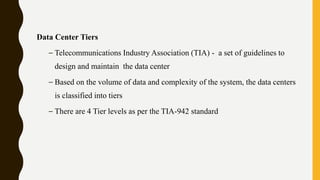
Data Center Tiers
– Telecommunications Industry Association (TIA) - a set of guidelines to
design and maintain the data center
– Based on the volume of data and complexity of the system, the data centers
is classified into tiers
– There are 4 Tier levels as per the TIA-942 standard
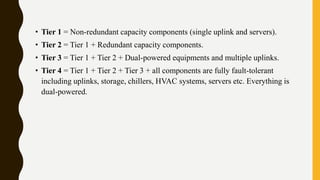
• Tier 1 = Non-redundant capacity components (single uplink and servers).
• Tier 2 = Tier 1 + Redundant capacity components.
• Tier 3 = Tier 1 + Tier 2 + Dual-powered equipments and multiple uplinks.
• Tier 4 = Tier 1 + Tier 2 + Tier 3 + all components are fully fault-tolerant
including uplinks, storage, chillers, HVAC systems, servers etc. Everything is
dual-powered.
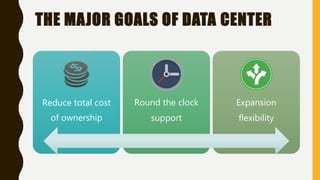
THE MAJOR GOALS OF DATA CENTER
Reduce total cost
of ownership
Round the clock
support
Expansion
flexibility
DATA CENTER COMPONENTS
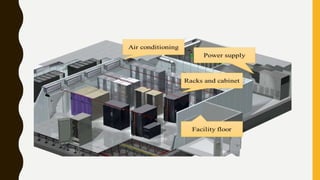
– Environmental Control Systems
• Temperature of the data centers should be maintain
• Humidity levels should also be maintained
• Environmental Control systems consume a large amount power
– Power Supply
• Ensure uninterrupted power supply, high availability of data center
systems and good power backup is essential
• To avoid single points of failure, redundancy should be induced into the
power backup system
• For critical server give multiple power supplies
• Static switches can be use
– Flooring Specifications:
• Maintain flooring height at 2 feet
• Three types of flooring
• Stringer-less Raised Floors:
– Created by an array of pedestals
– Pedestals provides necessary space from the ground for better air
circulation
– Material used for the pedestals should be non-conductive and also non-
combustible
– Flexible to change
– Stringered Raised Floors:
• Consists of an Array of steel pedestal
• The steel pedestal head has a stud
– Structured Platforms:
• Permanent metal structure is built with metal frames
• Embedded in the ground and placed in the racks
– Fire Protection Systems:
• Fire protection is a integral part of the data center design
• Include active and passive elements
• Smoke detectors and water sprinkler systems are essential part of data center
design
• Physical fire-wall can also construct around the data center
– External Security:
• Use Biometric mechanisms, to regulate access to the data center
• Use video cameras ,to monitor the activities
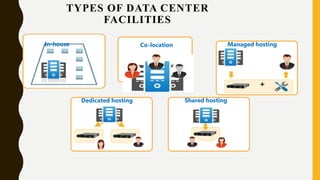
TYPES OF DATA CENTER
FACILITIES
In-house Co-location
Shared hosting
+
Managed hosting
Dedicated hosting
THE ROLES OF DATA CENTER
1)In an enterprise
2)Service provider environment
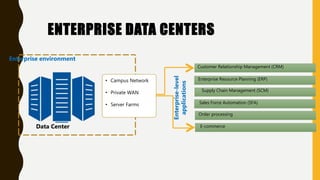
ENTERPRISE DATA CENTERS
Customer Relationship Management (CRM)
Enterprise Resource Planning (ERP)
Supply Chain Management (SCM)
Sales Force Automation (SFA)
Order processing
E-commerceData Center
Enterprise environment
Enterprise-level
applications
• Campus Network
• Private WAN
• Server Farms
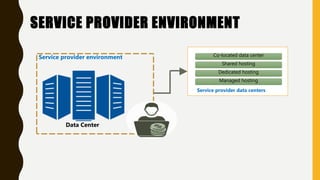
SERVICE PROVIDER ENVIRONMENT
Data Center
Service provider environment Co-located data center
Shared hosting
Dedicated hosting
Managed hosting
Service provider data centers
THANK YOU

Data center

  • 1.
    DATA CENTER J WAL A S H A R M A
  • 2.
    LEARNING OUTCOMES  Whatis data center? Goals of Data Center Data center Components Types Of Data Center  Roles of data Center : Enterprise and Service provider
  • 3.
    INTRODUCTION What is aData Center? – Contains large number of computing resources and its associated components. – Computing resources include: • Mainframes • Web servers • Application servers • File servers • Print servers • Messaging servers
  • 4.
    – A reliabledata center should have: • Redundant continuous power supply • Continuous network connectivity • Redundant data communications connections • High security – In client-server architecture, data center act as server – Network infrastructures, Processing and storage capabilities are improved – Internet data centers provides solutions for businesses of different scale and size
  • 5.
    Expectations from adata center: • Run and support the business operations robustly • To be immune to failures related to network and power supply • Provide scalability for the applications running on the servers • Manage the data and application hosted, despite the complexity involved in winding these to a single service set • Maintain the integrity of data • Ensure superior performance at the client-end, irrespective of the distance from the server
  • 6.
    Data Center Tiers –Telecommunications Industry Association (TIA) - a set of guidelines to design and maintain the data center – Based on the volume of data and complexity of the system, the data centers is classified into tiers – There are 4 Tier levels as per the TIA-942 standard
  • 7.
    • Tier 1= Non-redundant capacity components (single uplink and servers). • Tier 2 = Tier 1 + Redundant capacity components. • Tier 3 = Tier 1 + Tier 2 + Dual-powered equipments and multiple uplinks. • Tier 4 = Tier 1 + Tier 2 + Tier 3 + all components are fully fault-tolerant including uplinks, storage, chillers, HVAC systems, servers etc. Everything is dual-powered.
  • 8.
    THE MAJOR GOALSOF DATA CENTER Reduce total cost of ownership Round the clock support Expansion flexibility
  • 9.
    DATA CENTER COMPONENTS –Environmental Control Systems • Temperature of the data centers should be maintain • Humidity levels should also be maintained • Environmental Control systems consume a large amount power
  • 10.
    – Power Supply •Ensure uninterrupted power supply, high availability of data center systems and good power backup is essential • To avoid single points of failure, redundancy should be induced into the power backup system • For critical server give multiple power supplies • Static switches can be use
  • 11.
    – Flooring Specifications: •Maintain flooring height at 2 feet • Three types of flooring • Stringer-less Raised Floors: – Created by an array of pedestals – Pedestals provides necessary space from the ground for better air circulation – Material used for the pedestals should be non-conductive and also non- combustible – Flexible to change
  • 12.
    – Stringered RaisedFloors: • Consists of an Array of steel pedestal • The steel pedestal head has a stud – Structured Platforms: • Permanent metal structure is built with metal frames • Embedded in the ground and placed in the racks
  • 13.
    – Fire ProtectionSystems: • Fire protection is a integral part of the data center design • Include active and passive elements • Smoke detectors and water sprinkler systems are essential part of data center design • Physical fire-wall can also construct around the data center – External Security: • Use Biometric mechanisms, to regulate access to the data center • Use video cameras ,to monitor the activities
  • 14.
    TYPES OF DATACENTER FACILITIES In-house Co-location Shared hosting + Managed hosting Dedicated hosting
  • 16.
    THE ROLES OFDATA CENTER 1)In an enterprise 2)Service provider environment
  • 17.
    ENTERPRISE DATA CENTERS CustomerRelationship Management (CRM) Enterprise Resource Planning (ERP) Supply Chain Management (SCM) Sales Force Automation (SFA) Order processing E-commerceData Center Enterprise environment Enterprise-level applications • Campus Network • Private WAN • Server Farms
  • 18.
    SERVICE PROVIDER ENVIRONMENT DataCenter Service provider environment Co-located data center Shared hosting Dedicated hosting Managed hosting Service provider data centers
  • 19.

Editor's Notes

  • #4 A data center can be considered as a repository that contains computing facilities such as servers, firewalls, switches and routers. It is a physical facility that consists of computing equipment and the supporting infrastructural devices.
  • #5 A data center should have a redundant continuous power supply, continuous network connectivity, redundant data communications connections, and high security. All these characteristics ensure high availability of the resources in the data center and to make the data center reliable.   In terms of client-server architecture, a data center can be termed as a server farm comprising of application servers, storage servers, messaging servers, and other network infrastructure. Every enterprise has a data center where all mission-critical data is stored and processed as per the user requirements.   The processing capabilities and storage capabilities have immensely increased as compared to the earlier machines. Apart from the processing and storage capabilities, advancement in Internet and improved network infrastructure have enabled the use of client-server architecture with geographically distinct locations for clients and servers. Evolution of Internet has resulted in Internet data centers, which provide a variety of solutions for businesses of different scale and size. Appropriate technology has also evolved to handle these large scale operations. Independent data centers have emerged out of this requirement.
  • #7 The Telecommunications Industry Association (TIA) has established a set of guidelines for designing and maintaining a data center, called the TIA-942. This standard classifies the data canters into four tiers, based on the volume of data they handle, and complexity of the system. The classification is incremental where moving from Tier 1 to Tier 4, the complexity increases along with the capabilities of the data center. This classification is based on the following attributes such as Power and cooling delivery paths, Redundant components, Support space to raised floor ratio, Initial watts per square foot, Ultimate watts per square foot, Raised floor height, Floor loading pounds per square foot, Utility voltage, Construction cost per square foot, Annual IT downtime due to site, and Site availability.
  • #9 Provides round-the-clock support to the business operations Reduces the cost of operation and maintenance of the enterprises Infrastructure of the data center provides services such as server, storage capabilities etc
  • #15 Based on the business, functional, and design needs, a data center facility can be of the following types: In-house data center: In this type, the data center facility is designed, set-up, operated and maintained by the organisation itself. This requires huge investment, so only large organisations opt for this type of in-house facility. Co-location: In this type, a service provider offers equipment, space, and bandwidth on rent to organisations. Multiple tenants can lease parts of the data center based on their needs. Dedicated hosting: This is similar to co-location, but here the customer takes an entire server on rent. The customer has full control over the server and does not share it with other customers. Managed hosting: This is similar to co-location, but here the service provider not only operates the servers and storage, but also offers administrative and engineering services. Shared hosting: In this type, one single server is shared among multiple customers.
  • #17 A data center in an enterprise environment typically host enterprise-level applications. An in-house data center belongs to the category of enterprise data center. These data centers are available only to the employees of the organisation. The key building blocks that make up the enterprise data center environment include the campus network, private WAN and server farms. There can be three types of server farms that can be implemented in such an environment: Intranet server farm Internet server farm Extranet server farm
  • #18 A data center in an enterprise environment typically host enterprise-level applications. An in-house data center belongs to the category of enterprise data center. These data centers are available only to the employees of the organisation. The key building blocks that make up the enterprise data center environment include the campus network, private WAN and server farms. There can be three types of server farms that can be implemented in such an environment: Intranet server farm Internet server farm Extranet server farm
  • #19 In a service provider environment, the service provider offers computing infrastructure and administrative/engineering services to customers. Examples of such data center facilities include co-location and hosting facilities. Since the service providers leases out the equipment, such data centers become a source of revenue for the service providers. A service provider data center is a service-oriented environment that is designed to host the enterprise customer’s applications. The hosting specifications are controlled by Service Levels Agreements (SLAs) between the service provider and the customer.