By:-Dhanalaxmi.Nadar (Roll.no-20 new sies)
Vairavi.Vanniyar (Roll.no-19 old sies )
Presentation On
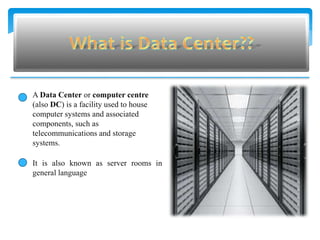
A Data Center or computer centre
(also DC) is a facility used to house
computer systems and associated
components, such as
telecommunications and storage
systems.
It is also known as server rooms in
general language
• Data centers have their roots in the huge computer rooms of the
early ages of the computing industry.
• Companies needed fast Internet connectivity and nonstop operation
to deploy systems and establish a presence on the Internet.
• .Many companies started building very large facilities, called
Internet data centers (IDCs), which provide businesses with a range
of solutions for systems deployment and operation.
• Data centers are typically very expensive to build and maintain.
History
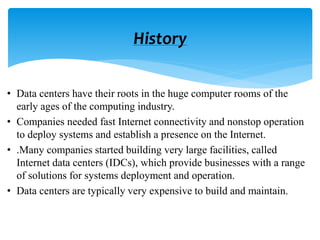
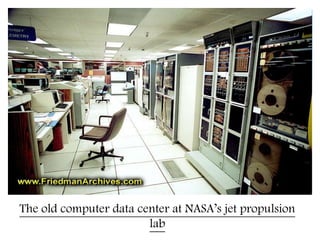
The old computer data center at NASA’s jet propulsion
lab
Various aspects of the data centers include:
•Facilities: layout, power/cooling, physical security
•System infrastructure: servers, networking,
storage, and security;
•Service management and operation considerations
REQUIREMENTS FOR MODERN DATA CENTERS
• A data center can occupy one room of a building or
more floors or entire building.
• Most of the equipment is often in the form of servers
mounted in 19 inch rack cabinets.
• Three elements of the building of data center are
facility
1. topology design (space planning),
2. engineering infrastructure design (mechanical
systems such as cooling and power)
3. technology infrastructure design (cable plant).
• The aim is to create a master plan such as number, size,
location, topology, IT floor system layouts, and power
and cooling technology and configurations.
DATA CENTER PHYSICAL INFRASTRUCTURE
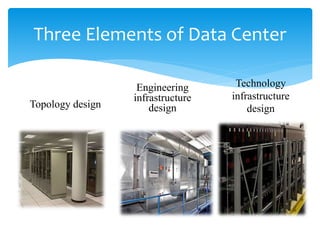
Three Elements of Data Center
Topology design
Engineering
infrastructure
design
Technology
infrastructure
design
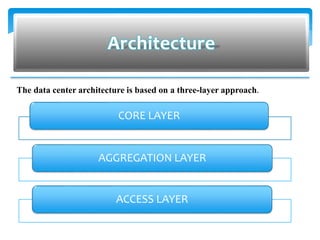
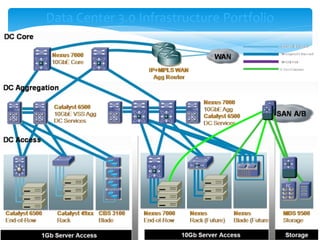
The data center architecture is based on a three-layer approach.
CORE LAYER
AGGREGATION LAYER
ACCESS LAYER
Data Center 3.0 Infrastructure Portfolio
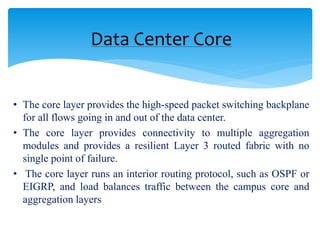
• The core layer provides the high-speed packet switching backplane
for all flows going in and out of the data center.
• The core layer provides connectivity to multiple aggregation
modules and provides a resilient Layer 3 routed fabric with no
single point of failure.
• The core layer runs an interior routing protocol, such as OSPF or
EIGRP, and load balances traffic between the campus core and
aggregation layers
Data Center Core
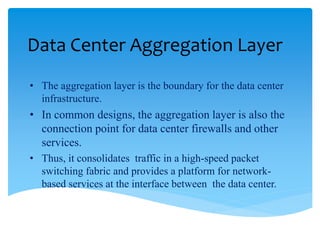
Data Center Aggregation Layer
• The aggregation layer is the boundary for the data center
infrastructure.
• In common designs, the aggregation layer is also the
connection point for data center firewalls and other
services.
• Thus, it consolidates traffic in a high-speed packet
switching fabric and provides a platform for network-
based services at the interface between the data center.
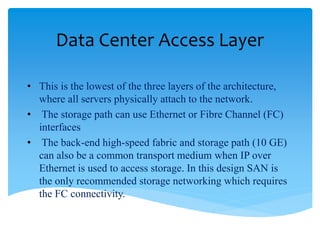
Data Center Access Layer
• This is the lowest of the three layers of the architecture,
where all servers physically attach to the network.
• The storage path can use Ethernet or Fibre Channel (FC)
interfaces
• The back-end high-speed fabric and storage path (10 GE)
can also be a common transport medium when IP over
Ethernet is used to access storage. In this design SAN is
the only recommended storage networking which requires
the FC connectivity.
• A Modular data center is a alternative to traditional data centers.
• A Modular data center can be placed anywhere data capacity is
needed.
• Modular data center systems consist of purpose-engineered
modules .
• It offer scalable data center capacity with multiple power and
cooling options.
• This can be shipped anywhere in the world, and can be added or
integrated in any other module.
• Modular data centers typically consist of standardized
components, making them easier and cheaper to build.
MODULAR DATA CENTER
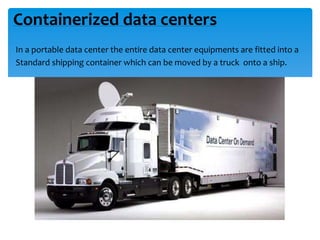
Containerized data centers
In a portable data center the entire data center equipments are fitted into a
Standard shipping container which can be moved by a truck onto a ship.
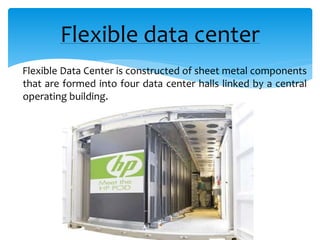
Flexible Data Center is constructed of sheet metal components
that are formed into four data center halls linked by a central
operating building.
Flexible data center
Data Center

Data Center

  • 1.
    By:-Dhanalaxmi.Nadar (Roll.no-20 newsies) Vairavi.Vanniyar (Roll.no-19 old sies ) Presentation On
  • 2.
    A Data Centeror computer centre (also DC) is a facility used to house computer systems and associated components, such as telecommunications and storage systems. It is also known as server rooms in general language
  • 3.
    • Data centershave their roots in the huge computer rooms of the early ages of the computing industry. • Companies needed fast Internet connectivity and nonstop operation to deploy systems and establish a presence on the Internet. • .Many companies started building very large facilities, called Internet data centers (IDCs), which provide businesses with a range of solutions for systems deployment and operation. • Data centers are typically very expensive to build and maintain. History
  • 4.
    The old computerdata center at NASA’s jet propulsion lab
  • 5.
    Various aspects ofthe data centers include: •Facilities: layout, power/cooling, physical security •System infrastructure: servers, networking, storage, and security; •Service management and operation considerations REQUIREMENTS FOR MODERN DATA CENTERS
  • 6.
    • A datacenter can occupy one room of a building or more floors or entire building. • Most of the equipment is often in the form of servers mounted in 19 inch rack cabinets. • Three elements of the building of data center are facility 1. topology design (space planning), 2. engineering infrastructure design (mechanical systems such as cooling and power) 3. technology infrastructure design (cable plant). • The aim is to create a master plan such as number, size, location, topology, IT floor system layouts, and power and cooling technology and configurations. DATA CENTER PHYSICAL INFRASTRUCTURE
  • 7.
    Three Elements ofData Center Topology design Engineering infrastructure design Technology infrastructure design
  • 8.
    The data centerarchitecture is based on a three-layer approach. CORE LAYER AGGREGATION LAYER ACCESS LAYER
  • 9.
    Data Center 3.0Infrastructure Portfolio
  • 10.
    • The corelayer provides the high-speed packet switching backplane for all flows going in and out of the data center. • The core layer provides connectivity to multiple aggregation modules and provides a resilient Layer 3 routed fabric with no single point of failure. • The core layer runs an interior routing protocol, such as OSPF or EIGRP, and load balances traffic between the campus core and aggregation layers Data Center Core
  • 11.
    Data Center AggregationLayer • The aggregation layer is the boundary for the data center infrastructure. • In common designs, the aggregation layer is also the connection point for data center firewalls and other services. • Thus, it consolidates traffic in a high-speed packet switching fabric and provides a platform for network- based services at the interface between the data center.
  • 12.
    Data Center AccessLayer • This is the lowest of the three layers of the architecture, where all servers physically attach to the network. • The storage path can use Ethernet or Fibre Channel (FC) interfaces • The back-end high-speed fabric and storage path (10 GE) can also be a common transport medium when IP over Ethernet is used to access storage. In this design SAN is the only recommended storage networking which requires the FC connectivity.
  • 13.
    • A Modulardata center is a alternative to traditional data centers. • A Modular data center can be placed anywhere data capacity is needed. • Modular data center systems consist of purpose-engineered modules . • It offer scalable data center capacity with multiple power and cooling options. • This can be shipped anywhere in the world, and can be added or integrated in any other module. • Modular data centers typically consist of standardized components, making them easier and cheaper to build. MODULAR DATA CENTER
  • 14.
    Containerized data centers Ina portable data center the entire data center equipments are fitted into a Standard shipping container which can be moved by a truck onto a ship.
  • 15.
    Flexible Data Centeris constructed of sheet metal components that are formed into four data center halls linked by a central operating building. Flexible data center

Editor's Notes