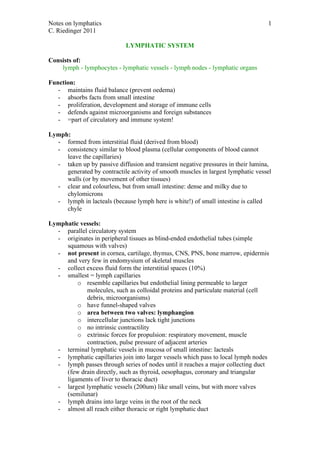
Notes on lymphatics                                                               1
C. Riedinger 2011

                             LYMPHATIC SYSTEM

Consists of:
    lymph - lymphocytes - lymphatic vessels - lymph nodes - lymphatic organs

Function:
   - maintains fluid balance (prevent oedema)
   - absorbs facts from small intestine
   - proliferation, development and storage of immune cells
   - defends against microorganisms and foreign substances
   - =part of circulatory and immune system!

Lymph:
  - formed from interstitial fluid (derived from blood)
  - consistency similar to blood plasma (cellular components of blood cannot
     leave the capillaries)
  - taken up by passive diffusion and transient negative pressures in their lumina,
     generated by contractile activity of smooth muscles in largest lymphatic vessel
     walls (or by movement of other tissues)
  - clear and colourless, but from small intestine: dense and milky due to
     chylomicrons
  - lymph in lacteals (because lymph here is white!) of small intestine is called
     chyle

Lymphatic vessels:
  - parallel circulatory system
  - originates in peripheral tissues as blind-ended endothelial tubes (simple
     squamous with valves)
  - not present in cornea, cartilage, thymus, CNS, PNS, bone marrow, epidermis
     and very few in endomysium of skeletal muscles
  - collect excess fluid form the interstitial spaces (10%)
  - smallest = lymph capillaries
         o resemble capillaries but endothelial lining permeable to larger
            molecules, such as colloidal proteins and particulate material (cell
            debris, microorganisms)
         o have funnel-shaped valves
         o area between two valves: lymphangion
         o intercellular junctions lack tight junctions
         o no intrinsic contractility
         o extrinsic forces for propulsion: respiratory movement, muscle
            contraction, pulse pressure of adjacent arteries
  - terminal lymphatic vessels in mucosa of small intestine: lacteals
  - lymphatic capillaries join into larger vessels which pass to local lymph nodes
  - lymph passes through series of nodes until it reaches a major collecting duct
     (few drain directly, such as thyroid, oesophagus, coronary and triangular
     ligaments of liver to thoracic duct)
  - largest lymphatic vessels (200um) like small veins, but with more valves
     (semilunar)
  - lymph drains into large veins in the root of the neck
  - almost all reach either thoracic or right lymphatic duct
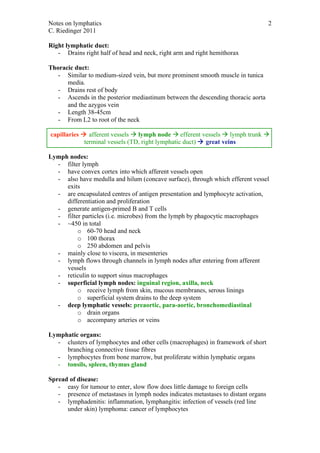
Notes on lymphatics                                                                 2
C. Riedinger 2011

Right lymphatic duct:
   - Drains right half of head and neck, right arm and right hemithorax

Thoracic duct:
   - Similar to medium-sized vein, but more prominent smooth muscle in tunica
      media.
   - Drains rest of body
   - Ascends in the posterior mediastinum between the descending thoracic aorta
      and the azygos vein
   - Length 38-45cm
   - From L2 to root of the neck

capillaries  afferent vessels  lymph node  efferent vessels  lymph trunk 
             terminal vessels (TD, right lymphatic duct)  great veins

Lymph nodes:
  - filter lymph
  - have convex cortex into which afferent vessels open
  - also have medulla and hilum (concave surface), through which efferent vessel
     exits
  - are encapsulated centres of antigen presentation and lymphocyte activation,
     differentiation and proliferation
  - generate antigen-primed B and T cells
  - filter particles (i.e. microbes) from the lymph by phagocytic macrophages
  - ~450 in total
         o 60-70 head and neck
         o 100 thorax
         o 250 abdomen and pelvis
  - mainly close to viscera, in mesenteries
  - lymph flows through channels in lymph nodes after entering from afferent
     vessels
  - reticulin to support sinus macrophages
  - superficial lymph nodes: inguinal region, axilla, neck
         o receive lymph from skin, mucous membranes, serous linings
         o superficial system drains to the deep system
  - deep lymphatic vessels: preaortic, para-aortic, bronchomediastinal
         o drain organs
         o accompany arteries or veins

Lymphatic organs:
  - clusters of lymphocytes and other cells (macrophages) in framework of short
     branching connective tissue fibres
  - lymphocytes from bone marrow, but proliferate within lymphatic organs
  - tonsils, spleen, thymus gland

Spread of disease:
   - easy for tumour to enter, slow flow does little damage to foreign cells
   - presence of metastases in lymph nodes indicates metastases to distant organs
   - lymphadenitis: inflammation, lymphangitis: infection of vessels (red line
      under skin) lymphoma: cancer of lymphocytes

Notes on the Lymphatic System

  • 1.
    Notes on lymphatics 1 C. Riedinger 2011 LYMPHATIC SYSTEM Consists of: lymph - lymphocytes - lymphatic vessels - lymph nodes - lymphatic organs Function: - maintains fluid balance (prevent oedema) - absorbs facts from small intestine - proliferation, development and storage of immune cells - defends against microorganisms and foreign substances - =part of circulatory and immune system! Lymph: - formed from interstitial fluid (derived from blood) - consistency similar to blood plasma (cellular components of blood cannot leave the capillaries) - taken up by passive diffusion and transient negative pressures in their lumina, generated by contractile activity of smooth muscles in largest lymphatic vessel walls (or by movement of other tissues) - clear and colourless, but from small intestine: dense and milky due to chylomicrons - lymph in lacteals (because lymph here is white!) of small intestine is called chyle Lymphatic vessels: - parallel circulatory system - originates in peripheral tissues as blind-ended endothelial tubes (simple squamous with valves) - not present in cornea, cartilage, thymus, CNS, PNS, bone marrow, epidermis and very few in endomysium of skeletal muscles - collect excess fluid form the interstitial spaces (10%) - smallest = lymph capillaries o resemble capillaries but endothelial lining permeable to larger molecules, such as colloidal proteins and particulate material (cell debris, microorganisms) o have funnel-shaped valves o area between two valves: lymphangion o intercellular junctions lack tight junctions o no intrinsic contractility o extrinsic forces for propulsion: respiratory movement, muscle contraction, pulse pressure of adjacent arteries - terminal lymphatic vessels in mucosa of small intestine: lacteals - lymphatic capillaries join into larger vessels which pass to local lymph nodes - lymph passes through series of nodes until it reaches a major collecting duct (few drain directly, such as thyroid, oesophagus, coronary and triangular ligaments of liver to thoracic duct) - largest lymphatic vessels (200um) like small veins, but with more valves (semilunar) - lymph drains into large veins in the root of the neck - almost all reach either thoracic or right lymphatic duct
  • 2.
    Notes on lymphatics 2 C. Riedinger 2011 Right lymphatic duct: - Drains right half of head and neck, right arm and right hemithorax Thoracic duct: - Similar to medium-sized vein, but more prominent smooth muscle in tunica media. - Drains rest of body - Ascends in the posterior mediastinum between the descending thoracic aorta and the azygos vein - Length 38-45cm - From L2 to root of the neck capillaries  afferent vessels  lymph node  efferent vessels  lymph trunk  terminal vessels (TD, right lymphatic duct)  great veins Lymph nodes: - filter lymph - have convex cortex into which afferent vessels open - also have medulla and hilum (concave surface), through which efferent vessel exits - are encapsulated centres of antigen presentation and lymphocyte activation, differentiation and proliferation - generate antigen-primed B and T cells - filter particles (i.e. microbes) from the lymph by phagocytic macrophages - ~450 in total o 60-70 head and neck o 100 thorax o 250 abdomen and pelvis - mainly close to viscera, in mesenteries - lymph flows through channels in lymph nodes after entering from afferent vessels - reticulin to support sinus macrophages - superficial lymph nodes: inguinal region, axilla, neck o receive lymph from skin, mucous membranes, serous linings o superficial system drains to the deep system - deep lymphatic vessels: preaortic, para-aortic, bronchomediastinal o drain organs o accompany arteries or veins Lymphatic organs: - clusters of lymphocytes and other cells (macrophages) in framework of short branching connective tissue fibres - lymphocytes from bone marrow, but proliferate within lymphatic organs - tonsils, spleen, thymus gland Spread of disease: - easy for tumour to enter, slow flow does little damage to foreign cells - presence of metastases in lymph nodes indicates metastases to distant organs - lymphadenitis: inflammation, lymphangitis: infection of vessels (red line under skin) lymphoma: cancer of lymphocytes