LYMPHATIC
SYSTEM/IMMUNITY
Mariah Rosette S. Handomon
BS Nursing – I (Human Anatomy & Physiology Lecture)
Lymphatic System
O Is a vast collection of cells and biochemicals that travel in
lymphatic vessels, and the organs and glands that
produce them. (Hole’s 2012)
O Includes a network of vessels that assist in circulating
body fluids, closely associated with the cardiovascular
system. (Hole’s 2012)
O Plays a crucial role in circulation by draining the fluids that
pour out into the extracellular space during capillary
exchange and returning them to the blood. (Norris &
Seigfried 2011)
O A drainage network through. (Norris & Seigfried 2011)
O It removes toxins, helps transports fats, and stabillizes
blood volume despite environmental stress. (Norris &
Seigfried 2011)
Lymphatic System – Second Major Function
O It enables us to live in the world with different types
of organisms, some of which take up residence in
or on the human body and may cause infectious
diseases.
O Cells & Biochemicals of Lymphatic System launch
both generalized and targeted attacks against
“foreign” particles, enabling the body to destroy
infectious micro-organisms and viruses.
Immune System
O Consist of variety of components: the Lymphatic
System, a body-wide network of vessels and
organs through which flows an important body
fluid called lymph; a variety of very peculiar cell
types; and several types of biological molecules,
some of them just as peculiar.
ANATOMY &
PHYSIOLOGY OF THE
LYMPHATIC SYSTEM
Lymphatic PathwaysLymphatic
Capillaries Lymphatic Vessels
O Are microscopic, closed-
ended tubes. They extend
into interstitial spaces,
forming complex networks
that parallel those of blood
capillaries.
O Formed by a single layer of
simple squamous epithelial
cells. Thin walls allows
tissue fluid to enter
lymphatic capillaries.
O Once it is inside the
lymphatic capillaries it is
called lymph.
O The walls of lymphatic
vessels are similar to those
of veins, but thinner. Like
veins, lymphatic vessels
have flap-like valves that
help prevent backflow of
lymph.
O The larger lymphatic vessels
lead to specialized organs
called lymph nodes.
(Moles 2012)
Lymphatic Pathways
Lymphatic Trunks &
Collecting Ducts
O Drain lymph from the
lymphatic vessels, are named
for the regions they serve.
O They join one of two
collecting ducts- the thoracic
duct or the right lymphatic
duct.
THORACIC DUCT – larger and
longer collecting duct. It
receives lymph from the lower
limbs and abdominal regions, t
left upper limb, and left side of
the thorax, head and neck and
empties into the left subclavian
vein near the junction of the left
jugular vein.
RIGHT LYMPHATIC DUCT –
receives lymph from the right
side of the head and neck, right
upper limb, and right thorax,
and empties into the right
subclavian vein near the
junction of the right jugular
vein.
O After leaving the two
collecting ducts, lymph
enters the venous system
and becomes part of the
plasma just before blood
returns to the right atrium.
(Moles 2012)
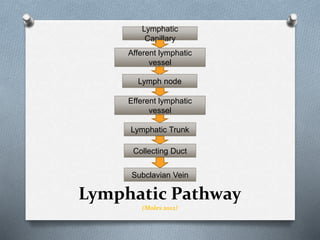
Lymphatic
Capillary
Afferent lymphatic
vessel
Lymph node
Efferent lymphatic
vessel
Lymphatic Trunk
Collecting Duct
Subclavian Vein
Lymphatic Pathway
(Moles 2012)
Structures of the Lymphatic
System
Lymphatic Vessels
O Are thin tubules that carry
lymph.
O Form a network very similar
to the venous system.
O (Lymph Capillaries,
Lymphatic Vessels,
Lymphatic Ducts)
Lymphatic Ducts
O Largest of the lymphatic
vessels , drain into two
large veins.
O Located on the right side of
your neck near your right
clavicle, drains lymph for the
right arm and right half of the
body above the diaphragm
into the right subclavian vein.
The thoracic duct also called
the left lymphatic duct, which
runs through the middle of
your thorax, drains lymph
from everywhere else into
the left subclavian vein.
(Norris & Seigfried
2011)
Structures of the Lymphatic
System
Lymph Nodes
O Are bean-shaped structures located along the lymph
vessels.
O Dense clusters of lymph nodes are found in the mouth,
pharynx, armpit, groin all through the digestive system, all
through the digestive system, and other locations.
O Each lymph node is encapsulated (covered) by a fibrous
connective tissue capsule.
O Nodule – numerous extensions that divide the node
internally into structures. It is filled with meshlike network of
fibers which lymphocytes and macrophages adhere.
O Also provide a safe and nurturing environment for
developing lymphocytes.
(Norris & Seigfried 2011)
Structures of the Lymphatic
System
Splendid Spleen
O A solid organ, located to the left of and slightly posterior to
the stomach.
O Roughly oval in shape, normally measuring about 1 by 3 by
5 in (3 by 8 by 13 cm) and weighing about 8 ounces
(23grams).
O Spleen’s structure is similar to the kidney , to the liver and
the lymph nodes. Enveloped by fibrous capsule.
O It has hilus, a spot where several diff. vessels cross the
capsule.
O Divided into functional subunits by outgrowths of the
capsule’s fibrous tissue.
(Norris & Seigfried
2011)
Structures of the Lymphatic
System
“T” Cells
O Thymus Gland - overlies the heart and straddles
the trachea, sitting just posterior to the sternum. It
produces thymosin, a hormone that stimulates the
differentiation and maturation of T Cells.
(Norris & Seigfried
2011)
Body Defenses against Infection
Innate (Nonspecific)
Defenses
PATHOGEN – presence and
multiplication of disease-
causing agent. Includes viruses,
bacteria, fungi and protozoans.
The human body can prevent
the entry of pathogens or
destroy them if they enter.
Some mechanisms are quite
general and protect against
many types of pathogens,
providing innate (nonspecific)
defense. These mechanisms
include species resistance,
mechanical barriers (enzyme
action, interferon, and
complement), natural killer cells,
inflammation, phagocytosis, and
fever.
Other defense mechanisms are
very precise, targeting specific
pathogens and providing
adaptive (specific) defense, or
immunity.
Specific Resistance – refers to
the fact that a given type of
organism, or species (such as
the human species homo
sapiens) may be resistant to the
diseases that affect other
species because its cells do not
have receptors for the
pathogens or its tissues do not
provide the temperature or
chemical environment that a
particular pathogen requires.
(Mole’s
MECHANICAL BARRIERS –
prevents the entrance of
infectious agents. These
barriers provide a first line of
defense. Skin, Mucous
Membranes lines the
passageway of the respiratory,
digestive, urinary, reproductive
systems.
CHEMICAL BARRIERS –
Enzymes in the body fluid.
Lymphocytes and fibroblasts
produce hormonelike peptides
called interferons in response
to viruses or tumor cells.
Complement group of
proteins, in plasma and other
body fluids, that interact in an
expanding series of reactions
or cascade.
NATURAL KILLERS (NK)
CELLS – small population of
lymphocytes different from the
lymphocytes that provide
adaptive (specific) defense
mechanisms. NK cells defend
the body against various
viruses and cancer cells by
secreting called perforins.
INFLAMMATION - tissue
response to injury or infection,
producing localized redness,
swelling, and pain,. The
redness result of blood
vessels dilation that increases
blood flow and volume of the
affected tissues.
pus– a thick fluid formed by
infection.
Adaptive (Specific)
Defenses, or Immunity
PHAGOCYTOSIS – removes
foreign particles from the
lymph as it moves from the
interstitial spaces to the
bloodstream.
FEVER – body temperature
elevated above an individuals
normal temperature due to an
elevated set point. It is
defense, it makes the body
inhospitable to certain
pathogens.
IMMUNITY – third line of
defense. Is resistance to
specific pathogens or to their
toxins or metabolic by-
products. Lymphocytes and
Macrophages that recognize
and remember
Specific foreign molecules
carry out adaptive immune
responses.
ANTIGENS – are protiens,
polysaccharides, glycoproteins
or glycolipids, usually located
on cell’s surface. Most effective
in eliciting an immune
response are large and
complex, with few repeating
parts.
LAMPHOCYTE ORIGINS
T Lymphocytes or T Cells-
reside in lymphatic organs and
are particularly abundant on
lymph nodes, thoracic duct,
and white pulp of the spleen.
B Lymphocytes or B Cells-
abundant in lymph nodes, bone
marrow, and intestinal lining.
Thank

Lymphatic system & Immunity

  • 1.
    LYMPHATIC SYSTEM/IMMUNITY Mariah Rosette S.Handomon BS Nursing – I (Human Anatomy & Physiology Lecture)
  • 2.
    Lymphatic System O Isa vast collection of cells and biochemicals that travel in lymphatic vessels, and the organs and glands that produce them. (Hole’s 2012) O Includes a network of vessels that assist in circulating body fluids, closely associated with the cardiovascular system. (Hole’s 2012) O Plays a crucial role in circulation by draining the fluids that pour out into the extracellular space during capillary exchange and returning them to the blood. (Norris & Seigfried 2011) O A drainage network through. (Norris & Seigfried 2011) O It removes toxins, helps transports fats, and stabillizes blood volume despite environmental stress. (Norris & Seigfried 2011)
  • 3.
    Lymphatic System –Second Major Function O It enables us to live in the world with different types of organisms, some of which take up residence in or on the human body and may cause infectious diseases. O Cells & Biochemicals of Lymphatic System launch both generalized and targeted attacks against “foreign” particles, enabling the body to destroy infectious micro-organisms and viruses.
  • 4.
    Immune System O Consistof variety of components: the Lymphatic System, a body-wide network of vessels and organs through which flows an important body fluid called lymph; a variety of very peculiar cell types; and several types of biological molecules, some of them just as peculiar.
  • 5.
    ANATOMY & PHYSIOLOGY OFTHE LYMPHATIC SYSTEM
  • 6.
    Lymphatic PathwaysLymphatic Capillaries LymphaticVessels O Are microscopic, closed- ended tubes. They extend into interstitial spaces, forming complex networks that parallel those of blood capillaries. O Formed by a single layer of simple squamous epithelial cells. Thin walls allows tissue fluid to enter lymphatic capillaries. O Once it is inside the lymphatic capillaries it is called lymph. O The walls of lymphatic vessels are similar to those of veins, but thinner. Like veins, lymphatic vessels have flap-like valves that help prevent backflow of lymph. O The larger lymphatic vessels lead to specialized organs called lymph nodes. (Moles 2012)
  • 7.
    Lymphatic Pathways Lymphatic Trunks& Collecting Ducts O Drain lymph from the lymphatic vessels, are named for the regions they serve. O They join one of two collecting ducts- the thoracic duct or the right lymphatic duct. THORACIC DUCT – larger and longer collecting duct. It receives lymph from the lower limbs and abdominal regions, t left upper limb, and left side of the thorax, head and neck and empties into the left subclavian vein near the junction of the left jugular vein. RIGHT LYMPHATIC DUCT – receives lymph from the right side of the head and neck, right upper limb, and right thorax, and empties into the right subclavian vein near the junction of the right jugular vein. O After leaving the two collecting ducts, lymph enters the venous system and becomes part of the plasma just before blood returns to the right atrium. (Moles 2012)
  • 8.
    Lymphatic Capillary Afferent lymphatic vessel Lymph node Efferentlymphatic vessel Lymphatic Trunk Collecting Duct Subclavian Vein Lymphatic Pathway (Moles 2012)
  • 9.
    Structures of theLymphatic System Lymphatic Vessels O Are thin tubules that carry lymph. O Form a network very similar to the venous system. O (Lymph Capillaries, Lymphatic Vessels, Lymphatic Ducts) Lymphatic Ducts O Largest of the lymphatic vessels , drain into two large veins. O Located on the right side of your neck near your right clavicle, drains lymph for the right arm and right half of the body above the diaphragm into the right subclavian vein. The thoracic duct also called the left lymphatic duct, which runs through the middle of your thorax, drains lymph from everywhere else into the left subclavian vein. (Norris & Seigfried 2011)
  • 10.
    Structures of theLymphatic System Lymph Nodes O Are bean-shaped structures located along the lymph vessels. O Dense clusters of lymph nodes are found in the mouth, pharynx, armpit, groin all through the digestive system, all through the digestive system, and other locations. O Each lymph node is encapsulated (covered) by a fibrous connective tissue capsule. O Nodule – numerous extensions that divide the node internally into structures. It is filled with meshlike network of fibers which lymphocytes and macrophages adhere. O Also provide a safe and nurturing environment for developing lymphocytes. (Norris & Seigfried 2011)
  • 11.
    Structures of theLymphatic System Splendid Spleen O A solid organ, located to the left of and slightly posterior to the stomach. O Roughly oval in shape, normally measuring about 1 by 3 by 5 in (3 by 8 by 13 cm) and weighing about 8 ounces (23grams). O Spleen’s structure is similar to the kidney , to the liver and the lymph nodes. Enveloped by fibrous capsule. O It has hilus, a spot where several diff. vessels cross the capsule. O Divided into functional subunits by outgrowths of the capsule’s fibrous tissue. (Norris & Seigfried 2011)
  • 12.
    Structures of theLymphatic System “T” Cells O Thymus Gland - overlies the heart and straddles the trachea, sitting just posterior to the sternum. It produces thymosin, a hormone that stimulates the differentiation and maturation of T Cells. (Norris & Seigfried 2011)
  • 14.
    Body Defenses againstInfection Innate (Nonspecific) Defenses PATHOGEN – presence and multiplication of disease- causing agent. Includes viruses, bacteria, fungi and protozoans. The human body can prevent the entry of pathogens or destroy them if they enter. Some mechanisms are quite general and protect against many types of pathogens, providing innate (nonspecific) defense. These mechanisms include species resistance, mechanical barriers (enzyme action, interferon, and complement), natural killer cells, inflammation, phagocytosis, and fever. Other defense mechanisms are very precise, targeting specific pathogens and providing adaptive (specific) defense, or immunity. Specific Resistance – refers to the fact that a given type of organism, or species (such as the human species homo sapiens) may be resistant to the diseases that affect other species because its cells do not have receptors for the pathogens or its tissues do not provide the temperature or chemical environment that a particular pathogen requires. (Mole’s
  • 15.
    MECHANICAL BARRIERS – preventsthe entrance of infectious agents. These barriers provide a first line of defense. Skin, Mucous Membranes lines the passageway of the respiratory, digestive, urinary, reproductive systems. CHEMICAL BARRIERS – Enzymes in the body fluid. Lymphocytes and fibroblasts produce hormonelike peptides called interferons in response to viruses or tumor cells. Complement group of proteins, in plasma and other body fluids, that interact in an expanding series of reactions or cascade. NATURAL KILLERS (NK) CELLS – small population of lymphocytes different from the lymphocytes that provide adaptive (specific) defense mechanisms. NK cells defend the body against various viruses and cancer cells by secreting called perforins. INFLAMMATION - tissue response to injury or infection, producing localized redness, swelling, and pain,. The redness result of blood vessels dilation that increases blood flow and volume of the affected tissues. pus– a thick fluid formed by infection.
  • 16.
    Adaptive (Specific) Defenses, orImmunity PHAGOCYTOSIS – removes foreign particles from the lymph as it moves from the interstitial spaces to the bloodstream. FEVER – body temperature elevated above an individuals normal temperature due to an elevated set point. It is defense, it makes the body inhospitable to certain pathogens. IMMUNITY – third line of defense. Is resistance to specific pathogens or to their toxins or metabolic by- products. Lymphocytes and Macrophages that recognize and remember Specific foreign molecules carry out adaptive immune responses. ANTIGENS – are protiens, polysaccharides, glycoproteins or glycolipids, usually located on cell’s surface. Most effective in eliciting an immune response are large and complex, with few repeating parts. LAMPHOCYTE ORIGINS T Lymphocytes or T Cells- reside in lymphatic organs and are particularly abundant on lymph nodes, thoracic duct, and white pulp of the spleen. B Lymphocytes or B Cells- abundant in lymph nodes, bone marrow, and intestinal lining.
  • 17.

Editor's Notes

  • #3 w/o lymphatic system, this fluid would accumulate in tissue spaces.
  • #5 w/o lymphatic system, this fluid would accumulate in tissue spaces.
  • #7 Interstitial Fluid – tissue fluid
  • #8 Interstitial Fluid – tissue fluid
  • #15 Interstitial Fluid – tissue fluid
  • #16 Interstitial Fluid – tissue fluid
  • #17 Interstitial Fluid – tissue fluid