CARDIOVASCULAR SYSTEM
COURSE OUTLINE A. Review of Anatomy and Physiology 1. Heart 2. Blood vessels 3. Blood circulation B. History and Assessment Findings 1. Risk Factors for Cardiac Diseases 2. Physical Assessment 2009
ANATOMY AND PHYSIOLOGY 2009
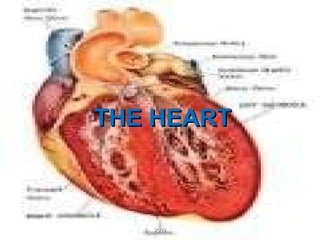
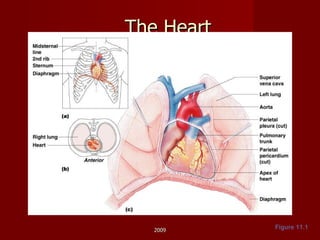
THE HEART 2009
I. Anatomy & Physiology: 300 gms / cone shaped & tilted  forward  & to the left size of a fist / rests only  location: mediastinum During the course of the day, your heart will beat approx  100,000 times  driving  2,000 gallons  of oxygen-rich blood through  60,000 miles  of blood vessels. 2009
The Heart Figure 11.1 2009
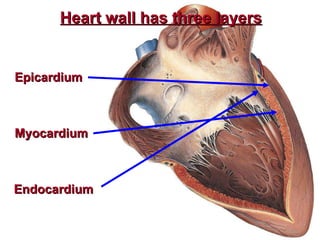
Heart wall has three layers Myocardium  Epicardium Endocardium
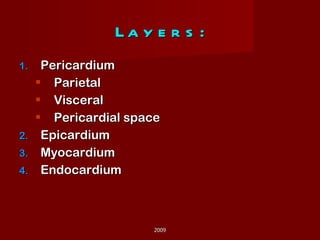
Layers: Pericardium Parietal Visceral Pericardial space Epicardium Myocardium Endocardium 2009
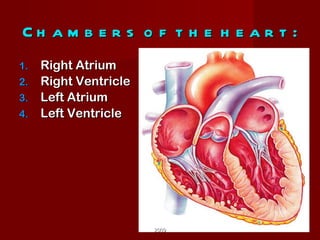
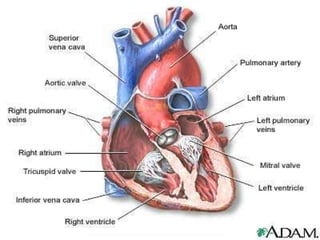
Chambers of the heart: Right Atrium Right Ventricle Left Atrium Left Ventricle 2009
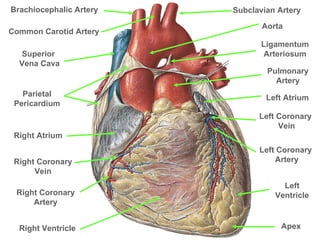
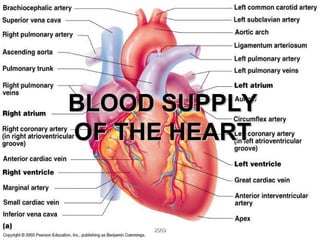
Superior  Vena Cava Brachiocephalic Artery Common Carotid Artery Subclavian Artery Aorta Pulmonary Artery Parietal Pericardium Right Atrium Right Ventricle Right Coronary Vein Right Coronary Artery Left Atrium Apex Left Ventricle Left Coronary  Vein Left Coronary  Artery Ligamentum Arteriosum
 
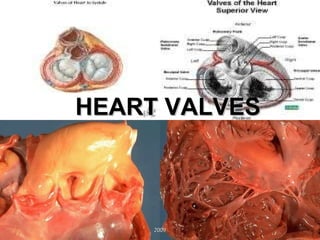
HEART VALVES 2009
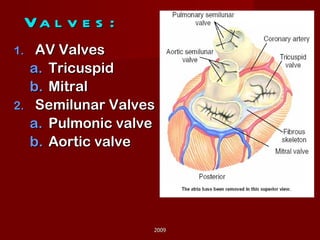
Valves: AV Valves Tricuspid Mitral Semilunar Valves Pulmonic valve Aortic valve 2009
BLOOD SUPPLY OF THE HEART 2009
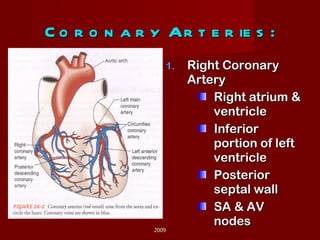
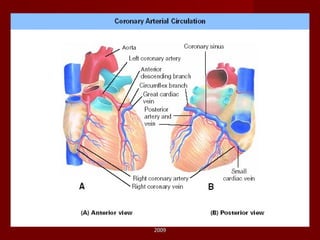
Coronary Arteries: Right Coronary Artery Right atrium & ventricle Inferior portion of left ventricle Posterior septal wall SA & AV nodes 2009
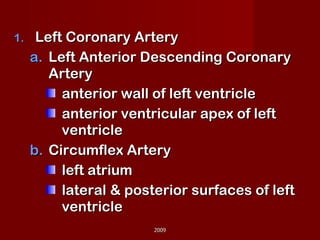
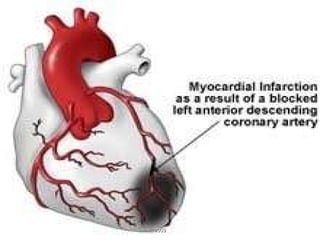
Left Coronary Artery Left Anterior Descending Coronary Artery anterior wall of left ventricle anterior ventricular apex of left ventricle Circumflex Artery left atrium  lateral & posterior surfaces of left ventricle 2009
2009
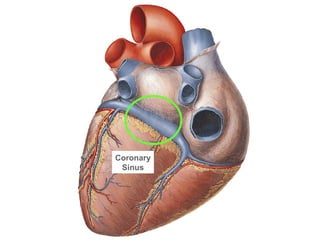
Coronary Sinus
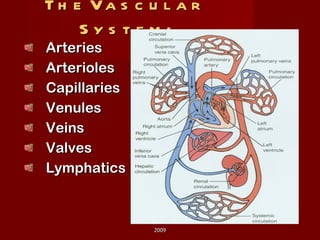
The Vascular System: Arteries Arterioles Capillaries Venules Veins Valves Lymphatics 2009
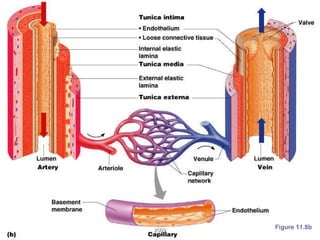
The Vascular System Figure 11.8b 2009
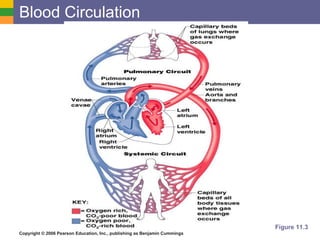
Blood Circulation Figure 11.3
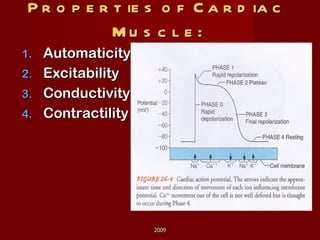
Properties of Cardiac Muscle: Automaticity Excitability Conductivity Contractility 2009
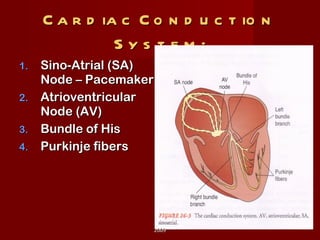
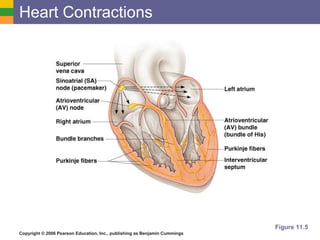
Cardiac Conduction System: Sino-Atrial (SA) Node – Pacemaker Atrioventricular Node (AV)  Bundle of His Purkinje fibers 2009
Heart Contractions Figure 11.5
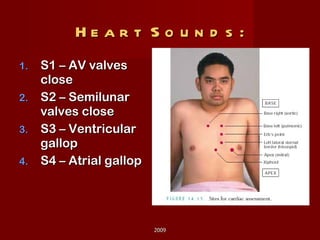
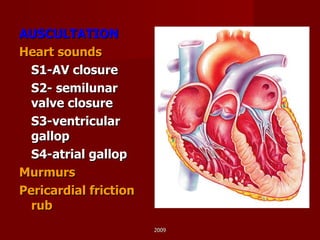
Heart Sounds: S1 – AV valves close S2 – Semilunar valves close S3 – Ventricular gallop S4 – Atrial gallop 2009
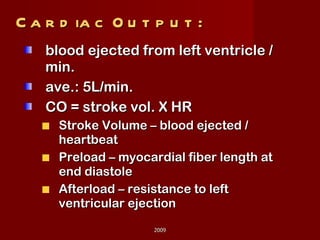
Cardiac Output: blood ejected from left ventricle / min. ave.: 5L/min. CO = stroke vol. X HR Stroke Volume – blood ejected / heartbeat Preload – myocardial fiber length at end diastole Afterload – resistance to left ventricular ejection 2009
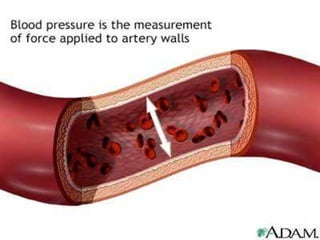
Blood Pressure The pressure exerted by the blood against the blood vessel wall Factors affecting Blood Pressure Neural Factors : the Autonomic Nervous System, particularly the Sympathetic Nervous System which often causes vasoconstriction or narrowing of the vessels and thus increasing blood pressure Renal Factors : the Kidneys Temperature :  Cold – causes vasoconstriction Heat – causes vasodilatation Chemicals and Hormones Catecholamines, Antidiuretic Hormone, Aldosterone, Atrial Natriuretic Peptide, Nicotine, Histamine & Alcohol Diet
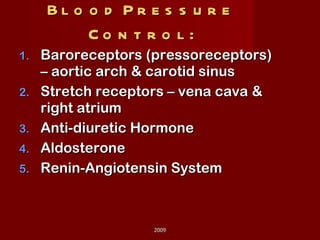
Blood Pressure Control: Baroreceptors (pressoreceptors) – aortic arch & carotid sinus Stretch receptors – vena cava & right atrium Anti-diuretic Hormone Aldosterone Renin-Angiotensin System 2009
HISTORY AND ASSESSMENT FINDINGS 2009
ASSESSMENT WITH CV DISORDERS NURSING HISTORY -  RISK FACTORS  PHYSICAL EXAMINATION COMMON SIGNS/ SYPMTOMS DIAGNOSTIC PROCEDURES  2009
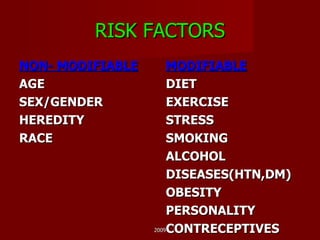
RISK FACTORS NON- MODIFIABLE AGE SEX/GENDER HEREDITY RACE MODIFIABLE DIET EXERCISE STRESS SMOKING ALCOHOL DISEASES(HTN,DM) OBESITY PERSONALITY CONTRECEPTIVES 2009
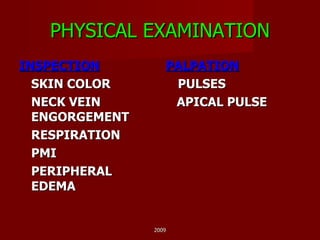
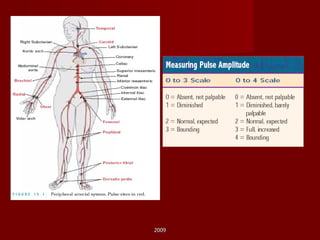
PHYSICAL EXAMINATION INSPECTION SKIN COLOR NECK VEIN ENGORGEMENT RESPIRATION PMI PERIPHERAL EDEMA PALPATION PULSES APICAL PULSE 2009
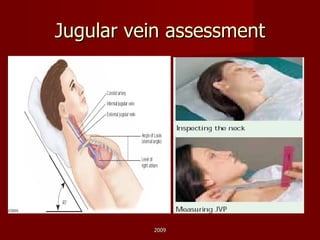
Jugular vein assessment 2009
2009
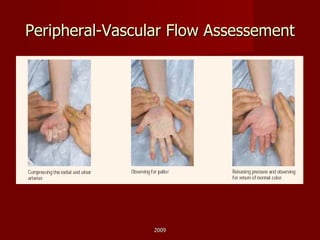
Peripheral-Vascular Flow Assessement 2009
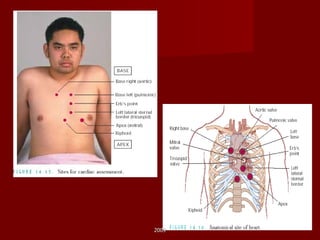
AUSCULTATION Heart sounds S1-AV closure S2- semilunar valve closure S3-ventricular gallop S4-atrial gallop Murmurs Pericardial friction rub 2009
2009
Common Signs and Symptoms: Subjective Dyspnea Chest pain Weight gain Syncope Palpitations Fatigue Objective Neck vein distention Respiration Peripheral edema Murmurs 2009
2009
2009
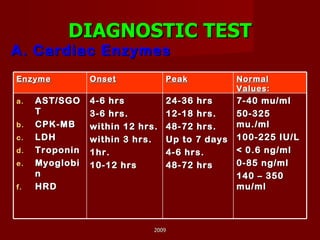
A. Cardiac Enzymes DIAGNOSTIC TEST 2009 Enzyme   Onset   Peak   Normal Values :  AST/SGOT CPK-MB LDH Troponin Myoglobin HRD 4-6 hrs 3-6 hrs. within 12 hrs. within 3 hrs. 1hr.  10-12 hrs 24-36 hrs 12-18 hrs. 48-72 hrs. Up to 7 days 4-6 hrs. 48-72 hrs 7-40 mu/ml 50-325 mu./ml 100-225 IU/L < 0.6 ng/ml 0-85 ng/ml 140 – 350 mu/ml
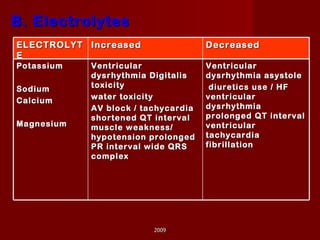
B. Electrolytes 2009 ELECTROLYTE Increased Decreased Potassium  Sodium  Calcium Magnesium  Ventricular dysrhythmia Digitalis toxicity  water toxicity  AV block / tachycardia shortened QT interval muscle weakness/ hypotension prolonged PR interval wide QRS complex Ventricular dysrhythmia asystole diuretics use / HF ventricular dysrhythmia  prolonged QT interval ventricular tachycardia fibrillation
2009
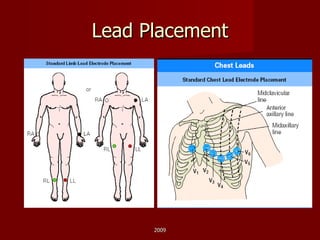
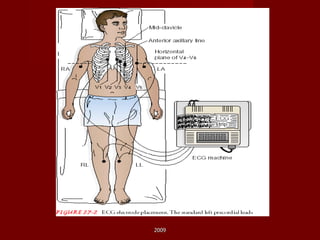
Lead Placement 2009
2009
2009
2009
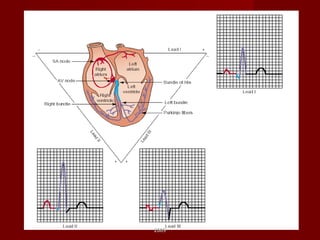
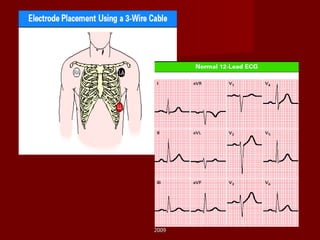
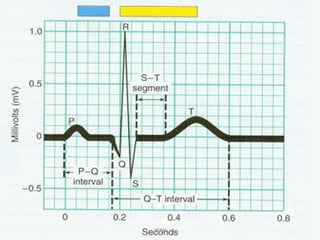
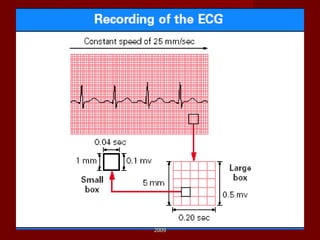
Electrocardiogram (ECG) 2009
2009
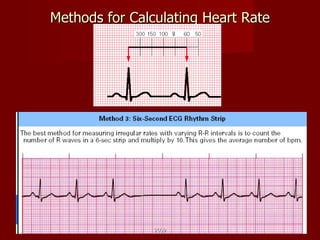
Methods for Calculating Heart Rate 2009
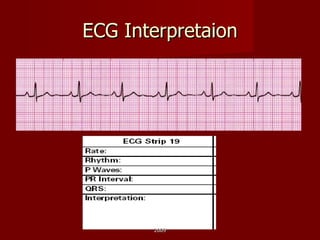
ECG Interpretaion 2009
2009
2009
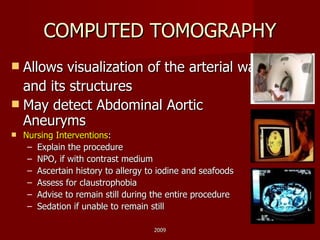
COMPUTED TOMOGRAPHY Allows visualization of the arterial wall  and its structures May detect Abdominal Aortic Aneuryms Nursing Interventions : Explain the procedure NPO, if with contrast medium Ascertain history to allergy to iodine and seafoods Assess for claustrophobia Advise to remain still during the entire procedure Sedation if unable to remain still  2009
CARDIAC DISORDERS 2009
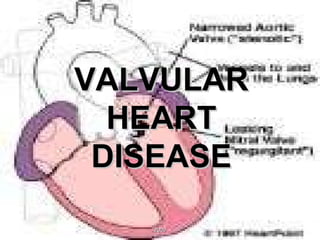
VALVULAR HEART DISEASE 2009
VALVULAR HEART DISEASE Mitral Valve Disease Mitral Valve prolapse Mitral Valve stenosis Mitral Valve regurgitation Aortic Valve Disease Aortic Stenosis Aortic Regurgitation Tricuspid Valve Disease Pulmonic Valve Disease 2009
2009
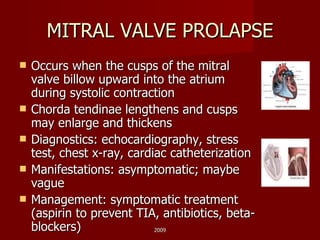
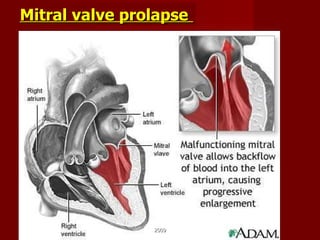
MITRAL VALVE PROLAPSE Occurs when the cusps of the mitral valve billow upward into the atrium during systolic contraction Chorda tendinae lengthens and cusps may enlarge and thickens Diagnostics: echocardiography, stress test, chest x-ray, cardiac catheterization Manifestations: asymptomatic; maybe vague Management: symptomatic treatment (aspirin to prevent TIA, antibiotics, beta-blockers) 2009
Mitral valve prolapse   2009
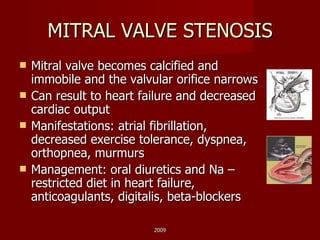
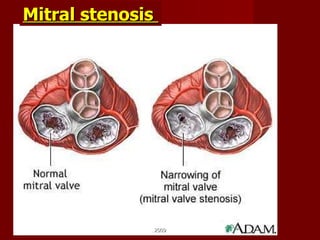
MITRAL VALVE STENOSIS Mitral valve becomes calcified and immobile and the valvular orifice narrows Can result to heart failure and decreased cardiac output Manifestations: atrial fibrillation, decreased exercise tolerance, dyspnea, orthopnea, murmurs Management: oral diuretics and Na – restricted diet in heart failure, anticoagulants, digitalis, beta-blockers 2009
Mitral stenosis  2009
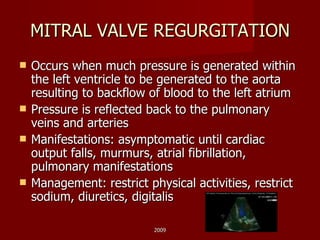
MITRAL VALVE REGURGITATION Occurs when much pressure is generated within the left ventricle to be generated to the aorta resulting to backflow of blood to the left atrium Pressure is reflected back to the pulmonary veins and arteries Manifestations: asymptomatic until cardiac output falls, murmurs, atrial fibrillation, pulmonary manifestations Management: restrict physical activities, restrict sodium, diuretics, digitalis 2009
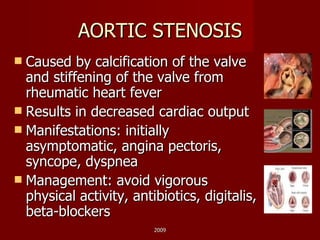
AORTIC STENOSIS Caused by calcification of the valve and stiffening of the valve from rheumatic heart fever Results in decreased cardiac output Manifestations: initially asymptomatic, angina pectoris, syncope, dyspnea Management: avoid vigorous physical activity, antibiotics, digitalis, beta-blockers 2009
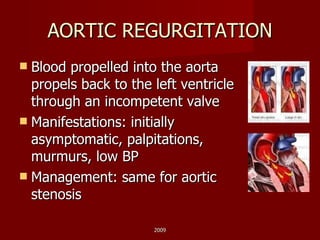
AORTIC REGURGITATION Blood propelled into the aorta propels back to the left ventricle through an incompetent valve Manifestations: initially asymptomatic, palpitations, murmurs, low BP Management: same for aortic stenosis 2009
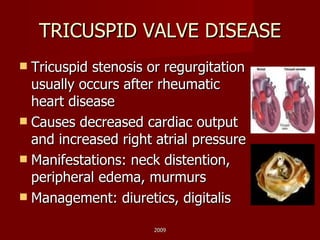
TRICUSPID VALVE DISEASE Tricuspid stenosis or regurgitation usually occurs after rheumatic heart disease Causes decreased cardiac output and increased right atrial pressure Manifestations: neck distention, peripheral edema, murmurs Management: diuretics, digitalis 2009
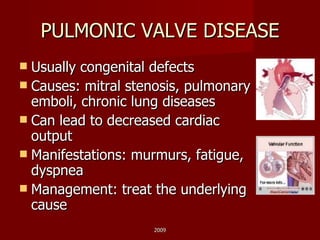
PULMONIC VALVE DISEASE Usually congenital defects Causes: mitral stenosis, pulmonary emboli, chronic lung diseases Can lead to decreased cardiac output Manifestations: murmurs, fatigue, dyspnea Management: treat the underlying cause 2009
2009
INFECTIOUS DISORDERS OF THE HEART 2009
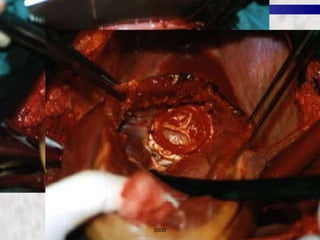
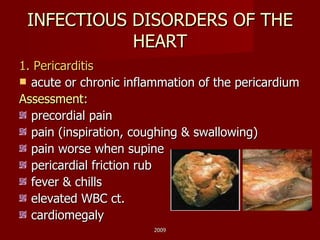
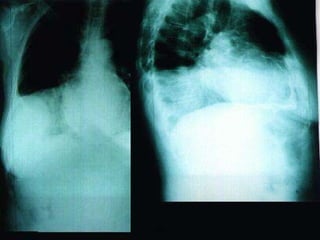
INFECTIOUS DISORDERS OF THE HEART 1. Pericarditis acute or chronic inflammation of the pericardium Assessment: precordial pain  pain (inspiration, coughing & swallowing) pain worse when supine pericardial friction rub fever & chills elevated WBC ct. cardiomegaly 2009
2009
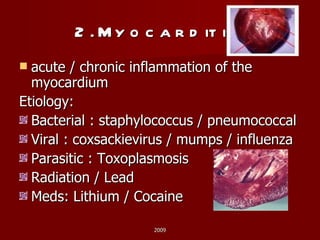
2. Myocarditis: acute / chronic inflammation of the myocardium Etiology: Bacterial : staphylococcus / pneumococcal Viral : coxsackievirus / mumps / influenza Parasitic : Toxoplasmosis Radiation / Lead Meds: Lithium / Cocaine 2009
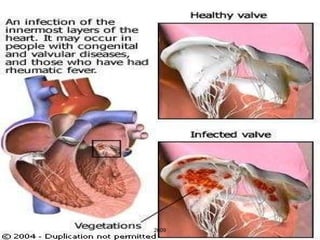
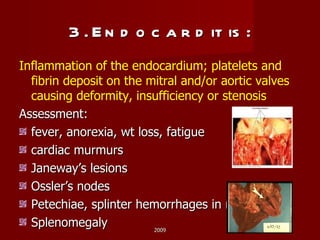
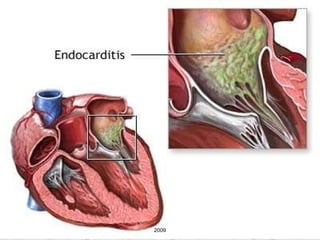
3. Endocarditis: Inflammation of the endocardium; platelets and fibrin deposit on the mitral and/or aortic valves causing deformity, insufficiency or stenosis Assessment: fever, anorexia, wt loss, fatigue cardiac murmurs Janeway’s lesions Ossler’s nodes Petechiae, splinter hemorrhages in nailbeds Splenomegaly 2009
2009
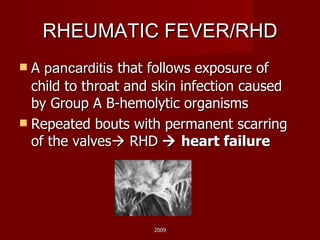
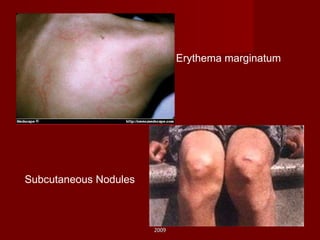
RHEUMATIC FEVER/RHD A  pancarditis  that follows exposure of child to throat and skin infection caused by Group A B-hemolytic organisms Repeated bouts with permanent scarring of the valves   RHD     heart failure 2009
Erythema marginatum Subcutaneous Nodules 2009
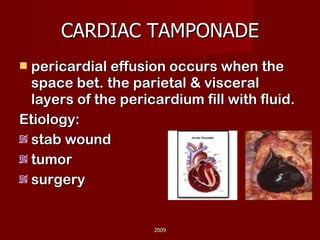
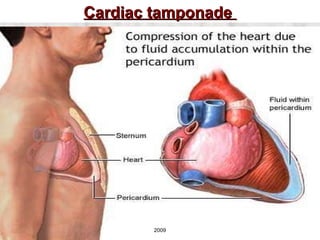
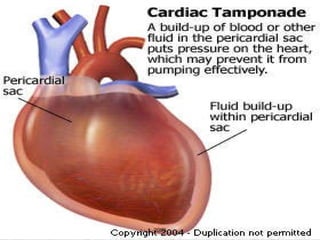
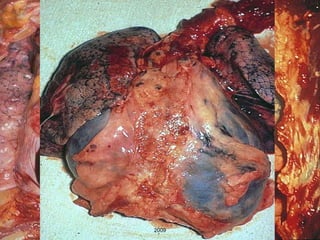
CARDIAC TAMPONADE pericardial effusion occurs when the space bet. the parietal & visceral layers of the pericardium fill with fluid.  Etiology: stab wound tumor surgery 2009
Cardiac tamponade   2009
2009
2009
CORONARY ARTERY DISORDERS 2009
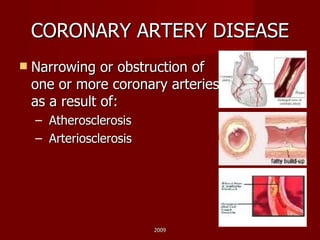
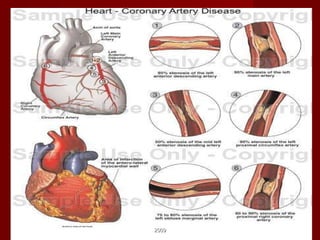
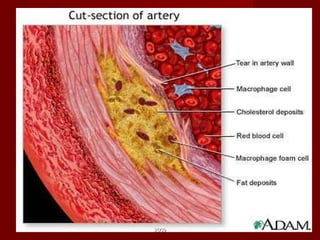
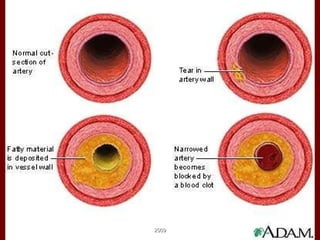
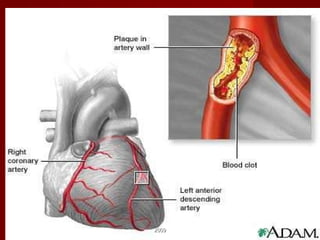
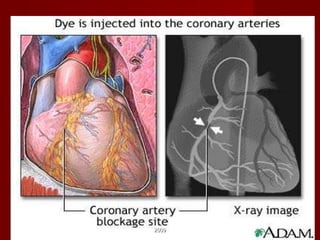
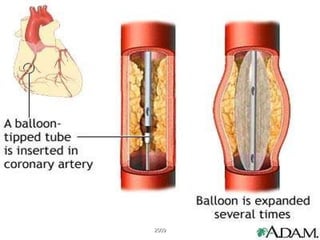
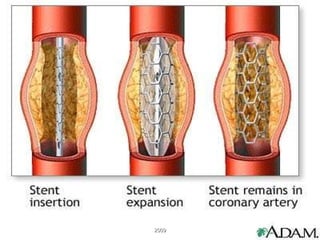
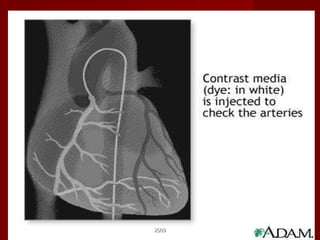
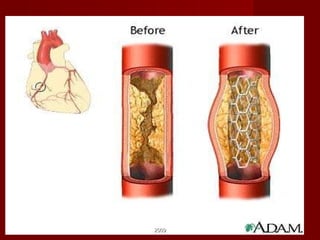
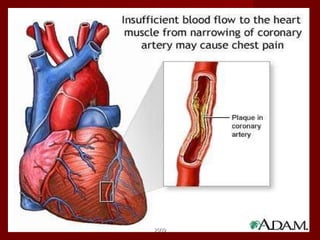
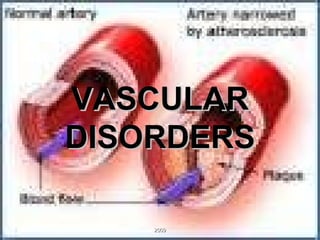
CORONARY ARTERY DISEASE Narrowing or obstruction of one or more coronary arteries as a result of: Atherosclerosis  Arteriosclerosis 2009
2009
2009
2009
2009
2009
2009
2009
2009
2009
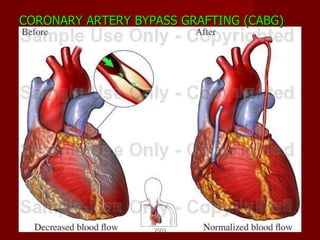
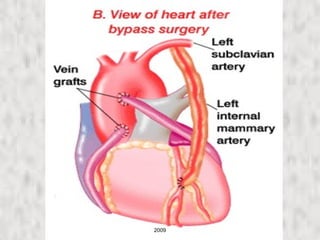
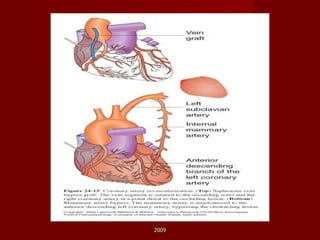
CORONARY ARTERY BYPASS GRAFTING (CABG) 2009
2009
2009
ANGINA PECTORIS 2009
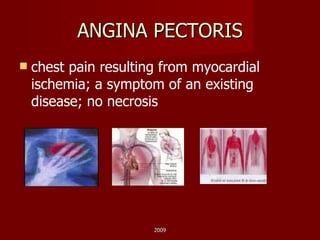
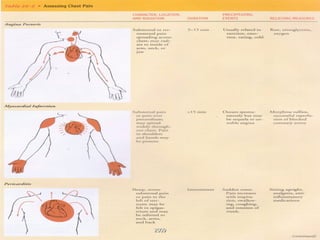
ANGINA PECTORIS chest pain resulting from myocardial ischemia; a symptom of an existing disease; no necrosis 2009
2009
MYOCARDIAL INFARCTION 2009
2009
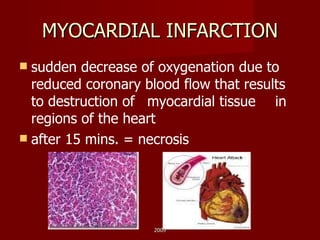
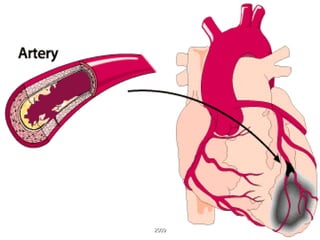
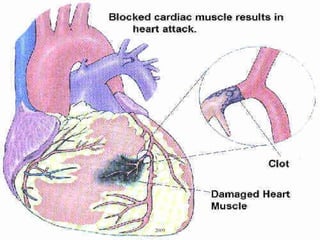
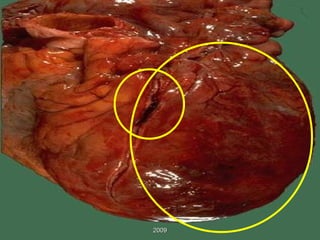
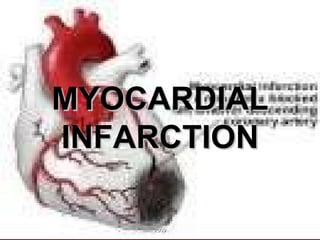
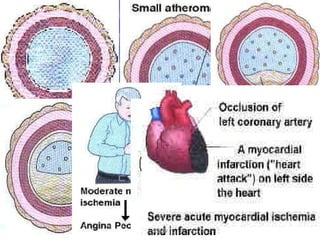
MYOCARDIAL INFARCTION sudden decrease of oxygenation due to reduced coronary blood flow that results to destruction of  myocardial tissue  in regions of the heart after 15 mins. = necrosis 2009
2009
2009
2009
2009
VASCULAR DISORDERS 2009
HYPERTENSION 2009
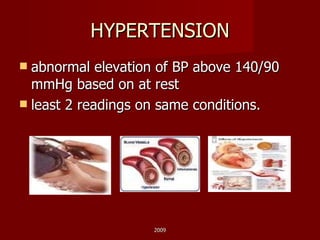
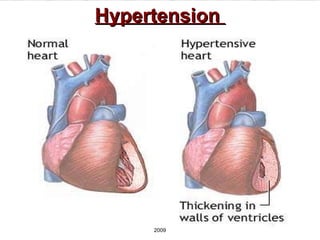
HYPERTENSION abnormal elevation of BP above 140/90 mmHg based on at rest least 2 readings on same conditions. 2009
Hypertension   2009
ARTERIAL ULCERS 2009
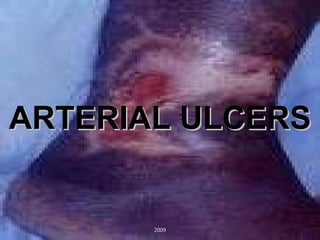
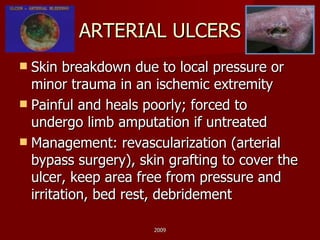
ARTERIAL ULCERS Skin breakdown due to local pressure or minor trauma in an ischemic extremity Painful and heals poorly; forced to undergo limb amputation if untreated Management: revascularization (arterial bypass surgery), skin grafting to cover the ulcer, keep area free from pressure and irritation, bed rest, debridement  2009
ANEURYMS 2009
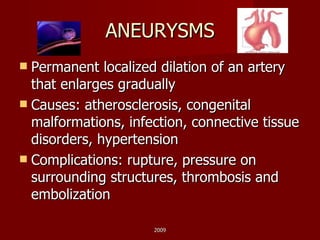
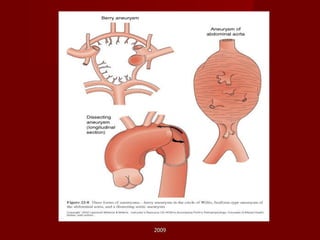
ANEURYSMS Permanent localized dilation of an artery that enlarges gradually Causes: atherosclerosis, congenital malformations, infection, connective tissue disorders, hypertension Complications: rupture, pressure on surrounding structures, thrombosis and embolization 2009
2009
RAYNAUD’S SYNDROME 2009
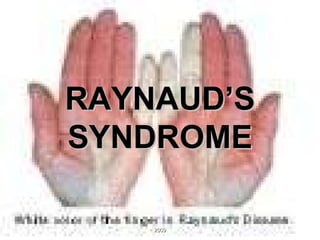
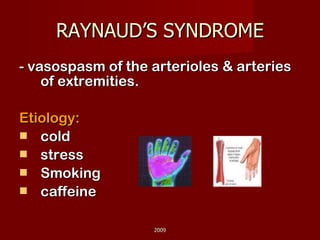
RAYNAUD’S SYNDROME - vasospasm of the arterioles & arteries of extremities. Etiology: cold stress Smoking caffeine 2009
BueRGER’S DISEASE 2009
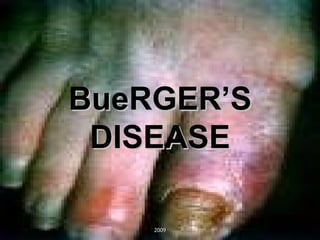
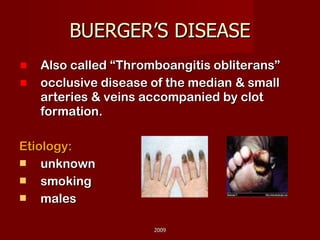
BUERGER’S DISEASE Also called “Thromboangitis obliterans” occlusive disease of the median & small arteries & veins accompanied by clot formation. Etiology: unknown  smoking males 2009
VARICOSE VEINS 2009
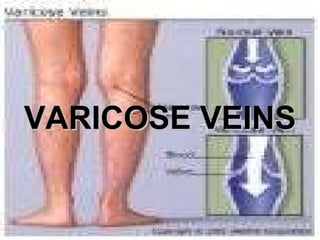
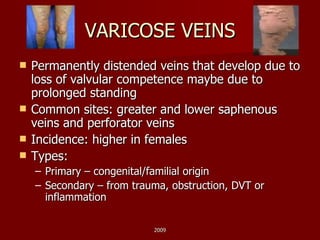
VARICOSE VEINS Permanently distended veins that develop due to loss of valvular competence maybe due to prolonged standing Common sites: greater and lower saphenous veins and perforator veins Incidence: higher in females Types: Primary – congenital/familial origin Secondary – from trauma, obstruction, DVT or inflammation 2009
CHRONIC VENOUS INSUFFICIENCY 2009
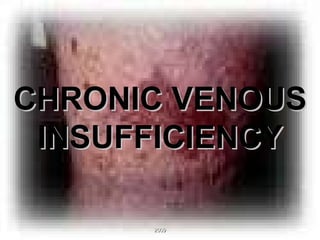
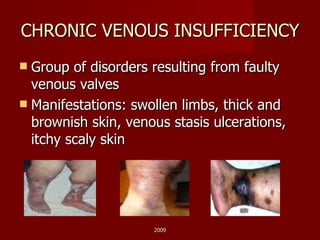
CHRONIC VENOUS INSUFFICIENCY Group of disorders resulting from faulty venous valves Manifestations: swollen limbs, thick and brownish skin, venous stasis ulcerations, itchy scaly skin 2009
LYMPHEDEMA 2009
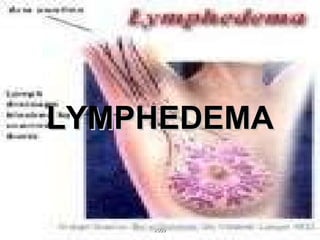
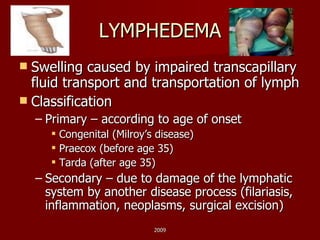
LYMPHEDEMA Swelling caused by impaired transcapillary fluid transport and transportation of lymph Classification Primary – according to age of onset Congenital (Milroy’s disease) Praecox (before age 35) Tarda (after age 35) Secondary – due to damage of the lymphatic system by another disease process (filariasis, inflammation, neoplasms, surgical excision) 2009
THE END

Ed tech boholano

  • 1.
  • 2.
    COURSE OUTLINE A.Review of Anatomy and Physiology 1. Heart 2. Blood vessels 3. Blood circulation B. History and Assessment Findings 1. Risk Factors for Cardiac Diseases 2. Physical Assessment 2009
  • 3.
  • 4.
  • 5.
    I. Anatomy &Physiology: 300 gms / cone shaped & tilted forward & to the left size of a fist / rests only location: mediastinum During the course of the day, your heart will beat approx 100,000 times driving 2,000 gallons of oxygen-rich blood through 60,000 miles of blood vessels. 2009
  • 6.
  • 7.
    Heart wall hasthree layers Myocardium Epicardium Endocardium
  • 8.
    Layers: Pericardium ParietalVisceral Pericardial space Epicardium Myocardium Endocardium 2009
  • 9.
    Chambers of theheart: Right Atrium Right Ventricle Left Atrium Left Ventricle 2009
  • 10.
    Superior VenaCava Brachiocephalic Artery Common Carotid Artery Subclavian Artery Aorta Pulmonary Artery Parietal Pericardium Right Atrium Right Ventricle Right Coronary Vein Right Coronary Artery Left Atrium Apex Left Ventricle Left Coronary Vein Left Coronary Artery Ligamentum Arteriosum
  • 11.
  • 12.
  • 13.
    Valves: AV ValvesTricuspid Mitral Semilunar Valves Pulmonic valve Aortic valve 2009
  • 14.
    BLOOD SUPPLY OFTHE HEART 2009
  • 15.
    Coronary Arteries: RightCoronary Artery Right atrium & ventricle Inferior portion of left ventricle Posterior septal wall SA & AV nodes 2009
  • 16.
    Left Coronary ArteryLeft Anterior Descending Coronary Artery anterior wall of left ventricle anterior ventricular apex of left ventricle Circumflex Artery left atrium lateral & posterior surfaces of left ventricle 2009
  • 17.
  • 18.
  • 19.
    The Vascular System:Arteries Arterioles Capillaries Venules Veins Valves Lymphatics 2009
  • 20.
    The Vascular SystemFigure 11.8b 2009
  • 21.
  • 22.
    Properties of CardiacMuscle: Automaticity Excitability Conductivity Contractility 2009
  • 23.
    Cardiac Conduction System:Sino-Atrial (SA) Node – Pacemaker Atrioventricular Node (AV) Bundle of His Purkinje fibers 2009
  • 24.
  • 25.
    Heart Sounds: S1– AV valves close S2 – Semilunar valves close S3 – Ventricular gallop S4 – Atrial gallop 2009
  • 26.
    Cardiac Output: bloodejected from left ventricle / min. ave.: 5L/min. CO = stroke vol. X HR Stroke Volume – blood ejected / heartbeat Preload – myocardial fiber length at end diastole Afterload – resistance to left ventricular ejection 2009
  • 27.
    Blood Pressure Thepressure exerted by the blood against the blood vessel wall Factors affecting Blood Pressure Neural Factors : the Autonomic Nervous System, particularly the Sympathetic Nervous System which often causes vasoconstriction or narrowing of the vessels and thus increasing blood pressure Renal Factors : the Kidneys Temperature : Cold – causes vasoconstriction Heat – causes vasodilatation Chemicals and Hormones Catecholamines, Antidiuretic Hormone, Aldosterone, Atrial Natriuretic Peptide, Nicotine, Histamine & Alcohol Diet
  • 28.
    Blood Pressure Control:Baroreceptors (pressoreceptors) – aortic arch & carotid sinus Stretch receptors – vena cava & right atrium Anti-diuretic Hormone Aldosterone Renin-Angiotensin System 2009
  • 29.
  • 30.
    ASSESSMENT WITH CVDISORDERS NURSING HISTORY - RISK FACTORS PHYSICAL EXAMINATION COMMON SIGNS/ SYPMTOMS DIAGNOSTIC PROCEDURES 2009
  • 31.
    RISK FACTORS NON-MODIFIABLE AGE SEX/GENDER HEREDITY RACE MODIFIABLE DIET EXERCISE STRESS SMOKING ALCOHOL DISEASES(HTN,DM) OBESITY PERSONALITY CONTRECEPTIVES 2009
  • 32.
    PHYSICAL EXAMINATION INSPECTIONSKIN COLOR NECK VEIN ENGORGEMENT RESPIRATION PMI PERIPHERAL EDEMA PALPATION PULSES APICAL PULSE 2009
  • 33.
  • 34.
  • 35.
  • 36.
    AUSCULTATION Heart soundsS1-AV closure S2- semilunar valve closure S3-ventricular gallop S4-atrial gallop Murmurs Pericardial friction rub 2009
  • 37.
  • 38.
    Common Signs andSymptoms: Subjective Dyspnea Chest pain Weight gain Syncope Palpitations Fatigue Objective Neck vein distention Respiration Peripheral edema Murmurs 2009
  • 39.
  • 40.
  • 41.
    A. Cardiac EnzymesDIAGNOSTIC TEST 2009 Enzyme Onset Peak Normal Values : AST/SGOT CPK-MB LDH Troponin Myoglobin HRD 4-6 hrs 3-6 hrs. within 12 hrs. within 3 hrs. 1hr. 10-12 hrs 24-36 hrs 12-18 hrs. 48-72 hrs. Up to 7 days 4-6 hrs. 48-72 hrs 7-40 mu/ml 50-325 mu./ml 100-225 IU/L < 0.6 ng/ml 0-85 ng/ml 140 – 350 mu/ml
  • 42.
    B. Electrolytes 2009ELECTROLYTE Increased Decreased Potassium Sodium Calcium Magnesium Ventricular dysrhythmia Digitalis toxicity water toxicity AV block / tachycardia shortened QT interval muscle weakness/ hypotension prolonged PR interval wide QRS complex Ventricular dysrhythmia asystole diuretics use / HF ventricular dysrhythmia prolonged QT interval ventricular tachycardia fibrillation
  • 43.
  • 44.
  • 45.
  • 46.
  • 47.
  • 48.
  • 49.
  • 50.
    Methods for CalculatingHeart Rate 2009
  • 51.
  • 52.
  • 53.
  • 54.
    COMPUTED TOMOGRAPHY Allowsvisualization of the arterial wall and its structures May detect Abdominal Aortic Aneuryms Nursing Interventions : Explain the procedure NPO, if with contrast medium Ascertain history to allergy to iodine and seafoods Assess for claustrophobia Advise to remain still during the entire procedure Sedation if unable to remain still 2009
  • 55.
  • 56.
  • 57.
    VALVULAR HEART DISEASEMitral Valve Disease Mitral Valve prolapse Mitral Valve stenosis Mitral Valve regurgitation Aortic Valve Disease Aortic Stenosis Aortic Regurgitation Tricuspid Valve Disease Pulmonic Valve Disease 2009
  • 58.
  • 59.
    MITRAL VALVE PROLAPSEOccurs when the cusps of the mitral valve billow upward into the atrium during systolic contraction Chorda tendinae lengthens and cusps may enlarge and thickens Diagnostics: echocardiography, stress test, chest x-ray, cardiac catheterization Manifestations: asymptomatic; maybe vague Management: symptomatic treatment (aspirin to prevent TIA, antibiotics, beta-blockers) 2009
  • 60.
  • 61.
    MITRAL VALVE STENOSISMitral valve becomes calcified and immobile and the valvular orifice narrows Can result to heart failure and decreased cardiac output Manifestations: atrial fibrillation, decreased exercise tolerance, dyspnea, orthopnea, murmurs Management: oral diuretics and Na – restricted diet in heart failure, anticoagulants, digitalis, beta-blockers 2009
  • 62.
  • 63.
    MITRAL VALVE REGURGITATIONOccurs when much pressure is generated within the left ventricle to be generated to the aorta resulting to backflow of blood to the left atrium Pressure is reflected back to the pulmonary veins and arteries Manifestations: asymptomatic until cardiac output falls, murmurs, atrial fibrillation, pulmonary manifestations Management: restrict physical activities, restrict sodium, diuretics, digitalis 2009
  • 64.
    AORTIC STENOSIS Causedby calcification of the valve and stiffening of the valve from rheumatic heart fever Results in decreased cardiac output Manifestations: initially asymptomatic, angina pectoris, syncope, dyspnea Management: avoid vigorous physical activity, antibiotics, digitalis, beta-blockers 2009
  • 65.
    AORTIC REGURGITATION Bloodpropelled into the aorta propels back to the left ventricle through an incompetent valve Manifestations: initially asymptomatic, palpitations, murmurs, low BP Management: same for aortic stenosis 2009
  • 66.
    TRICUSPID VALVE DISEASETricuspid stenosis or regurgitation usually occurs after rheumatic heart disease Causes decreased cardiac output and increased right atrial pressure Manifestations: neck distention, peripheral edema, murmurs Management: diuretics, digitalis 2009
  • 67.
    PULMONIC VALVE DISEASEUsually congenital defects Causes: mitral stenosis, pulmonary emboli, chronic lung diseases Can lead to decreased cardiac output Manifestations: murmurs, fatigue, dyspnea Management: treat the underlying cause 2009
  • 68.
  • 69.
  • 70.
    INFECTIOUS DISORDERS OFTHE HEART 1. Pericarditis acute or chronic inflammation of the pericardium Assessment: precordial pain pain (inspiration, coughing & swallowing) pain worse when supine pericardial friction rub fever & chills elevated WBC ct. cardiomegaly 2009
  • 71.
  • 72.
    2. Myocarditis: acute/ chronic inflammation of the myocardium Etiology: Bacterial : staphylococcus / pneumococcal Viral : coxsackievirus / mumps / influenza Parasitic : Toxoplasmosis Radiation / Lead Meds: Lithium / Cocaine 2009
  • 73.
    3. Endocarditis: Inflammationof the endocardium; platelets and fibrin deposit on the mitral and/or aortic valves causing deformity, insufficiency or stenosis Assessment: fever, anorexia, wt loss, fatigue cardiac murmurs Janeway’s lesions Ossler’s nodes Petechiae, splinter hemorrhages in nailbeds Splenomegaly 2009
  • 74.
  • 75.
    RHEUMATIC FEVER/RHD A pancarditis that follows exposure of child to throat and skin infection caused by Group A B-hemolytic organisms Repeated bouts with permanent scarring of the valves  RHD  heart failure 2009
  • 76.
  • 77.
    CARDIAC TAMPONADE pericardialeffusion occurs when the space bet. the parietal & visceral layers of the pericardium fill with fluid. Etiology: stab wound tumor surgery 2009
  • 78.
  • 79.
  • 80.
  • 81.
  • 82.
    CORONARY ARTERY DISEASENarrowing or obstruction of one or more coronary arteries as a result of: Atherosclerosis Arteriosclerosis 2009
  • 83.
  • 84.
  • 85.
  • 86.
  • 87.
  • 88.
  • 89.
  • 90.
  • 91.
  • 92.
    CORONARY ARTERY BYPASSGRAFTING (CABG) 2009
  • 93.
  • 94.
  • 95.
  • 96.
    ANGINA PECTORIS chestpain resulting from myocardial ischemia; a symptom of an existing disease; no necrosis 2009
  • 97.
  • 98.
  • 99.
  • 100.
    MYOCARDIAL INFARCTION suddendecrease of oxygenation due to reduced coronary blood flow that results to destruction of myocardial tissue in regions of the heart after 15 mins. = necrosis 2009
  • 101.
  • 102.
  • 103.
  • 104.
  • 105.
  • 106.
  • 107.
    HYPERTENSION abnormal elevationof BP above 140/90 mmHg based on at rest least 2 readings on same conditions. 2009
  • 108.
  • 109.
  • 110.
    ARTERIAL ULCERS Skinbreakdown due to local pressure or minor trauma in an ischemic extremity Painful and heals poorly; forced to undergo limb amputation if untreated Management: revascularization (arterial bypass surgery), skin grafting to cover the ulcer, keep area free from pressure and irritation, bed rest, debridement 2009
  • 111.
  • 112.
    ANEURYSMS Permanent localizeddilation of an artery that enlarges gradually Causes: atherosclerosis, congenital malformations, infection, connective tissue disorders, hypertension Complications: rupture, pressure on surrounding structures, thrombosis and embolization 2009
  • 113.
  • 114.
  • 115.
    RAYNAUD’S SYNDROME -vasospasm of the arterioles & arteries of extremities. Etiology: cold stress Smoking caffeine 2009
  • 116.
  • 117.
    BUERGER’S DISEASE Alsocalled “Thromboangitis obliterans” occlusive disease of the median & small arteries & veins accompanied by clot formation. Etiology: unknown smoking males 2009
  • 118.
  • 119.
    VARICOSE VEINS Permanentlydistended veins that develop due to loss of valvular competence maybe due to prolonged standing Common sites: greater and lower saphenous veins and perforator veins Incidence: higher in females Types: Primary – congenital/familial origin Secondary – from trauma, obstruction, DVT or inflammation 2009
  • 120.
  • 121.
    CHRONIC VENOUS INSUFFICIENCYGroup of disorders resulting from faulty venous valves Manifestations: swollen limbs, thick and brownish skin, venous stasis ulcerations, itchy scaly skin 2009
  • 122.
  • 123.
    LYMPHEDEMA Swelling causedby impaired transcapillary fluid transport and transportation of lymph Classification Primary – according to age of onset Congenital (Milroy’s disease) Praecox (before age 35) Tarda (after age 35) Secondary – due to damage of the lymphatic system by another disease process (filariasis, inflammation, neoplasms, surgical excision) 2009
  • 124.