Cardiac Anatomy and Physiology
Overview Anatomy and Physiology Terms
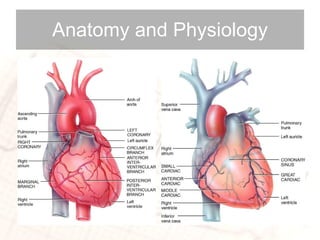
Anatomy and Physiology The body needs O 2  to support daily activity blood is that delivery system the heart is the medium to supply the blood  100,000 beats in 24 hours 5-20 litres per minute  Responds to activity
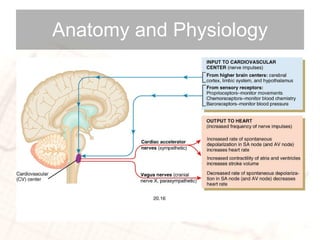
Anatomy and Physiology
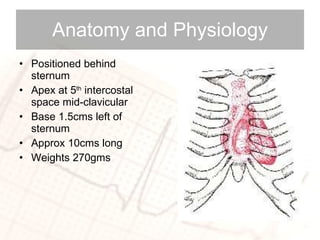
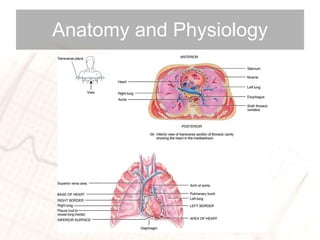
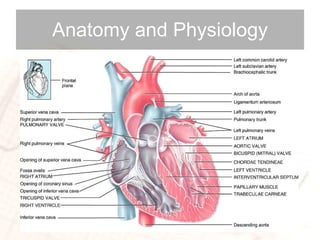
Anatomy and Physiology Positioned behind sternum  Apex at 5 th  intercostal space mid-clavicular  Base 1.5cms left of sternum  Approx 10cms long  Weights 270gms
Anatomy and Physiology
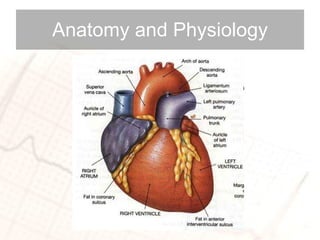
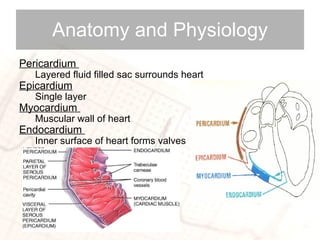
Anatomy and Physiology Pericardium  Layered fluid filled sac surrounds heart  Epicardium Single layer Myocardium  Muscular wall of heart  Endocardium  Inner surface of heart forms valves
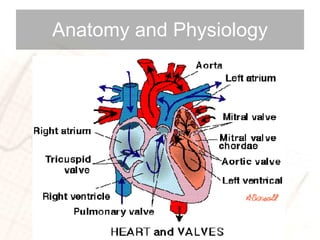
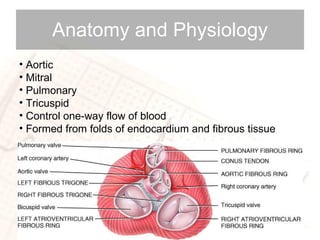
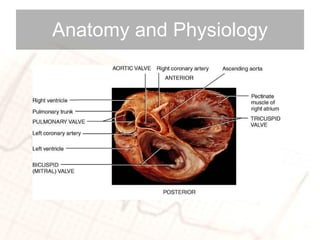
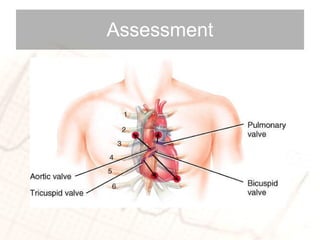
Anatomy and Physiology Aortic  Mitral  Pulmonary  Tricuspid  Control one-way flow of blood  Formed from folds of endocardium and fibrous tissue
Anatomy and Physiology
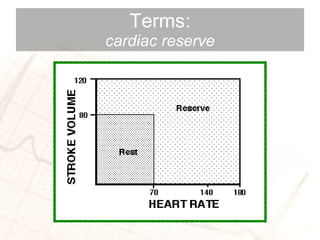
Terms Atrial kick Pre-load After-load Contractility Stroke Volume Cardiac output Cardiac reserve
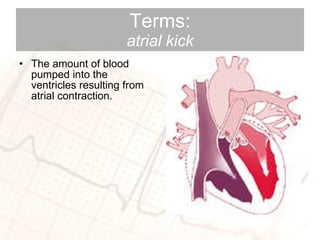
Terms: atrial kick The amount of blood pumped into the ventricles resulting from atrial contraction.
Terms: pre-load The stretch of the myocardial fibres at end diastole, The ventricle end diastolic pressure and volume.
Terms: after-load The resistance, against which the ventricle must eject its volume of blood during contraction. The resistance is produced by the volume blood already in the vascular system and the vessel walls.
Terms: contractility The ability of the  cardiac muscle fibres to contract or shorten  Frank-starlings law
Terms: stroke volume The amount blood ejected by ventricle during contraction, Ejection fraction proportion of blood expelled in contraction compared to filling volume,  Normally 65% used as measure of normal LV function,
Terms: cardiac output CO  = HR x SV BP  = CO x SVR Cardiac Index  = cardiac output of pt per square metre of body surface area
Terms: cardiac reserve
Cardiac Assessment
Overview Physical Assessment Inspection  Palpation (Percussion) Auscultation History
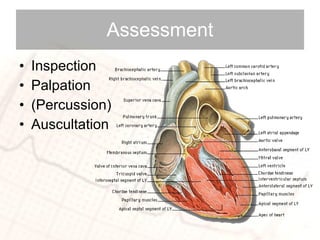
Assessment Inspection Palpation (Percussion) Auscultation
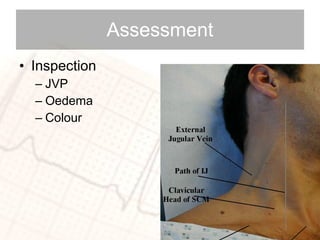
Assessment Inspection JVP Oedema Colour
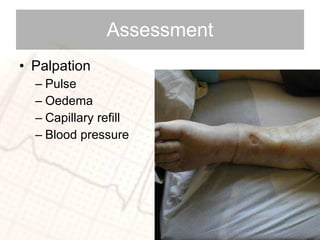
Assessment Palpation Pulse Oedema Capillary refill Blood pressure
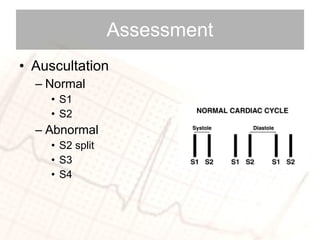
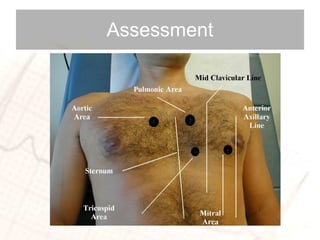
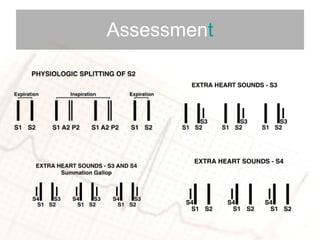
Assessment Auscultation Normal  S1  S2 Abnormal  S2 split S3 S4
Assessment
Assessment
Assessmen t
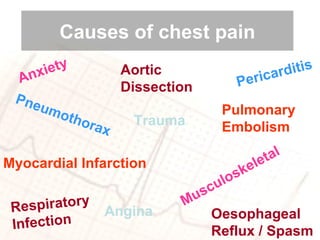
Pneumothorax Myocardial Infarction Respiratory Infection Angina Musculoskeletal Pericarditis Aortic Dissection Trauma Anxiety Pulmonary Embolism Oesophageal Reflux / Spasm Causes of chest pain
Case 1: 40 year old man 2 hours central chest pain Radiating to (L) arm Pale, cold, clammy Case 2: 55 year old woman 1 hour generalised weakness and unwell Discomfort in throat Who is having a MI?
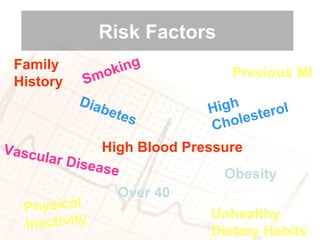
Diabetes High Blood Pressure Physical Inactivity Over 40 Vascular Disease High Cholesterol Previous MI Obesity Smoking Family History Unhealthy Dietary Habits Risk Factors
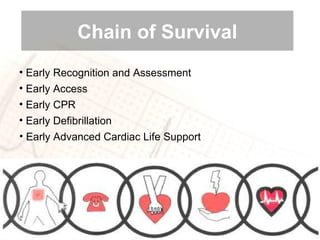
Early Recognition and Assessment Early Access Early CPR Early Defibrillation Early Advanced Cardiac Life Support Chain of Survival
Case 1: 40 year old man 2 hours central chest pain Radiating to (L) arm Pale, cold, clammy Triage: Rapid Assessment Prioritise Injury / Illness Allocate Triage Category  Scenario
Primary Assessment A – clear and open  B – spontaneous, AE R=L  o  added sounds  C – tachycardic - weak, diaphoretic D – GCS 15, PEARL, full ROM / Strength / Sensation all limbs  Secondary Assessment E – Change into patient gown F – Observations:  R: 28, P: 120, BP: 149/66, T: 37 2 ,  (monitor)   BSL: 6.9, Pain 5/10, SpO 2  99% RA   G  –  Comfort measures H – Detailed history / Family History / heat-to-toe assessment Time = Muscle Assessment
lleregies A M P L E edications revious medical, surgical and family history   ast meal vents Assessment
osition:  Where is the Pain? P Q R S T A A A uality:  What does the pain feel like?  [sharp, dull, burning] adiation:  Does the pain move anywhere?  everity:  Rate the pain on a scale between 0 and 10 iming:  When did the pain start? Is it continuous?  lleviating factors:  What makes it better? ggravating factors:  What makes it worse? ssociated symptoms:  e.g., nausea / pins and needles Assessment
Inspect Palpate Percussion Auscultation Assessment
Notify Nursing Team Leader and Senior Doctor Primary B – Supplementary Oxygen C – ECG Nursing Intervention
Nursing Intervention
Ineffective cardiopulmonary tissue perfusion related to reduced coronary blood flow Notify Nursing Team Leader and Senior Doctor Primary B – Supplementary Oxygen C – ECG IVC 18g Bloods to pathology (FBC, UEC, CP, CK, Troponin, ABG) Secondary F – Observations  G  –  Analgesia / Medications Reassurance, bed rest, patient and family education Nursing Intervention
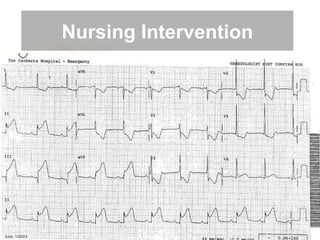
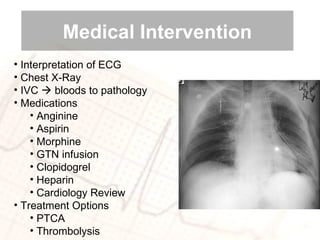
Interpretation of ECG  Chest X-Ray IVC    bloods to pathology Medications Anginine Aspirin  Morphine GTN infusion Clopidogrel Heparin Cardiology Review  Treatment Options PTCA Thrombolysis Medical Intervention

Cardiac Anatomy and Physiology

  • 1.
  • 2.
    Overview Anatomy andPhysiology Terms
  • 3.
    Anatomy and PhysiologyThe body needs O 2 to support daily activity blood is that delivery system the heart is the medium to supply the blood 100,000 beats in 24 hours 5-20 litres per minute Responds to activity
  • 4.
  • 5.
    Anatomy and PhysiologyPositioned behind sternum Apex at 5 th intercostal space mid-clavicular Base 1.5cms left of sternum Approx 10cms long Weights 270gms
  • 6.
  • 7.
  • 8.
  • 9.
    Anatomy and PhysiologyPericardium Layered fluid filled sac surrounds heart Epicardium Single layer Myocardium Muscular wall of heart Endocardium Inner surface of heart forms valves
  • 10.
    Anatomy and PhysiologyAortic Mitral Pulmonary Tricuspid Control one-way flow of blood Formed from folds of endocardium and fibrous tissue
  • 11.
  • 12.
  • 13.
  • 14.
    Terms Atrial kickPre-load After-load Contractility Stroke Volume Cardiac output Cardiac reserve
  • 15.
    Terms: atrial kickThe amount of blood pumped into the ventricles resulting from atrial contraction.
  • 16.
    Terms: pre-load Thestretch of the myocardial fibres at end diastole, The ventricle end diastolic pressure and volume.
  • 17.
    Terms: after-load Theresistance, against which the ventricle must eject its volume of blood during contraction. The resistance is produced by the volume blood already in the vascular system and the vessel walls.
  • 18.
    Terms: contractility Theability of the cardiac muscle fibres to contract or shorten Frank-starlings law
  • 19.
    Terms: stroke volumeThe amount blood ejected by ventricle during contraction, Ejection fraction proportion of blood expelled in contraction compared to filling volume, Normally 65% used as measure of normal LV function,
  • 20.
    Terms: cardiac outputCO = HR x SV BP = CO x SVR Cardiac Index = cardiac output of pt per square metre of body surface area
  • 21.
  • 22.
  • 23.
    Overview Physical AssessmentInspection Palpation (Percussion) Auscultation History
  • 24.
    Assessment Inspection Palpation(Percussion) Auscultation
  • 25.
  • 26.
    Assessment Palpation PulseOedema Capillary refill Blood pressure
  • 27.
    Assessment Auscultation Normal S1 S2 Abnormal S2 split S3 S4
  • 28.
  • 29.
  • 30.
  • 31.
    Pneumothorax Myocardial InfarctionRespiratory Infection Angina Musculoskeletal Pericarditis Aortic Dissection Trauma Anxiety Pulmonary Embolism Oesophageal Reflux / Spasm Causes of chest pain
  • 32.
    Case 1: 40year old man 2 hours central chest pain Radiating to (L) arm Pale, cold, clammy Case 2: 55 year old woman 1 hour generalised weakness and unwell Discomfort in throat Who is having a MI?
  • 33.
    Diabetes High BloodPressure Physical Inactivity Over 40 Vascular Disease High Cholesterol Previous MI Obesity Smoking Family History Unhealthy Dietary Habits Risk Factors
  • 34.
    Early Recognition andAssessment Early Access Early CPR Early Defibrillation Early Advanced Cardiac Life Support Chain of Survival
  • 35.
    Case 1: 40year old man 2 hours central chest pain Radiating to (L) arm Pale, cold, clammy Triage: Rapid Assessment Prioritise Injury / Illness Allocate Triage Category Scenario
  • 36.
    Primary Assessment A– clear and open B – spontaneous, AE R=L o added sounds C – tachycardic - weak, diaphoretic D – GCS 15, PEARL, full ROM / Strength / Sensation all limbs Secondary Assessment E – Change into patient gown F – Observations: R: 28, P: 120, BP: 149/66, T: 37 2 , (monitor) BSL: 6.9, Pain 5/10, SpO 2 99% RA G – Comfort measures H – Detailed history / Family History / heat-to-toe assessment Time = Muscle Assessment
  • 37.
    lleregies A MP L E edications revious medical, surgical and family history ast meal vents Assessment
  • 38.
    osition: Whereis the Pain? P Q R S T A A A uality: What does the pain feel like? [sharp, dull, burning] adiation: Does the pain move anywhere? everity: Rate the pain on a scale between 0 and 10 iming: When did the pain start? Is it continuous? lleviating factors: What makes it better? ggravating factors: What makes it worse? ssociated symptoms: e.g., nausea / pins and needles Assessment
  • 39.
    Inspect Palpate PercussionAuscultation Assessment
  • 40.
    Notify Nursing TeamLeader and Senior Doctor Primary B – Supplementary Oxygen C – ECG Nursing Intervention
  • 41.
  • 42.
    Ineffective cardiopulmonary tissueperfusion related to reduced coronary blood flow Notify Nursing Team Leader and Senior Doctor Primary B – Supplementary Oxygen C – ECG IVC 18g Bloods to pathology (FBC, UEC, CP, CK, Troponin, ABG) Secondary F – Observations G – Analgesia / Medications Reassurance, bed rest, patient and family education Nursing Intervention
  • 43.
    Interpretation of ECG Chest X-Ray IVC  bloods to pathology Medications Anginine Aspirin Morphine GTN infusion Clopidogrel Heparin Cardiology Review Treatment Options PTCA Thrombolysis Medical Intervention

Editor's Notes

  • #8 4 chambers Separated by septum and valves
  • #11 4 chambers Separated by septum and valves
  • #12 4 chambers Separated by septum and valves
  • #13 4 chambers Separated by septum and valves
  • #14 RCA is dominant in 84% of people Dominant artery usually does not perfuse largest % of myocardium Arise from aorta left branches into two large vessels right branches into single vessel from aortic sinus Can dilate meeting increased demand
  • #16 Contributes approximately 30% of CO alterations in atrial contraction effect CO
  • #27 Pulse – pulse deficit listen to apex and feel radial – if there is a difference this indicates a pulse deficit
  • #31 S2 split – A2 = aortic valve closure, P2 = pulmonic valve closure. On inspiration, venous return to the heart is impeded and pulmonic valve closure is delayed resulting in a split sound. Can be normal in some people. Get patient to hold breath to hear this better S3 – left ventricular failure: and is caused by blood from the left atrium slamming into an already overfilled ventricle during early diastolic filling S4 - left ventricular hypertrophy: blood trying to enter a stiff, non-compliant left ventricle during atrial contraction
  • #40 Inspect  skin colour, scars, etc.. Palpate  pulse Percussion  lungs / heart boarders Auscultation  heart murmurs
  • #41 B 2 via HM or NRB C FBC: Hb  anaemia, WCC  infection UEC: electrolyte imbalance CP: coagulation ?PE CK / Troponin: muscle / cardiac enzymes ABG: ventilation / perfusion status F Observations 5mins apart G Analgesia / medications
  • #43 B 2 via HM or NRB C FBC: Hb  anaemia, WCC  infection UEC: electrolyte imbalance CP: coagulation ?PE CK / Troponin: muscle / cardiac enzymes ABG: ventilation / perfusion status F Observations 5mins apart G Analgesia / medications
  • #44 Anginine Vasodilator, decreases preload and afterload therefore decreasing the workload of the heart, dilates coronary arteries Aspirin Platelet aggregation inhibitor  a study of 17,000 people showed a reduced re-infarction rate of 50% Morphine Analgesia, decreases anxiety, Clopidogrel Platelet aggregation inhibitor GTN Infusion Blood pressure control, reduces pain