Introduction to HAP
Introduction to HAP
By;
Dr. Mrs. Deepa K. Ingawale (Mandlik)
Department of Pharmacology
Poona College of Pharmacy, Pune
Introduction to HAP
Content in detail
Introduction to HAP
Learning Objectives
• To define anatomy and physiology.
• To describe the levels of structural organization of the human body.
• To list 12 systems of human body with their organs & functions.
• To enlist the important human life processes.
• To define the anatomical planes, sections & directional terms used
to illustrate the human body.
• To describe the major body cavities.
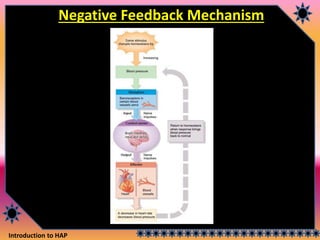
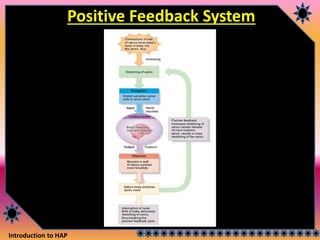
• Describe the positive and negative feedback mechanism system.
Introduction to HAP
Branches of science
• There are two branches of science.
• Anatomy
• Physiology
• It provides the information about different body parts &
their functions.
Introduction to HAP
Anatomy
• Anatomy: It is the scientific study of structures of human
body.
• Subdivisions of anatomy:
• Developmental biology: It is the study of complete development of
an individual from fertilization of an egg to death.
• Cell biology: It is the study of cell structure and functions.
• Histology: It is the study of microscopic structure of tissues.
• Gross anatomy: It is the study of cell structures without using a
microscope.
Introduction to HAP
Anatomy
• Systemic anatomy: It is the study of specific systems of body such
as nervous or respiratory systems.
• Regional anatomy: It is the study of specific regions of the body
such as head or chest.
• Radiographic anatomy: It is the study of body structures with the
help of x-rays.
• Pathological anatomy: It is the study of structural changes
associated with disease.
• Embryology: It is the study of first eight weeks of human
development.
Introduction to HAP
Physiology
• Physiology: It is the scientific study of normal functions of living
organisms and their parts.
• Subdivisions of physiology:
• Respiratory physiology: It is the study of functioning of lungs and
air passageways.
• Renal physiology: It is the study of functioning of the kidneys.
• Immunology: It is the study of defense mechanism of body against
disease-causing agents.
Introduction to HAP
Physiology
• Exercise physiology: It is the study of changes in cell and organ
functions as a result of exercise.
• Neurophysiology: It is the study of functioning of the nervous
system.
• Pathophysiology: It is the study of functional changes associated
with disease and aging.
• Cardiovascular physiology: It is the study of functioning of heart
and blood vessels.
• Endocrinology: It is the study of hormones and how they control
body functions.
•
Introduction to HAP
Levels of structural organizations
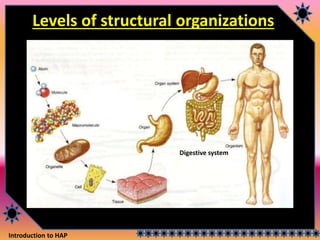
• There are six levels of organisations.
Chemical level
Cellular level
Tissue level
Organ level
System level
Organism level
Introduction to HAP
Levels of structural organizations
Digestive system
Introduction to HAP
Levels of structural organizations
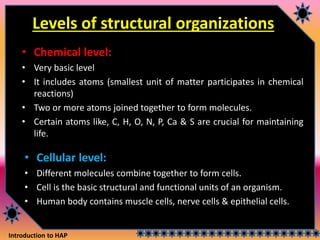
• Chemical level:
• Very basic level
• It includes atoms (smallest unit of matter participates in chemical
reactions)
• Two or more atoms joined together to form molecules.
• Certain atoms like, C, H, O, N, P, Ca & S are crucial for maintaining
life.
• Cellular level:
• Different molecules combine together to form cells.
• Cell is the basic structural and functional units of an organism.
• Human body contains muscle cells, nerve cells & epithelial cells.
Introduction to HAP
Levels of structural organizations
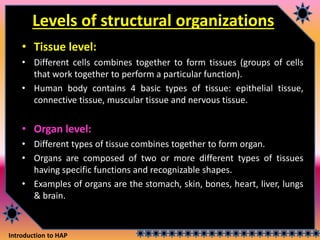
• Tissue level:
• Different cells combines together to form tissues (groups of cells
that work together to perform a particular function).
• Human body contains 4 basic types of tissue: epithelial tissue,
connective tissue, muscular tissue and nervous tissue.
• Organ level:
• Different types of tissue combines together to form organ.
• Organs are composed of two or more different types of tissues
having specific functions and recognizable shapes.
• Examples of organs are the stomach, skin, bones, heart, liver, lungs
& brain.
Introduction to HAP
Levels of structural organizations
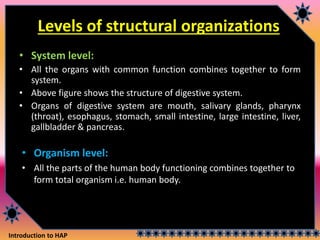
• System level:
• All the organs with common function combines together to form
system.
• Above figure shows the structure of digestive system.
• Organs of digestive system are mouth, salivary glands, pharynx
(throat), esophagus, stomach, small intestine, large intestine, liver,
gallbladder & pancreas.
• Organism level:
• All the parts of the human body functioning combines together to
form total organism i.e. human body.
Introduction to HAP
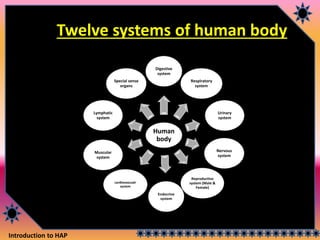
Twelve systems of human body
Human
body
Digestive
system
Respiratory
system
Urinary
system
Nervous
system
Reproductive
system (Male &
Female)
Endocrine
system
cardiovascualr
system
Muscular
system
Lymphatic
system
Special sense
organs
Introduction to HAP
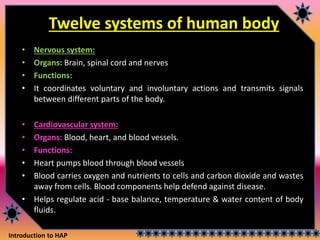
Twelve systems of human body
• Nervous system:
• Organs: Brain, spinal cord and nerves
• Functions:
• It coordinates voluntary and involuntary actions and transmits signals
between different parts of the body.
• Cardiovascular system:
• Organs: Blood, heart, and blood vessels.
• Functions:
• Heart pumps blood through blood vessels
• Blood carries oxygen and nutrients to cells and carbon dioxide and wastes
away from cells. Blood components help defend against disease.
• Helps regulate acid - base balance, temperature & water content of body
fluids.
Introduction to HAP
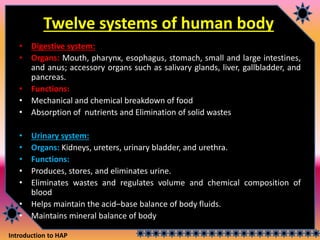
Twelve systems of human body
• Digestive system:
• Organs: Mouth, pharynx, esophagus, stomach, small and large intestines,
and anus; accessory organs such as salivary glands, liver, gallbladder, and
pancreas.
• Functions:
• Mechanical and chemical breakdown of food
• Absorption of nutrients and Elimination of solid wastes
• Urinary system:
• Organs: Kidneys, ureters, urinary bladder, and urethra.
• Functions:
• Produces, stores, and eliminates urine.
• Eliminates wastes and regulates volume and chemical composition of
blood
• Helps maintain the acid–base balance of body fluids.
• Maintains mineral balance of body
Introduction to HAP
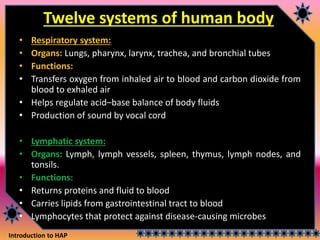
Twelve systems of human body
• Respiratory system:
• Organs: Lungs, pharynx, larynx, trachea, and bronchial tubes
• Functions:
• Transfers oxygen from inhaled air to blood and carbon dioxide from
blood to exhaled air
• Helps regulate acid–base balance of body fluids
• Production of sound by vocal cord
• Lymphatic system:
• Organs: Lymph, lymph vessels, spleen, thymus, lymph nodes, and
tonsils.
• Functions:
• Returns proteins and fluid to blood
• Carries lipids from gastrointestinal tract to blood
• Lymphocytes that protect against disease-causing microbes
Introduction to HAP
Twelve systems of human body
• Endocrine system:
• Organs: Pineal gland, hypothalamus, pituitary gland, thymus,
thyroid gland, parathyroid glands, adrenal glands, pancreas,
ovaries, and testes
• Functions:
• Regulates body activities by releasing hormones
• Muscular system:
• Organs: Skeletal muscle
• Functions:
• Produces body movements, such as walking
• Stabilizes body posture
• Generation of heat
Introduction to HAP
Twelve systems of human body
• Special sense organs:
• Organs: Eyes, ears, skin, tongue and nose
• Functions:
• Detects changes in the body’s internal and external environments,
• Vision, Hearing, Smell, Taste and Touch sensations
• Reproductive system:
• Organs: Male organs: Testes, epididymis, ductus deferens, and
penis; Female organs: Ovaries, uterine tubes, uterus, and vagina
• Functions:
• Gonads produce gametes that unite to form a new organism
• Gonads release hormones that regulate reproduction
• Other associated organs transport and store gametes
Introduction to HAP
Basic life processes
• Responsiveness:
• It is the body’s ability to detect and respond to changes.
• Metabolism:
• It is the sum of all the chemical processes that occur in the body.
• Catabolism is the breakdown of complex chemical substances into
simpler components.
• Anabolism is the building up of complex chemical substances from
smaller components.
• Movement:
• Movement includes motion of the whole body, individual organs,
single cells, and even tiny structures inside cells.
Introduction to HAP
Basic life processes
• Growth:
• It is an increase in body size that results from an increase in the size
of existing cells, an increase in the number of cells, or both.
• Differentiation:
• It is the development of a cell from an unspecialized to a specialized
state.
• Reproduction:
• It refers to the formation of new cells for tissue growth, repair, or
replacement, or to the production of a new individual.
Introduction to HAP
Basic life processes
• Respiration:
• Respiration processes involved in the exchange of oxygen and
carbon dioxide between the cells and the external environment.
• Digestion:
• It involves breaking down complex ingested foods into simple
molecules that can be absorbed into the blood and utilized by the
body for energy source.
• Excretion:
• Excretion is the process that removes the waste products of
digestion & metabolism from the body.
Introduction to HAP
Homeostasis
• “It is the ability of body to maintain an equilibrium
within its internal environment when dealing with the
external changes”
• Homeostasis is a dynamic condition.
Introduction to HAP
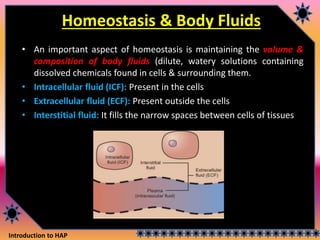
Homeostasis & Body Fluids
• An important aspect of homeostasis is maintaining the volume &
composition of body fluids (dilute, watery solutions containing
dissolved chemicals found in cells & surrounding them.
• Intracellular fluid (ICF): Present in the cells
• Extracellular fluid (ECF): Present outside the cells
• Interstitial fluid: It fills the narrow spaces between cells of tissues
Introduction to HAP
Homeostasis and Body Fluids
• ECF differs depending on its location in the body:
• ECF within blood vessels is termed as blood plasma.
• ECF within lymphatic vessels it called as lymph.
• ECF around the brain & spinal cord known as cerebrospinal
fluid.
• ECF in joints it is referred as synovial fluid.
• ECF of eyes is called as aqueous humor.
• The proper functioning of body cells depends on composition
of the interstitial fluid surrounding them.
Introduction to HAP
Feedback system or Feedback loop
• It is a cycle in which the status of a body condition is monitored,
evaluated, changed, remonitored, re-evaluated and so on.
• Each monitored variable, such as body temperature, blood
pressure or blood glucose level is termed a controlled condition.
• Any disruption that changes a controlled condition is called a
stimulus.
• A feedback system includes three basic components;
– Receptor
– Control centre
– Effector
Introduction to HAP
Feedback system or Feedback loop
• Receptor:
• It is a body structure that monitors changes in a controlled condition and
sends input to a control centre.
• The input is sent in the form of nerve impulses or chemical signals.
• Control centre:
• It sets the range of values within which a controlled condition should be
maintained, evaluates the input it receives from receptors & generates
output commands when they are needed.
• An effector:
• It is a body structure that receives output from the control centre &
produces a response or effect that changes the controlled condition.
Introduction to HAP
Negative Feedback Mechanism
Introduction to HAP
Positive Feedback System
Introduction to HAP
Basic anatomical terminologies
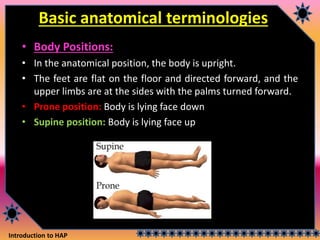
• Body Positions:
• In the anatomical position, the body is upright.
• The feet are flat on the floor and directed forward, and the
upper limbs are at the sides with the palms turned forward.
• Prone position: Body is lying face down
• Supine position: Body is lying face up
Introduction to HAP
Basic anatomical terminologies
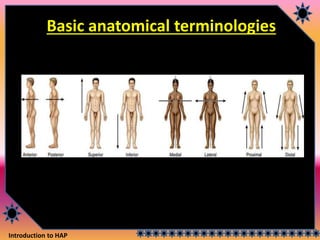
• Directional terms:
• It describe the position of one body part relative to another
body part.
• Most of the directional terms used have opposite meanings.
Introduction to HAP
Basic anatomical terminologies
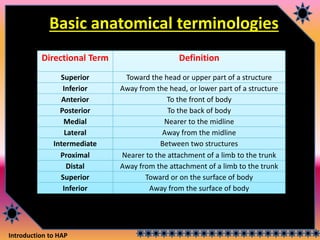
Directional Term Definition
Superior Toward the head or upper part of a structure
Inferior Away from the head, or lower part of a structure
Anterior To the front of body
Posterior To the back of body
Medial Nearer to the midline
Lateral Away from the midline
Intermediate Between two structures
Proximal Nearer to the attachment of a limb to the trunk
Distal Away from the attachment of a limb to the trunk
Superior Toward or on the surface of body
Inferior Away from the surface of body
Introduction to HAP
Basic anatomical terminologies
Introduction to HAP
Planes
• These are the imaginary flat surfaces that pass through the body
parts.
 Sagittal plane
 Frontal plane
 Transverse plane
 Oblique plane
• Sagittal plane: It is a vertical plane that divides the body or an
organ into right & left sides.
• Mid-sagittal plane: When sagittal plane passes through the midline
of the body or an organ & divides it into equal right and left sides, it
is called a mid-sagittal plane or a median plane.
Introduction to HAP
Planes
• Para-sagittal plane: If sagittal plane does not pass through the midline but
divides the body or an organ into unequal right & left sides, it is called a
para-sagittal plane.
• Frontal or coronal plane: It divides the body or an organ into anterior
(front) and posterior (back) parts.
• Transverse plane/horizontal plane/cross sectional plane: It divides the
body or an organ into superior (upper) and inferior (lower) portions.
Sagittal, frontal, & transverse planes are all at right angles to one another.
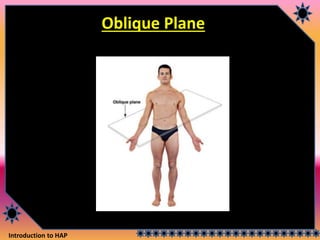
• Oblique plane: It passes through the body or an organ at an angle
between a transverse plane and a sagittal plane or between a transverse
plane and a frontal plane.
Introduction to HAP
Planes
Introduction to HAP
Oblique Plane
Introduction to HAP
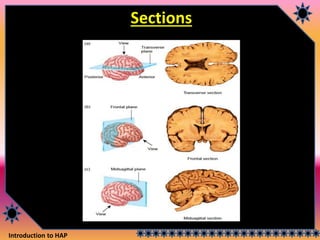
Sections
• It is a cut of the body or organs made along one of the planes.
• There are 3 sections;
• Transverse section: It is formed by a transverse plane cutting
through an object, usually at right angles to an axis.
• Frontal section: It is formed by a frontal plane cutting through
an object, dividing the body into dorsal & ventral parts.
• Midsagittal section: It is formed by a mid-sagittal plane
cutting through an object, dividing the body into right & left
parts
Introduction to HAP
Sections
Introduction to HAP
Body Cavities
• These are spaces within the body that helps to protect,
separate & support internal organs.
• 2 types of body cavity;
• Dorsal body cavity
• Ventral body cavity
Introduction to HAP
Dorsal body cavity
• It is located near the dorsal surface of the body.
• It consists of 2 cavities.
• Cranial cavity
• Vertebral canal
• Cranial cavity: The cranial bones form the cranial cavity,
which contains the brain.
• Vertebral canal: The bones of vertebral column form the
vertebral canal, which contains the spinal cord.
Introduction to HAP
Ventral body cavity
• It is located near the ventral surface of body.
• It has 2 parts;
• Superior part: Thoracic cavity, Pericardial cavity, Pleural cavity,
Mediastinum
• Inferior part: Abdominal cavity and Pelvic cavity
Introduction to HAP
Ventral body cavity
• Thoracic cavity or chest cavity: It is formed by the ribs,
muscles of the chest, sternum (breastbone) and vertebral
column (backbone).
• It is divided into 3 parts.
• Pleural cavity: Two fluid-filled spaces called pleural cavities,
that present around each lung
• Pericardial cavity: It is a fluid-filled space that surrounds the
heart
• Mediastinum: The central part of thoracic cavity called as
mediastinum.
Introduction to HAP
Ventral body cavity
• Abdominopelvic cavities: Divided into 2 portions,
• Abdominal cavity: The superior portion, is called as the
abdominal cavity, contains the stomach, spleen, liver,
gallbladder, small intestine, and most of the large intestine.
• Pelvic cavity: The inferior portion, is called as pelvic cavity,
contains the urinary bladder, portions of the large intestine,
and internal organs of the reproductive system.
Introduction to HAP
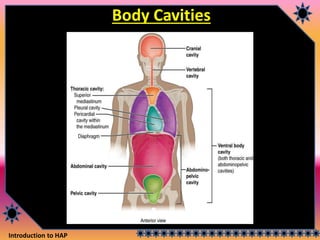
Body Cavities
Introduction to HAP
Body Cavities
Cavity Description
Cranial cavity It is formed by cranial bones and contains brain
Vertebral canal It is formed by vertebral column and it contains spinal cord and beginnings of spinal
nerves
Thoracic cavity It is called as chest cavity. It contains pleural and pericaridial cavity and mediastinum
Pleural cavity It presents surrounding the lungs and the serous membrane of each pleural cavity is
called as pleura.
Pericardial cavity It present surrounding the heart and the serous membrane of the pericardial cavity is
the pericardium.
Mediastinum It is the central portion of the thoracic cavity between the medial walls of pleural
cavities. It extends from sternum to verterbal column and from first rib to diaphragm.
It contains all the structure of the thoracic cavity other than the lungs including heart,
thymus, esophgus, trachea and several large blood vessels.
Abdominoplevic
cavity
It is divided into abdominal cavity and pelvic cavity.
Abdominal cavity It contains stomach, splen, liver, gall bladder, small intestine and large intestine. The
serous membrane of the abdominal cavity is called as peritoneum.
Pelvic cavity It contains urinary bladder, portion of large intestine and organs of reproduction.
Introduction to HAP
Questions
• LAQ:
• Enlist different systems of human body and give their
components and function.
• Explain different level of structural organizations.
• Explain different body processes.
• SAQ:
• Define anatomy and physiology.
• Write a note on homeostasis and feedback system.
• Enlist major body cavities along with their location.
• Explain different directional planes in human body.

Introduction to hap

  • 1.
    Introduction to HAP Introductionto HAP By; Dr. Mrs. Deepa K. Ingawale (Mandlik) Department of Pharmacology Poona College of Pharmacy, Pune
  • 2.
  • 3.
    Introduction to HAP LearningObjectives • To define anatomy and physiology. • To describe the levels of structural organization of the human body. • To list 12 systems of human body with their organs & functions. • To enlist the important human life processes. • To define the anatomical planes, sections & directional terms used to illustrate the human body. • To describe the major body cavities. • Describe the positive and negative feedback mechanism system.
  • 4.
    Introduction to HAP Branchesof science • There are two branches of science. • Anatomy • Physiology • It provides the information about different body parts & their functions.
  • 5.
    Introduction to HAP Anatomy •Anatomy: It is the scientific study of structures of human body. • Subdivisions of anatomy: • Developmental biology: It is the study of complete development of an individual from fertilization of an egg to death. • Cell biology: It is the study of cell structure and functions. • Histology: It is the study of microscopic structure of tissues. • Gross anatomy: It is the study of cell structures without using a microscope.
  • 6.
    Introduction to HAP Anatomy •Systemic anatomy: It is the study of specific systems of body such as nervous or respiratory systems. • Regional anatomy: It is the study of specific regions of the body such as head or chest. • Radiographic anatomy: It is the study of body structures with the help of x-rays. • Pathological anatomy: It is the study of structural changes associated with disease. • Embryology: It is the study of first eight weeks of human development.
  • 7.
    Introduction to HAP Physiology •Physiology: It is the scientific study of normal functions of living organisms and their parts. • Subdivisions of physiology: • Respiratory physiology: It is the study of functioning of lungs and air passageways. • Renal physiology: It is the study of functioning of the kidneys. • Immunology: It is the study of defense mechanism of body against disease-causing agents.
  • 8.
    Introduction to HAP Physiology •Exercise physiology: It is the study of changes in cell and organ functions as a result of exercise. • Neurophysiology: It is the study of functioning of the nervous system. • Pathophysiology: It is the study of functional changes associated with disease and aging. • Cardiovascular physiology: It is the study of functioning of heart and blood vessels. • Endocrinology: It is the study of hormones and how they control body functions. •
  • 9.
    Introduction to HAP Levelsof structural organizations • There are six levels of organisations. Chemical level Cellular level Tissue level Organ level System level Organism level
  • 10.
    Introduction to HAP Levelsof structural organizations Digestive system
  • 11.
    Introduction to HAP Levelsof structural organizations • Chemical level: • Very basic level • It includes atoms (smallest unit of matter participates in chemical reactions) • Two or more atoms joined together to form molecules. • Certain atoms like, C, H, O, N, P, Ca & S are crucial for maintaining life. • Cellular level: • Different molecules combine together to form cells. • Cell is the basic structural and functional units of an organism. • Human body contains muscle cells, nerve cells & epithelial cells.
  • 12.
    Introduction to HAP Levelsof structural organizations • Tissue level: • Different cells combines together to form tissues (groups of cells that work together to perform a particular function). • Human body contains 4 basic types of tissue: epithelial tissue, connective tissue, muscular tissue and nervous tissue. • Organ level: • Different types of tissue combines together to form organ. • Organs are composed of two or more different types of tissues having specific functions and recognizable shapes. • Examples of organs are the stomach, skin, bones, heart, liver, lungs & brain.
  • 13.
    Introduction to HAP Levelsof structural organizations • System level: • All the organs with common function combines together to form system. • Above figure shows the structure of digestive system. • Organs of digestive system are mouth, salivary glands, pharynx (throat), esophagus, stomach, small intestine, large intestine, liver, gallbladder & pancreas. • Organism level: • All the parts of the human body functioning combines together to form total organism i.e. human body.
  • 14.
    Introduction to HAP Twelvesystems of human body Human body Digestive system Respiratory system Urinary system Nervous system Reproductive system (Male & Female) Endocrine system cardiovascualr system Muscular system Lymphatic system Special sense organs
  • 15.
    Introduction to HAP Twelvesystems of human body • Nervous system: • Organs: Brain, spinal cord and nerves • Functions: • It coordinates voluntary and involuntary actions and transmits signals between different parts of the body. • Cardiovascular system: • Organs: Blood, heart, and blood vessels. • Functions: • Heart pumps blood through blood vessels • Blood carries oxygen and nutrients to cells and carbon dioxide and wastes away from cells. Blood components help defend against disease. • Helps regulate acid - base balance, temperature & water content of body fluids.
  • 16.
    Introduction to HAP Twelvesystems of human body • Digestive system: • Organs: Mouth, pharynx, esophagus, stomach, small and large intestines, and anus; accessory organs such as salivary glands, liver, gallbladder, and pancreas. • Functions: • Mechanical and chemical breakdown of food • Absorption of nutrients and Elimination of solid wastes • Urinary system: • Organs: Kidneys, ureters, urinary bladder, and urethra. • Functions: • Produces, stores, and eliminates urine. • Eliminates wastes and regulates volume and chemical composition of blood • Helps maintain the acid–base balance of body fluids. • Maintains mineral balance of body
  • 17.
    Introduction to HAP Twelvesystems of human body • Respiratory system: • Organs: Lungs, pharynx, larynx, trachea, and bronchial tubes • Functions: • Transfers oxygen from inhaled air to blood and carbon dioxide from blood to exhaled air • Helps regulate acid–base balance of body fluids • Production of sound by vocal cord • Lymphatic system: • Organs: Lymph, lymph vessels, spleen, thymus, lymph nodes, and tonsils. • Functions: • Returns proteins and fluid to blood • Carries lipids from gastrointestinal tract to blood • Lymphocytes that protect against disease-causing microbes
  • 18.
    Introduction to HAP Twelvesystems of human body • Endocrine system: • Organs: Pineal gland, hypothalamus, pituitary gland, thymus, thyroid gland, parathyroid glands, adrenal glands, pancreas, ovaries, and testes • Functions: • Regulates body activities by releasing hormones • Muscular system: • Organs: Skeletal muscle • Functions: • Produces body movements, such as walking • Stabilizes body posture • Generation of heat
  • 19.
    Introduction to HAP Twelvesystems of human body • Special sense organs: • Organs: Eyes, ears, skin, tongue and nose • Functions: • Detects changes in the body’s internal and external environments, • Vision, Hearing, Smell, Taste and Touch sensations • Reproductive system: • Organs: Male organs: Testes, epididymis, ductus deferens, and penis; Female organs: Ovaries, uterine tubes, uterus, and vagina • Functions: • Gonads produce gametes that unite to form a new organism • Gonads release hormones that regulate reproduction • Other associated organs transport and store gametes
  • 20.
    Introduction to HAP Basiclife processes • Responsiveness: • It is the body’s ability to detect and respond to changes. • Metabolism: • It is the sum of all the chemical processes that occur in the body. • Catabolism is the breakdown of complex chemical substances into simpler components. • Anabolism is the building up of complex chemical substances from smaller components. • Movement: • Movement includes motion of the whole body, individual organs, single cells, and even tiny structures inside cells.
  • 21.
    Introduction to HAP Basiclife processes • Growth: • It is an increase in body size that results from an increase in the size of existing cells, an increase in the number of cells, or both. • Differentiation: • It is the development of a cell from an unspecialized to a specialized state. • Reproduction: • It refers to the formation of new cells for tissue growth, repair, or replacement, or to the production of a new individual.
  • 22.
    Introduction to HAP Basiclife processes • Respiration: • Respiration processes involved in the exchange of oxygen and carbon dioxide between the cells and the external environment. • Digestion: • It involves breaking down complex ingested foods into simple molecules that can be absorbed into the blood and utilized by the body for energy source. • Excretion: • Excretion is the process that removes the waste products of digestion & metabolism from the body.
  • 23.
    Introduction to HAP Homeostasis •“It is the ability of body to maintain an equilibrium within its internal environment when dealing with the external changes” • Homeostasis is a dynamic condition.
  • 24.
    Introduction to HAP Homeostasis& Body Fluids • An important aspect of homeostasis is maintaining the volume & composition of body fluids (dilute, watery solutions containing dissolved chemicals found in cells & surrounding them. • Intracellular fluid (ICF): Present in the cells • Extracellular fluid (ECF): Present outside the cells • Interstitial fluid: It fills the narrow spaces between cells of tissues
  • 25.
    Introduction to HAP Homeostasisand Body Fluids • ECF differs depending on its location in the body: • ECF within blood vessels is termed as blood plasma. • ECF within lymphatic vessels it called as lymph. • ECF around the brain & spinal cord known as cerebrospinal fluid. • ECF in joints it is referred as synovial fluid. • ECF of eyes is called as aqueous humor. • The proper functioning of body cells depends on composition of the interstitial fluid surrounding them.
  • 26.
    Introduction to HAP Feedbacksystem or Feedback loop • It is a cycle in which the status of a body condition is monitored, evaluated, changed, remonitored, re-evaluated and so on. • Each monitored variable, such as body temperature, blood pressure or blood glucose level is termed a controlled condition. • Any disruption that changes a controlled condition is called a stimulus. • A feedback system includes three basic components; – Receptor – Control centre – Effector
  • 27.
    Introduction to HAP Feedbacksystem or Feedback loop • Receptor: • It is a body structure that monitors changes in a controlled condition and sends input to a control centre. • The input is sent in the form of nerve impulses or chemical signals. • Control centre: • It sets the range of values within which a controlled condition should be maintained, evaluates the input it receives from receptors & generates output commands when they are needed. • An effector: • It is a body structure that receives output from the control centre & produces a response or effect that changes the controlled condition.
  • 28.
    Introduction to HAP NegativeFeedback Mechanism
  • 29.
  • 30.
    Introduction to HAP Basicanatomical terminologies • Body Positions: • In the anatomical position, the body is upright. • The feet are flat on the floor and directed forward, and the upper limbs are at the sides with the palms turned forward. • Prone position: Body is lying face down • Supine position: Body is lying face up
  • 31.
    Introduction to HAP Basicanatomical terminologies • Directional terms: • It describe the position of one body part relative to another body part. • Most of the directional terms used have opposite meanings.
  • 32.
    Introduction to HAP Basicanatomical terminologies Directional Term Definition Superior Toward the head or upper part of a structure Inferior Away from the head, or lower part of a structure Anterior To the front of body Posterior To the back of body Medial Nearer to the midline Lateral Away from the midline Intermediate Between two structures Proximal Nearer to the attachment of a limb to the trunk Distal Away from the attachment of a limb to the trunk Superior Toward or on the surface of body Inferior Away from the surface of body
  • 33.
    Introduction to HAP Basicanatomical terminologies
  • 34.
    Introduction to HAP Planes •These are the imaginary flat surfaces that pass through the body parts.  Sagittal plane  Frontal plane  Transverse plane  Oblique plane • Sagittal plane: It is a vertical plane that divides the body or an organ into right & left sides. • Mid-sagittal plane: When sagittal plane passes through the midline of the body or an organ & divides it into equal right and left sides, it is called a mid-sagittal plane or a median plane.
  • 35.
    Introduction to HAP Planes •Para-sagittal plane: If sagittal plane does not pass through the midline but divides the body or an organ into unequal right & left sides, it is called a para-sagittal plane. • Frontal or coronal plane: It divides the body or an organ into anterior (front) and posterior (back) parts. • Transverse plane/horizontal plane/cross sectional plane: It divides the body or an organ into superior (upper) and inferior (lower) portions. Sagittal, frontal, & transverse planes are all at right angles to one another. • Oblique plane: It passes through the body or an organ at an angle between a transverse plane and a sagittal plane or between a transverse plane and a frontal plane.
  • 36.
  • 37.
  • 38.
    Introduction to HAP Sections •It is a cut of the body or organs made along one of the planes. • There are 3 sections; • Transverse section: It is formed by a transverse plane cutting through an object, usually at right angles to an axis. • Frontal section: It is formed by a frontal plane cutting through an object, dividing the body into dorsal & ventral parts. • Midsagittal section: It is formed by a mid-sagittal plane cutting through an object, dividing the body into right & left parts
  • 39.
  • 40.
    Introduction to HAP BodyCavities • These are spaces within the body that helps to protect, separate & support internal organs. • 2 types of body cavity; • Dorsal body cavity • Ventral body cavity
  • 41.
    Introduction to HAP Dorsalbody cavity • It is located near the dorsal surface of the body. • It consists of 2 cavities. • Cranial cavity • Vertebral canal • Cranial cavity: The cranial bones form the cranial cavity, which contains the brain. • Vertebral canal: The bones of vertebral column form the vertebral canal, which contains the spinal cord.
  • 42.
    Introduction to HAP Ventralbody cavity • It is located near the ventral surface of body. • It has 2 parts; • Superior part: Thoracic cavity, Pericardial cavity, Pleural cavity, Mediastinum • Inferior part: Abdominal cavity and Pelvic cavity
  • 43.
    Introduction to HAP Ventralbody cavity • Thoracic cavity or chest cavity: It is formed by the ribs, muscles of the chest, sternum (breastbone) and vertebral column (backbone). • It is divided into 3 parts. • Pleural cavity: Two fluid-filled spaces called pleural cavities, that present around each lung • Pericardial cavity: It is a fluid-filled space that surrounds the heart • Mediastinum: The central part of thoracic cavity called as mediastinum.
  • 44.
    Introduction to HAP Ventralbody cavity • Abdominopelvic cavities: Divided into 2 portions, • Abdominal cavity: The superior portion, is called as the abdominal cavity, contains the stomach, spleen, liver, gallbladder, small intestine, and most of the large intestine. • Pelvic cavity: The inferior portion, is called as pelvic cavity, contains the urinary bladder, portions of the large intestine, and internal organs of the reproductive system.
  • 45.
  • 46.
    Introduction to HAP BodyCavities Cavity Description Cranial cavity It is formed by cranial bones and contains brain Vertebral canal It is formed by vertebral column and it contains spinal cord and beginnings of spinal nerves Thoracic cavity It is called as chest cavity. It contains pleural and pericaridial cavity and mediastinum Pleural cavity It presents surrounding the lungs and the serous membrane of each pleural cavity is called as pleura. Pericardial cavity It present surrounding the heart and the serous membrane of the pericardial cavity is the pericardium. Mediastinum It is the central portion of the thoracic cavity between the medial walls of pleural cavities. It extends from sternum to verterbal column and from first rib to diaphragm. It contains all the structure of the thoracic cavity other than the lungs including heart, thymus, esophgus, trachea and several large blood vessels. Abdominoplevic cavity It is divided into abdominal cavity and pelvic cavity. Abdominal cavity It contains stomach, splen, liver, gall bladder, small intestine and large intestine. The serous membrane of the abdominal cavity is called as peritoneum. Pelvic cavity It contains urinary bladder, portion of large intestine and organs of reproduction.
  • 47.
    Introduction to HAP Questions •LAQ: • Enlist different systems of human body and give their components and function. • Explain different level of structural organizations. • Explain different body processes. • SAQ: • Define anatomy and physiology. • Write a note on homeostasis and feedback system. • Enlist major body cavities along with their location. • Explain different directional planes in human body.