Table of Contents First Principles Relative contribution to learning Traditional curriculum sequence Task-centered curriculum sequence Pebble-in-the-Pond Design Knowledge object for whole task Knowledge Components Instructional strategies for components RESOURCES Information and Portrayal Demonstration Entrepreneur ?
A Task-Centered  Instructional Strategy M. David Merrill Instructional Effectiveness Consultant Visiting Professor Florida State University Visiting Professor Brigham Young University Hawaii  next
Overview of Presentation Fundamental Principles for Effective Instruction A content-first approach to instructional design A task-centered instructional strategy
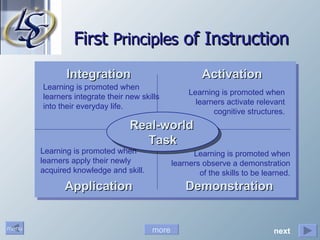
First  Principles  of Instruction Activation Demonstration Application Integration Learning is promoted when learners activate relevant cognitive structures. Learning is promoted when learners observe a demonstration of the skills to be learned. Learning is promoted when learners apply their newly acquired knowledge and skill. Learning is promoted when learners integrate their new skills into their everyday life. Learning is promoted when learners do real-world tasks. Real-world   Task more next
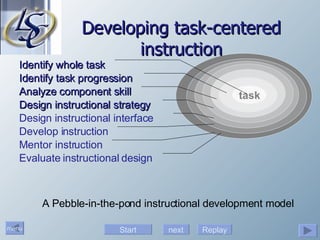
Developing task-centered instruction Start task Identify   whole task Identify task progression Analyze component skill Design instructional strategy Design instructional interface Develop instruction Mentor instruction A Pebble-in-the-pond instructional development model Evaluate instructional design next Replay
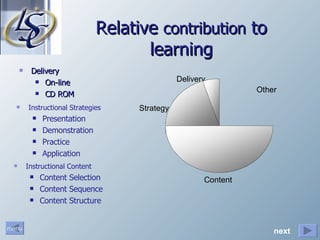
Relative  contribution  to learning Delivery On-line CD ROM Instructional Strategies Presentation Demonstration Practice Application Instructional Content Content Selection Content Sequence Content Structure Other next Delivery Strategy Content
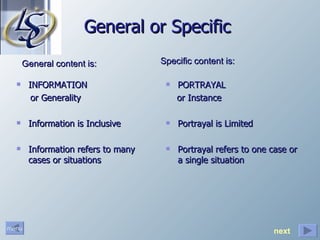
General or Specific INFORMATION  or Generality Information is Inclusive  Information refers to many cases or situations PORTRAYAL  or Instance Portrayal is Limited Portrayal refers to one case or a single situation General content is: Specific content is: next
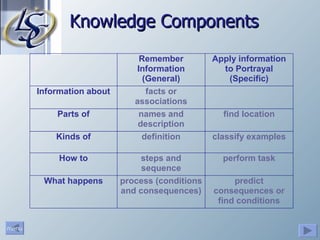
Knowledge Components
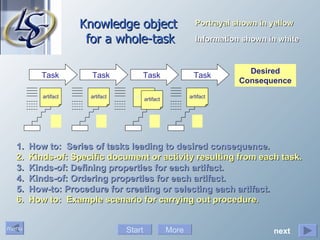
Knowledge object  for a whole-task Desired   Consequence Task Task Task Task 5.  How-to: Procedure for creating or selecting each artifact. 2.  Kinds-of: Specific document or activity resulting from each task. 3.  Kinds-of: Defining properties for each artifact.  Portrayal shown in yellow Information shown in white Start More 4.  Kinds-of: Ordering properties for each artifact. 6.  How to:  Example scenario for carrying out procedure. 1.  How to:  Series of tasks leading to desired consequence. next     artifact artifact artifact artifact artifact
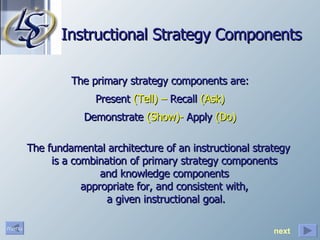
Instructional Strategy Components The primary strategy components are: Present  (Tell) –  Recall  (Ask) Demonstrate  (Show)-  Apply  (Do) The fundamental architecture of an instructional strategy  is a combination of primary strategy components  and knowledge components  appropriate for, and consistent with,  a given instructional goal. next
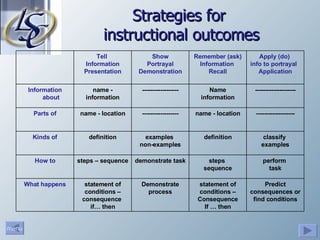
Strategies for  instructional outcomes Predict consequences or find conditions statement of conditions – Consequence If … then Demonstrate process statement of conditions – consequence  if… then What happens perform  task steps  sequence demonstrate task steps – sequence How to classify  examples definition examples  non-examples definition Kinds of ------------------- name - location ------------------ name - location Parts of -------------------- Name information ------------------ name - information Information about Apply (do)  info to portrayal  Application Remember (ask) Information  Recall Show Portrayal Demonstration Tell  Information Presentation
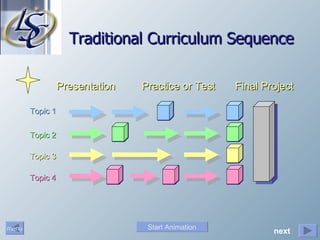
Traditional Curriculum Sequence Topic 1 Topic 2 Topic 3 Topic 4 Presentation Practice or Test Final Project Start Animation next
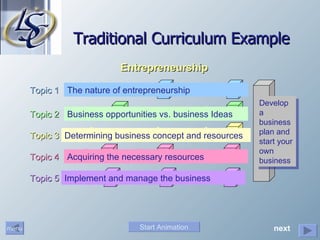
Traditional Curriculum Example Topic 1 Topic 2 Topic 3 Topic 4 Start Animation The nature of entrepreneurship Business opportunities vs. business Ideas Determining business concept and resources Implement and manage the business Topic 5 Develop a business plan and start your own business Entrepreneurship Acquiring the necessary resources next
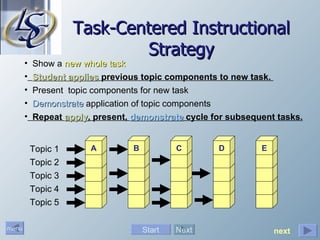
Task-Centered Instructional Strategy A B C D E Topic 1 Topic 2 Topic 3 Topic 5 Topic 4 Show a  new whole task Present  topic components for new task Demonstrate  application of topic components  Student applies  previous topic components to new task.  Start Next Repeat  apply , present,  demonstrate  cycle for subsequent tasks. next
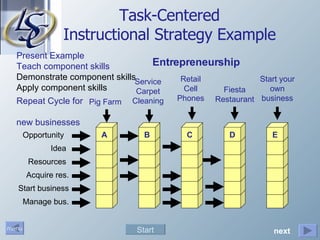
A B C D E Opportunity  Idea Resources Start business Acquire res. Start Entrepreneurship Manage bus. Task-Centered  Instructional Strategy Example  Present Example Teach component skills Demonstrate component skills Apply component skills Repeat Cycle for  new businesses next Pig Farm Service Carpet Cleaning Retail Cell Phones Fiesta Restaurant Start your own business
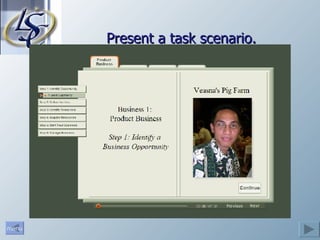
Present a task scenario.
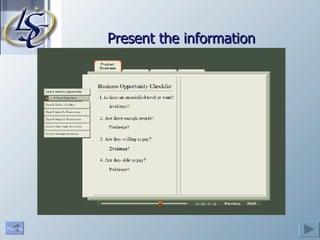
Present the information
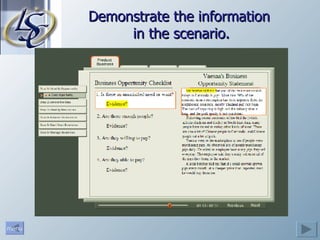
Demonstrate the information  in the scenario.
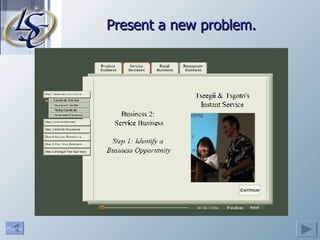
Present a new problem.
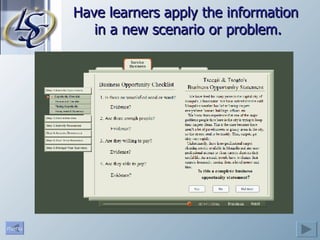
Have learners apply the information  in a new scenario or problem.
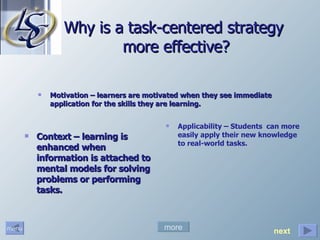
Why is a task-centered strategy  more effective? Motivation – learners are motivated when they see immediate application for the skills they are learning. Context – learning is enhanced when information is attached to mental models for solving problems or performing tasks. more Applicability – Students  can more easily apply their new knowledge to real-world tasks. next
Entrepreneurship http:// cito.byuh.edu/entrepreneur/main.swf Click on URL to go to this course on-line You can review the current version of the course at the following URL:
Ask me a question Thank You [email_address] 435 760 0419
Resources First principles of Instruction Click on the button or title to go to resource Entrepreneurship Course  (requires flash player on your computer) Click here to download flash player  Knowledge Objects To view related presentations on-line click on the following hyperlinks: Netherlands Part 1  2006 Netherlands Part 2  2006 Netherlands Part 3  2006 Florida State University Presentation  2007

Lsc Orlando Task Centered

  • 1.
    Table of ContentsFirst Principles Relative contribution to learning Traditional curriculum sequence Task-centered curriculum sequence Pebble-in-the-Pond Design Knowledge object for whole task Knowledge Components Instructional strategies for components RESOURCES Information and Portrayal Demonstration Entrepreneur ?
  • 2.
    A Task-Centered Instructional Strategy M. David Merrill Instructional Effectiveness Consultant Visiting Professor Florida State University Visiting Professor Brigham Young University Hawaii next
  • 3.
    Overview of PresentationFundamental Principles for Effective Instruction A content-first approach to instructional design A task-centered instructional strategy
  • 4.
    First Principles of Instruction Activation Demonstration Application Integration Learning is promoted when learners activate relevant cognitive structures. Learning is promoted when learners observe a demonstration of the skills to be learned. Learning is promoted when learners apply their newly acquired knowledge and skill. Learning is promoted when learners integrate their new skills into their everyday life. Learning is promoted when learners do real-world tasks. Real-world Task more next
  • 5.
    Developing task-centered instructionStart task Identify whole task Identify task progression Analyze component skill Design instructional strategy Design instructional interface Develop instruction Mentor instruction A Pebble-in-the-pond instructional development model Evaluate instructional design next Replay
  • 6.
    Relative contribution to learning Delivery On-line CD ROM Instructional Strategies Presentation Demonstration Practice Application Instructional Content Content Selection Content Sequence Content Structure Other next Delivery Strategy Content
  • 7.
    General or SpecificINFORMATION or Generality Information is Inclusive Information refers to many cases or situations PORTRAYAL or Instance Portrayal is Limited Portrayal refers to one case or a single situation General content is: Specific content is: next
  • 8.
  • 9.
    Knowledge object for a whole-task Desired Consequence Task Task Task Task 5. How-to: Procedure for creating or selecting each artifact. 2. Kinds-of: Specific document or activity resulting from each task. 3. Kinds-of: Defining properties for each artifact. Portrayal shown in yellow Information shown in white Start More 4. Kinds-of: Ordering properties for each artifact. 6. How to: Example scenario for carrying out procedure. 1. How to: Series of tasks leading to desired consequence. next     artifact artifact artifact artifact artifact
  • 10.
    Instructional Strategy ComponentsThe primary strategy components are: Present (Tell) – Recall (Ask) Demonstrate (Show)- Apply (Do) The fundamental architecture of an instructional strategy is a combination of primary strategy components and knowledge components appropriate for, and consistent with, a given instructional goal. next
  • 11.
    Strategies for instructional outcomes Predict consequences or find conditions statement of conditions – Consequence If … then Demonstrate process statement of conditions – consequence if… then What happens perform task steps sequence demonstrate task steps – sequence How to classify examples definition examples non-examples definition Kinds of ------------------- name - location ------------------ name - location Parts of -------------------- Name information ------------------ name - information Information about Apply (do) info to portrayal Application Remember (ask) Information Recall Show Portrayal Demonstration Tell Information Presentation
  • 12.
    Traditional Curriculum SequenceTopic 1 Topic 2 Topic 3 Topic 4 Presentation Practice or Test Final Project Start Animation next
  • 13.
    Traditional Curriculum ExampleTopic 1 Topic 2 Topic 3 Topic 4 Start Animation The nature of entrepreneurship Business opportunities vs. business Ideas Determining business concept and resources Implement and manage the business Topic 5 Develop a business plan and start your own business Entrepreneurship Acquiring the necessary resources next
  • 14.
    Task-Centered Instructional StrategyA B C D E Topic 1 Topic 2 Topic 3 Topic 5 Topic 4 Show a new whole task Present topic components for new task Demonstrate application of topic components Student applies previous topic components to new task. Start Next Repeat apply , present, demonstrate cycle for subsequent tasks. next
  • 15.
    A B CD E Opportunity Idea Resources Start business Acquire res. Start Entrepreneurship Manage bus. Task-Centered Instructional Strategy Example Present Example Teach component skills Demonstrate component skills Apply component skills Repeat Cycle for new businesses next Pig Farm Service Carpet Cleaning Retail Cell Phones Fiesta Restaurant Start your own business
  • 16.
    Present a taskscenario.
  • 17.
  • 18.
    Demonstrate the information in the scenario.
  • 19.
    Present a newproblem.
  • 20.
    Have learners applythe information in a new scenario or problem.
  • 21.
    Why is atask-centered strategy more effective? Motivation – learners are motivated when they see immediate application for the skills they are learning. Context – learning is enhanced when information is attached to mental models for solving problems or performing tasks. more Applicability – Students can more easily apply their new knowledge to real-world tasks. next
  • 22.
    Entrepreneurship http:// cito.byuh.edu/entrepreneur/main.swfClick on URL to go to this course on-line You can review the current version of the course at the following URL:
  • 23.
    Ask me aquestion Thank You [email_address] 435 760 0419
  • 24.
    Resources First principlesof Instruction Click on the button or title to go to resource Entrepreneurship Course (requires flash player on your computer) Click here to download flash player Knowledge Objects To view related presentations on-line click on the following hyperlinks: Netherlands Part 1 2006 Netherlands Part 2 2006 Netherlands Part 3 2006 Florida State University Presentation 2007