HRD Assignment 2 Advice & guidance Selecting a management behaviour you wish to encourage – examples: Management style – motivating Appraisal interviews - encouragement Making a presentation - communicating Carrying out a disciplinary interview - questioning Mentoring or coaching - helping
Behaviour you wish to discourage Sexist or racist behaviour Poor time management Poor communication skills Lack of leadership ability Management style – authoritarian Lack of financial planning skills Inability to train or coach effectively
Aims and objectives of the training session Aims:  What you want to achieve from the training in general terms Example: The aim of the training is to provide new managers with an understanding of the importance of following correct procedures when disciplining staff.
Objectives These tend to be more precise and can be expressed in behavioural terms e.g. At the end of the training the trainee will be able to: Demonstrate an understanding of the company’s disciplinary procedures; Explain the stages involved in an investigation to establish the facts, including interviews with the employee and any relevant witnesses; Assess and evaluate the evidence obtained from the investigation and make appropriate recommendations;
The Trainees and the purpose of the training? Who is the training for? Middle managers, line managers, supervisors? What is their previous experience? Purpose of the training e.g. To encourage or discourage certain types of managerial behaviour
Where, when and how will the training be carried out? In house or external consultants – why? Costs, expertise available?, less disruption to their work Training room or  hotel conference facilities – advantages and disadvantages When? Weekend, during their working day, as soon as possible? Within a fixed time period Length of training session
Who will carry out the training and why? Own training staff? HR staff? Outside/external training consultants Advantages and disadvantages of internal and external trainers
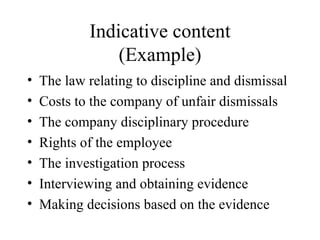
Indicative content (Example) The law relating to discipline and dismissal Costs to the company of unfair dismissals The company disciplinary procedure Rights of the employee The investigation process Interviewing and obtaining evidence Making decisions based on the evidence
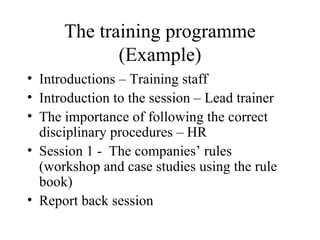
The training programme (Example) Introductions – Training staff Introduction to the session – Lead trainer The importance of following the correct disciplinary procedures – HR Session 1 -  The companies’ rules (workshop and case studies using the rule book) Report back session
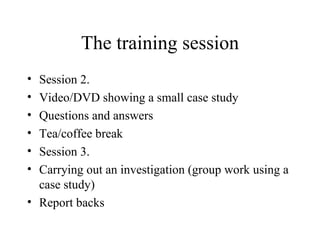
The training session Session 2. Video/DVD showing a small case study Questions and answers Tea/coffee break Session 3. Carrying out an investigation (group work using a case study) Report backs
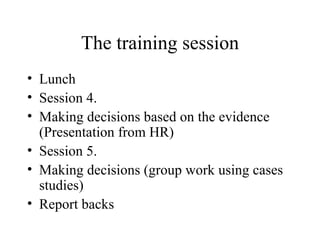
The training session Lunch Session 4. Making decisions based on the evidence (Presentation from HR) Session 5. Making decisions (group work using cases studies) Report backs
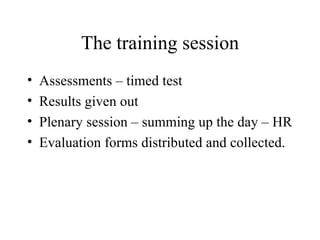
The training session Assessments – timed test Results given out Plenary session – summing up the day – HR Evaluation forms distributed and collected.
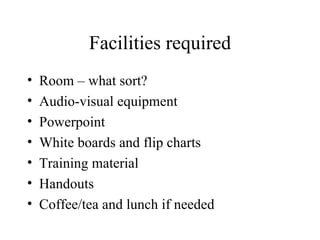
Facilities required Room – what sort? Audio-visual equipment Powerpoint White boards and flip charts Training material Handouts Coffee/tea and lunch if needed
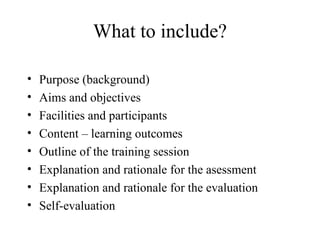
What to include? Purpose (background) Aims and objectives Facilities and participants Content – learning outcomes Outline of the training session Explanation and rationale for the asessment Explanation and rationale for the evaluation Self-evaluation
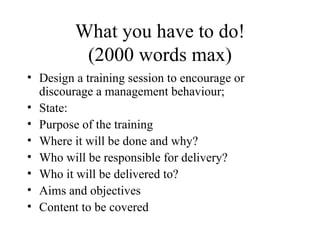
What you have to do! (2000 words max) Design a training session to encourage or discourage a management behaviour; State: Purpose of the training Where it will be done and why? Who will be responsible for delivery? Who it will be delivered to? Aims and objectives Content to be covered
What you have to do (cont’d) How the training will be delivered (methods and approach e.g. outcome based, student centred etc.) and justify choice of methods; How the learning will be assessed (tested) and justify choice of methods; How you will evaluate (measure the effectiveness of the training in meeting the aims and objectives) and justify methods
What you have to do (cont’d) (600words) Using the Kolb learning cycle, experience, reflection, theorising and action, carry out a self-evaluation based on the assignment; Explain what you did; How you did it (information, research) What difficulties you encountered? How you overcame those difficulties? What did you learn, through doing this assignment that you could put into practice in the future?

Gopi Assignment

  • 1.
    HRD Assignment 2Advice & guidance Selecting a management behaviour you wish to encourage – examples: Management style – motivating Appraisal interviews - encouragement Making a presentation - communicating Carrying out a disciplinary interview - questioning Mentoring or coaching - helping
  • 2.
    Behaviour you wishto discourage Sexist or racist behaviour Poor time management Poor communication skills Lack of leadership ability Management style – authoritarian Lack of financial planning skills Inability to train or coach effectively
  • 3.
    Aims and objectivesof the training session Aims: What you want to achieve from the training in general terms Example: The aim of the training is to provide new managers with an understanding of the importance of following correct procedures when disciplining staff.
  • 4.
    Objectives These tendto be more precise and can be expressed in behavioural terms e.g. At the end of the training the trainee will be able to: Demonstrate an understanding of the company’s disciplinary procedures; Explain the stages involved in an investigation to establish the facts, including interviews with the employee and any relevant witnesses; Assess and evaluate the evidence obtained from the investigation and make appropriate recommendations;
  • 5.
    The Trainees andthe purpose of the training? Who is the training for? Middle managers, line managers, supervisors? What is their previous experience? Purpose of the training e.g. To encourage or discourage certain types of managerial behaviour
  • 6.
    Where, when andhow will the training be carried out? In house or external consultants – why? Costs, expertise available?, less disruption to their work Training room or hotel conference facilities – advantages and disadvantages When? Weekend, during their working day, as soon as possible? Within a fixed time period Length of training session
  • 7.
    Who will carryout the training and why? Own training staff? HR staff? Outside/external training consultants Advantages and disadvantages of internal and external trainers
  • 8.
    Indicative content (Example)The law relating to discipline and dismissal Costs to the company of unfair dismissals The company disciplinary procedure Rights of the employee The investigation process Interviewing and obtaining evidence Making decisions based on the evidence
  • 9.
    The training programme(Example) Introductions – Training staff Introduction to the session – Lead trainer The importance of following the correct disciplinary procedures – HR Session 1 - The companies’ rules (workshop and case studies using the rule book) Report back session
  • 10.
    The training sessionSession 2. Video/DVD showing a small case study Questions and answers Tea/coffee break Session 3. Carrying out an investigation (group work using a case study) Report backs
  • 11.
    The training sessionLunch Session 4. Making decisions based on the evidence (Presentation from HR) Session 5. Making decisions (group work using cases studies) Report backs
  • 12.
    The training sessionAssessments – timed test Results given out Plenary session – summing up the day – HR Evaluation forms distributed and collected.
  • 13.
    Facilities required Room– what sort? Audio-visual equipment Powerpoint White boards and flip charts Training material Handouts Coffee/tea and lunch if needed
  • 14.
    What to include?Purpose (background) Aims and objectives Facilities and participants Content – learning outcomes Outline of the training session Explanation and rationale for the asessment Explanation and rationale for the evaluation Self-evaluation
  • 15.
    What you haveto do! (2000 words max) Design a training session to encourage or discourage a management behaviour; State: Purpose of the training Where it will be done and why? Who will be responsible for delivery? Who it will be delivered to? Aims and objectives Content to be covered
  • 16.
    What you haveto do (cont’d) How the training will be delivered (methods and approach e.g. outcome based, student centred etc.) and justify choice of methods; How the learning will be assessed (tested) and justify choice of methods; How you will evaluate (measure the effectiveness of the training in meeting the aims and objectives) and justify methods
  • 17.
    What you haveto do (cont’d) (600words) Using the Kolb learning cycle, experience, reflection, theorising and action, carry out a self-evaluation based on the assignment; Explain what you did; How you did it (information, research) What difficulties you encountered? How you overcame those difficulties? What did you learn, through doing this assignment that you could put into practice in the future?