High-Level Design Document
Design Solution Requirements
The optimal learning experience
Background and Project Goal
The goals and objectives for this project will focus on:
• Developing a quality product that is highly interactive and engaging, while keeping speed-to-
market in mind
• Migrating provided content into self-paced, web-based training modules within 6 months and
the allowed budget
Summary Description of the Training
The specific requirements include:
• Producing up to six training courses in Adobe Captivate, each consisting of four 60-minute
modules, for a total of 24 modules (24 total hours of training)
• Building courses utilizing the provided IAPP objectives, Design Document, Style Guide, and
storyboards
• Building courses that are fully narrated and will contain all the elements specified in the Design
Document
• Producing final deliverables that will be SCORM 1.2 compliant and will also be fully compatible
with IAPP’s TopClass LMS
Target Population Information
The following information is known regarding the learners, their level of knowledge toward the
subject, and the prerequisite knowledge required:
• Pharmaceutical professionals who hold at least a Master’s degree in their technical field
• Learners are US-based and English-speaking
• No prerequisites are required
• Approximately 2,000 learners will be involved in the courses
Course Structure
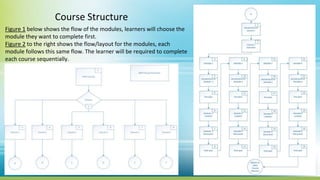
Figure 1 below shows the flow of the modules, learners will choose the
module they want to complete first.
Figure 2 to the right shows the flow/layout for the modules, each
module follows this same flow. The learner will be required to complete
each course sequentially.
Instructional Strategies
The following instructional strategy was selected and applied to the courses (see descriptions about each strategy
in the notes area below):
• Learning Contracts
• Connect training needs to individual learner’s needs
• Forum Platform
• Discuss issues; make comments; offer information; ask questions
• Collaborative Learning
• Promote cognitive development, self-esteem, and positive
learner-learner relationships
• Mentorship
• Allow frequent, and convenient communication between
mentor and student
Instructional Strategies
The following instructional strategy was selected and applied to the courses (see descriptions about each strategy
in the notes area below):
• Self-guided learning
• More involved, more motivated and more active
• Guided design
• Encourage learners to think critically and communicate ideas
• Role play
• Promotes understanding of other people’s position and
attitudes
• Games
• Reflect typical real-life situation
Testing Strategies
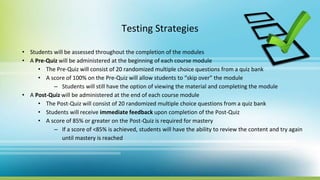
• Students will be assessed throughout the completion of the modules
• A Pre-Quiz will be administered at the beginning of each course module
• The Pre-Quiz will consist of 20 randomized multiple choice questions from a quiz bank
• A score of 100% on the Pre-Quiz will allow students to “skip over” the module
– Students will still have the option of viewing the material and completing the module
• A Post-Quiz will be administered at the end of each course module
• The Post-Quiz will consist of 20 randomized multiple choice questions from a quiz bank
• Students will receive immediate feedback upon completion of the Post-Quiz
• A score of 85% or greater on the Post-Quiz is required for mastery
– If a score of <85% is achieved, students will have the ability to review the content and try again
until mastery is reached
Design Considerations
• Design Considerations
• Courses will be highly engaging and interactive
• Courses will be developed in English only
• There are no prerequisites for the courses
• Students can save their progress in the modules to return at a later time
• Technical Considerations
• Courses will be fully compatible with Chrome, Internet Explorer, and Safari browsers
• Courses will be SCORM 1.2 compliant and will be compatible with IAPP’s TopClass LMS
• All modules will be fully narrated with transcripts provided and will include play, pause, seek, and
volume controls
• Videos will be embedded at 640x360 (16:9) size
• Course content, such as transcripts and diagrams, will also be available in “printer friendly” versions
for students to print
Visual Representation of Course
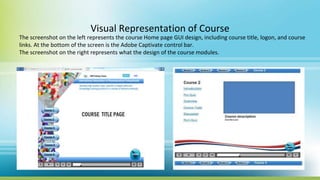
The screenshot on the left represents the course Home page GUI design, including course title, logon, and course
links. At the bottom of the screen is the Adobe Captivate control bar.
The screenshot on the right represents what the design of the course modules.

ATS-High-level design document

  • 1.
    High-Level Design Document DesignSolution Requirements The optimal learning experience
  • 2.
    Background and ProjectGoal The goals and objectives for this project will focus on: • Developing a quality product that is highly interactive and engaging, while keeping speed-to- market in mind • Migrating provided content into self-paced, web-based training modules within 6 months and the allowed budget
  • 3.
    Summary Description ofthe Training The specific requirements include: • Producing up to six training courses in Adobe Captivate, each consisting of four 60-minute modules, for a total of 24 modules (24 total hours of training) • Building courses utilizing the provided IAPP objectives, Design Document, Style Guide, and storyboards • Building courses that are fully narrated and will contain all the elements specified in the Design Document • Producing final deliverables that will be SCORM 1.2 compliant and will also be fully compatible with IAPP’s TopClass LMS
  • 4.
    Target Population Information Thefollowing information is known regarding the learners, their level of knowledge toward the subject, and the prerequisite knowledge required: • Pharmaceutical professionals who hold at least a Master’s degree in their technical field • Learners are US-based and English-speaking • No prerequisites are required • Approximately 2,000 learners will be involved in the courses
  • 5.
    Course Structure Figure 1below shows the flow of the modules, learners will choose the module they want to complete first. Figure 2 to the right shows the flow/layout for the modules, each module follows this same flow. The learner will be required to complete each course sequentially.
  • 6.
    Instructional Strategies The followinginstructional strategy was selected and applied to the courses (see descriptions about each strategy in the notes area below): • Learning Contracts • Connect training needs to individual learner’s needs • Forum Platform • Discuss issues; make comments; offer information; ask questions • Collaborative Learning • Promote cognitive development, self-esteem, and positive learner-learner relationships • Mentorship • Allow frequent, and convenient communication between mentor and student
  • 7.
    Instructional Strategies The followinginstructional strategy was selected and applied to the courses (see descriptions about each strategy in the notes area below): • Self-guided learning • More involved, more motivated and more active • Guided design • Encourage learners to think critically and communicate ideas • Role play • Promotes understanding of other people’s position and attitudes • Games • Reflect typical real-life situation
  • 8.
    Testing Strategies • Studentswill be assessed throughout the completion of the modules • A Pre-Quiz will be administered at the beginning of each course module • The Pre-Quiz will consist of 20 randomized multiple choice questions from a quiz bank • A score of 100% on the Pre-Quiz will allow students to “skip over” the module – Students will still have the option of viewing the material and completing the module • A Post-Quiz will be administered at the end of each course module • The Post-Quiz will consist of 20 randomized multiple choice questions from a quiz bank • Students will receive immediate feedback upon completion of the Post-Quiz • A score of 85% or greater on the Post-Quiz is required for mastery – If a score of <85% is achieved, students will have the ability to review the content and try again until mastery is reached
  • 9.
    Design Considerations • DesignConsiderations • Courses will be highly engaging and interactive • Courses will be developed in English only • There are no prerequisites for the courses • Students can save their progress in the modules to return at a later time • Technical Considerations • Courses will be fully compatible with Chrome, Internet Explorer, and Safari browsers • Courses will be SCORM 1.2 compliant and will be compatible with IAPP’s TopClass LMS • All modules will be fully narrated with transcripts provided and will include play, pause, seek, and volume controls • Videos will be embedded at 640x360 (16:9) size • Course content, such as transcripts and diagrams, will also be available in “printer friendly” versions for students to print
  • 10.
    Visual Representation ofCourse The screenshot on the left represents the course Home page GUI design, including course title, logon, and course links. At the bottom of the screen is the Adobe Captivate control bar. The screenshot on the right represents what the design of the course modules.

Editor's Notes

  • #5 Provided by the IAPP’s content manager, we have gathered a comprehensive understanding about our targeted learners. First of all, there is no pre-requisite knowledge or skill requirements for the learners. Everyone who is interested can participate. Secondly, according to the feedbacks that we received from the content manager, we were informed that our target audience group is comprised of U.S. based and English-speaking international pharmaceutical professionals who hold at least a Master’s degree in their technical field. Last, but not at least, the size of our targeted learners is at around 2000, in which everyone is capable of learning in English.
  • #7 We know that people learn best when they are truly engaged in what they are learning, when they have the opportunity to explore, debate, discuss, examine, defend, and experiment with the concepts and skills they are ready to learn. Therefore, our design team has utilized a wide variety of instructional strategies to motivate pharmaceutical professionals to learn in IAPP: LEARNING CONTRACTS Based on a comprehensive reward-and-punishment system, we will encourage pharmaceutical professionals in IAPP to sign learning contracts on specific topics that they are interested in, or on specific instructional units that will benefit their job the most. Learning contracts connect training needs to individual learner’s needs. This bridge is useful when there is diversity in learner needs and interests in a class. A learning contract is an agreement, written by the learner, that details what will be learned, how the learning will be accomplished, the period of time involved, and the specific evaluation criteria to be used in judging the completion of the learning. Learning contracts help the instructor and learner share the responsibility for learning. Contract learning can bring about many practical benefits, including deeper involvement of the learner in the learning activities which they themselves have been involved in planning. Once a learner passes through the stage of confusion and anxiety associated with developing a contract, he/she will get excited about carrying out their own plans. Another benefit of utilizing contract learning is an increase of accountability, since the learning contract provides more functional and validated evidence of the learning outcomes. For online instructional environment where traditional in-class rules could not be enforced to monitor student to learn, a learning contract would play a role of setting some specific goals and instructional rules for the training program. FORUM Given that many professionals in IAPP are locating in parts of the world, having everyone to come online at the same time and have live discussions would be a challenge. We will include Forum Platform for learners to share what they have learned and comments on others’ post. The forum is an open discussion between one or more resource people and a group. A moderator guides the discussion and the audience raises and discusses issues, make comments, offers information, or asks questions of the resource person(s) and each other. There are two variations of the forum- the panel and the symposium. “The panel” Usually three to six people who sit before an audience and have a purposeful conversation on a topic in which they have specialized knowledge. Guided by a moderator, the panel is informal in nature, but allows for no audience participation. “The symposium” A series of presentations given by two to five people different aspects of the same theme or closely related themes. Although the symposium is formal in nature, questions from the audience are encouraged following the presentations. An obvious benefit of the symposium is that it gives learners exposure to a variety of experts' viewpoints and offers an opportunity for the audience to ask questions. Because the online environment facilitates group communication, it is ideal for the types of information exchange typical in forums. In fact, the forum can be more convenient and effective in the online environment than in the traditional classroom because speakers, experts and moderator can participate without having to travel or even be available at a particular time. Both synchronous and asynchronous communication can be utilized to support online learning forums. Particularly, since our targeted pharmaceutical professionals are located around the world, forum would be one of the most effective way of learning given that it could be a challenge to have everyone online at the same time. Learners can read comments and feedbacks from others at their earliest convenience. COLLABORATIVE LEARNING In any learning environment, we believe that “anyone, who is a learner, is also a teacher”. Therefore, we will include collaborative learning strategy, to encourage professionals in IAPP to work with each other and learn from each other. Let collaboration be a positive multiplier for knowledge! Collaborative learning is the process of getting two or more learners to work together to learn. Compose small groups' participants of differing ability levels and use a variety of learning activities to master material initially developed by an instructor, or construct knowledge on substantive issues. Each member of the team is responsible for learning what is taught and for helping teammates learn. Collaborative learning can potentially be more effective than interpersonal competitive and individualistic efforts in promoting cognitive development, self-esteem, and positive learner-learner relationships. MENTORSHIP In the training instruction that we will be creating, we will invite experienced pharmaceutical professionals, or subject matter experts to serve as mentors for small groups of learners in their time zone. The aim of mentorship is to promote learner development drawing out and giving form to what the learner already knows. A mentor serves as a guide rather than a provider of knowledge and serves the function of introducing learners to the new world, interpreting it for them, and helping them to learn what they need to know to function in it. Mentors in training teach by interpreting the environment and modeling expected behaviors. They also support, challenge, and provide vision for their learners. A major benefit to online mentorship is the opportunity for frequent, convenient communication between mentor and student. Weekly or even daily journals and communications can be sent between mentor and student via e-mail, providing an ongoing "dialogue" which supports the development of the mentor relationship and offers numerous opportunities for timely feedback on student questions, concerns and issues.
  • #8 SELF-DIRECTED LEARNING ATS believes, learners gain knowledge the most efficiently when have the most flexibility. Therefore, self-directed learning will be an important part of our instructional strategies while designing for IAPP. Self-directed learning is learner-initiated and may also be called self-paced, independent, individualized learning, or self-instruction. Whatever term we use, self-directed learning places the responsibility for learning directly on the learner. In many ways, practically all learning is ultimately self-directed. Learners who take the initiative and are proactive learners learn more and better than passive (reactive) learners do. Proactive learners are more purposeful. They also tend to retain and make use of what they learn better and longer than do reactive learners. The independent learner is one who is more involved, more motivated, and more active while learning. Online learning supports the self-directed learner in pursuing individualized, self-paced learning activities. The learner, working at a computer at a convenient time and pace, is able to search and utilize the vast resources of the Internet research nearly any topic imaginable. Students can visit libraries, museums and various institutes world-wide, talk to professionals, access recent research, and read newspapers and peer reviewed scholarly journals online. Students can write collaboratively with peers and even publish written and multimedia products on web pages. While self-guided learning is one of the most effective learning strategy, the role of an instructor is also very important when it comes to guiding students to the right direction. GUIDED DESIGN Here the focus is on developing learners' decision-making skills as well as on teaching specific concepts and principles. Participants work to solve open-ended problems which require outside class work to gather information. This format encourages learners to think logically, communicate ideas, and apply steps in a decision-making process. Learners must apply what they have learned, exchange ideas, and reflect on suggested solutions. The instructor's role is to act as a consultant to the groups. Last but not at least, besides self-guided learning and guidance from the instructor, interactive learning strategies will also greatly improve the learning results, such Role Play Strategy and Games Strategy. ROLE PLAYING Recreate a situation relating to a real-world problem in which participants act out various roles. This promotes understanding other people's positions and attitudes, as well as the procedures useful for diagnosing and solving problems. Role playing can be used to simulate real-life group work situations and can help learners gain an understanding of a problem or situation. GAMES Two or more groups compete to meet a set of objectives. The game follows rules and procedures. The instructor provides Information that requires decision-making. Most instructional games reflect typical real-life situations. The rules, procedures, and objectives of the game must be clear and concise.