Developing an Instructional Strategy
Chapter 8
Betty Howard
APT 501
Developing an Instructional Strategy
Overview
• Background
• Selection of Delivery System
• Content Sequence and Clustering
• Learning Components of Instructional Strategies
• Learning Components for Learners of Different
Maturity and Ability Levels
• Learning Components for Various Learning Outcomes
• Learning Components for Constructivist Strategies
• Student Groupings
• Selection of Media and Delivery Systems
BACKGROUND
• In this presentation, we will be addressing the
ways a designer identifies how instruction will
be presented to and engage learners.
• procedures are described that can be used to
design an instructional strategy for different
types of instructional objectives
SELECTION OF DELIVERY SYSTEM
• The term is used to describe the means by
which instruction will be provided to learners.
Examples of Delivery Systems are:
– Instructor-Led Instruction
– Distance Education
– Computer-based Instruction Self-Instructional
Materials
SELECTION OF DELIVERY SYSTEM
• The best way to define delivery system more
precisely is through a list of exam- ples. The
following are a few examples of common
delivery systems (mixed in with some
instructional methods) for conducting
instruction
LEARNING COMPONENTS FOR
CONSTRUCTIVIST STRATEGIES
• Constructivism
– A learning theory in which learning is viewed as a n
internal process of constructing meaning by
combining existing knowledge with new knowledge
gained through experiences in social, cultural, and
physical world Constructivist Learning Environment
– Learners in collaborative groups with peers and
teachers consulting resources to solve problems.
Collaboration can be face to face or managed at a
distance by media. Collaboration can be real or
simulated in virtual learning space
SELECTION OF DELIVERY SYSTEM
• Delivery System Examples:
– Traditional model—instructor with group of
learners in classroom, training center, or lab
– Large-group lecture with small-group question
and answer follow-up
– Tele-course by broadcast, webcast, or two-way
interactive videoconference
– Computer-based instruction
– Can range from independent study to instructor-
facilitated
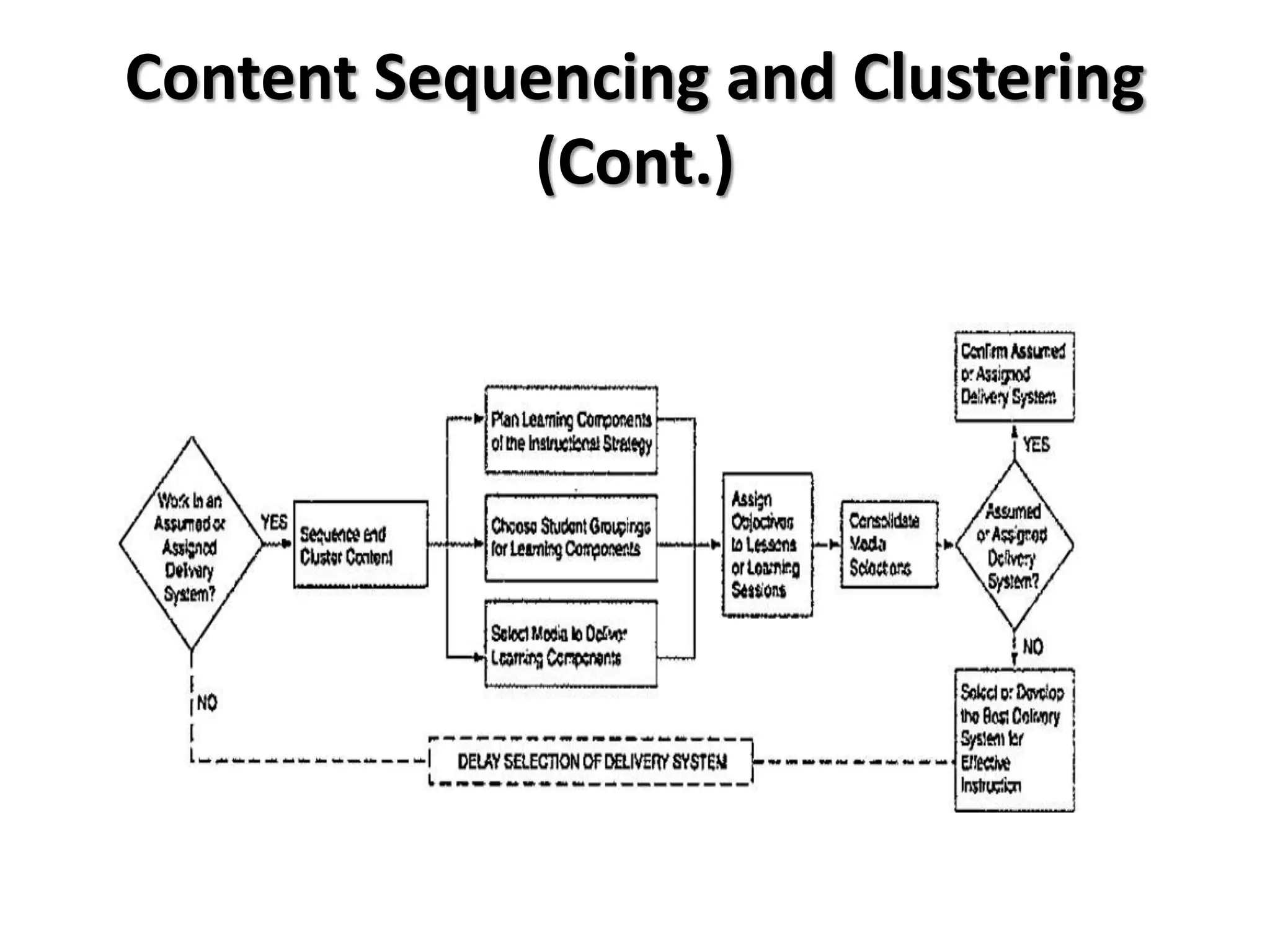
Content Sequencing and Clustering
• The first step in developing an instructional strategy is
identifying a teaching sequence and manageable
grouping of content.
• The instructional sequence for a goal would logically be
sequenced from the left, or the beginning point, and
proceed to the right.
– 1. The age level of learners
– 2. The complexity of material
– 3. The type of learning taking place
– 4. Whether the activity can be varied,
– 5. The amount of time required to include all the events
Content Sequencing and Clustering
(Cont.)
• Clustering Instruction:
• Deals with the size of the cluster of material
you will provide in your instruction. Five
Factors to Consider when Determining
Information 1. The age of the learners 2. The
complexity of the material 3. The type of
learning taking place 4. Whether the activity
can be varied 5. The amount of time required
to include all event
Content Sequencing and Clustering
(Cont.)
Learning Components of Instructional
Strategies
• The concept of an instructional strategy originated with the events
of instruction described in Gagné’s Conditions of Learning (1985). In
this cognitive psychologist’s view, nine events represent external
instructional activities that support internal mental processes of
learning:
– 1. Gaining attention
– 2. Informing learner of the objective
– 3. Stimulating recall of prerequisite learning
– 4. Presenting the stimulus material
– 5. Providing learning guidance
– 6. Eliciting the performance
– 7. Providing feedback about performance correctness
– 8. Assessing the performance
– 9. Enhancing retention and transfer
Learning Components of Instructional
Strategies (Cont.)
• The Dick and Carey model is based on this
cognitive perspective, and we teach it in this text
for several reasons:
– It is grounded in learning theory.
– It conforms to currently prevailing views of instruction
in public education (standards-based accountability),
higher education accreditation (outcomes
assessment), and business/industry/military training
(performance-based).
– It is a necessary foundational system of instructional
design for new students of the field and the most
intuitive system to learn.
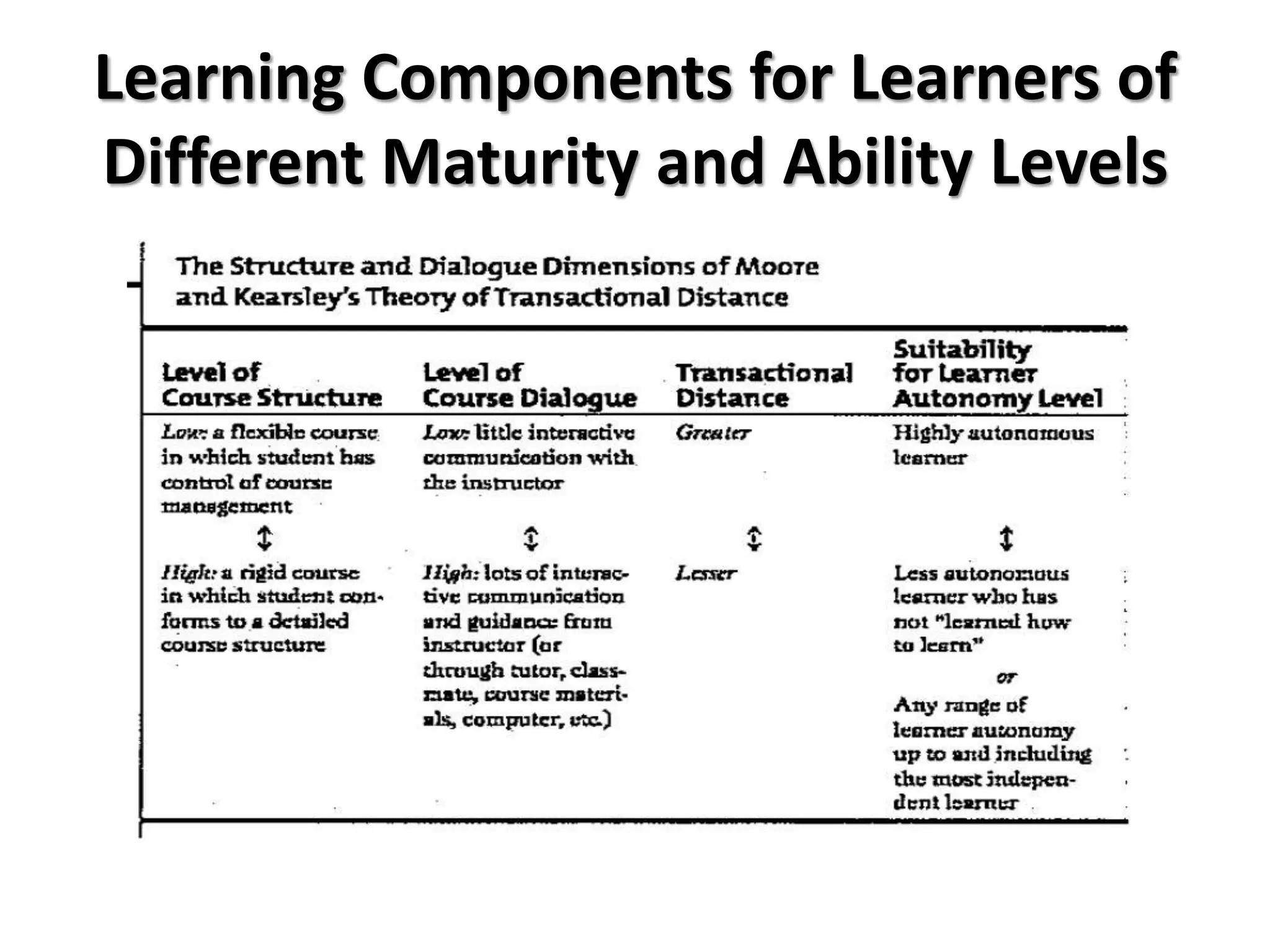
Learning Components for Learners of
Different Maturity and Ability Levels
• Consider different learners’ needs for
instructional strategies.
– Recall that learning components of an
instructional strategy are intended to guide
learners’ intellectual processing through the
mental states and activities that foster learning.
– Learning components for an instructional strategy
should be planned selectively rather than being
provided slavishly for all learners in all
instructional settings.
Learning Components for Learners of
Different Maturity and Ability Levels
Learning Components for Various
Learning Outcomes
• Intellectual Skills Each of the five learning
components should be considered when
designing instruction for intellectual skills.
– Preinstructional Activities.
• In addition to considering motivation, informing the learner
of objectives, and promoting recall of prerequisites, the
designer should be aware of both the way learners may have
organized their entry knowledge in memory and the limits of
their ability to remember new content. The strategy should
provide ways for the learner to link new content to existing
prerequisite knowledge in memory.
Learning Components for Various
Learning Outcomes (cont.)
Intellectual Skills
• Content Presentation and Learning Guidance.
– In presenting content for intellectual skills, it is
important to recall the hierarchical nature of
intellectual skills in determining the sequence for
presentation. Subordinate skills should always come
first. It is also important to point out the
distinguishing characteristics of concepts that make
up rules, which may include physical characteristics or
role and relationship characteristics.
Learning Components for Various
Learning Outcomes (cont.)
Intellectual Skills:
• Learner Participation:
– There are several important considerations when
designing practice exercises for intellectual skills.
• One is the congruence of the practice to the conditions
and behaviors prescribed in the objectives and covered
in the instruction. This criterion helps separate relevant
practice from busywork.
• Others are ensuring the link between prerequisite
knowledge and new skills and progressing from less
difficult to more complex problems..
Learning Components for Various
Learning Outcomes (cont.)
Intellectual Skills:
• Assessment
– The strategy for assessing learners’ performance of
intellectual skills involves determining when and how
to test the skills.
• In order to make these decisions, the designer should
consider how the test results will be used by both the de-
signer and the learner.
• Premature testing, or tests administered prior to learners’
readiness for them, can be more damaging than beneficial,
because they tend to dis- courage learners and to provide
incorrect information about the adequacy of the instruction.
Learning Components for Various
Learning Outcomes (cont.)
Intellectual Skills:
• Follow-Through:
– It is critical to consider the requirements for retention and
transfer of learning for hierarchically related skills,
especially when the skills from one instructional unit are
subordinate to those in a subsequent one.
– You must consider whether corrective feedback following
the posttest will suffice or whether ad ditional instruction
with practice and feedback will be required.
– You should also use data from the posttest to target
additional instruction on specific subordinate skills where
it is needed.
Learning Components for Various
Learning Outcomes (cont.)
• Verbal Information:
– This section considers each learning component in
relation to verbal information goals and
subordinate skills.
– Presentation Activities. In presenting verbal
information, the context for storing and recalling it
when needed is extremely important.
– Strategies linking new information to knowledge
currently stored in memory will improve the
effectiveness of the instruction.
Learning Components for
Constructivist Strategies
• Constructivism has roots in cognitive
psychology and has two branches:
– Cognitive constructivism
– Social constructivism
– Cognitive ID Models
– Constructivist planning practices
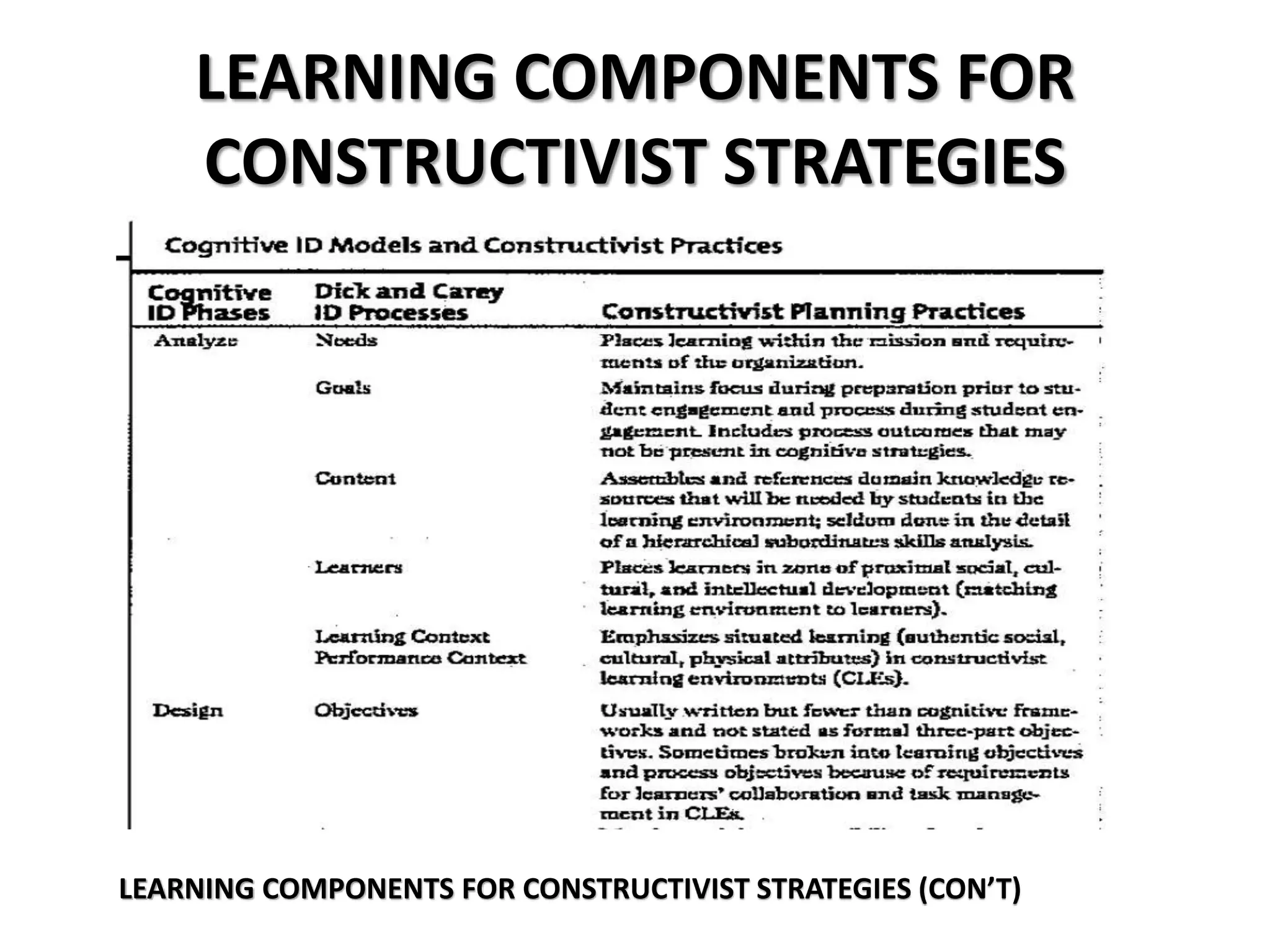
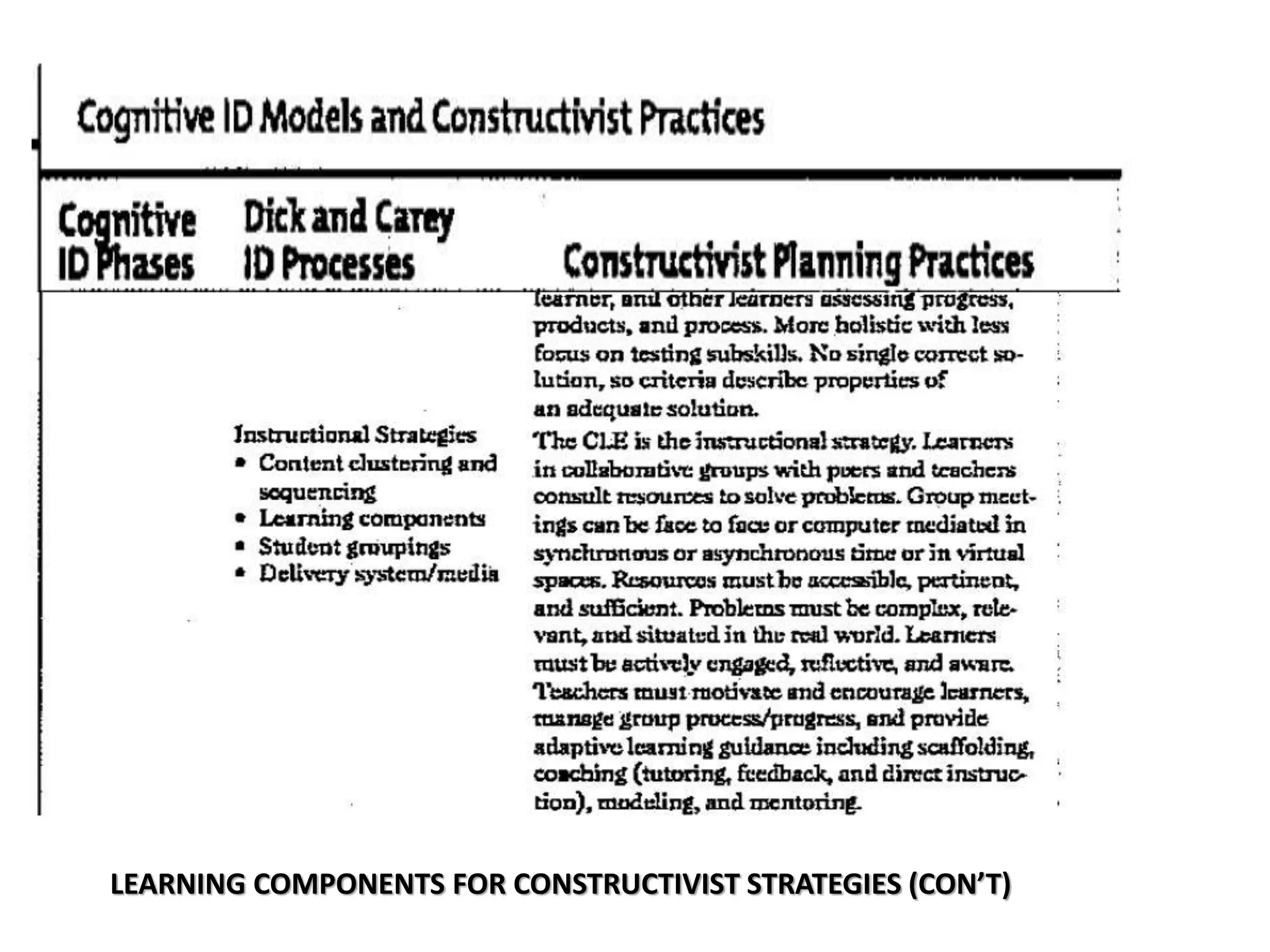
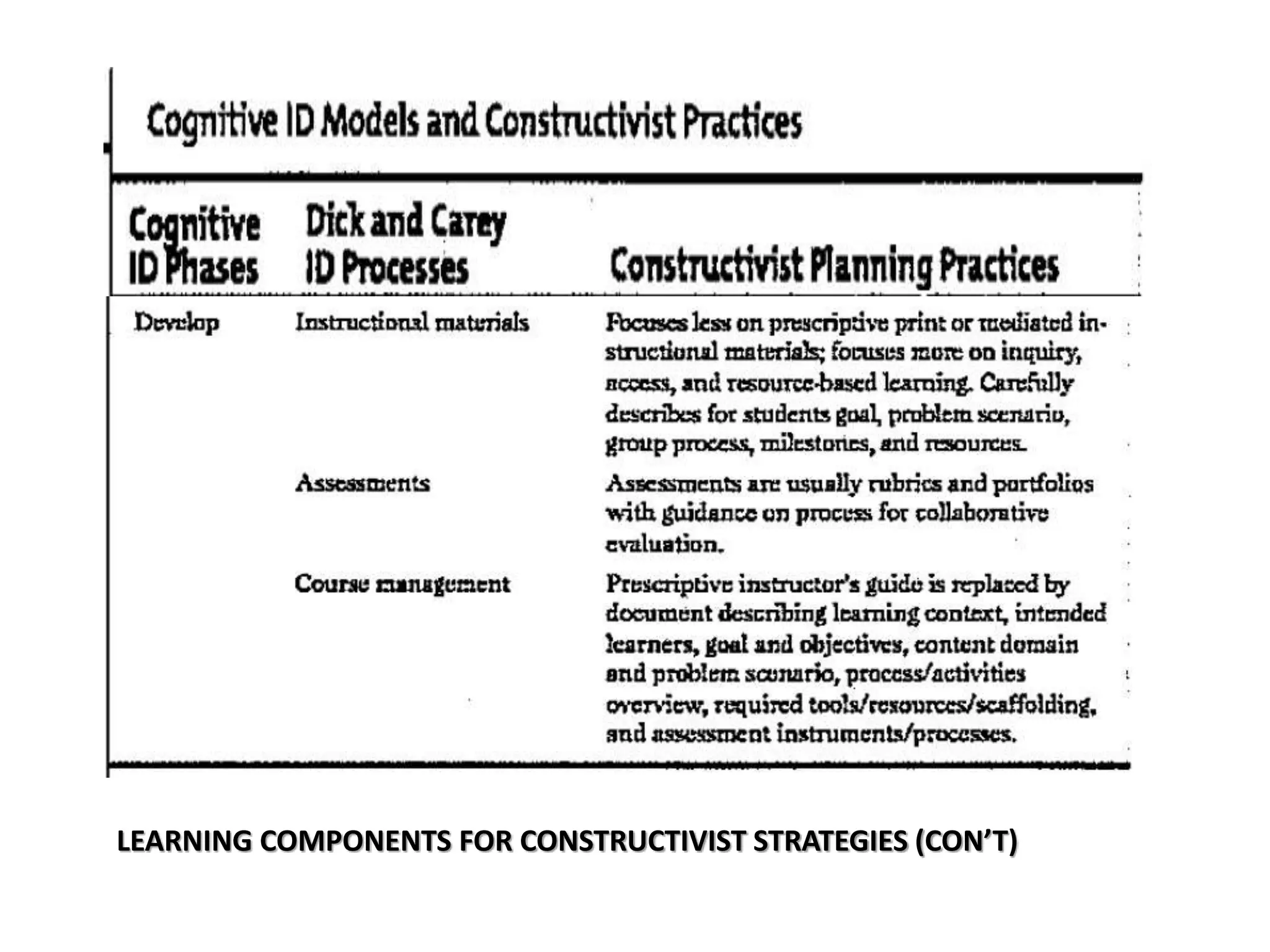
LEARNING COMPONENTS FOR
CONSTRUCTIVIST STRATEGIES
LEARNING COMPONENTS FOR CONSTRUCTIVIST STRATEGIES (CON’T)
Student Grouping
• Planning the learning components of an
instructional of an instructional strategy –
need to plans the details of student groupings
and media selections
• Type of student grouping – individual, pairs,
small group and large group – depends on
specific social interaction requirements
Selection of Media and Delivery
Systems
• Selection of Media and Delivery Systems
– Media selection for domains of learning
– Intellectual skills
– Verbal information
– Psychomotor skills
– Attitudes
• Media selection for certain learner characteristics.
• Media selection for certain task requirements found in
objectives.
• Media selection for replacing the need for instruction.
• Practical considerations in choosing media and delivery
systems
Developing an Instructional Strategy
Summary
• Background
• Selection of Delivery System
• Content Sequence and Clustering
• Learning Components of Instructional Strategies
• Learning Components for Learners of Different
Maturity and Ability Levels
• Learning Components for Various Learning Outcomes
• Learning Components for Constructivist Strategies
• Student Groupings
• Selection of Media and Delivery Systems
Developing an Instructional Strategy
Questions / Comments

Developing an Instructional Strategy

  • 1.
    Developing an InstructionalStrategy Chapter 8 Betty Howard APT 501
  • 2.
    Developing an InstructionalStrategy Overview • Background • Selection of Delivery System • Content Sequence and Clustering • Learning Components of Instructional Strategies • Learning Components for Learners of Different Maturity and Ability Levels • Learning Components for Various Learning Outcomes • Learning Components for Constructivist Strategies • Student Groupings • Selection of Media and Delivery Systems
  • 3.
    BACKGROUND • In thispresentation, we will be addressing the ways a designer identifies how instruction will be presented to and engage learners. • procedures are described that can be used to design an instructional strategy for different types of instructional objectives
  • 4.
    SELECTION OF DELIVERYSYSTEM • The term is used to describe the means by which instruction will be provided to learners. Examples of Delivery Systems are: – Instructor-Led Instruction – Distance Education – Computer-based Instruction Self-Instructional Materials
  • 5.
    SELECTION OF DELIVERYSYSTEM • The best way to define delivery system more precisely is through a list of exam- ples. The following are a few examples of common delivery systems (mixed in with some instructional methods) for conducting instruction
  • 6.
    LEARNING COMPONENTS FOR CONSTRUCTIVISTSTRATEGIES • Constructivism – A learning theory in which learning is viewed as a n internal process of constructing meaning by combining existing knowledge with new knowledge gained through experiences in social, cultural, and physical world Constructivist Learning Environment – Learners in collaborative groups with peers and teachers consulting resources to solve problems. Collaboration can be face to face or managed at a distance by media. Collaboration can be real or simulated in virtual learning space
  • 7.
    SELECTION OF DELIVERYSYSTEM • Delivery System Examples: – Traditional model—instructor with group of learners in classroom, training center, or lab – Large-group lecture with small-group question and answer follow-up – Tele-course by broadcast, webcast, or two-way interactive videoconference – Computer-based instruction – Can range from independent study to instructor- facilitated
  • 8.
    Content Sequencing andClustering • The first step in developing an instructional strategy is identifying a teaching sequence and manageable grouping of content. • The instructional sequence for a goal would logically be sequenced from the left, or the beginning point, and proceed to the right. – 1. The age level of learners – 2. The complexity of material – 3. The type of learning taking place – 4. Whether the activity can be varied, – 5. The amount of time required to include all the events
  • 9.
    Content Sequencing andClustering (Cont.) • Clustering Instruction: • Deals with the size of the cluster of material you will provide in your instruction. Five Factors to Consider when Determining Information 1. The age of the learners 2. The complexity of the material 3. The type of learning taking place 4. Whether the activity can be varied 5. The amount of time required to include all event
  • 10.
    Content Sequencing andClustering (Cont.)
  • 11.
    Learning Components ofInstructional Strategies • The concept of an instructional strategy originated with the events of instruction described in Gagné’s Conditions of Learning (1985). In this cognitive psychologist’s view, nine events represent external instructional activities that support internal mental processes of learning: – 1. Gaining attention – 2. Informing learner of the objective – 3. Stimulating recall of prerequisite learning – 4. Presenting the stimulus material – 5. Providing learning guidance – 6. Eliciting the performance – 7. Providing feedback about performance correctness – 8. Assessing the performance – 9. Enhancing retention and transfer
  • 12.
    Learning Components ofInstructional Strategies (Cont.) • The Dick and Carey model is based on this cognitive perspective, and we teach it in this text for several reasons: – It is grounded in learning theory. – It conforms to currently prevailing views of instruction in public education (standards-based accountability), higher education accreditation (outcomes assessment), and business/industry/military training (performance-based). – It is a necessary foundational system of instructional design for new students of the field and the most intuitive system to learn.
  • 13.
    Learning Components forLearners of Different Maturity and Ability Levels • Consider different learners’ needs for instructional strategies. – Recall that learning components of an instructional strategy are intended to guide learners’ intellectual processing through the mental states and activities that foster learning. – Learning components for an instructional strategy should be planned selectively rather than being provided slavishly for all learners in all instructional settings.
  • 14.
    Learning Components forLearners of Different Maturity and Ability Levels
  • 15.
    Learning Components forVarious Learning Outcomes • Intellectual Skills Each of the five learning components should be considered when designing instruction for intellectual skills. – Preinstructional Activities. • In addition to considering motivation, informing the learner of objectives, and promoting recall of prerequisites, the designer should be aware of both the way learners may have organized their entry knowledge in memory and the limits of their ability to remember new content. The strategy should provide ways for the learner to link new content to existing prerequisite knowledge in memory.
  • 16.
    Learning Components forVarious Learning Outcomes (cont.) Intellectual Skills • Content Presentation and Learning Guidance. – In presenting content for intellectual skills, it is important to recall the hierarchical nature of intellectual skills in determining the sequence for presentation. Subordinate skills should always come first. It is also important to point out the distinguishing characteristics of concepts that make up rules, which may include physical characteristics or role and relationship characteristics.
  • 17.
    Learning Components forVarious Learning Outcomes (cont.) Intellectual Skills: • Learner Participation: – There are several important considerations when designing practice exercises for intellectual skills. • One is the congruence of the practice to the conditions and behaviors prescribed in the objectives and covered in the instruction. This criterion helps separate relevant practice from busywork. • Others are ensuring the link between prerequisite knowledge and new skills and progressing from less difficult to more complex problems..
  • 18.
    Learning Components forVarious Learning Outcomes (cont.) Intellectual Skills: • Assessment – The strategy for assessing learners’ performance of intellectual skills involves determining when and how to test the skills. • In order to make these decisions, the designer should consider how the test results will be used by both the de- signer and the learner. • Premature testing, or tests administered prior to learners’ readiness for them, can be more damaging than beneficial, because they tend to dis- courage learners and to provide incorrect information about the adequacy of the instruction.
  • 19.
    Learning Components forVarious Learning Outcomes (cont.) Intellectual Skills: • Follow-Through: – It is critical to consider the requirements for retention and transfer of learning for hierarchically related skills, especially when the skills from one instructional unit are subordinate to those in a subsequent one. – You must consider whether corrective feedback following the posttest will suffice or whether ad ditional instruction with practice and feedback will be required. – You should also use data from the posttest to target additional instruction on specific subordinate skills where it is needed.
  • 20.
    Learning Components forVarious Learning Outcomes (cont.) • Verbal Information: – This section considers each learning component in relation to verbal information goals and subordinate skills. – Presentation Activities. In presenting verbal information, the context for storing and recalling it when needed is extremely important. – Strategies linking new information to knowledge currently stored in memory will improve the effectiveness of the instruction.
  • 21.
    Learning Components for ConstructivistStrategies • Constructivism has roots in cognitive psychology and has two branches: – Cognitive constructivism – Social constructivism – Cognitive ID Models – Constructivist planning practices
  • 22.
    LEARNING COMPONENTS FOR CONSTRUCTIVISTSTRATEGIES LEARNING COMPONENTS FOR CONSTRUCTIVIST STRATEGIES (CON’T)
  • 23.
    LEARNING COMPONENTS FORCONSTRUCTIVIST STRATEGIES (CON’T)
  • 24.
    LEARNING COMPONENTS FORCONSTRUCTIVIST STRATEGIES (CON’T)
  • 25.
    Student Grouping • Planningthe learning components of an instructional of an instructional strategy – need to plans the details of student groupings and media selections • Type of student grouping – individual, pairs, small group and large group – depends on specific social interaction requirements
  • 26.
    Selection of Mediaand Delivery Systems • Selection of Media and Delivery Systems – Media selection for domains of learning – Intellectual skills – Verbal information – Psychomotor skills – Attitudes • Media selection for certain learner characteristics. • Media selection for certain task requirements found in objectives. • Media selection for replacing the need for instruction. • Practical considerations in choosing media and delivery systems
  • 27.
    Developing an InstructionalStrategy Summary • Background • Selection of Delivery System • Content Sequence and Clustering • Learning Components of Instructional Strategies • Learning Components for Learners of Different Maturity and Ability Levels • Learning Components for Various Learning Outcomes • Learning Components for Constructivist Strategies • Student Groupings • Selection of Media and Delivery Systems
  • 28.
    Developing an InstructionalStrategy Questions / Comments