CBT
Competency-
Based Training
What is CBT?
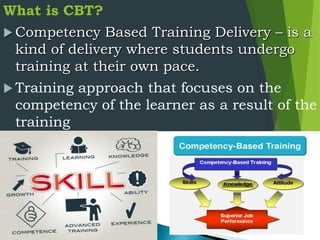
 Competency Based Training Delivery – is a
kind of delivery where students undergo
training at their own pace.
 Training approach that focuses on the
competency of the learner as a result of the
training
Principles of Delivering CBT
 The training is based on curriculum
developed from the competency standards
 Learning is competency-based or modular
in structure
 Training delivery is individualized
and self-paced
 Training is based on work that must be
performed
 Training materials are directly related to
the competency standards and the
curriculum
 Assessment of learners is based in the
collection of evidences of work performance
 Training is based both on and off the job
components
 The system allows Recognition of Prior
Learning (RPL)
 The system allows for learners to enter and
exit programs at different times
 Approved training programs are nationally
accredited
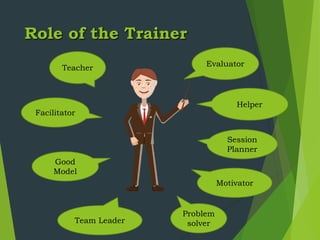
Role of the Trainer
Helper
Session
Planner
Motivator
Teacher
Facilitator
Good
Model
Problem
solver
Team Leader
Evaluator
Role of the trainee
 Select what they want to learn and when they
want to learn it, within a reason
 They may speed up or slow down, stop or repeat
a task
 May request to receive credit for what they
already know
 May choose how they want to learn-individual,
on a one to one basis. Small group, in large
group
 Responsible for what
they learn and when
they learn.
Role of the trainee
 Decide when they are ready to perform each task
or demonstrate mastery of learning
 Trainees compete against job standards and not
against other students ad are graded on
achievement of the standards
 Trainees knows “up front”
 Evaluate your own progress
 Trainees moves freely in the workshop
 Trainees learn according to their
interest, needs and abilities not
according to teacher timelines and
expediency
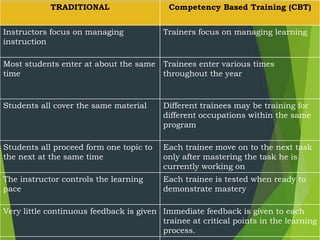
TRADITIONAL Competency Based Training (CBT)
Instructors focus on managing
instruction
Trainers focus on managing learning
Most students enter at about the same
time
Trainees enter various times
throughout the year
Students all cover the same material Different trainees may be training for
different occupations within the same
program
Students all proceed form one topic to
the next at the same time
Each trainee move on to the next task
only after mastering the task he is
currently working on
The instructor controls the learning
pace
Each trainee is tested when ready to
demonstrate mastery
Very little continuous feedback is given Immediate feedback is given to each
trainee at critical points in the learning
process.
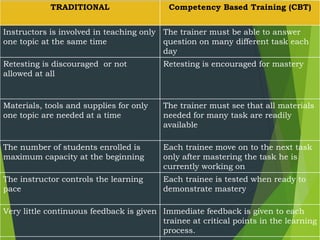
TRADITIONAL Competency Based Training (CBT)
Instructors is involved in teaching only
one topic at the same time
The trainer must be able to answer
question on many different task each
day
Retesting is discouraged or not
allowed at all
Retesting is encouraged for mastery
Materials, tools and supplies for only
one topic are needed at a time
The trainer must see that all materials
needed for many task are readily
available
The number of students enrolled is
maximum capacity at the beginning
Each trainee move on to the next task
only after mastering the task he is
currently working on
The instructor controls the learning
pace
Each trainee is tested when ready to
demonstrate mastery
Very little continuous feedback is given Immediate feedback is given to each
trainee at critical points in the learning
process.
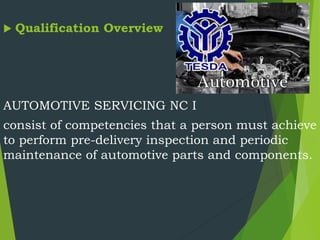
 Qualification Overview
AUTOMOTIVE SERVICING NC I
consist of competencies that a person must achieve
to perform pre-delivery inspection and periodic
maintenance of automotive parts and components.
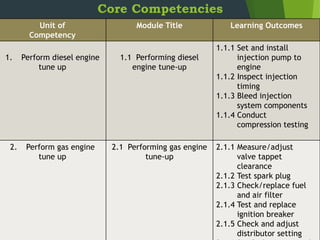
Core Competencies
.
Unit of
Competency
Module Title Learning Outcomes
1. Perform diesel engine
tune up
1.1 Performing diesel
engine tune-up
1.1.1 Set and install
injection pump to
engine
1.1.2 Inspect injection
timing
1.1.3 Bleed injection
system components
1.1.4 Conduct
compression testing
2. Perform gas engine
tune up
2.1 Performing gas engine
tune-up
2.1.1 Measure/adjust
valve tappet
clearance
2.1.2 Test spark plug
2.1.3 Check/replace fuel
and air filter
2.1.4 Test and replace
ignition breaker
2.1.5 Check and adjust
distributor setting
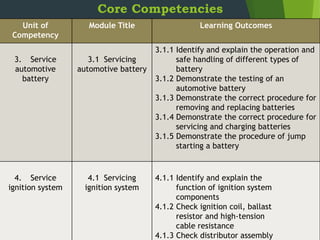
Core Competencies
.
Unit of
Competency
Module Title Learning Outcomes
3. Service
automotive
battery
3.1 Servicing
automotive battery
3.1.1 Identify and explain the operation and
safe handling of different types of
battery
3.1.2 Demonstrate the testing of an
automotive battery
3.1.3 Demonstrate the correct procedure for
removing and replacing batteries
3.1.4 Demonstrate the correct procedure for
servicing and charging batteries
3.1.5 Demonstrate the procedure of jump
starting a battery
4. Service
ignition system
4.1 Servicing
ignition system
4.1.1 Identify and explain the
function of ignition system
components
4.1.2 Check ignition coil, ballast
resistor and high-tension
cable resistance
4.1.3 Check distributor assembly
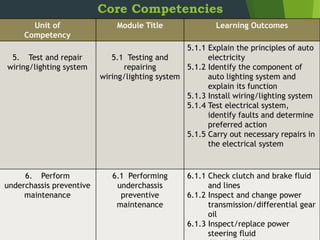
Core Competencies
.
Unit of
Competency
Module Title Learning Outcomes
5. Test and repair
wiring/lighting system
5.1 Testing and
repairing
wiring/lighting system
5.1.1 Explain the principles of auto
electricity
5.1.2 Identify the component of
auto lighting system and
explain its function
5.1.3 Install wiring/lighting system
5.1.4 Test electrical system,
identify faults and determine
preferred action
5.1.5 Carry out necessary repairs in
the electrical system
6. Perform
underchassis preventive
maintenance
6.1 Performing
underchassis
preventive
maintenance
6.1.1 Check clutch and brake fluid
and lines
6.1.2 Inspect and change power
transmission/differential gear
oil
6.1.3 Inspect/replace power
steering fluid
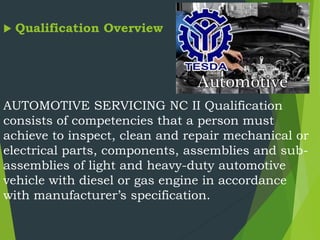
 Qualification Overview
AUTOMOTIVE SERVICING NC II Qualification
consists of competencies that a person must
achieve to inspect, clean and repair mechanical or
electrical parts, components, assemblies and sub-
assemblies of light and heavy-duty automotive
vehicle with diesel or gas engine in accordance
with manufacturer’s specification.
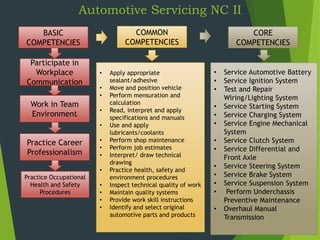
Automotive Servicing NC II
BASIC
COMPETENCIES
CORE
COMPETENCIES
COMMON
COMPETENCIES
Participate in
Workplace
Communication
Work in Team
Environment
Practice Career
Professionalism
Practice Occupational
Health and Safety
Procedures
• Apply appropriate
sealant/adhesive
• Move and position vehicle
• Perform mensuration and
calculation
• Read, interpret and apply
specifications and manuals
• Use and apply
lubricants/coolants
• Perform shop maintenance
• Perform job estimates
• Interpret/ draw technical
drawing
• Practice health, safety and
environment procedures
• Inspect technical quality of work
• Maintain quality systems
• Provide work skill instructions
• Identify and select original
automotive parts and products
• Service Automotive Battery
• Service Ignition System
• Test and Repair
Wiring/Lighting System
• Service Starting System
• Service Charging System
• Service Engine Mechanical
System
• Service Clutch System
• Service Differential and
Front Axle
• Service Steering System
• Service Brake System
• Service Suspension System
• Perform Underchassis
Preventive Maintenance
• Overhaul Manual
Transmission
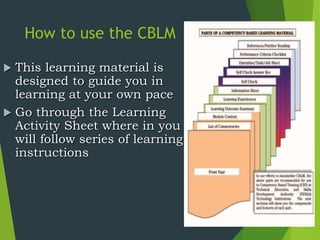
How to use the CBLM
 This learning material is
designed to guide you in
learning at your own pace
 Go through the Learning
Activity Sheet where in you
will follow series of learning
instructions
Overview of the Training
After completion of the requirements
for each competency, a post test will
be given
Trainee could also request for an
institutional assessment when ready
as required by the competency
standard
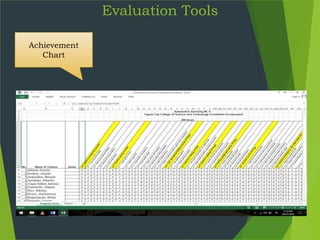
Record trainees achievement chart
and progress chart
Evaluation Tools
 Evidence Plan
 Written test
 Performance Test
 Questioning Tools
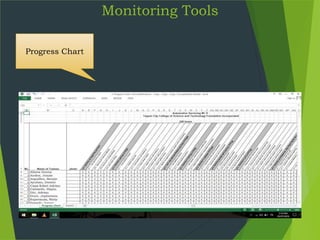
Monitoring Tools
Progress Chart
Evaluation Tools
Achievement
Chart
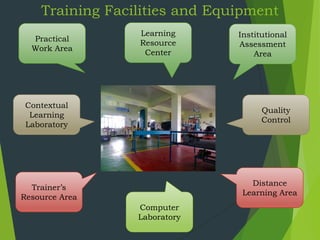
Training Facilities and Equipment
Practical
Work Area
Contextual
Learning
Laboratory
Learning
Resource
Center
Institutional
Assessment
Area
Trainer’s
Resource Area
Quality
Control
Distance
Learning Area
Computer
Laboratory

Want to learn CBT Competency-Based Training don't miss out!

  • 1.
  • 2.
    What is CBT? Competency Based Training Delivery – is a kind of delivery where students undergo training at their own pace.  Training approach that focuses on the competency of the learner as a result of the training
  • 3.
    Principles of DeliveringCBT  The training is based on curriculum developed from the competency standards  Learning is competency-based or modular in structure  Training delivery is individualized and self-paced  Training is based on work that must be performed  Training materials are directly related to the competency standards and the curriculum
  • 4.
     Assessment oflearners is based in the collection of evidences of work performance  Training is based both on and off the job components  The system allows Recognition of Prior Learning (RPL)  The system allows for learners to enter and exit programs at different times  Approved training programs are nationally accredited
  • 5.
    Role of theTrainer Helper Session Planner Motivator Teacher Facilitator Good Model Problem solver Team Leader Evaluator
  • 6.
    Role of thetrainee  Select what they want to learn and when they want to learn it, within a reason  They may speed up or slow down, stop or repeat a task  May request to receive credit for what they already know  May choose how they want to learn-individual, on a one to one basis. Small group, in large group  Responsible for what they learn and when they learn.
  • 7.
    Role of thetrainee  Decide when they are ready to perform each task or demonstrate mastery of learning  Trainees compete against job standards and not against other students ad are graded on achievement of the standards  Trainees knows “up front”  Evaluate your own progress  Trainees moves freely in the workshop  Trainees learn according to their interest, needs and abilities not according to teacher timelines and expediency
  • 8.
    TRADITIONAL Competency BasedTraining (CBT) Instructors focus on managing instruction Trainers focus on managing learning Most students enter at about the same time Trainees enter various times throughout the year Students all cover the same material Different trainees may be training for different occupations within the same program Students all proceed form one topic to the next at the same time Each trainee move on to the next task only after mastering the task he is currently working on The instructor controls the learning pace Each trainee is tested when ready to demonstrate mastery Very little continuous feedback is given Immediate feedback is given to each trainee at critical points in the learning process.
  • 9.
    TRADITIONAL Competency BasedTraining (CBT) Instructors is involved in teaching only one topic at the same time The trainer must be able to answer question on many different task each day Retesting is discouraged or not allowed at all Retesting is encouraged for mastery Materials, tools and supplies for only one topic are needed at a time The trainer must see that all materials needed for many task are readily available The number of students enrolled is maximum capacity at the beginning Each trainee move on to the next task only after mastering the task he is currently working on The instructor controls the learning pace Each trainee is tested when ready to demonstrate mastery Very little continuous feedback is given Immediate feedback is given to each trainee at critical points in the learning process.
  • 10.
     Qualification Overview AUTOMOTIVESERVICING NC I consist of competencies that a person must achieve to perform pre-delivery inspection and periodic maintenance of automotive parts and components.
  • 11.
    Core Competencies . Unit of Competency ModuleTitle Learning Outcomes 1. Perform diesel engine tune up 1.1 Performing diesel engine tune-up 1.1.1 Set and install injection pump to engine 1.1.2 Inspect injection timing 1.1.3 Bleed injection system components 1.1.4 Conduct compression testing 2. Perform gas engine tune up 2.1 Performing gas engine tune-up 2.1.1 Measure/adjust valve tappet clearance 2.1.2 Test spark plug 2.1.3 Check/replace fuel and air filter 2.1.4 Test and replace ignition breaker 2.1.5 Check and adjust distributor setting
  • 12.
    Core Competencies . Unit of Competency ModuleTitle Learning Outcomes 3. Service automotive battery 3.1 Servicing automotive battery 3.1.1 Identify and explain the operation and safe handling of different types of battery 3.1.2 Demonstrate the testing of an automotive battery 3.1.3 Demonstrate the correct procedure for removing and replacing batteries 3.1.4 Demonstrate the correct procedure for servicing and charging batteries 3.1.5 Demonstrate the procedure of jump starting a battery 4. Service ignition system 4.1 Servicing ignition system 4.1.1 Identify and explain the function of ignition system components 4.1.2 Check ignition coil, ballast resistor and high-tension cable resistance 4.1.3 Check distributor assembly
  • 13.
    Core Competencies . Unit of Competency ModuleTitle Learning Outcomes 5. Test and repair wiring/lighting system 5.1 Testing and repairing wiring/lighting system 5.1.1 Explain the principles of auto electricity 5.1.2 Identify the component of auto lighting system and explain its function 5.1.3 Install wiring/lighting system 5.1.4 Test electrical system, identify faults and determine preferred action 5.1.5 Carry out necessary repairs in the electrical system 6. Perform underchassis preventive maintenance 6.1 Performing underchassis preventive maintenance 6.1.1 Check clutch and brake fluid and lines 6.1.2 Inspect and change power transmission/differential gear oil 6.1.3 Inspect/replace power steering fluid
  • 14.
     Qualification Overview AUTOMOTIVESERVICING NC II Qualification consists of competencies that a person must achieve to inspect, clean and repair mechanical or electrical parts, components, assemblies and sub- assemblies of light and heavy-duty automotive vehicle with diesel or gas engine in accordance with manufacturer’s specification.
  • 15.
    Automotive Servicing NCII BASIC COMPETENCIES CORE COMPETENCIES COMMON COMPETENCIES Participate in Workplace Communication Work in Team Environment Practice Career Professionalism Practice Occupational Health and Safety Procedures • Apply appropriate sealant/adhesive • Move and position vehicle • Perform mensuration and calculation • Read, interpret and apply specifications and manuals • Use and apply lubricants/coolants • Perform shop maintenance • Perform job estimates • Interpret/ draw technical drawing • Practice health, safety and environment procedures • Inspect technical quality of work • Maintain quality systems • Provide work skill instructions • Identify and select original automotive parts and products • Service Automotive Battery • Service Ignition System • Test and Repair Wiring/Lighting System • Service Starting System • Service Charging System • Service Engine Mechanical System • Service Clutch System • Service Differential and Front Axle • Service Steering System • Service Brake System • Service Suspension System • Perform Underchassis Preventive Maintenance • Overhaul Manual Transmission
  • 16.
    How to usethe CBLM  This learning material is designed to guide you in learning at your own pace  Go through the Learning Activity Sheet where in you will follow series of learning instructions
  • 17.
    Overview of theTraining After completion of the requirements for each competency, a post test will be given Trainee could also request for an institutional assessment when ready as required by the competency standard Record trainees achievement chart and progress chart
  • 18.
    Evaluation Tools  EvidencePlan  Written test  Performance Test  Questioning Tools
  • 19.
  • 20.
  • 21.
    Training Facilities andEquipment Practical Work Area Contextual Learning Laboratory Learning Resource Center Institutional Assessment Area Trainer’s Resource Area Quality Control Distance Learning Area Computer Laboratory