ECOLOGICAL
SYSTEMS
THEORY
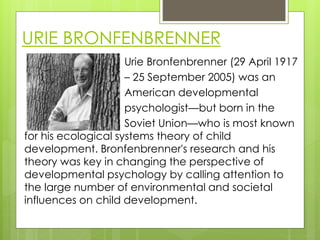
URIE BRONFENBRENNER
Urie Bronfenbrenner (29 April 1917
– 25 September 2005) was an
American developmental
psychologist—but born in the
Soviet Union—who is most known
for his ecological systems theory of child
development. Bronfenbrenner's research and his
theory was key in changing the perspective of
developmental psychology by calling attention to
the large number of environmental and societal
influences on child development.
Bronfenbrenner saw the process of human
development as being shaped by the
interaction between an individual and his or
her environment.
During his time, he saw developmental
psychology as only studying individual
influences on development in unnatural
settings; in his own words, developmental
psychology was, "...the science of strange
behavior of children in strange situations
with strange adults for the briefest possible
periods of time."
His theory states that there are many
different levels of environmental
influences that can affect a child's
development, starting from people
and institutions immediately
surrounding the individual to nation-
wide cultural forces.
He eventually renamed his theory the
bio ecological model in order to
recognize the importance of
biological processes in development.
According to Melvin L. Kohn, a
sociologist from Johns Hopkins
University, Bronfenbrenner was
critical in making social scientists
realize that, "...interpersonal
relationships, even [at] the smallest
level of the parent-child
relationship, did not exist in a social
vacuum but were embedded in
the larger social structures of
community, society, economics
and politics."
ECOLOGICAL SYSTEMS THEORY
Ecological systems theory, also called
development in context or human ecology
theory, identifies five environmental systems
with which an individual interacts.
 Microsystem
 Mesosystem
 Exosystem
 Macrosystem
 Chronosystem
ECOLOGICAL SYSTEMS THEORY
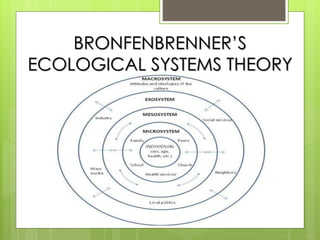
1. Microsystem
Refers to the institutions and groups that
most immediately and directly impact the
child's development including: family, school,
religious institutions, neighborhood, and peers.
2. Mesosystem
Interconnections between the
microsystems, interactions between the family
and teachers, relationship between the child’s
peers and the family.
3. Exosystem
Involves links between a social setting in
which the individual does not have an active
role and the individual's immediate context.
4. Macrosystem
Describes the culture in which individuals
live.
5. Chronosystem
The patterning of environmental events
and transitions over the life course, as well as
sociohistorical circumstances.
BRONFENBRENNER’S
ECOLOGICAL SYSTEMS THEORY

Ecological Systems Theory

  • 1.
  • 2.
    URIE BRONFENBRENNER Urie Bronfenbrenner(29 April 1917 – 25 September 2005) was an American developmental psychologist—but born in the Soviet Union—who is most known for his ecological systems theory of child development. Bronfenbrenner's research and his theory was key in changing the perspective of developmental psychology by calling attention to the large number of environmental and societal influences on child development.
  • 3.
    Bronfenbrenner saw theprocess of human development as being shaped by the interaction between an individual and his or her environment. During his time, he saw developmental psychology as only studying individual influences on development in unnatural settings; in his own words, developmental psychology was, "...the science of strange behavior of children in strange situations with strange adults for the briefest possible periods of time."
  • 4.
    His theory statesthat there are many different levels of environmental influences that can affect a child's development, starting from people and institutions immediately surrounding the individual to nation- wide cultural forces. He eventually renamed his theory the bio ecological model in order to recognize the importance of biological processes in development.
  • 5.
    According to MelvinL. Kohn, a sociologist from Johns Hopkins University, Bronfenbrenner was critical in making social scientists realize that, "...interpersonal relationships, even [at] the smallest level of the parent-child relationship, did not exist in a social vacuum but were embedded in the larger social structures of community, society, economics and politics."
  • 6.
    ECOLOGICAL SYSTEMS THEORY Ecologicalsystems theory, also called development in context or human ecology theory, identifies five environmental systems with which an individual interacts.  Microsystem  Mesosystem  Exosystem  Macrosystem  Chronosystem
  • 7.
    ECOLOGICAL SYSTEMS THEORY 1.Microsystem Refers to the institutions and groups that most immediately and directly impact the child's development including: family, school, religious institutions, neighborhood, and peers. 2. Mesosystem Interconnections between the microsystems, interactions between the family and teachers, relationship between the child’s peers and the family.
  • 8.
    3. Exosystem Involves linksbetween a social setting in which the individual does not have an active role and the individual's immediate context. 4. Macrosystem Describes the culture in which individuals live. 5. Chronosystem The patterning of environmental events and transitions over the life course, as well as sociohistorical circumstances.
  • 9.