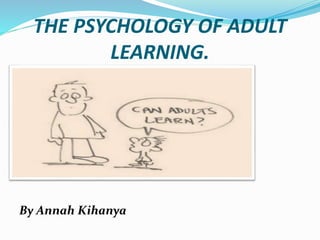
THE PSYCHOLOGY OF ADULT
LEARNING.
By Annah Kihanya
Definition of Terms.
Learning
Development:
Self-directed learning
(Class Discussion)
THEORIES OF ADULT
LEARNING.
1.Andragogy
2.Reinforcement theory
3.Experiential Learning
4.Information Processing Theory
5. Characteristics of Adults as
Learners (CAL) model
6. Cognitive theory
7. Cybernetics and information
1. Andragogy
NOTE…….
Learning is broadly divided into Pedagogy
and Andragogy.
1) Pedagogy – Teaching / educating children.
Teacher centered / oriented.
2) Andragogy – Teaching / educating adults
Participative
(Known as Knowles’ Andragogy)
Assumptions of Andragogy
 Adults need to know why they need to
learn something
 Adults need to learn experientially,
 Adults approach learning as problem-
solving
 Adults learn best when the topic is of
immediate value.
 Adults are autonomous and self-
directed
 Adults are goal oriented
 Adults have accumulated life
experiences
Implication for training
Instruction for adults needs to focus:
more on the process
less on the content being taught.
Most effective training strategies
Case studies
Role-playing
Simulations
Self-evaluations.
N.B. Instructor’s role…… facilitator or resource
(Not lecturer or grader.)
RULES
1.Explain why specific things are being
taught
2.Instruction should be task-oriented
instead of memorization
3. Instruction should take into account
the wide range of different
backgrounds of learners
4. Instruction should allow learners to
discover things for themselves (adults
are self-directed)
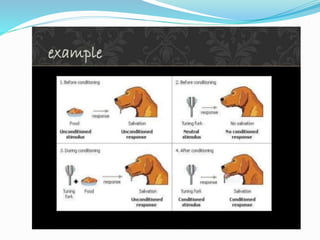
2. REINFORCEMENT THEORY
Developed by B.F. Skinner
(OPERANT CONDITIONING)
Reinforcement - Anything that
increases the likelihood that a response
will occur.
It increases or strengthens the behavior. )
.
3. EXPERIENTIAL LEARNING
Meaning - the process
of learning through experience,
Or "learning through reflection on
doing".
Difference with rote or
didactic learning - the learner plays a
comparatively passive role.
From the diagram learning is,
Through concrete experience
Through observation and reflection
Through abstract conceptualisation
Through active experimentation
Qualities of experiential learning
Personal involvement
Learner-initiated
Evaluated by learner
Pervasive effects on learner
4. INFORMATION PROCESSING THEORY
A cognitive approach to understanding
how the human mind transforms
sensory information.
Assumption- Information that comes
from the environment is subject to
mental processes beyond a simple
stimulus-response pattern. "
Based on two theoretical ideas:
1.Concept of chunking and the capacity
of the Short Term Memory (STM)
2.Concept of Information Processing -
uses the metaphor of computer as a
model for human learning
Concept of chunking and the
capacity of the STM
STM can hold between 5-9 chunks of
information
A chunk is any meaningful unit
A chunk can be digits, words,
people’s faces, etc.
Concept is TOTE (Test-Operate-
Test-Exit).
A goal is tested to see if it has been
achieved and if not an operation is
performed to achieve the goal
 Cycle of test-operate is repeated until
the goal is eventually achieved or
abandoned
Principles
1.Short-term memory (or attention
span) is limited to seven chunks of
information.
2.Planning (in the form of TOTE units)
is a fundamental cognitive process.
3.Behavior is hierarchically organized
(e.g., chunks, TOTE units).
5. CHARACTERISTICS OF ADULTS
AS LEARNERS (CAL) MODEL
Consists of two classes of variables:
i. Personal characteristics
ii. Situational characteristics.
Personal characteristics;
1.Aging –Leads to deterioration of eyesight,
hearing, reaction time
2. Life phases e.g., marriage, job changes,
retirement -involve a series of plateaus and
transitions
3. Developmental stages- Lead to improved
decision-making skills, reasoning,
vocabulary
Situational characteristics
Consist of
i. part-time versus full-time learning
Affects administration of learning i.e.,
schedules, locations, procedures
i. voluntary versus compulsory
learning.
pertains to the self-directed, problem-
centered nature of most adult learning
6. COGNITIVE THEORY.
Cognitive learning theories focus
primarily on how knowledge is:
 acquired, processed, stored,
retrieved, and activated
by the learner during the different
phases of the learning process
Knowledge acquisition is a mental
activity involving internal coding and
structuring by the learner
learning happens best under
conditions that are aligned with human
cognitive architecture.
Main focus of cognitive
teaching/learning approach…..,
making knowledge meaningful
helping learners organize and
relate new information to
prior knowledge in memory.
NOTES
Learning is not just a sit down and
listen pathway.
 It is a process of thinking that
influenced by past and present
surroundings and experiences.
Trainers must look at;
the learned behaviors of trainees
 the learning environment provided
 the environment they are accustomed
to outside the training venue
 their personal needs and ideals.
Jean Piaget: the endeavor to model the
processes of cognitive adaptation in the
human mind
They suggest feedback can control
people’s performance in the same way
that a thermostat controls a heating
system
 A learner reacts to cues of stimuli
7. CYBERNETICS AND INFORMATION
THEORIES
 Cybernetic Theories concentrate on how
information is received and monitored.
 The monitoring is a constant process in all
activities.
 In training, feedback is provided by simulators(act
as thermostats)
ADULT LEARNING PRINCIPLES
 Adults need to be involved in the planning and
evaluation of their instruction.
 Experience (including mistakes) provides the basis for
learning activities.
 Adults are most interested in learning subjects that
have immediate relevance to their job or personal life.
 Adult learning is problem-centered rather
than content-oriented.
 Adult learning programs should capitalize
on the experience of participants.
 Adult learning programs should adapt to the
aging limitations of the participants.
 Adults should be challenged to move to
increasingly advanced stages of personal
development.
 Adults should have as much choice as possible in
the availability and organization of learning
programs.
 Working to address a current, real-world problem
 They are highly vest in solving the current
problem
 They actually apply new materials and
information and
 Exchange ongoing feedback around their
experiences
What Motivates Adult Learners?
 To make or maintain social relationships
 To meet external expectations--the boss says you have
to upgrade skill X to keep your job
 Learn to better serve others -- managers often learn
basic First Aid to protect their employees
Barriers to Adult Learning
 Many other responsibilities (families, careers, social
commitments)
 Lack of time
 Lack of money
 Lack of child care
 Scheduling problems
 Transportation problems
 Insufficient confidence
 Having to learn, if told by boss, but not interested
or ready
THE LEARNING CURVE AND
PLATEAU
Graphs showing the relationship between
performance and training
There are two types of curves
 for easy tasks and
 for difficult tasks.
Explaining the learning plateau
 The trainee is temporarily discouraged by the
increasing difficulty of the task; he/she has lost
motivation
 The trainee has acquired some incorrect responses
during the first part of the learning programme, which
he/she must lose if further progress is to be made.
 The trainee wishes to look back at the material
learned so far and discover its significance.
 In the case of manual training, the task may
include some difficult perceptions or stimulus-
response associations.
THE END

Adult learning 2015

  • 1.
    THE PSYCHOLOGY OFADULT LEARNING. By Annah Kihanya
  • 2.
  • 3.
    THEORIES OF ADULT LEARNING. 1.Andragogy 2.Reinforcementtheory 3.Experiential Learning 4.Information Processing Theory
  • 4.
    5. Characteristics ofAdults as Learners (CAL) model 6. Cognitive theory 7. Cybernetics and information
  • 5.
    1. Andragogy NOTE……. Learning isbroadly divided into Pedagogy and Andragogy. 1) Pedagogy – Teaching / educating children. Teacher centered / oriented. 2) Andragogy – Teaching / educating adults Participative
  • 6.
    (Known as Knowles’Andragogy) Assumptions of Andragogy  Adults need to know why they need to learn something  Adults need to learn experientially,  Adults approach learning as problem- solving
  • 7.
     Adults learnbest when the topic is of immediate value.  Adults are autonomous and self- directed  Adults are goal oriented  Adults have accumulated life experiences
  • 8.
    Implication for training Instructionfor adults needs to focus: more on the process less on the content being taught.
  • 9.
    Most effective trainingstrategies Case studies Role-playing Simulations Self-evaluations. N.B. Instructor’s role…… facilitator or resource (Not lecturer or grader.)
  • 10.
    RULES 1.Explain why specificthings are being taught 2.Instruction should be task-oriented instead of memorization
  • 11.
    3. Instruction shouldtake into account the wide range of different backgrounds of learners 4. Instruction should allow learners to discover things for themselves (adults are self-directed)
  • 12.
    2. REINFORCEMENT THEORY Developedby B.F. Skinner (OPERANT CONDITIONING) Reinforcement - Anything that increases the likelihood that a response will occur. It increases or strengthens the behavior. ) .
  • 15.
    3. EXPERIENTIAL LEARNING Meaning- the process of learning through experience, Or "learning through reflection on doing". Difference with rote or didactic learning - the learner plays a comparatively passive role.
  • 17.
    From the diagramlearning is, Through concrete experience Through observation and reflection Through abstract conceptualisation Through active experimentation
  • 18.
    Qualities of experientiallearning Personal involvement Learner-initiated Evaluated by learner Pervasive effects on learner
  • 19.
    4. INFORMATION PROCESSINGTHEORY A cognitive approach to understanding how the human mind transforms sensory information. Assumption- Information that comes from the environment is subject to mental processes beyond a simple stimulus-response pattern. "
  • 20.
    Based on twotheoretical ideas: 1.Concept of chunking and the capacity of the Short Term Memory (STM) 2.Concept of Information Processing - uses the metaphor of computer as a model for human learning
  • 21.
    Concept of chunkingand the capacity of the STM STM can hold between 5-9 chunks of information A chunk is any meaningful unit A chunk can be digits, words, people’s faces, etc.
  • 22.
    Concept is TOTE(Test-Operate- Test-Exit). A goal is tested to see if it has been achieved and if not an operation is performed to achieve the goal  Cycle of test-operate is repeated until the goal is eventually achieved or abandoned
  • 23.
    Principles 1.Short-term memory (orattention span) is limited to seven chunks of information. 2.Planning (in the form of TOTE units) is a fundamental cognitive process. 3.Behavior is hierarchically organized (e.g., chunks, TOTE units).
  • 24.
    5. CHARACTERISTICS OFADULTS AS LEARNERS (CAL) MODEL Consists of two classes of variables: i. Personal characteristics ii. Situational characteristics.
  • 25.
    Personal characteristics; 1.Aging –Leadsto deterioration of eyesight, hearing, reaction time 2. Life phases e.g., marriage, job changes, retirement -involve a series of plateaus and transitions 3. Developmental stages- Lead to improved decision-making skills, reasoning, vocabulary
  • 26.
    Situational characteristics Consist of i.part-time versus full-time learning Affects administration of learning i.e., schedules, locations, procedures i. voluntary versus compulsory learning. pertains to the self-directed, problem- centered nature of most adult learning
  • 27.
    6. COGNITIVE THEORY. Cognitivelearning theories focus primarily on how knowledge is:  acquired, processed, stored, retrieved, and activated by the learner during the different phases of the learning process
  • 28.
    Knowledge acquisition isa mental activity involving internal coding and structuring by the learner learning happens best under conditions that are aligned with human cognitive architecture.
  • 29.
    Main focus ofcognitive teaching/learning approach….., making knowledge meaningful helping learners organize and relate new information to prior knowledge in memory.
  • 30.
    NOTES Learning is notjust a sit down and listen pathway.  It is a process of thinking that influenced by past and present surroundings and experiences.
  • 31.
    Trainers must lookat; the learned behaviors of trainees  the learning environment provided  the environment they are accustomed to outside the training venue  their personal needs and ideals.
  • 32.
    Jean Piaget: theendeavor to model the processes of cognitive adaptation in the human mind They suggest feedback can control people’s performance in the same way that a thermostat controls a heating system  A learner reacts to cues of stimuli
  • 33.
    7. CYBERNETICS ANDINFORMATION THEORIES  Cybernetic Theories concentrate on how information is received and monitored.  The monitoring is a constant process in all activities.  In training, feedback is provided by simulators(act as thermostats)
  • 34.
    ADULT LEARNING PRINCIPLES Adults need to be involved in the planning and evaluation of their instruction.  Experience (including mistakes) provides the basis for learning activities.  Adults are most interested in learning subjects that have immediate relevance to their job or personal life.
  • 35.
     Adult learningis problem-centered rather than content-oriented.  Adult learning programs should capitalize on the experience of participants.  Adult learning programs should adapt to the aging limitations of the participants.
  • 36.
     Adults shouldbe challenged to move to increasingly advanced stages of personal development.  Adults should have as much choice as possible in the availability and organization of learning programs.  Working to address a current, real-world problem
  • 37.
     They arehighly vest in solving the current problem  They actually apply new materials and information and  Exchange ongoing feedback around their experiences
  • 38.
    What Motivates AdultLearners?  To make or maintain social relationships  To meet external expectations--the boss says you have to upgrade skill X to keep your job  Learn to better serve others -- managers often learn basic First Aid to protect their employees
  • 39.
    Barriers to AdultLearning  Many other responsibilities (families, careers, social commitments)  Lack of time  Lack of money  Lack of child care
  • 40.
     Scheduling problems Transportation problems  Insufficient confidence  Having to learn, if told by boss, but not interested or ready
  • 41.
    THE LEARNING CURVEAND PLATEAU Graphs showing the relationship between performance and training There are two types of curves  for easy tasks and  for difficult tasks.
  • 42.
    Explaining the learningplateau  The trainee is temporarily discouraged by the increasing difficulty of the task; he/she has lost motivation  The trainee has acquired some incorrect responses during the first part of the learning programme, which he/she must lose if further progress is to be made.
  • 43.
     The traineewishes to look back at the material learned so far and discover its significance.  In the case of manual training, the task may include some difficult perceptions or stimulus- response associations.
  • 44.