LOOKING FOR A PERFECT BLEND: A Support System for Designing Blended Learning in Higher Education Mart Laanpere, Tallinn University Saima Tiirmaa-Oras, University of Tartu Estonia
Background Estonian E-university: consortium of 8 universities, successful co-operation Failure to fulfill the staff development plans Study of university staff’s training needs: self-evaluation of pedagogical skills E-learning is considered equal with asynchronous online studies with LMS  Similar problems in other countries
Socrates/Minerva project B-learn Aims :  Case studies of successful blended learning Analysis of existing research on blended learning Development of blended learning models and associated community-based Electronic Performance Support System (EPSS) Consortium : University of Tartu, University of Helsinki, University of Porto, Tallinn University, Kaunas Technical University, Stord/Haugesund University College, EDEN
What is blended learning? Blended (also mixed/hybrid) learning as the “next big thing”, replacing e-learning What are we blending: delivery modes, models of teaching, technologies and styles of learning University staff does not recognize that they are already using blended learning Blended learning concept is more spread within commercial training, universities lag behind New components in blender: Web 2.0, PLE
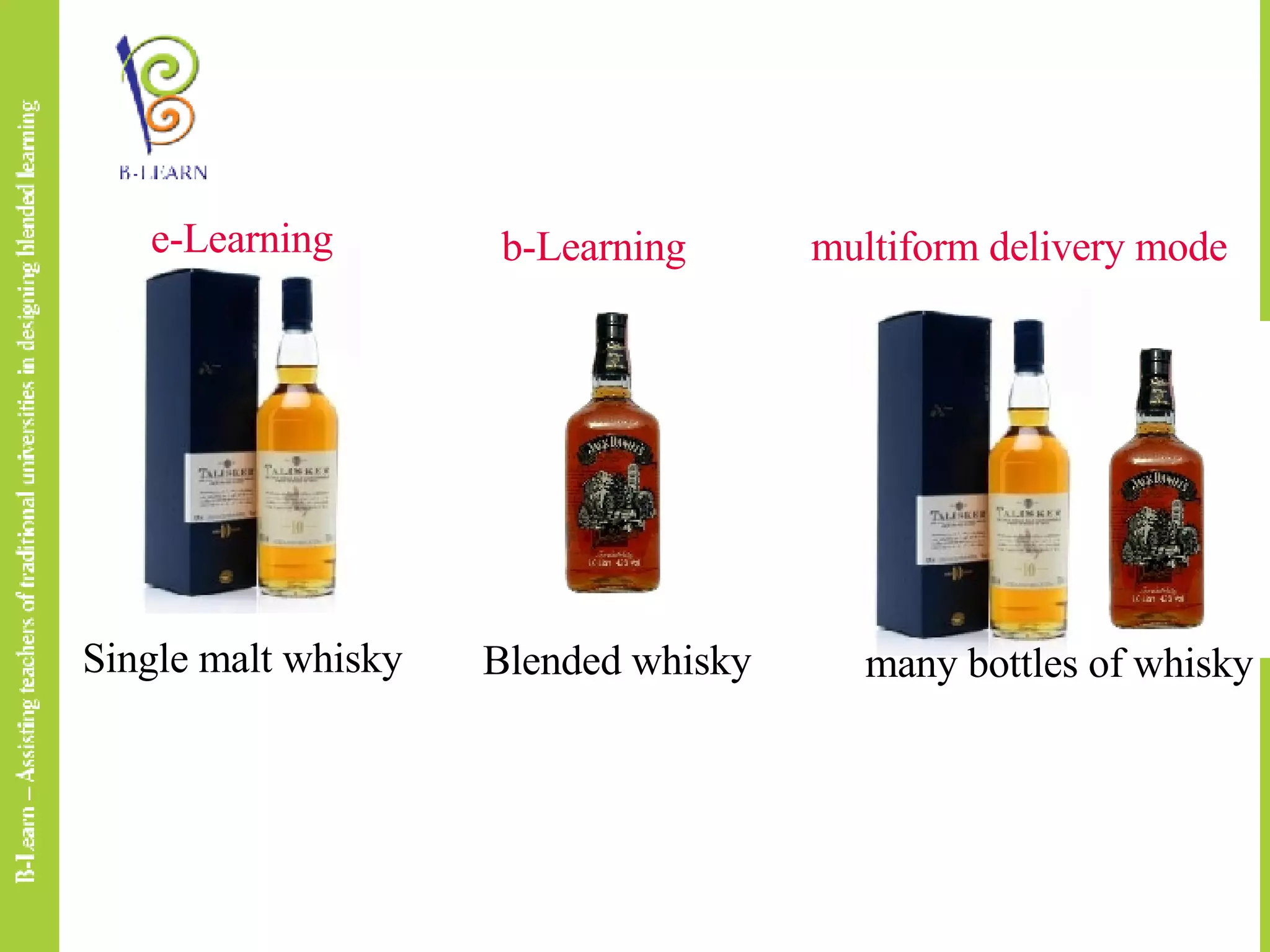
Single malt whisky Blended whisky many bottles of whisky e-Learning multiform delivery mode b-Learning
Folk pedagogy J.Bruner (1996): Culture of Education The concept of folk pedagogy: implicit “theories” about how people learn Our goal: horizontal diffusion of new pedagogical ideas and good practices, relevant for blended learning
What is EPSS? Raybould 1990 : … a computer-based system that improves worker productivity by providing on-the-job access to integrated information, advice and learning experiences Gery 1991 : … an integrated electronic environment that is available to and easily accessible by each employee and is structured to provide immediate, individualized on-line access to the full range of information, software, guidance, advice and assistance, data, images, tools, and assessment and monitoring systems to permit job performance with minimal support and intervention by others.
Designing B-learn EPSS Based on participatory design approach Scenarios (general-level narratives) Participatory design sessions Conceptual model User stories (short, detailed, operational) Use cases (UML) Rapid prototyping (paper prototypes, HTML-mockups), testing on users Development space: TracWiki at http://trac.htk.tlu.ee/blearn
Scenarios Scenario 1 : Switcher (switching from an old LMS to a new one) Scenario 2 : Beginner (new staff member) Scenario 3 : Pedagogical expert without e-learning experience Scenario 4 : Community support
Components of B-learn EPSS Templates : roster, studyguide, technique Calendar : events, news items Glossary Blended learning  handbook Good practice:  case studies Personal  portfolio  and blog Search  (simple, advanced, live)
The next steps Work-in-progress Implementing in Estonian E-university EDEN as possible service provider www.ut.ee/blearn, www.htk.tlu.ee/blearn

Looking for the perfect blend

  • 1.
    LOOKING FOR APERFECT BLEND: A Support System for Designing Blended Learning in Higher Education Mart Laanpere, Tallinn University Saima Tiirmaa-Oras, University of Tartu Estonia
  • 2.
    Background Estonian E-university:consortium of 8 universities, successful co-operation Failure to fulfill the staff development plans Study of university staff’s training needs: self-evaluation of pedagogical skills E-learning is considered equal with asynchronous online studies with LMS Similar problems in other countries
  • 3.
    Socrates/Minerva project B-learnAims : Case studies of successful blended learning Analysis of existing research on blended learning Development of blended learning models and associated community-based Electronic Performance Support System (EPSS) Consortium : University of Tartu, University of Helsinki, University of Porto, Tallinn University, Kaunas Technical University, Stord/Haugesund University College, EDEN
  • 4.
    What is blendedlearning? Blended (also mixed/hybrid) learning as the “next big thing”, replacing e-learning What are we blending: delivery modes, models of teaching, technologies and styles of learning University staff does not recognize that they are already using blended learning Blended learning concept is more spread within commercial training, universities lag behind New components in blender: Web 2.0, PLE
  • 5.
    Single malt whiskyBlended whisky many bottles of whisky e-Learning multiform delivery mode b-Learning
  • 6.
    Folk pedagogy J.Bruner(1996): Culture of Education The concept of folk pedagogy: implicit “theories” about how people learn Our goal: horizontal diffusion of new pedagogical ideas and good practices, relevant for blended learning
  • 7.
    What is EPSS?Raybould 1990 : … a computer-based system that improves worker productivity by providing on-the-job access to integrated information, advice and learning experiences Gery 1991 : … an integrated electronic environment that is available to and easily accessible by each employee and is structured to provide immediate, individualized on-line access to the full range of information, software, guidance, advice and assistance, data, images, tools, and assessment and monitoring systems to permit job performance with minimal support and intervention by others.
  • 8.
    Designing B-learn EPSSBased on participatory design approach Scenarios (general-level narratives) Participatory design sessions Conceptual model User stories (short, detailed, operational) Use cases (UML) Rapid prototyping (paper prototypes, HTML-mockups), testing on users Development space: TracWiki at http://trac.htk.tlu.ee/blearn
  • 9.
    Scenarios Scenario 1: Switcher (switching from an old LMS to a new one) Scenario 2 : Beginner (new staff member) Scenario 3 : Pedagogical expert without e-learning experience Scenario 4 : Community support
  • 10.
    Components of B-learnEPSS Templates : roster, studyguide, technique Calendar : events, news items Glossary Blended learning handbook Good practice: case studies Personal portfolio and blog Search (simple, advanced, live)
  • 11.
    The next stepsWork-in-progress Implementing in Estonian E-university EDEN as possible service provider www.ut.ee/blearn, www.htk.tlu.ee/blearn